|
시장보고서
상품코드
1850026
농업용 보조제 : 시장 점유율 분석, 산업 동향 & 통계, 성장 예측(2025-2030년)Agricultural Adjuvants - Market Share Analysis, Industry Trends & Statistics, Growth Forecasts (2025 - 2030) |
||||||
 Mordor Intelligence
농업용 보조제 시장의 2025년 시장 규모는 41억 달러로 평가되었고, CAGR은 5.7%를 나타낼 것으로 예측되며, 2030년에 54억 달러로 성장할 전망입니다.
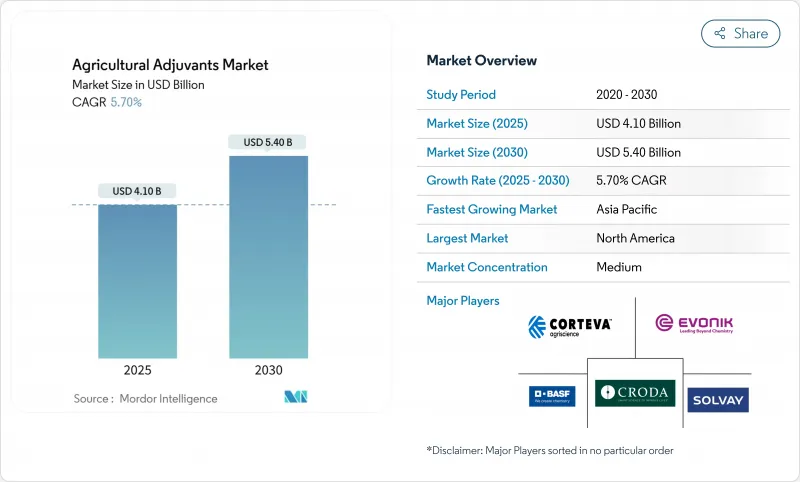
작물 생산성 향상 수요가 증가하는 반면 경작지는 지속적으로 감소하고 있으며, 정밀 살포 기술의 급속한 확산으로 인해 향상된 드리프트 제어 기술이 필요해지고, 최적의 흡수를 위해 고도로 맞춤화된 보조제 화학 기술에 의존하는 제초제 내성 종자의 인기가 높아지면서 꾸준한 성장이 이어지고 있습니다. 생물학적 작물 보호 솔루션에 대한 투자 증가 역시 수요를 뒷받침하는데, 이는 생물학적 미생물이 현장에서 효과성을 유지하기 위해 종종 보호용 캐리어와 습윤제가 필요하기 때문입니다. 또한 아시아태평양 지역의 현대화 추진으로 글로벌 생산 기반이 중국과 인도로 재편되면서 특수 계면활성제 및 유성 운반체의 현지 생산이 촉진되고 있습니다. 동시에 유럽과 북미의 독성학 규제 강화로 공급업체들은 저위험 생물 기반 원료 개발을 추진하게 되어 농업용 보조제 시장 전반의 제품 갱신 주기가 가속화되고 있습니다.
세계의 농업용 보조제 시장 동향 및 인사이트
증가하는 식량 수요와 감소하는 경작지
세계 인구 증가로 2050년까지 식량 생산량이 70% 증가해야 하는 반면, 경작지는 매년 0.3%씩 계속 감소하고 있어 농가들은 농약 성능을 극대화하는 화학 기술을 통해 헥타르당 수확량을 높여야 하는 상황입니다. 습윤제, 침투제, 접착제 기능을 결합한 보조제는 살포 빈도를 줄이고 인건비를 절감합니다. 토지 부족이 심각하고 쌀 수확량이 이미 생물학적 한계에 근접한 인구 밀집 아시아 국가에서 도입률이 가장 높습니다. 저독성 보조제를 보조금 지원하는 지역 프로그램이 소규모 농가의 채택을 가속화하고 있습니다. 많은 정부는 보조금 자격을 살포 품질 교육 이수 증명과 연계하여 프리미엄 보조제 수요를 간접적으로 촉진합니다. 공급업체들은 농가 현장에서 선택을 단순화하기 위해 수질 조절제와 비산 방지제를 묶은 패키지로 대응합니다. 이러한 상업적 수요는 이제 아프리카로까지 확대되고 있습니다. 곡물 수입 증가로 외환 보유고가 압박을 받자 정책 입안자들은 투입재 집약화를 지원하고 있습니다. 이에 공공-민간 협력 확충 서비스는 농민 현장 학교에 보조제 모듈을 추가해 수확량 격차를 해소하고 있습니다.
정밀 농업 도입으로 살포 정밀도 향상
가변 속도 붐, 드론, 로봇 살포기는 에이커당 최소 5갤런(약 19리터)만 살포하므로 물방울 형성 시 오차 허용 범위가 매우 좁다. 특수 폴리머 표류 억제제는 평균 액적 크기를 300-400 마이크론으로 확대하고 드론의 고속 기류 하에서도 잎에 대한 침착률을 향상시킵니다. 미국 재배자들은 이제 저습도 지역에서 증발을 방지하기 위해 현장 기상 데이터를 활용해 보조제 용량을 보정합니다. 장비 제조사들은 노즐 크기나 유효 성분이 선택될 때 적절한 보조제를 표시하는 소프트웨어 라이브러리를 사전 탑재해 규정 준수를 높입니다. 아시아태평양 지역 서비스 기업들은 드론 살포와 보조제 포함 요금제를 묶어 살포 기준을 보장합니다. 캐나다 보험 프로그램은 표적 외 피해 보상 전 유실 방지 인증을 요구하기 시작해 보조제를 위험 완화 투입물로 전환했습니다. 자율 살포기로의 전환은 인간의 미세 조정이 제한적이어서 일관된 액적 거동 필요성을 더욱 높입니다. 디지털 농업 모델이 성숙해짐에 따라 데이터 검증된 성능 지표가 입증되고 반복 가능한 결과를 가진 제형으로 구매를 전환시킬 것으로 예상됩니다.
공용제(Co-Formulants)에 대한 독성학 기준 강화
활성화 보조제는 2024년 매출의 62%를 차지하며, 표피 침투 및 전신 이동성 개선에 핵심적 역할을 강조했습니다. 제초제 내성 작물이 대두, 옥수수, 카놀라로 확산되면서 수요가 증가하고 있습니다. 해당 세그먼트 내에서 메틸화 종자유와 비이온성 계면활성제 혼합물이 여전히 주류를 이루지만, 바이오 기반 오일 유도체는 2030년까지 연평균 8.7%의 성장률을 기록할 전망입니다. 이러한 추세는 부분적으로 저독성 옵션에 대한 규제 선호와 잔류물 감소에 대한 재배자의 관심을 반영합니다. 결과적으로 바이오 오일 활성제에 연계된 농업용 보조제 시장 규모는 2030년까지 12억 달러에 달할 것으로 전망됩니다.
부문 분석
액티베이터 보조제는 2024년 매출의 62%를 차지했고, 쿠티클라로의 침투와 전신으로의 이동을 개선하는데 있어서 중심적인 역할을 담당하고 있는 것으로 밝혀졌습니다. 제초제 내성 작물이 콩, 옥수수, 카놀라로 퍼지면서 수요가 증가합니다. 이 부문에서 메틸화된 종자유와 비이온성 계면활성제 블렌드는 여전히 주요 제품이지만, 2030년까지 바이오기반 오일 유도체의 CAGR은 8.7%를 나타낼 전망입니다. 이 궤도는 저독성 옵션에 대한 규제 당국의 선호와 잔류 농약의 감소에 대한 생산자의 관심을 반영합니다. 그 결과, 바이오 오일 활성제와 관련된 농업용 보조제 시장 규모는 2030년까지 12억 달러에 달할 전망입니다.
드리프트 조절제, 수질 조절제, 소포제 등을 포함한 유틸리티 보조제는 규모는 작지만 점차 전략적 비중이 커지는 농업용 보조제 시장의 일부를 차지합니다. 미세 입자에 의존하는 드론 살포는 표류는 줄이면서도 살포 범위를 유지하는 고전단 안정성 폴리머의 중요성을 높입니다. 관개가 잘되는 지역의 극단적인 물 pH는 경도 이온을 격리하고 침전을 방지하는 컨디셔너 판매를 촉진합니다. 이 부문의 성공은 규제 기관의 표류 지침 시행과 장비 제조업체의 보조제 투여 소프트웨어 통합에 달려 있습니다.
지역 분석
아시아태평양 지역은 2030년까지 연평균 복합 성장률(CAGR) 6.4%로 글로벌 확장을 주도합니다. 인도와 중국의 정부 주도 기계화 프로그램 및 디지털 확장 서비스는 정밀 농약 사용을 장려하여 첨단 보조제 시장 기회를 창출합니다. 바스프(BASF)의 장장(湛江) 소재 100억 유로(109억 달러) 규모 베르분트(Verbund) 복합체는 지역 소비 및 수출 잠재력에 대한 장기적 투자를 시사합니다. 현지 공급업체들도 수요 충족을 위해 규모를 확장 중입니다. 샤르다 크롭켐(Sharda Cropchem)의 2025 회계연도 2분기 매출 34% 성장은 주요 작물 전반에 걸쳐 성능 향상 보조제에 대한 수요를 입증합니다.
북미는 가장 성숙한 시장이지만, 정밀 농업 장비의 지속적인 확장으로 2024년 35% 점유율을 기록하며 4.2% CAGR로 여전히 점유율 증가에 기여하고 있습니다. 멸종 위기 종에 대한 규제 강화로 유실 방지 폴리머 수요가 증가하고 있습니다. 농가들은 또한 옥수수 벨트 지역에서 우물물의 알칼리성 변동에 대응하기 위해 수질 조절제가 필요합니다. 북미 농업용 보조제 시장 규모는 2030년까지 3억 3천만 달러 증가할 것으로 전망됩니다.
기타 혜택 :
- 엑셀 형식 시장 예측(ME) 시트
- 3개월간의 애널리스트 지원
목차
제1장 서론
- 조사의 전제조건과 시장의 정의
- 조사 범위
제2장 조사 방법
제3장 주요 요약
제4장 시장 상황
- 시장 개요
- 시장 성장 촉진요인
- 증가하는 식량 수요와 감소하는 경작지
- 정밀 농업의 도입에 의해 살포 정밀도 향상
- 제초제 내성 종자로의 이행에 의해 보조제 필요성 증가
- 적합성이 있는 보조제를 필요로 하는 생물학적 작물 투입물 확대
- 살포 유출에 대한 규제 압박 및 고효율 조절제 수요 증가
- 생물 기반 계면활성제 혁신 급증으로 독성 감소
- 시장 성장 억제요인
- 보조제 독성학 기준 강화
- 석유화학 원료 가격 변동성
- 저수익 작물에서 농가 비용 민감도
- 차세대 RNAi 활성 물질과의 호환성 문제
- 규제 상황
- 기술의 전망
- Porter's Five Forces 분석
- 공급기업의 협상력
- 구매자의 협상력
- 신규 참가업체의 위협
- 대체품의 위협
- 경쟁 기업간 경쟁 관계
제5장 시장 규모와 성장 예측
- 유형별
- 활성화 보조제
- 계면활성제
- 오일 유도체
- 유틸리티 보조제
- 드리프트 조절제
- 수질 조절제
- 소포제
- 산성화제 및 완충제
- 활성화 보조제
- 용도별
- 제초제 보조제
- 살충제 보조제
- 살균제 보조제
- 기타 용도
- 지역별
- 북미
- 미국
- 캐나다
- 멕시코
- 기타 북미
- 남미
- 브라질
- 아르헨티나
- 기타 남미
- 유럽
- 독일
- 프랑스
- 영국
- 이탈리아
- 러시아
- 기타 유럽
- 아시아태평양
- 중국
- 인도
- 일본
- 호주
- 기타 아시아태평양
- 중동
- 사우디아라비아
- 아랍에미리트(UAE)
- 기타 중동
- 아프리카
- 남아프리카
- 나이지리아
- 기타 아프리카
- 북미
제6장 경쟁 구도
- 시장 집중도
- 전략적 동향
- 시장 점유율 분석
- 기업 프로파일
- BASF SE
- Corteva Agriscience
- Evonik Industries
- Solvay SA
- Croda International
- Nufarm Ltd
- Helena Agri-Enterprises
- AkzoNobel NV
- Brandt Consolidated
- Wilbur-Ellis Company
- Adjuvant Plus Inc.
- Huntsman Corporation
- Clariant AG
- Momentive Performance Materials
- Interagro Ltd
제7장 시장 기회와 장래의 전망
HBR 25.11.14The agricultural adjuvants market is valued at USD 4.1 billion in 2025 and is forecast to expand to USD 5.4 billion by 2030, reflecting a 5.7% CAGR.
Steady growth stems from the escalating need to lift crop productivity while arable land continues to shrink, the rapid spread of precision-spraying technologies that need improved drift control, and the rising popularity of herbicide-tolerant seeds that depend on highly tailored adjuvant chemistry for optimal uptake. Rising investment in biological crop protection solutions also underpins demand because live microbes often require protective carriers and wetting agents to remain effective in the field. In addition, Asia-Pacific's modernization initiatives are redirecting global production footprints toward China and India, stimulating local output of specialty surfactants and oil-based carriers. At the same time, tightening toxicology regulations in Europe and North America push suppliers to design lower-hazard, bio-based ingredients, accelerating product renewal cycles across the agricultural adjuvants market.
Global Agricultural Adjuvants Market Trends and Insights
Growing Food Demand versus Declining Arable Land
Global population growth requires a 70% rise in food output by 2050 while arable land continues to contract 0.3% each year, compelling growers to lift yields per hectare through chemistry that maximizes pesticide performance. Adjuvants that combine wetter, penetrant, and sticker functions cut application frequency and lower labor costs. Adoption is highest in densely populated Asian countries where land scarcity is acute and rice yields already approach biological ceilings. Regional programs that subsidize low-toxicity additives are accelerating uptake among smallholders. Many governments also tie subsidy eligibility to proof of spray-quality training, indirectly boosting demand for premium adjuvants. Suppliers respond with packs that bundle water conditioners with drift agents to simplify choice at the farm gate. The commercial pull now extends to Africa, where rising cereal imports strain foreign exchange reserves, pushing policymakers to support input intensification. Public-private extension services are therefore adding adjuvant modules to farmer field schools to close the yield gap.
Precision-Farming Adoption Boosting Spray Accuracy
Variable-rate booms, drones, and robotic sprayers apply as little as 5 gallons per acre, creating a narrow margin for error in droplet formation. Specialty polymer drift agents enlarge median droplet size to 300-400 microns and improve leaf deposition under high-speed airflow from drones. United States growers now calibrate adjuvant doses with field-level weather feeds to prevent evaporation in low-humidity bands. Equipment makers preload software libraries that flag the correct additive when a nozzle size or active ingredient is selected, raising compliance. Asia-Pacific service companies bundle drone spraying with adjuvant-inclusive fee structures that guarantee coverage standards. Insurance programs in Canada have begun to require drift-control certification before indemnifying off-target damage, turning adjuvants into a risk-mitigation input. The move toward autonomous sprayers further elevates the need for consistent droplet behavior because human fine-tuning is limited. As digital agronomy models mature, data-validated performance metrics are anticipated to shift purchasing toward formulations with proven, repeatable results.
Tightening Toxicology Thresholds for Co-Formulants
European Green Deal targets call for a 50% cut in chemical pesticide risk by 2030, and regulators now scrutinize adjuvant toxicity independently of actives. Organosilicone surfactants linked to bee mortality face new data demands that lengthen approval queues. Companies accelerate reformulation programs to swap suspect silicones for biogenic ethers but must absorb higher raw-material costs. The United States Environmental Protection Agency is anticipated to release updated inert ingredient assessment protocols in 2026, potentially triggering parallel phase-outs. Smaller formulators with limited toxicology budgets risk product discontinuations. Certifications such as Eco-Label prefer adjuvants with established food-contact clearances, narrowing the candidate pool. As pipeline pressure rises, licensing deals for safer chemistry climb, inflating royalty costs for latecomers.
Other drivers and restraints analyzed in the detailed report include:
- Shift to Herbicide-Tolerant Seeds Elevating Adjuvant Need
- Regulatory Pressure On Spray Drift And Higher Utility Adjuvant Demand
- Volatile Petrochemical Feedstock Pricing
For complete list of drivers and restraints, kindly check the Table Of Contents.
Segment Analysis
Activator adjuvants captured 62% of 2024 revenue, underscoring their central role in improving cuticular penetration and systemic movement. Demand climbs as herbicide-tolerant crops spread across soy, corn, and canola. Within the segment, methylated seed oil and non-ionic surfactant blends remain staples, yet bio-based oil derivatives post an 8.7% CAGR to 2030. That trajectory partly mirrors regulatory preference for low-toxicity options and grower interest in lower residue. As a result, the agricultural adjuvants market size tied to bio-oil activators is projected to reach USD 1.2 billion by 2030.
Utility adjuvants, including drift control agents, water conditioners, and antifoams, represent a smaller but increasingly strategic slice of the agricultural adjuvants market. Drone spraying, which relies on fine droplets, elevates the importance of high-shear-stable polymers that reduce drift yet preserve coverage. Water pH extremes in well-irrigated regions propel conditioner sales that sequester hardness ions and prevent precipitation. The segment's success relies on regulators enforcing drift guidelines and equipment makers integrating adjuvant dosing software.
The Agricultural Adjuvants Market Report is Segmented by Type (Activator Adjuvants and Utility Adjuvants), Application (Herbicide Adjuvants, Insecticide Adjuvants, and More), and by Geography (North America, South America, Europe, Asia-Pacific, Middle East, and More). The Market Forecasts are Provided in Terms of Value (USD).
Geography Analysis
Asia-Pacific heads global expansion with a 6.4% CAGR to 2030. Government-led mechanization programs and digital extension services in India and China encourage precise pesticide use, opening space for advanced adjuvants. BASF's EUR 10 billion (USD 10.9 billion) Verbund complex in Zhanjiang signals a long-term bet on regional consumption and export potential. Local suppliers also scale to meet demand: Sharda Cropchem's 34% revenue growth in Q2 FY25 underscores appetite for performance-boosting additives across staple crops.
North America, while the most mature market, still contributes incremental volume at a 4.2% CAGR as precision-farming fleets continue to expand and account for 35% share in 2024. Regulatory emphasis on endangered species drives uptake of drift-control polymers. Growers also require water conditioners to cope with variable well-water alkalinity across the Corn Belt. The agricultural adjuvants market size for North America is forecast to add USD 330 million by 2030.
Europe posts steady 4% growth as the Farm to Fork strategy shifts chemistry toward renewable feedstocks. Suppliers that can certify biodegradability and low ecotoxicity gain pricing power. Bionema's biodegradable Soil-Jet BSP100 met EU performance and environmental criteria, setting a benchmark for new entrants. South America records a 5.6% CAGR; expedited pesticide registrations in Brazil shorten the time to market for adjuvants that fit new active ingredients. Africa advances 5% on commercial farm expansion and donor-backed crop insurance that encourages approved chemical use, though cost sensitivity tempers premium-grade adoption.
- BASF SE
- Corteva Agriscience
- Evonik Industries
- Solvay SA
- Croda International
- Nufarm Ltd
- Helena Agri-Enterprises
- AkzoNobel NV
- Brandt Consolidated
- Wilbur-Ellis Company
- Adjuvant Plus Inc.
- Huntsman Corporation
- Clariant AG
- Momentive Performance Materials
- Interagro Ltd
Additional Benefits:
- The market estimate (ME) sheet in Excel format
- 3 months of analyst support
TABLE OF CONTENTS
1 Introduction
- 1.1 Study Assumptions and Market Definition
- 1.2 Scope of the Study
2 Research Methodology
3 Executive Summary
4 Market Landscape
- 4.1 Market Overview
- 4.2 Market Drivers
- 4.2.1 Growing food demand versus declining arable land
- 4.2.2 Precision-farming adoption boosting spray accuracy
- 4.2.3 Shift to herbicide-tolerant seeds elevating adjuvant need
- 4.2.4 Expansion of biological crop-inputs requiring compatible adjuvants
- 4.2.5 Regulatory pressure on spray drift and higher utility adjuvant demand
- 4.2.6 Surge in bio-based surfactant innovation lowering toxicity
- 4.3 Market Restraints
- 4.3.1 Tightening toxicology thresholds for co-formulants
- 4.3.2 Volatility in petrochemical feedstock pricing
- 4.3.3 Farmer cost-sensitivity in low-margin crops
- 4.3.4 Compatibility issues with next-gen RNAi actives
- 4.4 Regulatory Landscape
- 4.5 Technological Outlook
- 4.6 Porter's Five Forces Analysis
- 4.6.1 Bargaining Power of Suppliers
- 4.6.2 Bargaining Power of Buyers
- 4.6.3 Threat of New Entrants
- 4.6.4 Threat of Substitutes
- 4.6.5 Intensity of Competitive Rivalry
5 Market Size and Growth Forecasts (Value)
- 5.1 By Type
- 5.1.1 Activator Adjuvants
- 5.1.1.1 Surfactants
- 5.1.1.2 Oil Adjuvants
- 5.1.2 Utility Adjuvants
- 5.1.2.1 Drift Control Agents
- 5.1.2.2 Water Conditioners
- 5.1.2.3 Antifoaming Agents
- 5.1.2.4 Acidifiers and Buffers
- 5.1.1 Activator Adjuvants
- 5.2 By Application
- 5.2.1 Herbicide Adjuvants
- 5.2.2 Insecticide Adjuvants
- 5.2.3 Fungicide Adjuvants
- 5.2.4 Other Applications
- 5.3 By Geography
- 5.3.1 North America
- 5.3.1.1 United States
- 5.3.1.2 Canada
- 5.3.1.3 Mexico
- 5.3.1.4 Rest of North America
- 5.3.2 South America
- 5.3.2.1 Brazil
- 5.3.2.2 Argentina
- 5.3.2.3 Rest of South America
- 5.3.3 Europe
- 5.3.3.1 Germany
- 5.3.3.2 France
- 5.3.3.3 United Kingdom
- 5.3.3.4 Italy
- 5.3.3.5 Russia
- 5.3.3.6 Rest of Europe
- 5.3.4 Asia-Pacific
- 5.3.4.1 China
- 5.3.4.2 India
- 5.3.4.3 Japan
- 5.3.4.4 Australia
- 5.3.4.5 Rest of Asia-Pacific
- 5.3.5 Middle East
- 5.3.5.1 Saudi Arabia
- 5.3.5.2 United Arab Emirates
- 5.3.5.3 Rest of Middle East
- 5.3.6 Africa
- 5.3.6.1 South Africa
- 5.3.6.2 Nigeria
- 5.3.6.3 Rest of Africa
- 5.3.1 North America
6 Competitive Landscape
- 6.1 Market Concentration
- 6.2 Strategic Moves
- 6.3 Market Share Analysis
- 6.4 Company Profiles (includes Global level Overview, Market level Overview, Core Segments, Financials as available, Strategic Information, Market Rank/Share, Products and Services, and Recent Developments)
- 6.4.1 BASF SE
- 6.4.2 Corteva Agriscience
- 6.4.3 Evonik Industries
- 6.4.4 Solvay SA
- 6.4.5 Croda International
- 6.4.6 Nufarm Ltd
- 6.4.7 Helena Agri-Enterprises
- 6.4.8 AkzoNobel NV
- 6.4.9 Brandt Consolidated
- 6.4.10 Wilbur-Ellis Company
- 6.4.11 Adjuvant Plus Inc.
- 6.4.12 Huntsman Corporation
- 6.4.13 Clariant AG
- 6.4.14 Momentive Performance Materials
- 6.4.15 Interagro Ltd