|
시장보고서
상품코드
1850095
물리적 보안 정보 관리(PSIM) 시장 : 시장 점유율 분석, 산업 동향, 통계, 성장 예측(2025-2030년)Global Physical Security Information Management - Market Share Analysis, Industry Trends & Statistics, Growth Forecasts (2025 - 2030) |
||||||
 Mordor Intelligence
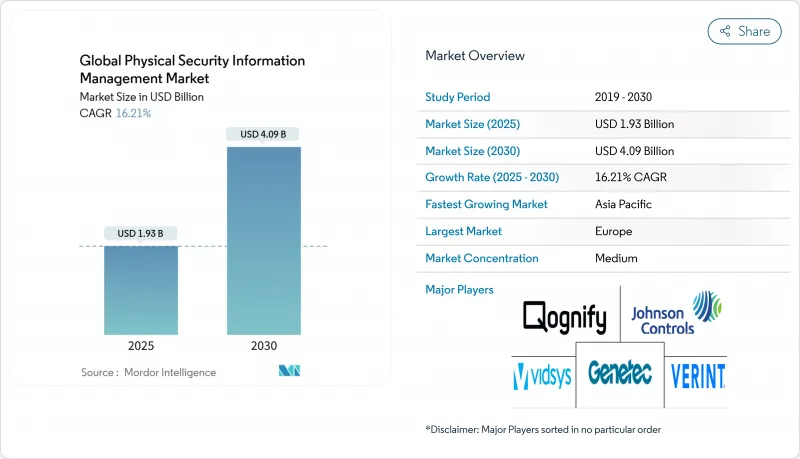
물리적 보안 정보 관리 시장 규모는 2025년에 19억 3,000만 달러로 추정되고, 2030년에는 40억 9,000만 달러에 이를 것으로 예측되며, 예측 기간 중 CAGR 16.21%로 성장이 전망됩니다.
센서의 급속한 보급, 규제 강화, 물리적 및 사이버 보호의 융합에 대한 축족은 자본 배분 결정을 재구성하고 최고 보안 책임자가 통합 명령 플랫폼을 우선하도록 촉구하고 있습니다. 교통기관의 허브, 데이터센터 캠퍼스, 헬스케어 네트워크 등에서는 다양한 센서 시설, 하이브리드한 근무 형태, 법적 책임 등이 교착하여 수요가 높아지고 있습니다. 공급업체는 개방형 오케스트레이션 계층, 클라우드 지원 전개 및 구독 기반 관리 서비스를 통해 진입 장벽을 낮추는 동시에 전개 주기를 단축하여 대응하고 있습니다. 빌딩 자동화 대기업, PSIM 전문 공급자, 퍼블릭 클라우드 하이퍼스케일러가 AI 분석, 지리공간 시각화, 워크플로우 자동화를 단일 운영 이미지에 통합하려고 경쟁해 경쟁이 치열해지고 있습니다.
세계의 물리적 보안 정보 관리 시장 동향 및 인사이트
IoT 대응 에지 센서 급증
2025년까지 416억 대의 연결 장치가 급증하고 사일로화된 도구로는 상관할 수 없는 기록적인 양의 원격 측정이 추진되고 있습니다. 현재 중요한 시설에서는 2022년 이후 43% 증가한 500개가 넘는 이종 센서를 취급하고 있으며, 오퍼레이터는 메타데이터를 정규화하고 경보에 우선순위를 부여하는 벤더에 얽매이지 않는 오케스트레이션 엔진의 채용을 강요하고 있습니다. 보안 관리자가 스마트 카메라, 환경 프로브 및 생체 인식 엔드포인트의 미래에 안전한 통합 경로를 찾고 있기 때문에 개방형 API는 필수 조달 기준이 되었습니다. 데이터의 입도가 높아짐에 따라 근본 원인 분석도 개선되어 대응 팀이 이벤트의 체인을 추적하고 해결까지의 평균 시간을 단축할 수 있게 되었습니다. 그 결과, 에너지, 유틸리티, 스마트 시티 프로그램 전체에서 차세대 플랫폼의 비즈니스 케이스가 강화되고 있습니다.
EU의 NIS2와 미국의 CISA 중요 인프라 의무화
NIS2 프레임워크 개정에서는 컴플라이언스 위반에 대해 최대 1,000만 유로(1,130만 달러)의 벌칙이 설정되고, CISA의 CIRCIA 규칙은 24시간에서 72시간의 보고 창이 강제되는 등 규제 압력은 이제 금전적인 의미를 가지고 있습니다. 따라서 전력, 운송, 헬스케어 분야의 사업자는 사고 문서화, 증거 보유 및 감사 추적을 자동화하는 플랫폼 업그레이드를 가속화하고 있습니다. 조달 팀은 즉시 사용할 수 있는 정책 템플릿, 역할 기반 액세스, 유럽의 GDPR(EU 개인정보보호규정) 요구 사항에 맞는 암호화 제어를 제공하는 솔루션을 지원합니다. 금융 및 제약의 조기 도입 기업은 잠재적 벌금에 대한 컴플라이언스 자동화가 정량화되면 이사회 승인이 더욱 원활해질 것이라고 보고합니다. 네이티브 정책 매핑 엔진과 사전 빌드 규제 당국 대시보드가 있는 공급업체는 결과적으로 대응할 수 있는 토대를 확장하고 있습니다.
레거시 아날로그 및 독점 시스템과의 복잡한 통합
산업 플랜트 및 운송 허브는 15-20년 전에 처음 도입된 독자적인 프로토콜에 의존하는 경우가 많아 데이터 정규화의 과제가 높아지고 구현 타임라인이 최대 60% 연장됩니다. 어댑터 계층은 종종 낮은 대역폭 직렬 피드를 최신 데이터 스키마로 변환하는 데 어려움을 겪고 있으며 통합자는 총 소유 비용을 높이는 사용자 정의 컨버터를 작성해야 합니다. 에너지 및 유틸리티 회사는 SCADA 인터페이스가 개방형 API 공개에 저항하는 경우 가장 날카로운 장애물에 직면합니다. 그 결과 프로젝트가 오버런되어 이해관계자의 신뢰를 잃게 되며 가동 중지 시간 허용도가 0에 가까운 분야에서는 롤아웃이 지연됩니다. 따라서 사전 인증된 드라이버 라이브러리 및 마이그레이션 툴킷을 제공하는 공급업체가 비교 우위를 확보했습니다.
부문 분석
2024년 물리적 보안 정보 관리 시장 점유율의 68%는 솔루션이 차지했으며, 명령 및 제어 소프트웨어의 영구 라이선스와 구독 업데이트가 그 중심이 되었습니다. 솔루션이 생성하는 물리적 보안 정보 관리 시장 규모는 중요 인프라 업데이트 사이클, AI 플러그인 및 지리 공간 대시보드와 같은 향상된 기능을 지원합니다.
그러나 매니지드 서비스의 CAGR은 16.9%로 핵심 소프트웨어 라인을 상회하는 속도로 추이합니다. 24시간 365일 모니터링, 사고 방어, 위협 탐색 루틴을 위한 사내 운영자가 부족한 조직에 대한 수요가 가장 강합니다. 서비스 제공업체는 멀티테넌트 아키텍처를 활용하고 계약 기간 동안 분석가 팀을 균등화함으로써 고객에게 예측 가능한 월간 지출과 서비스 수준 보증을 제공합니다. 컨설팅, 설계 및 통합과 같은 전문 서비스는 특히 레거시 PLC, 화재 경보 패널 및 건물 관리 시스템의 교량이 필요한 경우 복잡한 롤아웃을 지원합니다. 벤더의 성공은 기술 부족과 장기적인 플랫폼 유지 관리에 대한 구매자의 우려를 완화하는 권고와 운영 작업을 결과 기반 패키지로 번들링하는 데 점점 더 많은 노력을 기울이고 있습니다.
2024년 물리적 보안 정보 관리 시장 규모의 74%는 온프레미스형 시스템에서 차지했는데, 이는 유틸리티, 방위, 금융서비스 사업자가 데이터 주권형 에어갭 설비를 선호했기 때문입니다. 이러한 환경은 종종 밀리초 단위의 대기 시간과 결정적인 네트워크 동작을 요구하는 긴급 인터폰, 액세스 게이트, 산업용 제어 장치와 직접 통합됩니다.
그러나 클라우드 도입은 CAGR 18.1%로 확대되어 AI 추론을 수행하기 위한 탄력적인 컴퓨팅, 분산된 시설 전체의 집중 보고, 간소화된 패치 관리에 대한 수요에 힘쓰고 있습니다. 조기 도입 기업은 클라우드 비디오 감시를 활용하여 스토리지 비용을 절감하고 이벤트 플래그만을 로컬 에지 디바이스로 라우팅하여 신속한 차단을 실현하고 있습니다. 하이브리드 아키텍처는 기밀성이 높은 스트림을 현장에 남기면서 분석 대시보드와 머신러닝 파이프라인을 지역 데이터센터에 두는 것으로 인기를 끌고 있습니다.
지역 분석
북미는 2024년 물리적 보안 정보 관리 시장에서 세계 매출의 35%를 차지했으며, 연방 정부의 중요한 인프라 지침과 성숙한 시스템 통합 에코시스템에 의해 지원되고 있습니다. 검증 가능한 감시 플랫폼에 대해 15-30%의 보험료 우대 조치를 제공하는 보험사가 특히 코로케이션 데이터센터 사업자나 지역의 유틸리티자의 채용을 더욱 뒷받침하고 있습니다. 물리적 원격 측정과 사이버 원격 측정의 융합은 여전히 전략적 과제이며, 최고 보안 책임자의 68%가 2023년 이후 인시던트 중복을 지적하고 있습니다.
아시아는 2030년까지 연평균 복합 성장률(CAGR) 17.9%로 확대될 것으로 예측되며, 1조 7,000억 달러의 교통 메가 프로젝트와 스마트 시티 전개 확대가 뒷받침됩니다. 지방자치단체는 지하철 노선, 버스 터미널, 공항 등 여러 기관에 걸친 대응을 조정하기 위해 일원화된 상황 인식을 우선하고 있습니다. 벤더 전략은 기술 부족을 보완하고 조달의 현지화 규칙을 준수하기 위해 국내 통합자와의 합작 투자를 도입하는 경향이 강해지고 있습니다. 아시아는 향후 10년 이내에 물리적 보안 정보 관리 시장 규모로 북미를 추구할 것으로 보입니다.
유럽의 성장 궤도는 NIS2 지침의 시행 일정과 밀접하게 관련되어 있으며, 이 지침은 규정 준수 대상이 수천 개의 중요하고 필수적인 엔티티로 확장됩니다. 보안 리더는 규제 당국을 만족시키기 위해 인시던트 보고, 증거 보관 및 역할 기반 에스컬레이션을 자동화하는 플랫폼을 도입했습니다. 회원국 간의 다양한 설치 기반을 반영하여 개방형 표준을 선호하는 경향이 두드러집니다. 지속가능성은 조달 기준으로 부상하고 있으며, PSIM의 도입은 에너지 관리에 대한 지식을 통합하고 기업의 ESG 공개에 기여할 것으로 기대됩니다.
기타 혜택 :
- 엑셀 형식 시장 예측(ME) 시트
- 3개월간의 애널리스트 서포트
목차
제1장 서론
- 조사의 전제조건 및 시장 정의
- 조사 범위
제2장 조사 방법
제3장 주요 요약
제4장 시장 상황
- 시장 개요
- 시장 성장 촉진요인
- IoT 대응 엣지 센서의 보급이 통합 커맨드 플랫폼 추진
- EU NIS2와 미국 CISA의 중요 인프라 규제가 도입 가속
- 집중적인 상황 인식을 필요로 하는 아시아의 대규모 교통 프로젝트
- AI 비디오 분석의 급속한 보급으로 오픈 PSIM 오케스트레이션에 대한 수요 증가
- 하이브리드 워크의 보안 갭이 물리 및 사이버 통합 솔루션 추진 촉진
- 데이터센터의 PSIM 컴플라이언스에 연동한 보험료 할인
- 시장 성장 억제요인
- 기존의 아날로그 시스템 및 독자적인 시스템의 통합에 대한 복잡성
- Tier 1 플랫폼의 초기 라이선싱과 커스터마이즈의 높은 비용
- 신흥 시장에서 PSIM 스킬을 가진 시스템 통합자 부족
- 클라우드 기반 배포를 제한하는 데이터 주권 규칙
- 밸류체인 및 공급망 분석
- 규제 전망
- 기술의 전망
- Porter's Five Forces
- 공급기업의 협상력
- 구매자의 협상력
- 신규 참가업체의 위협
- 대체품의 위협
- 경쟁 기업 간 경쟁 관계
제5장 시장 규모 및 성장 예측
- 컴포넌트별
- 솔루션
- 비디오 및 인시던트 관리
- 액세스 제어 통합
- 커맨드 앤 컨트롤 대시보드
- 사건 및 증거 관리
- 서비스
- 전문(컨설팅, 설계, 통합)
- 관리 및 지원
- 솔루션
- 전개 모델별
- 온프레미스
- 클라우드
- 하이브리드
- 통합 방법별
- API 기반 오케스트레이션
- 미들 웨어 및 어댑터 레이어
- 최종 사용자 업계별
- BFSI
- 정부 및 방위
- 운송 및 물류
- 공항
- 해항
- 철도 및 지하철
- 에너지 및 유틸리티
- 소매
- 헬스케어
- 제조업 및 산업
- 교육
- IT 및 통신
- 지역별
- 북미
- 미국
- 캐나다
- 멕시코
- 남미
- 브라질
- 아르헨티나
- 기타 남미
- 아시아태평양
- 중국
- 인도
- 일본
- 한국
- 호주
- 뉴질랜드
- 기타 아시아태평양
- 유럽
- 독일
- 영국
- 프랑스
- 이탈리아
- 북유럽 국가
- 기타 유럽
- 중동 및 아프리카
- 사우디아라비아
- 아랍에미리트(UAE)
- 튀르키예
- 남아프리카
- 기타 중동 및 아프리카
- 북미
제6장 경쟁 구도
- 시장 집중도
- 전략적 동향
- 시장 점유율 분석
- 기업 프로파일
- Genetec Inc.
- Johnson Controls International plc(incl. Tyco Software House)
- Verint Systems Inc.
- Qognify(a Hexagon company)
- Everbridge Inc.
- Hexagon AB
- AxxonSoft Inc.
- LenelS2
- Advancis Software and Services GmbH
- Milestone Systems A/S
- Bosch Building Technologies
- Honeywell International Inc.
- Axis Communications AB
- Indigovision Group
- Pelco(Motorola Solutions)
- Prysm Software
- Ela-Soft GmbH
- VIDEONEXT Network Solutions
- Octopus Systems
- FAST Systems Inc.
- Easypsim AG
제7장 시장 기회 및 향후 전망
AJY 25.11.05The physical security information management market size stands at USD 1.93 billion in 2025 and is projected to advance to USD 4.09 billion by 2030, reflecting a 16.21% CAGR over the forecast horizon.
Rapid sensor proliferation, tighter regulations, and a pivot toward converged physical-cyber protection are reshaping capital allocation decisions, pushing chief security officers to prioritize unified command platforms. Demand is intensifying in transportation hubs, data-center campuses, and healthcare networks where diverse sensor estates, hybrid-work patterns, and liability exposures intersect. Vendors are responding with open orchestration layers, cloud-ready deployments, and subscription-based managed services that lower entry barriers while shortening deployment cycles. Competitive intensity is rising as established building-automation leaders, specialist PSIM providers, and public-cloud hyperscalers race to embed AI analytics, geospatial visualization, and workflow automation into a single operational picture.
Global Physical Security Information Management Market Trends and Insights
Proliferation of IoT-enabled Edge Sensors
A surge to 41.6 billion connected devices by 2025 is driving record volumes of telemetry that siloed tools cannot correlate. Critical facilities now juggle more than 500 heterogeneous sensors, a 43% jump since 2022, compelling operators to adopt vendor-agnostic orchestration engines that normalize metadata and prioritize alerts.Open APIs have become a must-have procurement criterion as security managers seek future-proof integration paths for smart cameras, environmental probes, and biometric endpoints. Heightened data granularity is also improving root-cause analysis, allowing response teams to trace event chains and shorten mean time to resolution. The resulting operational gains are reinforcing the business case for next-generation platforms across energy, utilities, and smart-city programs.
EU NIS2 & U.S. CISA Critical-Infrastructure Mandates
Regulatory pressure now carries meaningful financial teeth: the revised NIS2 framework sets penalties up to EUR 10 million (USD 11.3 million) for non-compliance, while CISA's CIRCIA rule enforces 24- to 72-hour reporting windows. Operators in power, transport, and healthcare sectors are therefore accelerating platform upgrades that automate incident documentation, evidence retention, and audit trails. Procurement teams favor solutions delivering out-of-the-box policy templates, role-based access, and encryption controls that align with European GDPR requirements. Early adopters in finance and pharmaceuticals report smoother board approvals once compliance automation is quantified against potential fines. Vendors with native policy-mapping engines and pre-built regulator dashboards are consequently widening their addressable base.
Integration Complexity with Legacy Analog & Proprietary Systems
Industrial plants and transport hubs often rely on proprietary protocols first deployed 15-20 years ago, elevating data normalization challenges that extend implementation timelines by up to 60%. Adapter layers frequently struggle to translate low-bandwidth serial feeds into modern data schemas, forcing integrators to script custom converters that raise the total cost of ownership. Energy utilities face the sharpest hurdles where SCADA interfaces resist open API exposure. The resulting project overruns dent stakeholder confidence and slow rollouts in sectors where downtime tolerance is close to zero. Vendors offering pre-certified driver libraries and migration toolkits are therefore gaining a comparative advantage.
Other drivers and restraints analyzed in the detailed report include:
- Rapid Uptake of AI Video-Analytics
- Asian Mega-Transit Projects
- High Up-front Licensing & Customisation Costs
For complete list of drivers and restraints, kindly check the Table Of Contents.
Segment Analysis
Solutions retained a 68% slice of the physical security information management market share in 2024, anchored by perpetual licences and subscription renewals for command-and-control software. The physical security information management market size generated by solutions is buoyed by critical infrastructure refresh cycles and feature expansions such as AI plug-ins and geospatial dashboards.
However, managed services are set to chart a 16.9% CAGR, a pace outstripping the core software line. Demand is strongest among organizations lacking in-house operators for 24/7 monitoring, incident triage, and threat-hunting routines. Service providers leverage multitenant architectures to amortize analyst teams across contracts, offering clients predictable monthly outlays and service-level guarantees. Professional services-consulting, design, and integration-continue to underpin complex rollouts, particularly where legacy PLCs, fire-alarm panels, and building-management systems must be bridged. Vendor success increasingly hinges on bundling advisory and run operations into cohesive outcome-based packages that ease buyer concerns over skill shortages and long-term platform upkeep.
On-premise systems controlled 74% of the physical security information management market size in 2024 as operators in utilities, defense, and financial services favored data-sovereign, air-gapped installations. These environments often integrate directly with emergency intercoms, access gates, and industrial controls that demand millisecond latencies and deterministic network behavior.
Yet, cloud deployments will expand at an 18.1% CAGR, fueled by demand for elastic compute to run AI inference, centralized reporting across distributed estates, and simplified patch management. Early adopters leverage cloud video surveillance to offload storage costs, routing only event flags to local edge devices for rapid interdiction. Hybrid architectures are gaining traction where sensitive streams stay on-site while analytics dashboards and machine-learning pipelines reside in regional data centers.
The Physical Security Information Management Market is Segmented by Component (Solutions and Services), Deployment (On-Premise, Cloud, and Hybrid), Integration Method (API-Based Orchestration, Middleware/Adapter Layer), End-User Industry (BFSI, Government and Defense, Transportation and Logistics, and More), and by Geography. The Market Forecasts are Provided in Terms of Value (USD).
Geography Analysis
North America commanded 35% of global revenue for the physical security information management market in 2024, underpinned by federal critical-infrastructure mandates and mature systems-integration ecosystems. Insurance carriers offering 15-30% premium incentives for verifiable monitoring platforms further encourage adoption, especially among colocation data-center operators and regional utilities. Convergence of physical and cyber telemetry remains a strategic agenda, with 68% of chief security officers noting incident overlaps since 2023.
Asia is projected to expand at an 17.9% CAGR through 2030, propelled by USD 1.7 trillion in transit megaprojects and escalating smart-city deployments. Local authorities prioritize centralized situational awareness to coordinate multi-agency responses across metro lines, bus terminals, and airports. Vendor strategies increasingly incorporate joint ventures with domestic integrators to offset skill shortages and comply with procurement localization rules. Asia will eclipse North America in physical security information management market size within the next decade.
Europe's growth trajectory is tightly linked to the enforcement timetable for the NIS2 Directive, which broadens compliance scope to thousands of essential and important entities. Security leaders are deploying platforms that automate incident reporting, evidence archiving, and role-based escalation to satisfy regulators. Preference for open standards is pronounced, reflecting diverse installed bases across member states. Sustainability is emerging as a procurement criterion, with PSIM rollouts expected to integrate energy-management insights and contribute to corporate ESG disclosures.
- Genetec Inc.
- Johnson Controls International plc (incl. Tyco Software House)
- Verint Systems Inc.
- Qognify (a Hexagon company)
- Everbridge Inc.
- Hexagon AB
- AxxonSoft Inc.
- LenelS2
- Advancis Software and Services GmbH
- Milestone Systems A/S
- Bosch Building Technologies
- Honeywell International Inc.
- Axis Communications AB
- Indigovision Group
- Pelco (Motorola Solutions)
- Prysm Software
- Ela-Soft GmbH
- VIDEONEXT Network Solutions
- Octopus Systems
- FAST Systems Inc.
- Easypsim AG
Additional Benefits:
- The market estimate (ME) sheet in Excel format
- 3 months of analyst support
TABLE OF CONTENTS
1 INTRODUCTION
- 1.1 Study Assumptions and Market Definition
- 1.2 Scope of the Study
2 RESEARCH METHODOLOGY
3 EXECUTIVE SUMMARY
4 MARKET LANDSCAPE
- 4.1 Market Overview
- 4.2 Market Drivers
- 4.2.1 Proliferation of IoT-enabled Edge Sensors Driving Unified Command Platforms
- 4.2.2 EU NIS2 and U.S. CISA Critical-Infrastructure Mandates Accelerating Adoption
- 4.2.3 Asian Mega-Transit Projects Requiring Centralised Situational Awareness
- 4.2.4 Rapid Uptake of AI Video-Analytics Creating Demand for Open PSIM Orchestration
- 4.2.5 Hybrid-Work Security Gaps Fueling Physical-Cyber Converged Solutions
- 4.2.6 Insurance Premium Discounts Linked to PSIM Compliance for Data Centres
- 4.3 Market Restraints
- 4.3.1 Integration Complexity with Legacy Analog and Proprietary Systems
- 4.3.2 High Up-front Licensing and Customisation Costs for Tier-1 Platforms
- 4.3.3 Shortage of PSIM-Skilled System Integrators in Emerging Markets
- 4.3.4 Data-Sovereignty Rules Limiting Cloud-Based Deployments
- 4.4 Value / Supply-Chain Analysis
- 4.5 Regulatory Outlook
- 4.6 Technological Outlook
- 4.7 Porter's Five Forces
- 4.7.1 Bargaining Power of Suppliers
- 4.7.2 Bargaining Power of Buyers
- 4.7.3 Threat of New Entrants
- 4.7.4 Threat of Substitutes
- 4.7.5 Intensity of Competitive Rivalry
5 MARKET SIZE AND GROWTH FORECASTS (VALUE)
- 5.1 By Component
- 5.1.1 Solutions
- 5.1.1.1 Video / Incident Management
- 5.1.1.2 Access-Control Integration
- 5.1.1.3 Command-and-Control Dashboards
- 5.1.1.4 Case and Evidence Management
- 5.1.2 Services
- 5.1.2.1 Professional (Consulting, Design and Integration)
- 5.1.2.2 Managed and Support
- 5.1.1 Solutions
- 5.2 By Deployment Model
- 5.2.1 On-premise
- 5.2.2 Cloud
- 5.2.3 Hybrid
- 5.3 By Integration Method
- 5.3.1 API-Based Orchestration
- 5.3.2 Middleware / Adapter Layer
- 5.4 By End-user Industry
- 5.4.1 BFSI
- 5.4.2 Government and Defense
- 5.4.3 Transportation and Logistics
- 5.4.3.1 Airports
- 5.4.3.2 Maritime Ports
- 5.4.3.3 Rail and Metro
- 5.4.4 Energy and Utilities
- 5.4.5 Retail
- 5.4.6 Healthcare
- 5.4.7 Manufacturing and Industrial
- 5.4.8 Education
- 5.4.9 IT and Telecom
- 5.5 By Geography
- 5.5.1 North America
- 5.5.1.1 United States
- 5.5.1.2 Canada
- 5.5.1.3 Mexico
- 5.5.2 South America
- 5.5.2.1 Brazil
- 5.5.2.2 Argentina
- 5.5.2.3 Rest of South America
- 5.5.3 APAC
- 5.5.3.1 China
- 5.5.3.2 India
- 5.5.3.3 Japan
- 5.5.3.4 South Korea
- 5.5.3.5 Australia
- 5.5.3.6 New Zealand
- 5.5.3.7 Rest of APAC
- 5.5.4 Europe
- 5.5.4.1 Germany
- 5.5.4.2 United Kingdom
- 5.5.4.3 France
- 5.5.4.4 Italy
- 5.5.4.5 Nordics
- 5.5.4.6 Rest of Europe
- 5.5.5 Middle East and Africa
- 5.5.5.1 Saudi Arabia
- 5.5.5.2 UAE
- 5.5.5.3 Turkey
- 5.5.5.4 South Africa
- 5.5.5.5 Rest of Middle East and Africa
- 5.5.1 North America
6 COMPETITIVE LANDSCAPE
- 6.1 Market Concentration
- 6.2 Strategic Moves
- 6.3 Market Share Analysis
- 6.4 Company Profiles (includes Global level Overview, Market level overview, Core Segments, Financials as available, Strategic Information, Market Rank/Share for key companies, Products and Services, and Recent Developments)
- 6.4.1 Genetec Inc.
- 6.4.2 Johnson Controls International plc (incl. Tyco Software House)
- 6.4.3 Verint Systems Inc.
- 6.4.4 Qognify (a Hexagon company)
- 6.4.5 Everbridge Inc.
- 6.4.6 Hexagon AB
- 6.4.7 AxxonSoft Inc.
- 6.4.8 LenelS2
- 6.4.9 Advancis Software and Services GmbH
- 6.4.10 Milestone Systems A/S
- 6.4.11 Bosch Building Technologies
- 6.4.12 Honeywell International Inc.
- 6.4.13 Axis Communications AB
- 6.4.14 Indigovision Group
- 6.4.15 Pelco (Motorola Solutions)
- 6.4.16 Prysm Software
- 6.4.17 Ela-Soft GmbH
- 6.4.18 VIDEONEXT Network Solutions
- 6.4.19 Octopus Systems
- 6.4.20 FAST Systems Inc.
- 6.4.21 Easypsim AG
7 MARKET OPPORTUNITIES AND FUTURE OUTLOOK
- 7.1 White-space and Unmet-Need Assessment