
|
시장보고서
상품코드
1850364
호버크래프트 : 시장 점유율 분석, 산업 동향, 통계, 성장 예측(2025-2030년)Hovercraft - Market Share Analysis, Industry Trends & Statistics, Growth Forecasts (2025 - 2030) |
||||||
 Mordor Intelligence
호버크래프트 시장 규모는 2025년에 2억 2,979만 달러로 평가되었고 2030년에 2억 7,831만 달러로 확대될 것으로 예측되며, CAGR은 3.91%를 나타낼 전망입니다.
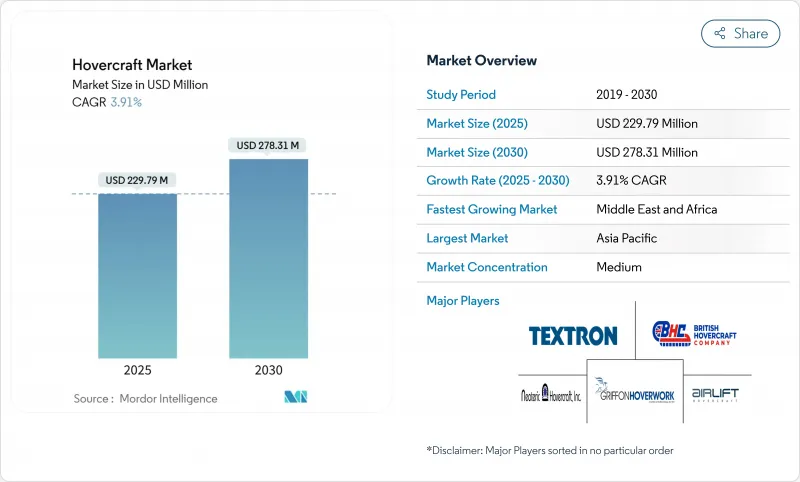
해안 홍수, 해양 에너지 확장, 재난 대응 계획으로 인해 공기부양선이 핵심 운송 인프라의 일부가 되면서 수요가 주로 군용 함대에서 상업적 용도로 전환되고 있습니다. 군 함대 교체 프로그램은 꾸준한 기본 지출을 유지하는 한편, 환경 규제와 소음 제한으로 인해 전기 및 하이브리드 추진 시스템에 대한 투자가 가속화되고 있습니다. 저소음 선박 인증을 획득하고 다목적 임무 수행 능력을 입증할 수 있는 제조업체들은 특히 지상 교통이 불안정하거나 해상 상태가 열악한 지역에서 신규 계약을 확보하고 있습니다. 기술 공급업체와 에너지 운영사 간의 파트너십도 고객 기반을 확대하여 호버크래프트 시장의 지속적인 성장을 뒷받침하고 있습니다.
세계의 호버크래프트 시장 동향 및 인사이트
기후 변화로 인한 홍수 속 양륙 수송 수요 증가
해안 홍수로 도로, 철도, 활주로가 마비되면서 기관들은 물, 진흙, 잔해 위를 미끄러지듯 이동할 수 있는 차량을 조달하고 있습니다. 캐나다 해안경비대의 차세대 에어쿠션 선박 500만 달러 규모 주문은 정부가 이제 호버크래프트를 틈새 도구가 아닌 핵심 복원력 자산으로 취급하는 방식을 상징합니다. 동남아시아와 미국 걸프 연안 지방자치단체들은 폭풍 시 대응 시간 단축 효과를 측정하는 시범 프로그램을 진행 중입니다. 보험사들은 신속한 대피 능력의 가치를 점점 더 인식하고 있으며, 이는 보험금 지급 기간을 단축하고 영업 중단 손실을 줄여줍니다. 이러한 요소들이 종합적으로 호버크래프트 시장의 장기적 기반을 강화하고 있습니다.
현대식 상륙정 군함의 함대 교체 주기
1980년대 제작된 구형 상륙정들은 수명이 다해가고 있으며, 국방부들은 더 높은 적재량, 낮은 탐지 신호, 자율 주행 옵션을 갖춘 후속 기종에 자금을 지원하고 있습니다. 미 해군의 ‘함정-해안 연결기(Ship-to-Shore Connector)’ 프로그램은 2024년 말 기준 6억 달러를 초과하는 다년 계약으로 이러한 추세를 보여줍니다. 일본, 영국, 중국에서도 유사한 조달 라인이 존재하며, 향후 센서나 무기 업그레이드가 가능한 공통 선체 모듈을 강조하고 있습니다. 긴 조달 기간은 기존 제조사에게 예측 가능한 수익 흐름으로 이어져, 군 예산이 호버크래프트 시장에서 차지하는 핵심적 역할을 강화합니다.
높은 작동음과 환경 한계
프로펠러 끝 소용돌이는 평평한 수면 위로 전파되는 음향 피크를 생성하며, 200m 거리에서 종종 90dB를 초과합니다. 1968년 호버크래프트 법으로 거슬러 올라가는 영국 법률은 여전히 면허 조건에 영향을 미쳐, 운영자가 저녁 시간대 운항 일정을 제한하도록 요구합니다. 프랑스와 캘리포니아의 연안 지역 사회는 음향 모델링을 통해 규정 준수가 입증될 때까지 제안된 노선을 차단해 왔습니다. 제조사들은 가변 피치 팬과 덮개형 흡입구 개발에 투자 중이지만, 소음·추력·항속거리 간 기술적 절충점은 여전히 존재합니다.
부문 분석
2024년 매출의 45.11%를 차지한 20-30m 중형 선박은 30-70톤의 적재량으로 병력 수송부터 구급차 임무까지 가장 광범위한 작전을 수행할 수 있기 때문입니다. 그러나 12m 미만 소형 선박은 연안 순찰 부대와 과학 기관이 적재량보다 기동성을 우선시함에 따라 4.82%의 가장 높은 연평균 성장률(CAGR)을 보입니다. 많은 관할 구역에서 승무원 요건이 낮고 면허 취득이 간소화된 점도 소형 플랫폼 호버크래프트 시장 규모를 뒷받침합니다.
제조사들은 측량 소나, 농업용 살포기, 들것 등을 장착할 수 있는 모듈식 갑판을 홍보하며 하나의 선체를 다양한 틈새 시장에 맞춤화하고 있습니다. 이러한 맞춤화 추세와 제한된 승무원 가용성을 상쇄하는 자율주행 패키지의 확산은 소형 선박 부문의 지속적인 두 자릿수 주문 증가를 뒷받침합니다.
방위 및 보안 임무는 상륙 공격, 항만 방어, 기뢰 대책을 아우르며 2024년 매출의 35.45%를 차지해 선두를 달렸습니다. 정부는 신속한 해변 접근성과 상륙 방어 장애물 극복 능력을 중시합니다. 반면 해양 에너지 지원은 규모는 작지만 5.12%의 연평균 성장률로 다른 모든 용도를 앞지르며 성장 중입니다. 풍력발전소 승무원 수송, 북극 지역 보급, 파이프라인 유지보수 분야는 여객 수송보다 투자 동력이 더 강합니다.
호버크래프트는 암석 제방이나 부유 얼음 위에 직접 접안할 수 있어, 더 깊은 흘수를 요구하는 바지선에 비해 이동 시간을 대폭 단축합니다. 에너지 운영사들은 이 유연성을 환영하는데, 이는 기상 관련 가동 중단 일수를 줄이고 안전성을 향상시키기 때문입니다. 이러한 역학 관계는 종합적으로 수익원을 다각화하고 방위 예산 주기에 따른 시장 변동성을 완화합니다.
지역 분석
아시아태평양 지역은 2024년 글로벌 매출의 32.40%를 차지했습니다. 중국 조선소는 섬 체인 물류 강화를 위해 국산 716형 및 726형 상륙정 생산을 확대하고 있으며, 일본은 원격 지역을 혼슈와 연결할 12,000톤급 여객선 단위에 투자하고 있습니다. 한국은 갯벌 지역을 위한 호버 구급차 시범 운영을 검토 중이며, 인도의 국가재난대응군은 삼각주 지역을 위한 신속 배치용 선박을 연구 중입니다. 이러한 프로그램들은 종합적으로 대용량 플랫폼에 대한 안정적인 수요를 보장합니다.
중동 및 아프리카 지역은 규모가 상대적으로 작지만, 2030년까지 연평균 5.75% 성장률이 예상됩니다. 아부다비가 리젠트 크래프트와 체결한 12인승 전기 해상 글라이더 제작 협정은 투자 펀드가 관대한 규제를 활용해 저배출 운송 수단으로 도약하는 방식을 보여줍니다. 사우디아라비아는 홍해 관광 연결 가능성을 위해 시범 노선을 모니터링 중이며, 나이지리아는 니제르 델타 지역에서 호버 파이프라인 순찰을 검토 중입니다. 기후 회복력 강화 우선순위와 풍부한 자본이 이 지역의 비약적 확장을 뒷받침합니다.
북미와 유럽은 방위 계약과 전통 여객 노선에 기반한 성숙하면서도 탄력적인 시장을 유지하고 있습니다. 미국은 다년간 LCAC(공기충전식 상륙정) 조달을 지속하고 있으며, 캐나다는 빙판 위에서 운용되는 북극 구조정 예산을 배정했습니다. 호버트래블은 유럽에서 솔렌트 해협 횡단 서비스 60주년을 기념하지만, 노선 확장은 엄격한 소음 제한과 환경 영향 평가에 직면해 있습니다. 그러나 스칸디나비아는 피오르드 통근 노선에 수소 동력 선박의 틈새 시장을 발견하며 진보적인 배출 목표를 반영하고 있습니다. 남미는 예산 제약으로 인해 아직 초기 단계이지만, 아마존의 환경 NGO들은 도로망이 부족한 지역에서 밀렵 방지 순찰을 위한 호버크래프트 활용을 모색 중입니다.
기타 혜택 :
- 엑셀 형식 시장 예측(ME) 시트
- 3개월간의 애널리스트 지원
목차
제1장 서론
- 조사의 전제조건과 시장의 정의
- 조사 범위
제2장 조사 방법
제3장 주요 요약
제4장 시장 상황
- 시장 개요
- 시장 성장 촉진요인
- 기후 변화로 인한 홍수 속 양륙 수송 수요 증가
- 현대식 상륙정 군함 함대 교체 주기
- 저소음 전기 및 수소 추진 기술 발전
- 상업 여객 서비스 지원 규제 완화
- 해상 에너지 및 극지 물류 수요 증가
- 홍수 대비 비상 대응 투자 확대
- 시장 성장 억제요인
- 높은 운용 소음 및 연안 환경 규제
- 인증된 조종사 및 정비 기술자 부족
- 지상 효과 선박 및 수중익선과의 경쟁
- 군수 조달 주기에 영향을 미치는 연료비 변동성
- 밸류체인 분석
- 규제 상황
- 기술의 전망
- Porter's Five Forces 분석
- 구매자의 협상력/소비자
- 공급기업의 협상력
- 신규 참가업체의 위협
- 대체품의 위협
- 경쟁 기업간 경쟁 관계
제5장 시장 규모와 성장 예측
- 호버크래프트 사이즈별
- 소
- 중
- 대
- 용도별
- 방위와 안보
- 여객 페리 서비스
- 해외 에너지 지원
- 수색 및 구조
- 측량과 지도 작성
- 농업과 환경관리
- 추진 시스템별
- 디젤 엔진
- 가스 터빈
- 하이브리드 전기
- 완전 전동
- 수소 연료전지
- 최종 사용자별
- 군용
- 상업용
- 지역별
- 북미
- 미국
- 캐나다
- 멕시코
- 유럽
- 영국
- 프랑스
- 독일
- 이탈리아
- 기타 유럽
- 아시아태평양
- 중국
- 일본
- 한국
- 인도
- 호주
- 기타 아시아태평양
- 남미
- 브라질
- 아르헨티나
- 기타 남미
- 중동 및 아프리카
- 중동
- 사우디아라비아
- 아랍에미리트(UAE)
- 기타 중동
- 아프리카
- 남아프리카
- 기타 아프리카
- 북미
제6장 경쟁 구도
- 시장 집중도
- 전략적 동향
- 시장 점유율 분석
- 기업 프로파일
- Griffon Hoverwork Ltd.
- Textron Systems Corporation(Textron Inc.)
- The British Hovercraft Company Ltd.
- Neoteric Hovercraft Inc.
- AEROHOD Ltd.
- Airlift Hovercraft Pty Ltd.
- CHRISTY HOVERCRAFT
- Hovertechnics, LLC.
- Ivanoff Hovercraft AB
- Bill Baker Vehicles Ltd.
- Mad Hovercraft
- Vigor Industrial LLC
제7장 시장 기회와 장래의 전망
HBR 25.11.19The hovercraft market size stood at USD 229.79 million in 2025 and is forecasted to advance to USD 278.31 million by 2030, registering a 3.91% CAGR.
Demand is shifting from predominantly military fleets toward commercial uses as coastal flooding, offshore energy expansion, and disaster-response planning make air-cushion vehicles part of critical transport infrastructure. Military fleet replacement programs contribute steady baseline spending, while environmental regulations and noise limits accelerate investment in electric and hybrid propulsion. Manufacturers that can certify low-noise craft and prove multi-mission flexibility are capturing new contracts, especially where ground transport is unreliable or sea-state conditions are harsh. Partnerships between technology providers and energy operators also broaden the customer base, supporting sustained growth in the hovercraft market.
Global Hovercraft Market Trends and Insights
Rising demand for amphibious transport amid climate-driven floods
Coastal flooding disrupts roads, railways, and runways, prompting agencies to procure vehicles that can glide over water, mud, and debris. The Canadian Coast Guard's USD 5 million order for next-generation air-cushion craft is emblematic of how governments now treat hovercraft as core resilience assets rather than niche tools. Municipal authorities in Southeast Asia and the United States Gulf Coast are conducting pilot programs that measure response-time savings during storms. Insurance firms increasingly recognize the value of rapid evacuation capability, which shortens claim settlements and reduces business-interruption losses. These factors collectively strengthen the long-term foundation of the hovercraft market.
Military fleet replacement cycles for modern assault craft
Legacy landing craft built in the 1980s are nearing the end of their service life, and defense ministries are funding successors with higher payloads, lower signatures, and autonomous options. The US Navy's Ship-to-Shore Connector program illustrates this push with multi-year contracts exceeding USD 600 million as of late 2024. Similar procurement lines exist in Japan, the UK, and China, emphasizing common hull modules that can accept future sensor or weapons upgrades. Long acquisition horizons translate into predictable revenue streams for incumbent manufacturers, reinforcing the central role of military budgets in the hovercraft market.
High operating noise and environmental limits
Propeller tip vortices generate tonal peaks propagating over flat water surfaces, often exceeding 90 dB at 200 m. The UK statutes, dating back to the Hovercraft Act of 1968, still influence license terms, requiring operators to curtail schedules during evening hours. Coastal communities in France and California have blocked proposed routes until acoustic modeling proves compliance. Manufacturers now invest in variable-pitch fans and shrouded intakes, yet engineering trade-offs remain between noise, thrust, and range.
Other drivers and restraints analyzed in the detailed report include:
- Advances in low-noise electric and hydrogen propulsion
- Offshore energy and polar logistics requirements
- Shortage of certified pilots and technicians
For complete list of drivers and restraints, kindly check the Table Of Contents.
Segment Analysis
Medium craft between 20 m and 30 m length made up 45.11% of 2024 revenue, largely because their 30-70 t payloads satisfy the broadest range of missions from troop lift to ambulance duty. However, small craft under 12 m length show the liveliest 4.82% CAGR as coastal patrol units and scientific agencies prioritize agility over capacity. Lower crew requirements and simplified licensing in many jurisdictions also support the hovercraft market size for small platforms.
Manufacturers promote modular decks that accept survey sonar, agricultural sprayers, or stretchers, tailoring one hull to multiple niches. This customization trend and the spread of autonomy packages that offset limited crew availability underpin sustained double-digit order growth for the small-craft segment.
Defense and security missions led 2024 revenue with a 35.45% share, spanning amphibious assault, port protection, and mine countermeasures. Governments value fast beach access and the ability to ride over anti-landing obstacles. Conversely, offshore energy support, while smaller, is growing at a 5.12% CAGR that outpaces every other use case. Wind-farm crew transfer, Arctic resupply, and pipeline maintenance outperform passenger travel in investment momentum.
Hovercraft can berth directly on rocky causeways and floating ice, slashing transit times compared to barges requiring deeper drafts. Energy operators embrace this flexibility because it lowers weather-related shutdown days and improves safety. Collectively, these dynamics diversify revenue streams and cushion the market against defense-budget cycles.
The Hovercraft Market Report is Segmented by Hovercraft Size (Small, Medium, and Large), Application (Defense and Security, Passenger Ferry Services, Offshore Energy Support, and More), Propulsion System (Diesel Engine, Gas Turbine, Hybrid-Electric, Fully Electric, and Hydrogen Fuel-Cell), End User (Military and Commercial), and Geography (North America, Europe, and More). The Market Forecasts are Provided in Terms of Value (USD).
Geography Analysis
Asia-Pacific retained 32.40% of global revenue in 2024. Chinese shipyards expand indigenous output of Type 716 and Type 726 assault craft to bolster island-chain logistics, while Japan invests in 12000TD passenger units that will connect remote communities to Honshu. South Korea explores hover-ambulance pilots for tidal flats, and India's National Disaster Response Force studies rapid-deployment craft for delta regions. These programs collectively ensure a stable demand for high-capacity platforms.
The Middle East and Africa region, representing a smaller base, is forecast to grow at 5.75% CAGR through 2030. Abu Dhabi's pact with Regent Craft to build 12-seat electric seagliders illustrates how investment funds leverage permissive regulations to leapfrog into low-emission transport. Saudi Arabia is monitoring the pilot line for potential Red Sea tourism links, while Nigeria evaluates hover-pipeline patrols in the Niger Delta. Climate resilience priorities and ample capital position the region for outsized expansion.
North America and Europe maintain mature yet resilient markets anchored in defense contracts and heritage passenger routes. The United States continues multi-year LCAC procurement, and Canada allocates a budget for Arctic rescue craft that operate on ice pans. Hovertravel celebrates six decades of cross-Solent service in Europe, but route expansions face stringent decibel caps and environmental impact assessments. Scandinavia, however, sees a niche for hydrogen-powered craft on fjord commuter lines, reflecting progressive emissions goals. South America remains nascent due to budget constraints, yet environmental NGOs in the Amazon explore hovercraft for anti-poaching patrols where road networks are sparse.
- Griffon Hoverwork Ltd.
- Textron Systems Corporation (Textron Inc.)
- The British Hovercraft Company Ltd.
- Neoteric Hovercraft Inc.
- AEROHOD Ltd.
- Airlift Hovercraft Pty Ltd.
- CHRISTY HOVERCRAFT
- Hovertechnics, LLC.
- Ivanoff Hovercraft AB
- Bill Baker Vehicles Ltd.
- Mad Hovercraft
- Vigor Industrial LLC
Additional Benefits:
- The market estimate (ME) sheet in Excel format
- 3 months of analyst support
TABLE OF CONTENTS
1 INTRODUCTION
- 1.1 Study Assumptions and Market Definition
- 1.2 Scope of the Study
2 RESEARCH METHODOLOGY
3 EXECUTIVE SUMMARY
4 MARKET LANDSCAPE
- 4.1 Market Overview
- 4.2 Market Drivers
- 4.2.1 Rising demand for amphibious transport amid climate-driven floods
- 4.2.2 Military fleet replacement cycles for modern assault craft
- 4.2.3 Advances in low-noise electric and hydrogen propulsion
- 4.2.4 Relaxed regulations supporting commercial passenger services
- 4.2.5 Offshore energy and polar logistics requirements
- 4.2.6 Increased investment in flood-oriented emergency response
- 4.3 Market Restraints
- 4.3.1 High operating noise and coastal environmental restrictions
- 4.3.2 Scarcity of certified pilots and maintenance technicians
- 4.3.3 Competition from ground-effect and hydrofoil vessels
- 4.3.4 Fuel-cost volatility affecting military procurement cycles
- 4.4 Value Chain Analysis
- 4.5 Regulatory Landscape
- 4.6 Technological Outlook
- 4.7 Porter's Five Forces Analysis
- 4.7.1 Bargaining Power of Buyers/Consumers
- 4.7.2 Bargaining Power of Suppliers
- 4.7.3 Threat of New Entrants
- 4.7.4 Threat of Substitute Products
- 4.7.5 Intensity of Competitive Rivalry
5 MARKET SIZE AND GROWTH FORECASTS (VALUE)
- 5.1 By Hovercraft Size
- 5.1.1 Small
- 5.1.2 Medium
- 5.1.3 Large
- 5.2 By Application
- 5.2.1 Defense and Security
- 5.2.2 Passenger Ferry Services
- 5.2.3 Offshore Energy Support
- 5.2.4 Search and Rescue
- 5.2.5 Surveying and Mapping
- 5.2.6 Agricultural and Environmental Management
- 5.3 By Propulsion System
- 5.3.1 Diesel Engine
- 5.3.2 Gas Turbine
- 5.3.3 Hybrid-Electric
- 5.3.4 Fully Electric
- 5.3.5 Hydrogen Fuel-Cell
- 5.4 By End User
- 5.4.1 Military
- 5.4.2 Commercial
- 5.5 By Geography
- 5.5.1 North America
- 5.5.1.1 United States
- 5.5.1.2 Canada
- 5.5.1.3 Mexico
- 5.5.2 Europe
- 5.5.2.1 United Kingdom
- 5.5.2.2 France
- 5.5.2.3 Germany
- 5.5.2.4 Italy
- 5.5.2.5 Rest of Europe
- 5.5.3 Asia-Pacific
- 5.5.3.1 China
- 5.5.3.2 Japan
- 5.5.3.3 South Korea
- 5.5.3.4 India
- 5.5.3.5 Australia
- 5.5.3.6 Rest of Asia-Pacific
- 5.5.4 South America
- 5.5.4.1 Brazil
- 5.5.4.2 Argentina
- 5.5.4.3 Rest of South America
- 5.5.5 Middle East and Africa
- 5.5.5.1 Middle East
- 5.5.5.1.1 Saudi Arabia
- 5.5.5.1.2 UAE
- 5.5.5.1.3 Rest of Middle East
- 5.5.5.2 Africa
- 5.5.5.2.1 South Africa
- 5.5.5.2.2 Rest of Africa
- 5.5.1 North America
6 COMPETITIVE LANDSCAPE
- 6.1 Market Concentration
- 6.2 Strategic Moves
- 6.3 Market Share Analysis
- 6.4 Company Profiles (includes Global level Overview, Market level overview, Core Segments, Financials as available, Strategic Information, Market Rank/Share for key companies, Products and Services, and Recent Developments)
- 6.4.1 Griffon Hoverwork Ltd.
- 6.4.2 Textron Systems Corporation (Textron Inc.)
- 6.4.3 The British Hovercraft Company Ltd.
- 6.4.4 Neoteric Hovercraft Inc.
- 6.4.5 AEROHOD Ltd.
- 6.4.6 Airlift Hovercraft Pty Ltd.
- 6.4.7 CHRISTY HOVERCRAFT
- 6.4.8 Hovertechnics, LLC.
- 6.4.9 Ivanoff Hovercraft AB
- 6.4.10 Bill Baker Vehicles Ltd.
- 6.4.11 Mad Hovercraft
- 6.4.12 Vigor Industrial LLC
7 MARKET OPPORTUNITIES AND FUTURE OUTLOOK
- 7.1 White-space and Unmet-Need Assessment