
|
시장보고서
상품코드
1850964
가상화 소프트웨어 시장 : 점유율 분석, 산업 동향, 통계, 성장 예측(2025-2030년)Virtualization Software - Market Share Analysis, Industry Trends & Statistics, Growth Forecasts (2025 - 2030) |
||||||
 Mordor Intelligence
가상화 소프트웨어 시장 규모는 2025년에 948억 2,000만 달러, 예측 기간(2025-2030년)의 CAGR은 18.20%를 나타내고, 2030년에는 2,187억 6,000만 달러에 달할 것으로 예측됩니다.
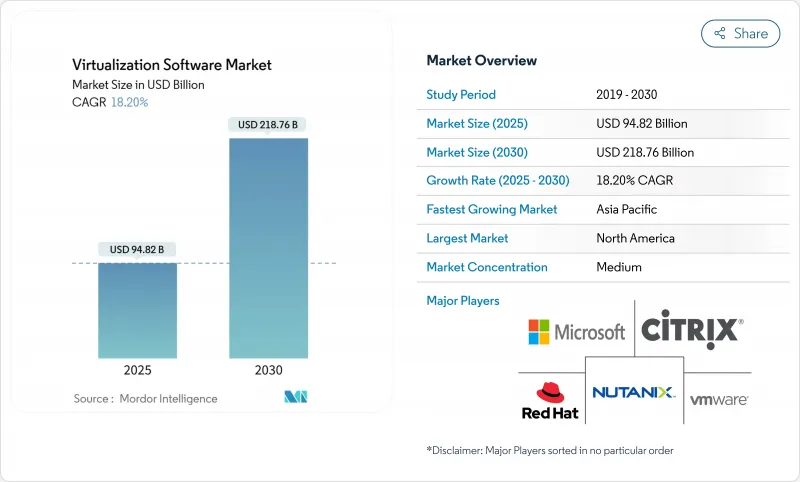
하이브리드 인프라로의 결정적인 변화, 클라우드 지출 증가, AI 최적화 워크로드의 보급 등이 견조한 전망 요인이 되고 있습니다. 브로드컴이 VMware를 통합함으로써 라이선스 수수료가 증가하고 공급업체 경제가 변화함에 따라 기업은 공급업체를 다양화하고 오픈소스 및 클라우드 네이티브 하이퍼바이저 평가판을 가속화하고 있습니다. 엣지 컴퓨팅 배포, 산업 컴플라이언스 강화, 하이브리드 워크 문화의 정착으로 데이터센터, 지점 사이트 및 모바일 엔드포인트에서 가상화 이용 사례가 확대되고 있습니다. 북미 바이어들은 최적화 이니셔티브를 추진하고 있으며, 아시아태평양 기업들은 멀티클라우드 기반의 최초 도입을 확대하고 있습니다. 가격에 대한 민감도 증가와 보안 요구사항의 진화는 자동화된 오케스트레이션 툴, AI 주도 자원 할당, 구독 기반 딜리버리 모델을 뒷받침하고 있으며, 이러한 요소는 종합적으로 가상화 소프트웨어 시장의 장기적인 성장을 지원하고 있습니다.
세계 가상화 소프트웨어 시장 동향과 통찰
서버 통합으로 비용 절감
가상 머신을 통해 기업은 단일 목적 하드웨어 랙을 사용률이 높은 노드가 적은 것으로 대체할 수 있으므로 서버 통합은 여전히 지속적인 재무 기폭제가 되고 있습니다. 이전 데이터센터를 폐쇄한 정부 프로그램은 통합 비율이 10:1을 넘어 에너지 요금 및 갱신 예산이 감소한 것으로 보고되었습니다. 하드웨어 비용 상승과 공급망 리드타임에 대한 우려는 새로운 서버를 조달하기 전에 기존 자산을 살펴보는 것의 중요성을 더욱 높여줍니다. 금융기관은 물리적 작은 물리적 공간과 더 빠른 복구 목표도 장점으로 꼽았습니다. 이러한 요인을 종합하면 가상화 소프트웨어 시장에서 비용 절감이 중심적인 과제가 되고 있습니다.
클라우드 우선 기업 IT 전략
클라우드 트랜스포메이션은 현재 가상화를 추상화 레이어로 하는 세련된 하이브리드 및 멀티클라우드의 설계도가 중심이 되고 있습니다. Microsoft의 클라우드 수익은 2025년에는 전년 대비 20-22% 증가한 424억 달러로 소비형 모델이 계속 확대되고 있음을 증명하고 있습니다. 아시아 기업은 특히 선진적이며 중국 경영 임원의 92%, 인도 경영 임원의 91%가 자사 조직이 클라우드에서 워크로드를 수행하고 있다고 답했습니다. AI 워크로드가 성숙함에 따라 컴퓨팅 풀을 빠르고 예측적으로 유연하게 만들 수 있는 하이퍼바이저에 대한 수요가 높아지고 있습니다. 따라서 구독 라이선싱 및 API 중심의 자동화는 향후 가상화 소프트웨어 시장에 필수적입니다.
배포 및 수명 주기 관리의 복잡성
하이브리드 아키텍처는 툴셋과 정책의 영역을 늘리고 가상화가 깊은 전문 지식이 없는 팀들에게 매일 운영하기가 어렵습니다. 정부기관에서는 레거시 스택을 최신화할 때의 장애물로 예산의 제한과 문화의 변화를 들고 있습니다. 중소기업은 관리를 아웃소싱하는 경우가 많지만 새로운 종속성과 계약 오버헤드가 발생합니다. 따라서 자동화가 더욱 성숙하기 전까지는 서로 다른 클라우드, 하이퍼바이저, 보안 기준선 간의 일관성이 가상화 소프트웨어 시장의 일부를 억제하게 됩니다.
부문 분석
2024년 가상화 소프트웨어 시장 규모의 67.4%는 PC와 서버 기술이었으나 성장세는 모바일과 엔드포인트 이용 사례로 옮겨갔고, 2030년까지 연평균 복합 성장률(CAGR)은 22.1%였습니다. 전통적인 서버 하이퍼바이저의 지속적인 리드는 기업의 깊은 설치 기반을 반영합니다. 헬스케어 시스템과 금융기업은 민감한 용도를 세분화하기 위해 가상 데스크톱을 도입하여 HIPAA 및 PCI에 대한 컴플라이언스를 보장하는 동시에 다양한 워크포스에 액세스할 수 있습니다. 일본의 Azure Virtual Desktop 배포는 사이버 보안 프레임워크와 엔드포인트 가상화가 융합하여 가능한 규모를 보여줍니다.
시장 선호도는 제로 트러스트 보안 모델과 AI를 통한 세션 최적화를 결합한 플랫폼으로 이동하고 있습니다. 사용자 행동 분석과 동적 정책 적용을 통합하는 공급업체는 가상화 소프트웨어 시장에서 차별화를 도모할 수 있습니다. 기업은 또한 디바이스에 얽매이지 않는 클라이언트, 저대역폭 코덱, 간소화된 라이선스를 구매 기준으로 강조합니다. 엔드포인트 가상화가 아이덴티티 서비스 및 보안 액세스 서비스 에지(SASE)와 융합됨으로써 예측 기간 동안 추가 성장이 예상됩니다.
2024년 가상화 소프트웨어 시장 점유율에서는 서버와 컴퓨팅 워크로드가 46.6%를 차지했만, 네트워크와 Software-Defined Networking의 가상화는 2030년까지 연평균 복합 성장률(CAGR)로 21.2%의 성장이 예상됩니다. 5G 사설 네트워크 및 에지 워크로드를 구현하는 조직에서는 지연에 민감한 용도를 지원하는 프로그래머블 네트워크 오버레이가 필요합니다. Broadcom의 VeloSky 제품은 파이버, 셀룰러 및 위성 링크를 가상화 인프라로 번들로 제공하여 기술 혁신의 방향을 명확하게 보여줍니다.
아시아태평양 기업들은 레거시 라우터를 피하고 멀티클라우드 전략에서 소프트웨어 정의 광역 네트워크를 채택하는 경향이 커지고 있습니다. AI에 의한 트래픽 스티어링과 네트워크 기능의 가상화가 교차하는 것으로, 수작업에 의한 설정의 부담이 경감되므로 도입이 가속화됩니다. 스토리지와 용도 가상화는 여전히 레거시 현대화에 중요하지만 예산 할당은 클라우드 민첩성을 이끌어내는 네트워크 계층으로 이동하고 있습니다.
가상화 소프트웨어 시장은 플랫폼별(PC/서버 가상화, 모바일/엔드포인트 가상화), 가상화 카테고리별(용도 가상화, 네트워크/SD-네트워크 가상화, 기타), 도입 모델별(On-Premise, 클라우드/SaaS 호스트형, 하이브리드), 조직 규모별(대기업, 중소기업), 최종 사용자 산업별(IT 및 통신, 은행, 금융서비스 및 보험(BFSI), 기타), 지역별로 세분화됩니다.
지역 분석
북미는 조기 도입, 하이퍼스케일 제공업체 생태계 밀집, VMware의 대규모 설치를 반영하여 2024년 매출 점유율 34.6%로 가상화 소프트웨어 시장을 독점했습니다. 연방 정부의 여러 통합 지침으로 각 기관은 90%의 용도 가상화를 목표로 하고 있으며, 공공 부문이 리더십을 발휘하고 있습니다. 브로드컴의 가격 전략이 마이크로소프트 Hyper-V와 Nutanix AHV의 대체 제품 평가를 촉구하고 있지만, 기업은 새로운 확장보다 최적화에 중점을 두고 있기 때문에 성장이 완만해지고 있습니다.
아시아태평양은 2030년까지 21.4%의 연평균 복합 성장률(CAGR)로 성장하여 가장 증가할 것으로 예측됩니다. 중국은 기술적 자립성을 높이기 위해 국내 클라우드 스택에 자금을 투자하고 인도는 정부의 디지털화와 민간 부문의 현대화 이니셔티브가 가상화의 광범위한 도입을 촉진합니다. Virtuozzo는 AXLBIT와 판매 계약을 체결하고 6개월 이내에 현지 VMware 사용자의 1/5을 이전하는 것을 목표로 합니다. 한국과 호주에서는 5G 배포와 관련된 엣지 컴퓨팅 배포로 인해 공간 제약이 있는 환경에서도 작동할 수 있는 경량 하이퍼바이저에 대한 수요가 더욱 높아지고 있습니다.
유럽에서는 GDPR(EU 개인정보보호규정)과 새로운 데이터 주권에 관한 법규에 따라 하이브리드 및 On-Premise 배포가 매력적이기 때문에 꾸준한 확대를 기록하고 있습니다. 독일과 영국에서는 기밀 데이터 세트를 국경 내에 유지하는 소블린 클라우드 블루프린트가 도입되었습니다. VMware Cloud Service Provider의 50개 파트너가 이미 VMware Cloud Foundation을 활용한 소블린 서비스를 제공합니다. 프랑스에서는 정부에 의한 클라우드의 의무화가 강화되고 동유럽 시장에서는 지정학적 리스크를 경감하기 위해 국내에서의 대체 수단을 모색하고 있습니다. 이 지역의 성장은 완만하면서도 뻣뻣하기 때문에 정책 요건이 가상 인프라 지출을 어떻게 자극할 수 있는지가 밝혀졌습니다.
라틴아메리카와 중동 및 아프리카는 여전히 수익 공헌이 작지만, 모바일 퍼스트의 경제권이 레거시 하드웨어의 제약을 회피하기 위해 클라우드 네이티브 가상화를 채택하는 새로운 기회를 제시하고 있습니다. 5G 독립형 코어를 배포하는 통신 사업자는 서비스 배포 주기를 단축하기 위해 가상 네트워크 기능을 활용합니다. 걸프 협력 회의 회원국의 공공 부문의 디지털 인클루전 프로젝트도 데이터 거주법을 준수하기 위해 가상화에 지원되는 프라이빗 클라우드 플랫폼에 투자하고 있습니다. 이러한 역학은 가상화 소프트웨어 시장의 지리적 수익원을 다양화하고 있습니다.
기타 혜택 :
- 엑셀 형식 시장 예측(ME) 시트
- 3개월간의 애널리스트 서포트
목차
제1장 서론
- 조사의 전제조건과 시장의 정의
- 조사 범위
제2장 조사 방법
제3장 주요 요약
제4장 시장 상황
- 시장 개요
- 시장 성장 촉진요인
- 서버 통합으로 비용 절감
- 클라우드 퍼스트의 엔터프라이즈 IT 전략
- 리모트 워크와 엣지 컴퓨팅의 보급
- vSphere에서 공급업체 다양화
- AI에 최적화된 워크로드 배치
- 시장 성장 억제요인
- 배포 및 라이프사이클 관리의 복잡성
- 하이퍼바이저 라이선스 비용 상승
- VM 고유의 보안 공격 대상 영역의 확대
- 업계 밸류체인 분석
- 규제 상황
- 기술의 전망
- 업계의 매력 - Porter's Five Forces 분석
- 신규 참가업체의 위협
- 공급기업의 협상력
- 구매자의 협상력
- 대체품의 위협
- 경쟁 기업간 경쟁 관계
- 거시 경제 요인이 시장에 미치는 영향
제5장 시장 규모와 성장 예측(가치관)
- 플랫폼별
- PC/서버 가상화
- 모바일/엔드포인트 가상화
- 가상화 카테고리별
- 용도 가상화
- 네트워크/SD 네트워크 가상화
- 서버/컴퓨팅 가상화
- 스토리지 가상화
- 전개 모델별
- On-Premise
- 클라우드/SaaS 호스트
- 하이브리드
- 조직 규모별
- 대기업
- 중소기업
- 최종 사용자 업계별
- IT 및 통신
- BFSI
- 헬스케어 및 생명과학
- 제조업
- 정부 및 방위
- 미디어 및 엔터테인먼트
- 기타 최종 사용자 산업
- 지역별
- 북미
- 미국
- 캐나다
- 멕시코
- 남미
- 브라질
- 아르헨티나
- 칠레
- 기타 남미
- 유럽
- 독일
- 영국
- 프랑스
- 이탈리아
- 스페인
- 러시아
- 기타 유럽
- 아시아태평양
- 중국
- 인도
- 일본
- 한국
- 싱가포르
- 말레이시아
- 호주
- 기타 아시아태평양
- 중동 및 아프리카
- 중동
- 아랍에미리트(UAE)
- 사우디아라비아
- 튀르키예
- 기타 중동
- 아프리카
- 남아프리카
- 나이지리아
- 이집트
- 기타 아프리카
- 북미
제6장 경쟁 구도
- 시장 집중도
- 전략적 동향
- 시장 점유율 분석
- 기업 프로파일
- VMware Inc.
- Microsoft Corporation
- Citrix Systems Inc.
- Red Hat Inc.(IBM Corporation)
- Nutanix Inc.
- Oracle Corp.
- Amazon Web Services Inc.
- Google LLC(Google Cloud)
- Huawei Technologies Co. Ltd.
- Parallels International GmbH
- NComputing Co. Ltd.
- Lynx Software Technologies
- TenAsys Corporation
- Proxmox Server Solutions GmbH
- SUSE LLC(Harvester)
- Virtuozzo International GmbH
- Xen Project
- KVM(Open-source)
- QEMU Project
- Scale Computing Inc.
- Dell Technologies Inc.
- Cisco Systems Inc.
- HPE(Hyperconverged SimpliVity)
- IBM PowerVM(IBM Corporation)
- TuxCare(KernelCare)
제7장 시장 기회와 미래 동향
- 화이트 스페이스와 미충족 요구의 평가
The Virtualization Software Market size is estimated at USD 94.82 billion in 2025, and is expected to reach USD 218.76 billion by 2030, at a CAGR of 18.20% during the forecast period (2025-2030).
A decisive shift toward hybrid infrastructure, higher cloud spending, and the spread of AI-optimized workloads all contribute to the robust outlook. Broadcom's integration of VMware has altered vendor economics by widening license fees, prompting enterprises to diversify suppliers and accelerate trials of open-source or cloud-native hypervisors. Edge computing roll-outs, tighter industry compliance mandates, and a permanent hybrid-work culture are broadening virtualization use cases across datacenters, branch sites, and mobile endpoints. North American buyers are driving optimization initiatives, while Asia-Pacific organizations are scaling first-time deployments on multi-cloud foundations. Heightened price sensitivity and evolving security requirements are encouraging automated orchestration tools, AI-driven resource allocation, and subscription-based delivery models, elements that collectively underpin long-term growth in the virtualization software market.
Global Virtualization Software Market Trends and Insights
Cost-reduction from Server Consolidation
Server consolidation remains an enduring financial catalyst because virtual machines let enterprises replace racks of single-purpose hardware with fewer highly utilized nodes. Government programmes that closed older data centers report consolidation ratios above 10:1, lowering energy bills and refresh budgets. Heightened hardware costs and supply-chain lead-time concerns further elevate the importance of sweating existing assets before procuring new servers. Financial institutions cite smaller physical footprints and faster recovery objectives as added advantages. Collectively, these factors keep cost-saving imperatives central to the virtualization software market trajectory.
Cloud-first Enterprise IT Strategies
Cloud transformation now centers on sophisticated hybrid and multi-cloud blueprints that rest on virtualization as the abstraction layer. Microsoft's cloud revenue grew 20-22% year over year to USD 42.4 billion in 2025, evidence that consumption-based models continue to scale. Asian enterprises are especially progressive; 92% of Chinese and 91% of Indian executives say their organizations run workloads in the cloud. As AI workloads mature, demand rises for hypervisors that can flex compute pools quickly and predictively. Subscription licensing and API-driven automation are thus integral to the future virtualization software market.
Deployment and Lifecycle-management Complexity
Hybrid architectures multiply toolsets and policy domains, making day-two operations a challenge for teams that lack deep virtualization expertise. Government agencies cite budget limits and culture change as hurdles when modernizing entrenched legacy stacks. Smaller businesses often outsource management but encounter new dependencies and contractual overhead. Consistency across disparate clouds, hypervisors, and security baselines thus restrains a portion of the virtualization software market until automation matures further.
Other drivers and restraints analyzed in the detailed report include:
- Remote-work and Edge-compute Proliferation
- Vendor Diversification Away from vSphere
- Escalating Hypervisor Licence Costs
For complete list of drivers and restraints, kindly check the Table Of Contents.
Segment Analysis
In 2024, PC and server technology accounted for 67.4% of the virtualization software market size, yet growth momentum has shifted toward mobile and endpoint use cases, advancing at 22.1% CAGR to 2030. The enduring lead of traditional server hypervisors reflects deep enterprise install bases; however, hybrid work patterns now demand secure remote desktops accessed from unmanaged devices. Healthcare systems and financial firms deploy virtual desktops to segment sensitive applications, ensuring compliance with HIPAA and PCI while enabling broad workforce reach. Japan's Azure Virtual Desktop roll-out illustrates the scale possible when cybersecurity frameworks and endpoint virtualization converge.
Market preference is shifting toward platforms that combine zero-trust security models with AI-assisted session optimization. Vendors that integrate user-behaviour analytics and dynamic policy enforcement can differentiate in the virtualization software market. Enterprises also weigh device-agnostic clients, lower bandwidth codecs, and simplified licensing as purchase criteria. The convergence of endpoint virtualization with identity services and secure access service edge (SASE) offerings presents further growth levers over the forecast horizon.
Server and compute workloads represented 46.6% of the virtualization software market share in 2024, but network and software-defined networking virtualization is on track for a 21.2% CAGR to 2030. Organizations implementing 5G private networks and edge workloads require programmable network overlays that adjust to latency-sensitive applications. Broadcom's VeloSky product bundles fiber, cellular, and satellite links via virtualized infrastructure, underscoring where innovation is heading.
Enterprises in Asia-Pacific increasingly bypass legacy routers to adopt software-defined wide area networks within multi-cloud strategies. The intersection of AI-assisted traffic steering and network-function virtualization accelerates adoption because it reduces manual configuration burdens. Storage and application virtualization remain important for legacy modernization, yet budget allocation is shifting to network layers that unlock cloud agility.
Virtualization Software Market is Segmented by Platform (PC/Server Virtualisation and Mobile/Endpoint Virtualisation), Virtualisation Category (Application Virtualisation, Network/SD-Network Virtualisation, and More), Deployment Model (On-Premise, Cloud/SaaS-hosted, and Hybrid), Organization Size (Large Enterprises and Small and Medium Enterprises), End-User Industry (IT and Telecommunications, BFSI, and More), and Geography.
Geography Analysis
North America dominated the virtualization software market with 34.6% revenue share in 2024, reflecting early adoption, a dense ecosystem of hyperscale providers, and a large installed VMware base. Multiple federal consolidation mandates pushed agencies toward 90% application virtualization, showcasing public-sector leadership. Growth is moderating as enterprises focus on optimization over net-new expansion, though Broadcom's pricing strategy is triggering evaluations of Microsoft Hyper-V and Nutanix AHV alternatives.
Asia-Pacific is projected to add the most incremental dollars, rising at a 21.4% CAGR to 2030. China finances domestic cloud stacks to enhance technological self-reliance, while India's government digitization and private-sector modernization initiatives drive broad virtualization uptake. Japanese organizations lead vendor diversification; Virtuozzo's distribution pact with AXLBIT targets migrating one-fifth of local VMware users within six months. Edge computing deployments tied to 5G roll-outs in South Korea and Australia create additional demand for lightweight hypervisors capable of operating in space-constrained environments.
Europe records steady expansion because GDPR and emerging data-sovereignty legislation make hybrid and on-premise deployments attractive. Germany and the United Kingdom implement sovereign cloud blueprints that keep sensitive datasets within national borders. Fifty VMware Cloud Service Provider partners already deliver sovereign services leveraging VMware Cloud Foundation. France intensifies government cloud mandates, while Eastern European markets explore domestic alternatives to mitigate geopolitical risk. The region's moderate but resilient growth profile underscores how policy requirements can stimulate virtual infrastructure spending.
Latin America and the Middle East, and Africa remain smaller revenue contributors but present emerging opportunities where mobile-first economies adopt cloud-native virtualization to bypass legacy hardware constraints. Telcos rolling out 5G stand-alone cores rely on virtual network functions to shorten service-introduction cycles. Public-sector digital-inclusion projects across Gulf Cooperation Council states likewise invest in private-cloud platforms backed by virtualization to comply with data-residency laws. These dynamics collectively diversify geographic revenue streams inside the virtualization software market.
- VMware Inc.
- Microsoft Corporation
- Citrix Systems Inc.
- Red Hat Inc. (IBM Corporation)
- Nutanix Inc.
- Oracle Corp.
- Amazon Web Services Inc.
- Google LLC (Google Cloud)
- Huawei Technologies Co. Ltd.
- Parallels International GmbH
- NComputing Co. Ltd.
- Lynx Software Technologies
- TenAsys Corporation
- Proxmox Server Solutions GmbH
- SUSE LLC (Harvester)
- Virtuozzo International GmbH
- Xen Project
- KVM (Open-source)
- QEMU Project
- Scale Computing Inc.
- Dell Technologies Inc.
- Cisco Systems Inc.
- HPE (Hyperconverged SimpliVity)
- IBM PowerVM (IBM Corporation)
- TuxCare (KernelCare)
Additional Benefits:
- The market estimate (ME) sheet in Excel format
- 3 months of analyst support
TABLE OF CONTENTS
1 INTRODUCTION
- 1.1 Study Assumptions and Market Definition
- 1.2 Scope of the Study
2 RESEARCH METHODOLOGY
3 EXECUTIVE SUMMARY
4 MARKET LANDSCAPE
- 4.1 Market Overview
- 4.2 Market Drivers
- 4.2.1 Cost-reduction from server consolidation
- 4.2.2 Cloud-first enterprise IT strategies
- 4.2.3 Remote-work and edge-compute proliferation
- 4.2.4 Vendor-diversification away from vSphere
- 4.2.5 AI-optimised workload placement
- 4.3 Market Restraints
- 4.3.1 Deployment and lifecycle-management complexity
- 4.3.2 Escalating hypervisor licence costs
- 4.3.3 Rising VM-specific security attack-surface
- 4.4 Industry Value Chain Analysis
- 4.5 Regulatory Landscape
- 4.6 Technological Outlook
- 4.7 Industry Attractiveness - Porter's Five Forces Analysis
- 4.7.1 Threat of New Entrants
- 4.7.2 Bargaining Power of Suppliers
- 4.7.3 Bargaining Power of Buyers
- 4.7.4 Threat of Substitutes
- 4.7.5 Intensity of Competitive Rivalry
- 4.8 Impact of Macroeconomic Factors on the Market
5 MARKET SIZE AND GROWTH FORECASTS (VALUES)
- 5.1 By Platform
- 5.1.1 PC/Server Virtualisation
- 5.1.2 Mobile/Endpoint Virtualisation
- 5.2 By Virtualisation Category
- 5.2.1 Application Virtualisation
- 5.2.2 Network/SD-Network Virtualisation
- 5.2.3 Server/Compute Virtualisation
- 5.2.4 Storage Virtualisation
- 5.3 By Deployment Model
- 5.3.1 On-premise
- 5.3.2 Cloud/SaaS-hosted
- 5.3.3 Hybrid
- 5.4 By Organization Size
- 5.4.1 Large Enterprises
- 5.4.2 Small and Medium Enterprises (SMEs)
- 5.5 By End-user Industry
- 5.5.1 IT and Telecommunications
- 5.5.2 BFSI
- 5.5.3 Healthcare and Life Sciences
- 5.5.4 Manufacturing
- 5.5.5 Government and Defence
- 5.5.6 Media and Entertainment
- 5.5.7 Other End-user Industries
- 5.6 By Geography
- 5.6.1 North America
- 5.6.1.1 United States
- 5.6.1.2 Canada
- 5.6.1.3 Mexico
- 5.6.2 South America
- 5.6.2.1 Brazil
- 5.6.2.2 Argentina
- 5.6.2.3 Chile
- 5.6.2.4 Rest of South America
- 5.6.3 Europe
- 5.6.3.1 Germany
- 5.6.3.2 United Kingdom
- 5.6.3.3 France
- 5.6.3.4 Italy
- 5.6.3.5 Spain
- 5.6.3.6 Russia
- 5.6.3.7 Rest of Europe
- 5.6.4 Asia-Pacific
- 5.6.4.1 China
- 5.6.4.2 India
- 5.6.4.3 Japan
- 5.6.4.4 South Korea
- 5.6.4.5 Singapore
- 5.6.4.6 Malaysia
- 5.6.4.7 Australia
- 5.6.4.8 Rest of Asia-Pacific
- 5.6.5 Middle East and Africa
- 5.6.5.1 Middle East
- 5.6.5.1.1 United Arab Emirates
- 5.6.5.1.2 Saudi Arabia
- 5.6.5.1.3 Turkey
- 5.6.5.1.4 Rest of Middle East
- 5.6.5.2 Africa
- 5.6.5.2.1 South Africa
- 5.6.5.2.2 Nigeria
- 5.6.5.2.3 Egypt
- 5.6.5.2.4 Rest of Africa
- 5.6.1 North America
6 COMPETITIVE LANDSCAPE
- 6.1 Market Concentration
- 6.2 Strategic Moves
- 6.3 Market Share Analysis
- 6.4 Company Profiles (includes Global level Overview, Market level overview, Core Segments, Financials as available, Strategic Information, Market Rank/Share for key companies, Products and Services, and Recent Developments)
- 6.4.1 VMware Inc.
- 6.4.2 Microsoft Corporation
- 6.4.3 Citrix Systems Inc.
- 6.4.4 Red Hat Inc. (IBM Corporation)
- 6.4.5 Nutanix Inc.
- 6.4.6 Oracle Corp.
- 6.4.7 Amazon Web Services Inc.
- 6.4.8 Google LLC (Google Cloud)
- 6.4.9 Huawei Technologies Co. Ltd.
- 6.4.10 Parallels International GmbH
- 6.4.11 NComputing Co. Ltd.
- 6.4.12 Lynx Software Technologies
- 6.4.13 TenAsys Corporation
- 6.4.14 Proxmox Server Solutions GmbH
- 6.4.15 SUSE LLC (Harvester)
- 6.4.16 Virtuozzo International GmbH
- 6.4.17 Xen Project
- 6.4.18 KVM (Open-source)
- 6.4.19 QEMU Project
- 6.4.20 Scale Computing Inc.
- 6.4.21 Dell Technologies Inc.
- 6.4.22 Cisco Systems Inc.
- 6.4.23 HPE (Hyperconverged SimpliVity)
- 6.4.24 IBM PowerVM (IBM Corporation)
- 6.4.25 TuxCare (KernelCare)
7 MARKET OPPORTUNITIES AND FUTURE TRENDS
- 7.1 White-Space and Unmet-Need Assessment