|
시장보고서
상품코드
1851075
유럽의 자전거 시장 : 시장 점유율 분석, 산업 동향, 통계, 성장 예측(2025-2030년)Europe Bicycle - Market Share Analysis, Industry Trends & Statistics, Growth Forecasts (2025 - 2030) |
||||||
 Mordor Intelligence
유럽의 자전거 시장은 2025년에 299억 7,000만 달러로 예상되며, 2030년에는 469억 8,000만 달러에 이르고, CAGR 9.41%를 나타낼 것으로 예측됩니다.
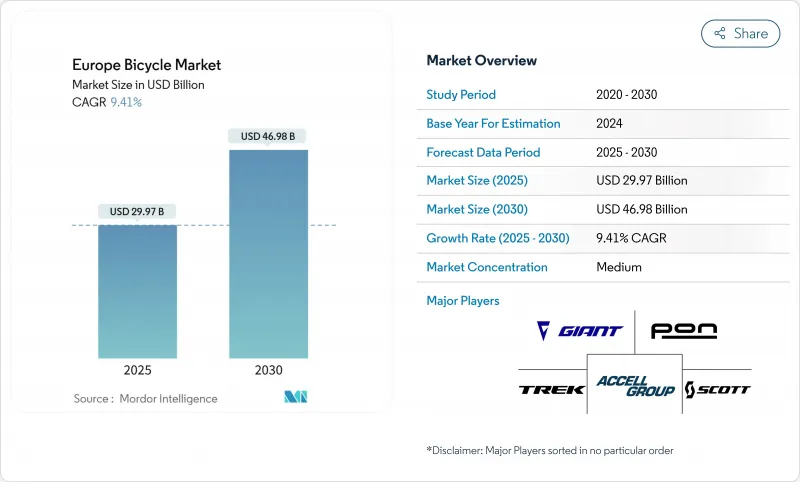
시장 확대의 원동력이 되고 있는 것은 지속 가능한 도시 이동성으로의 대륙의 시프트이며, 교통 혼잡이나 환경 문제에 대처하는 정부의 인프라 투자나 기업의 웰니스 프로그램에 의해 지지되고 있습니다. 소비자의 선호도는 특히 e-bike와 같은 프리미엄이며 특수한 부문으로 진화하고 있으며, 구매자는 고급 기능과 기술에 대한 투자 의욕을 보여줍니다. 게다가 피트니스와 레저 활동에서 자전거 이용 증가와 환경 의식의 고조가 함께, 자전거는 레크리에이션의 선택인 동시에 지속 가능한 교통 솔루션으로도 자리잡고 있습니다. 이 시장은 전통적인 오프라인 매장형 소매점, 자전거 전문점, 성장하는 온라인 판매 채널 등 견고한 유통망으로부터 혜택을 받고 있습니다. 게다가 자전거의 디자인, 소재, 제조 공정에 있어서의 혁신은 제품의 내구성과 성능을 계속 높여 캐주얼 라이더와 사이클링 애호가의 다양한 요구에 부응하고 있습니다.
유럽의 자전거 시장의 동향과 인사이트
도시에서의 교통 정체의 확대가 일상 통근에의 자전거 보급을 촉진
유럽 도시 지역의 교통 체증은 위기 수준에 도달했으며, 도시는 퍼스트 마일과 라스트 마일 연결을 위한 주요 솔루션으로 자전거를 채택하도록 촉구하고 있습니다. 유럽 위원회가 2025년 2월에 발표한 도시 모빌리티에 관한 전문가 그룹의 권고는 지속 가능한 도시 모빌리티 계획에서 사이클링 인프라의 정비를 강조합니다. 브뤼셀과 같은 도시는 2030년까지 자동차 교통량을 24% 줄이기 위한 'Good Move' 계획과 같은 노력을 통해 성공 사례를 보여줍니다. 자전거와 대중 교통의 통합은 교통망에 대한 압력을 줄이는 동시에 교통망의 도달 범위를 확대함으로써 효율적인 이점을 창출합니다. 행정구역이 도심부에서 가스 저배출 지역이나 자동차의 탑승 제한을 실시하고 있으며 주차 요금이나 정체 요금의 상승도 발생하여 사이클링은 경제적으로 유리하고, 도시의 모빌리티 시스템에 필요한 요소가 되고 있습니다. 종합적인 네트워크가 도입된 도시에서는 사이클링 인프라를 도입하여 대기의 질 개선과 소음 저감을 측정 가능한 형태로 보여주고 있습니다. 또한, 자전거 전용 도로나 안전한 자전거 주차장에 투자한 도시에서는 시민의 만족도가 향상되어, 자가용 차로부터 자전거로의 모달 시프트율이 높아진 것으로 나타났습니다.
건강 지향 증가와 피트니스 동향이 사이클링 활동을 촉진
팬데믹 후 건강 의식은 적극적인 교통 수단으로의 이동을 가속화하고 사이클링은 피트니스 활동 및 지속 가능한 통근 솔루션으로 지지를 모으고 있습니다. 기업의 복리후생 프로그램은 이 동향을 반영하여 자전거 보조금, 주행거리 환불, 사이클링 수당을 폭넓은 복리후생의 일환으로 제공합니다. 예를 들어, SAP는 자전거 및 e-bike 구매에 대한 금전적 인센티브와 구내 주차장 및 유지 보수 시설을 제공함으로써 직원의 자전거 통근을 지원합니다. 이러한 제도적 장려는 고급 자전거와 기어 수요를 불러 일으키고 시장에 새로운 가치 주도의 부문을 창출하고 있습니다. 동시에 도심부에서는 이 모달 시프트를 지원하기 위해 자전거 전용 도로나 안전한 보관고 등 사이클링 인프라에 대한 투자가 진행되고 있습니다. 예방 의료와 워크 라이프 밸런스를 중심으로 우선사항이 진화하고 있는 가운데, 특히 유럽의 대도시권에서는 사이클링이 현대의 라이프 스타일에 확실히 정착하고 있습니다. 사이클링이 일상생활에 녹아들면서, 제조업체 각사는 첨단 안전 기능부터 성능 향상 기술에 이르기까지 레크리에이션과 전문 사이클리스트 모두에 대응하는 혁신적인 제품의 개발에 주력하고 있습니다.
오토바이 및 고속 운송 시스템과 같은 대체 교통 수단이 자전거 보급률을 낮춤
유럽의 주요 도시에서는 광범위한 대중 교통망이 자전거 도입 경쟁을 창출하고 있습니다. 종합적인 고속 운송 시스템을 갖춘 도시는 통합 과제에 직면합니다. 자전거는 퍼스트 마일과 라스트 마일을 보완하는 솔루션이 아니라 보조금이 나오는 대중 교통과 경쟁하는 경우가 많기 때문입니다. 남유럽 시장에서는 오토바이와 스쿠터의 쉐어링 서비스가 인기를 얻고 있으며, 이는 사이클링 중 육체적 노동과 날씨에 노출되는 것을 우려하는 소비자를 끌어들이고 있습니다. 서비스형 모빌리티 통합 플랫폼의 출현은 사이클링이 단독 옵션이 아니라 종합적인 교통 솔루션의 일부가 될 가능성을 제시합니다. 교통 당국은 기차역의 안전한 주차장, 열차 내 자전거 전용 객실 등 자전거와 대중교통의 원활한 전환을 가능하게 하는 인프라 정비에 임하고 있습니다. 지자체는 또한 통합된 결제 시스템과 연계된 경로 계획 용도를 통해 멀티모달 교통의 통합을 촉진하는 정책을 시행하고 있습니다.
부문 분석
전기 자전거 부문은 2024년 시장 점유율에서 48.76%를 차지하였고 2030년까지 연평균 복합 성장률(CAGR)은 11.01%로 확대될 것으로 예측됩니다. 이 시장의 리더 지위는 특히 도시 교통에서 전동 어시스트 자전거가 언덕길, 거리, 체력 등 일반적인 사이클링의 문제에 효과적으로 대처하면서 주류로 받아들여지고 있기 때문입니다. 첨단 배터리 기술과 모터 효율 향상으로 e-bike의 신뢰성과 일상적인 사용에 있어서의 비용 효율성이 향상되었습니다. 환경적 이점에 대한 소비자의 의식과 지속 가능한 운송 솔루션에 대한 정부의 인센티브는 다양한 계층에서 전기자전거의 보급을 더욱 가속화하고 있습니다.
산악 자전거/전지형 대응 자전거와 도로 자전거/시티 사이클은 각각 레크리에이션과 전통적인 통근 분야에서 확립된 지위를 유지하고 있지만, 대두하는 e-bike 카테고리와의 경쟁은 점점 치열해지고 있습니다. 하이브리드 자전거는 범용성과 균형잡힌 성능을 선호하는 소비자에게 계속 어필하고 있으며, 전동 시스템과 같은 복잡성과 비용 없이 다목적 기능을 제공합니다. 이러한 전통적인 자전거 카테고리의 뿌리 깊은 인기는 유지 보수의 필요성이 낮고 피트니스 지향 소비자에게 어필할 수 있다는 사실에 의해 뒷받침됩니다. 또한 경량 소재와 컴포넌트 기술의 향상이 이러한 기존 부문의 승차감을 향상시키고 있습니다.
일반 자전거는 2024년에 86.56%의 점유율을 획득하여 시장 우위를 유지했습니다. 소비자는 대부분의 자전거 응용 분야에서 입증된 성능, 장기 내구성 및 비용 효율성에서 일관적으로 전통적인 자전거 형태를 선택하기 때문입니다. 예비 부품이 널리 이용 가능하고 서비스 네트워크가 확립되어 있는 것도, 특히 사이클링 인프라가 발달하고 있는 지역에서는 기존 자전거의 매력을 한층 더 높이고 있습니다. 기존 자전거가 시장에서 확고한 지위를 유지하고 있는 한편, 접이식 자전거 분야는 힌지 기구의 혁신과, 중량에 관한 우려를 최소한으로 억제하면서 과거의 성능 한계에 잘 대처한 선진 프레임 소재에 의해 2030년까지의 CAGR이 10.44%로 예측되어 큰 성장의 가능성을 나타냅니다.
유럽 주요 도시의 인구 밀도 증가와 제한된 거주 공간은 접이식 자전거 수요를 계속 추진하고 있습니다. 이러한 다용도 자전거는 공간 효율적인 이동 수단과 편리한 보관 솔루션을 아파트 거주자에게 제공하여 야외 주차와 관련된 도난과 날씨로 인한 손상의 걱정을 해소하기 때문입니다. 접이식 기구와 전동 어시스트 자전거 기술의 통합이 성공하면서 컴팩트한 수납 능력과 주행 거리의 연장을 모두 요구하는 도시의 통근자에게 특히 어필하는 프리미엄 시장 부문이 확립되어, 접이식 자전거 카테고리의 성장 궤도가 강화되었습니다. 이 동향은 지속 가능한 대체 교통수단을 촉진하는 지자체의 정책과 자전거로의 이동과 대중교통을 병용하는 복합 통근의 채용이 증가하고 있는 것도 뒷받침하고 있습니다.
기타 혜택
- 엑셀 형식 시장 예측(ME) 시트
- 3개월간의 애널리스트 서포트
목차
제1장 서론
- 조사의 전제조건과 시장의 정의
- 조사 범위
제2장 조사 방법
제3장 주요 요약
제4장 시장 상황
- 시장 개요
- 시장 성장 촉진요인
- 도시의 교통 정체의 확대가 일상적인 통근에 자전거를 보급시킴
- 건강 지향의 고조와 피트니스 동향이 사이클링 활동을 가속화함
- 정부의 이니셔티브의 고조가 지속 가능한 교통 수단의 도입을 촉진
- 환경 의식의 고조와 지속가능성에 대한 주목이 자전거 보급을 뒷받침
- 기업의 웰니스 프로그램 실시가 직원의 자전거 이용을 촉진
- 연료비의 상승으로 자전거가 경제적인 교통 수단의 선택지로 등장함
- 시장 성장 억제요인
- 이륜차나 고속철도 등의 대체 교통수단이 자전거 보급률을 저하시킴
- 가짜 자전거의 만연이 시장 확대에 악영향을 끼침
- 전동 어시스트 자전거의 가격 상승이 각 지역에서의 소비자 보급을 저해함
- 지방의 불충분한 도로 인프라가 자전거의 승차감에 영향을 끼침
- 규제 상황
- 기술적 진보
- Porter's Five Forces
- 신규 참가업체의 위협
- 구매자의 협상력
- 공급기업의 협상력
- 대체품의 위협
- 경쟁 기업간 경쟁 관계
제5장 시장 규모와 성장 예측
- 제품 유형별
- 도로/도시형
- 산악/전지형
- 하이브리드
- 전동 자전거
- 기타 유형
- 설계별
- 일반
- 접이식
- 최종 사용자별
- 남성
- 여성
- 어린이
- 유통 채널별
- 오프라인 소매점
- 온라인 소매점
- 지역별
- 독일
- 영국
- 이탈리아
- 프랑스
- 스페인
- 네덜란드
- 폴란드
- 벨기에
- 스웨덴
- 기타 유럽
제6장 경쟁 구도
- 시장 집중도
- 전략적 동향
- 시장 점유율 분석
- 기업 프로파일
- Trek Bicycle Corporation
- Accell Group NV
- Giant Manufacturing Co. Ltd
- Pon Holdings BV
- Scott Sports SA
- Decathlon SA
- Merida Industry Co. Ltd
- Pending System GmbH & Co. KG
- Canyon Bicycles GmbH
- Riese & Muller GmbH
- Orbea S. Coop.
- ZEG Zweirad-Einkaufs-Genossenschaft eG
- myStromer AG
- KTM Fahrrad GmbH
- Brompton Bicycle Ltd
- VanMoof
- Specialized Bicycle Components Inc.
- Cycles Follis
- Cycleurope AB
- Simplon Fahrrad GmbH
제7장 시장 기회와 미래 전망
CSM 25.11.20The Europe bicycle market, valued at USD 29.97 billion in 2025, is expected to reach USD 46.98 billion by 2030, growing at a CAGR of 9.41%.
The market's expansion is driven by the continent's shift toward sustainable urban mobility, supported by government infrastructure investments and corporate wellness programs addressing traffic congestion and environmental concerns. Consumer preferences are evolving toward premium and specialized segments, particularly in e-bikes, where buyers demonstrate willingness to invest in advanced features and technology. Additionally, the increasing adoption of cycling for fitness and leisure activities, combined with growing environmental consciousness, positions bicycles as both a recreational choice and a sustainable transportation solution. The market benefits from a robust distribution network, encompassing traditional brick-and-mortar retailers, specialized bicycle shops, and growing online sales channels. Furthermore, innovations in bicycle design, materials, and manufacturing processes continue to enhance product durability and performance, meeting the diverse needs of both casual riders and cycling enthusiasts.
Europe Bicycle Market Trends and Insights
Growing Traffic Congestion in Cities Drives Adoption of Bicycles for Daily Commuting
Urban congestion in European metropolitan areas has reached critical levels, prompting cities to adopt cycling as a primary solution for first- and last-mile connectivity. The European Commission's Expert Group on Urban Mobility recommendations in February 2025 emphasize cycling infrastructure development within Sustainable Urban Mobility Plans . Cities like Brussels demonstrate successful implementation through initiatives such as the Good Move plan, which aims to reduce car traffic by 24% by 2030 . The integration of cycling with public transport systems creates efficiency gains by reducing pressure on transit networks while extending their reach. As municipalities implement low-emission zones and car access restrictions in city centers, coupled with rising parking costs and congestion charges, cycling has become both an economically advantageous and necessary component of urban mobility systems. The adoption of cycling infrastructure has shown measurable improvements in air quality and noise reduction in urban areas where comprehensive networks have been implemented. Additionally, cities that have invested in dedicated cycling lanes and secure bicycle parking facilities report increased citizen satisfaction and higher rates of modal shift from private vehicles to bicycles.
Rising Health Consciousness and Fitness Trends Accelerate Cycling Activities
Post-pandemic health awareness has accelerated the shift toward active transportation, with cycling gaining traction as both a fitness activity and a sustainable commuting solution. Corporate wellness programs increasingly reflect this trend by offering bike subsidies, mileage reimbursements, and cycling allowances as part of broader employee benefits. For example, SAP supports employee cycling through financial incentives for purchasing bicycles and e-bikes, as well as providing on-site parking and maintenance facilities. This institutional encouragement has fueled demand for premium bicycles and gear, creating new value-driven segments in the market. Simultaneously, urban centers are investing in cycling infrastructure, such as dedicated bike lanes and secure storage, to support this modal shift. As priorities continue to evolve around preventive healthcare and work-life balance, cycling is becoming firmly embedded in the modern lifestyle, particularly in Europe's metropolitan areas. The integration of cycling into daily routines has also prompted manufacturers to develop innovative products that cater to both recreational and professional cyclists, from advanced safety features to performance-enhancing technologies.
Alternative Transportation Options Such as Motorcycles and Rapid Transit Systems Reduce Bicycle Adoption Rates
The extensive public transport networks in major European cities create competition for bicycle adoption, particularly where metro and bus systems provide faster travel times and protection from weather during longer commutes. Cities with comprehensive rapid transit systems face integration challenges, as cycling often competes with subsidized public transport instead of serving as a complementary first-and-last-mile solution. In Southern European markets, motorcycle and scooter sharing services have gained popularity by offering motorized transport that attracts consumers concerned about physical effort and weather exposure while cycling. The emergence of integrated mobility-as-a-service platforms presents opportunities for cycling to become part of comprehensive transport solutions rather than a standalone option. Transportation authorities are working to develop infrastructure that enables seamless transitions between cycling and public transit through secure bike parking facilities at stations and bike-friendly carriages on trains. Municipal governments are also implementing policies to encourage multimodal transport integration through unified payment systems and coordinated route planning applications.
Other drivers and restraints analyzed in the detailed report include:
- Increasing Government Initiatives Promote Adoption of Sustainable Transportation
- Growing Environmental Awareness and Focus on Sustainability Boost Bicycle Adoption
- Proliferation of Fake Bicycle Products Negatively Impacts Market Expansion
For complete list of drivers and restraints, kindly check the Table Of Contents.
Segment Analysis
The electric bicycle segment commands a dominant 48.76% market share in 2024 and is expected to expand at a CAGR of 11.01% through 2030. This market leadership position is driven by increasing mainstream acceptance, especially in urban transportation where electric assistance effectively addresses common cycling barriers like hills, distance, and physical effort. The integration of advanced battery technology and improved motor efficiency has made e-bikes more reliable and cost-effective for daily use. Consumer awareness of environmental benefits and government incentives for sustainable transportation solutions further accelerate e-bike adoption across various demographics.
Mountain/All-Terrain and Road/City bicycles maintain their established positions in recreational and traditional commuting segments respectively, though they increasingly compete with the rising e-bike category. Hybrid bicycles continue to appeal to consumers who prioritize versatility and balanced performance, offering multi-purpose functionality without the additional complexity and cost of electric systems. The enduring popularity of these conventional bicycle categories is supported by their lower maintenance requirements and appeal to fitness-oriented consumers. Additionally, improvements in lightweight materials and component technology enhance the riding experience across these traditional segments.
Regular bicycles maintain their market dominance with an 86.56% share in 2024, as consumers consistently choose traditional bicycle formats for their proven performance, long-term durability, and cost-effectiveness across most cycling applications. The widespread availability of spare parts and established service networks further reinforces the appeal of traditional bikes, particularly in regions with well-developed cycling infrastructure. While conventional bikes retain their strong market position, the folding bike segment demonstrates significant growth potential with a projected CAGR of 10.44% through 2030, driven by innovations in hinge mechanisms and advanced frame materials that successfully address historical performance limitations while minimizing weight concerns.
The rising urban population density and limited living spaces in major European cities continue to fuel the demand for folding bikes, as these versatile vehicles provide space-efficient transportation and convenient storage solutions for apartment dwellers, eliminating worries about theft and weather damage associated with outdoor parking. The successful integration of folding mechanisms with electric bike technology has established a premium market segment that particularly appeals to urban commuters seeking both compact storage capabilities and extended travel range, strengthening the growth trajectory of the folding bike category. This trend is further supported by municipal policies promoting sustainable transportation alternatives and the increasing adoption of mixed-mode commuting, where cyclists combine bike travel with public transit.
The Europe Bicycle Market Report is Segmented by Product Type (Road/City, Mountain/All-Terrain, Hybrid, E-Bicycle, and Other Types), Design (Regular and Folding), End User (Men, Women and Children), Distribution Channel (Offline Retail Stores and Online Retail Stores), and Geography (Germany, United Kingdom, Italy, and More). The Market Forecasts are Provided in Terms of Value (USD).
List of Companies Covered in this Report:
- Trek Bicycle Corporation
- Accell Group NV
- Giant Manufacturing Co. Ltd
- Pon Holdings BV
- Scott Sports SA
- Decathlon SA
- Merida Industry Co. Ltd
- Pending System GmbH & Co. KG
- Canyon Bicycles GmbH
- Riese & Muller GmbH
- Orbea S. Coop.
- ZEG Zweirad-Einkaufs-Genossenschaft eG)
- myStromer AG
- KTM Fahrrad GmbH
- Brompton Bicycle Ltd
- VanMoof
- Specialized Bicycle Components Inc.
- Cycles Follis
- Cycleurope AB
- Simplon Fahrrad GmbH
Additional Benefits:
- The market estimate (ME) sheet in Excel format
- 3 months of analyst support
TABLE OF CONTENTS
1 INTRODUCTION
- 1.1 Study Assumptions and Market Definition
- 1.2 Scope of the Study
2 RESEARCH METHODOLOGY
3 EXECUTIVE SUMMARY
4 MARKET LANDSCAPE
- 4.1 Market Overview
- 4.2 Market Drivers
- 4.2.1 Growing Traffic Congestion in Cities Drives Adoption of Bicycles for Daily Commuting
- 4.2.2 Rising Health Consciousness and Fitness Trends Accelerate Cycling Activities
- 4.2.3 Increasing Government Initiatives Promote Adoption of Sustainable Transportation
- 4.2.4 Growing Environmental Awareness and Focus on Sustainability Boost Bicycle Adoption
- 4.2.5 Implementation Of Corporate Wellness Programs Promotes Bicycle Usage Among Employees
- 4.2.6 Escalating Fuel Costs Make Bicycles an Economical Transportation Choice
- 4.3 Market Restraints
- 4.3.1 Alternative Transportation Options Such as Motorcycles and Rapid Transit Systems Reduce Bicycle Adoption Rates
- 4.3.2 Proliferation of Fake Bicycle Products Negatively Impacts Market Expansion
- 4.3.3 Elevated Prices of Electric Bicycles Limit Widespread Consumer Acceptance Across Regions
- 4.3.4 Inadequate Road Infrastructure in Rural Regions Affects Bicycle Riding Experience
- 4.4 Regulatory Landscape
- 4.5 Technological Advancements
- 4.6 Porter's Five Forces
- 4.6.1 Threat of New Entrants
- 4.6.2 Bargaining Power of Buyers
- 4.6.3 Bargaining Power of Suppliers
- 4.6.4 Threat of Substitute Products
- 4.6.5 Intensity of Competitive Rivalry
5 MARKET SIZE AND GROWTH FORECASTS (VALUE)
- 5.1 By Product Type
- 5.1.1 Road/City
- 5.1.2 Mountain/All-Terrain
- 5.1.3 Hybrid
- 5.1.4 E-Bicycle
- 5.1.5 Other Types
- 5.2 By Design
- 5.2.1 Regular
- 5.2.2 Folding
- 5.3 By End-User
- 5.3.1 Men
- 5.3.2 Women
- 5.3.3 Children
- 5.4 By Distribution Channel
- 5.4.1 Offline Retail Stores
- 5.4.2 Online Retail Stores
- 5.5 By Geography
- 5.5.1 Germany
- 5.5.2 United Kingdom
- 5.5.3 Italy
- 5.5.4 France
- 5.5.5 Spain
- 5.5.6 Netherlands
- 5.5.7 Poland
- 5.5.8 Belgium
- 5.5.9 Sweden
- 5.5.10 Rest of Europe
6 COMPETITIVE LANDSCAPE
- 6.1 Market Concentration
- 6.2 Strategic Moves
- 6.3 Market Share Analysis
- 6.4 Company Profiles (includes Global level Overview, Market level overview, Core Segments, Financials as available, Strategic Information, Market Rank/Share for key companies, Products and Services, and Recent Developments)
- 6.4.1 Trek Bicycle Corporation
- 6.4.2 Accell Group NV
- 6.4.3 Giant Manufacturing Co. Ltd
- 6.4.4 Pon Holdings BV
- 6.4.5 Scott Sports SA
- 6.4.6 Decathlon SA
- 6.4.7 Merida Industry Co. Ltd
- 6.4.8 Pending System GmbH & Co. KG
- 6.4.9 Canyon Bicycles GmbH
- 6.4.10 Riese & Muller GmbH
- 6.4.11 Orbea S. Coop.
- 6.4.12 ZEG Zweirad-Einkaufs-Genossenschaft eG)
- 6.4.13 myStromer AG
- 6.4.14 KTM Fahrrad GmbH
- 6.4.15 Brompton Bicycle Ltd
- 6.4.16 VanMoof
- 6.4.17 Specialized Bicycle Components Inc.
- 6.4.18 Cycles Follis
- 6.4.19 Cycleurope AB
- 6.4.20 Simplon Fahrrad GmbH