|
시장보고서
상품코드
1851118
증기 오토클레이브 시장 : 시장 점유율 분석, 산업 동향, 통계, 성장 예측(2025-2030년)Steam Autoclaves - Market Share Analysis, Industry Trends & Statistics, Growth Forecasts (2025 - 2030) |
||||||
 Mordor Intelligence
증기 오토클레이브 시장은 2025년에 26억 5,000만 달러로 추정되고, 2030년에는 39억 2,000만 달러에 이를 것으로 예측되며, CAGR 8.12%로 성장할 전망입니다.
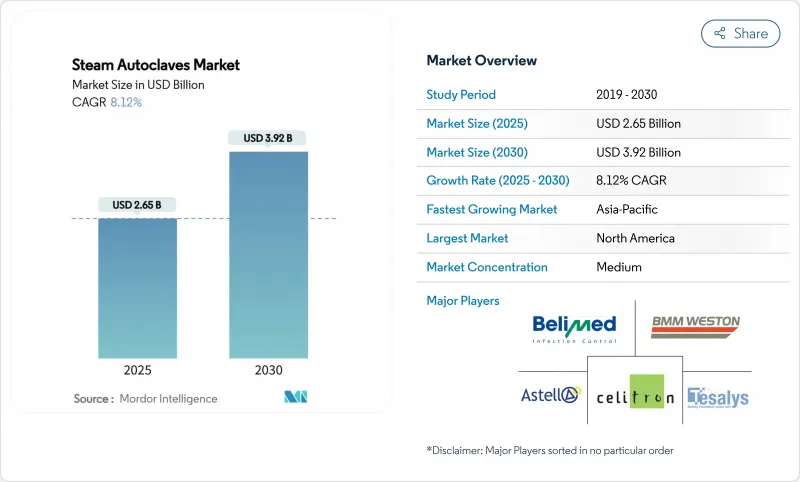
감염 관리 요건 증가, 산화에틸렌의 배출 규제 강화, 의료 관련 감염 억제의 긴급성 고조에 따라, 의료 시스템이 비용과 지속가능성의 트레이드 오프를 고려하면서도 증기 멸균에 대한 설비 투자는 견조하게 추진하고 있습니다. 북미 병원은 인증 주기에 따라 시설을 계속 업데이트하고 있으며, 아시아태평양 의료기관은 인프라 확장 및 의료기기 제조 성장에 대응하여 최초 도입을 가속화하고 있습니다. 미국 FDA가 품질 시스템 규칙을 ISO 13485와 일치시키거나 EU의 GMP Annex 1이 업데이트되는 등 규제 시프트는 검증 및 기록 관리를 자동화하는 디지털 연결 장치를 지원하며 프리미엄 부문 수요에 박차를 가하고 있습니다. 동시에, 공급업체는 물과 전력의 사용을 억제하기 위해 챔버와 사이클을 재설계하고 있으며, 멸균 효과를 손상시키지 않고 탈탄소화 목표를 달성하려고 하는 구매자에게 호소하고 있습니다.
세계의 증기 오토클레이브 시장 동향 및 인사이트
원내 감염 증가
세계의 헬스케어에서는 입원 환자의 약 31명 중 1명이 적어도 1건의 의료 관련 감염을 앓고 있으며, 내성균을 근절하는 신뢰할 수 있는 증기 사이클에 대한 투자가 계속되고 있습니다. CDC는 2022-2023년 MRSA와 CLABSI의 발생률이 2자리 감소했다고 지적하고 있지만, 관리자는 예방이 치료보다 저렴하다는 것에 변함이 없고, 외과, 중증 환자, 이식병동의 신축 및 갱신 수요가 그대로 유지되고 있다는 것을 인식하고 있습니다. 증기 오토클레이브는 화학물질을 잔류시키지 않고 신속하고 재현 가능한 치사성을 제공함으로써 수술실의 턴어라운드 및 환경, 위생, 안전 정책에 합치합니다. 따라서 공급업체는 자동 사이클 추적을 위한 IoT 센서를 통합하여 감염 관리 팀이 실시간으로 부하를 감사하고 위반이 확대되기 전에 시정 조치를 시행할 수 있도록 합니다. 이 기능은 다양한 장비 세트가 다른 매개변수를 필요로 하지만 엄격한 CoC 문서화를 필요로 하는 3차 의료 센터에서 가장 반향을 불러옵니다.
엄격한 감염 관리 및 인증 기준
FDA에 의한 2025년 21 CFR 880.6880의 갱신은 증기 오토클레이브에서 통합 모니터링과 전자 기록의 필요성을 공식적으로 규정하고 자동 데이터 내보내기가 없는 레거시 장비를 단계적으로 폐지하도록 시설에 촉구하고 있습니다. 유럽에서는 부속서 1이 오염 제어 전략과 품질 리스크 관리를 명확히 강조하고 있으며, 많은 의료 기관은 폐쇄형 루프 센서와 유효 누설률 테스트를 갖춘 오토클레이브를 도입함으로써 이를 충족합니다. 2024년 후반에 발행된 CDC 지침은 주당 1회의 생물학적 모니터링을 의무화하고 있지만, 이 요구사항은 내장 프린트 아웃 및 클라우드 보고서를 제공하는 거치형 장비로 쉽게 충족될 수 있습니다. 캐나다, 일본, 호주에서도 유사한 규제가 있으며, 감사 추적을 통일할 수 있는 디지털 네이티브 플랫폼이 세계적으로 요구되고 있습니다. 그 결과, 조달 주기는 지역 횡단 규제 팀과 장비의 15년의 서비스 수명에 걸쳐 컴플라이언스를 유지하는 설치 후 서비스 네트워크를 가진 제조업체에게 유리합니다.
대형 장비의 높은 자본 비용 및 유지 보수 비용
바닥에 설치된 양문 오토클레이브의 정가는 전기, 증기, 수도 유틸리티를 위한 사이트 업그레이드를 제외하고는 25만 달러를 초과할 수도 있으며, 자원이 부족한 공립 병원에 있어서는 장애물이 됩니다. 개스킷 교체부터 챔버 재검사에 이르기까지 연간 유지비는 경상적인 비용이 되므로 라틴아메리카, 중동 및 동남아시아의 여러 시설에서 구매를 연기하거나 재처리 아웃소싱을 선택합니다. 에너지와 물의 데이터는 예산 조직을 더욱 복잡하게 만듭니다. 400리터의 재킷이 있는 유닛 1대에서 사이클당 60갤런을 소비할 수 있으며, 공급자가 스코프 1과 스코프 2의 배출량을 추적하는 중 지속가능성의 과제가 됩니다. 공급업체는 모듈식 챔버 설계 및 열회수 시스템을 지원하지만 투자 회수 기간은 여전히 길고 가격에 민감한 지역에서의 확산을 억제합니다.
부문 분석
세로형 유닛은 2024년 증기 오토클레이브 시장 점유율의 42.35%를 차지했으며, 좁은 설치 면적과 인체공학을 기반으로 탑 로딩을 중시하는 극장이나 연구실에서 인기가 확인되었습니다. 유럽과 인도에서는 2차 병원 개보수가 증가하고 있으며, 이 세로 챔버는 대규모 배관 공사 없이 가운, 핸드피스, 배지를 멸균하기 때문에 기준 수요를 유지하고 있습니다. 이와는 대조적으로, 거치형은 2030년까지 연평균 복합 성장률(CAGR)이 10.25%로 성장할 것으로 예측되며, 이는 기구의 턴어라운드를 단축하기 위해 포인트 오브 케어 멸균을 도입하는 외래 센터에 의해 촉진됩니다. CDC의 2024년 치과 의료 지침은 주당 1회의 생물학적 모니터링이 강화되어 각 사이클을 기록하는 자동 탁상 스팀 유닛으로 노후화된 가열 전용 멸균기를 대체하도록 클리닉에 장려하고 있습니다.
제조업체는 사이클의 다양성과 직감성에 의해 차별화를 도모하고 있습니다. 터치스크린 HMI, 사전 프로그래밍된 조명장치 사이클, 클라우드 통합이 표준이 되어 옵션 절수 키트와 HEPA 배기 필터가 지속가능성을 높이고 있습니다. 가로형 바닥거치형 유닛은 여전히 높은 처리량의 중앙 무균 부문을 지원하지만, 공간의 제약과 취득 및 유지 비용과 관련된 CAGR 마이너스 1.3%의 족쇄에 의해 그 도입은 억제되고 있습니다. 그럼에도 불구하고 등을 맞추는 인공 관절 치환술을 실시하는 정형외과 센터는 대형 트레이를 처리할 수 있는 600리터 용기의 발주를 계속해, 이 틈새 분야를 치환으로부터 지키려고 하고 있습니다.
중력 대체 공정은 간편성, 저자본 비용, 최소 유지보수로 2024년 증기 오토클레이브 시장 규모의 46.53%를 차지했습니다. 소규모 클리닉의 경우, 특히 예산적으로 진공 펌프를 사용할 수 없는 경우 중력 사이클은 고체 기구와 액체 매체에 적합합니다. 그러나 수술 기구의 복잡화로 인해 CAGR 10.85%를 선도하는 프리 진공 시스템으로의 시프트가 진행되고 있습니다. 이 고진공 장치는 일련의 음의 펄스를 통해 공기를 흡입하여 스팀이 루멘과 다공성 랩에 확실하게 침투하도록 합니다.
스팀 플래시 압력 펄스(SFPP) 챔버는 고속 턴어라운드가 필요한 실험실에 대응하며 고에너지 진공 펌프를 사용하지 않고 25분 이내에 부하를 순환시킵니다. 한편, 패스스루의 더블 도어 설계는 많은 GMP 제조실의 규제 요건인 더티 존과 클린 존 사이의 단방향 워크플로우를 지원합니다. 벤더는 패시브 열회수와 재킷 단열을 거듭하여 광열비를 최대 25% 삭감함으로써 녹색 조달 지표와 사전 진공 설치 라이프사이클 비용의 정당화를 목표로 하고 있습니다.
지역 분석
북미는 성숙한 교환 사이클, 고급 인증 요건, IoT 대응 멸균 스위트의 급속한 채용으로 2024년 34.82%의 최대 매출 점유율을 유지했습니다. 병원은 중앙 무균 추적 플랫폼과 통합된 에너지 효율적인 고진공 오토클레이브로 레거시 중력 장치를 계속 교체하고 있습니다. 지속가능한 인프라에 대한 연방정부의 우대조치도 공급자를 절수형 모델로 향하게 하여 총 소유 비용에 대한 우려를 완화하고 있습니다.
유럽은 의료기기 규제에 대한 대응과 Brexit과 관련된 공급 중단이라는 두 가지 부담을 직면하고 있습니다. 부속서 1과 일치 표준은 수동 문서화를 규제하고 자동 로드 릴리스와 Wi-Fi 감사 추적을 갖춘 기계로 업그레이드를 추진하고 있습니다. 독일, 프랑스, 북유럽 국가들이 대체를 이끌고 있지만, 동유럽 시장은 여전히 재생품 수입에 의존하고 있습니다.
아시아태평양은 가장 급속히 확대된 지역으로, 2030년까지 연평균 복합 성장률(CAGR)은 11.61%로 예측됩니다. 중국과 인도에서는 병원 건설이 활발해 국내 장비 생산도 증가하고 있기 때문에 대형 센트럴 유닛과 휴대용 필드 모델 모두에 대한 수요가 높아지고 있습니다. 동남아시아의 정부 보조에 의한 의료보험제도는 감염 제어 벤치마크를 충족하도록 진료소를 더욱 자극합니다. 한편 중동 및 아프리카, 남미에서는 민간업자가 3차센터와 전문클리닉을 개설하고 있어 꾸준한 도입을 볼 수 있지만, 환율 변동 및 수입 관세가 일부 경제권에서 페이스를 억제하고 있습니다.
기타 혜택 :
- 엑셀 형식 시장 예측(ME) 시트
- 3개월간의 애널리스트 서포트
목차
제1장 서론
- 조사의 전제조건 및 시장 정의
- 조사 범위
제2장 조사 방법
제3장 주요 요약
제4장 시장 상황
- 시장 개요
- 시장 성장 촉진요인
- 원내 감염 증가
- 엄격한 감염 관리 및 인증 기준
- 바이오하자드 및 의료 폐기물 관리 요구 증가
- 외래의 포인트 오브 유스 멸균으로의 시프트
- 에너지 효율이 높은 그린 오토클레이브의 출현
- 원격 사이클 검증 및 컴플라이언스를 위한 Iot 센서 통합
- 시장 성장 억제요인
- 대형 유닛의 높은 자본 비용 및 유지 보수 비용
- 일회용 단회 사용 기구의 채용 확대
- 자원이 부족한 진료소에서 스페이스 및 유틸리티의 제약
- 복잡한 적격성 평가 및 재밸리데이션 문서 부담
- Porter's Five Forces
- 공급기업의 협상력
- 구매자의 협상력
- 신규 참가업체의 위협
- 대체품의 위협
- 경쟁 기업 간 경쟁 관계
제5장 시장 규모 및 성장 예측
- 제품 유형별
- 세로축 증기 오토클레이브
- 가로측 증기 오토클레이브
- 거치형 및 벤치탑형 오토클레이브
- 대용량 바닥거치형 오토 클레이브
- 멸균 기술별
- 중력 변위
- 프리 진공(고진공)
- 스팀 플래시 및 압력 펄스(SFPP)
- 더블 도어 패스 스루
- 모빌리티별
- 고정 및 바닥 거치형
- 휴대용
- 최종 사용자별
- 병원 및 클리닉
- 제약 및 바이오테크놀러지 기업
- 조사 및 학술기관
- 치과 시설
- 동물병원
- 멸균 서비스 계약 제공업체
- 지역별
- 북미
- 미국
- 캐나다
- 멕시코
- 유럽
- 독일
- 영국
- 프랑스
- 이탈리아
- 스페인
- 기타 유럽
- 아시아태평양
- 중국
- 일본
- 인도
- 한국
- 호주
- 기타 아시아태평양
- 중동 및 아프리카
- GCC
- 남아프리카
- 기타 중동 및 아프리카
- 남미
- 브라질
- 아르헨티나
- 기타 남미
- 북미
제6장 경쟁 구도
- 시장 집중도
- 시장 점유율 분석
- 기업 프로파일
- Getinge AB
- STERIS plc
- Tuttnauer Ltd.
- Steelco SpA(Miele Group)
- Shinva Medical Instrument Co. Ltd.
- Astell Scientific Ltd.
- Belimed AG
- MELAG Medizintechnik GmbH & Co. KG
- Celitron Medical Technologies
- Consolidated Sterilizer Systems
- Midmark Corporation
- SciCan Ltd.(Coltene)
- Matachana Group
- BMM Weston Ltd.
- Rodwell Engineering Group Ltd.
- Priorclave Ltd.
- TESALYS Group
- Hirayama Manufacturing Corporation
- Dental X
- Steriflow SAS
- LTE Scientific Ltd.
제7장 시장 기회 및 향후 전망
AJY 25.11.12The steam autoclaves market stood at USD 2.65 billion in 2025 and is on course to reach USD 3.92 billion by 2030, advancing at an 8.12% CAGR.
Rising infection-control requirements, tightening emissions rules for ethylene oxide, and the growing urgency to contain healthcare-associated infections are keeping capital expenditure on steam sterilization resilient, even as health systems weigh cost and sustainability trade-offs. North American hospitals continue to refresh their fleets in line with accreditation cycles, while Asia-Pacific providers accelerate first-time installations in response to infrastructure expansion and medical device manufacturing growth. Regulatory shifts-such as the U.S. FDA's alignment of quality system rules with ISO 13485 and the EU's GMP Annex 1 update-favour digitally connected units that automate validation and record-keeping, spurring premium segment demand. Concurrently, vendors are redesigning chambers and cycles to curb water and power usage, appealing to buyers intent on meeting decarbonisation targets without compromising sterilisation efficacy.
Global Steam Autoclaves Market Trends and Insights
Rising Prevalence of Hospital-Acquired Infections
Hospitals worldwide still record roughly 1 in 31 inpatients with at least one healthcare-associated infection, sustaining investment in reliable steam cycles that eradicate resistant organisms. Although the CDC noted double-digit declines in MRSA and CLABSI rates between 2022 and 2023, administrators recognise that prevention remains cheaper than treatment, keeping new-build and replacement demand intact across surgical, critical-care and transplant units. Steam autoclaves deliver rapid, reproducible lethality without chemical residuals, aligning with operating-room turnaround imperatives and environmental, health and safety policies. Suppliers are therefore embedding IoT sensors for automatic cycle tracking, enabling infection-control teams to audit loads in real time and trigger corrective action before breaches escalate. This capability resonates most in tertiary centres where diverse instrument sets require differentiated parameters yet strict chain-of-custody documentation.
Stringent Infection-Control & Accreditation Norms
The FDA's 2025 update to 21 CFR 880.6880 formalised the need for integrated monitoring and electronic records in steam sterilizers, pushing facilities to phase out legacy equipment lacking automated data export. In Europe, Annex 1 places explicit emphasis on contamination-control strategies and quality-risk management that many providers meet by deploying autoclaves with closed-loop sensors and validated leak-rate testing. Dental practices face comparable scrutiny; CDC guidance issued in late 2024 mandates weekly biological monitoring, a requirement easier to satisfy with benchtop units offering built-in printouts or cloud reporting. Comparable regimes in Canada, Japan and Australia mirror these expectations, creating a coordinated global pull for digitally native platforms capable of harmonised audit trails. Resulting procurement cycles favour manufacturers with cross-regional regulatory teams and post-installation service networks that sustain compliance across a device's 15-year life.
High Capital & Maintenance Costs of Large Units
Floor-standing, double-door autoclaves can command list prices above USD 250,000, excluding site upgrades for electrical, steam and water utilities, a hurdle for resource-strained public hospitals. Annual upkeep-ranging from gasket replacement to chamber re-qualification-adds recurring cost, prompting many facilities in Latin America, the Middle East and parts of Southeast Asia to defer purchases or opt for outsourced reprocessing. Energy and water data further complicate budgeting: a single 400-litre jacketed unit may consume 60 gallons per cycle, challenging sustainability pledges as providers track Scope 1 and Scope 2 emissions. Vendors respond with modular chamber designs and heat-recovery systems, yet payback periods remain lengthy, restraining uptake in price-sensitive territories.
Other drivers and restraints analyzed in the detailed report include:
- Growing Need to Manage Bio-Hazardous Medical Waste
- Shift Toward Point-of-Use Sterilisation in Ambulatory Settings
- Growing Adoption of Disposable Single-Use Instruments
For complete list of drivers and restraints, kindly check the Table Of Contents.
Segment Analysis
Vertical units accounted for 42.35% of steam autoclaves market share in 2024, confirming their popularity in theatres and labs that value narrow footprints and ergonomic top loading. Rising refurbishment of secondary hospitals in Europe and India maintains baseline demand, as these vertical chambers sterilise gowns, handpieces and culture media without extensive plumbing. Table-top models, in contrast, are set to post a 10.25% CAGR through 2030, fuelled by ambulatory centres installing point-of-care sterilisation to shorten instrument turnaround. The CDC's 2024 dental guidance reinforced weekly biological monitoring, encouraging clinics to replace ageing heat-only sterilisers with automated benchtop steam units that document each cycle.
Manufacturers differentiate through cycle versatility and intuitiveness. Touch-screen HMIs, pre-programmed lumened-device cycles and cloud integration have become standard, while optional water-savings kits and HEPA exhaust filters add sustainability. Horizontal floor-standing units still underpin high-throughput central sterile departments, yet their uptake is tempered by space constraints and the -1.3% CAGR drag associated with acquisition and maintenance costs. Nonetheless, orthopaedic centres performing back-to-back joint replacements will continue ordering 600-litre chambers capable of handling large trays, shielding this niche from displacement.
Gravity displacement processes held 46.53% of steam autoclaves market size in 2024 thanks to simplicity, low capital cost and minimal maintenance. In small clinics, gravity cycles remain adequate for solid instruments and liquid media, especially where budgets rule out vacuum pumps. Yet complexity in surgical devices is driving a shift toward pre-vacuum systems that demonstrate a leading 10.85% CAGR. These high-vac units draw air through a series of negative pulses, ensuring steam penetrates lumens and porous wraps, which is essential for robotic instruments and micro-laparoscopes in tertiary hospitals.
Steam-flush pressure pulse (SFPP) chambers serve labs needing rapid turnarounds, cycling loads in under 25 minutes without high-energy vacuum pumps. Meanwhile, pass-through double-door designs address unidirectional workflows between dirty and clean zones, a regulatory requirement in many GMP manufacturing suites. Vendors layer in passive heat recovery and jacket insulation to shrink utility draws by up to 25%, targeting green procurement metrics and life-cycle cost justifications for pre-vacuum installations.
The Steam Autoclave Market Report is Segmented by Product Type (Vertical Steam Autoclaves, Horizontal Steam Autoclaves, and More), Sterilization Technology (Gravity Displacement, Pre-Vacuum, and More), Mobility (Fixed and Portable), End-User (Hospitals and Clinics, Pharmaceutical & Biotech Companies, and More), and Geography (North America, Europe, and More). The Market Forecasts are Provided in Terms of Value (USD).
Geography Analysis
North America retained the largest revenue share at 34.82% in 2024 thanks to mature replacement cycles, advanced accreditation requirements and rapid adoption of IoT-enabled sterilisation suites. Hospitals continue swapping legacy gravity units for energy-efficient high-vac autoclaves that integrate with central sterile tracking platforms. Federal incentives for sustainable infrastructure also push providers toward water-saving models, cushioning total-cost-of-ownership concerns.
Europe follows closely, yet faces the dual burden of Medical Device Regulation compliance and Brexit-related supply disruptions. Annex 1 and harmonised standards clamp down on manual documentation, driving upgrades to machines with automated load release and Wi-Fi audit trails. Germany, France and the Nordics lead substitution, whereas Eastern European markets still rely on refurbished imports.
Asia-Pacific is the fastest expanding geography, with an 11.61% CAGR projected through 2030. Extensive hospital construction in China and India, coupled with rising domestic device manufacturing, fuels demand for both large central units and portable field models. Government-subsidised health-insurance schemes in Southeast Asia further incentivise clinics to meet infection-control benchmarks. Meanwhile, Middle East and Africa, along with South America, witness steady adoption as private operators open tertiary centres and specialty clinics, although foreign-exchange volatility and import tariffs temper the pace in select economies.
- Getinge
- STERIS
- Tuttnauer Ltd.
- Steelco S.p.A (Miele Group)
- Shinva Medical Instrument
- Astell Scientific Ltd.
- Belimed
- MELAG Medizintechnik
- Celitron Medical Technologies
- Consolidated Sterilizer Systems
- Midmark
- SciCan Ltd. (Coltene)
- Matachana Group
- BMM Weston
- Rodwell Engineering Group Ltd.
- Priorclave Ltd.
- TESALYS Group
- Hirayama Manufacturing
- Dental X
- Steriflow SAS
- LTE Scientific Ltd.
Additional Benefits:
- The market estimate (ME) sheet in Excel format
- 3 months of analyst support
TABLE OF CONTENTS
1 Introduction
- 1.1 Study Assumptions & Market Definition
- 1.2 Scope of the Study
2 Research Methodology
3 Executive Summary
4 Market Landscape
- 4.1 Market Overview
- 4.2 Market Drivers
- 4.2.1 Rising Prevalence Of Hospital-Acquired Infections
- 4.2.2 Stringent Infection-Control & Accreditation Norms
- 4.2.3 Growing Need To Manage Bio-Hazardous / Medical Waste
- 4.2.4 Shift Toward Point-Of-Use Sterilization In Ambulatory Settings
- 4.2.5 Emergence Of Energy-Efficient Green Autoclaves
- 4.2.6 Integration of Iot Sensors For Remote Cycle Validation & Compliance
- 4.3 Market Restraints
- 4.3.1 High Capital & Maintenance Costs Of Large Units
- 4.3.2 Growing Adoption Of Disposable Single-Use Instruments
- 4.3.3 Space & Utility Constraints In Resource-Limited Clinics
- 4.3.4 Complex Qualification / Re-Validation Documentation Burden
- 4.4 Porter's Five Forces
- 4.4.1 Bargaining Power of Suppliers
- 4.4.2 Bargaining Power of Buyers
- 4.4.3 Threat of New Entrants
- 4.4.4 Threat of Substitutes
- 4.4.5 Intensity of Competitive Rivalry
5 Market Size & Growth Forecasts (Value, USD)
- 5.1 By Product Type
- 5.1.1 Vertical Steam Autoclaves
- 5.1.2 Horizontal Steam Autoclaves
- 5.1.3 Table-top / Benchtop Autoclaves
- 5.1.4 Large-capacity Floor-standing Autoclaves
- 5.2 By Sterilization Technology
- 5.2.1 Gravity Displacement
- 5.2.2 Pre-vacuum (High-vac)
- 5.2.3 Steam-Flush Pressure Pulse (SFPP)
- 5.2.4 Double-door Pass-through
- 5.3 By Mobility
- 5.3.1 Fixed / Floor-standing
- 5.3.2 Portable
- 5.4 By End User
- 5.4.1 Hospitals & Clinics
- 5.4.2 Pharmaceutical & Biotech Companies
- 5.4.3 Research & Academic Institutes
- 5.4.4 Dental Facilities
- 5.4.5 Veterinary Clinics
- 5.4.6 Contract Sterilization Service Providers
- 5.5 Geography
- 5.5.1 North America
- 5.5.1.1 United States
- 5.5.1.2 Canada
- 5.5.1.3 Mexico
- 5.5.2 Europe
- 5.5.2.1 Germany
- 5.5.2.2 United Kingdom
- 5.5.2.3 France
- 5.5.2.4 Italy
- 5.5.2.5 Spain
- 5.5.2.6 Rest of Europe
- 5.5.3 Asia-Pacific
- 5.5.3.1 China
- 5.5.3.2 Japan
- 5.5.3.3 India
- 5.5.3.4 South Korea
- 5.5.3.5 Australia
- 5.5.3.6 Rest of Asia-Pacific
- 5.5.4 Middle East and Africa
- 5.5.4.1 GCC
- 5.5.4.2 South Africa
- 5.5.4.3 Rest of Middle East and Africa
- 5.5.5 South America
- 5.5.5.1 Brazil
- 5.5.5.2 Argentina
- 5.5.5.3 Rest of South America
- 5.5.1 North America
6 Competitive Landscape
- 6.1 Market Concentration
- 6.2 Market Share Analysis
- 6.3 Company Profiles (includes Global level Overview, Market level overview, Core Segments, Financials as available, Strategic Information, Market Rank/Share for key companies, Products & Services, and Recent Developments)
- 6.3.1 Getinge AB
- 6.3.2 STERIS plc
- 6.3.3 Tuttnauer Ltd.
- 6.3.4 Steelco S.p.A (Miele Group)
- 6.3.5 Shinva Medical Instrument Co. Ltd.
- 6.3.6 Astell Scientific Ltd.
- 6.3.7 Belimed AG
- 6.3.8 MELAG Medizintechnik GmbH & Co. KG
- 6.3.9 Celitron Medical Technologies
- 6.3.10 Consolidated Sterilizer Systems
- 6.3.11 Midmark Corporation
- 6.3.12 SciCan Ltd. (Coltene)
- 6.3.13 Matachana Group
- 6.3.14 BMM Weston Ltd.
- 6.3.15 Rodwell Engineering Group Ltd.
- 6.3.16 Priorclave Ltd.
- 6.3.17 TESALYS Group
- 6.3.18 Hirayama Manufacturing Corporation
- 6.3.19 Dental X
- 6.3.20 Steriflow SAS
- 6.3.21 LTE Scientific Ltd.
7 Market Opportunities & Future Outlook
- 7.1 White-space & Unmet-need Assessment