
|
시장보고서
상품코드
1851231
분자량 마커 시장 : 점유율 분석, 산업 동향, 통계, 성장 예측(2025-2030년)Molecular Weight Marker - Market Share Analysis, Industry Trends & Statistics, Growth Forecasts (2025 - 2030) |
||||||
 Mordor Intelligence
세계의 분자량 마커 시장 규모는 2025년 8억 6,000만 달러로, 2030년까지 16억 달러에 이를 것으로 예측됩니다.
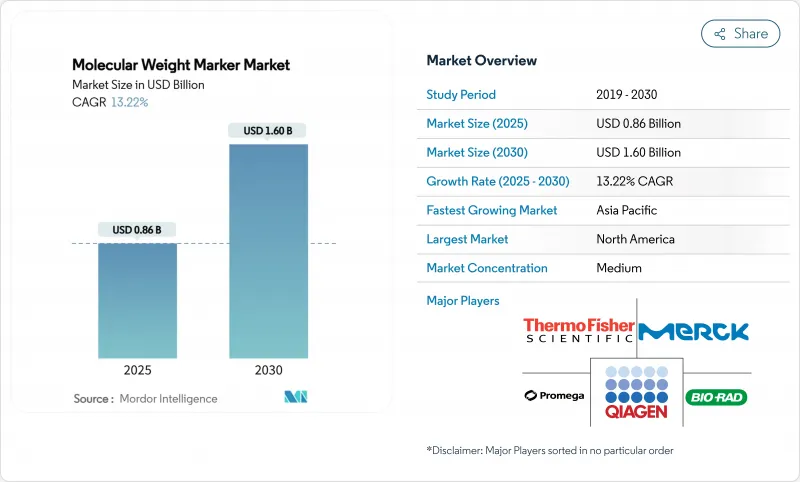
이 급속한 진전은 유전체학의 연구 개발 자금, 분자진단의 양적 확대, 고도로 표준화된 래더 수요를 높이는 엄격한 세포 및 유전자 치료 품질 관리 프로토콜의 수렴을 반영하고 있습니다. AI를 지원하는 블롯 이미징 플랫폼은 일관된 기계 판독 가능 신호를 제공하는 형광 단백질과 DNA 래더로 실험실의 기호를 바꾸고 있습니다. 북미의 혁신 생태계가 조기 채용을 지원하고 있지만, 아시아태평양의 야심적인 집단 규모의 유전체학 프로그램이 최대 수량 증가를 창출하고 있습니다. 벤더는 기존의 전기영동 소모품에 자동화, 인포매틱스, 곧바로 사용할 수 있는 케미스트리를 번들한 수직 통합형의 제품으로 대응하고 있어 숙련 노동자의 부족이나 규제의 복잡성을 완화하고 있습니다. 이러한 경쟁 구도는 분자량 마커 시장을 새로운 멀티오믹스 워크플로우의 중심에 위치시켜 POC(Point of Care) 진단, 마이크로플루이딕스 디바이스, 연속 바이오프로세스가 개념 실증에서 상업 전개로 이행하는 가운데 새로운 수익 풀을 창출합니다.
세계 분자량 마커 시장 동향과 통찰
유전체학와 단백질체학에서 세계 연구 개발비 증가
정부 자금을 이용한 유전체학 프로그램은 시퀀싱 출력을 확대하고 분석 워크플로우를 표준화하고 있습니다. 일본에서는 5년 이내에 10만개의 암 유전체을 프로파일링할 계획이 있으며, 연구기관간에 데이터를 조화시키기 위해 일관된 분자량 마커가 필요합니다. 인도의 10,000개 유전체 이니셔티브는 CARE 윤리 프레임워크를 채택하여 커뮤니티 모니터링과 양립하는 고정밀 DNA 래더를 지지합니다. 미국 국가 나노기술 계획은 2024년에 21억 6,000만 달러를 기록했으며, 그 일부는 나노를 이용한 약물 설계를 위한 분자량 표준과 같은 생명공학 툴의 자금원이 되었습니다. 머신러닝 파이프라인은 신뢰할 수 있는 바이오마커 발견 모델을 훈련하기 위해 균일한 입력 품질을 필요로 하므로 AI 중심의 연구 예산은 수요를 더욱 증폭시킵니다.
분자진단 확대(PCR/NGS)
POC와 분산형 실험실은 처리량을 높이고 턴어라운드 시간을 단축합니다. PCB 기반 실시간 PCR 칩은 +-0.1℃의 정확도로 8℃/초로 가열하여 빠른 실행에 맞는 저역 분자량 래더에 의존하는 일회용 분석을 가능하게 합니다. Dragonfly LAMP-LAMP 플랫폼은 휴대용 폼 팩터로 96.1%의 바이러스 검출 감도를 달성하고 현장 조건에서 안정성을 유지하는 프리스테인드 래더 수요를 환기합니다. myeloMATCH 테스트와 같은 고처리량 NGS 워크플로우에서는 당일 보고하기 전에 라이브러리의 무결성을 확인하기 위해 견고한 DNA 래더가 필요합니다. 마이크로플루이딕스 "랩 온 어 칩"시스템은 핵산 분석을 검사 당 9.5 달러로 28분 이내에 완료하기 때문에 공급업체는 비용에 중점을 둔 진단 경제에 맞게 마커를 일회용 카트리지에 포장하도록 촉구합니다.
숙련된 전기영동 기술자 부족
미국의 분자 실험실에서는 2024년에 13.4%의 미충족 위치가 보고되어 검사 처리량을 낮추고 자동화에 대한 투자를 촉진하고 있습니다. 채용 과제는 인건비를 상승시키기 때문에 관리자는 전처리 공정을 줄이는 싱글 튜브, 프리스테인드 래더를 선호합니다. 인증 프로그램을 확대하기 위한 학술적인 협력 관계가 탄생하고 있지만, 파이프라인이 안정되기까지 몇 년이 걸릴 것으로 보입니다. 유럽에서는 퇴직의 물결이 적자를 더욱 심각화시키고 있으며, 특히 지방의 병원에서는 이동 거리가 채용 후보자의 발판이 되고 있습니다.
부문 분석
mRNA 백신 파이프라인이 성숙하고 차세대 시퀀서(NGS) 프로토콜이 유비쿼터스가 됨에 따라 RNA 마커는 2030년까지 연평균 복합 성장률(CAGR)이 14.25%로 가장 빠를 것으로 보입니다. 정확한 폴리(A) 테일과 캡핑 효율의 검증은 100-10,000 nt의 넓은 범위를 커버하는 명확하게 정의된 래더에 의존하며, 치료 개발자들 사이에서 채용이 진행되고 있습니다. DNA 마커는 PCR, 클로닝, 서던 블롯의 루틴이 정착하고 있기 때문에 2024년 분자량 마커 시장 점유율은 51.51%를 유지했습니다. 그러나 합성 생물학 프로그램에서 CRISPR에 의한 유전체 변경을 해결하는 고분자량 포맷으로 수요가 이동하고 있습니다. 단백질 마커는 Thermofisher에 의한 Olink 인수로 대표되는 단백질체학의 자금 증가의 혜택을 받고 있습니다. Olink는 높은 처리량 스크리닝 파이프라인에 5,300개의 바이오마커를 추가하여 교정된 단백질 래더의 요구를 활성화했습니다.
상업용 실험실에서는 염색하지 않아도 보이는 프리스테인드 단백질 래더를 편리하게 하고, 1회 실행마다에 30분 절약할 수 있어 기술자의 대역폭이 부족한 연구실의 생산성을 향상시키고 있습니다. 구조 단백질체학를 연구하는 학술 그룹은 멀티플렉스 이미징 시스템을 수용하기 위해 형광 듀얼 채널 래더의 채택을 늘리고 있습니다. 한편, RNA 연구자들은 래더의 무결성을 유지하기 위해 뉴클레아제가 없는 패키징을 선호하고 있으며, 공급업체는 동결 융해로 인한 열화를 없애는 포일 포장을 일회용 바이알로 이동시키는 것을 촉구하고 있습니다.
단백질체학 용도는 CAGR 14.85%로 발전하고 있으며, 핵산 워크플로우의 역사적 우위성을 좁히고 있습니다. 웨스턴 블로팅은 여전히 주요 이용 사례이지만, 하향식 단백질체학, 리보솜 프로파일링, 열 변이 분석 등의 새로운 분야에서는 복잡한 매트릭스에서 크기 확인을 위해 래더가 사용되고 있습니다. AI 분석과 통합된 자동 겔 추출 로봇은 샘플 밴드의 절단 시간을 40% 줄이고 실험당 래더 소비를 증가시켰습니다. 핵산 분석은 분자량 마커 시장 규모의 60.53%의 점유율을 유지하며 호흡기 바이러스 모니터링을 위해 지속되는 유행성 시대의 PCR 능력에 의해 지원됩니다.
POC 환경에서 15분의 레이저 가열 PCR 사이클은 급속한 온도 전이 하에서 예측 가능한 전환을 하는 스냅 냉각 래더를 필요로 합니다. 서던 및 노던 블롯팅은 각각 후성 및 롱 리드 검증 연구에서 중요하지만, 서열 직접 검출은 일부 연구자를 계속 분리하고 있습니다. 따라서 연구자들은 인벤토리를 간소화하기 위해 핵산과 단백질 분석 모두에서 중복되는 크기 범위를 커버하는 범용 래더를 선호합니다.
지역 분석
북미는 2024년에 분자량 마커 시장의 38.32%를 차지했고 성숙한 생명공학 생태계, 연방정부 연구개발 할당 지속, AI 주도 실험실 자동화의 조기 도입에 지원되고 있습니다. 2024년 국가 나노기술 계획 예산은 21억 6,000만 달러로 나노포뮬레이션 연구를 위한 크기 표준을 포함한 분자 분석 툴의 자금원이 되었습니다. Thermofisher의 31억 달러 Olink 통합으로 대표되는 M&A는 소모품 포트폴리오를 통합하여 고처리량 단백질체학에 자원을 돌려보냅니다. 그러나 분자진단 실험실의 결원률은 13.4%로 시설은 수작업을 최소화하는 턴키 래더를 채택해야 합니다. 배치 균일성에 대한 FDA 지침은 품질에 대한 기대를 더욱 높이고 검증된 로트의 안정된 제품을 가진 공급업체를 우대합니다.
아시아태평양은 2030년까지 연평균 복합 성장률(CAGR)이 14.71%로 가장 급성장하는 지역으로 예상되며, 정부 주도의 인구 유전체 해석과 국산 백신 제조의 대두에 지지되고 있습니다. 일본의 10만명 유전체 계획과 인도의 CARE 주도의 1만명 유전체 구상은 실험실간의 표준화를 요구하고 고정밀 DNA 래더 수요를 밀어 올립니다. 중국의 폐암 프로파일링은 생식세포 계열과 체세포 돌연변이의 데이터를 통합하는 것으로, DNA와 RNA의 듀얼 사이즈 래더의 용도를 넓히고 있습니다. 이 지역의 제조업체는 비용 최적화된 POC 플랫폼에 주력하고 있으며, 습도가 높은 기후 운송을 견딜 수 있는 컴팩트한 동결건조 마커에 대한 병렬 요구를 자극하고 있습니다.
유럽은 공동연구 네트워크와 지속가능성의 중요성을 바탕으로 꾸준한 성장을 계속하고 있습니다. IVDR의 실시에 의해 품질 기준이 통일되어 견고한 문서화 체제를 가진 기업이 보상됩니다. 일류 대학의 AI 지원 겔 분석 프로젝트는 자동 이미징 파이프라인과 호환되는 형광 래더에 대한 수요를 증가시키고 있습니다. 환경 지침을 통해 공급업체는 유해 염료를 줄이고 EU 그린 거래 목표에 부합하도록 프리스텐디드 제품을 식물 유래 염료로 이동하도록 유도합니다.
기타 혜택:
- 엑셀 형식 시장 예측(ME) 시트
- 3개월의 애널리스트 서포트
목차
제1장 서론
- 조사의 전제조건과 시장의 정의
- 조사 범위
제2장 조사 방법
제3장 주요 요약
제4장 시장 상황
- 시장 개요
- 시장 성장 촉진요인
- 유전체학와 단백질체학의 세계적 연구개발비 증가
- 확대하는 분자진단제 볼륨(PCR/NGS)
- 바로 사용할 수 있는 프리스텐디드 래더의 보급
- 세포 및 유전자 치료의 QC 프로토콜에는 고정밀도의 DNA 래더가 필요
- Poc 디바이스의 미니겔 플랫폼이 저역 마커 수요를 증가
- AI 주도 블롯 이미징 소프트웨어가 형광 단백질 래더의 필요성을 견인
- 시장 성장 억제요인
- 전기영동 기술자 부족
- 엄격한 규제 등급 인증(IVDR, USP)
- 의약품 QA에서 배치 변동 재현성 감사의 계기
- 미세 유체 및 모세관 전기 영동 시스템으로의 이동
- 기술의 전망
- Porter's Five Forces
- 신규 참가업체의 위협
- 구매자의 협상력/소비자
- 공급기업의 협상력
- 대체품의 위협
- 경쟁 기업간 경쟁 관계
제5장 시장 규모와 성장 예측
- 제품별
- DNA 마커
- 단백질 마커
- RNA 마커
- 용도별
- 핵산 용도
- PCR
- 노던 블롯팅
- 서던 블롯팅
- 분자 클로닝
- 기타 핵산 용도
- 단백질체학 용도
- 웨스턴 블로팅
- 겔 추출
- 기타 단백질체학 용도
- 핵산 용도
- 유형별
- 염색 마커
- 무염색 마커
- 특수 및 형광 마커
- 최종 사용자별
- 학술기관 및 연구기관
- 제약 및 바이오테크놀러지 기업
- 연구 수탁 기관
- 임상 검사 및 진단 실험실
- 지역
- 북미
- 미국
- 캐나다
- 멕시코
- 유럽
- 독일
- 영국
- 프랑스
- 이탈리아
- 스페인
- 기타 유럽
- 아시아태평양
- 중국
- 일본
- 인도
- 한국
- 호주
- 기타 아시아태평양
- 중동 및 아프리카
- GCC
- 남아프리카
- 기타 중동 및 아프리카
- 남미
- 브라질
- 아르헨티나
- 기타 남미
- 북미
제6장 경쟁 구도
- 시장 집중도
- 시장 점유율 분석
- 기업 프로파일
- Thermo Fisher Scientific Inc.
- Bio-Rad Laboratories Inc.
- Agilent Technologies Inc.
- F. Hoffmann-La Roche AG
- Merck KGaA(MilliporeSigma)
- New England Biolabs
- Promega Corporation
- QIAGEN NV
- Takara Bio Inc.
- VWR International(Avantor)
- HiMedia Laboratories
- GeneDireX Inc.
- BioVision Inc.
- GenScript Biotech Corp.
- Abcam plc
- Cytiva(Danaher)
- SMOBIO Technology
- Analytik Jena GmbH
- Norgen Biotek Corp.
- Boster Biological Technology
제7장 시장 기회와 장래의 전망
JHS 25.11.21The global molecular weight markers market size is valued at USD 0.86 billion in 2025 and is forecast to reach USD 1.60 billion by 2030, translating into a 13.22% CAGR over the period.
This rapid advance reflects the convergence of genomics R&D funding, expanding molecular diagnostics volumes and stringent cell- and gene-therapy quality-control protocols that elevate demand for highly standardized ladders. AI-ready blot-imaging platforms are reshaping laboratory preferences toward fluorescent protein and DNA ladders that deliver consistent, machine-readable signals. The North American innovation ecosystem anchors early adoption, yet ambitious population-scale genomics programs in Asia-Pacific generate the largest incremental volume gains. Vendors are responding with vertically integrated offerings that bundle traditional electrophoresis consumables with automation, informatics and ready-to-use chemistries to mitigate skilled-labor shortages and regulatory complexity. These competitive moves position the molecular weight markers market at the center of emerging multi-omics workflows, creating new revenue pools as point-of-care (POC) diagnostics, microfluidic devices and continuous bioprocessing migrate from proof-of-concept to commercial deployment.
Global Molecular Weight Marker Market Trends and Insights
Rising Global R&D Expenditure in Genomics & Proteomics
Government-funded genomics programs are scaling sequencing output and standardizing analytical workflows. Japan plans to profile 100,000 cancer genomes within five years, requiring consistent molecular weight markers to harmonize data across institutions. India's 10,000-genome initiative employs the CARE ethical framework, favoring high-accuracy DNA ladders compatible with community oversight. The US National Nanotechnology Initiative earmarked USD 2.16 billion in 2024, part of which underwrites biotech tools such as molecular weight standards for nano-enabled drug design. AI-centric research budgets further amplify demand because machine-learning pipelines require uniform input quality to train reliable biomarker-discovery models.
Expanding Molecular Diagnostics Volumes (PCR/NGS)
POC and decentralized laboratories are increasing throughput and shortening turnaround times. A PCB-based real-time PCR chip heats at 8°C/s with +-0.1°C accuracy, enabling single-use assays that depend on low-range molecular weight ladders tailored to rapid runs. The Dragonfly LAMP-LAMP platform attains 96.1% viral-detection sensitivity in portable form factors, triggering demand for prestained ladders that remain stable in field conditions. High-throughput NGS workflows, such as the myeloMATCH trial, require robust DNA ladders to confirm library integrity ahead of same-day reporting. Microfluidic "lab-on-a-chip" systems finish nucleic-acid analysis within 28 minutes at USD 9.5 per test, pushing suppliers to package markers in single-use cartridges that align with cost-sensitive diagnostic economics.
Shortage of Skilled Electrophoresis Technicians
US molecular labs reported 13.4% unfilled positions in 2024, slowing test throughput and prompting automation investments. Recruitment challenges raise labor costs, so managers prefer single-tube, prestained ladders that cut prep steps. Academic collaborations are emerging to expand certification programs, but pipelines will take several years to stabilize. In Europe, retirement waves compound deficits, especially in rural hospitals where travel distances deter potential hires.
Other drivers and restraints analyzed in the detailed report include:
- Wider Availability of Ready-to-Use Prestained Ladders
- Cell & Gene-Therapy QC Protocols Require High-Accuracy DNA Ladders
- Stringent Reagent-Grade Regulatory Certifications (IVDR, USP)
For complete list of drivers and restraints, kindly check the Table Of Contents.
Segment Analysis
RNA markers are registering the fastest 14.25% CAGR to 2030 as mRNA vaccine pipelines mature and next-generation sequencing (NGS) protocols become ubiquitous. Accurate poly(A) tail and capping-efficiency verification relies on well-defined ladders that cover a broad 100-10,000 nt range, elevating adoption among therapeutic developers. DNA markers retained 51.51% molecular weight markers market share in 2024 due to entrenched PCR, cloning and Southern-blot routines. However, demand is shifting toward high-molecular-weight formats that resolve CRISPR-induced genomic alterations in synthetic biology programs. Protein markers benefit from rising proteomics funding, exemplified by Thermo Fisher's Olink acquisition, which added 5,300 biomarkers to high-throughput screening pipelines and invigorated need for calibrated protein ladders.
Commercial laboratories value prestained protein ladders that remain visible without staining, saving 30 minutes per run and improving lab productivity when technician bandwidth is scarce. Academic groups exploring structural proteomics increasingly adopt fluorescent dual-channel ladders to align with multiplex imaging systems. Meanwhile, RNA researchers prioritize nuclease-free packaging to maintain ladder integrity, prompting suppliers to shift toward foil-wrapped, single-use vials that eliminate freeze-thaw degradation.
Proteomics applications are advancing at 14.85% CAGR, narrowing the historical dominance of nucleic-acid workflows. Western blotting remains the primary use case, yet emerging disciplines such as top-down proteomics, ribosome profiling and thermal-shift assays now employ ladders for size confirmation in complex matrices. Automated gel extraction robots integrated with AI analysis cut sample-band excision time by 40%, driving greater ladder consumption per experiment. Nucleic-acid assays maintain a 60.53% share of the molecular weight markers market size, upheld by pandemic-era PCR capacity that persists for respiratory-virus surveillance.
In POC environments, 15-minute laser-heated PCR cycles require snap-cooling ladders that migrate predictably under rapid thermal transitions. Southern and Northern blotting remain relevant in epigenetics and long-read validation studies, respectively, but sequence-direct detection continues to pull some volume away. Researchers therefore prefer universal ladders covering overlapping size ranges for both nucleic-acid and protein analyses to streamline inventory.
The Molecular Weight Marker Market Report is Segmented by Product (DNA Markers, Protein Markers, and RNA Markers), Application (Nucleic-Acid Applications [PCR, and More] and Proteomics Applications [Western Blotting, and More]), Type (Prestained Markers, Unstained Markers and More), End User (Academic & Research Institutes and More), and Geography (North America, and More). The Market Forecasts are Provided in Terms of Value (USD).
Geography Analysis
North America controlled 38.32% of the molecular weight markers market in 2024, supported by a mature biotech ecosystem, sustained federal R&D allocations and early adoption of AI-driven laboratory automation. The USD 2.16 billion 2024 National Nanotechnology Initiative budget underwrites molecular analysis tools, including size standards for nanoformulation research. M&A activity, exemplified by Thermo Fisher's USD 3.1 billion Olink integration, consolidates consumables portfolios and funnels resources into high-throughput proteomics. Yet a 13.4% vacancy rate in molecular diagnostics laboratories compels facilities to adopt turnkey ladders that minimize manual intervention. FDA guidance on batch uniformity further escalates quality expectations, favoring suppliers with validated, lot-stable products.
Asia-Pacific is the fastest-expanding region at 14.71% CAGR through 2030, underpinned by government-sponsored population genomics and the rise of indigenous vaccine manufacturing. Japan's 100,000-genome program and India's CARE-guided 10,000-genome initiative call for cross-lab standardization, boosting demand for high-precision DNA ladders. China's lung-cancer profiling work integrates germline-somatic mutation data, broadening applications for dual-size DNA and RNA ladders. Regional manufacturers focus on cost-optimized POC platforms, stimulating a parallel requirement for compact, lyophilized markers that withstand transit in humid climates.
Europe follows steady growth, benefiting from collaborative research networks and an emphasis on sustainability. IVDR implementation harmonizes quality standards, rewarding companies with robust documentation structures. AI-assisted gel analysis projects from leading universities amplify demand for fluorescent ladders compatible with automated imaging pipelines. Environmental directives prompt suppliers to reduce hazardous dyes and shift toward plant-derived pigments in prestained products, aligning with EU Green Deal objectives.
- Thermo Fisher Scientific
- Bio-Rad Laboratories
- Agilent Technologies
- Roche
- Merck KGaA (MilliporeSigma)
- New England Biolabs
- Promega
- QIAGEN
- Takara Bio
- VWR International (Avantor)
- HiMedia Laboratories
- GeneDireX Inc.
- Biovision
- GenScript Biotech Corp.
- Abcam
- Cytiva
- SMOBIO Technology
- Analytik Jena GmbH
- Norgen Biotek
- Boster Biological Technology
Additional Benefits:
- The market estimate (ME) sheet in Excel format
- 3 months of analyst support
TABLE OF CONTENTS
1 Introduction
- 1.1 Study Assumptions & Market Definition
- 1.2 Scope of the Study
2 Research Methodology
3 Executive Summary
4 Market Landscape
- 4.1 Market Overview
- 4.2 Market Drivers
- 4.2.1 Rising Global R&D Expenditure In Genomics & Proteomics
- 4.2.2 Expanding Molecular Diagnostics Volumes (PCR/NGS)
- 4.2.3 Wider Availability Of Ready-To-Use Prestained Ladders
- 4.2.4 Cell & Gene-Therapy QC Protocols Require High-Accuracy DNA Ladders
- 4.2.5 Mini-Gel Platforms In Poc Devices Increase Low-Range Marker Demand
- 4.2.6 AI-Driven Blot-Imaging Software Pushes Need For Fluorescent Protein Ladders
- 4.3 Market Restraints
- 4.3.1 Shortage Of Skilled Electrophoresis Technicians
- 4.3.2 Stringent Reagent-Grade Regulatory Certifications (IVDR, USP)
- 4.3.3 Batch Variability Triggers Reproducibility Audits In Pharma QA
- 4.3.4 Shift Toward Microfluidic & Capillary-Electrophoresis Systems
- 4.4 Technological Outlook
- 4.5 Porter's Five Forces
- 4.5.1 Threat of New Entrants
- 4.5.2 Bargaining Power of Buyers/Consumers
- 4.5.3 Bargaining Power of Suppliers
- 4.5.4 Threat of Substitute Products
- 4.5.5 Intensity of Competitive Rivalry
5 Market Size & Growth Forecasts (Value, USD)
- 5.1 By Product
- 5.1.1 DNA Markers
- 5.1.2 Protein Markers
- 5.1.3 RNA Markers
- 5.2 By Application
- 5.2.1 Nucleic-Acid Applications
- 5.2.1.1 PCR
- 5.2.1.2 Northern Blotting
- 5.2.1.3 Southern Blotting
- 5.2.1.4 Molecular Cloning
- 5.2.1.5 Other Nucleic-Acid Apps
- 5.2.2 Proteomics Applications
- 5.2.2.1 Western Blotting
- 5.2.2.2 Gel Extraction
- 5.2.2.3 Other Proteomics Apps
- 5.2.1 Nucleic-Acid Applications
- 5.3 By Type
- 5.3.1 Prestained Markers
- 5.3.2 Unstained Markers
- 5.3.3 Specialty / Fluorescent Markers
- 5.4 By End User
- 5.4.1 Academic & Research Institutes
- 5.4.2 Pharmaceutical & Biotechnology Companies
- 5.4.3 Contract Research Organizations
- 5.4.4 Clinical & Diagnostic Laboratories
- 5.5 Geography
- 5.5.1 North America
- 5.5.1.1 United States
- 5.5.1.2 Canada
- 5.5.1.3 Mexico
- 5.5.2 Europe
- 5.5.2.1 Germany
- 5.5.2.2 United Kingdom
- 5.5.2.3 France
- 5.5.2.4 Italy
- 5.5.2.5 Spain
- 5.5.2.6 Rest of Europe
- 5.5.3 Asia-Pacific
- 5.5.3.1 China
- 5.5.3.2 Japan
- 5.5.3.3 India
- 5.5.3.4 South Korea
- 5.5.3.5 Australia
- 5.5.3.6 Rest of Asia-Pacific
- 5.5.4 Middle East and Africa
- 5.5.4.1 GCC
- 5.5.4.2 South Africa
- 5.5.4.3 Rest of Middle East and Africa
- 5.5.5 South America
- 5.5.5.1 Brazil
- 5.5.5.2 Argentina
- 5.5.5.3 Rest of South America
- 5.5.1 North America
6 Competitive Landscape
- 6.1 Market Concentration
- 6.2 Market Share Analysis
- 6.3 Company Profiles (includes Global level Overview, Market level overview, Core Segments, Financials as available, Strategic Information, Market Rank/Share for key companies, Products & Services, and Recent Developments)
- 6.3.1 Thermo Fisher Scientific Inc.
- 6.3.2 Bio-Rad Laboratories Inc.
- 6.3.3 Agilent Technologies Inc.
- 6.3.4 F. Hoffmann-La Roche AG
- 6.3.5 Merck KGaA (MilliporeSigma)
- 6.3.6 New England Biolabs
- 6.3.7 Promega Corporation
- 6.3.8 QIAGEN N.V.
- 6.3.9 Takara Bio Inc.
- 6.3.10 VWR International (Avantor)
- 6.3.11 HiMedia Laboratories
- 6.3.12 GeneDireX Inc.
- 6.3.13 BioVision Inc.
- 6.3.14 GenScript Biotech Corp.
- 6.3.15 Abcam plc
- 6.3.16 Cytiva (Danaher)
- 6.3.17 SMOBIO Technology
- 6.3.18 Analytik Jena GmbH
- 6.3.19 Norgen Biotek Corp.
- 6.3.20 Boster Biological Technology
7 Market Opportunities & Future Outlook
- 7.1 White-space & Unmet-Need Assessment