|
시장보고서
상품코드
1851304
독일의 태양 에너지 시장 : 시장 점유율 분석, 산업 동향, 통계, 성장 예측(2025-2030년)Germany Solar Energy - Market Share Analysis, Industry Trends & Statistics, Growth Forecasts (2025 - 2030) |
||||||
 Mordor Intelligence
독일의 태양 에너지 설치 기반 시장 규모는 2025년 100.93기가와트로 추정되고, 2030년에는 230.71기가와트까지 성장할 전망이며, 예측 기간(2025-2030년) CAGR 17.98%로 성장할 것으로 예측됩니다.
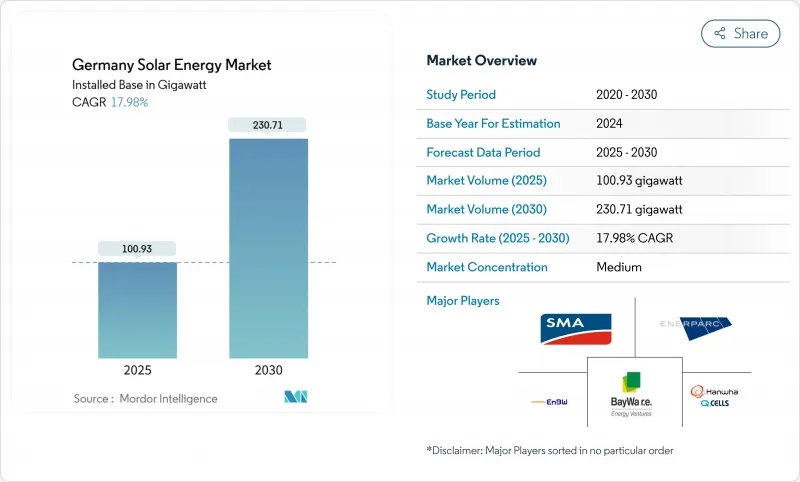
이 확대는 2030년까지 자연 에너지를 80%로 만드는 국가의 목표와 2025년 초 태양광 발전 설치 용량이 100GW를 돌파한다는 이정표에 의해 강화되고 있습니다. 솔라 패키지 i에서 합리화된 허가, 모듈 가격의 87% 급락, 기업 오프테이크 계약으로 모든 시스템 규모의 프로젝트 파이프라인이 가속화되고 있습니다. 루프탑 의무화, 발코니에 플러그인 도입, 계통 요금 인플레이션 등으로 일반 가정과 중소기업이 매우 중요한 투자자가 되고 있으며, CSP와 같은 발전 전력 기술은 야간 피크 서포트용으로 시험적인 자금을 확보하기 시작하고 있습니다. 기관 투자자의 자금이 유입되어 경쟁이 격화되고 있지만, 송전망의 혼잡과 숙련 노동자의 부족이 신규 송전망 접속의 페이스를 계속 제약하고 있습니다.
독일의 태양 에너지 시장 동향 및 인사이트
솔라 패키지 I 및 옥상 설치 의무화로 승인 가속
솔라 패키지 I은 주택용으로 70%, 상업용으로 45%의 승인 기간을 단축했습니다. 특정 시스템 유형에 대한 고정 가격 구매 장려금의 인상과 새로운 지붕에 대한 주 수준의 의무화가 2026년까지 연간 설치 가능량을 4-5GW 인상하는 다층적인 뒷받침이 되고 있습니다. 법률의 간소화는 설치업체의 파이프라인을 넓히고, 소프트 비용을 줄이며, 도시 개조 기회에 대한 투자자의 신뢰를 강화했습니다.
기업의 PPA 붐이 보조금 없이 전력 사업 프로젝트 뒷받침
고정가격 매입제도의 하락으로 전력 사업자는 장기적인 기업용 전력 구매 계약으로 방향전환했습니다. 독일은 2024년까지 유럽 2위의 PPA 시장이 되었으며 계약량은 3자리 성장을 보였습니다. 아마존과 메르세데스 벤츠와 같은 오프 테이커는 가격의 확실성을 보장하고 범위 2의 탈탄소화 목표를 달성하기 위해 PPA를 활용하고 보조금에 의존하지 않고 개발을 진행하도록 장려합니다. 이 추세는 매립된 산업 지역에서 100메가와트 이상의 프로젝트에 박차를 가해 자금 조달을 신속하게 완료하고 기존 경매 이외의 수익원을 다양화하고 있습니다.
배전망의 혼잡과 24개월의 대기 시간
2024년에는 2023년보다 97% 많은 태양광 발전의 출력이 억제되어 투자자의 수익이 악화되었습니다. 급속한 용량 증대와 송전망 증강 지연의 불일치로 인해 밸런싱 비용은 40억 유로를 넘어 소매 요금에 반영됩니다. 동적 라인 등급과 하이브리드 발전소 설계가 부분적인 구제책이 되는 한편, 태양 피크법에서는 마이너스 가격 시간대에 피드 인 캡을 도입하고 있습니다. 이러한 조치는 유용하지만, 도선의 확장이나 디지털 변전소의 전개를 대체할 수는 없습니다.
부문 분석
태양광 발전은 모듈 가격이 1W-p당 6-13유로센트로 낮고, LCOE가 1kWh당 3.7유로센트에 가깝기 때문에 2024년에는 독일의 태양광발전 시장 규모의 100%를 차지했습니다. 주택, 상업 시설 및 전력 회사의 이해 관계자는 설치 면적을 확대하지 않고 발전량을 밀어 올리는 고효율의 모노 PERC 모듈과 점점 증가하는 바이 페이셜 모듈을 지지하고 있습니다. 플라운호퍼 ISE의 조사는 페로브스카이트 실리콘 탠덤 셀의 효율이 33% 이상임을 입증하고 있으며, 추가 가격 하락을 지지하는 미래의 상승을 시사하고 있습니다.
집광형 태양광 발전은 현재 점유율 제로이지만, 2030년까지 연평균 복합 성장률(CAGR) 18.5%로 성장할 것으로 예측됩니다. 그 통합 축열은 야간의 피크 전력과 공정 열을 공급하여 태양광 발전의 보급이 진행됨에 따라 우려되는 간헐성을 다룹니다. 유럽 위원회의 로드맵은 CSP를 기존 지역 난방 네트워크 및 산업용 증기 루프와 하이브리드화하는 것으로 나타났으며 실증 시험에 대한 자금 지원을 시사합니다. 현재의 파일럿 플랜트가 운송 능력과 비용 목표를 달성하면, 이 분야는 향후 10년 이내에 독일 태양 에너지 시장을 보완하는 기둥으로 발전할 수 있습니다.
독일의 태양 에너지 시장 보고서는 기술별(태양광 발전, 집광형 태양광 발전), 컴포넌트별(PV 모듈, 인버터, 밸런스 오브 시스템, 축전지 시스템 등), 용도별(유틸리티 규모 태양광 파크, 상업 및 산업용 옥상, 주택 옥상, 기타)로 분류되어 있습니다. 시장 규모 및 예측은 설치 용량(GW)으로 제공됩니다.
기타 혜택 :
- 엑셀 형식 시장 예측(ME) 시트
- 3개월간의 애널리스트 서포트
목차
제1장 서론
- 조사의 전제조건 및 시장 정의
- 조사 범위
제2장 조사 방법
제3장 주요 요약
제4장 시장 상황
- 시장 개요
- 시장 성장 촉진요인
- 솔라 패키지 i와 옥상 설치의 의무화, 가속하는 승인
- 기업의 PPA 붐이 보조금 없는 전력 사업 프로젝트 뒷받침
- 그리드 요금의 상승이 비하인드 더 미터 태양광 발전+축전 촉진
- 발코니 설치형 태양광 발전의 임대 주택에 대한 대량 도입
- 87% 모듈 가격의 폭락에 의해 코스트 패리티 대 도매가 가능화
- 신축 기준에서 BIPV의 통합 요건(2026년 이후)
- 시장 성장 억제요인
- 배전망의 혼잡 및 24개월의 대기 시간
- 전기공사 업체 및 설치업자의 기능 노동자 부족
- 공급 리스크를 낳는 EU 대 중국 모듈의 60% 비용 차이
- FiT의 감소와 갑작스런 보조금 조정으로 주택 ROI가 저하
- 공급망 분석
- 규제 전망(EEG 2023, 솔라 패킷 i, 주에 의한 옥상 설치 의무화)
- 기술적 전망(페로브스카이트 탠덤, 농업용 태양광 발전, 차재용 태양광 발전)
- Porter's Five Forces
- 경쟁 기업 간 경쟁 관계
- 신규 참가업체의 위협
- 구매자의 협상력
- 공급기업의 협상력
- 대체품의 위협(풍력, 히트펌프, 수요응답)
- PESTEL 분석
제5장 시장 규모 및 성장 예측
- 기술별
- 태양광 발전(PV)
- 집광형 태양광 발전(CSP)
- 컴포넌트별
- PV 모듈
- 인버터(스트링, 센트럴, 마이크로 및 파워 옵티마이저)
- 밸런스 오브 시스템(가대, 케이블)
- 축전지 시스템
- 모니터링 및 SCADA 소프트웨어
- EPC 및 O&M 서비스
- 용도별
- 대규모 태양광 공원
- 상업 및 산업용 옥상(30kW-1MW)
- 주택 옥상(30kW 미만, 발코니 PV 포함한다)
- 기타(농업 및 아그리볼타이크스)
제6장 경쟁 구도
- 시장 집중도
- 전략적 움직임(M&A, 파트너십, PPA)
- 시장 점유율 분석(주요 기업의 시장 순위 및 점유율)
- 기업 프로파일
- BayWa re AG
- SMA Solar Technology AG
- EnBW Energie Baden-Wurttemberg AG
- Hanwha Q CELLS GmbH
- IBC Solar AG
- Enerparc AG
- RWE Renewables GmbH
- Encavis AG
- juwi GmbH
- ABO Wind AG
- Vattenfall GmbH
- BayWa re Power Solutions GmbH
- Next2Sun GmbH
- Solnet Green Energy OY
- Axitec Energy GmbH & Co. KG
- Solarwatt GmbH
- Meyer Burger Technology AG(Freiberg)
- Tesla Germany GmbH(Powerwall & Roof)
- 1KOMMA5°GmbH
- Centrotherm International AG
제7장 시장 기회 및 향후 전망
AJY 25.11.21The Germany Solar Energy Market size in terms of installed base is expected to grow from 100.93 gigawatt in 2025 to 230.71 gigawatt by 2030, at a CAGR of 17.98% during the forecast period (2025-2030).
The expansion is reinforced by the country's 80% renewables-by-2030 target and the early-2025 milestone of surpassing 100 GW of installed solar capacity . Streamlined permitting under Solar Package I, the 87% plunge in module prices, and corporate off-take agreements are accelerating project pipelines across all system sizes. Rooftop mandates, balcony-plug-in adoption, and grid-fee inflation have turned households and small businesses into pivotal investors, while dispatchable technologies such as CSP are starting to secure pilot funding for evening peak support. Competitive intensity is heightening as institutional capital flows in, yet grid congestion and skilled-labour shortages continue to constrain the pace of new grid connections.
Germany Solar Energy Market Trends and Insights
Solar Package I & Rooftop Mandates Accelerating Approvals
Germany's solar energy market projects now clear rooftops without construction permits, as Solar Package I cut residential approval times by 70% and commercial by 45%. Higher feed-in incentives for specific system types and state-level obligations on new roofs have formed a multi-layered push that lifts annual installation potential by 4-5 GW by 2026. Legal simplification has broadened installer pipelines, reduced soft costs, and strengthened investor confidence in urban retrofit opportunities.
Corporate PPA Boom Lifting Unsubsidised Utility Projects
Falling feed-in tariffs redirected utility developers toward long-term corporate power purchase agreements. Germany became Europe's second-largest PPA market by 2024, with triple-digit growth in contracted volumes. Off-takers like Amazon and Mercedes-Benz use PPAs to lock in price certainty and meet Scope 2 decarbonisation goals, encouraging developers to move forward without subsidy dependence. The trend is spurring 100-plus-MW projects on reclaimed industrial land, closing financing swiftly, and diversifying revenue streams beyond traditional auctions.
Distribution-Grid Congestion & 24-Month Queue Times
Queue delays stretch to two years in several rural districts, curtailing 97% more solar output in 2024 than in 2023 and eroding investor returns. The mismatch between rapid capacity additions and slower grid reinforcement elevates balancing costs above EUR 4 billion, which feeds into retail tariffs. Dynamic line rating and hybrid plant designs offer partial relief, while the Solar Peak Law introduces feed-in caps during negative price hours. These measures, though helpful, cannot substitute for expanded conductor upgrades and digital substation roll-outs.
Other drivers and restraints analyzed in the detailed report include:
- Rising Grid-Fee Inflation Driving Behind-the-Meter PV + Storage
- Mass Adoption of Balcony-Plug-in PV by Renters
- Skilled-Labour Shortages in Licensed Electricians & Installers
For complete list of drivers and restraints, kindly check the Table Of Contents.
Segment Analysis
Solar photovoltaic commanded 100% of Germany's solar energy market size in 2024, enabled by module prices as low as 6-13 euro cents per W-p and LCOE near 3.7 euro cents per kWh. Residential, commercial, and utility stakeholders favour high-efficiency mono-PERC and increasingly bifacial modules that push yield without expanding footprint. Research by Fraunhofer ISE demonstrates perovskite-silicon tandem cell lab efficiencies above 33% , pointing toward future gains that can underpin further price declines.
Concentrated solar power holds no share today, yet is forecast to grow at an 18.5% CAGR through 2030. Its integrated thermal storage delivers evening peaking power and process heat, addressing intermittency concerns as PV penetration rises. European Commission roadmaps identify CSP hybridisation with existing district-heating networks and industrial steam loops, indicating supportive funding for demonstrators. If current pilot plants meet dispatchability and cost targets, the segment could evolve into a complementary pillar of the German solar energy market by the next decade.
The Germany Solar Energy Market Report is Segmented by Technology (Solar Photovoltaic and Concentrated Solar Power), Component (PV Modules, Inverters, Balance-Of-System, Battery Energy-Storage Systems, and Others), Application (Utility-Scale Solar Parks, Commercial and Industrial Rooftop, Residential Rooftop, and Others). The Market Sizes and Forecasts are Provided in Terms of Installed Capacity (GW).
List of Companies Covered in this Report:
- BayWa r.e. AG
- SMA Solar Technology AG
- EnBW Energie Baden-Wurttemberg AG
- Hanwha Q CELLS GmbH
- IBC Solar AG
- Enerparc AG
- RWE Renewables GmbH
- Encavis AG
- juwi GmbH
- ABO Wind AG
- Vattenfall GmbH
- BayWa r.e. Power Solutions GmbH
- Next2Sun GmbH
- Solnet Green Energy OY
- Axitec Energy GmbH & Co. KG
- Solarwatt GmbH
- Meyer Burger Technology AG (Freiberg)
- Tesla Germany GmbH (Powerwall & Roof)
- 1KOMMA5° GmbH
- Centrotherm International AG
Additional Benefits:
- The market estimate (ME) sheet in Excel format
- 3 months of analyst support
TABLE OF CONTENTS
1 Introduction
- 1.1 Study Assumptions & Market Definition
- 1.2 Scope of the Study
2 Research Methodology
3 Executive Summary
4 Market Landscape
- 4.1 Market Overview
- 4.2 Market Drivers
- 4.2.1 Solar Package I & Rooftop Mandates Accelerating Approvals
- 4.2.2 Corporate PPA Boom Lifting Unsubsidised Utility Projects
- 4.2.3 Rising Grid-Fee Inflation Driving Behind-the-Meter PV + Storage
- 4.2.4 Mass Adoption of Balcony-Plug-in PV by Renters
- 4.2.5 87 % Module-Price Collapse Enables Cost-Parity vs. Wholesale
- 4.2.6 Integrated BIPV Requirements in New-Build Codes (from 2026)
- 4.3 Market Restraints
- 4.3.1 Distribution-Grid Congestion & 24-Month Queue Times
- 4.3.2 Skilled-Labour Shortages in Licensed Electricians & Installers
- 4.3.3 60 % Cost Gap on EU-vs-China Modules Creating Supply-Risk
- 4.3.4 Declining FiTs & Sudden Subsidy Tweaks Eroding Residential ROI
- 4.4 Supply-Chain Analysis
- 4.5 Regulatory Outlook (EEG 2023, Solar-Paket I, State Rooftop Mandates)
- 4.6 Technological Outlook (Perovskite Tandems, Agrivoltaics, Vehicle-Integrated PV)
- 4.7 Porter's Five Forces
- 4.7.1 Competitive Rivalry
- 4.7.2 Threat of New Entrants
- 4.7.3 Bargaining Power of Buyers
- 4.7.4 Bargaining Power of Suppliers
- 4.7.5 Threat of Substitutes (Wind, Heat-Pumps, Demand Response)
- 4.8 PESTLE Analysis
5 Market Size & Growth Forecasts
- 5.1 By Technology
- 5.1.1 Solar Photovoltaic (PV)
- 5.1.2 Concentrated Solar Power (CSP)
- 5.2 By Component
- 5.2.1 PV Modules
- 5.2.2 Inverters (String, Central, Micro/Power-Optimiser)
- 5.2.3 Balance-of-System (Mounts, Cables)
- 5.2.4 Battery Energy-Storage Systems
- 5.2.5 Monitoring and SCADA Software
- 5.2.6 EPC and O&M Services
- 5.3 By Application
- 5.3.1 Utility-Scale Solar Parks
- 5.3.2 Commercial and Industrial Rooftop (30 kW - 1 MW)
- 5.3.3 Residential Rooftop (below 30 kW incl. Balcony PV)
- 5.3.4 Others (Agricultural/Agrivoltaics)
6 Competitive Landscape
- 6.1 Market Concentration
- 6.2 Strategic Moves (M&A, Partnerships, PPAs)
- 6.3 Market Share Analysis (Market Rank/Share for key companies)
- 6.4 Company Profiles (includes Global level Overview, Market level overview, Core Segments, Financials as available, Strategic Information, Products & Services, and Recent Developments)
- 6.4.1 BayWa r.e. AG
- 6.4.2 SMA Solar Technology AG
- 6.4.3 EnBW Energie Baden-Wurttemberg AG
- 6.4.4 Hanwha Q CELLS GmbH
- 6.4.5 IBC Solar AG
- 6.4.6 Enerparc AG
- 6.4.7 RWE Renewables GmbH
- 6.4.8 Encavis AG
- 6.4.9 juwi GmbH
- 6.4.10 ABO Wind AG
- 6.4.11 Vattenfall GmbH
- 6.4.12 BayWa r.e. Power Solutions GmbH
- 6.4.13 Next2Sun GmbH
- 6.4.14 Solnet Green Energy OY
- 6.4.15 Axitec Energy GmbH & Co. KG
- 6.4.16 Solarwatt GmbH
- 6.4.17 Meyer Burger Technology AG (Freiberg)
- 6.4.18 Tesla Germany GmbH (Powerwall & Roof)
- 6.4.19 1KOMMA5° GmbH
- 6.4.20 Centrotherm International AG
7 Market Opportunities & Future Outlook
- 7.1 White-Space & Unmet-Need Assessment (e.g., Vehicle-to-Grid PV, Industrial Heat-via-PV-Electrolysis)