
|
시장보고서
상품코드
1851444
그래핀 시장 : 점유율 분석, 산업 동향, 통계, 성장 예측(2025-2030년)Graphene - Market Share Analysis, Industry Trends & Statistics, Growth Forecasts (2025 - 2030) |
||||||
 Mordor Intelligence
그래핀 시장 규모는 2025년에 16억 6,000만 달러, 2030년에는 92억 8,000만 달러에 이르고, 2025-2030년의 CAGR은 41.22%를 나타낼 전망입니다.
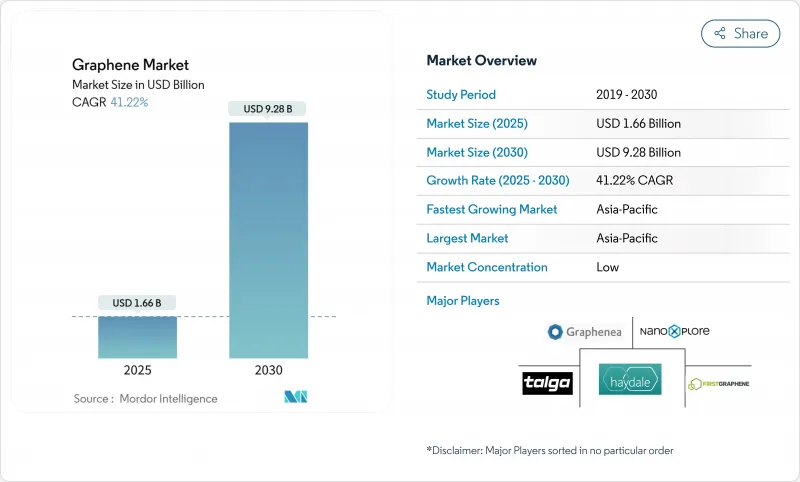
이 급성장은 상업적 규모의 생산 장애물이 후퇴하고 그래핀이 실험실에서 주류 산업 공급망으로 결정적으로 전환하고 있음을 보여줍니다. 공정 수율 향상, 단가 저하, 강하 사용자와의 긴밀한 통합이 배터리, 항공우주 복합재료, 바이오 의료기기 등 고성장 틈새 분야의 지속적인 수요를 지원합니다. 아시아태평양은 2024년 매출의 46%를 차지했고, 전자 집적지의 밀집, 정부의 적극적인 자금 지원, 재료 및 최종 제품 제조업체의 긴밀한 협력으로 CAGR 44.69%로 성장하고 있습니다. 기업이 특수 용도를 중심으로 수직 포지션을 확립함에 따라 세분화가 진행되고 있습니다. 예를 들어, 업계별로 강화된 배터리 화학물질에 대한 지적재산의 관리는 이미 결정적인 경쟁력이 되고 있습니다.
세계 그래핀 시장 동향과 통찰
항공우주산업을 지원하는 그래핀
그래핀으로 강화된 탄소섬유 폴리머는 기계적 성능을 유지 또는 향상시키면서 기존의 복합재료에 비해 20-30%의 질량 삭감을 실현하고 있습니다. 임베디드 그래핀 센서 메쉬는 실시간으로 구조 건전성 데이터를 제공하여 예보 유지 사이클을 가능하게 하며 예정되지 않은 다운타임을 줄입니다. 북미와 유럽의 민간 항공기 프로그램에서는 먼저 이러한 다기능 구조를 2차 부품, 레이돔, 페어링, 인테리어 패널에 통합한 다음 주요 내하중 부품으로 확대합니다. 조기 취항 데이터가 축적됨에 따라 규제 경로가 단축되고 아시아태평양의 기체 제조업체공급업체 인증이 가속화되고 있습니다. 카본프라이스제도가 강화되는 가운데, 제트연료의 절약은 배출요금의 인하에 직결되므로, 항공사는 장기적인 그래핀 복합재 공급계약을 확보하는 인센티브를 높여, 재료 제조업체에게는 수요의 가시성이 강화됩니다.
중동 해수 담수화 인프라에서 그래핀 방청 코팅 채택
걸프 협력 회의의 유틸리티은 강철 배관 및 압력 용기를 부식시키는 극단적인 염분 농도와 고온 환경에서 운영됩니다. 그래핀을 적용한 장벽층은 이온의 침입을 방해하고 자산의 수명을 15-20년 연장하여 유지보수 예산을 최대 30% 삭감합니다. 그래핀 산화물 코팅은 동시에 막의 물 유속을 80-90% 증가시켜 운영자는 설치 용량당 처리 능력을 향상시키고 에너지 비용을 상쇄할 수 있습니다. 2030년까지 지역의 해수 담수화 능력은 두배로 될 것으로 예측되고 있기 때문에 신규 플랜트의 건설에 그래핀 보호막을 사용하는 것이 입찰 사양으로 의무화되는 경우가 많아지고 있으며, 현지의 제조업자는 기존의 프로바이더로부터 기술을 라이선싱하도록 촉구되고 있습니다.
높은 생산 비용
화학기상증착법(CVD)은 첨단전자공학에 필요한 순도를 제공하지만 진공실과 온도제어시스템에 의해 운영비용이 높고 채택은 고가격대의 용도로 한정됩니다. 재료 연구원의 보고에 따르면 배치 간의 편차는 다운스트림 품질 관리를 복잡하게 하고 위험을 싫어하는 고객의 발판이 되고 있습니다. 용융염의 대체 전해 경로는 결정질서를 희생하지 않고 비용을 최대 90%까지 줄일 수 있지만, 상업화는 아직 초기 시험 단계에 그치고 있습니다. 규모의 효율화가 실현될 때까지, 많은 대중용 제품은 보다 저렴한 충전재에 계속 의존하고 그래핀의 수량에 상한이 마련됩니다.
부문 분석
그래핀 나노플레이트렛은 2024년 매출의 57%를 차지했고, 2030년까지 CAGR 47.63%에 달할 전망으로 그래핀 시장의 주력 제품으로서의 지위를 확고한 것으로 하고 있습니다. 얇고 폭이 넓은 형태는 중합체, 금속 및 아스팔트에 쉽게 분산되어 낮은 하중으로 강도와 장벽 특성을 향상시킵니다. 수량 증가로 단가가 낮아지고 수요의 기세를 더욱 강화하고 있습니다. 아바다인의 독자적인 대박형 무결함 플레이크 제법은 2025년 중반의 생산을 위해 화학 파트너에게 라이선스가 부여되어 공급을 확대하고 예측 가능한 성능 배치를 요구하는 항공우주나 배터리 개발 제조업체를 지원할 것으로 기대됩니다.
시트와 필름, 그리고 그래핀 산화물(GO)은 각각 나노플레이트렛을 따르는 것이지만, 본질적인 틈새를 채우는 것입니다. GO의 친수성은 글루코스 수준의 상승에 반응하는 이중 가교 드레싱으로 나타난 바와 같이 만성 상처의 치유를 촉진하는 바이오메디컬 하이드로겔에 적합합니다. CVD 성장에 의한 다층막은 비용이 높지만 고속 트랜지스터나 차세대 센서에 있어서 귀중한 양자 수송 현상을 풀어 놓고 있습니다. 하이브리드 발포 엘라스토머는 마이크로파 대역에서 약 75dB의 감쇠를 보였습니다.
지역 분석
아시아태평양은 그래핀 시장을 독점하고 있으며, 2024년 매출은 46%, CAGR 44.69%로 가장 빠릅니다. 중국은 흑연 원료와 하류의 전지 조립에 있어서 카와카미로부터 주도권을 잡고 있어 에코시스템상의 우위성이 있습니다. 국가 보조금은 국내 에너지 저장 통합업체에 공급하는 수 톤 규모의 GO 확장 라인을 맡고 있습니다. 한국 그룹은 아프리카로부터의 흑연 공급을 다양화하는 한편, 실리콘을 많이 포함하는 음극의 생산 능력을 확대하고, 전도성 첨가제의 그래핀 사용량을 간접적으로 높여가고 있습니다.
북미는 공급망의 회복력을 추구하고 있습니다. 캘리포니아 주 리튬 금속 시설의 2,000만 달러를 개조하여 2025년 후반에 200MWh의 그래핀 강화 리튬 황 전지 생산을 시작하고 2027년에는 10GWh의 네바다 주 기가팩토리를 계획하고 있습니다. 방위용 전자 장비의 국산화를 선호하는 연방 조달 지침은 웨이퍼 규모의 CVD 생산 능력 향상을 더욱 강화할 것입니다.
유럽은 맨체스터, 케임브리지, 아헨을 중심으로 깊은 학술 전문 지식의 혜택을 누리고 있습니다. 표준 자기장에서 100% 실온 자기 저항과 같은 획기적인 성과는 이 지역의 기초 과학의 힘을 이야기합니다.
기타 혜택 :
- 엑셀 형식 시장 예측(ME) 시트
- 3개월간의 애널리스트 서포트
목차
제1장 서론
- 조사의 전제조건과 시장의 정의
- 조사 범위
제2장 조사 방법
제3장 주요 요약
제4장 시장 상황
- 시장 개요
- 시장 성장 촉진요인
- 그래핀 항공우주 산업에 기여
- 중동의 해수 담수화 인프라에 있어서의 그래핀 방식 코팅의 채택
- 에너지 저장 용도의 확대
- 전자와 반도체 수요 증가
- 그래핀 유럽 5G 인프라용 EMI 실드 폼의 사업화
- 시장 성장 억제요인
- 높은 생산 비용
- 대체품의 가능성
- 대면적 CVD 그래핀 제조 라인에는 높은 설비 투자가 필요
- 밸류체인 분석
- Porter's Five Forces
- 공급기업의 협상력
- 구매자의 협상력
- 신규 참가업체의 위협
- 대체품의 위협
- 경쟁도
제5장 시장 규모와 성장 예측
- 제품 유형별
- 그래핀 시트와 필름
- 그래핀 나노 플레이트렛(GNP)
- 그래핀 산화물(GO)
- 나노 플레이트렛
- 기타
- 용도별
- 복합 재료
- 에너지 저장과 발전
- 인쇄 및 유연한 전자기기
- 바이오메디컬 및 헬스케어
- 페인트
- 기타
- 최종 사용자 업계별
- 일렉트로닉스 및 통신
- 항공우주 및 방위
- 에너지 및 전력
- 바이오메디컬&헬스케어
- 기타(자동차, 화학, 코팅)
- 지역별
- 아시아태평양
- 중국
- 일본
- 한국
- 인도
- ASEAN
- 기타 아시아태평양
- 북미
- 미국
- 캐나다
- 멕시코
- 유럽
- 독일
- 영국
- 프랑스
- 이탈리아
- 스페인
- 북유럽
- 기타 유럽
- 남미
- 브라질
- 아르헨티나
- 콜롬비아
- 기타 남미
- 중동 및 아프리카
- 사우디아라비아
- 아랍에미리트(UAE)
- 튀르키예
- 남아프리카
- 이집트
- 기타 중동 및 아프리카
- 아시아태평양
제6장 경쟁 구도
- 시장 집중도
- 전략적 동향
- 시장 점유율(%)/랭킹 분석
- 기업 프로파일
- ACS Material
- Cabot Corporation
- Directa Plus SpA
- First Graphene Ltd
- G6 Materials Corp.
- Global Graphene Group
- Grafoid Inc
- Graphene Manufacturing Group Ltd
- Graphenea
- Haydale Graphene Industries plc
- NanoXplore Inc.
- Perpetuus Advanced Materials
- Talga Group
- The Sixth Element(Changzhou)Materials Technology Co.,Ltd
- Thomas Swan & Co. Ltd
- Universal Matter Inc
- Versarien plc
- Vorbeck Materials Corp.
제7장 시장 기회와 장래의 전망
SHW 25.11.21The graphene market size is estimated at USD 1.66 billion in 2025 and is expected to reach USD 9.28 billion by 2030, expanding at a 41.22% CAGR between 2025-2030.
This steep ascent signals that commercial-scale production hurdles are receding, moving graphene decisively from the laboratory into mainstream industrial supply chains. Increased process yields, falling unit costs, and closer integration with downstream users now underpin sustained demand from high-growth niches such as batteries, aerospace composites, and biomedical devices. Asia-Pacific remains the centre of gravity: the region held 46% of 2024 revenue and is growing at a 44.69% CAGR thanks to dense electronics clusters, active government funding, and tight coupling between material producers and end-product manufacturers. Fragmentation is increasing as companies carve out vertical positions around specialty uses; intellectual-property control over graphene-enhanced battery chemistries, for example, is already a decisive competitive lever.
Global Graphene Market Trends and Insights
Graphene Aiding the Aerospace Industry
Lightweighting remains a core airline objective, and graphene-reinforced carbon-fiber polymers are yielding 20-30% mass reductions versus legacy composites while maintaining or improving mechanical performance. Embedded graphene sensor meshes also deliver real-time structural-health data, enabling predictive maintenance cycles and lowering unplanned downtime. Commercial aircraft programs in North America and Europe first integrate such multifunctional structures into secondary parts, radomes, fairings, and interior panels, before scaling to primary load-bearing components. Regulatory pathways are shortening as early-service data accumulate, accelerating supplier qualification for Asia-Pacific airframe builders. With jet-fuel savings translating directly into lower emissions fees under tightening carbon-pricing regimes, airlines are incentivised to secure long-term graphene composite supply agreements, reinforcing demand visibility for material producers.
Adoption of Graphene Anti-corrosion Coatings in the Middle-East Desalination Infrastructure
Gulf Cooperation Council utilities operate in extreme salinity and high-temperature environments that corrode steel piping and pressure vessels. Graphene-laden barrier layers impede ion ingress, extending asset life by 15-20 years and cutting maintenance budgets by up to 30%. Because graphene oxide coatings simultaneously raise membrane water flux 80-90%, operators gain higher throughput per installed capacity, which offsets energy expenses, crucial where desalination already accounts for a material share of national electricity demand. As regional capacity is projected to double by 2030, tender specifications increasingly mandate graphene protection for new-build plants, stimulating local formulators to license technology from established providers.
High Production Cost
Chemical-vapor-deposition (CVD) delivers the purity required for advanced electronics, yet its vacuum chambers and temperature control systems drive operating expenditure that limits adoption to premium-priced applications. Material researchers report batch-to-batch variability that complicates downstream quality control, deterring risk-averse customers. Alternative electrolysis routes in molten salts could cut costs by up to 90% without sacrificing crystalline order, though commercialisation remains in early trials. Until scale efficiencies arrive, many mass-market products will continue to rely on cheaper filler materials, capping graphene volumes.
Other drivers and restraints analyzed in the detailed report include:
- Expansion of Energy-Storage Applications
- Growing Demand in Electronics and Semiconductors
- Availability of Substitutes
For complete list of drivers and restraints, kindly check the Table Of Contents.
Segment Analysis
Graphene nanoplatelets captured 57% of 2024 sales and are on track for a 47.63% CAGR to 2030, cementing their status as the workhorse of the graphene market. Their thin but wide morphology disperses easily in polymers, metals, and asphalt, delivering strength and barrier gains at low loadings. Volume growth is lowering unit prices, which further reinforces demand momentum. Avadain's proprietary large-thin-defect-free flake process, licensed to a chemical partner for mid-2025 production, is expected to widen supply and support aerospace and battery developers seeking predictable performance batches.
Sheets and films, and graphene oxide (GO) each trail nanoplatelets but fill essential niches. GO's hydrophilicity suits biomedical hydrogels that accelerate chronic-wound healing, as shown in double-cross-linked dressings that respond to elevated glucose levels. CVD-grown multilayer films, though costlier, unlock quantum transport phenomena valuable for high-speed transistors and next-generation sensors. Demand for three-dimensional foams is also rising where electromagnetic shielding and thermal interface performance are critical; hybrid graphene-foam elastomers have exhibited around 75 dB attenuation across microwave bands.
The Graphene Market Report Segments the Industry by Product Type (Graphene Sheets and Films, Graphene Nanoplatelets (GNP), Graphene Oxide (GO), Nanoplatelets, and Others), Application (Composites, Energy Storage and Harvesting, and More), End-User Industry (Electronics and Telecommunication, Aerospace and Defense, and More), and Geography (Asia-Pacific, North America, Europe, South America, and Middle-East and Africa).
Geography Analysis
Asia-Pacific dominates the graphene market with 46% revenue in 2024 and the fastest 44.69% CAGR outlook. China's upstream leadership in graphite feedstock and downstream battery assembly grants ecosystem advantages; state grants have underwritten multi-tonne GO expansion lines that feed domestic energy-storage integrators. South Korean groups are diversifying graphite supply from Africa while scaling silicon-rich anode capacity, which indirectly elevates graphene usage for conductivity additives.
North America is pursuing supply-chain resilience. A USD 20 million retrofit of a lithium-metal facility in California will start 200 MWh of graphene-enhanced lithium-sulfur cell output in late 2025, with a 10 GWh Nevada gigafactory planned for 2027. Federal procurement guidelines prioritising domestic content for defense electronics further incentivise local wafer-scale CVD capacity builds.
Europe benefits from deep academic expertise clustered around Manchester, Cambridge and Aachen. Breakthroughs such as 100% room-temperature magnetoresistance in standard magnetic fields illustrate the region's basic-science prowess.
- ACS Material
- Cabot Corporation
- Directa Plus S.p.A.
- First Graphene Ltd
- G6 Materials Corp.
- Global Graphene Group
- Grafoid Inc
- Graphene Manufacturing Group Ltd
- Graphenea
- Haydale Graphene Industries plc
- NanoXplore Inc.
- Perpetuus Advanced Materials
- Talga Group
- The Sixth Element (Changzhou) Materials Technology Co.,Ltd
- Thomas Swan & Co. Ltd
- Universal Matter Inc
- Versarien plc
- Vorbeck Materials Corp.
Additional Benefits:
- The market estimate (ME) sheet in Excel format
- 3 months of analyst support
TABLE OF CONTENTS
1 Introduction
- 1.1 Study Assumptions and Market Definition
- 1.2 Scope of the Study
2 Research Methodology
3 Executive Summary
4 Market Landscape
- 4.1 Market Overview
- 4.2 Market Drivers
- 4.2.1 Graphene Aiding the Aerospace Industry
- 4.2.2 Adoption of Graphene Anti-corrosion Coatings in Middle-East Desalination Infrastructure
- 4.2.3 Expansion of Energy Storage Applications
- 4.2.4 Growing Demand in Electronics and Semiconductors
- 4.2.5 Commercialization of Graphene EMI-shielding Foams for European 5G Infrastructure
- 4.3 Market Restraints
- 4.3.1 High Production Cost
- 4.3.2 Avalability of Substitutes
- 4.3.3 High capex needs for large-area CVD graphene production lines
- 4.4 Value Chain Analysis
- 4.5 Porter's Five Forces
- 4.5.1 Bargaining Power of Suppliers
- 4.5.2 Bargaining Power of Buyers
- 4.5.3 Threat of New Entrants
- 4.5.4 Threat of Substitutes
- 4.5.5 Degree of Competition
5 Market Size and Growth Forecasts (Value)
- 5.1 By Product Type
- 5.1.1 Graphene Sheets and Films
- 5.1.2 Graphene Nanoplatelets (GNP)
- 5.1.3 Graphene Oxide (GO)
- 5.1.4 Nanoplatelets
- 5.1.5 Others
- 5.2 By Application
- 5.2.1 Composites
- 5.2.2 Energy Storage and Harvesting
- 5.2.3 Printed and Flexible Electronics
- 5.2.4 Biomedical and Healthcare
- 5.2.5 Coatings and Paints
- 5.2.6 Others
- 5.3 By End-user Industry
- 5.3.1 Electronics and Telecommunications
- 5.3.2 Aerospace and Defense
- 5.3.3 Energy and Power
- 5.3.4 Biomedical and Healthcare
- 5.3.5 Others (Automotive, Chemical, and Coatings)
- 5.4 By Geography
- 5.4.1 Asia-Pacific
- 5.4.1.1 China
- 5.4.1.2 Japan
- 5.4.1.3 South Korea
- 5.4.1.4 India
- 5.4.1.5 ASEAN
- 5.4.1.6 Rest of Asia-Pacific
- 5.4.2 North America
- 5.4.2.1 United States
- 5.4.2.2 Canada
- 5.4.2.3 Mexico
- 5.4.3 Europe
- 5.4.3.1 Germany
- 5.4.3.2 United Kingdom
- 5.4.3.3 France
- 5.4.3.4 Italy
- 5.4.3.5 Spain
- 5.4.3.6 Nordic
- 5.4.3.7 Rest of Europe
- 5.4.4 South America
- 5.4.4.1 Brazil
- 5.4.4.2 Argentina
- 5.4.4.3 Colombia
- 5.4.4.4 Rest of South America
- 5.4.5 Middle-East and Africa
- 5.4.5.1 Saudi Arabia
- 5.4.5.2 United Arab Emirates
- 5.4.5.3 Turkey
- 5.4.5.4 South Africa
- 5.4.5.5 Egypt
- 5.4.5.6 Rest of Middle-East and Africa
- 5.4.1 Asia-Pacific
6 Competitive Landscape
- 6.1 Market Concentration
- 6.2 Strategic Moves
- 6.3 Market Share(%)/ Ranking Analysis
- 6.4 Company Profiles (includes Global level Overview, Market level overview, Core Segments, Financials as available, Strategic Information, Market Rank/Share for key companies, Products and Services, and Recent Developments)
- 6.4.1 ACS Material
- 6.4.2 Cabot Corporation
- 6.4.3 Directa Plus S.p.A.
- 6.4.4 First Graphene Ltd
- 6.4.5 G6 Materials Corp.
- 6.4.6 Global Graphene Group
- 6.4.7 Grafoid Inc
- 6.4.8 Graphene Manufacturing Group Ltd
- 6.4.9 Graphenea
- 6.4.10 Haydale Graphene Industries plc
- 6.4.11 NanoXplore Inc.
- 6.4.12 Perpetuus Advanced Materials
- 6.4.13 Talga Group
- 6.4.14 The Sixth Element (Changzhou) Materials Technology Co.,Ltd
- 6.4.15 Thomas Swan & Co. Ltd
- 6.4.16 Universal Matter Inc
- 6.4.17 Versarien plc
- 6.4.18 Vorbeck Materials Corp.
7 Market Opportunities and Future Outlook
- 7.1 Development of Graphene Nanodevices for DNA Sequencing
- 7.2 Adoption of Graphene into Photodetectors
- 7.3 White-space and Unmet-need Assessment