|
시장보고서
상품코드
1851540
음향 센서 : 시장 점유율 분석, 산업 동향, 통계, 성장 예측(2025-2030년)Sound Sensors - Market Share Analysis, Industry Trends & Statistics, Growth Forecasts (2025 - 2030) |
||||||
 Mordor Intelligence
음향 센서 시장 규모는 2025년 12억 3,000만 달러로, CAGR 6.08%를 나타내 2030년에는 16억 5,000만 달러에 달할 것으로 예상됩니다.
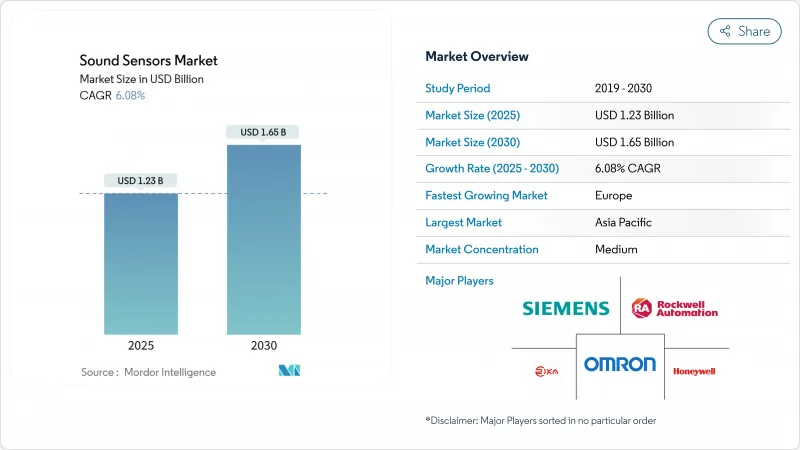
소형화된 MEMS 설계, 온디바이스 AI, 엣지 커넥티비티를 통해 음향 센서의 사용은 오디오 캡처에서 예지 보전, 환경 컴플라이언스, 음성 우선 휴먼 머신 상호작용으로 확장되었습니다. 소비자 일렉트로닉스는 여전히 양적 성장을 지원하고 있지만 제조업체와 도시가 지속적인 상태 모니터링을 추구함에 따라 산업, 자동차 및 인프라의 도입이 확대되고 있습니다. 북미와 유럽에서는 소음 감시의 규제가 있고, 아시아태평양에서는 대규모 전자기기 생산이 이루어지고 있기 때문에 지역에 따라 수요의 패턴이 다릅니다. 압전 재료공급망 위험과 단편적인 MEMS ASIC 특허는 기술 소유와 비용 관리를 보장하려는 기업의 수직 통합을 촉진합니다. 센싱과 엣지 AI를 융합시킨 전략적인수는 음향 데이터를 로컬로 처리하고 보다 신속한 의사결정을 하는 미래를 가리키고 있습니다.
세계의 음향 센서 시장 동향과 인사이트
소비자를 위한 IoT 및 자동차 조종석에서 음성 우선 인터페이스의 보급이 MEMS 마이크 수요를 끌어올립니다.
소프트웨어 정의 자동차에는 현재 여러 개의 MEMS 마이크가 내장되어 있어 비상시 음성 감지, 차량 내 노이즈 취소 및 운전자의 건강 상태 감지가 가능합니다. Qorvo는 컨텍스트 차량 제어용 힘 감지 유닛을 2,000만 개 이상 출하하고 있습니다. Knowles의 포트리스 진동 센서는 가혹한 차량 실내 내구성을 더욱 향상시킵니다. 이러한 진보로 오디오 픽업이라는 리액티브한 것으로부터 환경인식이라는 프로액티브한 것으로 가치가 변화하고 있습니다.
아시아 인더스트리 4.0 제조 기지에서 예측 유지 보수를위한 어쿠스틱 방출 센서의 도입 증가
중국, 일본, 동남아시아의 제조업에서는 어쿠스틱 방출 어레이의 도입이 진행되고 있습니다. 소리의 패턴을 학습한 머신러닝 모델은 계획외의 다운타임을 줄이고, 신속한 ROI를 실현해, 이 지역의 CAGR 7.3%를 나타낼 전망입니다.
자율 주행 차량의 광학 및 레이더 기반 감지와의 경쟁은 음향 점유율 감소
4D mmWave 레이더는 비와 안개 속에서도 뛰어난 물체 감지 능력을 발휘하여 장거리 음향 센서 수요를 축소. 자동차 제조업체 각사는 현재 LiDAR, 레이더, 카메라를 융합시켜 견고한 지각을 실현하고 있습니다. 음향 장치는 사이렌 감지 및 차량 내 모니터링의 역할을 유지하면서 레이더의 전천후 신뢰성이 그 범위를 제한하고 있습니다.
부문 분석
MEMS 마이크는 스마트폰, 스마트 스피커, 트루 무선 이어폰이 견인해 2024년 매출의 42%를 차지해 음향 센서 시장의 볼륨 앵커로서의 역할을 굳혔습니다. 어쿠스틱 방출 장치는 절대 금액으로 작지만 공장이 예보 보전 시스템을 도입하기 때문에 CAGR 8.9%로 성장을 이끌고 있습니다. 압전 마이크와 다이나믹 마이크는 여전히 MEMS가 내구성과 충실도에 미치지 못하는 혹독한 환경이나 특수한 환경에서는 필수적입니다. 표면 탄성파 필터와 벌크 탄성파 필터는 5G 기지국에서 널리 보급되었으며 예외적인 포인트 SAW 프로토타입은 2ppm의 가스 검출 한계에 도달했습니다. 온세미는 2023년에 2억개의 초음파 유닛을 출하한다고 보고했으며, 자동차 주차 및 탑승자 감지 시스템 수요 증가를 뒷받침했습니다.
센서의 아키텍처가 다양화됨에 따라 틈새 성능 요구가 획일적인 솔루션을 대체하는 경쟁 환경이 형성됩니다. 감도, 대역폭, 전력 소비를 조정할 수 있는 제조업체는 최종 사용자가 목적에 맞는 설계를 우선시하면서 수비 범위가 넓은 포지션을 확보하고 있습니다. 이를 위해 음향 센서 업계 각사는 용도에 특화된 MEMS ASIC에 다액의 투자를 하고 차별화를 도모하고 있습니다.
2024년 수요의 55%를 소비자용 전자 기기가 차지하고, 스마트폰과 스마트 스피커가 그 중심이 되었습니다. 그러나 Industry 4.0의 보급에 따라 공장 자동화과 자산 건강 모니터링은 CAGR 7.3%로 가속화되고 있습니다. 통신 인프라에서는 BAW와 SAW 필터가 통합되어 5G 라디오의 성능 목표를 달성하고 자동차 용도는 핸즈프리 통화에서 탑승자 상태 감지 및 로드 노이즈 취소까지 확장됩니다. 건강 관리는 광대역 초음파 트랜스 듀서에 의존하는 비 침습적 진단 및 환자 모니터링 기기를 유망시합니다. 도시가 소음 규제를 강화하는 동안 환경기관은 네트워크 모니터를 조달하고 있습니다.
소비자의 금리가 줄어들면서 공급업체는 더 긴 수명주기와 표준화된 자격 요건을 가진 산업계약으로 축족을 옮기고 있습니다. 보쉬 센서텍은 2030년에 출하하는 제품의 90%에 AI를 탑재한다고 선언하고 있는데, 이는 벤더가 원시 하드웨어를 넘어서는 가치를 획득하는 방법을 보여줍니다.
음향 센서 시장 보고서는 센서 유형(MEMS 마이크, 압전 마이크, 기타), 주파수 대역(무향음(20Hz 이상), 가청음(20Hz-20KHz), 기타), 최종 사용자 산업(컨슈머 일렉트로닉스, 기타), 용도(음성 인식과 음성 처리, 기타) 지역(북미, 유럽, 아시아태평양, 기타) 시장 규모와 예측은 금액(달러) 기준입니다.
지역 분석
북미가 2024년 31%의 수익 점유율로 음향 센서 시장을 선도했습니다. 운송 장비 및 주 고속도로 프로젝트에 대한 연방 소음 기준은 센서의 보급을 촉진하고 미국과 캐나다의 자동차 부문은 캐빈의 안전 기능을 위해 멀티 마이크로어레이를 통합합니다. 해외 풍력 발전과 심해 조사가 양쪽 해안의 수화기 수요를 더욱 강화하고 있습니다.
아시아태평양은 2030년까지 연평균 복합 성장률(CAGR)이 7.8%로 가장 급성장하고 있는 지역입니다. 반도체의 자급 자족을 목표로 하는 중국의 국책이 국내의 MEMS 생산 능력을 육성합니다. 일본의 TDK는 연률 10% 수요 증가에 대응하기 위해 2025년 중반까지 자동차용 센서의 생산량을 두배로 할 계획입니다. 인도에서는 스마트폰 생산량이 증가하고 마이크 수량이 증가합니다. 지역적 비용 우위성과 대규모 설치 기반이 APAC 공급업체에 규모의 이점을 제공하고 세계 가격 설정에 압력을 가하지만 설계 혁신도 촉진합니다.
유럽은 견조한 확대를 유지합니다. 북해와 발트해의 해상 풍력 발전 프로젝트에는 고급 하이드로폰 어레이가 필요하며 독일의 고급 자동차 제조업체는 고성능 캐빈 모니터링 센서를 지정합니다. 유럽의 규제 당국에 의한 엄격한 소음 공해 지령에 의해 지자체의 모니터링 예산은 안정되어 있습니다. 그러나 수입 압전 재료가 공급망에 미치는 영향과 아시아 제조업체의 경쟁 압력이 이 지역의 성장을 억제하고 있습니다.
기타 혜택 :
- 엑셀 형식 시장 예측(ME) 시트
- 3개월간의 애널리스트 지원
목차
제1장 서론
- 조사 전제조건과 시장 정의
- 조사 범위
제2장 조사 방법
제3장 주요 요약
제4장 시장 상황
- 시장 개요
- 시장 성장 촉진요인
- 소비자 IoT와 자동차 조종석에서 음성 고속 인터페이스의 보급이 MEMS 마이크 수요 촉진
- 아시아의 인더스트리 4.0 제조 거점에서 예측 유지관리용 어쿠스틱 에미션 센서의 도입이 증가
- 확대하는 해상 풍력 발전과 해저 인프라 프로젝트, 유럽에서의 하이드로폰 조달을 촉진
- 북미 전역에서 도시 소음 모니터링 규제가 의무화되어 환경 설치 촉진
- 스마트폰의 보급을 가속화하는 모바일 결제에 대한 음향 바이오메트릭스의 통합
- TWS 이어폰용 멀티 마이크로어레이를 가능하게 하는 벌크 음향파 칩의 소형화 진전
- 시장 성장 억제요인
- 자율주행차에 있어서 광학 및 레이더 베이스의 센싱과의 경쟁이 음향 쉐어를 축소
- 심해 용도에서의 압전식 하이드로폰이 높은 교정 드리프트가 TCO를 증가
- MEMS ASIC을 둘러싼 지적 재산의 분단이 라이선싱 장벽 형성
- 스케일업에 영향을 미치는 니오브산리튬과 다른 압전 재료공급 체인 변동
- 가치/공급망 분석
- 규제 전망
- 기술 전망
- 기술 스냅샷
- 수중청음기별
- 전방향성
- 지향성
- 마이크로폰별
- 일렉트릿 마이크로폰
- 압전 마이크로폰
- 콘덴서 마이크로폰
- 다이내믹/자기 마이크로폰
- 기타 마이크
- 기술 스냅샷
- 투자분석
- Porter's Five Forces 분석
- 공급기업의 협상력
- 구매자의 협상력
- 신규 참가업체의 위협
- 대체품의 위협
- 경쟁 기업 간 경쟁 관계
제5장 시장 규모와 성장 예측
- 센서 유형별
- MEMS 마이크로폰
- 압전 마이크로폰
- 동적/이동 코일 마이크로폰
- 수중 마이크로폰
- 표면 음향파(SAW) 센서
- 벌크 음향파(BAW) 센서
- 초음파 공기 중 센서
- 음향 방출 센서
- 기타 센서 유형
- 주파수 범위별
- 초저주파음(20Hz 이상)
- 가청음(20Hz-20kHz)
- 초음파(20kHz 미만)
- 최종 사용자 업계별
- 소비자 일렉트로닉스
- 통신 인프라
- 산업용(예지 보전, 프로세스 제어)
- 자동차 및 운송
- 국방 및 보안
- 헬스케어 및 의료기기
- 환경 모니터링
- 기타 최종 사용자
- 용도별
- 음성 인식 및 음성 처리
- 노이즈 캔슬링 및 오디오 향상
- 예측 유지보수 및 상태 모니터링
- 환경 및 소음 모니터링
- 보안 및 감시
- 의료진단 및 헬스케어
- 품질 관리 및 공정 모니터링
- 근접 감지 및 제스처 인식
- 누수 감지 및 안전 모니터링
- 기타 용도
- 지역별
- 북미
- 미국
- 캐나다
- 멕시코
- 유럽
- 영국
- 독일
- 프랑스
- 이탈리아
- 기타 유럽
- 아시아태평양
- 중국
- 일본
- 인도
- 한국
- 기타 아시아태평양
- 중동
- 이스라엘
- 사우디아라비아
- 아랍에미리트(UAE)
- 튀르키예
- 기타 중동
- 아프리카
- 남아프리카
- 이집트
- 기타 아프리카
- 남미
- 브라질
- 아르헨티나
- 기타 남미
- 북미
제6장 경쟁 구도
- 시장 집중도
- 전략적 동향
- 시장 점유율 분석
- 기업 프로파일
- Honeywell International Inc.
- Omron Corporation
- Hunan Rika Electronic Tech Co. Ltd
- Rockwell Automation Inc.
- Siemens AG
- STMicroelectronics NV
- Robert Bosch GmbH
- Panasonic Corporation
- Bruel and Kjaer(HBK)
- Teledyne Technologies Inc.
- Knowles Corporation
- Infineon Technologies AG
- TDK InvenSense
- AAC Technologies Holdings Inc.
- Goertek Inc.
- Cirrus Logic Inc.
- Murata Manufacturing Co. Ltd
- Analog Devices Inc.
- Sonardyne International Ltd
- Ocean Sonics Ltd
- BAE Systems plc
- L3Harris Technologies Inc.
- Sensirion AG
- Texas Instruments Inc.
- Qualcomm Inc.
제7장 시장 기회와 향후 전망
KTH 25.11.21The acoustic sensors market size is valued at USD 1.23 billion in 2025 and is forecast to reach USD 1.65 billion by 2030, reflecting a 6.08% CAGR.
Miniaturized MEMS designs, on-device AI, and edge connectivity are broadening acoustic sensor use from audio capture to predictive maintenance, environmental compliance, and voice-first human-machine interaction. Consumer electronics still anchor volume growth, but industrial, automotive, and infrastructure deployments are scaling as manufacturers and cities pursue continuous condition monitoring. Regulatory noise-monitoring mandates in North America and Europe, combined with large-scale electronics production in Asia-Pacific, shape divergent regional demand patterns. Supply chain risks for piezoelectric materials and fragmented MEMS ASIC patents encourage vertical integration as firms look to secure technology ownership and cost control. Strategic acquisitions that blend sensing and edge AI point to a future in which acoustic data is processed locally for faster decision making.
Global Sound Sensors Market Trends and Insights
Proliferation of Voice-First Interfaces in Consumer IoT and Automotive Cockpits Boosting MEMS Microphone Demand
Software-defined vehicles now embed multiple MEMS microphones that enable emergency-sirens detection, cabin-noise cancellation, and driver-health sensing. Qorvo has shipped more than 20 million force-sensing units for contextual vehicle controls. Knowles' port-less vibration sensor further improves durability in harsh automotive cabins. These advances shift value from reactive audio pickup to proactive environmental awareness.
Rising Deployment of Acoustic Emission Sensors for Predictive Maintenance in Industry 4.0 Manufacturing Hubs in Asia
Manufacturers in China, Japan, and Southeast Asia increasingly install acoustic emission arrays that detect early-stage bearing faults faster than traditional vibration methods. Machine-learning models trained on sound patterns reduce unplanned downtime and deliver rapid ROI, supporting a regional market CAGR of 7.3%.
Competition from Optical and Radar-Based Sensing in Autonomous Vehicles Curtailing Acoustic Share
4D mmWave radar offers superior object detection in rain and fog, trimming demand for long-range acoustic sensors. Automakers now fuse LiDAR, radar, and cameras for robust perception. While acoustic devices retain roles in siren detection and cabin monitoring, radar's all-weather reliability limits their scope.
Other drivers and restraints analyzed in the detailed report include:
- Expanding Offshore Wind and Sub-Sea Infrastructure Projects Elevating Hydrophone Procurement in Europe
- Mandatory Urban Noise-Monitoring Regulations Across North America Stimulating Environmental Installations
- High Calibration Drift of Piezoelectric Hydrophones in Deep-Water Applications Increasing Total Cost of Ownership
For complete list of drivers and restraints, kindly check the Table Of Contents.
Segment Analysis
MEMS microphones captured 42% of 2024 revenues, driven by smartphones, smart speakers, and true wireless earbuds, solidifying their role as the volume anchor of the acoustic sensors market. Acoustic emission devices, though smaller in absolute value, lead growth at an 8.9% CAGR as factories deploy predictive maintenance systems. Piezoelectric and dynamic microphones remain vital for harsh or specialist environments where MEMS cannot yet match durability or fidelity. Surface and bulk acoustic wave filters gain traction in 5G base stations, with exceptional-point SAW prototypes reaching 2 ppm gas-detection limits. onsemi reported shipments of 200 million ultrasonic units in 2023, underscoring rising demand in automotive parking and occupant-sensing systems.
Growing diversity in sensor architectures shapes a competitive environment in which niche performance needs trump one-size-fits-all solutions. Manufacturers able to tailor sensitivity, bandwidth, and power draw secure defensible positions as end users prioritize fit-for-purpose designs. Acoustic sensors industry participants thus invest heavily in application-specific MEMS ASICs to lock in differentiation.
Consumer electronics accounted for 55% of 2024 demand, anchored by smartphones and smart speakers. Yet factory automation and asset-health monitoring are accelerating at a 7.3% CAGR as Industry 4.0 adoption spreads. Telecommunications infrastructure integrates BAW and SAW filters to meet 5G radio performance targets, while automotive applications broaden from hands-free calling to occupant-state sensing and road-noise cancellation. Healthcare shows promise in non-invasive diagnostics and patient-monitoring devices that rely on wide-band ultrasonic transducers. Environmental agencies continue to procure networked monitors as cities enforce tighter noise regulations.
As consumer margins compress, suppliers pivot toward industrial contracts with longer lifecycles and standardized qualification requirements. Bosch Sensortec's pledge that 90% of its 2030 shipments will embed AI illustrates how vendors seek to raise value capture beyond raw hardware.
Sound Sensors Market Report is Segmented Into Sensor Type (MEMS Microphones, Piezoelectric Microphones, and More), Frequency Range(Infrasound(greater Than 20 Hz), Audible (20 Hz - 20 KHz), and More), End-User Industry(Consumer Electronics, and More) and Application(Voice Recognition and Speech Processing and More) Geography (North America, Europe, Asia-Pacific, and More). The Market Sizes and Forecasts are in Terms of Value (USD)
Geography Analysis
North America led the acoustic sensors market with a 31% revenue share in 2024. Federal noise standards for transportation equipment and state highway projects compel widespread sensor deployments, while US and Canadian automotive sectors integrate multi-microphone arrays for cabin-safety functions. Offshore wind and deep-sea research further support hydrophone demand on both coasts.
Asia-Pacific is the fastest growing region at a 7.8% CAGR to 2030. China's national push for self-sufficiency in semiconductors fosters domestic MEMS capacity; Japan's TDK plans to double automotive sensor output by mid-2025 to meet 10% annual demand growth. India's rising smartphone production amplifies microphone volumes. Regional cost advantages and large installed bases give APAC vendors scale economies that pressure global pricing but also encourage design innovation.
Europe maintains steady expansion. Offshore wind projects in the North and Baltic Seas require sophisticated hydrophone arrays, while Germany's premium-automotive firms specify high-performance cabin-monitoring sensors. European regulators' strict noise-pollution directives keep municipal monitoring budgets stable. However, supply chain exposure to imported piezo materials and competitive pressure from Asian producers temper regional growth.
- Honeywell International Inc.
- Omron Corporation
- Hunan Rika Electronic Tech Co. Ltd
- Rockwell Automation Inc.
- Siemens AG
- STMicroelectronics N.V.
- Robert Bosch GmbH
- Panasonic Corporation
- Bruel and Kjaer (HBK)
- Teledyne Technologies Inc.
- Knowles Corporation
- Infineon Technologies AG
- TDK InvenSense
- AAC Technologies Holdings Inc.
- Goertek Inc.
- Cirrus Logic Inc.
- Murata Manufacturing Co. Ltd
- Analog Devices Inc.
- Sonardyne International Ltd
- Ocean Sonics Ltd
- BAE Systems plc
- L3Harris Technologies Inc.
- Sensirion AG
- Texas Instruments Inc.
- Qualcomm Inc.
Additional Benefits:
- The market estimate (ME) sheet in Excel format
- 3 months of analyst support
TABLE OF CONTENTS
1 INTRODUCTION
- 1.1 Study Assumptions and Market Definition
- 1.2 Scope of the Study
2 RESEARCH METHODOLOGY
3 EXECUTIVE SUMMARY
4 MARKET LANDSCAPE
- 4.1 Market Overview
- 4.2 Market Drivers
- 4.2.1 Proliferation of Voice-First Interfaces in Consumer IoT and Automotive Cockpits Boosting MEMS Microphone Demand
- 4.2.2 Rising Deployment of Acoustic Emission Sensors for Predictive Maintenance in Industry 4.0 Manufacturing Hubs in Asia
- 4.2.3 Expanding Offshore Wind and Sub-Sea Infrastructure Projects Elevating Hydrophone Procurement in Europe
- 4.2.4 Mandatory Urban Noise-Monitoring Regulations Across North America Stimulating Environmental Installations
- 4.2.5 Integration of Acoustic Biometrics in Mobile Payments Accelerating Smartphone Adoption
- 4.2.6 Miniaturization Advances in Bulk Acoustic Wave Chips Enabling Multi-Microphone Arrays for TWS Earbuds
- 4.3 Market Restraints
- 4.3.1 Competition from Optical and Radar-Based Sensing in Autonomous Vehicles Curtailing Acoustic Share
- 4.3.2 High Calibration Drift of Piezoelectric Hydrophones in Deep-Water Applications Increasing TCO
- 4.3.3 Intellectual-Property Fragmentation Around MEMS ASICs Creating Licensing Barriers
- 4.3.4 Supply-Chain Volatility of Lithium-Niobate and Other Piezo Materials Affecting Scale-Up
- 4.4 Value / Supply-Chain Analysis
- 4.5 Regulatory Outlook
- 4.6 Technological Outlook
- 4.6.1 Technology Snapshot
- 4.6.1.1 By Hydrophone
- 4.6.1.1.1 Omni-directional
- 4.6.1.1.2 Directional
- 4.6.1.2 By Microphone
- 4.6.1.2.1 Electret Microphones
- 4.6.1.2.2 Piezoelectric Microphones
- 4.6.1.2.3 Condenser Microphones
- 4.6.1.2.4 Dynamic / Magnetic Microphones
- 4.6.1.2.5 Other Microphones
- 4.6.1 Technology Snapshot
- 4.7 Investment Analysis
- 4.8 Porter's Five Forces Analysis
- 4.8.1 Bargaining Power of Suppliers
- 4.8.2 Bargaining Power of Buyers
- 4.8.3 Threat of New Entrants
- 4.8.4 Threat of Substitutes
- 4.8.5 Intensity of Competitive Rivalry
5 MARKET SIZE AND GROWTH FORECASTS (VALUE)
- 5.1 By Sensor Type
- 5.1.1 MEMS Microphones
- 5.1.2 Piezoelectric Microphones
- 5.1.3 Dynamic / Moving-Coil Microphones
- 5.1.4 Hydrophones
- 5.1.5 Surface Acoustic Wave (SAW) Sensors
- 5.1.6 Bulk Acoustic Wave (BAW) Sensors
- 5.1.7 Ultrasonic Airborne Sensors
- 5.1.8 Acoustic Emission Sensors
- 5.1.9 Other Sensor Types
- 5.2 By Frequency Range
- 5.2.1 Infrasound (greater than 20 Hz)
- 5.2.2 Audible (20 Hz - 20 kHz)
- 5.2.3 Ultrasound (Less than 20 kHz)
- 5.3 By End-User Industry
- 5.3.1 Consumer Electronics
- 5.3.2 Telecommunications Infrastructure
- 5.3.3 Industrial (Predictive Maintenance, Process Control)
- 5.3.4 Automotive and Transportation
- 5.3.5 Defense and Security
- 5.3.6 Healthcare and Medical Devices
- 5.3.7 Environmental Monitoring
- 5.3.8 Other End-users
- 5.4 By Application
- 5.4.1 Voice Recognition and Speech Processing
- 5.4.2 Noise Cancellation and Audio Enhancement
- 5.4.3 Predictive Maintenance and Condition Monitoring
- 5.4.4 Environmental and Noise Monitoring
- 5.4.5 Security and Surveillance
- 5.4.6 Medical Diagnostics and Healthcare
- 5.4.7 Quality Control and Process Monitoring
- 5.4.8 Proximity Detection and Gesture Recognition
- 5.4.9 Leak Detection and Safety Monitoring
- 5.4.10 Other Applications
- 5.5 By Geography
- 5.5.1 North America
- 5.5.1.1 United States
- 5.5.1.2 Canada
- 5.5.1.3 Mexico
- 5.5.2 Europe
- 5.5.2.1 United Kingdom
- 5.5.2.2 Germany
- 5.5.2.3 France
- 5.5.2.4 Italy
- 5.5.2.5 Rest of Europe
- 5.5.3 Asia-Pacific
- 5.5.3.1 China
- 5.5.3.2 Japan
- 5.5.3.3 India
- 5.5.3.4 South Korea
- 5.5.3.5 Rest of Asia-Pacific
- 5.5.4 Middle East
- 5.5.4.1 Israel
- 5.5.4.2 Saudi Arabia
- 5.5.4.3 United Arab Emirates
- 5.5.4.4 Turkey
- 5.5.4.5 Rest of Middle East
- 5.5.5 Africa
- 5.5.5.1 South Africa
- 5.5.5.2 Egypt
- 5.5.5.3 Rest of Africa
- 5.5.6 South America
- 5.5.6.1 Brazil
- 5.5.6.2 Argentina
- 5.5.6.3 Rest of South America
- 5.5.1 North America
6 COMPETITIVE LANDSCAPE
- 6.1 Market Concentration
- 6.2 Strategic Moves
- 6.3 Market Share Analysis
- 6.4 Company Profiles {(includes Global level Overview, Market level overview, Core Segments, Financials as available, Strategic Information, Market Rank/Share for key companies, Products and Services, and Recent Developments)}
- 6.4.1 Honeywell International Inc.
- 6.4.2 Omron Corporation
- 6.4.3 Hunan Rika Electronic Tech Co. Ltd
- 6.4.4 Rockwell Automation Inc.
- 6.4.5 Siemens AG
- 6.4.6 STMicroelectronics N.V.
- 6.4.7 Robert Bosch GmbH
- 6.4.8 Panasonic Corporation
- 6.4.9 Bruel and Kjaer (HBK)
- 6.4.10 Teledyne Technologies Inc.
- 6.4.11 Knowles Corporation
- 6.4.12 Infineon Technologies AG
- 6.4.13 TDK InvenSense
- 6.4.14 AAC Technologies Holdings Inc.
- 6.4.15 Goertek Inc.
- 6.4.16 Cirrus Logic Inc.
- 6.4.17 Murata Manufacturing Co. Ltd
- 6.4.18 Analog Devices Inc.
- 6.4.19 Sonardyne International Ltd
- 6.4.20 Ocean Sonics Ltd
- 6.4.21 BAE Systems plc
- 6.4.22 L3Harris Technologies Inc.
- 6.4.23 Sensirion AG
- 6.4.24 Texas Instruments Inc.
- 6.4.25 Qualcomm Inc.
7 MARKET OPPORTUNITIES AND FUTURE OUTLOOK
- 7.1 White-Space and Unmet-Need Assessment