|
시장보고서
상품코드
1851550
디지털 후각 : 시장 점유율 분석, 산업 동향, 통계, 성장 예측(2025-2030년)Digital Scent - Market Share Analysis, Industry Trends & Statistics, Growth Forecasts (2025 - 2030) |
||||||
 Mordor Intelligence
디지털 후각 시장 규모는 2025년에 13억 9,000만 달러, 2030년에는 19억 8,000만 달러에 이르고, CAGR 7.33%를 나타낼 것으로 예상됩니다.

인공지능, IoT 네트워킹, 센서 소형화의 꾸준한 진전으로 건강 관리, 방어, 환경 모니터링, 가전, 몰입형 미디어 등에서 실시간 후각 디지털화가 가능해지고 있습니다. 상업적인 기세는 임상 환경에서 86%의 정확성을 입증한 호기 기반 질병 진단에 의해 지원됩니다. 미국의 EXHALE 프로그램은 부대의 건강 보호를 위해 핸드헬드형 휘발성 화합물 검출기에 자금을 제공합니다. 지역별 수요는 북미로 치우쳐 북미는 2024년 디지털 후각 시장의 37.6%를 차지했습니다. 한편 아시아태평양은 일본의 향기경제와 중국의 지각인텔리전스 분야가 급속히 확대됨에 따라 CAGR 9.3%로 가장 급속히 확대하고 있습니다. 하드웨어 매출은 여전히 전자코(e-nose) 시스템에 집중되고 있으며, 2024년에는 61.8%의 점유율을 얻었지만 브랜드가 핸드헬드 아로마 디바이스와 웹 연동형 배포 플랫폼을 개발함에 따라 향기 합성기가 성장을 가속화하고 있습니다. 헬스케어 진단이 2024년 점유율 34.4%로 최종 용도 채용을 선도했지만, 메타버스 개발자가 후각 피드백을 통합하기 때문에 VR/AR엔터테인먼트가 CAGR 9.1%를 나타낼 것으로 예측됩니다. EU의 포름알데히드 0.062mg/m3 규제(2026년 시행)와 같은 배출 규제 강화는 동시에 벤더를 생분해성 카트리지 화학물질로 향하게 합니다.
세계의 디지털 후각 시장 동향과 인사이트
몰입 형 VR과 메타 버스 경험에서 디지털 후각 통합
향기를 이용한 VR은 시각만의 체험에 비해 기억 유지를 40% 강화. 실험실 규모의 웨어러블 인터페이스는 오디오 비주얼 스트림과 원활하게 동기화되어 0.07초 이내에 냄새 단서를 제공합니다. Aroma Shooter Wearable과 같은 상업적 프로토타입은 교체 가능한 향기 카트리지와 블루투스 링크를 사용하여 400달러 이하의 개발자 가격을 타겟팅하는 복합 현실 컨텐츠를 지원합니다. OGDiffusion과 같은 일반 AI 툴은 질량 분석 프로파일로부터 95%의 디스크립터 매칭 정밀도로 새로운 향기를 만들어 처방의 리드 타임을 단축합니다. 이러한 진보는 메타버스 플랫폼을 차별화하고 센서 기업과 컨텐츠 퍼블리셔의 생태계 파트너십에 박차를 가합니다.
유럽의 건강 관리 경로에서 E-Nose 진단 채택
유럽 병원에서는 스크리닝 프로토콜에 브레스 오믹스를 통합하고 있습니다. 머신러닝 모델은 평균 절대 오차 13.7% 이내에서 콜레스테롤을 추정하고 종양학 이외에도 이용을 넓히고 있습니다. 표준화된 호기 분석은 이미 97.15%의 모집단 변동을 설명하고, 휴대용 멀티채널 냄새 테스터는 정확도를 유지하면서 클리닉의 작업 부담을 줄이는 자기 투여 냄새 평가를 가능하게 합니다. 보험 상환의 틀이 성숙함에 따라 e-nose 진단은 초기 단계의 일상적인 스크리닝 도구가 되고 있습니다.
멀티 센서 E-Nose의 높은 캘리브레이션 및 유지보수 비용
다양한 온도 및 습도 조건에서 센서 드리프트로 인해 정밀도가 저하되므로 연간 재교정은 초기 하드웨어 비용의 30%에 이를 수 있습니다. 새로운 자기 교정 알고리즘은 기준 장비에 대한 상관 계수를 0.9까지 높여 유지 보수 간격을 늘리지만 소규모 검사실과 식품 가산업자에게는 여전히 비용이 장벽이 되고 있습니다. 저가의 오픈소스 설계가 시장에 진입하고 있지만, 여전히 숙련된 모니터링이 필요하며 단기적인 채용이 억제됩니다.
부문 분석
E-노즈 플랫폼은 2024년 디지털 후각 시장 수익의 61.8%를 창출해 병원, 산업 플랜트, 보안 기관이 입증된 분류 정밀도와 성숙도를 우선시했습니다. 1만 개의 어드레싱 가능한 가스 센서가 내장된 생체 모방 칩은 핸드헬드 패키지로 기준 실험실의 선택성을 제공하며, 온도 변조된 삼산화텅스텐 필름은 감지 창을 1초 이하로 단축합니다. 향기 합성기의 디지털 후각 시장 규모는 2025년 4억 4,000만 달러에서 2030년에는 6억 7,000만 달러로 확대될 것으로 예측되며, CAGR은 8.4%를 나타낼 전망입니다. 공급업체는 다가오는 EU 포름알데히드 규정을 충족하기 위해 생분해성 고분자 카트리지에 투자하고 있습니다. AI 가속기와의 지속적인 융합은 온 디바이스에서의 스펙트럼 매칭을 가능하게 하여 현장 작업 중 대기 시간과 대역폭 소비를 줄여줍니다.
2세대 하드웨어는 휴대성을 강조합니다. 밀리초 단위로 폭발물을 식별하는 신용카드 디바이스는 구급대원을 대상으로 한 시험 운용이 이루어지고 있으며, 넥밴드형 디퓨저는 스포츠 이벤트나 음악 콘서트에 아로마 버스트를 동기화시킵니다. 모듈 설계의 철학을 통해 센서 어레이, 팬 어셈블리, 카트리지 베이와 같은 구성 요소를 교체할 수 있어 디바이스 수명을 연장하고 총 소유 비용을 절감할 수 있습니다. 이 반복적인 하드웨어 로드맵은 디지털 후각 시장이 실험실 중심 실험에서 일상적인 소비자로 전환하는 것을 지원합니다.
2024년 디지털 후각 시장 매출의 34.4%는 의료시설이 차지하고, 암, 콜레스테롤, 감염증 등의 호기 검사가 연구에서 실천으로 이행했습니다. E-nose 진단은 영상 진단 및 침습적 샘플링에 비해 대기 시간을 단축하고 환자의 불편함을 줄입니다. 한편 엔터테인먼트 분야는 메타버스 플랫폼, 테마파크, esports 경기장이 몰입감과 브랜드 차별화를 높이는 후각층을 내장함으로써 CAGR 9.1%로 상승해 2030년까지 1억 2,000만 달러를 획득할 것으로 예측됩니다. 컨텐츠 제작자는 센서 회사와 연동하여 장면별 향기를 자동 트리거하고 동영상 스트리밍의 수익 구조를 반영하는 구독 기반 향기 팩 모델을 구축합니다.
산업용 냄새 컴플라이언스, 식품 안전, 스마트 홈 디퓨저는 다양화된 중간층을 형성합니다. 자동차 제조업체 각 회사는 차내 공기의 시그니처를 커스터마이즈하려고 시도하고 있으며, 고급 소매점은 체류 시간과 구매 의욕을 높이기 위해 향기 구역을 도입하고 있습니다. 국경 경비 및 위험물 스크리닝을 위해 e-nose를 설치하는 정부에 대한 의존도가 높아지고 있으며, 방위 관련 수요가 계속 증가하고 있습니다. 이러한 업종을 총칭하여 디지털 후각 업계는 단일 업종의 경기 후퇴에 대한 회복력을 강화하고 있습니다.
지역 분석
북미는 2024년 디지털 후각 시장 매출의 37.6%를 차지하고 왕성한 방어 예산, 벤처 캐피탈 네트워크, e-nose 치료제를 검증하는 주요 종양 센터로부터 혜택을 받았습니다. 캘리포니아주 대기자원위원회의 VOC 규제는 동시에 배출량을 줄이고 컴플라이언스를 문서화하는 산업 전개를 장려합니다. 지역 소프트웨어 에코시스템은 클라우드 분석과 하드웨어 신흥 기업을 결합하여 상업화를 가속화하고 시장 출시 사이클을 단축합니다.
아시아태평양의 CAGR은 9.3%로 세계에서 가장 빠른 성장이 예측됩니다. 이는 일본의 향수 부문이 2년 이내에 거의 두 배로 증가했으며 중국의 스마트 시티 구상이 센서 기반 공기질 모니터링을 의무화하고 있기 때문입니다. 정부의 기술 혁신 보조금과 제조 규모의 확대는 제조 비용을 낮추고, 스마트 디퓨저와 AR 연동형 향기 디바이스의 소비자에게의 급속한 보급을 촉진하고 있습니다. 현지 기업은 향기를 언어와 감정 점수로 변환하여 소매점과 접객 이용 사례를 확대하고 있습니다.
유럽은 산업 배출 지침과 대학 및 특수 화학 기업과의 오랜 연구 개발 파트너십에 힘입어 안정적인 기여를 계속하고 있습니다. 2026년 포름알데히드 규제가 눈앞에 다가오고 있으며, 적합 카트리지 재료와 연속 모니터링 센서에 대한 수요가 가속화되고 있습니다. 선도적인 향수 메종은 파리에 본사를 둔 디지털 공장을 활용하여 AI가 디자인 한 향기를 고객과 공동 창출함으로써이 지역의 창조적 공급망을 강화하고 있습니다. 남미와 중동 및 아프리카는 현재 소폭의 점유율이지만, 환경 컴플라이언스와 석유 및 가스의 안전성, 특히 유출 현장에서 탄화수소를 검출하는 e-noses의 비즈니스 기회가 높아지고 있습니다.
기타 혜택 :
- 엑셀 형식 시장 예측(ME) 시트
- 3개월간의 애널리스트 지원
목차
제1장 서론
- 조사 전제조건과 시장 정의
- 조사 범위
제2장 조사 방법
제3장 주요 요약
제4장 시장 상황
- 시장 개요
- 시장 성장 촉진요인
- 몰입형 VR과 메타버스 체험에 있어서 디지털 후각의 통합
- 유럽 헬스케어 패스에 있어서 E-Nose 진단의 채용
- EU와 중국에서 실시간 산업 냄새 모니터링의 규제 강화
- 화학·생물 위협 검지 시스템의 방위 계약
- AI가 향기를 개인화하는 IoT 대응 스마트 홈 디퓨저
- 자동차와 기함점에서의 프리미엄 브랜드의 향기 마케팅
- 시장 성장 억제요인
- 멀티 센서 E-NOSE의 높은 교정과 유지 보수 비용
- 표준 디지털 후각 프로토콜의 부족에 의한 상호 운용성의 갭
- 카트리지의 배합을 제한하는 EU의 VOC 배출 규제
- AI 모델용 대규모 주석이 있는 후각 데이터 세트의 희소성
- 업계 밸류체인 분석
- 규제와 기술 전망
- Porter's Five Forces 분석
- 구매자의 협상력
- 공급기업의 협상력
- 신규 참가업체의 위협
- 대체품의 위협
- 경쟁 기업 간 경쟁 관계
- 투자분석
제5장 시장 규모와 성장 예측
- 하드웨어별
- E-노즈
- 향기 합성기
- 향기 카트리지/모듈
- 최종 이용 산업별
- 헬스케어 진단
- 식음료 품질관리
- 환경 모니터링 및 폐기물 관리
- 국방 및 보안
- 소비자 일렉트로닉스 및 스마트 홈
- 엔터테인먼트 및 VR/AR
- 마케팅 및 소매 경험
- 용도별
- 의료용 호기 및 질환 진단(호기 및 체액)
- 품질 검사 및 등급 분류
- 악취 모니터링 및 오염 제어
- 위협 및 폭발물 탐지
- 몰입형 컨텐츠 및 게임
- 몰입형 아로마 마케팅
- 폼 팩터별
- 고정형/벤치탑 시스템
- 휴대용 핸드헬드 디바이스
- 웨어러블 및 임베디드 모듈
- 네트워크 센서 어레이
- 지역별
- 북미
- 미국
- 캐나다
- 멕시코
- 유럽
- 독일
- 영국
- 프랑스
- 북유럽 국가
- 기타 유럽
- 남미
- 브라질
- 기타 남미
- 아시아태평양
- 중국
- 일본
- 인도
- 동남아시아
- 기타 아시아태평양
- 중동 및 아프리카
- 중동
- GCC
- 기타 중동
- 아프리카
- 남아프리카
- 기타 아프리카
- 북미
제6장 경쟁 구도
- 전략적 동향
- 시장 점유율 분석
- 기업 프로파일
- Alpha MOS SA
- Aryballe Technologies SA
- Electronic Sensor Technology Inc.
- Airsense Analytics GmbH
- Plasmion GmbH
- Odotech Inc.
- The eNose Company
- Comon Invent BV
- Aroma Bit, Inc.
- Aromajoin Corporation
- Scent Sciences Corporation
- Olorama Technology
- Aromyx Corporation
- Stratuscent Inc.
- Scentrealm Inc.
- Vapor Communications
- Olfactomics BV
- SmellSpace Pte Ltd
- Nose Labs AB
- Bosch Sensortec GmbH
제7장 시장 기회와 향후 전망
KTH 25.11.21The Digital Scent market size stood at USD 1.39 billion in 2025 and is projected to reach USD 1.98 billion by 2030, advancing at a 7.33% CAGR.
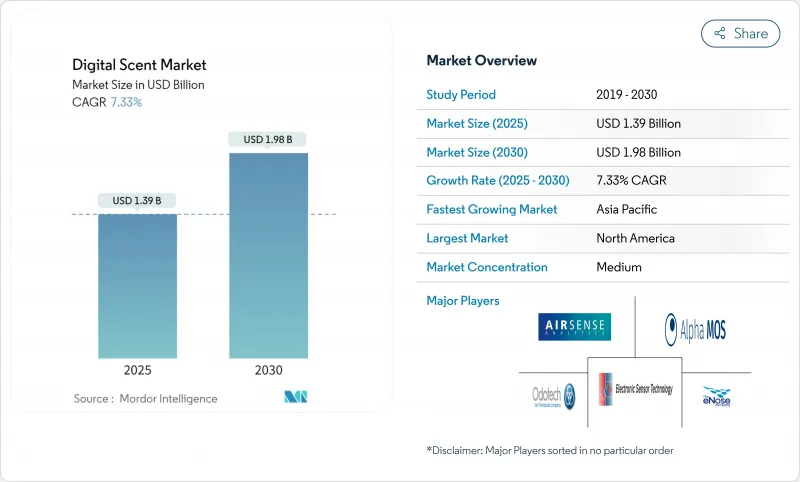
Steady progress in artificial intelligence, IoT networking, and sensor miniaturization is allowing real-time olfactory digitization across healthcare, defense, environmental monitoring, consumer electronics, and immersive media. Commercial momentum is anchored in breath-based disease diagnostics that have demonstrated 86% accuracy in clinical settings. Military procurement also underpins spending, with the U.S. EXHALE program funding handheld volatile-compound detectors for force health protection. Regional demand skews toward North America, which controlled 37.6% of the Digital Scent market in 2024, while Asia-Pacific is expanding the fastest on 9.3% CAGR as Japan's fragrance economy and China's perception-intelligence sector scale rapidly. Hardware revenues remain concentrated in electronic-nose (e-nose) systems that captured 61.8% share in 2024, yet scent synthesizers are pacing growth as brands develop handheld aroma devices and web-linked distribution platforms. Healthcare diagnostics led end-use adoption at 34.4% share in 2024, but VR/AR entertainment is projected to rise at 9.1% CAGR as metaverse developers integrate olfactory feedback. Stricter emission caps-such as the EU's 0.062 mg/m3 formaldehyde limit effective 2026-are simultaneously pushing vendors toward biodegradable cartridge chemistries.
Global Digital Scent Market Trends and Insights
Integration of Digital Scent in Immersive VR and Metaverse Experiences
Scent-enabled VR enhances memory retention by 40% versus visual-only experiences. Lab-scale wearable interfaces now deliver odor cues within 0.07 seconds, synchronizing seamlessly with audiovisual streams. Commercial prototypes such as Aroma Shooter Wearable use replaceable scent cartridges and Bluetooth links to mixed-reality content, targeting sub-USD 400 developer pricing. Generative AI tools like OGDiffusion create new fragrances from mass-spectrometry profiles with 95% descriptor matching accuracy, reducing formulation lead times. These advances differentiate metaverse platforms and spur ecosystem partnerships among sensor firms and content publishers.
Adoption of E-Nose Diagnostics in European Healthcare Pathways
European hospitals are embedding breathomics into screening protocols because e-noses align with histopathology in 86% of lung-cancer cases while costing roughly USD 10 per test. Machine-learning models estimate cholesterol within 13.7% mean absolute error, broadening use beyond oncology. Standardized breathprint analytics already explain 97.15% population variance, and portable multi-channel odor testers enable self-administered smell assessments that cut clinic workload while retaining accuracy. As reimbursement frameworks mature, e-nose diagnostics are on track to become routine early-stage screening tools.
High Calibration and Maintenance Costs of Multi-Sensor E-Noses
Annual recalibration can reach 30% of initial hardware cost because sensor drift undermines accuracy in diverse temperature and humidity conditions. Emerging self-calibrating algorithms boost correlation coefficients to 0.9 against reference instruments and lengthen maintenance intervals, yet cost remains a barrier for small laboratories and food processors. Lower-priced open-source designs are entering the market, but they still require skilled oversight, tempering near-term adoption.
Other drivers and restraints analyzed in the detailed report include:
- Regulatory Push for Real-Time Industrial Odor Monitoring in EU and China
- Defense Contracts for Chemical and Bio-Threat Detection Systems
- Interoperability Gaps from Lack of Standard Digital Scent Protocols
For complete list of drivers and restraints, kindly check the Table Of Contents.
Segment Analysis
E-nose platforms generated 61.8% of Digital Scent market revenue in 2024 as hospitals, industrial plants, and security agencies prioritized their proven classification accuracy and maturity. Biomimetic chips embedding 10,000 addressable gas sensors now provide reference-lab selectivity in handheld packages, while temperature-modulated tungsten-trioxide films shorten detection windows to under a second. The Digital Scent market size for scent synthesizers is projected to lift from USD 0.44 billion in 2025 to USD 0.67 billion by 2030 on 8.4% CAGR, supported by luxury retail and streaming-media clients seeking multisensory engagement. Vendors are investing in biodegradable polymer cartridges to meet looming EU formaldehyde limits. Ongoing convergence with AI accelerators allows on-device spectral matching, reducing latency and bandwidth consumption during field operations.
Second-generation hardware emphasizes portability. Credit-card devices that identify explosives in milliseconds are in pilot trials with first responders, while neckband diffusers synchronize aroma bursts to sporting events and music concerts. Modular design philosophies enable component swaps-sensor arrays, fan assemblies, cartridge bays-prolonging device life and lowering total cost of ownership. This iterative hardware roadmap supports the Digital Scent market's transition from lab-centric experiments to everyday consumer
Healthcare facilities accounted for 34.4% of Digital Scent market revenue in 2024 as breath tests for oncology, cholesterol, and infectious diseases moved from research to practice. E-nose diagnostics shorten wait times and reduce patient discomfort relative to imaging or invasive sampling. Meanwhile, the entertainment sector is forecast to capture an incremental USD 120 million by 2030, rising at 9.1% CAGR as metaverse platforms, theme parks, and esports arenas embed olfactory layers that heighten immersion and brand differentiation. Content producers collaborate with sensor firms to auto-trigger scene-specific aromas, creating subscription-based scent-pack models that mirror video streaming revenue structures.
Industrial odor compliance, food safety, and smart-home diffusers form a diversified mid-tier. Automotive OEMs are trialing cabin-air signature customization, and premium retailers deploy scent zones to boost dwell time and purchase intent. Governments' increasing reliance on e-nose installations for border security and hazardous-material screening continues to add to defense-derived demand. Collectively, these verticals reinforce the Digital Scent industry's resilience against single-sector slowdowns.
The Digital Scent Market Report is Segmented by Hardware (E-Nose, Scent Synthesizer, and More), End-Use Industry (Healthcare Diagnostics, Food and Beverage Quality Control, and More), Application (Medical Breath and Disease Diagnostics, Quality Inspection and Grading, and More), Form Factor (Fixed/Benchtop Systems, Portable Handheld Devices, and More), and Geography. The Market Forecasts are Provided in Terms of Value (USD).
Geography Analysis
North America retained 37.6% of Digital Scent market revenue in 2024, benefiting from robust defense budgets, venture-capital networks, and leading oncology centers that validate e-nose therapeutics. California's Air Resources Board VOC regulations simultaneously incentivize industrial deployments that cut emissions and document compliance. Regional software ecosystems accelerate commercialization by pairing cloud analytics with hardware start-ups, shortening go-to-market cycles.
Asia-Pacific is forecast to grow at 9.3% CAGR, the fastest worldwide, as Japan's fragrance segment nearly doubled within two years and Chinese smart-city initiatives mandate sensor-based air-quality monitoring. Government innovation subsidies and manufacturing scale lower production costs, encouraging rapid consumer adoption of smart diffusers and AR-linked scent devices. Local firms translate scents into language and emotion scores, expanding retail and hospitality use cases.
Europe remains a steady contributor, underpinned by the Industrial Emission Directive and long-standing R&D partnerships between universities and specialty-chemicals companies. The impending 2026 formaldehyde limit accelerates demand for compliant cartridge materials and continuous-monitoring sensors. Leading fragrance houses leverage Paris-based digital factories to co-create AI-designed scents with clients, strengthening the region's creative supply chain. South America and the Middle East & Africa currently capture modest shares but show rising opportunity in environmental compliance and oil-and-gas safety, particularly where e-noses detect hydrocarbons at spill sites.
- Alpha MOS SA
- Aryballe Technologies SA
- Electronic Sensor Technology Inc.
- Airsense Analytics GmbH
- Plasmion GmbH
- Odotech Inc.
- The eNose Company
- Comon Invent BV
- Aroma Bit, Inc.
- Aromajoin Corporation
- Scent Sciences Corporation
- Olorama Technology
- Aromyx Corporation
- Stratuscent Inc.
- Scentrealm Inc.
- Vapor Communications
- Olfactomics BV
- SmellSpace Pte Ltd
- Nose Labs AB
- Bosch Sensortec GmbH
Additional Benefits:
- The market estimate (ME) sheet in Excel format
- 3 months of analyst support
TABLE OF CONTENTS
1 INTRODUCTION
- 1.1 Study Assumptions and Market Definition
- 1.2 Scope of the Study
2 RESEARCH METHODOLOGY
3 EXECUTIVE SUMMARY
4 MARKET LANDSCAPE
- 4.1 Market Overview
- 4.2 Market Drivers
- 4.2.1 Integration of Digital Scent in Immersive VR and Metaverse Experiences
- 4.2.2 Adoption of E-Nose Diagnostics in European Healthcare Pathways
- 4.2.3 Regulatory Push for Real-Time Industrial Odor Monitoring in EU and China
- 4.2.4 Defense Contracts for Chemical and Bio-Threat Detection Systems
- 4.2.5 IoT-Enabled Smart-Home Diffusers with AI Scent Personalization
- 4.2.6 Premium Brand Scent Marketing in Automotive and Flagship Retail
- 4.3 Market Restraints
- 4.3.1 High Calibration and Maintenance Costs of Multi-Sensor E-Noses
- 4.3.2 Interoperability Gaps from Lack of Standard Digital Scent Protocols
- 4.3.3 EU VOC-Emission Rules Limiting Cartridge Formulations
- 4.3.4 Scarcity of Large Annotated Olfactory Datasets for AI Models
- 4.4 Industry Value Chain Analysis
- 4.5 Regulatory and Technological Outlook
- 4.6 Porter's Five Forces Analysis
- 4.6.1 Bargaining Power of Buyers
- 4.6.2 Bargaining Power of Suppliers
- 4.6.3 Threat of New Entrants
- 4.6.4 Threat of Substitute Products
- 4.6.5 Intensity of Competitive Rivalry
- 4.7 Investment Analysis
5 MARKET SIZE AND GROWTH FORECASTS (VALUES)
- 5.1 By Hardware
- 5.1.1 E-Nose
- 5.1.2 Scent Synthesizer
- 5.1.3 Scent Cartridge/Module
- 5.2 By End-use Industry
- 5.2.1 Healthcare Diagnostics
- 5.2.2 Food and Beverage Quality Control
- 5.2.3 Environmental Monitoring and Waste Management
- 5.2.4 Defense and Security
- 5.2.5 Consumer Electronics and Smart Home
- 5.2.6 Entertainment and VR/AR
- 5.2.7 Marketing and Retail Experiences
- 5.3 By Application
- 5.3.1 Medical Breath and Disease Diagnostics (Breath and Fluid)
- 5.3.2 Quality Inspection and Grading
- 5.3.3 Odor Monitoring and Pollution Control
- 5.3.4 Threat and Explosive Detection
- 5.3.5 Immersive Content and Gaming
- 5.3.6 Immersive Aroma Marketing
- 5.4 By Form Factor
- 5.4.1 Fixed/Benchtop Systems
- 5.4.2 Portable Handheld Devices
- 5.4.3 Wearable and Embedded Modules
- 5.4.4 Networked Sensor Arrays
- 5.5 By Geography
- 5.5.1 North America
- 5.5.1.1 United States
- 5.5.1.2 Canada
- 5.5.1.3 Mexico
- 5.5.2 Europe
- 5.5.2.1 Germany
- 5.5.2.2 United Kingdom
- 5.5.2.3 France
- 5.5.2.4 Nordics
- 5.5.2.5 Rest of Europe
- 5.5.3 South America
- 5.5.3.1 Brazil
- 5.5.3.2 Rest of South America
- 5.5.4 Asia-Pacific
- 5.5.4.1 China
- 5.5.4.2 Japan
- 5.5.4.3 India
- 5.5.4.4 South-East Asia
- 5.5.4.5 Rest of Asia-Pacific
- 5.5.5 Middle East and Africa
- 5.5.5.1 Middle East
- 5.5.5.1.1 Gulf Cooperation Council Countries
- 5.5.5.1.2 Rest of Middle East
- 5.5.5.2 Africa
- 5.5.5.2.1 South Africa
- 5.5.5.2.2 Rest of Africa
- 5.5.1 North America
6 COMPETITIVE LANDSCAPE
- 6.1 Strategic Moves
- 6.2 Market Share Analysis
- 6.3 Company Profiles (includes Global Overview, Market Overview, Core Segments, Financials, Strategic Info, Market Rank/Share, Products and Services, Recent Developments)
- 6.3.1 Alpha MOS SA
- 6.3.2 Aryballe Technologies SA
- 6.3.3 Electronic Sensor Technology Inc.
- 6.3.4 Airsense Analytics GmbH
- 6.3.5 Plasmion GmbH
- 6.3.6 Odotech Inc.
- 6.3.7 The eNose Company
- 6.3.8 Comon Invent BV
- 6.3.9 Aroma Bit, Inc.
- 6.3.10 Aromajoin Corporation
- 6.3.11 Scent Sciences Corporation
- 6.3.12 Olorama Technology
- 6.3.13 Aromyx Corporation
- 6.3.14 Stratuscent Inc.
- 6.3.15 Scentrealm Inc.
- 6.3.16 Vapor Communications
- 6.3.17 Olfactomics BV
- 6.3.18 SmellSpace Pte Ltd
- 6.3.19 Nose Labs AB
- 6.3.20 Bosch Sensortec GmbH
7 MARKET OPPORTUNITIES AND FUTURE OUTLOOK
- 7.1 White-Space and Unmet-Need Assessment