|
시장보고서
상품코드
1851626
분만 모니터링 기기 : 시장 점유율 분석, 산업 동향, 통계, 성장 예측(2025-2030년)Intrapartum Monitoring Devices - Market Share Analysis, Industry Trends & Statistics, Growth Forecasts (2025 - 2030) |
||||||
 Mordor Intelligence
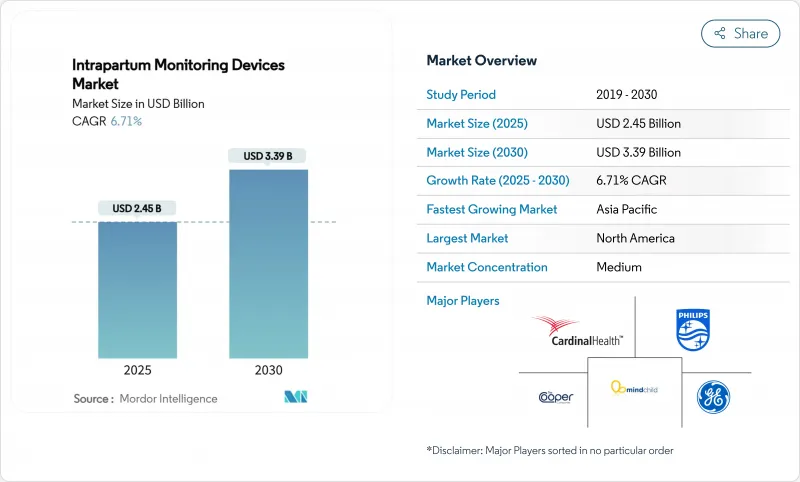
분만 모니터링 기기 시장 규모는 2025년 24억 5,000만 달러에 이르고, CAGR 6.71%를 나타낼 전망이며, 2030년에는 33억 9,000만 달러로 상승할 것으로 예측됩니다.
성장세는 딥러닝 모델이 태아의 심신호와 모체의 심신호를 분리할 때 97.9%의 정확도를 달성한 인공지능과 기존의 심전도의 급속한 페어링을 반영하고 있습니다. 미국에서는 2014년부터 2022년에 걸쳐 조산의 유병률이 12% 상승해, NICU에의 입실도 병행해 증가했기 때문에 분만중의 감시를 보다 스마트하게 하고 싶다고 하는 수요가 높아졌습니다. 건강 관리 제공업체는 임산부의 이동성을 향상시키는 비침습적인 기술도 지원합니다. 이러한 외부 시스템은 2024년 매출의 약 70%를 차지하고 환자의 쾌적성 지표에 보답하는 진료 보수의 틀로 확대를 계속했습니다. 한편, 제조업체 각사는 지방 시설이나 구급 팀에 대응하는 휴대용 AI 대응 디바이스로 차별화를 도모하고 있어, 2026년 1월 이후, 모든 분만실에 태아 모니터링용 하드웨어를 설치하는 것을 의무화하는 정책에 의해 그 자리 매김은 강화되고 있습니다.
세계의 분만 모니터링 기기 시장 동향과 인사이트
비침습적 태아 심전도 기술의 신속한 채용
비침습적 태아 심전도는 벨트나 두피 전극 없이 비트-투-비트 심박수 분석을 제공하며, 특히 높은 BMI 환자에서 도플러 정확도에 필적하거나 능가합니다. 그 자유로운 움직임은 현재 병원의 진료보수에 연결되어 있는 지표인 어머니의 만족도를 높입니다. 유행성 시대의 원격 모니터링 시험에서 임상가에게 지속적으로 데이터를 전송하는 홈 ECG 패치가 검증되었습니다. 따라서 의료 시스템 구매위원회는 이동성, 편안함 및 신호 견고성을 핵심 기준으로 삼고 ECG 채널을 무선 패치 플랫폼에 통합하기 위해 공급업체를 지원하고 있습니다. AI 해석에 중점을 둔 신흥 기업은 연속 파형을 몇 초 이내에 실용적인 경보로 변환하여 부가가치를 높이고 있습니다.
조산아와 NICU 입실 증가
2020년에는 전 세계에서 1,340만 명의 조산아가 태어날 것으로 예측되었으며, 이는 출생아의 9.9%에 해당합니다. 미국에서는 NICO 입실률이 2016년 8.7%에서 2023년 9.8%로 상승했습니다. NICU의 일일 비용은 3,000-5,000달러이며, 분만 중 조기 발견은 지불자에게 경제적으로 매력적입니다. 감속과 자궁 빈맥을 몇 분 빨리 발견하는 고급 모니터링은 긴급 제왕 절개와 신경 발달의 이환율을 줄일 수 있습니다. 이 동향은 출산을 지연시키는 여성에 의해 증폭됩니다. 35세 이상의 어머니의 임신은 위험이 높고 간헐적인 청진보다 지속적인 전자 감시가 필요합니다.
고급 중앙 모니터링 스테이션을 위한 고액의 자본 지출
다상식 태아 텔레메트리 플랫폼에 투자하는 병원은 종종 EHR과의 통합, 사이버 보안 강화, 직원 재교육 등 7자리 예산에 직면하게 됩니다. 프리즈마 헬스가 1,500개 유닛에 4,100만 달러의 스마트 침대를 도입한 것은 자본 헌신의 규모를 보여줍니다. BARTS Health NHS 트러스트 사이트 전체의 바이탈 사인 모니터링과 같은 조달 입찰은 개방형 API와 ISO 27001 규정 준수를 요구하며 IT 오버헤드를 추가합니다. 자금 부족 지역 병원은 업그레이드를 연기하고, 지방 어머니가 지속적인 CTG 대신 촉진과 간헐적인 도플러 검사를 받는 단계적인 기술 상황을 만들고 있습니다.
부문 분석
2024년 매출은 전극이 65.45%를 차지하고 모든 모달리티의 신호 포착에 필수적인 역할을 하는 것으로 밝혀졌습니다. 그러나 모니터는 태아, 모체, 자궁 채널을 하나의 인클로저에 포함한 멀티 파라미터, AI 대응 플랫폼에 대한 수요를 반영하여 CAGR이 7.12% 상승했습니다. GE의 Novi 무선 패치는 벨트가 필요없는 쉘에 ECG와 EMG를 통합하여 환자의 편의성을 높이는 동시에 문서화 의무를 충족합니다. 삼성에 의한 9,240만 달러의 소니오 인수는 CTG 워크플로우를 강화하는 초음파 연동 분석의 중요성을 강조합니다. 이러한 통합은 하드웨어 교체 사이클을 초월한 종합적인 분만 모니터링 기기 시장 가치 제안을 실현합니다. 각 모니터는 여전히 일회용 또는 재사용 가능한 변환기를 필요로 하므로 전극 유닛의 판매가 꾸준히 증가하여 대규모 소모품의 수익 흐름을 유지하고 있습니다.
2세대 모니터는 클라우드 연결 및 의사결정 지원을 번들로 제공하여 구매 기준을 하드웨어 사양에서 소프트웨어 로드맵으로 이동합니다. EDAN의 F3 태아 모니터는 온보드 CTG 분석을 제공하여 젊은 직원의 해석 부하를 줄입니다. 구독 기반 알고리즘 업데이트를 모색하는 공급업체는 병원이 자본 업데이트 없이 지속적으로 개선되는 분류에 액세스할 수 있는 반면 수익을 원활하게 할 수 있습니다. 그 결과, 모니터는 소모품인 전극에 뒷받침된 소프트웨어 플랫폼으로 재위치되어 분만 모니터링 기기 시장에서의 지속적인 견인력이 확보됩니다.
비침습성 시스템은 2024년 매출의 69.91%를 차지했고 수익과 예측 CAGR은 7.21%로 규모와 성장 양면에서 주도권을 유지하고 있습니다. 외부 도플러 초음파와 토코다이나모미터는 자궁 경관 확장과 감염 위험을 피할 수 있으므로 일상적인 산과 관리를 지배합니다. 분만 모니터링 기기 시장 규모는 새로운 패치가 블루투스를 통해 신호를 중계하고 어머니가 스트랩 재조정 없이 도보하거나 분만 공을 사용할 수 있게 되면서 더욱 확대됩니다. 내부 두피 전극과 자궁 내압 카테터는 비만, 악영향, 신호 잡음으로 인해 외부 측정을 방해하는 경우 여전히 정확도가 높은 골드 표준입니다. 최근의 임상시험에서는 내부 CTG는 외부 모니터링에 비해 제왕절개의 발생률이나 신생아의 결과도 악화시키지 않는 것으로 나타나 임상적응이 퍼질 가능성이 있습니다. 그러나 막 파열의 필요성으로 인해 사용이 제한됩니다.
하이브리드 원격 측정은 고충실도 신호와 이동성의 두 가지 이점을 제공합니다. 어머니의 맥박 동시 기록에 관한 헬싱키 대학의 연구 결과는 아티팩트 필터링이 신생아 뇌증을 예방하고 멀티 매개 변수 솔루션의 채택을 가속화합니다. 따라서 외부 플랫폼은 크로스토크를 자동으로 제거하는 모체 ECG 채널을 포함하도록 진화하여 분만 모니터링 기기 시장에서 비침습적 우위성을 강화합니다.
지역 분석
북미의 42.29% 점유율은 엄격한 기준과 1인당 건강 관리 지출의 높이 때문입니다. CMS 규칙은 태아 모니터에 대한 보편적인 접근을 의무화하고 NICU 입장은 출산의 10%를 향하고 있으며 모니터링의 진화가 진행되고 있습니다. 그러나 2024년에는 지방 산과 병동의 폐쇄가 잇따라 의료 과오 보험료가 급등했기 때문에 의료 시스템은 현장 전문의가 없어도 감시할 수 있는 원격 CTG 허브를 시험적으로 설치하게 되었습니다. Philips가 조지아의 헬스 플랜과 제휴한 원격 임산부 프로그램과 같은 공급업체와의 파트너십은 분만 모니터링 기기 시장이 노동력 부족에 어떻게 적응하고 있는지를 보여줍니다.
아시아태평양은 임산부 사망률 감소의 추진과 도시 지역의 병원 건설 붐에 힘입어 CAGR 7.45%로 제일 빠른 성장률을 나타낼 전망입니다. 정부는 3차 의료 센터의 클라우드 대시보드에 연결된 Bluetooth CTG를 산과 병동에 장비하는 디지털 헬스 파일럿을 조성하고 있습니다. 일본과 한국에서는 AI 통역 파일럿에 의해 의사결정이 신속화되는 한편, 신흥국에서는 조산사 연수와 병행하여 기본적인 기기의 배치가 우선되고 있습니다. 아시아 개발 은행의 통합 케어 보조금은 하이브리드 임산부-NCD 원격 측정 네트워크에 자금을 제공하고 수요를 더욱 확대하고 있습니다.
유럽은 규제 스위트 스팟에 위치하고 있습니다. EU-MDR의 정합화는 국경을 넘는 인증을 간소화하고, 확립된 상환 제도가 고급 CTG의 사용을 커버하고 있습니다. 프랑스 병원에서는 미숙아 신생아 조기 퇴원을 위해 Massimo SafetyNet을 사용하고 있으며 비용 효과가 일치하면 원격 모니터링에 투자 의욕이 있음을 입증합니다. 중동 및 아프리카, 남미는 아직 발전도상이지만 유망합니다. 사하라 이남의 아프리카에서는 디지털 헬스 렌즈가 모바일 CTG를 고정 인프라가 부족한 지역에서 리프플로그 기술로 자리잡고 있습니다.
기타 혜택 :
- 엑셀 형식 시장 예측(ME) 시트
- 3개월간의 애널리스트 지원
목차
제1장 서론
- 조사 전제조건과 시장 정의
- 조사 범위
제2장 조사 방법
제3장 주요 요약
제4장 시장 상황
- 시장 개요
- 시장 성장 촉진요인
- 비침습적 태아 ECG 기술의 급속한 보급
- 조산과 NICE 입실 증가
- 분만내 모니터링 기준에 관한 정부의 의무화
- 35세 이상의 여성에서 고위험 임신 증가
- CTG 시스템에 내장된 AI 탑재의 실시간 진통 분석
- 사하라 이남의 아프리카에 있어서 원격 노동 병동의 진료 보수 인상
- 시장 성장 억제요인
- 고급 중앙 감시 스테이션을 위한 고액의 자본 지출
- 엄격한 FDA와 EU-MDR의 임상 증거 요구
- Wi-Fi 대응 CTG 모니터의 사이버 보안 책임
- 산과 간호사의 부족
- 규제 상황
- Porter's Five Forces 분석
- 신규 참가업체의 위협
- 구매자의 협상력
- 공급기업의 협상력
- 대체품의 위협
- 기업 간 경쟁 관계
제5장 시장 규모와 성장 예측
- 제품 유형별
- 전극
- 자궁내압 카테터(IUPC)
- 태아 두피 전극
- 자궁 수축 변환기
- 태아 심박수 변환기
- 모니터
- 전극
- 모니터링 방법별
- 침습적
- 비침습적
- 휴대성별
- 고정형
- 휴대형
- 최종 사용자별
- 병원
- 전문 클리닉
- 기타
- 지역별
- 북미
- 미국
- 캐나다
- 멕시코
- 유럽
- 독일
- 영국
- 프랑스
- 이탈리아
- 스페인
- 기타 유럽
- 아시아태평양
- 중국
- 일본
- 인도
- 호주
- 한국
- 기타 아시아태평양
- 중동 및 아프리카
- GCC
- 남아프리카
- 기타 중동 및 아프리카
- 남미
- 브라질
- 아르헨티나
- 기타 남미
- 북미
제6장 경쟁 구도
- 시장 집중도
- 시장 점유율 분석
- 기업 프로파일
- GE Healthcare
- Koninklijke Philips NV
- Medtronic plc
- Natus Medical Inc.
- Cardinal Health
- Analogic Corp.
- Shenzhen Mindray Bio-Medical
- Nihon Kohden Corp.
- Dragerwerk AG & Co. KGaA
- Arjo-Huntleigh(Huntleigh Healthcare)
- Samsung Medison
- EDAN Instruments
- Cooper Surgical(The Cooper Companies)
- Stryker Corp.
- Olympus Corp.
- Bionet Co. Ltd.
- Monica Healthcare
- Nonin Medical
- Wallach Surgical Devices
- MindChild Medical
제7장 시장 기회와 향후 전망
KTH 25.11.24The intrapartum monitoring devices market size reached USD 2.45 billion in 2025 and is forecast to climb to USD 3.39 billion by 2030 at a 6.71% CAGR.
Growth momentum reflects the rapid pairing of artificial intelligence with traditional cardiotocography, where deep-learning models have achieved 97.9% accuracy in separating fetal and maternal heart signals. Rising pre-term birth prevalence-up 12% in the United States between 2014 and 2022-and the parallel increase in NICU admissions fuel demand for smarter surveillance during labor. Healthcare providers also favor non-invasive technologies that improve maternal mobility; these external systems captured almost 70% of 2024 revenues and continue to expand as reimbursement frameworks reward patient-comfort metrics. Meanwhile, manufacturers differentiate through portable, AI-ready devices that serve rural facilities and emergency teams, a positioning reinforced by policy mandates requiring fetal monitoring hardware in all labor rooms from January 2026.
Global Intrapartum Monitoring Devices Market Trends and Insights
Rapid Adoption of Non-Invasive Fetal ECG Technology
Non-invasive fetal electrocardiography offers beat-to-beat heart-rate analysis without belts or scalp electrodes, matching or surpassing Doppler accuracy, particularly in high-BMI patients. Its freedom of movement boosts maternal satisfaction scores, a metric now tied to hospital reimbursement. Pandemic-era remote-monitoring pilots validated home-based ECG patches that transmit continuous data to clinicians, lowering exposure risk while sustaining oversight. Health-system purchasing committees thus rank mobility, comfort, and signal robustness as core criteria, pushing suppliers to embed ECG channels into wireless patch platforms. Start-ups focused on AI interpretation layer additional value by converting continuous waveforms into actionable alerts within seconds.
Rising Pre-Term Births & NICU Admissions
Worldwide, 13.4 million babies were born preterm in 2020, equivalent to 9.9% of live births . In the United States, NICU admissions rose from 8.7% in 2016 to 9.8% in 2023. Each NICU day costs USD 3,000-5,000, making early intrapartum detection financially attractive to payers . Advanced monitoring that flags decelerations or uterine tachysystole minutes earlier can reduce emergency cesareans and neurodevelopmental morbidity. The trend is amplified by women delaying childbirth; pregnancies in mothers > 35 years carry higher risks and more often trigger continuous electronic surveillance rather than intermittent auscultation.
High Capital Outlay for Advanced Central Surveillance Stations
Hospitals investing in multi-bed fetal telemetry platforms often face seven-figure budgets when integration with EHR, cybersecurity hardening, and staff re-training are included. Prisma Health's USD 41 million smart-bed deployment across 1,500 units illustrates the scale of capital commitments. Procurement tenders such as BARTS Health NHS Trust's site-wide vital-signs monitoring call for open APIs and ISO 27001 compliance, adding IT overhead. Under-funded community hospitals postpone upgrades, creating a tiered technology landscape where rural mothers receive palpation or intermittent doppler checks instead of continuous CTG.
Other drivers and restraints analyzed in the detailed report include:
- Government Mandates on Intrapartum Monitoring Standards
- Growth of High-Risk Pregnancies in Women More Than 35 Years
- Stringent FDA & EU-MDR Clinical Evidence Demands
For complete list of drivers and restraints, kindly check the Table Of Contents.
Segment Analysis
Electrodes retained 65.45% revenue in 2024, underscoring their indispensable role in signal capture across all modalities. Yet monitors post a faster 7.12% CAGR, reflecting demand for multi-parameter, AI-ready platforms that house fetal, maternal, and uterine channels in one chassis. GE's Novii wireless patch incorporates ECG and EMG within a belt-free shell that elevates patient comfort while satisfying documentation mandates. Samsung's USD 92.4 million Sonio purchase highlights the premium on ultrasound-linked analytics that augment CTG workflows. Such integrations deliver holistic intrapartum monitoring devices market value propositions that transcend hardware replacement cycles. Electrode unit sales nonetheless rise steadily because each monitor still needs disposable or reusable transducers, preserving a large consumables revenue stream.
Second-generation monitors bundle cloud connectivity and decision support, shifting purchasing criteria from hardware specifications toward software roadmaps. EDAN's F3 fetal monitor offers on-board CTG analytics, easing interpretation load for junior staff. Vendors exploring subscription-based algorithm updates can smooth revenue while hospitals gain access to continuously improving classifications without capital refresh. The resulting convergence repositions monitors as software platforms backed by consumable electrodes, ensuring lasting traction within the intrapartum monitoring devices market.
Non-invasive systems captured 69.91% of 2024 revenue and are forecast for a 7.21% CAGR, maintaining dual leadership in size and growth. External Doppler ultrasound and tocodynamometers dominate routine obstetric care because they avoid cervical dilation and infection risk. Intrapartum monitoring devices market size gains further as new patches relay signals via Bluetooth, freeing mothers to ambulate or use birthing balls without strap readjustments. Internal scalp electrodes and intrauterine pressure catheters remain the precision gold standard when obesity, malpresentation, or signal noise impede external readings. Recent trials show internal CTG neither raises cesarean incidence nor worsens neonatal outcomes versus external monitoring, potentially broadening clinical indications. However, the need for ruptured membranes limits usage.
Hybrid telemetry arranges dual benefits: high-fidelity signals plus mobility. University of Helsinki findings on simultaneous maternal pulse recording confirm that artifact filtering prevents neonatal encephalopathy, accelerating adoption of multiparameter solutions. External platforms therefore evolve to include maternal ECG channels that auto-subtract cross-talk, reinforcing non-invasive dominance inside the intrapartum monitoring devices market.
The Intrapartum Monitoring Devices Market Report is Segmented by Product Type (Electrodes, Monitors), Monitoring Method (Invasive, Non-Invasive), Portability (Fixed, Portable), End-User (Hospitals, Specialty Clinics, Others), and Geography (North America, Europe, Asia-Pacific, Middle East and Africa, South America). The Market Forecasts are Provided in Terms of Value (USD).
Geography Analysis
North America's 42.29% stake stems from stringent standards and high per-capita healthcare spending. Forthcoming CMS rules compel universal fetal-monitor access, and NICU admissions edging toward 10% of births intensify monitoring sophistication. Yet 2024 saw multiple rural obstetric unit shutdowns and rising malpractice premiums, pushing health systems to pilot tele-CTG hubs that extend oversight without on-site specialists. Vendor partnerships, such as Philips' collaboration with Georgia health plans for remote maternal programs, illustrate how the intrapartum monitoring devices market adapts to workforce deficits.
Asia-Pacific claims the speed crown at 7.45% CAGR, lifted by maternal mortality reduction drives and urban hospital construction booms. Governments subsidize digital health pilots that outfit district maternity wards with Bluetooth CTG linked to cloud dashboards in tertiary centers. In Japan and South Korea, AI-interpretation pilots expedite decision making, while emerging economies prioritize basic device deployment alongside midwife training. The Asian Development Bank's integrated-care grants finance hybrid maternal-NCD telemetry networks, further scaling demand.
Europe sits in a regulatory sweet spot: EU-MDR harmonization simplifies cross-border certifications, and established reimbursement structures cover advanced CTG usage. French hospitals using Masimo SafetyNet for premature newborn early discharge evidence willingness to invest in telemonitoring when cost-benefit aligns. Middle East, Africa, and South America remain nascent but promising. Sub-Saharan Africa's digital-health lens positions mobile CTG as a leapfrog technology in regions lacking fixed infrastructure.
- GE Healthcare
- Koninklijke Philips
- Medtronic
- Natus Medical
- Cardinal Health
- Analogic Corp.
- Shenzhen Mindray Bio-Medical
- Nihon Kohden Corp.
- Dragerwerk
- Arjo-Huntleigh (Huntleigh Healthcare)
- Samsung Group
- EDAN Instruments
- Cooper Surgical (The Cooper Companies)
- Stryker
- Olympus Corp.
- Bionet Co. Ltd.
- Monica Healthcare
- Nonin Medical
- Wallach Surgical Devices
- MindChild Medical
Additional Benefits:
- The market estimate (ME) sheet in Excel format
- 3 months of analyst support
TABLE OF CONTENTS
1 Introduction
- 1.1 Study Assumptions & Market Definition
- 1.2 Scope of the Study
2 Research Methodology
3 Executive Summary
4 Market Landscape
- 4.1 Market Overview
- 4.2 Market Drivers
- 4.2.1 Rapid adoption of non-invasive fetal ECG technology
- 4.2.2 Rising pre-term births & NICU admissions
- 4.2.3 Government mandates on intrapartum monitoring standards
- 4.2.4 Growth of high-risk pregnancies in women more than 35 yrs
- 4.2.5 AI-powered real-time labour analytics embedded in CTG systems
- 4.2.6 Reimbursement uplifts for remote labour wards in Sub-Saharan Africa
- 4.3 Market Restraints
- 4.3.1 High capital outlay for advanced central surveillance stations
- 4.3.2 Stringent FDA & EU-MDR clinical evidence demands
- 4.3.3 Cyber-security liabilities of Wi-Fi enabled CTG monitors
- 4.3.4 Shortage of trained obstetric nurses
- 4.4 Regulatory Landscape
- 4.5 Porter's Five Forces Analysis
- 4.5.1 Threat of New Entrants
- 4.5.2 Bargaining Power of Buyers
- 4.5.3 Bargaining Power of Suppliers
- 4.5.4 Threat of Substitutes
- 4.5.5 Intensity of Competitive Rivalry
5 Market Size & Growth Forecasts (Value, USD)
- 5.1 By Product Type
- 5.1.1 Electrodes
- 5.1.1.1 Intra-uterine Pressure Catheters (IUPC)
- 5.1.1.2 Fetal Scalp Electrodes
- 5.1.1.3 Uterine Contraction Transducers
- 5.1.1.4 Fetal Heart-Rate Transducers
- 5.1.2 Monitors
- 5.1.1 Electrodes
- 5.2 By Monitoring Method
- 5.2.1 Invasive
- 5.2.2 Non-Invasive
- 5.3 By Portability
- 5.3.1 Fixed
- 5.3.2 Portable
- 5.4 By End-User
- 5.4.1 Hospitals
- 5.4.2 Specilaty Clinics
- 5.4.3 Others
- 5.5 By Geography
- 5.5.1 North America
- 5.5.1.1 United States
- 5.5.1.2 Canada
- 5.5.1.3 Mexico
- 5.5.2 Europe
- 5.5.2.1 Germany
- 5.5.2.2 United Kingdom
- 5.5.2.3 France
- 5.5.2.4 Italy
- 5.5.2.5 Spain
- 5.5.2.6 Rest of Europe
- 5.5.3 Asia-Pacific
- 5.5.3.1 China
- 5.5.3.2 Japan
- 5.5.3.3 India
- 5.5.3.4 Australia
- 5.5.3.5 South Korea
- 5.5.3.6 Rest of Asia-Pacific
- 5.5.4 Middle East and Africa
- 5.5.4.1 GCC
- 5.5.4.2 South Africa
- 5.5.4.3 Rest of Middle East and Africa
- 5.5.5 South America
- 5.5.5.1 Brazil
- 5.5.5.2 Argentina
- 5.5.5.3 Rest of South America
- 5.5.1 North America
6 Competitive Landscape
- 6.1 Market Concentration
- 6.2 Market Share Analysis
- 6.3 Company Profiles (includes Global level Overview, Market level overview, Core Segments, Financials as available, Strategic Information, Market Rank/Share for key companies, Products & Services, and Recent Developments)
- 6.3.1 GE Healthcare
- 6.3.2 Koninklijke Philips N.V.
- 6.3.3 Medtronic plc
- 6.3.4 Natus Medical Inc.
- 6.3.5 Cardinal Health
- 6.3.6 Analogic Corp.
- 6.3.7 Shenzhen Mindray Bio-Medical
- 6.3.8 Nihon Kohden Corp.
- 6.3.9 Dragerwerk AG & Co. KGaA
- 6.3.10 Arjo-Huntleigh (Huntleigh Healthcare)
- 6.3.11 Samsung Medison
- 6.3.12 EDAN Instruments
- 6.3.13 Cooper Surgical (The Cooper Companies)
- 6.3.14 Stryker Corp.
- 6.3.15 Olympus Corp.
- 6.3.16 Bionet Co. Ltd.
- 6.3.17 Monica Healthcare
- 6.3.18 Nonin Medical
- 6.3.19 Wallach Surgical Devices
- 6.3.20 MindChild Medical
7 Market Opportunities & Future Outlook
- 7.1 White-space & Unmet-need Assessment