|
시장보고서
상품코드
1851702
냉동요법 시장 : 시장 점유율 분석, 산업 동향, 통계, 성장 예측(2025-2030년)Global Cryotherapy - Market Share Analysis, Industry Trends & Statistics, Growth Forecasts (2025 - 2030) |
||||||
 Mordor Intelligence
세계의 냉동요법 시장 규모는 2025년에 3,601억 5,000만 달러로 추정되고, 2030년에는 4,579억 달러에 이를 것으로 예측되며, 2025-2030년 CAGR 4.92%로 성장할 전망입니다.

이 궤적은 냉동요법 시장이 피부과 수술 증가, 비침습적 통증 관리, 프랜차이즈 네트워크의 확대 등에 지지되어 전문 의료용에서 폭넓은 웰니스 용도로 이동하고 있음을 뒷받침하고 있습니다. 질소 소비를 줄이는 장비 혁신, 새로운 전기 시스템 및 데이터가 풍부한 선수 회복 플랫폼이 임상 및 소비자에게 받아들여지고 있습니다. 북미는 현재 가장 높은 지역 점유율을 차지하고 있지만 아시아태평양이 가장 빠른 지역 CAGR을 달성하고 도시 지역의 웰니스 지출과 현지 제조 규모의 혜택을 받고 있기 때문에 냉동요법 시장은 재조정을 시작하고 있습니다. 규제의 이중 구조도 성장을 형성하고 있습니다. 대상 장치가 FDA의 허가를 받는 반면, 전신 챔버는 웰니스 전용으로 남아 있으며, 가격 설정, 상환, 시장 진출 전략의 방향타를 끊고 있습니다.
세계의 냉동요법 시장 동향 및 인사이트
피부과 및 미용 시술의 급증
피부과 클리닉은 일반적인 건강법에서 증거로 뒷받침되는 치료법으로 이동하고 있습니다. 메디케어의 크라이오 신경 융해의 청구 코드는 현재, 냉열 기반의 신경 소작을 상환 대상으로 하고 있어, 의사의 채용이 퍼지고 있습니다. 1회 50-300달러의 크라이오페이셜은 병변의 제거에 그치지 않고 수익을 확대했으며, 관리된 냉동요법은 바이러스성 사마귀에 대한 효능이 문서화되어 있어 한랭 두드러기가 보고된 증례는 2% 미만이었습니다. 환자 수요 증가, 예측 가능한 상환, 합병증 발생률의 낮음으로 피부과는 크라이오서저리 시장에서 중요한 이용 사례가 되고 있습니다.
비침습적 통증 치료에 대한 선호도 증가
11의 무작위화 시험을 대상으로 하는 2025년 네이처 잡지의 메타분석에서 전신 냉동요법이 염증성 IL-1B를 감소시키고 항염증성 IL-10을 상승시키는 것으로 확인되어 진통 효과의 주장이 검증되었습니다. 현재 임상의는 관절염, 섬유근통증, 수술 후 통증의 보조 요법으로 저온 요법을 권장하고 오피오이드에 대한 의존도를 줄이고 있습니다. 스포츠 의학에서는 웨어러블이 젖산과 크레아틴 키나아제의 저하를 추적하고 운동 선수가 회복 타이밍을 미세 조정하는 데 도움이 되기 때문에 냉동요법이 주류가 되고 있습니다. 이 바이오마커 검증을 통해 크라이오서저리 시장은 집학적 통증 프로토콜에서 눈에 띄는 존재로 남아 있습니다.
부작용 및 동상 소송
2025년 4월 파리에서 발생한 치명적인 질소 누출은 챔버의 설계와 환기에 대한 세계 감시의 눈을 돌렸습니다. 유럽 산업가스협회는 환기 불량으로 질소가 산소를 대체하여 질식사를 일으킨다고 경고했습니다. 미국 FDA의 MAUDE 파일에는 시판되는 크라이오 스프레이와 관련된 동상과 봉소염이 포함되어 있습니다. 주 감시가 느슨한 곳에서는 배상 책임 보험료가 급등하고, 오퍼레이터는 산소 센서나 스탭 알람을 개수하도록 촉구되어 크라이오서저리 시장 전체의 비용 구조를 끌어올리고 있습니다.
부문 분석
냉동요법 장비는 2024년 매출의 44.00%를 차지하며 치료용 저온 모달리티의 장비 중심주의를 뒷받침합니다. 조직 접촉 및 스프레이 프로브는 센티미터 단위의 정확도가 가장 중요한 피부과 및 종양과에 기여합니다. 전기 챔버는 현재 낮은 운전 비용 및 조용한 운전 소리로 질소 모델에 대항하여 비임상 채택을 확대하고 있습니다. 동시에 액체 질소, 극저온 장갑, 산소 센서, 필터 카트리지, 교체 씰 등 신뢰할 수 있는 소모품 흐름이 공급업체의 경제성을 지원합니다. 소모품은 이미 CAGR 5.29%로 장비를 상회하고 있으며, 표준화된 소모품을 일괄 구입하는 다거점 프랜차이즈에 견인되어 Cryotherapy 시장의 지속적인 연금 모델이 강화되고 있습니다.
지역 분석
북미가 2024년 금액의 42.23%를 획득했습니다. 높은 가처분 소득, 성숙한 스포츠 의학, 유리한 프랜차이즈 규정이 지속적인 수요를 지원합니다. 연방법에서 질소 챔버는 웰빙 장비로 취급되므로 비의료 장비 판매를 위한 FDA 장비 시판 전 심사가 면제되고 보급이 가속화되고 있습니다. 그럼에도 불구하고 콜로라도 주에서는 의사의 감독, 네바다 주에서는 연령 임계값 등 주에 따라 요구 사항이 다르기 때문에 컴플라이언스가 복잡해지고 프로토콜을 사용자 정의할 수 있는 전국 규모의 사업자가 유리합니다.
아시아태평양은 2030년까지 연평균 복합 성장률(CAGR)이 6.89%로 가장 급성장하고 있는 지역입니다. 도시화, 중간 소득층 증가, 부티크 웰니스 체인의 급증이 보급의 원동력이 됩니다. 일본은 수십년에 걸친 류마티스 관절염의 데이터를 활용하여 냉온요법을 널리 일반적으로 받아들이는 것으로 선행자로서의 지위를 유지하고 있습니다. 중국과 한국은 챔버의 현지 생산을 급격히 진행하고 수입 관세를 줄이며 리드 타임을 단축합니다. 지역사업자는 저온요법을 페이셜 에스테틱 및 전통의료와 통합하여 하이브리드 소비자 제안을 함으로써 저온요법 시장을 확대하고 있습니다.
유럽은 꾸준한 성장을 유지하고 있지만 2025년 4월 질소 누출 사망 사고 이후 안전 감시 강화에 직면하고 있습니다. 각국의 노동위생기관은 현재 산소 감시 시스템과 직원의 인정을 의무화하는 가이드라인을 초안하고 있습니다. 동시에 EU의 기후 변화에 관한 법률이 그린암모니아 유래의 질소와 저GWP 크라이오스프레이의 채용에 박차를 가합니다. 서유럽의 웰니스 거점은 부유한 고객층으로부터 이익을 얻고, 동유럽 사립 병원은 EU 구조 기금과 관련하여 크라이오 어블레이션 스위트를 도입하여 안전 투자와 임상 수요의 균형을 맞추고 있습니다.
기타 혜택 :
- 엑셀 형식 시장 예측(ME) 시트
- 3개월간의 애널리스트 서포트
목차
제1장 서론
- 조사의 전제조건 및 시장 정의
- 조사 범위
제2장 조사 방법
제3장 주요 요약
제4장 시장 상황
- 시장 개요
- 시장 성장 촉진요인
- 피부과학 및 미용 시술의 급증
- 비침습적 통증 치료에 대한 기호 증가
- 프랜차이즈에 의한 전신 크라이오 센터의 규모 확대
- 메디케어 및 민간보험사의 보험 적용 확대
- 웨어러블에 선수 회복 데이터 통합
- 그린 암모니아 공장을 통한 액체 질소 조달
- 시장 성장 억제요인
- 유해 사건 및 동상 소송
- 멀티 챔버 설치를 위한 고액 설비 투자
- 크라이오스프레이의 프론 배출 규제 강화
- 비료의 피크에 있어서 질소 공급망 혼란
- 밸류체인 및 공급망 분석
- 규제 상황
- 기술의 전망
- Porter's Five Forces
- 신규 참가업체의 위협
- 구매자의 협상력
- 공급기업의 협상력
- 대체품의 위협
- 경쟁 기업 간 경쟁 관계
제5장 시장 규모 및 성장 예측
- 제품 유형별
- 디바이스
- 조직 접촉 프로브
- 조직 스프레이 프로브
- 표피 및 피하 동결 융해 장치
- 크라이오 챔버
- 극저온 가스 및 소모품
- 액세서리
- 디바이스
- 용도별
- 종양학
- 피부과학
- 심장병학
- 통증 관리 및 스포츠 회복
- 기타 용도
- 치료 유형별
- 전신
- 부분 바디
- 국소 요법 및 아이스팩 요법
- 크라이오서저리
- 최종 사용자별
- 병원 및 전문 클리닉
- 외래수술센터(ASC)
- 기타
- 지역별
- 북미
- 미국
- 캐나다
- 멕시코
- 남미
- 브라질
- 아르헨티나
- 기타 남미
- 유럽
- 독일
- 영국
- 프랑스
- 이탈리아
- 스페인
- 러시아
- 기타 유럽
- 아시아태평양
- 중국
- 인도
- 일본
- 한국
- 호주
- 기타 아시아태평양
- 중동 및 아프리카
- GCC
- 남아프리카
- 기타 중동 및 아프리카
- 북미
제6장 경쟁 구도
- 시장 집중도
- 전략적 동향
- 시장 점유율 분석
- 기업 프로파일
- Medtronic plc
- Zimmer MedizinSysteme GmbH
- CooperSurgical Inc.
- Brymill Cryogenic Systems
- Metrum CryoFlex
- IceCure Medical Ltd.
- Erbe Elektromedizin GmbH
- Metcast Medical
- CryoScience Ltd.
- Impact Cryotherapy
- CryoBuilt
- MECOTEC GmbH
- Galil Medical(Boston Scientific)
- Cortex Technology
- Quantum Cryogenics
- Kriosystem Life
- Varian Medical Systems
- Sanarus Technologies
- Shanghai Med-X Scientific
- CPSI Biotech
제7장 시장 기회 및 향후 전망
AJY 25.11.24The global Cryotherapy market size stood at USD 360.15 billion in 2025 and is forecast to reach USD 457.90 billion by 2030, reflecting a 4.92% CAGR over 2025-2030.
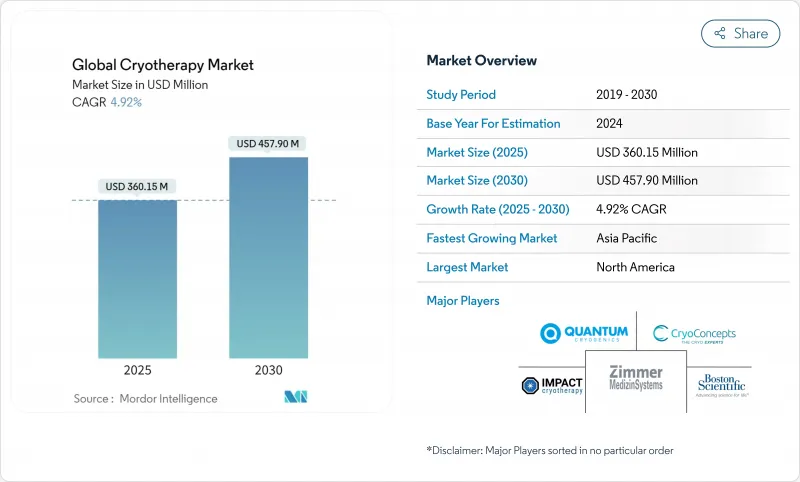
The trajectory underscores how the Cryotherapy market is shifting from specialized medical use toward broad wellness adoption, supported by rising dermatology procedures, non-invasive pain management, and expanding franchise networks. Equipment innovation that lowers nitrogen consumption, emerging electric systems, and data-rich athlete recovery platforms are widening clinical and consumer acceptance. North America currently commands the highest regional share, yet the Cryotherapy market is beginning to rebalance as Asia-Pacific delivers the quickest regional CAGR, benefiting from urban wellness spending and local manufacturing scale. Regulatory duality also shapes growth: targeted devices gain FDA clearance while whole-body chambers remain wellness-only, steering pricing, reimbursement, and go-to-market strategies.
Global Cryotherapy Market Trends and Insights
Rapid Rise in Dermatology & Cosmetic Procedures
Dermatology clinics are shifting from general wellness claims to evidence-backed therapies that command premium pricing and win insurer recognition. Medicare billing codes for cryoneurolysis now reimburse cold-based nerve ablation, broadening physician adoption. Cryofacials priced at USD 50-300 per visit extend revenue beyond lesion removal, while controlled cryotherapy shows documented efficacy against viral warts with cold urticaria reported in fewer than 2% of cases. Rising patient demand, predictable reimbursement and low complication rates reinforce dermatology as an anchor use-case within the cryosurgery market.
Increasing Preference for Non-Invasive Pain Therapies
A 2025 Nature meta-analysis of 11 randomized trials confirmed whole-body cryotherapy lowered pro-inflammatory IL-1B and elevated anti-inflammatory IL-10, validating analgesic claims. Clinicians now recommend cold therapy as an adjunct for arthritis, fibromyalgia and postoperative pain, reducing reliance on opioids. Sports medicine has mainstreamed cryotherapy as wearables track lactate and creatine-kinase drop-offs, helping athletes fine-tune recovery windows. This biomarker validation keeps the cryosurgery market prominent in multidisciplinary pain protocols.
Adverse Events & Frostbite Litigations
A fatal nitrogen leak in Paris in April 2025 drew worldwide scrutiny of chamber design and ventilation. The European Industrial Gases Association warned that poor ventilation lets nitrogen displace oxygen, causing asphyxiation. U.S. FDA MAUDE files include frostbite and cellulitis linked to over-the-counter cryo-sprays. Liability premiums surge where state oversight is light, prompting operators to retrofit oxygen sensors and staff alarms, thus raising cost structures across the cryosurgery market.
Other drivers and restraints analyzed in the detailed report include:
- Whole-Body Cryo-Centers Scaling Through Franchising
- Medicare & Private Insurer Coverage Expansions
- High Capex for Multi-Chamber Installations
For complete list of drivers and restraints, kindly check the Table Of Contents.
Segment Analysis
Cryotherapy devices generated 44.00% of 2024 revenue, confirming the equipment-centric nature of therapeutic cold modalities. Tissue contact and spray probes serve dermatology and oncology, where centimeter-scale precision is paramount. Electric chambers now challenge nitrogen models through lower operating cost and quieter operation, widening non-clinical adoption. Simultaneously, a dependable consumables stream anchors vendor economics: liquid nitrogen, cryogenic gloves, oxygen sensors, filter cartridges and replacement seals ensure recurring margin. Consumables already outpace devices with a 5.29% CAGR, driven by multi-location franchises that bulk-purchase standardized supplies, reinforcing a durable annuity model for the Cryotherapy market.
The Cryotherapy Market Report is Segmented by Product Type (Devices Including Tissue Contact Probes, Tissue Spray Probes, Epidermal and Subcutaneous Cryoablation Devices, Cryochambers; Cryogenic Gas & Consumables; Accessories), Application (Oncology, Dermatology, and More), End-User (Hospitals & Specialty Clinics, and More), and Geography (North America, Europe, and More. The Market Forecasts are Provided in Terms of Value (USD).
Geography Analysis
North America captured 42.23% of 2024 value. High disposable income, mature sports medicine and favorable franchise regulation underpin sustained demand. Federal code treats nitrogen chambers as wellness devices, sidelining FDA device premarket review for non-medical marketing, thereby accelerating rollout. Nonetheless, variability among state requirements-physician oversight in Colorado, age thresholds in Nevada-adds compliance complexity that favors nationwide operators able to tailor protocols.
Asia-Pacific represents the fastest-growing territory at 6.89% CAGR to 2030. Urbanization, rising middle-class income and a surge in boutique wellness chains drive uptake. Japan maintains early-mover status, leveraging decades of rheumatoid-arthritis data to broaden public acceptance of cold therapy. China and South Korea fast-track local chamber manufacturing, trimming import duties and shortening lead times. Regional operators integrate cryotherapy with facial aesthetics and traditional medicine, creating hybrid consumer propositions that expand the Cryotherapy market.
Europe sustains steady growth but faces intensified safety oversight after the April 2025 nitrogen-leak fatality. National occupational-health agencies now draft guidelines that mandate oxygen-monitoring systems and staff certification. Concurrently, EU climate legislation spurs adoption of green-ammonia-derived nitrogen and low-GWP cryosprays. Western European wellness hubs profit from affluent clientele, while Eastern European private hospitals introduce cryoablation suites tied to EU structural funds, balancing safety investment with clinical demand.
- Medtronic
- Zimmer MedizinSysteme
- The Cooper Companies
- Brymill Cryogenic Systems
- Metrum CryoFlex
- IceCure Medical Ltd.
- Erbe Elektromedizin
- Metcast Medical
- CryoScience Ltd.
- Impact Cryotherapy
- CryoBuilt
- MECOTEC GmbH
- Galil Medical (Boston Scientific)
- Cortex Technology
- Quantum Cryogenics
- Kriosystem Life
- Varian Medical Systems
- Sanarus Technologies
- Shanghai Med-X Scientific
- CPSI Biotech
Additional Benefits:
- The market estimate (ME) sheet in Excel format
- 3 months of analyst support
TABLE OF CONTENTS
1 Introduction
- 1.1 Study Assumptions & Market Definition
- 1.2 Scope of the Study
2 Research Methodology
3 Executive Summary
4 Market Landscape
- 4.1 Market Overview
- 4.2 Market Drivers
- 4.2.1 Rapid rise in dermatology & cosmetic procedures
- 4.2.2 Increasing preference for non-invasive pain therapies
- 4.2.3 Whole-body cryo-centers scaling through franchising
- 4.2.4 Medicare & private insurer coverage expansions
- 4.2.5 Under-reported: athlete recovery data integration into wearables
- 4.2.6 Under-reported: liquid-nitrogen sourcing via green-ammonia plants
- 4.3 Market Restraints
- 4.3.1 Adverse events & frostbite litigations
- 4.3.2 High capex for multi-chamber installations
- 4.3.3 Under-reported: tightening fluorocarbon emission rules on cryosprays
- 4.3.4 Under-reported: nitrogen supply chain disruptions in fertiliser peaks
- 4.4 Value / Supply-Chain Analysis
- 4.5 Regulatory Landscape
- 4.6 Technological Outlook
- 4.7 Porter's Five Forces
- 4.7.1 Threat of New Entrants
- 4.7.2 Bargaining Power of Buyers
- 4.7.3 Bargaining Power of Suppliers
- 4.7.4 Threat of Substitutes
- 4.7.5 Competitive Rivalry
5 Market Size & Growth Forecasts (Value, USD)
- 5.1 By Product Type
- 5.1.1 Devices
- 5.1.1.1 Tissue Contact Probes
- 5.1.1.2 Tissue Spray Probes
- 5.1.1.3 Epidermal and Subcutaneous Cryoablation Devices
- 5.1.2 Cryochambers
- 5.1.3 Cryogenic Gas & Consumables
- 5.1.4 Accessories
- 5.1.1 Devices
- 5.2 By Application
- 5.2.1 Oncology
- 5.2.2 Dermatology
- 5.2.3 Cardiology
- 5.2.4 Pain Management & Sports Recovery
- 5.2.5 Other Applications
- 5.3 By Therapy Type
- 5.3.1 Whole-body
- 5.3.2 Partial-body
- 5.3.3 Localized / Ice-pack Therapy
- 5.3.4 Cryosurgery
- 5.4 By End-user
- 5.4.1 Hospitals & Specialty Clinics
- 5.4.2 Ambulatory Surgical Centers
- 5.4.3 Others
- 5.5 By Geography
- 5.5.1 North America
- 5.5.1.1 United States
- 5.5.1.2 Canada
- 5.5.1.3 Mexico
- 5.5.2 South America
- 5.5.2.1 Brazil
- 5.5.2.2 Argentina
- 5.5.2.3 Rest of South America
- 5.5.3 Europe
- 5.5.3.1 Germany
- 5.5.3.2 United Kingdom
- 5.5.3.3 France
- 5.5.3.4 Italy
- 5.5.3.5 Spain
- 5.5.3.6 Russia
- 5.5.3.7 Rest of Europe
- 5.5.4 APAC
- 5.5.4.1 China
- 5.5.4.2 India
- 5.5.4.3 Japan
- 5.5.4.4 South Korea
- 5.5.4.5 Australia
- 5.5.4.6 Rest of APAC
- 5.5.5 Middle East and Africa
- 5.5.5.1 GCC
- 5.5.5.2 South Africa
- 5.5.5.3 Rest of Middle East and Africa
- 5.5.1 North America
6 Competitive Landscape
- 6.1 Market Concentration
- 6.2 Strategic Moves
- 6.3 Market Share Analysis
- 6.4 Company Profiles (includes Global level Overview, Market level overview, Core Segments, Financials as available, Strategic Information, Market Rank/Share for key companies, Products & Services, and Recent Developments)
- 6.4.1 Medtronic plc
- 6.4.2 Zimmer MedizinSysteme GmbH
- 6.4.3 CooperSurgical Inc.
- 6.4.4 Brymill Cryogenic Systems
- 6.4.5 Metrum CryoFlex
- 6.4.6 IceCure Medical Ltd.
- 6.4.7 Erbe Elektromedizin GmbH
- 6.4.8 Metcast Medical
- 6.4.9 CryoScience Ltd.
- 6.4.10 Impact Cryotherapy
- 6.4.11 CryoBuilt
- 6.4.12 MECOTEC GmbH
- 6.4.13 Galil Medical (Boston Scientific)
- 6.4.14 Cortex Technology
- 6.4.15 Quantum Cryogenics
- 6.4.16 Kriosystem Life
- 6.4.17 Varian Medical Systems
- 6.4.18 Sanarus Technologies
- 6.4.19 Shanghai Med-X Scientific
- 6.4.20 CPSI Biotech
7 Market Opportunities & Future Outlook
- 7.1 White-space & Unmet-need Assessment