|
시장보고서
상품코드
1851730
폐활량계 시장 : 시장 점유율 분석, 산업 동향, 통계, 성장 예측(2025-2030년)Spirometers - Market Share Analysis, Industry Trends & Statistics, Growth Forecasts (2025 - 2030) |
||||||
 Mordor Intelligence
폐활량계 시장 규모는 2025년에 6억 3,844만 달러로 추정되고, 예측 기간(2025-2030년) CAGR 5.93%로 성장할 전망이며, 2030년에는 8억 5,156만 달러에 달할 것으로 예측됩니다.
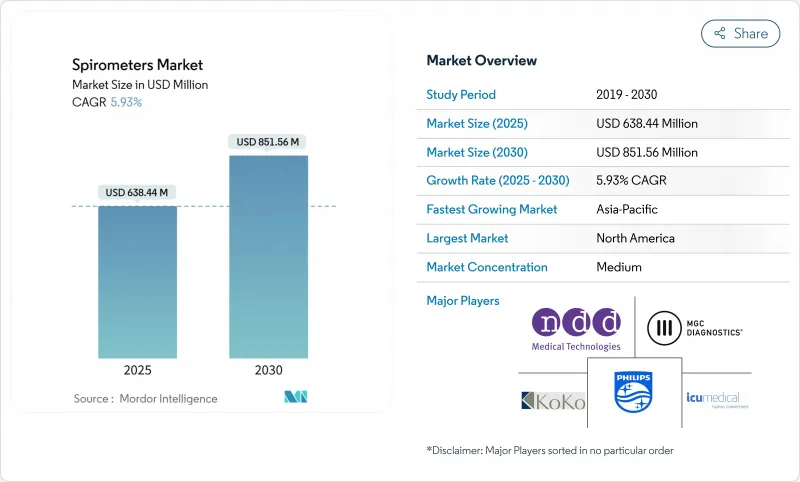
이 확장은 호흡기 질환의 유병률 증가, 환경 규제 강화, 포인트 오브 케어 및 원격 환경에서의 신속한 기술 채용을 반영합니다. COPD의 세계 부담 무게, PM2.5 규제 강화, 고용주 건강 증진 프로그램이 지속적으로 검사 수요를 자극하고 있습니다. 스마트폰 연동형 마이크로 폐활량계, AI 기반 분석, 초음파 센서의 병행적인 진보로 임상적 신뢰성이 강화되고 3차 병원 이외의 사용도 확대됩니다. 기존 벤더의 전략적 인수와 디지털 헬스에 주력하는 신규 진입은 지속적인 혁신과 질서 있는 경쟁의 성숙을 시사하고 있습니다.
세계의 폐활량계 시장 동향 및 인사이트
COPD의 급증으로 진단 인프라 확대 촉진
세계 COPD 환자 수는 2억 1,300만 명에서 4억 5,400만 명으로, 40세 이상의 성인 유병률은 선진국의 8.5%에 비해 개발도상국에서는 13.1%로 피크에 달했습니다. 바이오매스 연소 및 산업 오염물질에 대한 노출이 증가함에 따라 COPD의 이환율은 증가하고, 각국 정부는 아웃리치 검진의 도입을 장려하고 있습니다. 인도의 SAVE 프로그램은 1만 5,602명의 주민을 스크리닝하고, 1,154명의 만성 호흡기 진단을 휴대용 'PFT in a Box' 장치를 사용해 확인했습니다. 이는 대규모 커뮤니티 검사의 실현 가능성을 입증하고 비용 효율적인 솔루션에 대한 잠재적인 수요를 명확히 합니다.
스마트폰과의 통합으로 임상 도입 가속
NuvoAir의 블루투스 지원 가정용 폐활량계가 2024년 1월에 FDA 인증을 받았으며 원격 검사 워크플로가 활성화되었습니다. 검토를 받은 임상시험에서 FEV1은 0.994 이상, FVC는 0.993 이상의 상관 계수가 보고되었습니다. 전자 기록으로 실시간 데이터를 전송하면 의사 결정주기가 단축되고, 낭포성 섬유증 센터의 95%가 가정용 폐활량계를 처방하게 되었으며, 88%가 치료의 질 향상을 꼽았습니다.
장비 교정 과제는 임상적 신뢰 손상 초래
휴대형 폐활량계 중 일부는 6개월 이내에 허용 범위를 벗어날 수 있습니다. 초음파 센서는 움직이는 부분을 없애고 유지 보수를 줄이지만 고가와 규제 지연이 보급을 늦추고 있습니다.
부문 분석
탁상형 기기는 멀티파라미터 검사와 병원 정보 시스템의 통합에 힘입어 2024년 매출의 47.86%를 유지했습니다. 기관지 과제, 호흡근력, 확산능 등 프로토콜 카탈로그가 충실하기 때문에 폐과학 검사실에는 필수적입니다. 그럼에도 불구하고 핸드헬드 유형은 CAGR 7.84%로 성장하여 고용주 선별검사, 응급조치, 재택 모니터링 프로그램에 뒷받침됩니다. 성능 차이는 축소되고 있으며 HooHoo와 같은 기기는 ATS/ERS 임계값을 충족하는 0.887을 넘는 클래스 내 상관 점수를 검사실 기준 기기에 대해 기록하고 있습니다. HooHoo와 같은 장치는 클래스 내 상관 점수가 0.887을 넘어 ATS/ERS의 기준치를 클리어하고 있습니다.
클리닉 보상 프레임워크가 원격 클리닉을 받아들이고 임상의가 빠른 처리량을 선호함에 따라 수요는 경량 솔루션으로 기울어지고 있습니다. 30시간 이상의 배터리 수명, 블루투스 5.0, 일회용 마우스피스는 감염 제어의 의무에 부합합니다. 제조업체 각 회사는 이동식 터빈 헤드, 클라우드 대시보드 및 자동화된 적합성 평가를 특징으로 하는 하이브리드 설계로 대응합니다. 이 시프트는 정확성을 희생하지 않고 이동성으로의 전환이 계속되고 폐활량계 시장이 분산 모델로 방향타를 끊고 있음을 보여줍니다.
플로우 기반 시스템은 2024년 매출의 53.81%를 차지했으며 실시간 루프 플롯과 합리적인 가격을 지원했습니다. 터빈과 플라이슈의 뉴모터치 설계는 1차 케어의 배치를 지배하고, 가이드라인 주도의 해석을 지원하는 유량-용적 곡선을 즉시 생성합니다. 그러나 초음파 어레이로 대표되는 체적 측정 플랫폼은 11.27%의 연평균 복합 성장률(CAGR)로 상승하고 있습니다. 비접촉 아키텍처는 결로 및 미생물의 축적을 방지하여 재교정의 필요성을 줄이고 수명을 연장합니다.
초음파 기술의 폐활량계 시장 규모는 인적 부족으로 병원이 낮은 유지보수 자본 자산을 표준화함에 따라 확대될 것으로 예측됩니다. 현재 하이브리드 기기는 저유량 정밀도의 차압과 고범위에서 초음파 전송 시간을 결합하여 선형성을 향상시키고 있습니다. 피크 유량계는 편의성과 낮은 가격으로 소아 천식 실행 계획을 위한 틈새 시장을 유지합니다. 예측 기간 동안 센서의 소형화와 AI 내장 펌웨어는 특히 감염에 민감한 환경에서 부피 측정을 프리미엄 표준으로 재배치할 것으로 보입니다.
지역 분석
북미는 2024년 매출의 37.61%를 차지했으며, 메디케어 적용, 고용주 웰빙 의무화, 디지털 플랫폼의 조기 도입에 지원되었습니다. 미국 OSHA의 프레임워크는 14가지 위험 물질 기준에 걸쳐 스파이로메트리를 의무화하고 있으며 지속적인 수요를 보장합니다. 캐나다 국민 모두 보험제도는 40세 이상의 흡연자에 대한 기준선의 폐검사를 환불하고 1차 케어에 스파이로메트리를 통합하고 있습니다. 고급 분석 벤더가 보스턴과 실리콘 밸리에 모여 AI 툴의 검증을 가속합니다.
유럽에서는 엄격한 환경 대기 지령과 ESG의 요청으로 지속적인 투자가 이루어지고 있습니다. 미국의 '공해 제로' 로드맵과 각 회원국의 탄소 중립 병원 목표는 낮은 유지 보수 초음파 장비 조달에 박차를 가합니다. 독일의 DRG 시스템은 수술 전 스파이로메트리를 상환하고 영국의 NHS 장기 계획은 중증 천식의 원격 모니터링 파일럿 사업에 자금을 제공합니다. 프라이버시에 대한 지역적 관심은 온프레미스 데이터 호스팅 옵션과 GDPR(EU 개인정보보호규정) 호환 암호화에 대한 수요를 증가시키고 있습니다.
아시아태평양은 성장 엔진이며 CAGR 11.17%로 예측됩니다. 인도의 SAVE 이니셔티브는 확장 가능한 지구 수준의 전개를 보여 주며, 중국의 Healthy China 2030 청사진은 3,300개 현립 병원에서 호흡기 질환 스크리닝을 확대할 예정입니다. 일본에서는 고령화가 진행되는 인구동태가 1인 당 검사 건수를 밀어 올려, 가정용 모니터링 킷에 대한 정부 보조금이 그것을 보완하고 있습니다. 동남아 경제는 건설 붐 속에서 직업성 노출이 증가하고 있으며 기업의 웰니스 투자를 촉진하고 있습니다.
라틴아메리카와 중동 및 아프리카는 모두 새로운 비즈니스 기회 프론티어를 형성하고 있습니다. 브라질의 대기 정화법은 폐기능 검사를 의무화하는 산업보건 감사를 창출하고, 사우디아라비아의 비전 2030은 석유화학 제품의 통로에서 직원의 건강 진단을 의무화하고 있습니다. 사우디아라비아의 '비전 2030'은 석유화학 제품의 통로에서 직원의 건강 진단을 의무화하고 있지만 보험 상환이 단편적이며 훈련받은 검사기사가 부족하기 때문에 단기적인 보급에는 이르지 못하고 있습니다. 개발 은행과 NGO는 접근성의 격차를 메우기 위해 종이 기반 또는 스마트폰 지원 장비를 사용한 파일럿 프로젝트를 후원하고 미래의 스케일 업을 위한 토대 만들기를 실시했습니다.
기타 혜택 :
- 엑셀 형식 시장 예측(ME) 시트
- 3개월간의 애널리스트 서포트
목차
제1장 서론
- 조사의 전제조건 및 시장 정의
- 조사 범위
제2장 조사 방법
제3장 주요 요약
제4장 시장 상황
- 시장 개요
- 시장 성장 촉진요인
- 중저소득국에서 COPD 유병률 급증
- 대기 환경 규제 강화
- 스마트폰 연동형 마이크로 스피로미터가 임상으로 도입
- 고용주 부담의 웰니스 검진 프로그램
- 원격 FEV1 동향 및 어드히어런스 경보를 위한 Ai 알고리즘
- ESG 주도의 병원의 탈탄소화 예산
- 시장 성장 억제요인
- 교정 컴플라이언스 불량에 의한 디바이스의 정밀도 불량
- OECD 회원국 이외의 상환 격차
- 호흡기 검사 기사의 부족
- 클라우드 PFT 플랫폼을 둘러싼 데이터 프라이버시에 대한 우려
- Porter's Five Forces 분석
- 신규 참가업체의 위협
- 구매자의 협상력
- 공급기업의 협상력
- 대체품의 위협
- 경쟁 기업 간 경쟁 관계
제5장 시장 규모 및 성장 예측
- 제품 유형별
- 핸드헬드
- 탁상
- 기술별
- 수량 측정
- 유량 측정
- 피크 유량계
- 용도별
- 천식
- COPD
- 낭포성 섬유증
- 직업성 폐질환
- 기타 용도
- 최종 사용자별
- 병원 및 클리닉
- 진단 실험실
- 홈 헬스케어
- 외래수술센터(ASC)
- 지역별
- 북미
- 미국
- 캐나다
- 멕시코
- 유럽
- 독일
- 영국
- 프랑스
- 이탈리아
- 스페인
- 기타 유럽
- 아시아태평양
- 중국
- 일본
- 인도
- 호주
- 한국
- 기타 아시아태평양
- 중동 및 아프리카
- GCC
- 남아프리카
- 기타 중동 및 아프리카
- 남미
- 브라질
- 아르헨티나
- 기타 남미
- 북미
제6장 경쟁 구도
- 시장 집중도
- 시장 점유율 분석
- 기업 프로파일
- Baxter International(Hill-Rom)
- Vyaire Medical
- Vitalograph
- NDD Medical Technologies
- COSMED
- Schiller AG
- BD(CareFusion)
- Midmark Corp.
- KoKo PFT
- Koninklijke Philips NV
- MIR-Medical International Research
- Fukuda Denshi
- Contec Medical Systems
- Smiths Medical
- ResMed
- ICU Medical
- Teleflex Inc.
- MGC Diagnostics
- Spirohome/Arik Medical
- NuvoAir AB
제7장 시장 기회 및 향후 전망
AJY 25.11.24The Spirometers Market size is estimated at USD 638.44 million in 2025, and is expected to reach USD 851.56 million by 2030, at a CAGR of 5.93% during the forecast period (2025-2030).
The expansion reflects growing respiratory disease prevalence, tighter environmental regulation, and rapid technology adoption in point-of-care and remote settings. COPD's heavy global burden, tighter PM2.5 limits, and employers' wellness programs continue to stimulate testing demand. Parallel advances in smartphone-linked micro-spirometers, AI-based analytics, and ultrasonic sensors strengthen clinical confidence while broadening use beyond tertiary hospitals. Strategic acquisitions among established vendors, coupled with new entrants focused on digital health, suggest sustained innovation and orderly competitive maturation.
Global Spirometers Market Trends and Insights
COPD prevalence surge drives diagnostic infrastructure expansion
The global COPD patient pool ranges between 213 million and 454 million, with prevalence peaking at 13.1% among adults over 40 in developing economies compared with 8.5% in developed markets. Intensifying exposure to biomass combustion and industrial pollutants magnifies disease incidence and encourages governments to deploy outreach screening. India's SAVE program screened 15,602 residents and confirmed 1,154 chronic respiratory diagnoses using portable "PFT in a Box" devices, proving the feasibility of large-scale community testing and underscoring latent demand for cost-effective solutions.
Smartphone integration accelerates clinical adoption
FDA clearance of NuvoAir's Bluetooth-enabled home spirometer in January 2024 validated remote testing workflows. Peer-reviewed trials reported correlation coefficients above 0.994 for FEV1 and 0.993 for FVC versus laboratory reference systems. Real-time data transfer into electronic records shortens decision cycles, and 95% of cystic-fibrosis centers now prescribe home spirometers, with 88% citing quality-of-care gains.
Device calibration challenges undermine clinical confidence
Variability among low-cost turbines erodes diagnostic reliability; some portables drift outside acceptable limits within six months. Ultrasonic sensors remove moving parts and lessen maintenance, but higher price points and regulatory lag defer mass uptake.
Other drivers and restraints analyzed in the detailed report include:
- AI-powered analytics transform respiratory care
- Ambient air quality regulations drive workplace screening
- Reimbursement disparities limit global market penetration
For complete list of drivers and restraints, kindly check the Table Of Contents.
Segment Analysis
Table-top equipment retained 47.86% revenue in 2024, supported by multi-parameter testing and integration with hospital information systems. Their deep protocol catalog-bronchial challenge, respiratory muscle strength, and diffusing capacity-keeps them essential for pulmonology labs. Nonetheless, hand-held models are set to grow at a 7.84% CAGR, propelled by employer screenings, emergency triage, and home monitoring programs. The performance gap is narrowing; devices like HooHoo posted intraclass correlation scores above 0.887 versus lab reference instruments, satisfying ATS/ERS thresholds. Desktop-PC-attached units serve midsized clinics, marrying analytic software with modest portability.
Demand tilts toward lightweight solutions as reimbursement frameworks embrace remote care, and as clinicians favor quicker throughput. Battery life exceeding 30 hours, Bluetooth 5.0, and disposable mouthpieces align with infection-control mandates. Manufacturers answer with hybrid designs featuring detachable turbine heads, cloud dashboards, and automated acceptability grading. The shift indicates continued migration toward mobility without sacrificing accuracy, steering the spirometers market toward decentralized models.
Flow-based systems captured 53.81% of 2024 revenue, favored for real-time loop plotting and affordability. Turbine and Fleisch pneumotach designs dominate primary-care deployments, generating immediate flow-volume curves that underpin guideline-driven interpretation. Yet volume-measurement platforms led by ultrasonic arrays are climbing at an 11.27% CAGR. Their contactless architecture sidesteps condensation and microbial buildup, consequently cutting recalibration needs and boosting longevity.
The spirometers market size for ultrasonic technology is projected to expand as hospitals standardize on low-maintenance capital assets amid staffing constraints. Hybrid devices now combine differential pressure for low-flow accuracy with ultrasonic transit-time at higher ranges, improving linearity. Peak-flow meters keep a niche for pediatric asthma action plans due to simplicity and rock-bottom price. Over the forecast window, sensor miniaturization and AI-embedded firmware will reposition volume measurement as the premium standard, especially in infection-sensitive environments.
The Spirometers Market Report Segments the Industry Into by Product Type (Hand-Held, Table-Top), Technology (Volume Measurement, Flow Measurement, Peak-Flow Meter), Application (Asthma, COPD, Cystic Fibrosis, and More), by End-User (Hospitals and Clinics, and More), and Geography (North America, Europe, Asia-Pacific, Middle East and Africa, South America). The Market Forecasts are Provided in Terms of Value (USD).
Geography Analysis
North America commanded 37.61% of 2024 sales, underpinned by Medicare coverage, employer wellness mandates, and early uptake of digital platforms. The U.S. OSHA framework obliges spirometry across 14 hazardous-substance standards, guaranteeing recurrent demand. Canada's universal health plans reimburse baseline lung tests for smokers over 40, embedding spirometry in primary care. Advanced analytics vendors cluster around Boston and Silicon Valley, accelerating AI tool validation.
Europe follows with sustained investment driven by stringent ambient-air directives and ESG imperatives. The EU's "Zero Pollution" roadmap and member-state carbon-neutral hospital targets fuel procurement of low-maintenance ultrasonic units. Germany's DRG system reimburses pre-operative spirometry, while the UK's NHS Long Term Plan funds remote monitoring pilots for severe asthma. Regional focus on privacy elevates demand for on-premise data-hosting options and GDPR-compliant encryption.
Asia-Pacific represents the growth engine, projected to notch an 11.17% CAGR. India's SAVE initiative showcased scalable district-level deployments, while China's Healthy China 2030 blueprint earmarks respiratory disease screening expansion across 3,300 county hospitals. Japan's aging demographic drives per-capita testing volumes, complemented by government subsidies for home-monitoring kits. Southeast Asian economies experience rising occupational exposure amid construction booms, prompting corporate wellness investments.
Latin America and the Middle East & Africa together form an emerging opportunity frontier. Brazil's Clean Air Act spawned industrial health audits requiring pulmonary testing, whereas Saudi Arabia's Vision 2030 mandates employee health screenings in petrochemical corridors. However, fragmented reimbursement and shortages of trained technologists curb near-term penetration. Development banks and NGOs sponsor pilot projects using paper-based or smartphone-assisted devices to bridge accessibility gaps, laying groundwork for future scale-up.
- Baxter International (Hill-Rom)
- Vyaire Medical
- Vitalograph
- NDD Medical Technologies
- COSMED
- Schiller
- BD (CareFusion)
- Midmark
- KoKo PFT
- Koninklijke Philips
- MIR - Medical International Research
- Fukuda Denshi
- Contec Medical Systems
- Smiths Group
- Resmed
- ICU Medical
- Teleflex
- MGC Diagnostics
- Spirohome / Arik Medical
- NuvoAir AB
Additional Benefits:
- The market estimate (ME) sheet in Excel format
- 3 months of analyst support
TABLE OF CONTENTS
1 Introduction
- 1.1 Study Assumptions & Market Definition
- 1.2 Scope of the Study
2 Research Methodology
3 Executive Summary
4 Market Landscape
- 4.1 Market Overview
- 4.2 Market Drivers
- 4.2.1 COPD Prevalence Surge in Low- & Middle-Income Countries
- 4.2.2 Ambient-Air Quality Regulation Tightening
- 4.2.3 Smartphone-Linked Micro-Spirometers Gain Clinical Acceptance
- 4.2.4 Employer-Funded Wellness Screening Programs
- 4.2.5 Ai Algorithms For Remote FEV1 Trending & Adherence Alerts
- 4.2.6 ESG-Driven Hospital Decarbonisation Budgets
- 4.3 Market Restraints
- 4.3.1 Device Inaccuracy Due to Poor Calibration Compliance
- 4.3.2 Reimbursement Gaps Outside OECD
- 4.3.3 Shortage of Trained Respiratory Technologists
- 4.3.4 Data-Privacy Concerns Around Cloud PFT Platforms
- 4.4 Porter's Five Forces Analysis
- 4.4.1 Threat of New Entrants
- 4.4.2 Bargaining Power of Buyers
- 4.4.3 Bargaining Power of Suppliers
- 4.4.4 Threat of Substitutes
- 4.4.5 Competitive Rivalry
5 Market Size & Growth Forecasts (Value in USD)
- 5.1 By Product Type
- 5.1.1 Hand-held
- 5.1.2 Table-top
- 5.2 By Technology
- 5.2.1 Volume Measurement
- 5.2.2 Flow Measurement
- 5.2.3 Peak-flow Meter
- 5.3 By Application
- 5.3.1 Asthma
- 5.3.2 COPD
- 5.3.3 Cystic Fibrosis
- 5.3.4 Occupational Lung Disease
- 5.3.5 Other Applications
- 5.4 By End-User
- 5.4.1 Hospitals & Clinics
- 5.4.2 Diagnostic Laboratories
- 5.4.3 Home Healthcare
- 5.4.4 Ambulatory Surgical Centers
- 5.5 By Geography
- 5.5.1 North America
- 5.5.1.1 United States
- 5.5.1.2 Canada
- 5.5.1.3 Mexico
- 5.5.2 Europe
- 5.5.2.1 Germany
- 5.5.2.2 United Kingdom
- 5.5.2.3 France
- 5.5.2.4 Italy
- 5.5.2.5 Spain
- 5.5.2.6 Rest of Europe
- 5.5.3 APAC
- 5.5.3.1 China
- 5.5.3.2 Japan
- 5.5.3.3 India
- 5.5.3.4 Australia
- 5.5.3.5 South Korea
- 5.5.3.6 Rest of APAC
- 5.5.4 Middle East & Africa
- 5.5.4.1 GCC
- 5.5.4.2 South Africa
- 5.5.4.3 Rest of MEA
- 5.5.5 South America
- 5.5.5.1 Brazil
- 5.5.5.2 Argentina
- 5.5.5.3 Rest of South America
- 5.5.1 North America
6 Competitive Landscape
- 6.1 Market Concentration
- 6.2 Market Share Analysis
- 6.3 Company Profiles (includes Global level Overview, Market level overview, Core Segments, Financials as available, Strategic Information, Market Rank/Share for key companies, Products & Services, and Recent Developments)
- 6.3.1 Baxter International (Hill-Rom)
- 6.3.2 Vyaire Medical
- 6.3.3 Vitalograph
- 6.3.4 NDD Medical Technologies
- 6.3.5 COSMED
- 6.3.6 Schiller AG
- 6.3.7 BD (CareFusion)
- 6.3.8 Midmark Corp.
- 6.3.9 KoKo PFT
- 6.3.10 Koninklijke Philips N.V.
- 6.3.11 MIR - Medical International Research
- 6.3.12 Fukuda Denshi
- 6.3.13 Contec Medical Systems
- 6.3.14 Smiths Medical
- 6.3.15 ResMed
- 6.3.16 ICU Medical
- 6.3.17 Teleflex Inc.
- 6.3.18 MGC Diagnostics Corporation
- 6.3.19 Spirohome / Arik Medical
- 6.3.20 NuvoAir AB
7 Market Opportunities & Future Outlook
- 7.1 White-space & Unmet-need Assessment