|
시장보고서
상품코드
1851739
가스 감지 시스템 시장 : 시장 점유율 분석, 산업 동향, 통계, 성장 예측(2025-2030년)Gas Detection System - Market Share Analysis, Industry Trends & Statistics, Growth Forecasts (2025 - 2030) |
||||||
 Mordor Intelligence
가스 감지 시스템 시장 규모는 2025년 56억 1,000만 달러로 추정되고, 2030년에는 71억 3,000만 달러에 이를 전망이며, CAGR 4.91%로 확대될 것으로 예측되고 있습니다.

석유 및 가스 의존에서 수소 인프라, 배터리 에너지 저장 및 저 GWP 냉매 용도으로의 전환은 견조한 수요를 지원합니다. 중국의 IIoT 안전 업그레이드 의무화, 에너지 저장에 관한 NFPA 855 규범의 갱신, 유럽의 REPowerEU 수소 목표 등이 총체적으로 대처 가능한 베이스를 확대합니다. 성장을 가속시키는 요인으로는 무선 네트워킹, 예측 분석, 멀티 가스 통합 등을 들 수 있지만, 센서의 교정이나 인증된 무선 주파수대를 둘러싼 기술적 장벽이 기세를 깎고 있습니다. 기존 벤더가 인수와 합작을 통해 기술의 폭을 확보하고 있기 때문에 경쟁 구도는 완만하게 남아 있습니다.
세계의 가스 감지 시스템 시장 동향 및 인사이트
수소경제 확대
REPowerEU 계획에 따른 유럽의 수소 생산 확대는 기존의 가연물 및 산소 결핍 위험과 함께 수소를 추적할 수 있는 센서를 필요로 합니다. 팔라듐 나노트랜지스터의 프로토타입은 현재 최소 전력 소비로 10억분의 1의 수소를 검출합니다. 프로젝트 규모가 확대됨에 따라 멀티 가스 장치는 예산화되고 가스 감지 시스템 시장은 유럽의 에너지 인프라에 더 깊게 통합될 것입니다. 조달 사이클은 수소 전문 분석 및 ATEX 인증을 갖춘 공급업체에게 유리하며 설계 복잡성 및 평균 판매 가격을 올리고 있습니다.
해양 심해 탐사 증가
2026년까지 13개의 새로운 미국 만 유전이 가동 예정이며, 0.27Bcf/d의 가스가 추가되기 때문에 오퍼레이터는 해양 인증의 메탄 검출기를 지정하도록 촉구되고 있습니다. Honeywell의 Emission Management Suite는 위험한 해양 지역에서의 사용이 승인되었으며, 더 엄격한 가동 시간과 원격 유지 보수 기준을 충족하는 제품의 차별화를 보여줍니다. 오보를 40% 줄이는 예측 알고리즘은 해외 개입이 한 번의 통보당 수백만 달러에 이를 때 가치 제안을 강화합니다.
황이 풍부한 환경에서의 잘못된 교정
50ppm을 초과하는 황화수소는 전기화학 센서의 수명을 60% 줄이고 유지보수 예산을 팽창시켜 운영자의 신뢰를 손상시킵니다. MEMS 기반 검출기는 피독을 줄이지만 자본 비용이 높습니다. 크로스 센시티 비티는 중복 어레이를 강요하고 배선 스키마가 복잡해져 가스 감지 시스템 시장의 사워 가스 시설에서의 단기적인 보급에 찬물을 끼얹습니다.
부문 분석
메쉬 토폴로지는 링크의 탄력성을 유지하고 NB-IoT 에너지 수집 프로토타입은 미래의 자율성을 강조합니다. 인증 장애 및 간섭 관리는 여전히 단기적인 확산을 막고 있지만, 무선은 여전히 브라운필드 프로젝트의 주요 현대화 기술입니다.
홈 파기 비용 절감은 일시적인 건설 및 턴어라운드 시나리오에 호소하며, 배터리가 없는 센서 노드는 유지 보수의 완화를 약속합니다. 무선 링크가 클라우드 대시보드에 공급됨에 따라 운영자는 컴플라이언스 주도 모니터링에서 자산 건전성 예측으로 전환하여 가스 감지 시스템 시장에서 경상 서비스의 수익원을 강화합니다.
고정식 감지기는 2024년에 71.3%의 점유율을 유지하며 석유화학 및 유틸리티 사이트에서 지속적인 적용 범위에 대한 법규제 요건을 반영합니다. 직원 이동 및 종료 활동으로 인해 CAT-M 셀룰러 모뎀과 클라우드 API가 번들로 제공되는 휴대용 CAGR은 5.7%에 달할 전망입니다. 플릿 전체의 분석은 컴플라이언스 문서를 간소화하고 ROI 분석을 개선합니다.
하이브리드 에어리어 모니터는 100일간의 배터리 수명으로 휴대용 커버 범위를 확대하여 개인용 및 고정 레이어의 갭을 메웁니다. 고정 어레이는 공정 제어 통합의 기초가 되고 있는 반면, 모듈식 센서 카트리지와 핫 스왑 설계는 가동 중단 시간을 줄이고 가스 감지 시스템 시장에서 장기적인 지위를 강화하고 있습니다.
전기화학 전지는 2024년 매출의 44.9%를 차지했지만 적외선 장치는 안정성과 낮은 드리프트로 CAGR 7.1% 상승했습니다. 광음향 IR 시스템은 빈번한 재교정 없이 암모니아를 1ppm까지 감지합니다. 중적외선 메타서피스 마이크로스펙트로미터는 칩 스케일 실적에서 멀티 가스 분석에 유망합니다.
촉매 비드 센서는 여전히 기본적인 탄화수소 알람을 지원하지만, 센서 융합 펌웨어는 현재 IR, PID 및 전기화학 채널을 결합하여 선택성을 향상시키고 있습니다. 이러한 발전으로 평생 소유비용이 절감되고 가스 감지 시스템 시장은 유지보수 접근이 제한되는 환경으로 확대됩니다.
지역 분석
북미는 2024년 32.1%의 점유율로 매출을 이끌었습니다. 종합적인 안전 감시를 의무화하는 OSHA와 NFPA의 틀이 정착되어 있음을 반영합니다. 해외 프로젝트 시작과 LNG 건설은 해양 인증 검출기에 자본 지출을 유지하는 반면, 배터리 에너지 저장의 전개는 유틸리티과 상업 부동산으로 범위를 넓히고 있습니다. 캐나다의 수소 파일럿 테스트와 탄소 포획 허브는 멀티 가스 플랫폼 수요를 더욱 강화합니다.
유럽은 수소 인프라와 냉매의 단계적 감소와 관련된 강력한 성장으로 이어집니다. ATEX와 IECEx의 컴플라이언스 요구 사항은 진입 장벽을 높이고 계약은 확립된 인증 혈통을 가진 기업으로 흐릅니다. 독일의 화학 클러스터와 영국 제약 회사는 무선 분석의 조기 도입을 지지하고 북유럽 사업자는 -40℃로 교정된 저온 센서 패키지를 지정하고 있습니다.
아시아태평양의 CAGR은 5.8%로 가장 빠르며 중국의 IIoT 안전 지침과 인도의 위험 화학물질 규제가 뒷받침되고 있습니다. 일본의 고압가스보안법의 갱신과 SEA의 석유화학 투자도 보급을 뒷받침합니다. 급속한 산업화 및 성숙한 안전 문화가 결합되어 기본 및 고급 제품 모두의 지역적 기회가 확대되고 2030년까지 APAC는 가스 감지 시스템 시장의 주요 증가 엔진으로 자리매김하고 있습니다.
기타 혜택 :
- 엑셀 형식 시장 예측(ME) 시트
- 3개월의 애널리스트 서포트
목차
제1장 서론
- 조사의 전제조건 및 시장 정의
- 조사 범위
제2장 조사 방법
제3장 주요 요약
제4장 시장 상황
- 시장 개요
- 시장 성장 촉진요인
- 수소경제 확대가 유럽의 멀티가스 검출기 수요 견인
- 고신뢰성 가스 모니터링을 필요로 하는 해양 심해 E&P 활동 증가(북미)
- 중국 국가 노동 안전 관리 총국의 IIoT 대응 안전 업그레이드의 의무화
- 소방 및 가스 규제를 갖춘 축전지 시스템(BESS)의 채용 가속(아시아)
- 그린 암모니아 프로젝트의 급증이 NH3 누설 검출 뒷받침(EMEA)
- 냉매 가스 검지(HVAC-R)를 견인하는 저GWP 냉매로의 이행
- 시장 성장 억제요인
- 황이 많은 환경에서의 잘못된 교정이 알람의 오작동 발생
- 위험 장소(존 0/1)용 인정 무선 스펙트럼의 희소성
- 브라운필드 정유소에서의 중복 센서 네트워크의 높은 설비 투자액
- 긴 수명 -40℃ 이하 고체 NH3 센서의 한정된 이용가능성(북유럽)
- 산업 생태계 분석
- 규제 및 기술의 전망
- Porter's Five Forces 분석
- 공급기업의 협상력
- 소비자의 협상력
- 신규 참가업체의 위협
- 경쟁 기업 간 경쟁 관계
- 대체품의 위협
제5장 시장 규모 및 성장 예측
- 통신 유형별
- 유선
- 무선
- 검출기 유형별
- 고정
- 휴대용
- 센서 기술별
- 전기화학
- 적외선(IR)
- 촉매 비드
- 광이온화(PID)
- 기타(MOS, 빛)
- 가스 유형별
- 가연성 탄화수소
- 유독가스(CO, H2S, Cl2, SO2)
- 산소 결핍증
- 냉매가스
- 특수가스 및 희귀가스
- 디바이스 유형별
- 싱글 가스 검출기
- 멀티 가스 검출기
- 전원별
- 배터리 구동
- 하드 와이어 및 메인
- 최종 사용자 업계별
- 석유 및 가스
- 화학 및 석유화학
- 상하수도
- 금속 및 광업
- 전력 및 유틸리티
- 음식
- 제약과 생명과학
- 디스크리트 제조(반도체, 자동차, 전지)
- 기타 산업(배터리 에너지 저장, 기타)
- 지역별
- 북미
- 미국
- 캐나다
- 멕시코
- 유럽
- 독일
- 영국
- 프랑스
- 북유럽 국가
- 기타 유럽
- 남미
- 브라질
- 기타 남미
- 아시아태평양
- 중국
- 일본
- 인도
- 동남아시아
- 기타 아시아태평양
- 중동 및 아프리카
- 중동
- GCC
- 튀르키예
- 기타 중동
- 아프리카
- 남아프리카
- 기타 아프리카
- 북미
제6장 경쟁 구도
- 시장 집중도
- 전략적 동향
- 시장 점유율 분석
- 기업 프로파일
- Honeywell International Inc.
- Dragerwerk AG and Co. KGaA
- MSA Safety Inc.
- Emerson Electric Co.
- Teledyne Gas and Flame Detection
- Industrial Scientific Corp.
- Riken Keiki Co. Ltd.
- GfG Gas Detection Germany
- Det-Tronics(Carrier)
- New Cosmos Electric Co.
- Sensidyne LP
- SENSIT Technologies
- Crowcon Detection Instruments Ltd.
- Trolex Ltd.
- Hanwei Electronics Group
- International Gas Detectors Ltd.
- OTIS Instruments Inc.
- GASTEC Corp.
- ABB Ltd.
- Xylem Inc.(YSI)
- General Monitors(United Technologies)
제7장 시장 기회 및 향후 전망
AJY 25.11.24The gas detection system size is estimated USD 5.61 billion in 2025 and is forecast to reach USD 7.13 billion by 2030, expanding at a 4.91% CAGR.
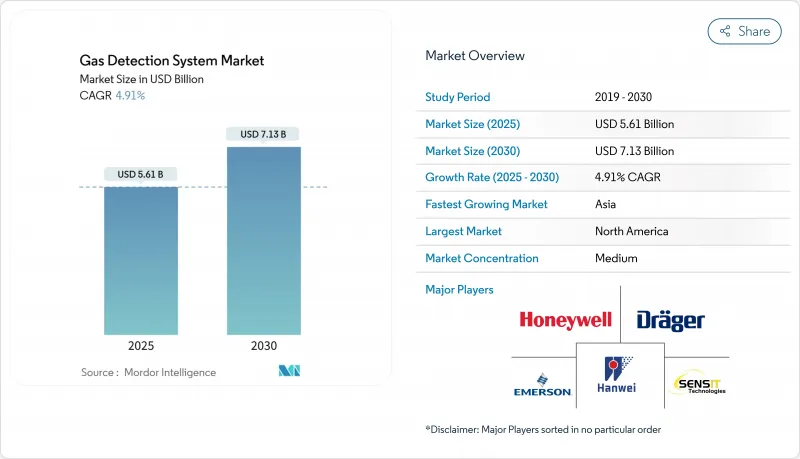
A shift away from exclusive oil-and-gas dependence toward hydrogen infrastructure, battery energy storage, and low-GWP refrigerant applications supports steady demand. Mandatory IIoT safety upgrades in China, updated NFPA 855 codes for energy storage, and Europe's REPowerEU hydrogen targets collectively enlarge the addressable base. Growth accelerators include wireless networking, predictive analytics, and multi-gas integration, while technical barriers around sensor calibration and certified wireless spectrum temper momentum. Competitive activity remains moderate as established vendors secure technology breadth through acquisitions and joint ventures.
Global Gas Detection System Market Trends and Insights
Expansion of Hydrogen Economy
Europe's hydrogen build-out under the REPowerEU plan demands sensors able to track hydrogen alongside traditional combustibles and oxygen-deficiency risks. Palladium-nanotransistor prototypes now detect parts-per-billion H2 with minimal power draw. As projects scale, multi-gas devices become budgeted line items, embedding the gas detection system market deeper into European energy infrastructure. Procurement cycles favor vendors with hydrogen-specific analytics and ATEX certificates, elevating design complexity and average selling prices.
Rising Offshore Deepwater Exploration
Thirteen new Gulf of America fields scheduled online through 2026 will add 0.27 Bcf/d of gas, prompting operators to specify marine-certified methane detectors. Honeywell's Emissions Management Suite-approved for hazardous marine zones-illustrates product differentiation that meets stricter uptime and remote-maintenance criteria. Predictive algorithms trimming false alarms by 40% strengthen value propositions where offshore interventions run into millions of USD per call-out.
Faulty Calibrations in Sulfur-Rich Environments
Hydrogen sulfide above 50 ppm shortens electrochemical sensor life by 60%, inflating maintenance budgets and eroding operator trust. MEMS-based detectors mitigate poisoning but carry higher capital costs . Cross-sensitivities force redundant arrays, complicating wiring schemas and dampening the gas detection system market's short-term uptake in sour-gas facilities.
Other drivers and restraints analyzed in the detailed report include:
- Mandatory IIoT Safety Upgrades in China
- Accelerating Battery Energy Storage Deployment
- Scarcity of Certified Wireless Spectrum
For complete list of drivers and restraints, kindly check the Table Of Contents.
Segment Analysis
Wired installations accounted for 67.4% of 2024 revenue, anchoring the gas detection system market in legacy process industries. Modern plants now weigh material cost savings and installation agility; hence wireless revenues are advancing at 6.4% CAGR.
Mesh topologies preserve link resilience, while NB-IoT energy-harvesting prototypes underscore future autonomy. Certification roadblocks and interference management still cap near-term penetration, yet wireless remains the chief modernization lever across brownfield projects.
Reduced trenching costs appeal to temporary construction and turnaround scenarios, and battery-free sensor nodes promise maintenance relief. With wireless links feeding cloud dashboards, operators move from compliance-driven monitoring toward predictive asset health, reinforcing recurring-service revenue streams in the gas detection system market.
Fixed detectors retained 71.3% share in 2024, reflecting code requirements for continuous coverage in petrochemical and utility sites. Workforce mobility and shutdown activities fuel a 5.7% CAGR for portables, which now bundle CAT-M cellular modems and cloud APIs. Fleet-wide analytics streamline compliance documentation, improving ROI narratives.
Hybrid area monitors extend portable coverage with 100-day battery life, bridging gaps between personal and fixed layers. While fixed arrays remain foundational for process control integration, modular sensor cartridges and hot-swap designs cut downtime, fortifying their long-term position inside the gas detection system market.
Electrochemical cells delivered 44.9% of 2024 revenues, yet infrared devices are rising 7.1% CAGR on stability and low drift. Photoacoustic IR systems detect ammonia to 1 ppm without frequent recalibration. Mid-IR metasurface microspectrometers show promise for multi-gas analytics at chip-scale footprints.
Catalytic bead sensors still underpin basic hydrocarbon alarms, but sensor-fusion firmware now marries IR, PID, and electrochemical channels for selectivity gains. These advances cut lifetime ownership costs and expand the gas detection system market into environments where maintenance access is constrained.
The Gas Detection System Market Report is Segmented by Communication Type (Wired, and Wireless), Detector Type (Fixed, and Portable), Sensor Technology (Electrochemical, and More), Gas Type (Combustible Hydrocarbons, and More), Device Type (Single-Gas Detectors, and More), Power Source (Battery-Powered, and More), End-User Industry (Oil and Gas, and More), and Geography. The Market Forecasts are Provided in Terms of Value (USD).
Geography Analysis
North America led revenue with 32.1% share in 2024, reflecting entrenched OSHA and NFPA frameworks that compel comprehensive safety monitoring. Offshore project starts and LNG build-outs sustain capital spending on marine-certified detectors, while battery energy storage rollouts widen scope into utility and commercial real estate. Canadian hydrogen pilots and carbon-capture hubs further reinforce demand across multi-gas platforms.
Europe follows with strong growth tied to hydrogen infrastructure and refrigerant phase-downs. ATEX and IECEx compliance requirements raise entry barriers, channeling contracts toward firms with established certification pedigrees. German chemical clusters and UK pharmaceuticals champion early adoption of wireless analytics, whereas Nordic operators specify low-temperature sensor packages calibrated to -40 °C.
Asia-Pacific records the fastest 5.8% CAGR, propelled by China's IIoT safety mandate and India's hazardous-chemical rules. Japanese updates to the High-Pressure Gas Safety Act and SEA petrochemical investments also boost uptake. Rapid industrialization, combined with maturing safety cultures, enlarges regional opportunity for both basic and advanced offerings, positioning APAC as the primary incremental engine for the gas detection system market through 2030.
- Honeywell International Inc.
- Dragerwerk AG and Co. KGaA
- MSA Safety Inc.
- Emerson Electric Co.
- Teledyne Gas and Flame Detection
- Industrial Scientific Corp.
- Riken Keiki Co. Ltd.
- GfG Gas Detection Germany
- Det-Tronics (Carrier)
- New Cosmos Electric Co.
- Sensidyne LP
- SENSIT Technologies
- Crowcon Detection Instruments Ltd.
- Trolex Ltd.
- Hanwei Electronics Group
- International Gas Detectors Ltd.
- OTIS Instruments Inc.
- GASTEC Corp.
- ABB Ltd.
- Xylem Inc. (YSI)
- General Monitors (United Technologies)
Additional Benefits:
- The market estimate (ME) sheet in Excel format
- 3 months of analyst support
TABLE OF CONTENTS
1 INTRODUCTION
- 1.1 Study Assumptions and Market Definition
- 1.2 Scope of the Study
2 RESEARCH METHODOLOGY
3 EXECUTIVE SUMMARY
4 MARKET LANDSCAPE
- 4.1 Market Overview
- 4.2 Market Drivers
- 4.2.1 Expansion of Hydrogen Economy Driving Demand for Multi-Gas Detectors in Europe
- 4.2.2 Rising Off-shore Deepwater E&P Activities Requiring High-Reliability Gas Monitoring (North America)
- 4.2.3 Mandatory IIoT-enabled Safety Upgrades under China State Administration of Work Safety
- 4.2.4 Accelerating Adoption of Battery Energy Storage Systems (BESS) with Fire/Gas Codes (Asia)
- 4.2.5 Surge in Green Ammonia Projects Boosting NH3 Leak Detection (EMEA)
- 4.2.6 Transition to Low-GWP Refrigerants Driving Refrigerant Gas Detection (HVAC-R)
- 4.3 Market Restraints
- 4.3.1 Faulty Calibrations in Sulphur-rich Environments Causing False Alarms
- 4.3.2 Scarcity of Certified Wireless Spectrum for Hazardous Locations (Zones 0/1)
- 4.3.3 High CapEx for Redundant Sensor Networks in Brown-field Refineries
- 4.3.4 Limited Availability of Long-life Solid-State NH3 Sensors Less than -40 degree C (Nordics)
- 4.4 Industry Ecosystem Analysis
- 4.5 Regulatory and Technological Outlook
- 4.6 Porter's Five Forces Analysis
- 4.6.1 Bargaining Power of Suppliers
- 4.6.2 Bargaining Power of Consumers
- 4.6.3 Threat of New Entrants
- 4.6.4 Intensity of Competitive Rivalry
- 4.6.5 Threat of Substitute Products
5 MARKET SIZE AND GROWTH FORECASTS (VALUES)
- 5.1 By Communication Type
- 5.1.1 Wired
- 5.1.2 Wireless
- 5.2 By Detector Type
- 5.2.1 Fixed
- 5.2.2 Portable
- 5.3 By Sensor Technology
- 5.3.1 Electrochemical
- 5.3.2 Infra-red (IR)
- 5.3.3 Catalytic Bead
- 5.3.4 Photo-ionization (PID)
- 5.3.5 Others (MOS, Optical)
- 5.4 By Gas Type
- 5.4.1 Combustible Hydrocarbons
- 5.4.2 Toxic Gases (CO, H2S, Cl2, SO2)
- 5.4.3 Oxygen Deficiency
- 5.4.4 Refrigerant Gases
- 5.4.5 Specialty and Rare Gases
- 5.5 By Device Type
- 5.5.1 Single-Gas Detectors
- 5.5.2 Multi-Gas Detectors
- 5.6 By Power Source
- 5.6.1 Battery-Powered
- 5.6.2 Hard-wired/Mains
- 5.7 By End-user Industry
- 5.7.1 Oil and Gas
- 5.7.2 Chemicals and Petrochemicals
- 5.7.3 Water and Wastewater
- 5.7.4 Metals and Mining
- 5.7.5 Power and Utilities
- 5.7.6 Food and Beverage
- 5.7.7 Pharma and Life-Sciences
- 5.7.8 Discrete Manufacturing (Semiconductor, Automotive, Battery)
- 5.7.9 Other Industries (Battery Energy Storage, and More)
- 5.8 By Geography
- 5.8.1 North America
- 5.8.1.1 United States
- 5.8.1.2 Canada
- 5.8.1.3 Mexico
- 5.8.2 Europe
- 5.8.2.1 Germany
- 5.8.2.2 United Kingdom
- 5.8.2.3 France
- 5.8.2.4 Nordics
- 5.8.2.5 Rest of Europe
- 5.8.3 South America
- 5.8.3.1 Brazil
- 5.8.3.2 Rest of South America
- 5.8.4 Asia-Pacific
- 5.8.4.1 China
- 5.8.4.2 Japan
- 5.8.4.3 India
- 5.8.4.4 South-East Asia
- 5.8.4.5 Rest of Asia-Pacific
- 5.8.5 Middle East and Africa
- 5.8.5.1 Middle East
- 5.8.5.1.1 Gulf Cooperation Council Countries
- 5.8.5.1.2 Turkey
- 5.8.5.1.3 Rest of Middle East
- 5.8.5.2 Africa
- 5.8.5.2.1 South Africa
- 5.8.5.2.2 Rest of Africa
- 5.8.1 North America
6 COMPETITIVE LANDSCAPE
- 6.1 Market Concentration
- 6.2 Strategic Moves
- 6.3 Market Share Analysis
- 6.4 Company Profiles {(includes Global level Overview, Market level overview, Core Segments, Financials as available, Strategic Information, Market Rank/Share for key companies, Products and Services, and Recent Developments)}
- 6.4.1 Honeywell International Inc.
- 6.4.2 Dragerwerk AG and Co. KGaA
- 6.4.3 MSA Safety Inc.
- 6.4.4 Emerson Electric Co.
- 6.4.5 Teledyne Gas and Flame Detection
- 6.4.6 Industrial Scientific Corp.
- 6.4.7 Riken Keiki Co. Ltd.
- 6.4.8 GfG Gas Detection Germany
- 6.4.9 Det-Tronics (Carrier)
- 6.4.10 New Cosmos Electric Co.
- 6.4.11 Sensidyne LP
- 6.4.12 SENSIT Technologies
- 6.4.13 Crowcon Detection Instruments Ltd.
- 6.4.14 Trolex Ltd.
- 6.4.15 Hanwei Electronics Group
- 6.4.16 International Gas Detectors Ltd.
- 6.4.17 OTIS Instruments Inc.
- 6.4.18 GASTEC Corp.
- 6.4.19 ABB Ltd.
- 6.4.20 Xylem Inc. (YSI)
- 6.4.21 General Monitors (United Technologies)
7 MARKET OPPORTUNITIES AND FUTURE OUTLOOK
- 7.1 White-space and Unmet-need Assessment