|
시장보고서
상품코드
1851750
자동차 점화 코일 : 시장 점유율 분석, 산업 동향, 통계, 성장 예측(2025-2030년)Automotive Ignition Coil - Market Share Analysis, Industry Trends & Statistics, Growth Forecasts (2025 - 2030) |
||||||
 Mordor Intelligence
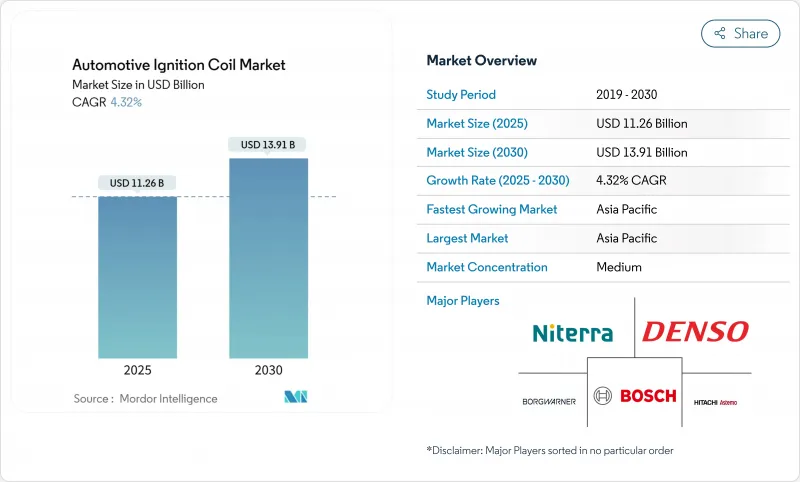
자동차 점화 코일 시장 규모는 2025년에 112억 6,000만 달러로 평가되었고, 2030년에 139억 1,000만 달러에 이를 것으로 예측되며, CAGR은 4.32%를 나타낼 전망입니다.
아시아태평양 지역의 경량 차량 생산 증가, 코일 온 플러그(COP) 기술의 지속적인 우위, 성숙한 차량 군의 탄탄한 교체 주기가 종합적으로 성장을 뒷받침하고 있습니다. OEM 업체들은 단기적인 유로 7 배출 기준을 준수해야 하는 터보차저 다운사이징 엔진용 점화 설계를 세밀하게 조정하고 있으며, 애프터마켓은 미국 내 평균 차량 연령이 12.5년에 달하는 점으로부터 혜택을 보고 있습니다. 동시에 고공행진 중인 구리 가격과 희토류 자석 공급 리스크가 공급업체 마진을 압박하고 있으며, 배터리 전기차(BEV) 보급률은 장기 수요에 명확한 상한선을 설정하고 있습니다. 이러한 상반된 흐름 속에서 자동차 점화 코일 시장은 기존 내연기관 수요와 급속한 전기화 미래 사이의 전략적 전환점에 놓여 있습니다.
세계의 자동차 점화 코일 시장 동향 및 인사이트
승용차 및 경상용차 글로벌 생산량 증가
차량 생산량은 팬데믹 저점에서 회복세를 이어가고 있으며, 특히 아시아태평양 지역에서 2024년 상반기 산업 매출이 7% 증가했습니다. 생산 증가세는 자동차 점화 코일 시장에 유리하게 작용하는데, 이는 경상용차의 전기화 속도가 승용차보다 약 5년 정도 뒤처지기 때문입니다. 자동차 제조사들은 또한 내연기관(ICE)을 유지하면서 배출량을 줄이는 48V 마일드 하이브리드 플랫폼을 도입하고 있어 코일 수요를 연장시키고 있습니다. 유로 7 기준 충족을 위한 정밀 점화 타이밍 강조는 개별 실린더 제어를 지원하는 COP 어셈블리 수요를 촉진합니다. 이러한 요인들이 복합적으로 작용하여 성장 궤도에 적정 수준의 상승세를 더하고 있습니다.
노후화된 차량 보유량에 따른 애프터마켓 교체 수요
2024년 미국 평균 차량 보유 연령은 12.5년에 달했습니다. 노후 차량은 더 빈번한 정비가 필요하여 코일 애프터마켓을 활성화시킵니다. 스탠다드 모터 프로덕츠(SMP)는 이미 800개 SKU로 99% 커버리지를 확보했으며, NGK의 유럽 라인업은 420개 부품 번호로 운행 차량의 87%를 커버합니다. 독립 정비소는 광범위한 호환성에 의존하므로 애프터마켓은 점점 더 수익성 높은 채널이 되고 있습니다. 기존 차량이 퇴출되기까지의 시간적 여유는 최소한 한 모델 주기 동안 안정적인 수익원을 창출합니다.
BEV의 보급이 기존의 점화 시스템을 배제
전기차는 점화 장치 전체를 제거해 유지보수 비용을 최대 40% 절감합니다. 덴소는 2035년까지 BEV가 글로벌 생산을 주도할 것으로 전망하며, 이에 따라 공급업체들은 배터리, 인버터, 열관리 모듈로 전환하고 있습니다. 승용차 부문이 가장 먼저 급격한 감소를 보일 것이며, 중량 상용차 부문은 주행 거리 및 적재량 제한으로 인해 후속 전환될 것입니다. 그럼에도 이러한 방향 전환은 향후 코일 수요에 상한선을 설정합니다.
부문 분석
코일온플러그(COP) 시스템은 2024년 매출의 51.33%를 차지했으며, 6.32%의 연평균 복합 성장률(CAGR)로 자동차 점화 코일 시장의 확실한 성장 동력으로 자리매김했습니다. 이 설계는 고전압 리드를 제거하고 전자기 손실을 줄이며, 터보차저 엔진이 요구하는 고급 노크 제어 전략을 지원합니다. 블록 코일과 레일 어셈블리는 특히 신흥 경제국의 엔트리 레벨 부문를 중심으로 비용에 민감한 모델에서 경쟁력을 유지하고 있습니다.
OEM 사례 연구는 이러한 전환을 뒷받침합니다. 보쉬는 BMW 모델에 스프링 접점 COP를 도입해 점화 플러그 연결 신뢰성을 개선했으며, 덴소의 포트폴리오 로드맵은 분배기 없는 솔루션을 핵심 제품 라인으로 부각시켰습니다. 내연기관(ICE)과 48V 전기 모터를 결합한 하이브리드 파워트레인은 여전히 실린더당 하나의 코일이 필요하여 2030년까지 COP 장치의 판매량을 보장합니다. 경쟁력 있는 가격, 간소화된 설치, 점진적인 엔진 관리 개선은 COP를 자동차 점화 코일 시장의 중심에 계속 위치시킬 것입니다.
2024년 싱글 스파크 설계 제품이 판매량의 62.41%를 차지했으며, 이는 성숙한 제조 기술, 검증된 신뢰성, 낮은 비용을 반영합니다. 그러나 프리미엄 OEM 업체들이 연소 효율 향상을 추구함에 따라 듀얼 스파크 유닛은 5.97%의 연평균 성장률(CAGR)을 기록 중입니다. 브라질의 플렉스 연료 차량에서는 가변적인 에탄올 함량으로 인해 안정적인 화염 전파를 위해 다중 점화 지점이 유리합니다.
보그워너의 멀티 스파크 제품군은 공급업체들이 연소 시간을 최적화하기 위해 드웰 타임을 연장하거나 순차적 펄스를 전달하는 방식을 보여줍니다. 규제 기관이 미립자 배출 한도를 강화할수록 듀얼 스파크의 가치는 상승합니다. 그럼에도 싱글 스파크의 방대한 설치 기반과 다양한 엔진과의 호환성으로 인해, 이 구성의 자동차 점화 코일 시장 규모는 예측 기간 내내 상당한 수준을 유지할 것입니다.
지역 분석
아시아태평양 지역은 46.21%의 점유율로 자동차 점화 코일 시장을 주도하며 6.97%의 연평균 복합 성장률(CAGR)을 기록할 전망입니다. 중국은 2024년 자동차 산업 매출 10조 위안을 기록했으며, 국내 브랜드가 판매의 61.9%를 차지하여 강력한 현지 코일 수요를 이끌었습니다. NGK와 같은 일본 제조업체들은 전 세계에 첨단 제품을 공급하는 반면, 인도의 저비용 기반은 OEM 공급 및 애프터마켓 수출을 위한 투자를 유치하고 있습니다. 북미는 성숙했지만 수익성이 높은 시장입니다. 평균 차량 연령이 12.5년으로 안정적인 애프터마켓 수요를 보장하며, 엄격한 미국 EPA 규정은 남아있는 내연기관 플랫폼에 프리미엄 코일의 필요성을 유지시킵니다.
유럽은 공격적인 BEV 정책과 중간 단계인 유로 7 규정을 조화시키고 있습니다. 배터리 플랫폼이 확대되기 전까지 자동차 제조사들은 미세먼지 배출 기준 충족을 위해 고출력 코일을 장착해야 하며, NGK의 87% 애프터마켓 점유율은 노후화된 가솔린 및 마일드 하이브리드 차량 군에 대한 부품 공급을 보장합니다. 남미 시장은 브라질의 플렉스 연료 생태계에 의해 주도되며, 경차량의 82%가 에탄올 혼합 연료를 사용합니다. 이는 코일 부하를 증가시키고 부식 방지 설계 수요를 촉진하는 시나리오이다; 브라질의 에탄올 생산량은 2023년 353억 리터를 기록했습니다.
중동 및 아프리카 지역은 여전히 기여도가 낮으나, 자동차 보급률 상승에 따라 점진적 성장을 기록 중입니다. 정치적 불안정성과 통화 변동성이 물류에 복잡성을 더하지만, 일본 및 중국 브랜드의 현지 조립 생산으로 나이지리아, 이집트, 남아프리카 공화국에서 코일 시장 기회가 열리고 있습니다. 전반적으로 지리적 다양성은 싱글 지역 충격으로부터 자동차 점화 코일 시장을 보호하는 완충 역할을 합니다.
기타 혜택 :
- 엑셀 형식 시장 예측(ME) 시트
- 3개월간의 애널리스트 지원
목차
제1장 서론
- 조사의 전제조건과 시장의 정의
- 조사 범위
제2장 조사 방법
제3장 주요 요약
제4장 시장 상황
- 시장 개요
- 시장 성장 촉진요인
- 승용차 및 경상용차 글로벌 생산 증가
- 노후 차량으로 인한 애프터마켓 교체 수요
- 엄격한 배출 규제로 인한 고성능 코일 수요 증가
- 터보차저 장착 소형 가솔린 엔진에 필요한 COP 코일
- 신흥 시장의 플렉스 연료 프로그램에 필요한 견고한 코일
- 커넥티드 차량용 스마트 진단 코일 채택
- 시장 성장 억제요인
- BEV 보급으로 기존 점화 시스템 대체
- 구리와 희토류 자석의 가격 변동
- 48V 하이브리드 아키텍처로 차량당 코일 수 감소
- 저전압 플라즈마 점화 기술 등장
- 가치/공급망 분석
- 기술의 전망
- 규제 상황
- Porter's Five Forces
- 신규 참가업체의 위협
- 구매자의 협상력
- 공급기업의 협상력
- 대체품의 위협
- 경쟁 기업간 경쟁 관계
제5장 시장 규모와 성장 예측
- 유형별
- 블록 점화 코일
- 코일 온 플러그(COP)
- 점화 코일 레일
- 동작 원리별
- 싱글 스파크 기술
- 듀얼 스파크 기술
- 유통 채널별
- OEM
- 애프터마켓
- 차량 유형별
- 승용차
- 상용차
- 지역별
- 북미
- 미국
- 캐나다
- 기타 북미
- 남미
- 브라질
- 아르헨티나
- 기타 남미
- 유럽
- 독일
- 영국
- 프랑스
- 이탈리아
- 러시아
- 기타 유럽
- 아시아태평양
- 중국
- 일본
- 인도
- 한국
- 호주
- 뉴질랜드
- 기타 아시아태평양
- 중동 및 아프리카
- 사우디아라비아
- 아랍에미리트(UAE)
- 이집트
- 튀르키예
- 남아프리카
- 기타 중동 및 아프리카
- 북미
제6장 경쟁 구도
- 시장 집중도
- 전략적 동향
- 시장 점유율 분석
- 기업 프로파일
- NGK Spark Plug Co. Ltd(Niterra)
- Denso Corporation
- Robert Bosch GmbH
- Hitachi Astemo Ltd
- Diamond Electric Holdings Co. Ltd
- Taiwan Ignition System Co. Ltd
- BorgWarner Inc.(incl. Delphi Technologies)
- Eldor Corporation
- Valeo SA
- Continental AG
- Mitsubishi Electric Corporation
- Standard Motor Products Inc.
- Federal-Mogul(Tenneco)
- Mahle GmbH
- Walker Products Inc.
제7장 시장 기회와 장래의 전망
HBR 25.11.25The automotive ignition coil market size is sized at USD 11.26 billion in 2025 and is forecast to touch USD 13.91 billion by 2030, advancing at a 4.32% CAGR.
Rising light-vehicle output in Asia Pacific, continued dominance of coil-on-plug (COP) technology, and a resilient replacement cycle in mature fleets collectively underpin growth. OEMs are fine-tuning ignition designs for turbocharged downsized engines that must comply with near-term Euro 7 limits, while the aftermarket benefits from the 12.5-year average vehicle age in the United States. At the same time, elevated copper prices and supply risks for rare-earth magnets are compressing supplier margins, and battery-electric-vehicle (BEV) penetration sets a clear upper bound on long-term demand. These crosscurrents place the automotive ignition coil market at a strategic pivot between legacy combustion needs and a rapidly electrifying future.
Global Automotive Ignition Coil Market Trends and Insights
Rising Global Production of Passenger and Light Commercial Vehicles
Vehicle volumes continue to rebound from pandemic lows, especially in Asia Pacific, where industry revenue climbed 7% in 1H 2024. Production upswings favor the automotive ignition coil market because light commercial electrification trails passenger adoption by roughly five years. Automakers are also rolling out 48V mild-hybrid platforms that keep internal-combustion engines (ICE) in play, extending coil demand while cutting emissions. The emphasis on precise ignition timing to satisfy Euro 7 creates tailwinds for COP assemblies that support individual-cylinder control. Together, these forces add a moderate uplift to the growth trajectory.
Aftermarket Replacement Demand From Ageing Parc
Average fleet age reached 12.5 years in the United States during 2024. Older vehicles require more frequent service, which supports a vibrant aftermarket for coils. Standard Motor Products already fields 800 SKUs with 99% coverage, while NGK's European range covers 420-part numbers that fit 87% of vehicles on the road. Independent workshops rely on broad compatibility, making the aftermarket an increasingly lucrative channel. The time buffer before legacy vehicles retire creates a durable revenue stream for at least one model cycle.
BEV Penetration Eliminates Conventional Ignition Systems
Electric cars remove the entire spark-ignition assembly, cutting maintenance costs by up to 40%. DENSO projects BEVs will dominate global production by 2035, prompting suppliers to pivot toward battery, inverter, and thermal-management modules . Passenger segments will see the sharpest drop first, while heavier commercial classes will transition later due to range and payload limits. Nonetheless, the directional shift places a ceiling on future coil volumes.
Other drivers and restraints analyzed in the detailed report include:
- Stringent Emission Norms Pushing High-Performance Coils
- Turbo-Charged Downsized Gasoline Engines Need COP Coils
- Price Volatility of Copper and Rare-Earth Magnets
For complete list of drivers and restraints, kindly check the Table Of Contents.
Segment Analysis
Coil-on-plug systems accounted for 51.33% of 2024 revenue, and their 6.32% CAGR positions them as the clear growth engine for the automotive ignition coil market. The design removes high-voltage leads, reduces electromagnetic loss, and supports advanced knock-control strategies demanded by turbocharged engines. Block coils and rail assemblies stay competitive in cost-sensitive models, especially in entry-level segments across emerging economies.
OEM case studies reinforce the shift: Bosch introduced a spring-contact COP for BMW models to improve spark-plug connection reliability, while DENSO's portfolio roadmap highlights distributor-less solutions as a core product line. Hybrid powertrains, which blend a 48 V e-motor with an ICE, still require one coil per cylinder, securing volume for COP units through 2030. Competitive pricing, simplified installation, and incremental engine-management gains will keep COP at the center of the automotive ignition coil market narrative.
Single-spark designs owned 62.41% of sales in 2024, reflecting mature manufacturing, proven reliability, and lower cost. Yet dual-spark units are tracking a 5.97% CAGR as premium OEMs chase further combustion efficiency. In Brazil's flex-fuel fleet, variable ethanol content makes multiple ignition points advantageous for stable flame propagation.
BorgWarner's multi-spark line illustrates how suppliers extend dwell time or deliver sequential pulses to optimize burn time. Dual-spark value scales when regulators tighten particulate limits. Even so, single-spark's sizeable installed base and compatibility with a broad engine mix mean that the automotive ignition coil market size for this configuration will remain substantial through the forecast horizon.
The Automotive Ignition Coil Market Report is Segmented by Type (Block Ignition Coils, Coil On Plug, and More), Operating Principle (Single Spark Technology and Dual Spark Technology), Distribution Channel (OEM and Aftermarket), Vehicle Type (Passenger Cars and Commercial Vehicles), and Geography (North America, South America, and More). The Market Forecasts are Provided in Terms of Value (USD).
Geography Analysis
Asia Pacific leads the automotive ignition coil market with 46.21% share and is on pace for 6.97% CAGR. China recorded auto-industry revenue of 10 trillion yuan in 2024, and domestic brands accounted for 61.9% of sales, driving strong local coil demand. Japanese manufacturers such as NGK ship advanced units worldwide, while India's low-cost base draws investment for OEM supply and aftermarket export. North America is a mature but profitable arena; the 12.5-year average fleet age secures steady aftermarket pull, and strict U.S. EPA rules keep premium coils relevant for remaining ICE platforms.
Europe balances aggressive BEV policy with interim Euro 7 compliance. Automakers must fit high-output coils to meet particulate limits until battery platforms scale, and NGK's 87% aftermarket coverage ensures part availability for aging gasoline and mild-hybrid fleets. South America is driven by Brazil's flex-fuel ecosystem, where 82% of the light-vehicle park runs on ethanol blends, a scenario that raises coil stress and boosts demand for corrosion-resistant designs; Brazil's ethanol output reached 35.3 billion liters in 2023 .
The Middle East and Africa remain smaller contributors yet record incremental gains as motorization rates climb. Political instability and currency volatility complicate logistics, but localized assembly by Japanese and Chinese brands is opening coil opportunities in Nigeria, Egypt, and South Africa. Overall, geographic diversity cushions the automotive ignition coil market against single-region shocks.
- NGK Spark Plug Co. Ltd (Niterra)
- Denso Corporation
- Robert Bosch GmbH
- Hitachi Astemo Ltd
- Diamond Electric Holdings Co. Ltd
- Taiwan Ignition System Co. Ltd
- BorgWarner Inc. (incl. Delphi Technologies)
- Eldor Corporation
- Valeo SA
- Continental AG
- Mitsubishi Electric Corporation
- Standard Motor Products Inc.
- Federal-Mogul (Tenneco)
- Mahle GmbH
- Walker Products Inc.
Additional Benefits:
- The market estimate (ME) sheet in Excel format
- 3 months of analyst support
TABLE OF CONTENTS
1 Introduction
- 1.1 Study Assumptions & Market Definition
- 1.2 Scope of the Study
2 Research Methodology
3 Executive Summary
4 Market Landscape
- 4.1 Market Overview
- 4.2 Market Drivers
- 4.2.1 Rising Global Production of Passenger and Light Commercial Vehicles
- 4.2.2 Aftermarket Replacement Demand From Ageing Parc
- 4.2.3 Stringent Emission Norms Pushing High-Performance Coils
- 4.2.4 Turbo-Charged Downsized Gasoline Engines Need COP Coils
- 4.2.5 Flex-Fuel Programs in Emerging Markets Require Robust Coils
- 4.2.6 Connected-Vehicle Smart-Diagnostic Coils Adoption
- 4.3 Market Restraints
- 4.3.1 BEV Penetration Eliminates Conventional Ignition Systems
- 4.3.2 Price Volatility of Copper and Rare-Earth Magnets
- 4.3.3 48 V Hybrid Architectures Cutting Coil Count per Vehicle
- 4.3.4 Emergence of Low-Tension Plasma Ignition Techs
- 4.4 Value / Supply-Chain Analysis
- 4.5 Technological Outlook
- 4.6 Regulatory Landscape
- 4.7 Porter's Five Forces
- 4.7.1 Threat of New Entrants
- 4.7.2 Bargaining Power of Buyers
- 4.7.3 Bargaining Power of Suppliers
- 4.7.4 Threat of Substitutes
- 4.7.5 Competitive Rivalry
5 Market Size & Growth Forecasts (Value (USD))
- 5.1 By Type
- 5.1.1 Block Ignition Coils
- 5.1.2 Coil-on-Plug (COP)
- 5.1.3 Ignition Coil Rail
- 5.2 By Operating Principle
- 5.2.1 Single Spark Technology
- 5.2.2 Dual Spark Technology
- 5.3 By Distribution Channel
- 5.3.1 OEM
- 5.3.2 Aftermarket
- 5.4 By Vehicle Type
- 5.4.1 Passenger Cars
- 5.4.2 Commercial Vehicles
- 5.5 By Geography
- 5.5.1 North America
- 5.5.1.1 United States
- 5.5.1.2 Canada
- 5.5.1.3 Rest of North America
- 5.5.2 South America
- 5.5.2.1 Brazil
- 5.5.2.2 Argentina
- 5.5.2.3 Rest of South America
- 5.5.3 Europe
- 5.5.3.1 Germany
- 5.5.3.2 United Kingdom
- 5.5.3.3 France
- 5.5.3.4 Italy
- 5.5.3.5 Russia
- 5.5.3.6 Rest of Europe
- 5.5.4 Asia Pacific
- 5.5.4.1 China
- 5.5.4.2 Japan
- 5.5.4.3 India
- 5.5.4.4 South Korea
- 5.5.4.5 Australia
- 5.5.4.6 New Zealand
- 5.5.4.7 Rest of Asia Pacific
- 5.5.5 Middle East and Africa
- 5.5.5.1 Saudi Arabia
- 5.5.5.2 United Arab Emirates
- 5.5.5.3 Egypt
- 5.5.5.4 Turkey
- 5.5.5.5 South Africa
- 5.5.5.6 Rest of Middle East and Africa
- 5.5.1 North America
6 Competitive Landscape
- 6.1 Market Concentration
- 6.2 Strategic Moves
- 6.3 Market Share Analysis
- 6.4 Company Profiles (Includes Global Level Overview, Market Level Overview, Core Segments, Financials as Available, Strategic Information, Market Rank/Share for Key Companies, Products and Services, SWOT Analysis, and Recent Developments)
- 6.4.1 NGK Spark Plug Co. Ltd (Niterra)
- 6.4.2 Denso Corporation
- 6.4.3 Robert Bosch GmbH
- 6.4.4 Hitachi Astemo Ltd
- 6.4.5 Diamond Electric Holdings Co. Ltd
- 6.4.6 Taiwan Ignition System Co. Ltd
- 6.4.7 BorgWarner Inc. (incl. Delphi Technologies)
- 6.4.8 Eldor Corporation
- 6.4.9 Valeo SA
- 6.4.10 Continental AG
- 6.4.11 Mitsubishi Electric Corporation
- 6.4.12 Standard Motor Products Inc.
- 6.4.13 Federal-Mogul (Tenneco)
- 6.4.14 Mahle GmbH
- 6.4.15 Walker Products Inc.
7 Market Opportunities & Future Outlook
- 7.1 White-space & Unmet-need Assessment