

|
시장보고서
상품코드
1851844
스마트 공압 : 시장 점유율 분석, 산업 동향, 통계, 성장 예측(2025-2030년)Smart Pneumatics - Market Share Analysis, Industry Trends & Statistics, Growth Forecasts (2025 - 2030) |
||||||
 Mordor Intelligence
스마트 공압 시장의 2025년 시장 규모는 58억 8,000만 달러로, CAGR 6.14%를 나타내 2030년에는 79억 2,000만 달러에 이를 것으로 예상되고 있습니다.
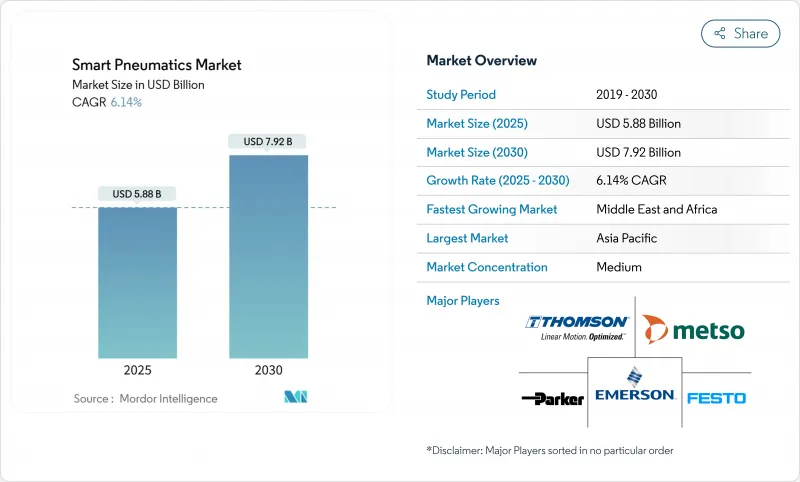
성장을 뒷받침하는 것은 압축공기 동력과 IIoT 커넥티비티의 융합으로 공장 환경 내 실시간 모니터링, 에너지 최적화, 예지보전이 가능합니다. 제조업체는 예기치 않은 가동 중지 시간을 줄이고 압축 공기 누출을 줄이고 MES 및 클라우드 분석과 원활하게 통합하는 공압 업그레이드를 선호합니다. 아시아태평양의 기세는 가장 강하며 대규모 반도체 투자와 정부의 자동화 프로그램으로 연결된 공압 장비의 설치 기반이 확대되고 있습니다. 한편, 중동에서는 석유 및 가스 우물 헤드의 용도으로 급속하게 보급이 진행되고 있어, 안전성이 중요한 밸브의 작동에 라이브 헬스 진단이 도움이 되고 있습니다. 경쟁의 중심은 데이터 관리이며, 선도적인 공급업체는 센서 데이터를 실용적인 인사이트으로 변환하는 AI 기능을 추가합니다.
세계의 스마트 공압 시장 동향과 인사이트
자동차 Tier-1 공장에서의 예지 보전의 필요성
자동차 Tier-1 공급업체는 고장 몇 주 전에 마모 패턴을 감지하기 위해 실린더 어셈블리에 압력, 유량 및 온도 센서를 내장하고 있습니다. 유럽의 바디 인 화이트 라인은 비정상 클러스터에 플래그를 지정하는 머신러닝 알고리즘과 공압 센서 스트림을 결합하여 20-30%의 유지 보수 비용을 절감하고 예기치 않은 정지가 거의 0이 되었다는 것을 기록합니다. 북미의 파워트레인 공장에서는 라인의 택트타임을 지키기 위해 이 모델을 재현하고 있으며, 아시아의 OEM은 현지 노동력 부족이 심각해지는 가운데 이 모델을 시험적으로 도입하고 있습니다. 전동화 차량 프로그램이 확대됨에 따라 혼합 모델의 조립 라인은 시간당 처리량을 유지하기 위한 고장 예측 정확도에 따라 달라집니다. 따라서 스마트 공압 장비의 예측 건전성 데이터는 유지보수 계획을 캘린더에서 상태 기반 로직으로 전환하여 가동 시간을 유지하며 중요한 예비 부품의 재고를 압축합니다.
공압 밸브에 IO-Link 대응 센서 통합
IO-Link는 밸브를 수동 공기 스위치에서 어드레싱 가능한 필드 장치로 변환합니다. Emerson의 필드 데이터는 밸브 아일랜드가 자체 식별하고 컨트롤러 태그를 자동 입력하면 시운전 시간이 40% 단축됨을 보여줍니다. 하나의 마스터에 8개의 클래스 A 포트가 있으며 PLC 캐비닛에서 최대 30m 떨어진 곳에 설치된 유량, 압력 및 위치 센서의 조합을 신호 손실 없이 지원합니다. 장치 교체가 빨라지면 평균 수리 시간이 단축되고 매개변수 백업은 수동 설정 오류를 방지합니다. 일본과 한국에서는 공구를 자주 교환해야 하는 전자기기 패키징 라인에서의 채용이 가속화되고 있습니다. 공장이 IO-Link에서 센서 연결을 통일함에 따라 공압 진단이 CMMS 용도에 알람 패킷을 푸시하는 에지 게이트웨이에 공급되어 작업과 유지 보수 사이의 루프를 닫습니다.
레거시 필드 버스 아일랜드와의 이더넷 - IP 상호 운용성 부족
브라운필드 현장에서는 종종 CIP 객체를 네이티브로 교환할 수 없는 PROFIBUS, DeviceNet 또는 CC-Link 아일랜드를 운영하고 있습니다. 프로토콜 게이트웨이를 추가하면 5-15ms의 대기 시간이 발생하여 고속 픽 앤 플레이스 장치의 시간이 중요한 블로오프 시퀀싱가 위험합니다. 격리된 자동화 포켓은 엔드 투 엔드 데이터 가시성을 방해하고 유지보수 팀은 여러 진단 도구를 사용해야 합니다. 다중 프로토콜 노드와 시간 감지 네트워킹은 구제를 약속하지만, 자본 예산의 사이클을 기다리고 광범위한 배포를 기다리고 있습니다. 그때까지 시스템 통합사업자는 속도나 비용을 절충한 하이브리드 제품을 설계해야 하며 스마트 공압 시장을 확장해야 하는 새로 고침 프로젝트가 느리게 진행되지 않습니다.
부문 분석
스마트 공압 밸브는 압력, 유량 및 사이클 카운트를 PLC에 브로드캐스트하는 센서가 풍부한 매니폴드 플랫폼을 대부분의 산업에 공급하여 2024년 스마트 공압 시장의 45% 매출을 차지했습니다. 밸브의 건전성 메트릭은 컨디션 기반 오버홀 스케줄을 알리고 자동차 페인트 공장이 압력 드리프트와 관련된 오버스프레이 결함을 피하는 데 도움이 됩니다. IO-Link를 매니폴드 블록에 통합하면 8웨이 마스터가 배선을 변경하지 않고 핫 스왑 카트리지를 수용하므로 확장이 간소화됩니다. 애드온 분석은 밸브 당 누출을 계산하고 레거시 시스템에서는 보이지 않는 에너지 손실을 부각시킵니다. 반도체 공장에서는 클린룸의 미립자 규격에 준거한 스테인리스 밸브를 채용하여 수요의 연속성을 강화하고 있습니다.
스마트 공압 모듈은 2030년까지 연평균 복합 성장률(CAGR) 8.5%로 가속하고 밸브 제어, 압력 조정, 엣지 컴퓨팅을 하나의 인클로저에 번들하여 단일 기능 구성 요소를 능가합니다. 페스트의 모션 터미널은 다운로드 가능한 앱을 실행하고 모듈을 온/오프 제어에서 비례 제어 및 진공 생성으로 몇 분 안에 전환합니다. 이러한 유연성은 SKU 수를 줄이고 빠르게 움직이는 소비재 공장에서 제품 전환을 가속화합니다. 모듈은 또한 대기 압력을 자동으로 감소시키는 에너지 절약 알고리즘을 통합하여 공장 전체의 탈탄소화 목표를 지원합니다. 시스템 레벨 오케스트레이션에서 모듈의 역할은 확대되고 있으며, 특히 플러그 앤 플레이의 확장성을 목표로 설계된 그린 필드 라인에서는 스마트 공압 시장의 매우 중요한 날개를 담당하고 있습니다.
하드웨어는 2024년 매출의 60%를 차지하며, 이는 공장 바닥에서 사용되는 밸브, 실린더, 레귤레이터 및 매니폴드의 교체 사이클을 반영했습니다. 차세대 실린더는 0.1mm 분해능의 위치 피드백을 제공하는 자기 엔코더를 내장하고 패키징 셀에서 조정된 다축 이동을 가능하게 합니다. 소형화된 유량 센서는 레귤레이터 본체에 장착되어 리터 단위의 소비 데이터를 취득합니다. 공급업체는 OT 사이버 보안 프레임워크와 협력하여 잘못된 코드 주입을 방지하는 보안 부팅 펌웨어가 장착된 하드웨어 출하량을 늘리고 있습니다.
서비스는 2025-2030년 CAGR이 10%로 가장 급성장하는 구성 요소입니다. 클라우드 대시보드는 밸브 아일랜드의 KPI를 집계하고 비정상적인 위험으로 순위를 매기며 CMMS 플랫폼에서 자동 작업 지시를 생성합니다. 에너지 감사 서비스는 데이터를 사용하여 누출에 비용 값을 할당하고 항공 회수에 자금을 제공하도록 재무 부서를 설득합니다. 원격 지원 구독을 통해 공급업체 전문가가 장치 로그에 액세스하고 플랜트 기술자를 시정 조치로 안내하고 출장을 줄일 수 있습니다. 이러한 데이터 중심의 서비스 계층은 장기적으로 거래형 제품의 판매를 지속적인 수익으로 전환합니다.
스마트 공압 시장은 제품 유형(스마트 공압 밸브, 스마트 공압 액추에이터, 스마트 공압 모듈), 구성 요소, 기기 유형, 최종 사용자 산업(자동차, 석유 및 가스, 식음료), 통신 프로토콜(EtherNet/IP, PROFINET, IO-Link), 유통 채널, 지역별로 세분화되어 있습니다. 시장 예측은 금액(달러)으로 제공됩니다.
지역 분석
아시아태평양은 2024년에 38%의 매출을 차지해 중국의 '메이드 인 차이나 2025'에 의한 자동화 추진과 대만의 329억 대만 달러의 반도체 투자에 지지되었습니다. 고밀도 공장 클러스터는 광열비가 부풀어 오르기 전에 압축 공기의 누설에 플래그를 세우는 분석 기능을 내장한 밸브 매니폴드를 채용. 일본의 자동차 공장은 IO-Link 대응의 실린더를 프레스기 전체에 전개해, 복수 모델의 변화시의 전환 시간을 단축하고 있습니다. 닝보 Smart Pneumatic과 같은 현지 공급업체는 지역 중소기업에 맞추어 비용을 최적화한 모듈을 공급하고 경쟁을 격화시키고 가격 성능의 급속한 개선을 촉진하여 지역 우위를 강화하고 있습니다.
북미는 성숙하면서도 기술 혁신에 중점을 둔 구매층이 많습니다. 자동차 OEM은 밸브 아일랜드를 클라우드 AI 엔진에 연결하고 라인 정지를 30일 전에 예측함으로써 다운타임 벌금을 완화합니다. CHIPS 방법은 애리조나, 텍사스, 오하이오의 새로운 공장에 인센티브를 제공하고 각각 라이브 이슬점 경보가있는 ISO 클래스 1 깨끗한 압축 공기 네트워크를 지정합니다. 에너지 절감의 의무화로 인해 공장은 유휴 시 공급 라인을 차단할 수 있는 공기 관리 시스템을 채택하게 되어 스마트 공압 시장에서의 지속가능성에 대한 폭넓은 뒷받침을 반영하고 있습니다.
중동은 2030년까지 연평균 복합 성장률(CAGR) 7.5%의 성장이 예상됩니다. 국영 석유 회사는 갱정 헤드를 PLC 기반 안전 셧다운 장치로 개조하고 이중 중복 공압 액추에이터를 통합하여 스템의 움직임 프로파일을 중앙 제어실로 보냅니다. 가혹한 기후는 내식성 합금, 고온 밀봉, 모래 침입을 예측하는 자기 진단 밸브 블록 수요를 촉진합니다. 석유 및 가스뿐만 아니라 걸프 국가들은 경제의 다양화를 위해 식품 공장 및 제약 공장에 투자하고 있으며 현지 엔지니어링 지원이 제한된 고립된 시설에 적합한 모듈식 공압를 채택하고 있습니다. 이 새로운 수요는 스마트 공압 시장 공급업체의 지역 실적을 확대하고 있습니다.
기타 혜택 :
- 엑셀 형식 시장 예측(ME) 시트
- 3개월간의 애널리스트 지원
목차
제1장 서론
- 조사 범위
제2장 조사 방법
제3장 주요 요약
제4장 시장 상황
- 시장 성장 촉진요인
- 자동차 Tier1 공장에서의 예지 보전의 필요성(유럽)
- IO-Link 대응 센서의 공압 밸브에의 통합(북미)
- 중국과 대만에서 반도체 생산 능력 증강이 가속
- 석유 및 가스 우물 헤드의 세이프티 크리티컬 채용(중동)
- 시장 성장 억제요인
- 레거시 필드 버스 아일랜드와의 이더넷 IP 상호 운용성의 부족
- 라이트 듀티 라인의 전기 기계식 대체품에 대한 높은 TCO
- 가치/공급망 분석
- 규제 또는 기술적 전망
- 세계의 ISO 5599-2 디지털 밸브의 표준화
- Porter's Five Forces 분석
- 신규 참가업체의 위협
- 구매자의 협상력/소비자
- 공급기업의 협상력
- 대체품의 위협
- 경쟁 기업 간 경쟁 관계
제5장 시장 규모와 성장 예측
- 스마트 공압 액추에이터
- 스마트 공압 모듈
- 구성 요소별
- 하드웨어
- 소프트웨어
- 서비스
- 계측기 유형별
- 실린더
- 변환기
- 스위치
- 최종 사용자 업계별
- 자동차
- 석유 및 가스
- 식음료
- 통신 프로토콜별
- EtherNet/IP
- PROFINET
- IO 링크
- 유통 채널별
- 직접 판매
- 간접/시스템 통합업체
- 지역별
- 북미
- 미국
- 캐나다
- 멕시코
- 유럽
- 영국
- 독일
- 프랑스
- 이탈리아
- 기타 유럽
- 아시아태평양
- 중국
- 일본
- 인도
- 한국
- 기타 아시아
- 중동
- 이스라엘
- 사우디아라비아
- 아랍에미리트(UAE)
- 튀르키예
- 기타 중동
- 아프리카
- 남아프리카
- 이집트
- 기타 아프리카
- 남미
- 브라질
- 아르헨티나
- 기타 남미
- 북미
제6장 경쟁 구도
- 전략적 동향
- 시장 점유율 분석
- 기업 프로파일
- Emerson Electric Co.(incl. Aventics)
- Festo SE and Co. KG
- Parker Hannifin Corporation
- SMC Corporation
- Bosch Rexroth AG
- Siemens AG(Industrial Automation)
- Rotork plc
- IMI Norgren(part of IMI plc)
- Bimba Manufacturing Co.(a part of IMI)
- PHD Inc.
- PNEUMAX SpA
- Cypress EnviroSystems Corp.
- AirTAC International Group
- Ningbo Smart Pneumatic Co. Ltd.
- Bosch Rexroth AG
- Thomson Industries Inc.
- The Smart Actuator Company Ltd.
- Aventics(now part of Emerson)
- Ham-Let Group
- Metso Automation(Flow Control)
제7장 시장 기회와 향후 전망
KTH 25.11.17The smart pneumatics market is valued at USD 5.88 billion in 2025 and is forecast to reach USD 7.92 billion by 2030, reflecting a 6.14% CAGR.
Growth is propelled by the fusion of compressed-air power with IIoT connectivity, which allows real-time monitoring, energy optimization, and predictive maintenance within factory environments. Manufacturers are prioritizing pneumatic upgrades that reduce unplanned downtime, cut compressed-air leaks, and integrate seamlessly with MES and cloud analytics. Regional momentum is strongest in Asia-Pacific, where large-scale semiconductor investments and government automation programs are expanding the installed base of connected pneumatic devices. Meanwhile, the Middle East shows rapid uptake in oil-and-gas wellhead applications, where safety-critical valve actuation benefits from live health diagnostics. Competition centers on data stewardship, with leading suppliers adding AI capabilities that convert sensor data into actionable insights.
Global Smart Pneumatics Market Trends and Insights
Predictive-maintenance imperatives in automotive tier-1 plants
Automotive tier-1 suppliers are embedding pressure, flow, and temperature sensors into cylinder assemblies to detect wear patterns weeks before failure. European body-in-white lines have documented 20-30% maintenance cost reductions and near-zero unplanned stops by coupling pneumatic sensor streams with machine-learning algorithms that flag anomaly clusters. North American power-train plants replicate the model to protect line takt times, and Asian OEMs are piloting it as local labour shortages intensify. As electrified vehicle programs expand, mixed-model assembly lines rely on fault-prediction accuracy to sustain hourly throughput. Predictive health data from smart pneumatic devices therefore shifts maintenance planning from calendar to condition-based logic, preserving uptime and compressing inventory of critical spares.
Integration of IO-Link-ready sensors in pneumatic valves
IO-Link converts valves from passive air switches into addressable field devices. Emerson field data indicates commissioning time cuts of 40% when valve islands self-identify and auto-populate controller tags. Eight Class A ports on a single master support combinations of flow, pressure, and position sensors placed up to 30 m from PLC cabinets without signal loss. Faster device replacement lowers mean-time-to-repair, while parameter backups prevent manual set-point errors. Japan and South Korea have accelerated adoption in electronics packaging lines that must swap tooling frequently. As factories unify sensor connectivity on IO-Link, pneumatic diagnostics feed edge gateways that push alarm packets to CMMS applications, closing the loop between operations and maintenance.
Lack of Ethernet-IP interoperability with legacy fieldbus islands
Brownfield sites often operate PROFIBUS, DeviceNet, or CC-Link islands that cannot natively exchange CIP objects. Adding protocol gateways introduces 5-15 ms latency, which jeopardizes time-critical blow-off sequences in high-speed pick-and-place units. Isolated automation pockets hinder end-to-end data visibility, forcing maintenance teams to juggle multiple diagnostic tools. Multi-protocol nodes and Time-Sensitive Networking promise relief, yet widespread deployment awaits capital-budget cycles. Until then, system integrators must design hybrids that compromise on either speed or cost, slowing refresh projects that would otherwise expand the smart pneumatics market.
Other drivers and restraints analyzed in the detailed report include:
- Accelerated semiconductor capacity build-out in China and Taiwan
- Safety-critical adoption in oil and gas well-heads
- High TCO versus electromechanical alternatives in light-duty lines
For complete list of drivers and restraints, kindly check the Table Of Contents.
Segment Analysis
Smart pneumatic valves anchored the smart pneumatics market with 45% revenue in 2024, supplying most industries with sensor-rich manifold platforms that broadcast pressure, flow, and cycle counts to PLCs. Valve health metrics inform condition-based overhaul schedules, helping automotive paint shops avoid overspray defects linked to pressure drift. Integration of IO-Link within manifold blocks simplifies expansion, as eight-way masters accept hot-swap cartridges without rewiring. Add-on analytics calculate leakage per valve, highlighting energy losses invisible in legacy systems. Semiconductor fabs adopt stainless-steel variants that comply with cleanroom particulate standards, reinforcing demand continuity.
Smart pneumatic modules are accelerating at an 8.5% CAGR through 2030, outpacing single-function components by bundling valve control, pressure regulation, and edge computing in one enclosure. Festo's Motion Terminal runs downloadable apps that switch a module from on/off control to proportional regulation or vacuum generation in minutes. Such flexibility lowers SKU counts and speeds product changeovers in fast-moving consumer-goods plants. Modules also embed energy-savings algorithms that auto-reduce stand-by pressure, supporting factory-wide decarbonization goals. Their expanding role in system-level orchestration positions them as pivotal contributors to the smart pneumatics market, particularly in greenfield lines designed for plug-and-play scalability.
Hardware accounted for 60% of 2024 revenue, reflecting the replacement cycle of valves, cylinders, regulators, and manifolds that populate factory floors. New-generation cylinders incorporate magnetic encoders delivering 0.1 mm resolution positional feedback, enabling coordinated multi-axis moves in packaging cells. Miniaturized flow sensors fit into regulator bodies, capturing consumption data down to the litre. Vendors increasingly ship hardware with secure boot firmware to guard against unauthorized code injection, aligning with OT cybersecurity frameworks.
Services represent the fastest-growing component at a 10% CAGR from 2025-2030. Cloud dashboards aggregate valve-island KPIs, rank them by anomaly risk, and generate automatic work orders in CMMS platforms. Energy-audit services use the data to assign cost values to leaks, convincing finance departments to fund air-line retrofits. Remote-assist subscriptions let vendor specialists access device logs, guiding plant technicians through corrective actions and reducing travel. Over time, this data-driven service layer converts transactional product sales into recurring revenue, an approach echoed by similar transitions in the smart pneumatics industry.
Smart Pneumatics Market Segmented by Product Type (Smart Pneumatic Valves, Smart Pneumatic Actuators and Smart Pneumatic Modules), Component, Instrument Type, End-User Industry (Automotive, Oil & Gas and Food & Beverage), Communication Protocol (EtherNet/IP, PROFINET and IO-Link), Distribution Channel and Geography. The Market Forecasts are Provided in Terms of Value (USD).
Geography Analysis
Asia-Pacific held 38% revenue in 2024, supported by China's automation drive under "Made in China 2025" and Taiwan's NT$32.9 billion semiconductor investments. High-density factory clusters adopt valve manifolds with built-in analytics that flag compressed-air leaks before they inflate utility bills. Japanese automotive plants roll out IO-Link enabled cylinders across stamping presses, cutting changeover times during multi-model shifts. Local vendors such as Ningbo Smart Pneumatic supply cost-optimized modules tailored to regional SMEs, intensifying competition and stimulating rapid price-performance improvements that strengthen regional dominance.
North America represents a mature yet innovation-focused buyer base. Automotive OEMs connect valve islands to cloud AI engines that predict line stoppages 30 days in advance, reducing downtime penalties. The CHIPS Act incentivizes new fabs in Arizona, Texas, and Ohio, each specifying ISO Class 1 clean-compressed-air networks with live dew-point alarms. Energy-reduction mandates push plants to adopt air-management systems capable of shutting off feed lines during idle periods, reflecting a broader push toward sustainability in the smart pneumatics market.
The Middle East is expected to grow at 7.5% CAGR through 2030. National oil companies retrofit wellheads with PLC-based safety shutdown units integrating dual-redundant pneumatic actuators that broadcast stem-movement profiles to central control rooms. The harsh climate drives demand for corrosion-resistant alloys, extended-temperature seals, and self-diagnosing valve blocks that anticipate sand ingress. Beyond oil and gas, Gulf states invest in food and pharmaceutical plants to diversify economies, adopting modular pneumatics that fit isolated facilities with limited local engineering support. This emerging demand widens the geographic footprint of smart pneumatics market suppliers.
- Emerson Electric Co. (incl. Aventics)
- Festo SE and Co. KG
- Parker Hannifin Corporation
- SMC Corporation
- Bosch Rexroth AG
- Siemens AG (Industrial Automation)
- Rotork plc
- IMI Norgren (part of IMI plc)
- Bimba Manufacturing Co. (a part of IMI)
- PHD Inc.
- PNEUMAX S.p.A.
- Cypress EnviroSystems Corp.
- AirTAC International Group
- Ningbo Smart Pneumatic Co. Ltd.
- Bosch Rexroth AG
- Thomson Industries Inc.
- The Smart Actuator Company Ltd.
- Aventics (now part of Emerson)
- Ham-Let Group
- Metso Automation (Flow Control)
Additional Benefits:
- The market estimate (ME) sheet in Excel format
- 3 months of analyst support
TABLE OF CONTENTS
1 INTRODUCTION
- 1.1 Scope of the Study
2 RESEARCH METHODOLOGY
3 EXECUTIVE SUMMARY
4 MARKET LANDSCAPE
- 4.1 Market Drivers
- 4.1.1 Predictive-maintenance imperatives in automotive tier-1 plants (Europe)
- 4.1.2 Integration of IO-Link-ready sensors in pneumatic valves (North America)
- 4.1.3 Accelerated semiconductor capacity build-out in China and Taiwan
- 4.1.4 Safety-critical adoption in oil and gas well-heads (Middle East)
- 4.2 Market Restraints
- 4.2.1 Lack of Ethernet-IP interoperability with legacy fieldbus islands
- 4.2.2 High TCO versus electromechanical alternatives in light-duty lines
- 4.3 Value / Supply-Chain Analysis
- 4.4 Regulatory or Technological Outlook
- 4.4.1 Global ISO 5599-2 digital valve standardization
- 4.5 Porter's Five Forces Analysis
- 4.5.1 Threat of New Entrants
- 4.5.2 Bargaining Power of Buyers/Consumers
- 4.5.3 Bargaining Power of Suppliers
- 4.5.4 Threat of Substitute Products
- 4.5.5 Intensity of Competitive Rivalry
5 MARKET SIZE AND GROWTH FORECASTS (VALUE)
- 5.1 Smart Pneumatic Actuators
- 5.1.1 Smart Pneumatic Modules
- 5.2 By Component
- 5.2.1 Hardware
- 5.2.2 Software
- 5.2.3 Services
- 5.3 By Instrument Type
- 5.3.1 Cylinders
- 5.3.2 Transducers
- 5.3.3 Switches
- 5.4 By End-user Industry
- 5.4.1 Automotive
- 5.4.2 Oil and Gas
- 5.4.3 Food and Beverage
- 5.5 By Communication Protocol
- 5.5.1 EtherNet/IP
- 5.5.2 PROFINET
- 5.5.3 IO-Link
- 5.6 By Distribution Channel
- 5.6.1 Direct Sales
- 5.6.2 Indirect / System-Integrator
- 5.7 By Geography
- 5.7.1 North America
- 5.7.1.1 United States
- 5.7.1.2 Canada
- 5.7.1.3 Mexico
- 5.7.2 Europe
- 5.7.2.1 United Kingdom
- 5.7.2.2 Germany
- 5.7.2.3 France
- 5.7.2.4 Italy
- 5.7.2.5 Rest of Europe
- 5.7.3 Asia-Pacific
- 5.7.3.1 China
- 5.7.3.2 Japan
- 5.7.3.3 India
- 5.7.3.4 South Korea
- 5.7.3.5 Rest of Asia
- 5.7.4 Middle East
- 5.7.4.1 Israel
- 5.7.4.2 Saudi Arabia
- 5.7.4.3 United Arab Emirates
- 5.7.4.4 Turkey
- 5.7.4.5 Rest of Middle East
- 5.7.5 Africa
- 5.7.5.1 South Africa
- 5.7.5.2 Egypt
- 5.7.5.3 Rest of Africa
- 5.7.6 South America
- 5.7.6.1 Brazil
- 5.7.6.2 Argentina
- 5.7.6.3 Rest of South America
- 5.7.1 North America
6 COMPETITIVE LANDSCAPE
- 6.1 Strategic Moves
- 6.2 Market Share Analysis
- 6.3 Company Profiles (includes Global level Overview, Market level overview, Core Segments, Financials as available, Strategic Information, Market Rank/Share for key companies, Products and Services, and Recent Developments)
- 6.3.1 Emerson Electric Co. (incl. Aventics)
- 6.3.2 Festo SE and Co. KG
- 6.3.3 Parker Hannifin Corporation
- 6.3.4 SMC Corporation
- 6.3.5 Bosch Rexroth AG
- 6.3.6 Siemens AG (Industrial Automation)
- 6.3.7 Rotork plc
- 6.3.8 IMI Norgren (part of IMI plc)
- 6.3.9 Bimba Manufacturing Co. (a part of IMI)
- 6.3.10 PHD Inc.
- 6.3.11 PNEUMAX S.p.A.
- 6.3.12 Cypress EnviroSystems Corp.
- 6.3.13 AirTAC International Group
- 6.3.14 Ningbo Smart Pneumatic Co. Ltd.
- 6.3.15 Bosch Rexroth AG
- 6.3.16 Thomson Industries Inc.
- 6.3.17 The Smart Actuator Company Ltd.
- 6.3.18 Aventics (now part of Emerson)
- 6.3.19 Ham-Let Group
- 6.3.20 Metso Automation (Flow Control)
7 MARKET OPPORTUNITIES AND FUTURE OUTLOOK
- 7.1 White-space and Unmet Need Analysis


