
|
시장보고서
상품코드
1851869
바이오프로세스 분석기 : 시장 점유율 분석, 산업 동향, 통계, 성장 예측(2025-2030년)Bioprocess Analyzers - Market Share Analysis, Industry Trends & Statistics, Growth Forecasts (2025 - 2030) |
||||||
 Mordor Intelligence
바이오프로세스 분석기 시장 규모는 2025년에 23억 2,000만 달러, 2030년에는 48억 2,000만 달러에 이르고, 예측 기간의 CAGR은 15.81%에 달할 전망입니다.
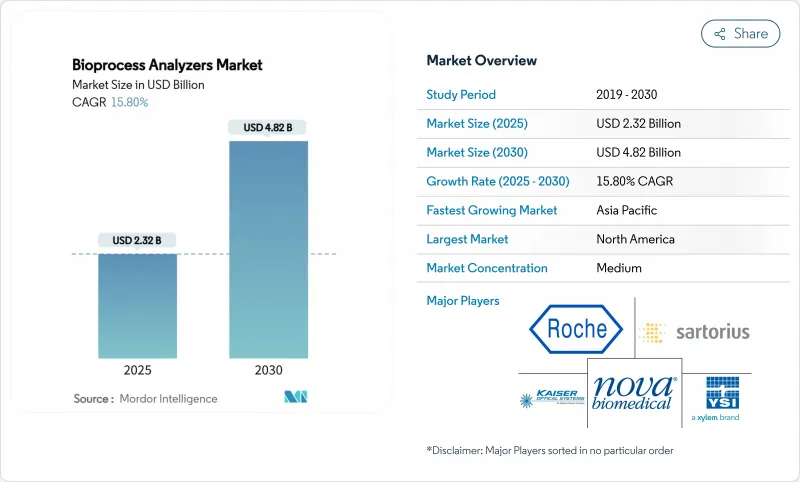
규제 당국이 지속적인 제조를 우선시하고 COVID-19 백신의 신속한 스케일업으로 유행 시대의 개념 실증이 달성됨에 따라 제조업체가 레트로 스펙티브 배치 테스트를 중단하고 실시간 최적화로 이행함에 따라 수요가 가속화됩니다. 성장은 세계 바이오 제조 능력 확대, 단일 사용 기술에 대한 적극적인 투자, 예측 품질 관리를 위한 분광법과 AI 구동 모델을 융합시킨 성숙한 디지털 트윈 에코시스템에 직접 연결되어 있습니다. 장비는 여전히 모니터링 워크플로우의 핵심이지만, 공장이 폐쇄 루프 제어 전략을 도입함에 따라 소프트웨어와 애널리틱스가 불균형한 증가 달러를 차지하고 있습니다. 지역별로는 북미가 압도적인 설치 대수를 유지하는 한편, 아시아태평양에서는 그린필드 공장이 급증하고 증가 대수가 가장 많아지고 있습니다. M&A는 신중한 속도로 계속되고 있으며, 선도적인 공급업체는 최종 사용자가 검증, 데이터 무결성, 노동력 부족에 대응할 수 있도록 수직 통합 하드웨어 소프트웨어 서비스 스택을 제공하기 위해 통합을 진행하고 있습니다.
세계의 바이오프로세스 분석기 시장 동향과 인사이트
바이오 의약품 제조 능력 성장
그린필드와 브라운필드의 급속한 확대로 세계설치용량은 1,500개 이상의 시설에서 1,650만L을 넘어, 새로운 바이오리액터는 각각 독자적인 분석 스위트를 필요로 합니다. 삼성바이오로직스의 플랜트 5만으로도 18만L가 추가되어 캠퍼스 합계는 78만4천L가 되어, 분광분석, 질량분석, 전기화학 센서의 주문이 쇄도하고 있습니다. 비슷한 기세는 노스캐롤라이나주에서도 볼 수 있으며, 후지필름은 2만 리터의 리액터를 8기 증설해, 인라인 라만 프로브의 하류로의 당김을 낳고 있습니다. 개발 도상 지역에서는 규제 당국이 ICH 준수 프로세스와의 동등성을 의무화하고 있기 때문에 현지 제조업체는 세계 벤더로부터 검증된 시스템을 구입할 수 없어 수요가 확대되고 있습니다. 용기의 대형화는 샘플 처리량에 대한 요구를 강화하고 대사산물, 영양소, 물리화학적 지표를 동시에 모니터링하는 멀티플렉스 솔루션에 대한 구매 의욕을 추구합니다. 이러한 프로젝트를 종합하면 바이오프로세스 분석기 시장의 기준선이 상승하고 기업이 플랫폼 기술을 표준화함으로써 임베디드 사이클이 연장됩니다.
공정 분석 기술(PAT) 채용 증가
FDA의 2025년 1월 가이던스 초안은 실시간 출시 테스트를 지원하고 검증 경로를 명확히 하고 보류된 설비 투자를 동결 해제했습니다. 제조업체는 「프로세스 분석 4.0」을 급피치로 진행하고 있어, 라만, NIR, MS와 머신러닝 모델을 통합해, 소규모 시험으로 포도당, 젖산, IgG의 예측으로 R2>0.9를 달성했습니다. 디지털 트윈 시스템은 라이브 데이터와 기계식 시뮬레이션을 비교하여 몇 시간이 아닌 몇 초 만에 피드 속도를 조정할 수 있습니다. 이러한 폐쇄 루프 아키텍처는 편차를 줄이고 배치 검토 주기를 단축하며 예산 승인을 가속화하는 CFO 수준의 ROI를 제공합니다. 조기 도입 기업은 제품 릴리스 타임라인이 25% 단축된 것으로 보고되어 전사적인 롤아웃 비즈니스 사례가 강화되었습니다. 벤더는 소프트웨어 구독을 하드웨어에 번들함으로써 장기적인 연금 수입을 확보하고 저비용 센서 참가 기업과의 차별화를 도모합니다.
높은 자본 비용과 운영 비용
통합 PAT 워크스테이션은 10만 달러를 초과할 수 있으며 시드 스테이지의 생명 공학 기업과 학술 연구소의 채용 의욕을 깎고 있습니다. 자본이 확보되더라도 시약, 교정용 표준물질, 서비스 계약 등의 지속적인 비용이 예산을 부담합니다. DIY와 오픈 하드웨어 솔루션의 시도는 진입 장벽을 낮추지만 라이선스 생산에 필요한 GMP 혈통에는 부족합니다. 비용에 민감한 구매자는 업그레이드를 늦추고 생산성이 저하되지만 기존 오프라인 분석의 사용을 연장합니다. 공급업체는 임대, 페이퍼 샘플, 클라우드 기반 애널리틱스를 제공하여 현금화를 원활하게 하여 대응하고 있습니다. 그럼에도 불구하고, 특히 보조금의 자금 조달 사이클이 구매 능력을 좌우하는 지역에서는 스티커 충격이 단기 성장의 구체적인 발판이 되고 있습니다.
부문 분석
2024년 매출의 58.54%를 장비 부문이 차지했으며, 하드웨어는 계속 필수적입니다. 이 점유율은 바이오 리액터와 물리적으로 상호 작용하는 특정 센서, 분광기 및 샘플러에 대한 기본적인 요구를 반영합니다. 단일 사용 프로브에 대한 수요가 소모품 연금을 확대하고, 특히 일회용 가방이 업스트림 워크플로우의 85%를 나타낼 전망입니다. 장비의 바이오프로세스 분석기 시장 규모는 메가 플랜트의 전개와 연계하여 확대될 것으로 예상되지만, 레거시 지역의 설치 기반이 성숙함에 따라 성장률은 완만해집니다.
소프트웨어와 애널리틱스는 2024년 지출액의 14.1%에 불과하지만 공장이 완전히 디지털 트윈으로 전환함에 따라 17.65%의 연평균 복합 성장률(CAGR)을 나타낼 전망입니다. AI 대응 플랫폼은 데이터 로깅에 그치지 않고, 예지 보전이나 파라미터의 자동 수정에까지 확대해, 설비 전체의 유효성을 2자리 상승시킵니다. 증가하는 데이터 실적는 클라우드 네이티브 아키텍처를 촉진하여 계측기 공급업체와 하이퍼스케일 제공업체의 파트너십을 촉진합니다. 이러한 상호작용은 월렛 점유율을 경상 라이선스로 전환하고 공급업체의 손익을 재구성하며 기존 하드웨어 중심이었던 바이오프로세스 분석기 업계에 SaaS 평가 배율을 도입합니다.
라만 분광법은 샘플 준비 없이 대사산물 프로파일의 비파괴적이고 내수성 인사이트를 제공함으로써 2024년 매출의 42.45%를 획득했습니다. 인라인 광섬유는 포도당, 젖산 및 아미노산 풀의 연속 추적을 가능하게 하고 폐쇄 루프 영양 공급을 지원합니다. 미니 바이오리액터로 개발된 모델 라이브러리는 제조 규모로 원활하게 이동하여 캘리브레이션 비용을 절감합니다.
한편 질량분석은 17.94%의 연평균 복합 성장률(CAGR)로 주류가 되고 있습니다. 마이크로플루이딕스 인터페이스는 현재 서브밀리리터 용량으로 온라인 샘플링을 가능하게 하고, 이전에는 오프라인에서만 가능했던 실시간 역가 및 불순물 맵을 가능하게 합니다. 벤더는 고해상도, 낮은 유지 보수 설계를 강조하고 복잡성의 이미지를 닦습니다. NIR은 바이오매스 추정용으로 견인력을 유지하고, 전기화학 센서는 중요한 품질 속성을 위한 저비용 리던던시를 제공하며, 바이오프로세스 분석기 시장을 지원하는 다양한 측정 포트폴리오를 완성하고 있습니다.
지역 분석
북미는 GMP 시설의 밀집, PAT에 대한 FDA의 적극적인 정책, 2025년 프로젝트 전체에서 1,600억 달러 이상의 의약품 설비 투자가 발표되어 2024년 매출의 40.32%를 차지했습니다. 론자에 의한 Roche의 Vacaville 사이트 인수와 같은 대규모 인수는 33만 리터의 반응기를 보유하고 있으며, 현지 공급망의 성숙이 계속되고 있음을 뒷받침하고 있습니다. 반면, BIOSECURE 법안 초안은 21억 달러 상당의 생물제제 생산계약을 중국 기업에서 벗어나 국내 장비 수요를 더욱 자극할 수 있습니다. 캐나다에서는 정부의 공동 투자 보조금으로 백신 분석의 확대가 촉진되고 하드웨어 판매에 더욱 탄력이 있습니다.
아시아태평양은 16.54%의 연평균 복합 성장률(CAGR)을 기록했으며, 지역 챔피언이 수십억 달러의 설비 투자를 수행했습니다. 삼성 바이오로직스는 6공장 완성 시 96만 4,000L의 생산능력을 목표로 내세우며 분광학, 크로마토그래피, 데이터 관리 시스템 등의 다운스트림 공정으로 끌어오기를 창출했습니다. 일본의 스타트업 5개년 계획에서는 바이오테크놀러지에 대한 세제우대조치가 설치되어 중소기업이 확장 가능한 분석장치를 갖춘 파일럿 플랜트를 건설하도록 촉구하고 있습니다. CGMP 패리티를 추구하는 중국은 FDA의 검증된 장비에 대한 수요를 지원하는 반면 인도의 바이오 이코노미 로드맵은 구미 아웃소싱의 흐름을 캡처하기 위해 고사양 측정 도구를 조달하도록 현지 기업을 밀어줍니다. 동남아시아는 2차 허브로 떠오르고 있으며, CDMO는 엄격한 ICH 기준 하에서 치료제를 수출하도록 설계된 소규모의 세련된 스위트를 건설하고 있습니다.
유럽은 잘토리아스의 BioPAT Spectro Raman 플랫폼으로 대표되는 바와 같이 데이터 무결성과 단일 사용 혁신에 대한 규제 당국의 강한 강조에 힘입어 두 자릿수 전반의 안정적인 성장을 유지하고 있습니다. 독일과 스위스는 장비 설계 및 용도 지원의 기둥으로 지속되며, 아일랜드는 숙련 노동력과 세제를 활용하여 미국의 생물 제제 프로젝트를 유치하고 있습니다. 중동 및 아프리카와 남미에서는 지방정부가 기술이전 컨소시엄에 출자하여 백신의 자급자족을 확보하고 향후 채용의 종이 되는 시험적 수주를 창출하고 있습니다. 이러한 지역 역학이 결합되어 세계의 바이오프로세스 분석기 시장은 상승 기조를 유지하고 있습니다.
기타 혜택 :
- 엑셀 형식 시장 예측(ME) 시트
- 3개월의 애널리스트 지원
목차
제1장 서론
- 조사 전제조건과 시장 정의
- 조사 범위
제2장 조사 방법
제3장 주요 요약
제4장 시장 상황
- 시장 개요
- 시장 성장 촉진요인
- 바이오 의약품 제조 능력의 성장
- 공정 분석 기술(PAT) 채용 증가
- 생명과학 분야의 연구개발비 증가
- 맞춤형 의료 수요 급증
- 제조 수탁 기관(CMO)의 확대
- 지속적인 제조에 대한 유리한 규제 지원
- 시장 성장 억제요인
- 높은 자본 비용과 운영 비용
- 엄격한 밸리데이션과 컴플라이언스 요건
- 숙련된 바이오프로세스 전문가의 부족
- 데이터 통합과 상호 운용성의 과제
- 규제 상황
- Porter's Five Forces 분석
- 신규 참가업체의 위협
- 구매자의 협상력
- 공급기업의 협상력
- 대체품의 위협
- 경쟁 기업 간 경쟁 관계
제5장 시장 규모와 성장 예측(금액, 2024-2030년)
- 제품별
- 기기
- 소모품
- 소프트웨어 및 애널리틱스
- 측정 원리별
- 라만 분광법
- 근적외선(NIR)
- 질량 분석
- 전기화학 센서
- 유형별
- 기질 분석
- 대사산물 분석
- 농도 검출
- 물리화학적 매개변수 모니터링
- 용도별
- 백신
- 항생제
- 재조합 단백질
- 바이오시밀러
- 기타 용도
- 최종 사용자별
- 바이오의약품 및 제약기업
- 수탁제조/연구기관
- 학술 및 연구 기관
- 기타 최종 사용자
- 지역
- 북미
- 미국
- 캐나다
- 멕시코
- 유럽
- 독일
- 영국
- 프랑스
- 이탈리아
- 스페인
- 기타 유럽
- 아시아태평양
- 중국
- 일본
- 인도
- 호주
- 한국
- 기타 아시아태평양
- 중동 및 아프리카
- GCC
- 남아프리카
- 기타 중동 및 아프리카
- 남미
- 브라질
- 아르헨티나
- 기타 남미
- 북미
제6장 경쟁 구도
- 시장 집중도
- 시장 점유율 분석
- 기업 프로파일
- 4BioCell GmbH & Co. KG
- Agilent Technologies
- F. Hoffmann-La Roche AG
- Groton Biosystems
- Kaiser Optical Systems Inc.
- Nova Biomedical Corporation
- Randox Laboratories Ltd
- Sartorius AG
- SYSBIOTECH GmbH
- Thermo Fisher Scientific, Inc.
- YSI Inc.
- Mettler-Toledo International
- Hamilton Company
- Pall Corporation
- Eppendorf SE
- Applikon Biotechnology
- Shimadzu Corporation
- Emerson Electric(Rosemount)
- Cytiva(Danaher)
- Waters Corporation
- Beckman Coulter Life Sciences
제7장 시장 기회와 향후 전망
KTH 25.11.17The bioprocess analyzers market size stood at USD 2.32 billion in 2025 and is set to reach USD 4.82 billion by 2030, translating into a 15.81% CAGR over the forecast period.
Demand accelerates as manufacturers abandon retrospective batch testing in favor of real-time optimization, spurred by regulatory preference for continuous manufacturing and the pandemic-era proof of concept delivered during rapid COVID-19 vaccine scale-up. Growth links directly to expanded global biomanufacturing capacity, aggressive investment in single-use technology, and the maturing digital-twin ecosystem that fuses spectroscopy with AI-driven models for predictive quality control. Instruments remain the backbone of monitoring workflows, yet software and analytics capture disproportionate incremental dollars as factories deploy closed-loop control strategies. Regionally, North America retains a dominant installed base, while Asia-Pacific's surge in green-field plants drives the highest incremental volume. M&A continues at a measured pace, with leading suppliers consolidating to offer vertically integrated hardware-software-service stacks that help end-users navigate validation, data integrity, and workforce shortages.
Global Bioprocess Analyzers Market Trends and Insights
Growth of Biopharmaceutical Manufacturing Capacity
Rapid green-field and brown-field expansion pushes global installed capacity above 16.5 million L across more than 1,500 facilities, each new bioreactor requiring its own analytical suite. Samsung Biologics' Plant 5 alone adds 180,000 L, bringing the campus total to 784,000 L and catalyzing orders for spectroscopy, mass-spectrometry, and electrochemical sensors. Similar momentum is visible in North Carolina, where Fujifilm is building eight additional 20,000 L reactors, creating downstream pull for in-line Raman probes. Developing regions amplify demand because regulators mandate equivalency with ICH-compliant processes, forcing local manufacturers to buy validated systems from global vendors. Larger vessels intensify sample throughput requirements, nudging buyers toward multiplexed solutions that monitor metabolite, nutrient, and physicochemical indicators simultaneously. Collectively these projects raise the bioprocess analyzers market baseline and extend replacement cycles as firms standardize on platform technologies.
Rising Adoption of Process Analytical Technology (PAT)
The FDA's January 2025 draft guidance endorses real-time release testing, clarifying validation pathways and unfreezing capex that had been on hold. Manufacturers fast-track "Process Analytics 4.0," integrating Raman, NIR, and MS with machine-learning models that hit R2 > 0.9 for glucose, lactate, and IgG prediction in small-scale runs. Digital twins compare live data against mechanistic simulations, enabling feed-rate adjustments within seconds instead of hours. These closed-loop architectures cut deviations and shorten batch-review cycles, providing CFO-level ROI that accelerates budget approvals. Early adopters report 25% reductions in product-release timelines, reinforcing the business case for enterprise-wide roll-outs. Vendors respond by bundling software subscriptions with hardware to lock in long-term annuity revenue and differentiate against low-cost sensor entrants.
High Capital and Operating Costs
An integrated PAT workstation can top USD 100,000, discouraging adoption among seed-stage biotech firms and academic labs. Even when capital is secured, ongoing expenses for reagents, calibration standards, and service contracts erode budgets. Attempts to create DIY or open-hardware solutions lower entry barriers but lack the GMP pedigree required for licensed production. Cost-sensitive buyers delay upgrades, extending the use of legacy off-line assays despite productivity penalties. Vendors counter by offering leasing, pay-per-sample, and cloud-based analytics to smooth cash outflows. Still, sticker shock remains a tangible drag on short-term growth, particularly in regions where grant funding cycles dictate purchasing capacity.
Other drivers and restraints analyzed in the detailed report include:
- Increasing R&D Expenditure in Life Sciences
- Surge in Demand for Personalized Medicine
- Stringent Validation and Compliance Requirements
For complete list of drivers and restraints, kindly check the Table Of Contents.
Segment Analysis
Hardware remained essential, with the instruments segment contributing 58.54% of 2024 revenue. That share reflects a baseline need for tangible sensors, spectroscopy units, and samplers that physically interact with bioreactors. Demand for single-use compatible probes expands the consumables annuity, particularly where disposable bags represent 85% of upstream workflows. The bioprocess analyzers market size for instruments is projected to scale in tandem with mega-plant roll-outs, but growth rates moderate as installed bases mature in legacy geographies.
Software and analytics, although just 14.1% of 2024 spending, deliver a 17.65% CAGR as factories transition to fully digital twins. AI-enabled platforms extend beyond data logging to predictive maintenance and automatic parameter correction, raising overall equipment effectiveness by double digits. The swelling data footprint encourages cloud-native architectures, driving partnerships between instrument vendors and hyperscale providers. This interplay shifts wallet share toward recurring licenses, reshaping vendor P&L and introducing SaaS valuation multiples into the traditionally hardware-centric bioprocess analyzers industry.
Raman spectroscopy captured 42.45% revenue in 2024 by offering non-destructive, water-tolerant insight into metabolite profiles without sample preparation. Inline fiber optics allow continuous tracking of glucose, lactate, and amino-acid pools, underpinning closed-loop nutrient feeds. Model libraries developed in mini-bioreactors transfer seamlessly to manufacturing scale, lowering calibration costs.
Mass spectrometry, however, edges into mainstream acceptance with a 17.94% CAGR. Microfluidic interfaces now permit online sampling at sub-milliliter volumes, enabling real-time titer and impurity maps previously possible only off-line. Vendors emphasize high-resolution, low-maintenance designs to dispel perceptions of complexity. NIR retains traction for biomass estimation, while electrochemical sensors offer low-cost redundancy for critical-quality attributes, rounding out a diversified measurement portfolio that sustains the bioprocess analyzers market.
The Bioprocess Analyzers Market Report is Segmented by Product (Instruments, and More), Measurement Principle (Raman Spectroscopy, and More), Type (Substrate Analysis, and More), Application (Vaccines, and More), End-User (Biopharmaceutical & Pharmaceutical Companies, and More), and Geography (North America, Europe, Asia-Pacific, Middle East & Africa, South America). The Market Forecasts are Provided in Terms of Value (USD).
Geography Analysis
North America held 40.32% of 2024 revenue due to a dense concentration of GMP facilities, proactive FDA policy on PAT, and more than USD 160 billion in announced pharmaceutical capex across 2025 projects. Mega-acquisitions such as Lonza's purchase of Roche's Vacaville site-housing 330,000 L of reactors-underscore continued maturation of the local supply chain. Meanwhile, draft BIOSECURE legislation could redirect USD 2.1 billion worth of biologics production contracts away from Chinese entities, further stimulating domestic instrument demand. In Canada, government co-investment grants expedite vaccine analytics expansion, offering additional runway for hardware sales.
Asia-Pacific posts a 16.54% CAGR as regional champions execute multi-billion-dollar builds. Samsung Biologics targets 964,000 L of capacity upon completion of Plant 6, generating downstream pull for spectroscopy, chromatography, and data-management systems. Japan's Five-Year Startup Plan allocates tax incentives for biotech, pushing smaller firms to equip pilot plants with scalable analytics. China's pursuit of CGMP parity anchors demand for FDA-validated instrumentation, while India's bioeconomy roadmap pushes indigenous companies to source high-spec measuring tools to tap western outsourcing flows. Southeast Asia emerges as a secondary hub, where CDMOs erect smaller yet sophisticated suites designed to export therapies under stringent ICH standards.
Europe maintains steady, low-double-digit growth underpinned by strong regulatory emphasis on data integrity and single-use innovation, epitomized by Sartorius' BioPAT Spectro Raman platform. Germany and Switzerland remain pillars for equipment design and application support, while Ireland leverages a skilled workforce and tax regimes to attract U.S. biologics projects. Elsewhere, Middle East & Africa and South America represent nascent opportunities: local governments fund technology-transfer consortia to secure vaccine self-sufficiency, creating pilot orders that seed future adoption. Together these regional dynamics maintain an upward trajectory for the global bioprocess analyzers market.
- 4BioCell
- Agilent Technologies
- Roche
- Groton Biosystems
- Kaiser Optical Systems
- Nova Biomedical
- Randox Laboratories
- Sartorius
- SYSBIOTECH
- Thermo Fisher Scientific
- YSI
- Mettler-Toledo International
- Hamilton Company
- Pall
- Eppendorf
- Applikon Biotechnology
- Shimadzu
- Emerson Electric (Rosemount)
- Cytiva
- Waters Corporation
- Beckman Coulter Life Sciences
Additional Benefits:
- The market estimate (ME) sheet in Excel format
- 3 months of analyst support
TABLE OF CONTENTS
1 Introduction
- 1.1 Study Assumptions & Market Definition
- 1.2 Scope of the Study
2 Research Methodology
3 Executive Summary
4 Market Landscape
- 4.1 Market Overview
- 4.2 Market Drivers
- 4.2.1 Growth of Biopharmaceutical Manufacturing Capacity
- 4.2.2 Rising Adoption of Process Analytical Technology (PAT)
- 4.2.3 Increasing R&D Expenditure in Life Sciences
- 4.2.4 Surge in Demand for Personalized Medicine
- 4.2.5 Expansion of Contract Manufacturing Organizations (CMOs)
- 4.2.6 Favorable Regulatory Support for Continuous Manufacturing
- 4.3 Market Restraints
- 4.3.1 High Capital and Operating Costs
- 4.3.2 Stringent Validation and Compliance Requirements
- 4.3.3 Shortage of Skilled Bioprocessing Professionals
- 4.3.4 Data Integration and Interoperability Challenges
- 4.4 Regulatory Landscape
- 4.5 Porter's Five Forces Analysis
- 4.5.1 Threat of New Entrants
- 4.5.2 Bargaining Power of Buyers
- 4.5.3 Bargaining Power of Suppliers
- 4.5.4 Threat of Substitutes
- 4.5.5 Intensity of Competitive Rivalry
5 Market Size & Growth Forecasts (Value, 2024-2030)
- 5.1 By Product
- 5.1.1 Instruments
- 5.1.2 Consumables
- 5.1.3 Software & Analytics
- 5.2 By Measurement Principle
- 5.2.1 Raman Spectroscopy
- 5.2.2 Near-Infrared (NIR)
- 5.2.3 Mass Spectrometry
- 5.2.4 Electrochemical Sensors
- 5.3 By Type
- 5.3.1 Substrate Analysis
- 5.3.2 Metabolite Analysis
- 5.3.3 Concentration Detection
- 5.3.4 Physicochemical Parameter Monitoring
- 5.4 By Application
- 5.4.1 Vaccines
- 5.4.2 Antibiotics
- 5.4.3 Recombinant Proteins
- 5.4.4 Biosimilars
- 5.4.5 Other Applications
- 5.5 By End-User
- 5.5.1 Biopharmaceutical & Pharmaceutical Companies
- 5.5.2 Contract Manufacturing/Research Organizations
- 5.5.3 Academic & Research Institutes
- 5.5.4 Other End-Users
- 5.6 Geography
- 5.6.1 North America
- 5.6.1.1 United States
- 5.6.1.2 Canada
- 5.6.1.3 Mexico
- 5.6.2 Europe
- 5.6.2.1 Germany
- 5.6.2.2 United Kingdom
- 5.6.2.3 France
- 5.6.2.4 Italy
- 5.6.2.5 Spain
- 5.6.2.6 Rest of Europe
- 5.6.3 Asia-Pacific
- 5.6.3.1 China
- 5.6.3.2 Japan
- 5.6.3.3 India
- 5.6.3.4 Australia
- 5.6.3.5 South Korea
- 5.6.3.6 Rest of Asia-Pacific
- 5.6.4 Middle East & Africa
- 5.6.4.1 GCC
- 5.6.4.2 South Africa
- 5.6.4.3 Rest of Middle East & Africa
- 5.6.5 South America
- 5.6.5.1 Brazil
- 5.6.5.2 Argentina
- 5.6.5.3 Rest of South America
- 5.6.1 North America
6 Competitive Landscape
- 6.1 Market Concentration
- 6.2 Market Share Analysis
- 6.3 Company Profiles (includes Global level Overview, Market level overview, Core Business Segments, Financials, Headcount, Key Information, Market Rank, Market Share, Products and Services, and analysis of Recent Developments)
- 6.3.1 4BioCell GmbH & Co. KG
- 6.3.2 Agilent Technologies
- 6.3.3 F. Hoffmann-La Roche AG
- 6.3.4 Groton Biosystems
- 6.3.5 Kaiser Optical Systems Inc.
- 6.3.6 Nova Biomedical Corporation
- 6.3.7 Randox Laboratories Ltd
- 6.3.8 Sartorius AG
- 6.3.9 SYSBIOTECH GmbH
- 6.3.10 Thermo Fisher Scientific, Inc.
- 6.3.11 YSI Inc.
- 6.3.12 Mettler-Toledo International
- 6.3.13 Hamilton Company
- 6.3.14 Pall Corporation
- 6.3.15 Eppendorf SE
- 6.3.16 Applikon Biotechnology
- 6.3.17 Shimadzu Corporation
- 6.3.18 Emerson Electric (Rosemount)
- 6.3.19 Cytiva (Danaher)
- 6.3.20 Waters Corporation
- 6.3.21 Beckman Coulter Life Sciences
7 Market Opportunities & Future Outlook
- 7.1 White-space & Unmet-need Assessment