
|
시장보고서
상품코드
1851898
모델 기반 기업 시장 : 점유율 분석, 산업 동향, 통계, 성장 예측(2025-2030년)Model-based Enterprise - Market Share Analysis, Industry Trends & Statistics, Growth Forecasts (2025 - 2030) |
||||||
 Mordor Intelligence
모델 기반 기업 시장의 2025년 시장 규모는 260억 2,000만 달러, 2030년에는 530억 8,000만 달러에 이르고, CAGR은 15.33%를 나타낼 전망입니다.
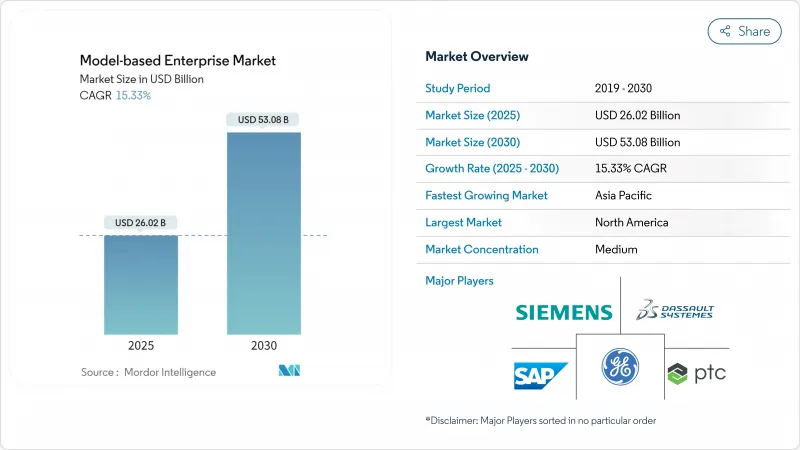
이 기세는 문서 중심의 워크플로우에서 설계, 엔지니어링, 제조 및 서비스의 각 기능을 연결하는 일관된 디지털 원사로의 전환에 힘입어 있습니다. 미국 국방부는 디지털 모델을 단일 권위있는 데이터 소스로 사용하도록 요구하고 있으며 항공우주 및 방위 관련 기업의 신속한 도입에 박차를 가하고 있습니다. 자동차 제조업체는 전기자동차 개발 기간을 단축하기 위해 유사한 기술을 채택하고 있으며, 클라우드 네이티브 제품 수명주기 관리 스위트는 아시아태평양의 중소 제조업체의 장벽을 낮추고 있습니다. 벤더는 AI를 활용한 시뮬레이션, 부가제조 품질 루프, 통합 디지털 트윈에 투자하여 보다 신속한 ROI를 실현하려고 하지만, 많은 사용자는 노동력의 재교육 비용과 데이터 상호 운용성의 격차에 고민하고 있습니다.
세계 모델 기반 기업 시장 동향 및 통찰
북미에서 도입이 가속화되는 국방부의 디지털 엔지니어링 의무화
국방부의 계약자는 현재 설계, 분석, 조달 및 유지 의사결정에서 3D 모델을 유일한 진실한 출처로 취급해야 합니다. 300,000명공급업체가 향후 계약 자격을 유지하기 위해 프로세스, 소프트웨어 스택 및 사이버 보안 안전 가드를 업데이트하기 시작했습니다. 공유 하도급업자가 의무에 준거한 워크플로우에 맞추는 것으로, 그 보급은 민간 항공우주에도 파급되고 있습니다. 툴 벤더는 패키징된 컴플라이언스 템플릿과 자동화된 모델 기반 정의(MBD) 검사기로 지원되며 문서화 시간을 단축하고 추적성을 향상시킵니다.
자동차 OEM, EV 플랫폼용 풀 3D 디지털 스레드로 이동
배터리 전기 프로그램은 기계, 전기 및 열 시스템의 동시 설계에 의존합니다. 통합된 3D 디지털 스레드를 도입함으로써 선도적인 자동차 제조업체는 추적성을 향상시키면서 플랫폼 사이클을 72개월에서 36개월로 단축할 수 있었습니다. 디지털 트윈과 모델 기반 시스템 엔지니어링을 통합함으로써 팀은 에너지 흐름, 충돌 거동 및 배터리 열화를 조기에 시뮬레이션할 수 있게 되었으며, 설계 재실행 및 보증 위험을 억제할 수 있습니다. 이러한 이점은 유럽, 북미, 중국에서 광범위한 전개를 추진하고 있습니다.
원활한 통합을 막는 데이터 상호 운용성 문제
엔지니어링 프로젝트의 약 65%는 과거 CAD 파일을 기능이 풍부한 MBD 지원 모델로 변환하는 데 지연이 있습니다. 지오메트리 변환만으로는 충분하지 않으며 수십 년에 걸쳐 구축된 피쳐, 제약, 연결된 도면을 유지해야 합니다. 전문적인 변환 도구가 개선되고 있지만, 전사적 마이그레이션에는 여전히 리소스가 필요하며 데이터 유출의 위험이 있기 때문에 디지털 스레드 개념이 정체될 수 있습니다.
부문 분석
솔루션 부서는 2024년 매출의 71%를 차지하며 대부분의 배포에서 중추적인 역할을 하고 있음을 강조했습니다. 그러나 서비스 계약은 기업이 모델 기반 사례를 대규모로 배포하는 복잡성에 직면하여 CAGR 17.8%로 성장을 지속하고 있습니다. 서비스 제공업체는 데이터 마이그레이션 및 검증을 자동화하기 위해 AI를 통합하여 가치 실현 시간을 단축하고 모델 정확성에 대한 신뢰성을 높입니다. 디지털 스레드 기술에 초점을 맞춘 교육 및 인증 패키지에 대한 수요가 높아지고 있으며, 인재 격차의 뿌리를 돋보이게 합니다. 전문적인 서비스를 제공하는 기업의 진입은 대규모 컨설팅 팀의 비용을 들이지 않고 지침을 요구하는 중견 제조자의 선택을 확대하고 있습니다.
구독 모델의 부상으로 지속적인 소프트웨어에서 성과 지표 및 성과 기반 계약과 관련된 지속적인 서비스 관계로 수익이 이동하고 있습니다. 유지보수 계약 및 지원 계약에 적용되는 예측 분석은 통합 결함이 생산을 방해하기 전에 경고를 발행할 수 있습니다. 이러한 기능은 신뢰할 수 있는 파트너에 대한 고객의 신뢰를 강화하고 모델 기반 기업 시장에서 서비스 점유율 상승 궤도를 유지합니다.
제품 수명주기 관리 플랫폼은 여전히 많은 도입의 기반이 되고 있지만, 설계와 운영 사이의 폐쇄 루프 피드백을 요구하는 조직으로서 디지털 트윈 및 시뮬레이션 분야가 각광을 받고 있습니다. 실시간 센서 데이터가 충실도가 높은 모델에 공급됨으로써 자체 갱신형 디지털 트윈 모델이 구축되어 유지보수 지침과 성능 최적화, 자산 수명 연장이 가능합니다. 시뮬레이션과 시스템 엔지니어링의 융합은 요구 사항을 조기에 검증함으로써 귀환을 줄입니다.
시각화 및 협업 도구는 AR/VR 오버레이를 추가하여 몰입형 디자인 검토를 촉진합니다. 엔지니어, 공급업체, 현장 기술자까지도 동일한 모델을 실시간으로 검사할 수 있어 의사 결정 창을 축소할 수 있습니다. CAD/CAM/CAE 제품군은 현재 제품 제조 정보를 3D 형상에 직접 내장하고 있습니다. 이를 통해 검사 계획 및 현장 측정 플랫폼과 같은 다운스트림 소프트웨어가 단일 데이터 세트를 활용할 수 있어 변환 단계가 줄어들고 수정 오류가 최소화됩니다.
지역 분석
북미는 국방 지출, 성숙한 항공우주 공급망, 전기자동차 출시를 가속화하려는 자동차 제조업체에 의해 지원되어 2024년 매출의 38%를 차지했습니다. 디지털 모델을 공식 기술 기준으로 강제하는 연방 정책은 보수적인 계약자조차도 현대화를 촉구합니다. 캐나다와 멕시코는 컴플라이언스를 입증해야 하는 통합 공급망을 통해 참여하고 있으며 대륙 전체에서 광범위한 채택을 추진하고 있습니다.
아시아태평양은 2025-2030년 CAGR이 18.7%로 가장 급성장하고 있는 지역입니다. 클라우드 호스팅 PLM은 일본 정밀 제조업체, 한국 전자 챔피언, 인도 엔지니어링 서비스 제공업체의 진입 장벽을 낮춥니다. 중국의 디지털 공장에 대한 투자는 광대한 생산 네트워크로 확장 가능한 디지털 스레드 솔루션에 대한 수요를 높입니다. 지방 정부는 스마트 제조 보조금을 추진하고 중소기업 참여를 가속화하고 있습니다.
유럽에서는 독일의 Industrie 4.0 이니셔티브와 프랑스의 선진 항공우주 프로그램이 견인하여 견고한 도입이 계속되고 있습니다. 벨파스트에 위치한 영국의 디지털 트윈 센터는 차세대 항공기 개발 경쟁력을 유지하기 위한 국가적 헌신을 보여줍니다. 지속가능성 규제는 탄소발자국을 추적하고 자원 이용을 최적화하기 위해 모델 중심 설계를 더욱 장려합니다. 지역의 표준화 단체가 상호 운용성의 프레임워크로 협력해, 국경을 넘은 콜라보레이션을 원활하게 하고 있습니다.
기타 혜택 :
- 엑셀 형식 시장 예측(ME) 시트
- 3개월의 애널리스트 서포트
목차
제1장 서론
- 조사의 전제조건과 시장의 정의
- 조사 범위
제2장 조사 방법
제3장 주요 요약
제4장 시장 상황
- 시장 개요
- 시장 성장 촉진요인
- 국방부의 디지털 엔지니어링 의무화에 의해 북미에서 도입 가속
- 자동차 OEM, EV 플랫폼용 풀 3D 디지털 스레드로 전환
- 아시아태평양에서 SMB 액세스를 가능하게 하는 클라우드 네이티브 PLM 스위트의 급증
- 항공우주 MRO의 턴어라운드 타임 단축에 의한 ROI
- 모델 기반의 정의와 부가제조 품질 워크플로우의 통합
- 시장 성장 억제요인
- 레거시 CAD와 차세대 MBD 표준 간의 데이터 상호 운용성의 갭
- 높은 초기 인력 재교육 비용
- 클라우드 배포에 있어서의 IP를 둘러싼 사이버 보안의 우려
- 규제 전망
- 기술의 전망
- Porter's Five Forces 분석
- 신규 참가업체의 위협
- 구매자의 협상력/소비자
- 공급기업의 협상력
- 대체품의 위협
- 경쟁 기업간 경쟁 관계
- 거시경제 영향 분석
제5장 시장 규모와 성장 예측
- 제공별
- 솔루션
- 서비스
- 솔루션 유형별
- PLM 소프트웨어
- CAD/CAM/CAE
- 디지털 트윈과 시뮬레이션
- 시각화 및 협업
- 서비스 유형별
- 통합 및 실시
- 컨설팅 및 트레이닝
- 지원 및 유지 보수
- 전개 모드별
- On-Premise
- 클라우드
- 퍼블릭 클라우드
- 프라이빗 클라우드
- 하이브리드 클라우드
- 최종 사용자 산업별
- 항공우주 및 방위
- 자동차
- 건설 및 인프라
- 전력 및 에너지
- 소매·CPG
- 일렉트로닉스와 하이테크
- 해상 및 해양
- 기타 산업
- 지역별
- 북미
- 미국
- 캐나다
- 멕시코
- 남미
- 브라질
- 아르헨티나
- 칠레
- 페루
- 기타 남미
- 유럽
- 독일
- 영국
- 프랑스
- 이탈리아
- 스페인
- 기타 유럽
- 아시아태평양
- 중국
- 일본
- 한국
- 인도
- 호주
- 뉴질랜드
- 기타 아시아태평양
- 중동
- 아랍에미리트(UAE)
- 사우디아라비아
- 튀르키예
- 기타 중동
- 아프리카
- 남아프리카
- 기타 아프리카
- 북미
제6장 경쟁 구도
- Strategic Developments
- Vendor Positioning Analysis
- 기업 프로파일
- Siemens AG
- Dassault Systemes SE
- PTC Inc.
- SAP SE
- Ansys, Inc.
- Autodesk Inc.
- IBM Corporation
- Oracle Corporation
- HCL Technologies Limited
- Aras Corporation
- Anark Corporation
- Hexagon AB
- Altair Engineering Inc.
- Ansys Inc.
- Rockwell Automation Inc.
- IFS AB
- Bentley Systems Inc.
- Capgemini SE
제7장 시장 기회와 장래의 전망
SHW 25.11.25The model-based enterprise market is valued at USD 26.02 billion in 2025 and is forecast to reach USD 53.08 billion by 2030, reflecting a CAGR of 15.33%.
This momentum is anchored in the shift from document-centric workflows to coherent digital threads that connect design, engineering, manufacturing, and service functions. The United States Department of Defense requirement that digital models act as the single authoritative data source is spurring swift uptake among aerospace and defense contractors. Automotive manufacturers are adopting similar practices to compress electric-vehicle development timelines, while cloud-native product-lifecycle-management suites are lowering barriers for small and medium manufacturers in Asia-Pacific. Vendors are investing in AI-driven simulation, additive-manufacturing quality loops, and integrated digital twins to deliver faster ROI, yet many users still grapple with workforce reskilling costs and data-interoperability gaps.
Global Model-based Enterprise Market Trends and Insights
DoD Digital Engineering Mandates Accelerating Adoption in North America
Defense contractors must now treat 3D models as the single source of truth for design, analysis, sourcing, and sustainment decisions. Close to 300,000 suppliers have started updating processes, software stacks, and cybersecurity safeguards to stay eligible for future contracts. Uptake is spilling over to commercial aerospace as shared subcontractors align with mandate-compliant workflows. Tool vendors are responding with packaged compliance templates and automated model-based definition (MBD) checkers that cut documentation time and enhance traceability.
Automotive OEM Shift to Full-3D Digital Thread for EV Platforms
Battery-electric programs rely on concurrent design of mechanical, electrical, and thermal systems. Deploying a unified 3D digital thread has allowed leading automakers to shrink platform cycles from 72 months to 36 months while improving traceability. The integration of digital twins with model-based systems engineering lets teams simulate energy flow, crash behavior, and battery degradation early, curbing late redesigns and warranty risk. These gains drive widespread rollouts across Europe, North America, and China.
Data-Interoperability Challenges Hinder Seamless Integration
Roughly 65% of engineering projects still encounter delays when transforming historical CAD files into feature-rich, MBD-ready models. Geometry translation alone is not enough; teams must also preserve features, constraints, and linked drawings built over decades. Specialized conversion tools are improving, yet enterprise-wide migrations remain resource intensive and carry risk of data loss that can stall digital-thread initiatives.
Other drivers and restraints analyzed in the detailed report include:
- Surge in Cloud-Native PLM Suites Enabling SMB Access in Asia-Pacific
- ROI From Aerospace MRO Turn-Around-Time Reduction
- Workforce Reskilling Creates Implementation Hurdle
For complete list of drivers and restraints, kindly check the Table Of Contents.
Segment Analysis
The Solutions segment generated 71% of 2024 revenue, underscoring its role as the backbone of most deployments. Service engagements, however, are registering a 17.8% CAGR as enterprises confront the complexity of rolling out model-based practices at scale. Service providers are embedding AI to automate data migration and validation, shortening time-to-value and boosting confidence in model accuracy. Training and certification packages focused on digital-thread skills are rising in demand, highlighting the persistent talent gap. The influx of specialized service firms is broadening options for mid-market manufacturers seeking guidance without the expense of large consulting teams.
Rising subscription models are shifting revenue from perpetual software toward continuous service relationships tied to performance metrics and outcome-based contracts. Predictive analytics applied within maintenance and support agreements can flag integration glitches before they disrupt production. These capabilities reinforce client reliance on trusted partners, sustaining the upward trajectory of the Services share within the model-based enterprise market.
Product-lifecycle-management platforms remain the foundation of most implementations, but the Digital-Twin & Simulation segment is gaining prominence as organizations seek closed-loop feedback between design and operation. Real-time sensor data feeding high-fidelity models creates self-updating digital twins that guide maintenance, optimize performance, and extend asset life. The convergence of simulation and systems engineering reduces rework by validating requirements early, a benefit that is especially acute in regulated domains such as aerospace and medical devices.
Visualization and collaboration tools are adding AR/VR overlays to facilitate immersive design reviews. Engineers, suppliers, and even field technicians can inspect the same model in real time, shrinking the decision window. CAD/CAM/CAE suites now embed product-manufacturing information directly in 3D geometry. This allows downstream software, including inspection planning and shop-floor metrology platforms, to consume a single data set, trimming translation steps and minimizing revision errors.
The Model-Based Enterprise Market Report is Segmented by Offering (Solutions, and Services), Solution Type (PLM Software, CAD/CAM/CAE, and More), Service Type (Integration and Implementation, Consulting and Training, and More), Deployment Mode (On-Premise, and Cloud), End User Industry (Aerospace and Defense, Construction and Infrastructure, and More), and Geography. The Market Forecasts are Provided in Terms of Value (USD).
Geography Analysis
North America contributed 38% of 2024 revenue, supported by defense spending, a mature aerospace supply chain, and automakers seeking to accelerate electric-vehicle launches. Federal policies that enforce digital models as the official technical baseline are nudging even conservative contractors to modernize. Canada and Mexico participate through integrated supply chains that must also prove compliance, driving widespread adoption across the continent.
Asia-Pacific is the fastest-growing region with an 18.7% CAGR over 2025-2030. Cloud-hosted PLM lowers entry barriers for Japan's precision manufacturers, South Korea's electronics champions, and India's engineering-services providers. China's investment in digital factories fuels demand for digital-thread solutions that can scale across vast production networks. Local governments promote smart-manufacturing grants, accelerating SMB participation.
Europe maintains robust adoption driven by Germany's Industrie 4.0 initiatives and France's advanced aerospace programs. A United Kingdom digital-twin center in Belfast demonstrates national commitment to remain competitive in next-generation aircraft development. Sustainability regulations further encourage model-centric design to track carbon footprints and optimize resource use. Regional standards bodies collaborate on interoperability frameworks, smoothing cross-border collaboration.
- Siemens AG
- Dassault Systemes SE
- PTC Inc.
- SAP SE
- Ansys, Inc.
- Autodesk Inc.
- IBM Corporation
- Oracle Corporation
- HCL Technologies Limited
- Aras Corporation
- Anark Corporation
- Hexagon AB
- Altair Engineering Inc.
- Ansys Inc.
- Rockwell Automation Inc.
- IFS AB
- Bentley Systems Inc.
- Capgemini SE
Additional Benefits:
- The market estimate (ME) sheet in Excel format
- 3 months of analyst support
TABLE OF CONTENTS
1 Introduction
- 1.1 Study Assumptions and Market Definition
- 1.2 Scope of the Study
2 Research Methodology
3 Executive Summary
4 Market Landscape
- 4.1 Market Overview
- 4.2 Market Drivers
- 4.2.1 DoD Digital Engineering Mandates Accelerating Adoption in North America
- 4.2.2 Automotive OEM Shift to Full-3D Digital Thread for EV Platforms
- 4.2.3 Surge in Cloud-Native PLM Suites Enabling SMB Access in Asia-Pacific
- 4.2.4 ROI From Aerospace MRO Turn-Around Time Reduction
- 4.2.5 Integrating Model-Based Definition with Additive-Manufacturing Quality Workflows
- 4.3 Market Restraints
- 4.3.1 Data-Interoperability Gaps Between Legacy CAD and Next-Gen MBD Standards
- 4.3.2 High Up-Front Workforce Reskilling Costs
- 4.3.3 Cyber-security Concerns Over IP in Cloud Deployments
- 4.4 Regulatory Outlook
- 4.5 Technological Outlook
- 4.6 Porter's Five Forces Analysis
- 4.6.1 Threat of New Entrants
- 4.6.2 Bargaining Power of Buyers/Consumers
- 4.6.3 Bargaining Power of Suppliers
- 4.6.4 Threat of Substitute Products
- 4.6.5 Intensity of Competitive Rivalry
- 4.7 Macroeconomic Impact Analysis
5 Market Size and Growth Forecasts (Value)
- 5.1 By Offering
- 5.1.1 Solutions
- 5.1.2 Services
- 5.2 By Solution Type
- 5.2.1 PLM Software
- 5.2.2 CAD/CAM/CAE
- 5.2.3 Digital-Twin and Simulation
- 5.2.4 Visualization and Collaboration
- 5.3 By Service Type
- 5.3.1 Integration and Implementation
- 5.3.2 Consulting and Training
- 5.3.3 Support and Maintenance
- 5.4 By Deployment Mode
- 5.4.1 On-premise
- 5.4.2 Cloud
- 5.4.2.1 Public Cloud
- 5.4.2.2 Private Cloud
- 5.4.2.3 Hybrid Cloud
- 5.5 By End User Industry
- 5.5.1 Aerospace and Defense
- 5.5.2 Automotive
- 5.5.3 Construction and Infrastructure
- 5.5.4 Power and Energy
- 5.5.5 Retail and CPG
- 5.5.6 Electronics and Hi-Tech
- 5.5.7 Marine and Offshore
- 5.5.8 Other Industries
- 5.6 By Geography
- 5.6.1 North America
- 5.6.1.1 United States
- 5.6.1.2 Canada
- 5.6.1.3 Mexico
- 5.6.2 South America
- 5.6.2.1 Brazil
- 5.6.2.2 Argentina
- 5.6.2.3 Chile
- 5.6.2.4 Peru
- 5.6.2.5 Rest of South America
- 5.6.3 Europe
- 5.6.3.1 Germany
- 5.6.3.2 United Kingdom
- 5.6.3.3 France
- 5.6.3.4 Italy
- 5.6.3.5 Spain
- 5.6.3.6 Rest of Europe
- 5.6.4 Asia-Pacific
- 5.6.4.1 China
- 5.6.4.2 Japan
- 5.6.4.3 South Korea
- 5.6.4.4 India
- 5.6.4.5 Australia
- 5.6.4.6 New Zealand
- 5.6.4.7 Rest of Asia-Pacific
- 5.6.5 Middle East
- 5.6.5.1 United Arab Emirates
- 5.6.5.2 Saudi Arabia
- 5.6.5.3 Turkey
- 5.6.5.4 Rest of Middle East
- 5.6.6 Africa
- 5.6.6.1 South Africa
- 5.6.6.2 Rest of Africa
- 5.6.1 North America
6 Competitive Landscape
- 6.1 Strategic Developments
- 6.2 Vendor Positioning Analysis
- 6.3 Company Profiles (includes Global level Overview, Market level overview, Core Segments, Financials as available, Strategic Information, Products and Services, and Recent Developments)
- 6.3.1 Siemens AG
- 6.3.2 Dassault Systemes SE
- 6.3.3 PTC Inc.
- 6.3.4 SAP SE
- 6.3.5 Ansys, Inc.
- 6.3.6 Autodesk Inc.
- 6.3.7 IBM Corporation
- 6.3.8 Oracle Corporation
- 6.3.9 HCL Technologies Limited
- 6.3.10 Aras Corporation
- 6.3.11 Anark Corporation
- 6.3.12 Hexagon AB
- 6.3.13 Altair Engineering Inc.
- 6.3.14 Ansys Inc.
- 6.3.15 Rockwell Automation Inc.
- 6.3.16 IFS AB
- 6.3.17 Bentley Systems Inc.
- 6.3.18 Capgemini SE
7 Market Opportunities and Future Outlook
- 7.1 White-space and Unmet-Need Assessment