
|
시장보고서
상품코드
1906046
컴퓨터 단층 촬영(CT) 시장 : 점유율 분석, 업계 동향 및 통계, 성장 예측(2026-2031년)Computed Tomography (CT) - Market Share Analysis, Industry Trends & Statistics, Growth Forecasts (2026 - 2031) |
||||||
 Mordor Intelligence
컴퓨터 단층촬영(CT) 시장은 2025년 91억 7,000만 달러에서 2026년에는 96억 9,000만 달러로 성장하고 2026년부터 2031년에 걸쳐 CAGR 5.68%로 성장을 지속하여 2031년까지 127억 7,000만 달러에 달할 전망입니다.
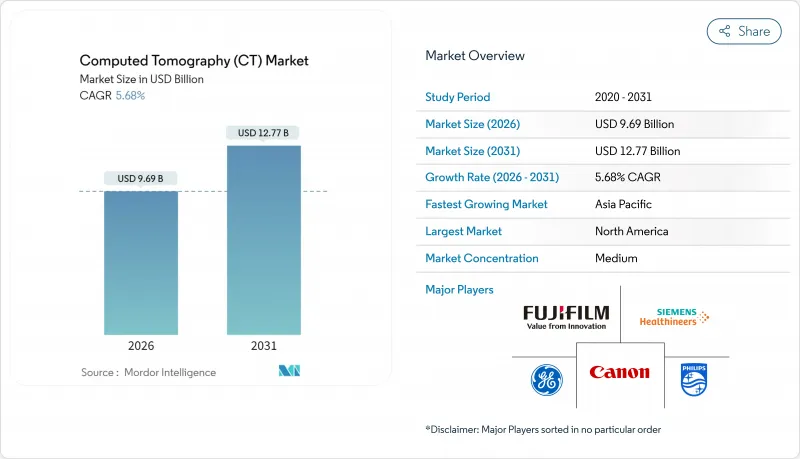
지속적인 성장 요인으로는 광자 계수형 검출기의 도입 가속화, 인공지능을 활용한 워크플로 최적화, 종양학, 심장학, 전신 예방용 영상 진단의 실시건수 증가를 들 수 있습니다. CT 스캐너 시장은 저침습 진단을 필요로 하는 노인 인구 증가로부터도 혜택을 받고 있으며, 이동형 뇌졸중 유닛과 지방 지원 프로그램에 의해 지리적 범위도 확대하고 있습니다. GE 헬스케어, 지멘스 헬시니어스 및 Philips사가 제품 사이클 단축, 클라우드 연결 기능의 통합, 하드웨어와 소프트웨어를 융합하는 전략적 제휴를 진행하는 가운데 경쟁 기업 간 경쟁 관계는 격화하고 있습니다. 반도체 부품을 둘러싼 공급망의 취약성과 방사선기사의 만성적인 부족이 성장세를 둔화시키는 한편, CT 시장의 접근 확대로 자동화 및 원격 조작 기능에 대한 투자가 동시에 촉진되고 있습니다.
세계의 컴퓨터 단층촬영(CT) 시장의 동향 및 인사이트
만성 질환 부담의 급증
2030년까지 2,300만 명 이상의 사망이 예상되는 심혈관 질환의 유병률 상승으로 심흉부 영상 진단에 대한 수요가 급격히 높아지고 있습니다. CT 검사는 이미 의약품 시험에서 영상 진단량의 25.87%를 차지하고 있으며, 종양학 및 심혈관계 약물 평가에서 핵심적인 역할을 뒷받침하고 있습니다. 저선량 폐암 검진 프로그램은 여러 지역에서 확대되고 있으며, 고위험 집단에서 사망률을 약 25% 줄이는 효과가 확인되었습니다. 의료시스템에서는 AI 트리아지를 도입해 판독 간의 편차를 42.5% 줄였으며, 보고서 작성 시간을 63% 단축함으로써, 품질을 유지하면서 검사 처리 능력을 향상시키고 있습니다. 신흥국에서는 인프라 정비를 배경으로 지금까지 충족되지 않았던 진단 요구에 대응하면서 CT 시장이 급속히 침투하고 있습니다.
고속 검출기 및 스펙트럼 CT의 혁신
지멘스 헬시니어스사의 Naeotom Alpha 클래스 등의 광자 계수형 검출기는 방사선량을 줄이면서 134.7 HU/mm의 공간 분해능을 실현하여 혈관 검사의 해상도를 재정의하고 있습니다. 스펙트럼 이미징은 물질 분해능과 정량적 요오드 매핑을 추가하여 종양학적 병기 분류 및 심장 플라크 분석을 지원합니다. 고성능 스캐너를 탑재한 이동형 뇌졸중 유닛은 도어 투 니들 시간을 단축하고 혈전 용해 요법을 가속화합니다. 지멘스사는 보다 광범위한 의료기술 프로그램 가운데 CT 개발에만 3억 5,000만 달러를 투자하는 등 자본 배분은 기술적 리더십을 따르고 있습니다.
고가의 도입 및 유지 비용
프리미엄 스캐너의 자본 지출은 1대당 200만 달러를 초과할 수 있으며 공급망 부담은 제조 수익의 최대 20%에 달하기 때문에 공급업체의 이익률이 축소됩니다. 고순도 석영 채굴의 혼란이 돋보이는 반도체 공급의 취약점은 CT 시장의 생산 일정을 유지하는 다운스트림 부품의 공급을 위협하고 있습니다. 의료기관은 자산 수명 주기 연장, 클라우드 호스팅 재구성 엔진 활용, 스캔 금액에 따른 결제 시스템 공급업체의 금융 도입으로 비용 장벽을 줄입니다. 계약 노동비 상승에 직면하는 소규모 센터는 기술 업그레이드와 재무적 지속 가능성 간의 균형을 맞추어야 합니다.
부문 분석
미드 슬라이스 플랫폼의 규모는 CT 시장에서 2025년에 35억 8,000만 달러에 이르렀으며, 세계 설치 대수의 39.02%를 차지했습니다. 이 카테고리는 일상 진단에서의 처리 능력과 저렴한 가격의 밸런스를 실현하고 있지만, 수요는 1초 미만의 심장 이미징과 서브mm 등방성 해상도를 제공하는 하이 슬라이스 스캐너로 이행하고 있습니다. 심장학, 종양학, 외상 전문의가 스펙트럼 분해나 장기 전체의 관류를 우선시하는 가운데, 하이 슬라이스 모델은 현재 6.62%의 연평균 복합 성장률(CAGR)로 성장하고 있습니다. 광자 계수형 검출기는 대조도 대 노이즈비를 향상시키면서 방사선량을 줄여 프리미엄을 한층 더 높이고 있으며, 소아과나 연속 경과 관찰 프로토콜에서 평가되는 제안입니다. 제조업체 각사는 128 슬라이스에서 256 슬라이스로의 현장 업그레이드를 가능하게 하는 모듈형 갠트리 설계를 채용하여 자본 예산을 보호하고 있습니다. 임상적 증거는 진단 우위를 뒷받침하고 있으며, 혈관의 선명도 점수는 134.7 HU/mm(기존 에너지 적분 방식에서는 100.9 HU/mm)을 기록하고 있습니다. 의료기관은 적은 수의 고성능 장비에 조달을 집중시키는 경향이 있으며, CT 시장에서 하이 슬라이스 장비의 기세를 더욱 강화하고 있습니다.
한편, 로우 슬라이스 스캐너는 신속한 설치, 최소한의 차폐, 적당한 가격이 해상도 요구를 웃도는 응급 의료 및 포인트 오브 케어 분야에서 존재감을 유지하고 있습니다. 지방 병원에서는 외상 트리아지용으로 이동식 트레일러에 탑재되는 16 슬라이스 장치를 도입해, 고가의 검사실 설치 없이 CT 시장의 접근성을 확대하고 있습니다. 콘 빔과 멀티 검출기 영역의 융합이 진행되어 알고리즘에 의한 콘 빔 아티팩트 보정으로 임상 적용 범위가 확대되어 양자의 경계가 모호해지고 있습니다.
2025년 시점에 고정식 스캐너는 CT 시장에서 61.96%의 점유율을 차지했으며 높은 가동률과 RIS/PACS 네트워크와의 통합이 필요한 병원 및 진단센터에서 사용되고 있습니다. 벤더 각사는 스캔부터 이미지 표시까지의 시간을 단축하는 AI 재구성 엔진과 향후 방사선 보고 의무에 따른 반복적 선량 저감 소프트웨어로 차별화를 도모하고 있습니다. 그러나 응급 의료팀이 구급차나 야외 진료소에 배치하는 이동식 및 휴대형 장치가 가장 빠르게 성장하는 카테고리입니다. ARPA-H의 견고한 이동 플랫폼 개발에 대한 1,200만 달러의 보조금은 이동형 솔루션에 대한 기관의 신뢰를 뒷받침합니다.
이동식 뇌졸중 유닛이 혈전 용해 요법까지 시간을 30분 단축함으로써 수익 기회가 확대되어 환자의 예후 개선과 장기적인 신경 재활 비용의 절감으로 이어집니다. 집중치료실(ICU)에서의 채용률이 높으며 의사의 97%가 불안정한 환자의 이송을 회피하는 휴대형 두부 CT의 유용성을 보고하고 있습니다. GE 헬스케어와 칼베사의 동남아시아 제조 제휴 및 시설 확장은 리드타임 단축과 서비스 현지화를 촉진하고 모바일 부문의 확대를 지원하고 있습니다.
지역별 분석
북미는 2025년에 컴퓨터 단층촬영(CT) 시장 점유율의 41.85%를 차지하였으며, 이 기반은 광범위한 모달리티 플릿, 견조한 환급 및 광자 계수 시스템의 급속한 채용에 의해 뒷받침되고 있습니다. 메디케어의 관상동맥 CT 혈관 조영에 대한 지불액이 2배로 증가하면서 외래서비스의 확대가 촉진되고 있습니다. GE Healthcare와 Satter Health와의 7년 계약과 같은 전략적 제휴는 기술자 부족을 완화하는 것을 목적으로 하는 설비 투자와 인재 개발 프로그램을 조합한 사례입니다. 이 지역에서는 2027년까지 방사선량 보고가 의무화될 예정이며, 병원은 저선량 소프트웨어와 분석 대시보드로 업그레이드를 실시하고 있습니다. 원격 방사선 의학 및 원격 스캐너 작동 테스트는 지역 인력 부족을 완화하는 전략으로 기세를 늘리고 있습니다.
아시아태평양은 의료 인프라에 대한 대규모 정부 투자와 포인트 오브 케어 이미징의 확대에 힘입어 2031년까지 7.36%라는 가장 빠른 CAGR을 기록할 전망입니다. GE Health Care의 인도네시아 공장과 Wipro GE의 9억 5,900만 달러 규모 생산 능력 증대 등 현지 제조 파트너십을 통해 공급망을 단축하고 지역 구매자의 비용 장벽을 줄일 수 있습니다. 고령화와 생활습관병 증가가 영상 진단에 대한 수요를 끌어올리는 한편, 클라우드 대응 AI 플랫폼은 소규모 시설의 진입 장벽을 낮추고 있습니다. 중국, 일본 및 한국에서는 국가 암 검진 의무화가 저선량 CT 기술의 지속적 조달을 촉진하고 있습니다. 유럽에서는 엄격한 품질 기준이 프리미엄 검출기 기술과 환경친화적인 워크플로 솔루션을 뒷받침해 견조한 설치 기반을 유지하고 있습니다. 환경 정책은 절전 모드와 재활용 가능한 부품 설계를 갖춘 스캐너 조달을 촉진합니다. 중동 및 아프리카에서는 정부와 민간의 연계를 통해 병원 정비 사업이 진행되어, 선진 CT 시스템을 갖춘 3차 의료시설의 급속한 근대화가 진행중입니다. GE Healthcare와 Dr. Sulaiman Al-Habib Medical Group의 제휴는 밸류체인의 현지화를 구현하는 사례입니다. 남미에서는 브라질의 전국적인 원격 의료 전개를 바탕으로 꾸준한 성장이 나타나고 있지만, 재정 여지의 제약이나 복잡한 수입 규제에 의해 하이엔드 스캐너의 도입 속도는 억제되고 있습니다.
기타 혜택
- 시장 예측(ME) 엑셀 시트
- 3개월 애널리스트 서포트
자주 묻는 질문
목차
제1장 서론
- 조사 전제조건 및 시장 정의
- 조사 범위
제2장 조사 방법
제3장 경영진 요약
제4장 시장 상황
- 시장 개요
- 촉진요인
- 만성질환의 부담 급증
- 검출기 기술과 스펙트럼 CT 기술의 급속한 혁신
- 저침습 진단법에 대한 수요 증가
- 고령화 인구 기반의 확대
- 환경 지속가능성의 요청이 저선량 CT에 대한 투자를 촉진
- 심장 CT 혈관 조영 가이드라인의 채용 상황
- 억제요인
- 높은 도입 및 유지 비용
- 방사선 피폭량의 우려와 규제 강화
- 가격에 민감한 국가의 환급 압력
- CT 훈련을 받은 방사선기사의 부족
- 가치 및 공급망 분석
- 규제 상황
- 기술 전망
- Porter's Five Forces
- 신규 참가업체의 위협
- 공급자의 협상력
- 구매자의 협상력
- 대체품의 위협
- 업계 간 경쟁
제5장 시장 규모 및 성장 예측
- 기술별(슬라이스 수)
- 로우 슬라이스(64 미만)
- 미드 슬라이스(64)
- 하이 슬라이스(128-256)
- 제품 유형별
- 거치형 CT 스캐너
- 휴대용 및 모바일 CT 스캐너
- 소모품 및 부속품
- 소프트웨어 및 서비스
- 용도별
- 종양
- 폐암 진단
- 두경부 종양
- 대장 종양
- 기타 종양
- 심장학
- 관상동맥 CT 혈관 조영
- 칼슘 스코어링
- 구조적 심장병
- 신경학
- 뇌졸중 평가
- 뇌외상
- 혈관 조영
- 말초혈관 질환
- 폐 혈관 조영
- 근골격계
- 정형외과 외상
- 스포츠 외상
- 치과 및 구강외과
- 외상 및 응급
- 기타 용도
- 종양
- 최종 사용자별
- 병원
- 공립병원
- 사립병원
- 영상 진단 센터
- 외래수술센터(ASC)
- 치과 진료소
- 동물병원 및 동물 진료소
- 학술기관 및 연구기관
- 병원
- 디바이스 아키텍처별
- 나선형 및 헬리컬 CT
- 링 갠트리 CT
- C암 CT
- O암 CT
- 플랫 패널 검출기 CT
- 지역별
- 북미
- 미국
- 캐나다
- 멕시코
- 유럽
- 독일
- 영국
- 프랑스
- 이탈리아
- 스페인
- 기타 유럽
- 아시아태평양
- 중국
- 인도
- 일본
- 한국
- 호주
- 기타 아시아태평양
- 남미
- 브라질
- 아르헨티나
- 기타 남미
- 중동 및 아프리카
- GCC
- 남아프리카
- 기타 중동 및 아프리카
- 북미
제6장 경쟁 구도
- 시장 집중도
- 시장 점유율 분석
- 기업 프로파일
- GE HealthCare Technologies Inc.
- Siemens Healthineers AG
- Koninklijke Philips NV
- Canon Medical Systems Corp.
- Shimadzu Corp.
- Fujifilm Holdings Corp.
- Hitachi Ltd.
- Samsung Electronics Co., Ltd.
- United Imaging Healthcare Co., Ltd.
- Neusoft Medical Systems Co., Ltd.
- Shenzhen Anke Hi-Tech Co., Ltd.
- Medtronic plc
- Carestream Health, Inc.
- J. Morita Corp.
- Planmed Oy
- CurveBeam LLC
- IMRIS Inc.
- NeuroLogica Corp.
- RefleXion Medical, Inc.
- SinoVision Technologies(Beijing) Co., Ltd.
제7장 시장 기회 및 미래 전망
CSM 26.02.02The Computed Tomography (CT) market is expected to grow from USD 9.17 billion in 2025 to USD 9.69 billion in 2026 and is forecast to reach USD 12.77 billion by 2031 at 5.68% CAGR over 2026-2031.
Continued gains come from accelerating adoption of photon-counting detectors, artificial-intelligence-enabled workflow orchestration, and higher scan volumes for oncology, cardiology, and full-body preventive imaging. The CT scanner market also benefits from a growing geriatric population that demands minimally invasive diagnostics, while mobile stroke units and rural outreach programs broaden geographic reach. Competitive rivalry intensifies as GE HealthCare, Siemens Healthineers, and Philips shorten product cycles, embed cloud connectivity, and form strategic alliances that fuse hardware with software. Supply-chain fragility around semiconductor components and persistent radiologic-technologist shortages temper momentum but simultaneously spark investment in automation and remote-operation capabilities that extend CT market access.
Global Computed Tomography (CT) Market Trends and Insights
Surging Chronic-Disease Burden
Rising prevalence of cardiovascular disease, projected to cause more than 23 million deaths by 2030, is sharply elevating demand for cardiothoracic imaging. CT scans already account for 25.87% of imaging volume in pharmaceutical trials, underscoring their central role in oncology and cardiovascular drug evaluation. Low-dose lung-cancer screening programs are scaling across multiple regions and demonstrate mortality reductions near 25% in high-risk cohorts. Health systems integrate AI triage that cuts inter-reader variability by 42.5% and shortens report turnaround by 63%, enabling higher throughput without sacrificing quality. Emerging economies, supported by infrastructure upgrades, are rapidly widening CT market penetration to address previously unmet diagnostic needs.
Rapid Detector & Spectral-CT Innovations
Photon-counting detectors such as Siemens Healthineers' Naeotom Alpha class reach spatial-resolution ratings of 134.7 HU/mm while lowering radiation dose, redefining image clarity for vascular studies. Spectral imaging adds material decomposition and quantitative iodine mapping that assist oncologic staging and cardiology plaque analysis. Mobile stroke units equipped with high-performance scanners accelerate thrombolysis by shrinking door-to-needle times. Capital allocation follows technology leadership, as Siemens commits USD 350 million exclusively for CT advancement within its broader med-tech program.
High Acquisition & Maintenance Cost
Capital outlays for premium scanners can exceed USD 2 million per unit and the supply-chain burden equals up to 20% of manufacturing revenue, compressing margins for vendors. Semiconductor vulnerabilities, highlighted by disruptions to high-purity quartz mining, threaten downstream component availability that keeps CT market production on schedule. Providers mitigate cost barriers by lengthening asset life cycles, leveraging cloud-hosted reconstruction engines, and adopting vendor financing that aligns payments with scan volumes. Smaller centers, facing elevated contract-labor expenses, must balance technology upgrades against financial sustainability.
Other drivers and restraints analyzed in the detailed report include:
- Growing Demand for Minimally-Invasive Diagnostics
- Expanding Geriatric Population Base
- Radiation-Dose Concerns and Tightening Regulation
For complete list of drivers and restraints, kindly check the Table Of Contents.
Segment Analysis
The CT market size for mid-slice platforms stood at USD 3.58 billion in 2025, reflecting 39.02% of global installations. This cohort balances throughput and affordability for routine diagnostics, yet demand is shifting toward high-slice scanners that deliver sub-second cardiac imaging and sub-millimeter isotropic resolution. High-slice models now grow at 6.62% CAGR as cardiology, oncology, and trauma specialists prioritize spectral decomposition and whole-organ perfusion. Photon-counting detectors further elevate the premium tier by enhancing contrast-to-noise ratios while trimming radiation dose, a proposition valued by pediatric and serial-follow-up protocols. Manufacturers leverage modular gantry designs that allow in-field upgrades from 128-slice to 256-slice, protecting capital budgets. Clinical evidence underscores diagnostic superiority: vessel sharpness scores of 134.7 HU/mm versus 100.9 HU/mm for energy-integrating predecessors. Health systems consolidate procurement around fewer, more capable units, reinforcing high-slice momentum within the CT market.
At the opposite end, low-slice scanners preserve relevance in emergency and point-of-care deployments where quick setup, minimal shielding, and favorable pricing outweigh resolution demands. Rural hospitals adopt 16-slice units mounted on mobile trailers for trauma triage, expanding CT market access without expensive room construction. Convergence between cone-beam and multidetector domains blurs boundaries as algorithms correct cone-beam artifacts, widening their clinical scope.
Stationary scanners accounted for 61.96% of Computed Tomography (CT) market share in 2025, anchored within hospitals and diagnostic centers that need high uptime and integration with RIS/PACS networks. Vendors differentiate through AI-reconstruction engines that shorten scan-to-view times and through iterative dose-reduction software that aligns with upcoming radiation-reporting mandates. However, mobile and portable devices represent the fastest-growing category as emergency-medicine teams deploy them in ambulances and field clinics. ARPA-H's USD 12 million grant to develop rugged mobile platforms validates institutional confidence in transportable solutions.
Revenue opportunity escalates when mobile stroke units demonstrate 30-minute reductions in time to thrombolysis, translating to improved patient outcomes and lower long-term neuro-rehabilitation expenses. ICU adoption is high, with 97% of physicians reporting portable head CT utility to avoid transporting unstable patients. Manufacturing collaborations such as GE HealthCare and Kalbe's facility expansion in Southeast Asia shorten lead times and localize service, supporting mobile-segment expansion.
The Computed Tomography (CT) Market Report is Segmented by Technology (Low-Slice, Mid-Slice, High-Slice), Product Type (Stationary, Portable/Mobile and More), Application (Oncology, Cardiology, Neurology, and More), End-User (Hospitals, Diagnostic Centers, and More), Device Architecture (Spiral, Ring-Gantry, and More), and Geography (North America, Europe, and More). Market Forecasts are Provided in Terms of Value (USD).
Geography Analysis
North America held 41.85% of Computed Tomography (CT) market share in 2025, anchored by extensive modality fleets, robust reimbursement, and rapid adoption of photon-counting systems. Medicare's doubled payment for coronary CT angiography incentivizes outpatient service expansion. Strategic alliances such as GE HealthCare's seven-year deal with Sutter Health pair capital investment with workforce-development programs that aim to ease technologist shortages. The region prepares for compulsory radiation-dose reporting by 2027, prompting hospitals to upgrade to low-dose software and analytics dashboards. Teleradiology and remote scanner operation trials gain momentum as a mitigation strategy for rural staffing deficits.
Asia-Pacific registers the fastest 7.36% CAGR through 2031, propelled by large-scale government investment in healthcare infrastructure and expansion of point-of-care imaging. Local manufacturing partnerships, including GE HealthCare-Kalbe's Indonesian plant and Wipro GE's USD 959 million capacity build-out, shorten supply chains and reduce cost barriers for regional buyers. Population aging and escalating lifestyle-related diseases underpin higher imaging demand, while cloud-enabled AI platforms lower entry hurdles for smaller centers. National cancer-screening mandates across China, Japan, and South Korea stimulate sustained procurement of low-dose CT technology. Europe retains a robust installed base, propelled by stringent quality standards that favor premium detector technology and eco-friendly workflow solutions. Environmental policies encourage procurement of scanners with intelligent power-saving modes and recyclable component designs. Middle East and Africa undergo rapid modernization with public-private partnerships that fund tertiary hospitals equipped with advanced CT suites; GE HealthCare's collaboration with Dr. Sulaiman Al-Habib Medical Group exemplifies value-chain localization. South America experiences steady growth led by Brazil's nationwide telehealth roll-outs, although constrained fiscal space and complex import regulations temper the pace of high-end scanner adoption.
- GE HealthCare Technologies Inc.
- Siemens Healthineers
- Koninklijke Philips
- Canon
- Shimadzu
- Fujifilm Holdings Corp.
- Hitachi
- Samsung Group
- United Imaging Healthcare Co., Ltd.
- Neusoft
- Shenzhen Anke Hi-Tech Co., Ltd.
- Medtronic
- Carestream Health
- J. Morita Corp.
- Planmed
- CurveBeam LLC
- IMRIS Inc.
- NeuroLogica
- RefleXion Medical, Inc.
- SinoVision Technologies (Beijing) Co., Ltd.
Additional Benefits:
- The market estimate (ME) sheet in Excel format
- 3 months of analyst support
TABLE OF CONTENTS
1 Introduction
- 1.1 Study Assumptions & Market Definition
- 1.2 Scope of the Study
2 Research Methodology
3 Executive Summary
4 Market Landscape
- 4.1 Market Overview
- 4.2 Market Drivers
- 4.2.1 Surging Chronic-Disease Burden
- 4.2.2 Rapid Detector & Spectral-CT Innovations
- 4.2.3 Growing Demand For Minimally-Invasive Diagnostics
- 4.2.4 Expanding Geriatric Population Base
- 4.2.5 Eco-Sustainability Mandates Driving Low-Dose CT Investment
- 4.2.6 Cardiac CT Angiography Guideline Adoption
- 4.3 Market Restraints
- 4.3.1 High Acquisition & Maintenance Cost
- 4.3.2 Radiation-Dose Concerns And Tightening Regulation
- 4.3.3 Reimbursement Pressure In Price-Sensitive Nations
- 4.3.4 Shortage Of CT-Trained Radiologic Technologists
- 4.4 Value / Supply-Chain Analysis
- 4.5 Regulatory Landscape
- 4.6 Technological Outlook
- 4.7 Porter's Five Forces
- 4.7.1 Threat of New Entrants
- 4.7.2 Bargaining Power of Suppliers
- 4.7.3 Bargaining Power of Buyers
- 4.7.4 Threat of Substitutes
- 4.7.5 Industry Rivalry
5 Market Size & Growth Forecasts (Value)
- 5.1 By Technology (Slice Count)
- 5.1.1 Low-slice (<64)
- 5.1.2 Mid-slice (64)
- 5.1.3 High-slice (128-256)
- 5.2 By Product Type
- 5.2.1 Stationary CT Scanners
- 5.2.2 Portable / Mobile CT Scanners
- 5.2.3 Consumables and Accessories
- 5.2.4 Software and Services
- 5.3 By Application
- 5.3.1 Oncology
- 5.3.1.1 Lung Cancer Screening
- 5.3.1.2 Head & Neck Oncology
- 5.3.1.3 Colorectal Oncology
- 5.3.1.4 Other Oncology
- 5.3.2 Cardiology
- 5.3.2.1 Coronary CT Angiography
- 5.3.2.2 Calcium Scoring
- 5.3.2.3 Structural Heart Disease
- 5.3.3 Neurology
- 5.3.3.1 Stroke Assessment
- 5.3.3.2 Brain Trauma
- 5.3.4 Vascular
- 5.3.4.1 Peripheral Vascular Disease
- 5.3.4.2 Pulmonary Angiography
- 5.3.5 Musculoskeletal
- 5.3.5.1 Orthopedic Trauma
- 5.3.5.2 Sports Injuries
- 5.3.6 Dental & Maxillofacial
- 5.3.7 Trauma & Emergency
- 5.3.8 Other Applications
- 5.3.1 Oncology
- 5.4 By End-User
- 5.4.1 Hospitals
- 5.4.1.1 Public Hospitals
- 5.4.1.2 Private Hospitals
- 5.4.2 Diagnostic Imaging Centers
- 5.4.3 Ambulatory Surgical Centers
- 5.4.4 Dental Clinics
- 5.4.5 Veterinary Clinics & Hospitals
- 5.4.6 Academic & Research Institutes
- 5.4.1 Hospitals
- 5.5 By Device Architecture
- 5.5.1 Spiral / Helical CT
- 5.5.2 Ring-Gantry CT
- 5.5.3 C-arm CT
- 5.5.4 O-arm CT
- 5.5.5 Flat-Panel Detector CT
- 5.6 By Geography
- 5.6.1 North America
- 5.6.1.1 United States
- 5.6.1.2 Canada
- 5.6.1.3 Mexico
- 5.6.2 Europe
- 5.6.2.1 Germany
- 5.6.2.2 United Kingdom
- 5.6.2.3 France
- 5.6.2.4 Italy
- 5.6.2.5 Spain
- 5.6.2.6 Rest of Europe
- 5.6.3 Asia-Pacific
- 5.6.3.1 China
- 5.6.3.2 India
- 5.6.3.3 Japan
- 5.6.3.4 South Korea
- 5.6.3.5 Australia
- 5.6.3.6 Rest of Asia-Pacific
- 5.6.4 South America
- 5.6.4.1 Brazil
- 5.6.4.2 Argentina
- 5.6.4.3 Rest of South America
- 5.6.5 Middle East and Africa
- 5.6.5.1 GCC
- 5.6.5.2 South Africa
- 5.6.5.3 Rest of Middle East and Africa
- 5.6.1 North America
6 Competitive Landscape
- 6.1 Market Concentration
- 6.2 Market Share Analysis
- 6.3 Company Profiles {(includes Global level Overview, Market level overview, Core Segments, Financials as available, Strategic Information, Market Rank/Share for key companies, Products & Services, and Recent Developments)}
- 6.3.1 GE HealthCare Technologies Inc.
- 6.3.2 Siemens Healthineers AG
- 6.3.3 Koninklijke Philips N.V.
- 6.3.4 Canon Medical Systems Corp.
- 6.3.5 Shimadzu Corp.
- 6.3.6 Fujifilm Holdings Corp.
- 6.3.7 Hitachi Ltd.
- 6.3.8 Samsung Electronics Co., Ltd.
- 6.3.9 United Imaging Healthcare Co., Ltd.
- 6.3.10 Neusoft Medical Systems Co., Ltd.
- 6.3.11 Shenzhen Anke Hi-Tech Co., Ltd.
- 6.3.12 Medtronic plc
- 6.3.13 Carestream Health, Inc.
- 6.3.14 J. Morita Corp.
- 6.3.15 Planmed Oy
- 6.3.16 CurveBeam LLC
- 6.3.17 IMRIS Inc.
- 6.3.18 NeuroLogica Corp.
- 6.3.19 RefleXion Medical, Inc.
- 6.3.20 SinoVision Technologies (Beijing) Co., Ltd.
7 Market Opportunities & Future Outlook
- 7.1 White-space & Unmet-need Assessment