|
시장보고서
상품코드
1906053
정형외과용 의지 시장 : 점유율 분석, 업계 동향 및 통계, 성장 예측(2026-2031년)Orthopedic Prosthetics - Market Share Analysis, Industry Trends & Statistics, Growth Forecasts (2026 - 2031) |
||||||
 Mordor Intelligence
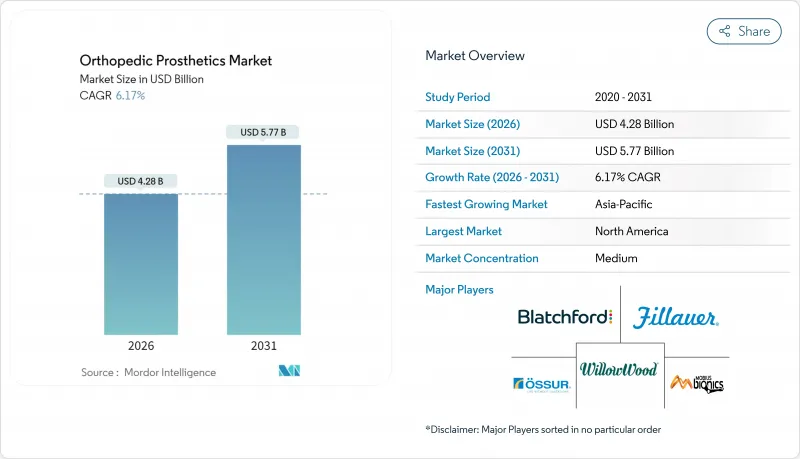
2026년 정형외과용 의지 시장의 규모는 42억 8,000만 달러로 추정되며, 2025년 40억 3,000만 달러에서 성장할 것으로 예상됩니다.
2031년에는 57억 7,000만 달러에 달하고, 2026년부터 2031년에 걸쳐 CAGR 6.17%로 확대될 전망입니다.
지속적인 성장은 당뇨병 관련 절단 수술 증가, 획기적인 신경 인터페이스 의지, 생산주기의 단축 및 맞춤형 향상을 제공하는 저비용 3D 인쇄 기술의 보급 확대에 의해 지원됩니다. 고령화와 골관절염의 유병률 증가가 대상 사용자층을 확대하는 한편, 아시아태평양의 제대 군인 재활 프로그램이 신흥 경제권에서의 기술 보급을 가속화하고 있습니다. 경쟁차별화는 현재 실시간 감각 피드백, 탄소섬유 대체 소재, 연결 디바이스용 사이버 보안 대책에 초점이 맞춰져 있으며 기존 기업과 신흥 기업이 수직 통합과 틈새 분야의 전문화를 추구하는 역동적인 상황을 만들어내고 있습니다. 엄격한 환급 환경과 티타늄 공급 부족이 단기적인 이익률을 억제하는 한편, 제조업체에게는 공급망의 효율화와 적층 제조 거점의 현지화를 추진하는 동기부여도 되고 있습니다.
세계의 정형외과용 의지 시장의 동향 및 인사이트
당뇨병 관련 절단 수술 증가가 시장 확대를 견인
연간 100만 건이 넘는 당뇨병 관련 하지 절단 수술이 발생하고 있으며, 취약한 피부 표면의 전단력을 줄이고 감염 관리를 개선하는 고급 소켓 설계에 대한 수요가 급증하고 있습니다. 미국, 중국, 인도의 전문적인 발 관리 체계는 환자를 조기 의지 선택으로 이끌고 교체 사이클을 앞당겨 지속적인 부품 판매를 확대하고 있습니다. 이 수요 증가에 대응하는 각 제조업체는 신경장애성 보행 패턴에 대응해 에너지 소비를 줄이는 경량 탄소 복합재 파이론의 개발에 투자하고 있습니다. 이 현상은 특히 아시아태평양의 도시 지역에서 현저하며, 급속한 생활양식의 변화가 당뇨병 유병률의 상승을 초래하고, 지역 시장의 확대가 공중 위생의 우선 과제나 기증자 자금에 의한 사지 상실 대책과 연동하고 있습니다.
고령화가 골관절염 관련 수요를 확대
북유럽, 일본, 호주에서는 평균 연령이 40세를 넘어 관절치환술이 필요한 고령층 및 재치환 시나리오에서 부분 의지에 대한 수요층이 확대되고 있습니다. 베이비붐 세대는 골프, 하이킹, 가벼운 조깅을 지원하는 고활동성 인공 무릎을 요구한다는 점에서 이전 세대와 다릅니다. 결과적으로 설계의 우선순위는 스윙 단계를 실시간으로 조정하는 적응형 댐핑 마이크로프로세서 유닛으로 이동합니다. 보험 지불자는 추락 감소의 증거와 연동하여 이러한 고기능 장치의 환급을 증가시키고 있으며, 노인 선수의 업그레이드 사이클을 강화하고 있습니다. 병원에서는 골밀도 스크리닝과 의지 선택을 통합한 노년 정형외과 프로그램을 도입하여 장치의 지속적인 업그레이드를 더욱 지원하고 있습니다.
보험 환급 불일치가 시장 접근을 제한
미국에서는 메디케어 수급자에서도 보험 적용 후 사지당 3,580달러의 자가부담금이 발생하며, 이는 장치를 포기하도록 하는 장벽이 되어 교환 사이클과 애프터마켓 판매를 감소시키고 있습니다. 프랑스에서는 2025년의 25% 보조금 삭감에 의해 공급업체의 철수나 간헐적인 임플란트 부족 현상이 발생하여 정책 변동이 공급 상황을 바꾸는 실태가 부각되었습니다. 신흥기업은 마이크로프로세서 무릎관절을 판매가 아닌 임대 방식으로 제공하고 소프트웨어 업그레이드 및 유지보수를 지불자의 예산주기에 맞춘 구독 플랜에 통합함으로써 이익률의 압박에 대항하고 있습니다.
부문 분석
2025년 정형외과용 의지 시장의 55.12%를 하지 솔루션이 차지하였고 발생률이 높은 하퇴절단술과 대퇴절단술이 그 기반이 되고 있습니다. 수요의 집중은 규모의 경제를 낳고, 제조업체는 이것을 활용해 스포츠 활동에서의 고토크 부하에 견디는 차세대 회전 어댑터의 연구 개발에 자금을 조달하고 있습니다. 라이너는 수익 규모가 작지만, 피부의 땀 관리와 잔존 사지 부피 변동이라는 장치 포기와 강하게 상관되는 두 가지 요인을 다루면서 2031년까지 연평균 복합 성장률(CAGR) 9.52%를 달성할 전망입니다. 항균 나노입자를 배합한 신형 열가소성 엘라스토머 겔은 라이너 교환 간격을 연장하여 최소한의 임상 관리로 지속적인 매출을 창출합니다. 특수 스포츠용 의지는 틈새 시장이면서 높은 가격대를 형성하여, 주류인 상지 의지 업그레이드를 견인하는 브랜드 쇼케이스로서의 역할을 합니다. 소켓 분야에서는 커스텀 3D 프린팅 래티스가 수작업 적층 유리 섬유 쉘을 대체하고 무게를 30% 줄여 마라톤 러너의 통기성을 향상시킴으로써 정형외과용 의지 시장에서의 점유율을 서서히 확대하고 있습니다.
지역별 분석
북미는 2025년 41.88%의 수익 점유율을 유지했습니다. 이는 고기능 마이크로프로세서식 무릎 관절 및 상지 의지의 보험 적용과 인증 시술자의 밀접한 네트워크가 지원하고 있습니다. 미국은 지역 혁신을 견인하여 획기적인 AMI(인공 심근) 및 OMP(인공 골수) 연구를 주도하고 있습니다. 이에 따라 정형외과용 의지 시장 전체에 기술 리더십의 후광 효과를 가져오고 있습니다. 캐나다에서는 주를 초월하는 원격 의지 장비 플랫폼을 활용하여 북부 지역에 대한 접근을 확대하고 있습니다. 멕시코에서는 마킬라도라(수출가공구역) 클러스터를 통합하여 수출용 경량 철탑의 공동제조를 실현하고 있습니다.
아시아태평양은 10.71%의 연평균 복합 성장률(CAGR)로 성장이 예상되며, 당뇨병 환자의 압도적인 숫자와 야심찬 전국민 보험제도의 도입이 함께 시장을 견인합니다. 중국의 현지 기업은 수입품을 35% 밑도는 저비용 3D 프린팅 의지 소켓의 개발을 가속하고 있습니다. 인도에서는 지방 외상 센터용 모듈식 발의 공공 조달에 의해 수요가 더욱 확대되고 있습니다. 일본과 한국은 감각 피드백 기술의 최첨단을 추진하고 있으며, 첨단 펌웨어 업그레이드로 지역 수요를 환기하고 있습니다. 호주에서는 의료 종사자가 부족함에도 불구하고 AI에 의한 위치 조정 도구의 도입률이 높아 인력 부족을 보완하고 있습니다. 갈등 지역에서의 원격 의지 지원과 같은 지역 인도주의 프로젝트는 위성 네트워크를 통한 크로스보더 설계 파일 보급을 보여줍니다. 유럽은 규제가 엄격한 성숙 시장이며 가격 상한이 이익률을 압박하는 한편 임상 실천 기준은 엄격하게 유지되고 있습니다. 독일은 재료 부족을 완화하는 탄소섬유 재활용 사업을 선도하고 영국은 NHS 장기 계획 하에 디지털 정형외과의 파일럿 사업을 신속하게 추진하고 있습니다. 프랑스의 환급액 삭감은 지역적 공급 부족을 초래하고, 병행 수입 루트를 촉진하는 동시에 지속 가능한 가격 설정에 관한 논의를 환기하고 있습니다. 남미, 중동 및 아프리카는 현재 소규모 점유율에 머무르지만, 브라질과 UAE에 3D 프린팅 거점이 출현하여 문화를 존중하는 화장 커버와 충격 흡수 발의 리드 타임이 서서히 단축되는 가운데, 한 자릿대 후반의 높은 성장률을 나타내고 있습니다.
기타 혜택
- 시장 예측(ME) 엑셀 시트
- 3개월 애널리스트 서포트
자주 묻는 질문
목차
제1장 서론
- 조사 전제조건 및 시장 정의
- 조사 범위
제2장 조사 방법
제3장 주요 요약
제4장 시장 상황
- 시장 개요
- 촉진요인
- 당뇨병 관련 절단 수술 증가
- 고령화와 골관절염의 유병률
- 마이크로프로세서 및 근전 의지의 진보
- 신흥 시장에서의 3D 프린팅 서비스 거점 확대
- 아시아태평양에서의 방위 및 제대 군인 재활 자금 급증
- 전자상거래를 통한 애프터마켓 부품 판매 성장
- 억제요인
- 고가의 기기와 불충분한 환급 제도
- 개발도상국에서의 공인 의지보조기기사 부족
- 티타늄 및 탄소섬유 공급의 병목
- 스마트 의지에 대한 사이버 보안 모니터링
- 가치 및 공급망 분석
- 규제 상황
- 기술 전망
- Porter's Five Forces
- 신규 참가업체의 위협
- 공급자의 협상력
- 구매자의 협상력
- 대체품의 위협
- 경쟁 기업 간 경쟁 관계
제5장 시장 규모 및 성장 예측
- 제품 유형별
- 상지 의지
- 하지 의지
- 라이너
- 의지 소켓
- 모듈러 컴포넌트
- 전문 및 스포츠용 의지
- 기술별
- 기존
- 전동식 및 근전식
- 하이브리드
- 3D 프린팅 및 적층 제조
- 로봇 및 마이크로프로세서 제어
- 최종 사용자별
- 병원
- 의지장비 클리닉
- 재활센터
- 외래수술센터(ASC)
- 재택 케어 환경
- 지역별
- 북미
- 미국
- 캐나다
- 멕시코
- 유럽
- 독일
- 영국
- 프랑스
- 이탈리아
- 스페인
- 기타 유럽
- 아시아태평양
- 중국
- 인도
- 일본
- 한국
- 호주
- 기타 아시아태평양
- 남미
- 브라질
- 아르헨티나
- 기타 남미
- 중동 및 아프리카
- GCC
- 남아프리카
- 기타 중동 및 아프리카
- 북미
제6장 경쟁 구도
- 시장 집중도
- 시장 점유율 분석
- 기업 프로파일
- Ossur
- Ottobock
- Zimmer Biomet
- Stryker
- Smith & Nephew
- DePuy Synthes(J&J)
- Medtronic
- Enovis(DJO)
- Blatchford
- Willow Wood
- Freedom Innovations
- Touch Bionics
- Steeper Group
- College Park Industries
- Ultraflex Systems
- Fillauer
- SHL Medical
- ReWalk Robotics
- Proteor
- Ability Dynamics
- Mobius Bionics, LLC
제7장 시장 기회 및 미래 전망
CSM 26.01.28Orthopedic Prosthetics market size in 2026 is estimated at USD 4.28 billion, growing from 2025 value of USD 4.03 billion with 2031 projections showing USD 5.77 billion, growing at 6.17% CAGR over 2026-2031.
Continuous growth is supported by rising diabetes-linked amputations, breakthrough neural-interface limbs, and widening access to lower-cost 3-D printing capabilities that shorten production cycles and improve customization. Demographic aging, coupled with osteoarthritis prevalence, enlarges the addressable user base, while defense-veteran rehabilitation programs in Asia-Pacific accelerate technology diffusion across emerging economies. Competitive differentiation now pivots on real-time sensory feedback, carbon-fiber alternatives, and cybersecurity readiness for connected devices, creating a dynamic landscape in which incumbents and start-ups pursue vertical integration and niche specialization. Tight reimbursement environments and titanium supply shortages temper near-term margins but also motivate manufacturers to streamline supply chains and localize additive manufacturing hubs.
Global Orthopedic Prosthetics Market Trends and Insights
Rising Diabetes-Linked Amputations Drive Market Expansion
More than 1 million diabetes-related lower-limb amputations occur yearly, sharply lifting demand for sophisticated socket designs that reduce shear forces and improve infection control for fragile skin surfaces. Specialized foot-care pathways in the United States, China, and India now funnel patients toward earlier prosthetic intervention, bringing forward replacement cycles and expanding recurring component sales. Manufacturers responding to this volume uptick are investing in lighter carbon-composite pylons that accommodate neuropathic gait patterns and reduce energy expenditure. The phenomenon is particularly acute in urban Asia-Pacific where rapid lifestyle changes drive higher diabetes prevalence, aligning regional market expansion with public-health priorities and donor-funded limb-loss initiatives.
Ageing Population Amplifies Osteoarthritis-Related Demand
Median ages are climbing above 40 years in Northern Europe, Japan, and Australia, widening the pool of seniors requiring joint replacements and, in revision scenarios, partial limb prostheses. Baby-boomer cohorts differ from earlier generations by insisting on high-activity prosthetic knees that support golfing, hiking, and light-jogging. Consequently, design priorities have shifted toward adaptive damping microprocessor units that modulate swing phase in real time. Payers increasingly reimburse for such higher-end devices when linked to fall-reduction evidence, reinforcing the upgrade cycle for elderly athletes. Hospitals have introduced geriatric-orthopedics programs integrating bone-density screening with prosthetic selection, further supporting sustained device turnover.
Reimbursement Inconsistencies Constrain Market Access
Medicare beneficiaries in the United States still pay USD 3,580 out-of-pocket per limb despite insurance, a barrier prompting device abandonment that reduces replacement cycles and aftermarket sales. France's 25% reimbursement cut in 2025 led to supplier exits and sporadic implant shortages, underscoring how policy swings reshape supply availability. Start-ups counteract margin pressure by leasing rather than selling microprocessor knees, bundling software updates and maintenance into subscription plans aligned with payer budget cycles.
Other drivers and restraints analyzed in the detailed report include:
- Microprocessor and Myoelectric Technology Breakthrough
- 3-D Printing Democratizes Access in Emerging Markets
- Workforce Shortages Limit Service Delivery Capacity
For complete list of drivers and restraints, kindly check the Table Of Contents.
Segment Analysis
Lower-extremity solutions represented 55.12% of the orthopedic prosthetics market size in 2025, anchored by high-incidence transtibial and transfemoral procedures. Demand concentration creates scale economies that manufacturers leverage to fund R&D for next-generation rotary adapters that tolerate higher torsional loads during sports. Liners, while a smaller revenue pool, deliver 9.52% CAGR through 2031 by addressing skin-sweat management and residual-limb volume fluctuation, two factors strongly correlated with device abandonment. New thermoplastic elastomer gels infused with antimicrobial nanoparticles extend liner replacement intervals, generating recurring sales with minimal clinical oversight. Specialty-sports prosthetics, though niche, attract premium pricing and act as branding showcases that inspire mainstream upper-limb upgrades. The orthopedic prosthetics market share for sockets climbs gradually as custom 3-D printed lattices displace hand-laminated fiberglass shells, reducing weight by 30% and improving airflow for marathon runners.
The Orthopedic Prosthetics Market Report is Segmented by Product Type (Upper Extremity Prosthetics, Lower Extremity Prosthetics, Liners, Sockets, Modular Components, and Specialty & Sports Prosthetics), Technology (Conventional, Electric Powered/Myoelectric, and More), End-User (Hospitals, Prosthetic Clinics, and More), and Geography (North America, Europe, and More). The Market Forecasts are Provided in Terms of Value (USD).
Geography Analysis
North America retained 41.88% regional revenue share in 2025, powered by insurance coverage that reimburses high-end microprocessor knees and arms, as well as dense networks of certified practitioners. The United States drives regional innovation, hosting landmark AMI and OMP research that secures technology-leadership halo effects across the orthopedic prosthetics market. Canada leverages cross-provincial tele-orthotics platforms to extend access to northern communities, whereas Mexico integrates maquiladora clusters to co-manufacture lightweight pylons for export.
Asia-Pacific, forecast to rise at a 10.71% CAGR, combines outsized diabetes prevalence with ambitious universal-health coverage rollouts. China's local innovators accelerate low-cost 3-D printed sockets that undercut imports by 35%. India's public procurement of modular feet for district-level trauma centers further lifts volume. Japan and South Korea push the frontier in sensory feedback, driving regional demand for advanced firmware upgrades. Australia, despite practitioner scarcity, maintains high adoption of AI-guided alignment tools that compensate for workforce gaps. Regional humanitarian projects, such as remote prosthetic aid in conflict zones, illustrate cross-border dissemination of design files over satellite networks. Europe presents a mature, regulation-intensive environment where price caps squeeze margins yet clinical practice standards remain rigorous. Germany pioneers carbon-fiber recycling initiatives to mitigate material scarcity, while the United Kingdom fast-tracks digital orthopedics pilots under the NHS Long-Term Plan. France's reimbursement cuts create localized shortages, prompting parallel-import channels and sparking debate on sustainable pricing. South America, Middle East, and Africa collectively account for modest share today yet post high single-digit growth as 3-D printing hubs emerge in Brazil and the UAE, gradually reducing lead times for culturally attuned cosmetic covers and shock-absorbing feet.
- Ossur
- Ottobock
- Zimmer Biomet
- Stryker
- Smiths Group
- DePuy Synthes (J&J)
- Medtronic
- Enovis (DJO)
- Blatchford
- Willow Wood
- Freedom Innovations
- Touch Bionics
- Steeper Group
- College Park Industries
- Ultraflex Systems
- Fillauer
- SHL Medical
- ReWalk Robotics
- Proteor
- Ability Dynamics
- Mobius Bionics, LLC
Additional Benefits:
- The market estimate (ME) sheet in Excel format
- 3 months of analyst support
TABLE OF CONTENTS
1 Introduction
- 1.1 Study Assumptions & Market Definition
- 1.2 Scope of the Study
2 Research Methodology
3 Executive Summary
4 Market Landscape
- 4.1 Market Overview
- 4.2 Market Drivers
- 4.2.1 Rising diabetes-linked amputations
- 4.2.2 Ageing population & osteoarthritis prevalence
- 4.2.3 Advancements in microprocessor & myoelectric limbs
- 4.2.4 Expansion of 3-D printing service hubs in emerging markets
- 4.2.5 Defence-veteran rehab funding surge in Asia-Pacific
- 4.2.6 E-commerce aftermarket component sales growth
- 4.3 Market Restraints
- 4.3.1 High device cost & inconsistent reimbursement
- 4.3.2 Shortage of certified prosthetists in developing nations
- 4.3.3 Titanium & carbon-fibre supply bottlenecks
- 4.3.4 Cyber-security scrutiny of smart prosthetics
- 4.4 Value / Supply-Chain Analysis
- 4.5 Regulatory Landscape
- 4.6 Technological Outlook
- 4.7 Porter's Five Forces
- 4.7.1 Threat of New Entrants
- 4.7.2 Bargaining Power of Suppliers
- 4.7.3 Bargaining Power of Buyers
- 4.7.4 Threat of Substitutes
- 4.7.5 Competitive Rivalry
5 Market Size & Growth Forecasts (Value, USD)
- 5.1 By Product Type
- 5.1.1 Upper Extremity Prosthetics
- 5.1.2 Lower Extremity Prosthetics
- 5.1.3 Liners
- 5.1.4 Sockets
- 5.1.5 Modular Components
- 5.1.6 Specialty & Sports Prosthetics
- 5.2 By Technology
- 5.2.1 Conventional
- 5.2.2 Electric Powered / Myoelectric
- 5.2.3 Hybrid
- 5.2.4 3-D Printed / Additively Manufactured
- 5.2.5 Robotic / Microprocessor Controlled
- 5.3 By End-User
- 5.3.1 Hospitals
- 5.3.2 Prosthetic Clinics
- 5.3.3 Rehabilitation Centers
- 5.3.4 Ambulatory Surgical Centers
- 5.3.5 Home-care Settings
- 5.4 By Geography
- 5.4.1 North America
- 5.4.1.1 United States
- 5.4.1.2 Canada
- 5.4.1.3 Mexico
- 5.4.2 Europe
- 5.4.2.1 Germany
- 5.4.2.2 United Kingdom
- 5.4.2.3 France
- 5.4.2.4 Italy
- 5.4.2.5 Spain
- 5.4.2.6 Rest of Europe
- 5.4.3 Asia-Pacific
- 5.4.3.1 China
- 5.4.3.2 India
- 5.4.3.3 Japan
- 5.4.3.4 South Korea
- 5.4.3.5 Australia
- 5.4.3.6 Rest of Asia-Pacific
- 5.4.4 South America
- 5.4.4.1 Brazil
- 5.4.4.2 Argentina
- 5.4.4.3 Rest of South America
- 5.4.5 Middle East and Africa
- 5.4.5.1 GCC
- 5.4.5.2 South Africa
- 5.4.5.3 Rest of Middle East and Africa
- 5.4.1 North America
6 Competitive Landscape
- 6.1 Market Concentration
- 6.2 Market Share Analysis
- 6.3 Company Profiles (includes Global level Overview, Market level overview, Core Segments, Financials as available, Strategic Information, Market Rank/Share for key companies, Products & Services, and Recent Developments)
- 6.3.1 Ossur
- 6.3.2 Ottobock
- 6.3.3 Zimmer Biomet
- 6.3.4 Stryker
- 6.3.5 Smith & Nephew
- 6.3.6 DePuy Synthes (J&J)
- 6.3.7 Medtronic
- 6.3.8 Enovis (DJO)
- 6.3.9 Blatchford
- 6.3.10 Willow Wood
- 6.3.11 Freedom Innovations
- 6.3.12 Touch Bionics
- 6.3.13 Steeper Group
- 6.3.14 College Park Industries
- 6.3.15 Ultraflex Systems
- 6.3.16 Fillauer
- 6.3.17 SHL Medical
- 6.3.18 ReWalk Robotics
- 6.3.19 Proteor
- 6.3.20 Ability Dynamics
- 6.3.21 Mobius Bionics, LLC
7 Market Opportunities & Future Outlook
- 7.1 White-space & Unmet-need Assessment