

|
시장보고서
상품코드
1906066
나노 다공성 멤브레인 시장 : 점유율 분석, 업계 동향 및 통계, 성장 예측(2026-2031년)Nanoporous Membranes - Market Share Analysis, Industry Trends & Statistics, Growth Forecasts (2026 - 2031) |
||||||
 Mordor Intelligence
나노 다공성 멤브레인 시장은 2025년 11억 5,000만 달러로 평가되었고, 2026년 12억 4,000만 달러에서 2031년까지 18억 3,000만 달러에 이를 것으로 예측됩니다.
예측기간(2026-2031년)의 CAGR은 8.03%로 전망됩니다.
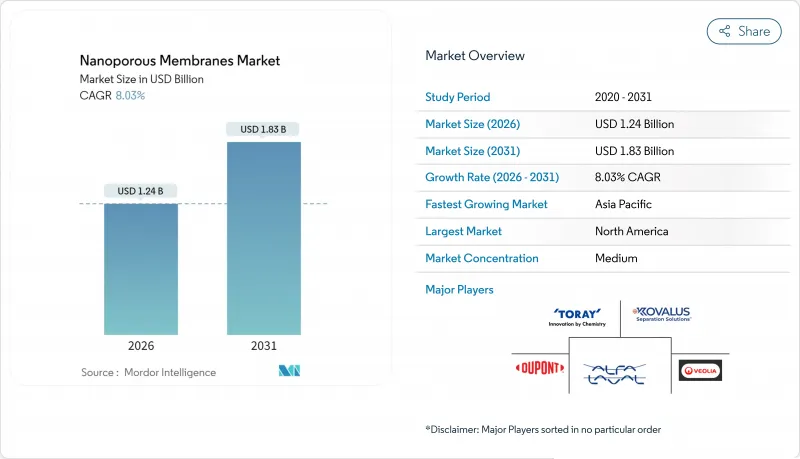
수처리, 연료전지, 바이오메디컬 프로세스에서의 고성능 분리 기술에 대한 수요 증가가 성장의 주요인이 되고 있습니다. 산업 배수에 대한 규제 강화, 세계적으로 발생하는 해수 담수화 시설의 적극적인 건설, 바이오프로세스 처리 능력의 증대 등의 요인이 더해져, 선진적인 막 플랫폼의 급속한 보급을 뒷받침하고 있습니다. 기술 공급자는 에너지 사용량을 줄이고, 파울링 대책, 개발 사이클을 단축하기 위해 하이브리드 유무기 설계와 AI를 활용한 성능 모델링을 축으로 사업 전개를 진행하고 있습니다. 기존 기업이 틈새 시장의 혁신자를 인수하고, 제조에서 규모의 우위성을 확보하는 것과 동시에 응용 범위를 확대하는 움직임이 가속화하는 가운데, 경쟁의 격화가 진행되고 있습니다.
세계의 나노 다공성 멤브레인 시장의 동향 및 인사이트
폐기물 및 폐수의 재이용 수요 증가
지자체 및 산업 운영자는 수자원 순환, 식수 재사용 목표 달성, 엄격한 배출 규제 준수를 목적으로 분리막 생물 반응기 라인과 나노 여과에 의한 최종 처리 공정의 규모 확대를 추진하고 있습니다. 홍콩대학의 실크 나노 여과 플랫폼은 정수 속도를 10배로 높이면서 에너지 사용량을 80% 저감하여 현재 실현 가능한 최대의 효율 향상을 실현하고 있습니다. 유틸리티 공급자는 높은 오염물질 제거율과 내오염성을 모두 갖는 막을 우선적으로 도입하고 있으며, 이는 생물학적 전처리와 나노스케일 여과를 조합한 하이브리드 시스템에 대한 설비투자를 자극하고 있습니다. 자산 소유자가 성능 기반 계약을 채택함에 따라 예측 유지 보수 및 저압 설계를 제공하는 공급업체 수요가 증가하고 있습니다. 그 결과 물 부족으로 고민하는 도시 회랑에 신속하게 전개 가능한 모듈식 플랜트에 대한 투자가 가속화되고 있습니다.
물 부족 지역에서 해수 담수화 능력 증강
이집트, 알제리, 걸프 국가에서의 대규모 기수 및 해수 담수화 허브가 초고압 역삼투막 부품 수요를 역대 최고 수준으로 밀어 올리고 있습니다. 이집트에서 새롭게 완성된 일량 750만m3의 플랜트는 정부의 수자원 안보 프로그램이 현재 목표로 하는 규모의 크기를 나타내고 있습니다. EU 시설(2,178 플랜트, 일량 686만 m3)에서는 막 처리 라인에 재생에너지와 에너지 회수 장치를 조합하여 운전 비용을 대폭 저감하고 있습니다. 한편 공급업체는 25만ppm의 급수농도에 대응하여 수명을 연장하고 가혹한 전처리 화학약품을 견디는 막의 개발을 진행하고 있습니다. 지하 취수나 염수 채수의 파일럿 프로젝트에서는 더욱 내구성이 요구되며 고염분 환경이라는 틈새 시장에서 복합재나 세라믹 기재의 가치가 높아지고 있습니다.
가격에 민감한 개발도상국의 도입 지연
깨끗한 물에 대한 긴급한 요구가 있음에도 불구하고 자본제약과 숙련노동력 부족은 막기술 도입을 억제하고 있습니다. 알제리의 해수 담수화 로드맵은 프로젝트 파이프라인이 확대되는 가운데 자금 조달 장벽이 부각되고 있습니다. 수입 모듈에 대한 의존은 라이프 사이클 비용을 밀어 올리고 현지의 제조 능력 부족으로 예비 부품공급이 지연되고 있습니다. 개발 금융 이니셔티브는 자금 갭을 해소하기 위해 노력하고 있지만 수요에 비해 보급 속도는 여전히 느린 상황입니다. 모듈 제조와 서비스 모델에서 비용 절감의 진전 없이는 지방이나 도시 주변 지역에서의 보급은 제한될 전망입니다.
부문 분석
유기막은 나노 다공성 멤브레인 시장 규모의 63.44%를 차지하였고 2031년까지 연평균 복합 성장률(CAGR) 8.47%가 전망되고 있습니다. 유기막은 비용 효율적인 롤 투 롤 생산과 탁월한 염분 제거 성능으로 주도적 지위를 유지하고 있습니다. 폴리아미드 박막 복합 시트는 높은 선택성과 확장 가능한 제조 기술을 결합하여 해수 담수화 및 산업 폐수 처리 분야에서 주류가 되고 있습니다. 설폰화 폴리에테르 에테르 케톤(PEC)의 최근 발전으로 저렴한 연료전지용 양성자 교환 옵션이 제공되며, 고가의 기존 불소 수지 제품은 어려움을 겪고 있습니다.
그래핀 산화물이나 지르코니아 등의 무기 필러를 폴리머 매트릭스에 배합한 하이브리드 설계는 나노 다공성 멤브레인 시장에서 가장 급속히 확대되고 있으며, 유기 재료의 가공성과 세라믹의 내구성을 양립시키고 있습니다. 키토산에서 유래한 막은 기계적 강도를 유지하면서 생분해성을 부가하는 재생 가능 원료를 특징으로 하며, 순환형 경제의 지표를 추구하는 고객에게 호소력이 있습니다. 제조 비용 곡선은 여전히 대량 생산 부문에서는 순유기계가 유리하지만, 고온 고용제 환경에서는 세라믹 및 하이브리드막이 기반을 확고히 하고 있습니다. 이러한 환경에서는 높은 초기 비용이 모듈 수명의 연장에 의해 상쇄됩니다.
나노 다공성 멤브레인 시장의 보고서는 재료 유형(유기, 무기, 하이브리드), 용도(수처리, 연료전지, 바이오메디컬, 식품가공, 기타), 지역(아시아태평양, 북미, 유럽, 남미, 중동, 아프리카)별로 분류되어 있습니다. 시장 예측은 금액(달러)으로 제공됩니다.
지역별 분석
북미는 엄격한 환경 규제와 대규모 물 인프라 예산을 배경으로 2025년에도 37.20%의 수익 점유율을 유지했습니다. 텍사스 주에서만 60곳의 지자체 해수 담수화 플랜트를 가동하여 일량 1억 7,200만 갤런을 생산하고 있습니다. 해안 해수 프로젝트의 실현 가능성 조사도 함께 진행 중입니다. 이 지역은 리튬 염수 정화의 거점이기도 하며, 듀폰의 FilmTec LiNE-XD 나노 여과 라인은 높은 리튬 투과성과 2가 금속의 제거율을 특징으로 하며 리튬 직접추출을 목표로 하고 있습니다.
아시아태평양은 중국의 거대한 막 제조기반, 인도의 도시 수처리시설 확충, 일본의 연료전지 공급망 확대에 힘입어 9.22%라는 가장 높은 CAGR을 나타낼 것으로 예측되고 있습니다. Guochu Technology 등 중국 기업들은 공업, 제약, 지자체 시설에 막기술을 통합하고 있으며 이 지역이 생산자이자 소비자라는 이중 역할을 담당하고 있음을 보여주고 있습니다. 싱가포르의 NEWater 전략은 먼지에 강한 나노여과 기술에 대한 지속적인 R&D 투자를 추진하고 있으며, 동남아시아 국가에서는 농촌의 위생 요구에 대응하기 위해 저압 시스템을 도입하고 있습니다.
유럽은 성숙하면서도 혁신적인 거점으로, 2,178기의 해수 담수화 플랜트를 가동하여 재생에너지 기업과의 제휴를 강화하고 있습니다. 독일의 연구 컨소시엄은 압력 요건을 줄이는 원자 수준 박막의 시험을 진행하고 있으며, 지중해 국가들은 프로젝트의 경제성을 높이기 위한 농축 염수 활용 파일럿 사업을 실시 중입니다. 중동 및 아프리카에서는 이집트의 세계적인 해수 담수화 플랜트를 필두로 자금 조달의 복잡성에 대한 대가로 대량 공급의 기회를 획득합니다. 남미에서는 브라질과 아르헨티나에서의 건설이 초기 단계이지만 가속하고 있으며, 물 부족 현상이 수력 발전의 신뢰성을 해치는 가운데 진전이 나타나고 있습니다.
기타 혜택
- 시장 예측(ME) 엑셀 시트
- 3개월 애널리스트 서포트
자주 묻는 질문
목차
제1장 서론
- 조사 전제조건 및 시장 정의
- 조사 범위
제2장 조사 방법
제3장 주요 요약
제4장 시장 상황
- 시장 개요
- 촉진요인
- 폐기물 및 폐수 재사용에 대한 수요 증가
- 물 부족 지역에서의 해수 담수화 능력 강화
- 보다 엄격한 산업 배수 배출 기준
- 바이오프로세스에서의 고순도 여과 수요
- 나노 스케일 멤브레인을 도입한 랩온어칩 진단 기술
- 억제요인
- 가격에 민감한 개발도상국에서의 도입률 저조
- 막힘 및 세척 사이클에 따른 비용 증가
- 특수 나노 재료의 공급 및 가격 변동성
- 밸류체인 분석
- Porter's Five Forces
- 공급자의 협상력
- 구매자의 협상력
- 신규 참가업체의 위협
- 대체품의 위협
- 경쟁도
제5장 시장 규모 및 성장 예측
- 재료 유형별
- 유기
- 무기
- 하이브리드
- 용도별
- 수처리
- 연료전지
- 바이오메디컬
- 식품가공
- 기타
- 지역별
- 아시아태평양
- 중국
- 인도
- 일본
- 한국
- ASEAN
- 기타 아시아태평양
- 북미
- 미국
- 캐나다
- 멕시코
- 유럽
- 독일
- 영국
- 이탈리아
- 프랑스
- 스페인
- 기타 유럽
- 남미
- 브라질
- 아르헨티나
- 기타 남미
- 중동 및 아프리카
- 사우디아라비아
- 남아프리카
- 기타 중동 및 아프리카
- 아시아태평양
제6장 경쟁 구도
- 시장 집중도
- 전략적 동향
- 시장 점유율(%) 및 순위 분석
- 기업 프로파일
- Alfa Laval
- Applied Membranes Inc.
- AXEON Water Technologies Inc.
- BASF
- DuPont
- Hunan Keensen Technology Co. Ltd
- Hydranautics-A Nitto Group Company
- inopor GmbH
- InRedox LLC
- Kovalus Separation Solutions
- MICRODYN-NADIR GmbH
- Osmotech Membranes Pvt Ltd
- Pure-Pro Water Corporation
- SiMPore Inc.
- SmartMembranes GmbH
- Synder Filtration Inc.
- TORAY INDUSTRIES, INC.
- Veolia
제7장 시장 기회 및 미래 전망
CSM 26.01.21The Nanoporous Membranes Market was valued at USD 1.15 billion in 2025 and estimated to grow from USD 1.24 billion in 2026 to reach USD 1.83 billion by 2031, at a CAGR of 8.03% during the forecast period (2026-2031).
Growing demand for high-performance separation in water treatment, fuel cells, and biomedical processes is the primary engine behind this expansion. Regulatory tightening on industrial effluents, aggressive global desalination build-outs, and rising bioprocessing throughput needs all favor the rapid adoption of advanced membrane platforms. Technology suppliers are positioning around hybrid organic-inorganic designs and AI-enabled performance modeling to reduce energy use, tackle fouling, and shorten development cycles. Competitive intensity is rising as incumbents acquire niche innovators to secure scale advantages in manufacturing and broaden application coverage.
Global Nanoporous Membranes Market Trends and Insights
Growing Need for Waste- and Waste-Water Re-Use
Municipal and industrial operators are scaling membrane bioreactor lines and nanofiltration polishing steps to close water loops, achieve potable-reuse goals, and meet stringent discharge caps. A silk-based nanofiltration platform from the University of Hong Kong purifies water 10 times faster while cutting energy use by 80%, illustrating the step-change efficiency gains now possible. Utilities prioritize membranes that balance high contaminant rejection with fouling resistance, driving capital spending toward hybrid systems that pair biological pretreatment with nano-scale filtration. As asset owners adopt performance-based contracts, suppliers offering predictive maintenance and low-pressure designs gain traction. The result is accelerating investment in modular plants that can be deployed rapidly in water-scarce urban corridors.
Desalination Capacity Additions in Water-Scarce Regions
Mega-scale brackish and seawater desalination hubs in Egypt, Algeria, and Gulf states are catalyzing record demand for ultra-high-pressure reverse-osmosis elements. Egypt's newly completed 7.5 million m3/day station underscores the volumetric scale now targeted by government water-security programs. EU facilities, 2,178 plants producing 6.86 million m3/day, are layering renewable power and energy-recovery devices onto membrane trains to slash operating costs. Suppliers are, in turn, engineering membranes rated for 250,000 ppm feed, longer lifespans, and harsh pretreatment chemistries. Subsurface intakes and brine-mining pilots add further durability requirements, elevating the value of composite and ceramic substrates in niche high-salinity settings.
Low Adoption in Price-Sensitive Developing Countries
Capital constraints and limited skilled labor curb membrane roll-outs, despite urgent needs for safe water. Algeria's desalination roadmap highlights financing hurdles even as project pipelines swell. Dependence on imported modules inflates life-cycle costs, while sparse local manufacturing capacity delays spare-part deliveries. Development-finance initiatives attempt to bridge funding gaps, yet scaling remains slow relative to demand. Without cost-down advances in module fabrication and service models, adoption in rural and peri-urban centers will remain muted.
Other drivers and restraints analyzed in the detailed report include:
- Stricter Industrial Effluent Discharge Norms
- Bioprocessing Demand for High-Purity Filtration
- Fouling and Cleaning-Cycle Cost Penalties
For complete list of drivers and restraints, kindly check the Table Of Contents.
Segment Analysis
Organic membranes command 63.44% of the nanoporous membranes market size and are projected for an 8.47% CAGR through 2031, sustaining their lead via cost-effective roll-to-roll production and strong salt-rejection performance. Polyamide thin-film-composite sheets dominate desalination and industrial wastewater service because they marry high selectivity with scalable fabrication. Recent advances in sulfonated poly(ether ether ketone) provide low-cost proton-exchange options for fuel cells, challenging premium fluoropolymer incumbents.
Hybrid designs blending polymer matrices with inorganic fillers such as graphene oxide or zirconia are expanding fastest within the nanoporous membranes market, pairing the processability of organics with ceramic durability. Chitosan-derived membranes highlight renewable feedstocks that add biodegradability while maintaining mechanical integrity, appealing to customers pursuing circular-economy metrics. Manufacturing cost curves still favor pure organics for high-volume bids, yet ceramics and hybrids are gaining footholds in high-temperature, solvent-rich environments where extended module life offsets up-front premiums.
The Nanoporous Membranes Report is Segmented by Material Type (Organic, Inorganic, and Hybrid), Application (Water Treatment, Fuel Cell, Biomedical, Food Processing, and Others), and Geography (Asia-Pacific, North America, Europe, South America, and Middle-East and Africa). The Market Forecasts are Provided in Terms of Value (USD).
Geography Analysis
North America retained a 37.20% revenue lead in 2025 on the back of rigorous environmental oversight and expansive water-infrastructure budgets. Texas alone operates 60 municipal desalination units producing 172 million gallons daily, with coastal seawater projects in feasibility review. The region is also a hotbed for lithium-brine purification, where DuPont's FilmTec LiNE-XD nanofiltration line targets direct-lithium-extraction flows with high lithium passage and divalent-metal rejection.
Asia-Pacific is forecast to register the fastest 9.22% CAGR, buoyed by China's massive membrane manufacturing base, India's urban water-treatment build-out, and Japan's fuel-cell supply-chain expansion. Chinese firms such as Guochu Technology integrate membranes across industrial, pharma, and municipal installations, underscoring the region's dual role as producer and consumer. Singapore's NEWater strategy drives sustained research and development spend on fouling-resistant nanofiltration, while South-East Asian nations adopt low-pressure systems to address rural sanitation needs.
Europe remains a mature yet innovative hub, running 2,178 desalination plants and increasingly pairing them with renewable-energy inputs. German research consortia trial atomically thin membranes to trim pressure requirements, and Mediterranean states are implementing brine-valorization pilots to enhance project economics. The Middle East and Africa, led by Egypt's world-scale desal plant, offer high-volume opportunities balanced against financing complexities. South America's build-outs in Brazil and Argentina are nascent but accelerating as water scarcity dents hydro-power reliability.
- Alfa Laval
- Applied Membranes Inc.
- AXEON Water Technologies Inc.
- BASF
- DuPont
- Hunan Keensen Technology Co. Ltd
- Hydranautics - A Nitto Group Company
- inopor GmbH
- InRedox LLC
- Kovalus Separation Solutions
- MICRODYN-NADIR GmbH
- Osmotech Membranes Pvt Ltd
- Pure-Pro Water Corporation
- SiMPore Inc.
- SmartMembranes GmbH
- Synder Filtration Inc.
- TORAY INDUSTRIES, INC.
- Veolia
Additional Benefits:
- The market estimate (ME) sheet in Excel format
- 3 months of analyst support
TABLE OF CONTENTS
1 Introduction
- 1.1 Study Assumptions and Market Definition
- 1.2 Scope of the Study
2 Research Methodology
3 Executive Summary
4 Market Landscape
- 4.1 Market Overview
- 4.2 Market Drivers
- 4.2.1 Growing Need for Waste- and Waste-Water Re-Use
- 4.2.2 Desalination Capacity Additions in Water-Scarce Regions
- 4.2.3 Stricter Industrial Effluent Discharge Norms
- 4.2.4 Bioprocessing Demand for High-Purity Filtration
- 4.2.5 Lab-on-Chip Diagnostics Adopting Nano-Scale Membranes
- 4.3 Market Restraints
- 4.3.1 Low Adoption in Price-Sensitive Developing Countries
- 4.3.2 Fouling and Cleaning-Cycle Cost Penalties
- 4.3.3 Volatile Supply and Pricing of Specialty Nanomaterials
- 4.4 Value Chain Analysis
- 4.5 Porter's Five Forces
- 4.5.1 Bargaining Power of Suppliers
- 4.5.2 Bargaining Power of Buyers
- 4.5.3 Threat of New Entrants
- 4.5.4 Threat of Substitutes
- 4.5.5 Degree of Competition
5 Market Size and Growth Forecasts (Value)
- 5.1 By Material Type
- 5.1.1 Organic
- 5.1.2 Inorganic
- 5.1.3 Hybrid
- 5.2 By Application
- 5.2.1 Water Treatment
- 5.2.2 Fuel Cell
- 5.2.3 Biomedical
- 5.2.4 Food Processing
- 5.2.5 Others
- 5.3 By Geography
- 5.3.1 Asia-Pacific
- 5.3.1.1 China
- 5.3.1.2 India
- 5.3.1.3 Japan
- 5.3.1.4 South Korea
- 5.3.1.5 ASEAN
- 5.3.1.6 Rest of Asia-Pacific
- 5.3.2 North America
- 5.3.2.1 United States
- 5.3.2.2 Canada
- 5.3.2.3 Mexico
- 5.3.3 Europe
- 5.3.3.1 Germany
- 5.3.3.2 United Kingdom
- 5.3.3.3 Italy
- 5.3.3.4 France
- 5.3.3.5 Spain
- 5.3.3.6 Rest of Europe
- 5.3.4 South America
- 5.3.4.1 Brazil
- 5.3.4.2 Argentina
- 5.3.4.3 Rest of South America
- 5.3.5 Middle-East and Africa
- 5.3.5.1 Saudi Arabia
- 5.3.5.2 South Africa
- 5.3.5.3 Rest of Middle-East and Africa
- 5.3.1 Asia-Pacific
6 Competitive Landscape
- 6.1 Market Concentration
- 6.2 Strategic Moves
- 6.3 Market Share (%)/Ranking Analysis
- 6.4 Company Profiles (includes Global Overview, Market-level overview, Core Segments, Financials, Strategic Info, Market Rank/Share, Products and Services, Recent Developments)
- 6.4.1 Alfa Laval
- 6.4.2 Applied Membranes Inc.
- 6.4.3 AXEON Water Technologies Inc.
- 6.4.4 BASF
- 6.4.5 DuPont
- 6.4.6 Hunan Keensen Technology Co. Ltd
- 6.4.7 Hydranautics - A Nitto Group Company
- 6.4.8 inopor GmbH
- 6.4.9 InRedox LLC
- 6.4.10 Kovalus Separation Solutions
- 6.4.11 MICRODYN-NADIR GmbH
- 6.4.12 Osmotech Membranes Pvt Ltd
- 6.4.13 Pure-Pro Water Corporation
- 6.4.14 SiMPore Inc.
- 6.4.15 SmartMembranes GmbH
- 6.4.16 Synder Filtration Inc.
- 6.4.17 TORAY INDUSTRIES, INC.
- 6.4.18 Veolia
7 Market Opportunities and Future Outlook
- 7.1 White-space and Unmet-need Assessment


