
|
시장보고서
상품코드
1906076
안구건조증 : 시장 점유율 분석, 업계 동향과 통계, 성장 예측(2026-2031년)Dry Eye Disease - Market Share Analysis, Industry Trends & Statistics, Growth Forecasts (2026 - 2031) |
||||||
 Mordor Intelligence
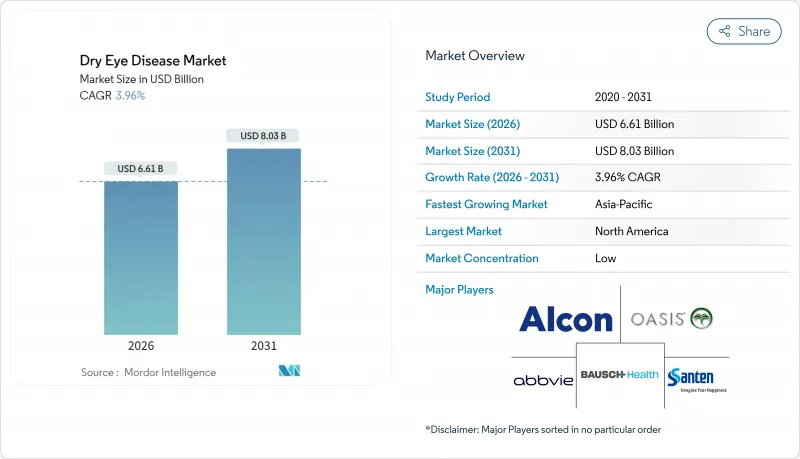
안구건조증 시장은 2025년 63억 6,000만 달러로 평가되었고, 2026년에는 66억 1,000만 달러로 성장할 것으로 예측되고, 2026-2031년에 걸쳐 CAGR 3.96%로 성장할 것으로 보이며, 2031년까지 80억 3,000만 달러에 달할 것으로 예측되고 있습니다.

이러한 성장세는 일반의약품 윤활제에서 염증 기전을 표적으로 하는 처방 치료제로의 구조적 전환에 의해 형성됩니다. 처방약이 발전하는 이유는 의료진이 현재 마이봄샘 기능 장애, 안구 표면 염증, 눈물막 불안정성을 해결하는 질환 수정 요법을 우선시하기 때문입니다. 진단률 증가, 원격 안과 네트워크 확대, 기전 기반 치료제에 대한 규제 신속 승인 제도가 대상 환자 풀을 확대하고 있습니다. 온라인 약국은 접근 경로를 재정의하고 가격 투명성을 촉진하는 한편, 열 펄스 시스템 및 표적 에너지 플랫폼과 같은 기기 기반 중재는 치료 옵션을 확대하고 있습니다. 한편, 오염된 인공눈물의 안전성 리콜은 더 엄격한 품질 감독을 촉발하여 제조사들이 방부제 시스템과 공급망 추적성을 재고하도록 하고 있습니다.
세계의 안구건조증 시장 동향 및 인사이트
고령화와 병존 질환과 관련된 안구건조증 세계적 유병률 상승
60세 이상 인구가 세계의에서 가장 빠르게 증가하는 인구층을 차지함에 따라 고령화 사회가 안구건조증 시장을 재편하고 있습니다. 현재 3,400만 명 이상의 미국인이 임상적으로 유의미한 안구건조증을 앓고 있으며, 유럽과 동아시아에서도 유병률이 상승 중입니다. 당뇨병, 자가면역 질환, 호르몬 변화는 위험을 증폭시켜 만성 치료 요법에 대한 지속적인 수요를 촉진합니다. 의료진은 이제 다인자 진단 프로토콜을 적용하여 환자를 눈물막 결핍, 마이봄샘 폐쇄, 염증 상태에 따라 계층화하며, 이는 맞춤형 치료 선택을 안내합니다. 최근 동료 검토 데이터는 염증 경로 관리가 증상 완화만 하는 것에 비해 장기적 결과를 개선함을 강조합니다.
모든 연령층에서 증가하는 스크린 사용 시간이 안구 표면 스트레스를 가중
디지털 기기 사용은 자연적인 깜빡임 빈도를 최대 60%까지 감소시켜 눈물막 파열 시간을 단축하고 각막 표면을 증발에 노출시킵니다. 어린이, 사무직 근로자, 게이머들도 이제 노년층에만 국한되던 안구건조증 증상을 호소합니다. 제품 개발사들은 '디지털 안구 피로'에 대응하는 무방부제 윤활제 출시와 원격 안과 플랫폼에 깜빡임 알림 소프트웨어 통합으로 대응하고 있습니다. 기업들은 오후 증상 급증을 막기 위해 오후 복용량 보강 마케팅을 확대했습니다. 그 결과 장시간 화면 사용 시 눈물막 안정성을 유지하는 지질층 안정제와 인공눈물을 병용하는 복합 요법에 대한 수요가 증가하고 있습니다.
제네릭 경쟁으로 기존 사이클로스포린 및 윤활제 브랜드 가격 압박
특허 만료로 인해 주력 사이클로스포린 제제의 프리미엄 가격이 하락하며, 판매량은 15-20% 할인된 저가 제네릭 및 사설 브랜드 인공눈물로 이동 중입니다. 브랜드 제약사들은 즉시 사용 가능한 무방부제 다회용 병 출시 및 마이보그래피 진단과 연계 판매로 마진을 보호하고 있습니다. 그러나 처방위원회가 점점 더 저렴한 제네릭을 선호함에 따라 단위 성장의 상한선이 제한되고 있습니다. 제조사들은 기존 포트폴리오의 현금 흐름 감소와 신제품 개발 투자 사이에서 균형을 맞춰야 합니다.
부문 분석
2025년 기준, 일반의약품 인공눈물은 판매처에서의 보편적 접근성과 자가 선택 덕분에 안구건조증 시장 규모의 38.92%를 차지했습니다. 그러나 단순한 탈수 현상이 아닌 만성 염증이 질환 진행의 근본 원인이라는 강력한 증거에 힘입어 처방약 시장은 연평균 8.72%의 성장률로 가속화되고 있습니다. 신규 사이클로스포린 나노에멀젼, 리피테그라스트 인테그린 길항제, TRPM8 작용제가 윤활제 단독 요법을 대체하는 초기 치료 경로로 부상하고 있습니다. 미국, 독일, 일본에서 처방 옵션에 대한 포괄적인 보험 적용 확대는 채택을 더욱 촉진하며, 약리학적 조절을 통한 눈물막 항상성 유지라는 구조적 전환을 강화하고 있습니다.
안구건조증 치료 산업은 처방군 내 차별화도 확대되고 있습니다. 안정적인 유중수형(O/W) 캐리어를 통해 구현된 고농도 사이클로스포린은 기존 0.05% 유화액 대비 증상 완화 속도가 빠르며 환자 유지율도 높습니다. 분비촉진제는 신경감각 반사를 통해 내인성 눈물 생성을 자극함으로써 새로운 수익원을 창출하고 있으며, 빈번한 점안 의존도를 낮추고 있습니다. 점액 플러그는 여전히 수분 유지에 역할을 하지만, 약물 방출형 변종과의 경쟁 속에서 시장 점유율이 정체되고 있습니다. 오메가-3 지방산과 식물영양소를 함유한 기능성 식품은 임상적 검증을 지속적으로 획득하며 처방 요법의 대체제가 아닌 보조제로 자리매김하고 있습니다. .
증발성 안구건조증은 2025년 안구건조증 시장 점유율의 52.40%를 차지하며 여전히 주요 증상으로 남아 있습니다. 마이봄샘 기능 장애 요인은 지질층 안정제, 열 기반 샘 압출 장치, 모낭충 감염을 표적으로 한 미생물군집 중심 치료법에 대한 수요를 촉진합니다. 샘 줄기세포 고갈에서 헤지호그 및 EGFR 경로를 규명한 연구는 장기적 질환 관리를 재정의할 수 있는 재생 치료법의 가능성을 열었습니다.
눈물 결핍성 안구건조증은 규모는 작지만, 진단 영상 기술이 눈물샘 분비 저하를 증발성 요인과 구분함에 따라 2031년까지 연평균 7.45% 성장할 것으로 예측됩니다. 많은 경우 복합 기전 병리가 임상가들로 하여금 분비 촉진제와 지질 강화 점안액, 열 치료를 병용하도록 유도하여 다중 기전 솔루션 수요를 강화하고 있습니다. 산화 스트레스가 두 병리 모두와 연관된다는 신흥 데이터를 고려하여, 기업들은 미토콘드리아 보호를 융합 전략으로 탐구하고 있습니다.
지역별 분석
북미는 안구건조증 시장을 선도해 2025년에는 수익의 35.42%를 차지할 전망입니다. 이는 높은 진단률, 임상의의 영상 진단법의 채택, 처방약에 대한 종합적인 상환 제도에 지지되고 있습니다. 미국에서는 FDA 승인 직후에 TRPM8 효능제의 채택이 가속화되어, 신규 메커니즘의 전개 거점으로서의 이 지역의 역할이 강화되었습니다. 그러나 오염된 윤활제의 품질 리콜은 규제 당국의 모니터링을 강화하고 공급업체는 생산 감사 및 유통 추적성을 강화해야 합니다.
아시아태평양은 도시 지역의 스크린 노출 시간 증가와 중국, 한국, 태국의 보험 적용 확대를 배경으로 2031년까지 연평균 복합 성장률(CAGR) 7.28%에서 가장 높은 성장률이 예상됩니다. 중국 단독으로도 안구건조증이 안과 진찰의 20%를 차지한다고 보고되고 있어, 선견적인 상환제도 개혁에 의해 질환 수식약에의 액세스 확대가 기대됩니다. 일본의 기업은 점막 부착성 미립자나 방부제 프리의 멀티 도즈 펌프 등 혁신적인 투여 시스템의 선구자이며, 지역 라이선싱 계약을 통해 주변 시장에서도 주목을 받고 있습니다.
유럽은 국민 모두 건강 관리 제도와 급속한 고령화를 배경으로 안구건조증 시장에서 여전히 큰 존재감을 유지하고 있습니다. 독일, 프랑스, 영국이 처방량의 상당 부분을 차지하고 있으며 유럽 의약품청(EMA)의 무수시클로스포린 0.1% 제제의 승인은 차세대 제제의 보급 확대를 예감시킵니다. 건조 기후의 남유럽 국가에서는 계절적인 수요가 높아지고 있으며, 국경을 넘은 유통 조정이 촉진되고 있습니다. 중동 및 아프리카에서는 극단적인 기후 조건과 도시 오염이 증발성 안구건조증의 유병률을 악화시키고 있으며, 다국적 기업이 진단과 현지 조제를 조합한 이동 진료 프로그램의 시험 도입을 추진하고 있습니다. 브라질을 필두로 하는 남미에서는 민간의료보험이 시클로스포린 유제의 상환을 개시한 것으로 성장 거점으로서 대두하고 있어 처방 확대의 기반이 갖추어지고 있습니다.
기타 혜택 :
- 엑셀 형식 시장 예측(ME) 시트
- 애널리스트의 3개월간 지원
자주 묻는 질문
목차
제1장 서론
- 조사의 전제조건과 시장의 정의
- 조사 범위
제2장 조사 방법
제3장 주요 요약
제4장 시장 상황
- 시장 개요
- 시장 성장 촉진요인
- 노화 및 병존 질환과 관련된 안구건조증의 세계적 유병률 상승
- 모든 연령층에서 증가하는 스크린 사용 시간으로 인한 안구 표면 스트레스 증가
- 세계의적으로 처방용 항염증제 및 분비 촉진제 치료법 채택
- 신규 눈물 조절제에 대한 유리한 규제 경로와 신속 승인
- 소비자 직접 대상 인식 캠페인 및 원격 안과 진료로 인한 진단률 확대
- 치료 선택의 혁신의 진전
- 시장 성장 억제요인
- 기존 사이클로스포린 및 윤활제 브랜드 가격을 압박하는 제네릭 경쟁
- 신흥 의료기기 및 생물학적 제제의 장기 유효성 및 안전성 데이터의 부족
- 개발 도상 지역의 불충분한 보험 적용 범위와 고액의 자기 부담 비용
- 만성적인 투약 부담으로 인한 낮은 환자 순응도 및 최적화되지 않은 치료 결과
- 밸류체인 분석
- 기술의 전망
- Porter's Five Forces
- 신규 참가업체의 위협
- 구매자 및 소비자의 협상력
- 공급기업의 협상력
- 대체품의 위협
- 경쟁 기업간 경쟁 관계
제5장 시장 규모와 성장 예측
- 유형별
- 치료
- 인공눈물
- 처방약
- 항염증제
- 분비 촉진제
- 기타 처방전 치료
- 점액 플러그
- 기타
- 진단 검사
- 쉬르메르 검사
- 각막 염색
- 눈물 파열 시간(TBUT)
- 광간섭 단층계(OCT)
- 눈물 안정성 분석
- 눈물 삼투압
- 기타
- 치료
- 질환 유형별
- 증발성 안구건조증
- 눈물 결핍성 안구건조증
- 혼합 메커니즘
- 제형별
- 점안액
- 연고 및 젤
- 기타
- 유통 채널별
- 병원 약국
- 독립계 약국 및 드럭스토어
- 온라인 약국 및 전자상거래포털
- 지역
- 북미
- 미국
- 캐나다
- 멕시코
- 유럽
- 독일
- 영국
- 프랑스
- 이탈리아
- 스페인
- 기타 유럽
- 아시아태평양
- 중국
- 일본
- 인도
- 한국
- 호주
- 기타 아시아
- 중동 및 아프리카
- GCC
- 남아프리카
- 기타 중동 및 아프리카
- 남미
- 브라질
- 아르헨티나
- 기타 남미
- 북미
제6장 경쟁 구도
- 시장 집중도
- 전략적 동향
- 시장 점유율 분석
- 기업 프로파일
- Alcon Inc.
- Bausch Health Companies Inc.
- AbbVie Inc.(Allergan)
- Santen Pharmaceutical Co. Ltd
- Johnson & Johnson Vision Care
- Novartis AG
- Viatris Inc.(Oyster Point Pharma)
- Kala Pharmaceuticals
- Sun Pharmaceutical Industries Ltd
- Harrow Health(ImprimisRx)
- AFT Pharmaceuticals
- Horus Pharma
- Novaliq GmbH
- OASIS Medical Inc.
- Prestige Consumer Healthcare
- Sentiss Pharma Pvt. Ltd
- VISUfarma BV
- Reckitt Benckiser Group plc(TheraTears)
- Scope Ophthalmics Ltd
- Dompe Farmaceutici
- Otsuka Pharmaceutical Co., Ltd.
- Advanced Tear Diagnostics
- Tomey Corporation
- Carl Zeiss Meditec AG
- TearLab Corporation
제7장 시장 기회와 장래의 전망
HBR 26.01.26The dry eye disease market is expected to grow from USD 6.36 billion in 2025 to USD 6.61 billion in 2026 and is forecast to reach USD 8.03 billion by 2031 at 3.96% CAGR over 2026-2031.
This trajectory is shaped by a structural shift from over-the-counter lubricants to prescription therapies targeting inflammatory mechanisms. Prescription drugs are advancing because clinicians now prioritize disease-modifying regimens that address meibomian gland dysfunction, ocular surface inflammation, and tear-film instability. Heightened diagnosis rates, expanding tele-ophthalmology networks, and regulatory fast-tracking for mechanism-based therapies are enlarging the addressable patient pool. Online pharmacies are redefining access pathways and promoting price transparency, while device-based interventions, such as thermal pulsation systems and targeted energy platforms, are broadening the treatment options. Meanwhile, safety recalls of contaminated artificial tears have prompted stricter quality oversight, prompting manufacturers to rethink preservative systems and supply-chain traceability.
Global Dry Eye Disease Market Trends and Insights
Rising Global Prevalence of Dry Eye Disease Linked to Aging and Comorbidities
An aging population is reshaping the dry eye disease market as people over 60 represent the fastest-growing demographic worldwide. More than 34 million Americans presently live with clinically significant dry eye, and prevalence is climbing in Europe and East Asia. Diabetes, autoimmune disorders, and hormonal shifts amplify risk, driving sustained demand for chronic-care regimens. Clinicians now apply multifactorial diagnostic protocols to stratify patients by tear-film deficiency, meibomian gland obstruction, and inflammatory status, which in turn guide targeted therapy selection. Recent peer-reviewed data underscore that managing inflammatory pathways improves long-term outcomes compared with symptomatic relief alone.
Escalating Screen-Time Across All Age Groups Increasing Ocular Surface Stress
Digital device use has lowered spontaneous blink rate by up to 60%, shortening tear-film breakup time and exposing the corneal surface to evaporation. Children, office workers, and gamers now report dry eye symptoms once confined to older adults. Product developers respond with preservative-free lubricants positioned for "digital eye strain" and by embedding blink-reminder software into tele-ophthalmology platforms. Companies have expanded marketing around afternoon dosage reinforcement to counter mid-day symptom spikes. As a result, demand is rising for combination regimens pairing artificial tears with lipid-layer stabilizers that sustain tear-film integrity during prolonged screen use.
Generic Competition Compressing Prices of Established Cyclosporine & Lubricant Brands
The patent cliff is eroding price premiums for flagship cyclosporine formulations, transferring volume toward lower-cost generics and private-label artificial tears that sell at discounts of 15-20%. Branded firms protect margins by releasing ready-to-use multidose preservative-free bottles and by bundling with meibography diagnostics. However, formulary committees increasingly favor less-expensive generics, limiting upside on unit growth. Manufacturers must balance investment in new mechanisms against shrinking cash flows from legacy portfolios.
Other drivers and restraints analyzed in the detailed report include:
- Adoption of Prescription Anti-inflammatory & Secretagogue Therapies Worldwide
- Favorable Regulatory Pathways & Fast-Track Approvals for Novel Tear Modulators
- Chronic Dosing Burden Leading to Poor Patient Adherence & Sub-optimal Outcomes
For complete list of drivers and restraints, kindly check the Table Of Contents.
Segment Analysis
In 2025, over-the-counter artificial tears accounted for 38.92% of the dry eye disease market size, thanks to their universal availability and self-selection at the point of sale. Yet prescription drugs are accelerating with a 8.72% CAGR, propelled by robust evidence that chronic inflammation, not simple dehydration, underpins disease progression. New cyclosporine nanoemulsions, lifitegrast integrin antagonists, and TRPM8 agonists are displacing lubricant monotherapy as initial care pathways. More exhaustive insurance coverage for prescription options in the United States, Germany, and Japan further catalyzes uptake, reinforcing a structural shift toward pharmacologic modulation of tear-film homeostasis.
The dry eye disease treatment industry also sees rising differentiation within prescription classes. High-concentration cyclosporine, enabled by stable oil-in-water carriers, delivers faster symptom relief and supports higher patient retention compared with earlier 0.05% emulsions. Secretagogues are opening new revenue streams by stimulating endogenous tear production through neurosensory reflexes, reducing dependence on frequent drop instillation. Although punctal plugs still play a role in maintaining aqueous retention, their market share is plateauing amid competition from drug-eluting variants. Nutraceuticals containing omega-3 fatty acids and phytonutrients continue to gain clinical validation, positioning them as adjuncts rather than substitutes for prescription regimens.
Evaporative dry eye remains the dominant presentation, holding 52.40% of dry eye disease market share in 2025. The meibomian gland dysfunction component fosters demand for lipid-layer stabilizers, heat-based gland expression devices, and microbiome-oriented therapies aimed at Demodex infestation. Research identifying hedgehog and EGFR pathways in gland stem-cell depletion has opened potential for regenerative treatments that could redefine long-term disease control.
Aqueous-deficient dry eye, though smaller, is predicted to expand at 7.45% CAGR through 2031 as diagnostic imaging distinguishes lacrimal gland hypo-secretion from evaporative components. In many cases, mixed-mechanism pathology drives clinicians to combine secretagogues with lipid-enhancing drops and thermal therapies, reinforcing demand for multi-mechanism solutions. Companies are exploring mitochondrial protection as a convergent strategy, given emerging data linking oxidative stress to both pathologies.
The Dry Eye Disease Market Report is Segmented by Type (Treatment {Artificial Tears, and More] and Diagnostic Test {Schirmer's Test, Corneal Staining and More}), Disease Type (Evaporative Dry Eye, and More), Dosage Form (Eye Drops, and More), Distribution Channel (Hospital Pharmacies, Drug Stores and More), and Geography (North America, Europe, Asia Pacific, and More). The Market Forecasts are Provided in Terms of Value (USD).
Geography Analysis
North America leads the dry eye disease market, capturing 35.42% of the revenue in 2025, driven by strong diagnosis rates, clinician adoption of imaging modalities, and comprehensive reimbursement for prescription drugs. The United States saw accelerated uptake of TRPM8 agonists immediately after FDA approval, reinforcing the region's role as a launchpad for novel mechanisms. Quality recalls of contaminated lubricants, however, have intensified regulatory scrutiny, prompting suppliers to upgrade production audits and distribution traceability.
The Asia-Pacific region is projected to grow at the fastest rate, with a 7.28% CAGR through 2031, driven by increasing screen exposure among urban populations and the expansion of insurance in China, South Korea, and Thailand. China alone reports that dry eye disease accounts for 20% of ophthalmic consultations, and forward-looking reimbursement reforms are poised to expand access to disease-modifying drugs. Japanese firms spearhead innovative delivery systems, including muco-adhesive microparticles and preservative-free multidose pumps, which are gaining attention in surrounding markets through regional licensing agreements.
Europe retains a sizable footprint in the dry eye disease market, supported by universal healthcare frameworks and rapid aging demographics. Germany, France, and the United Kingdom together contribute a substantial portion of prescription volume, and EMA's acceptance of water-free ciclosporin 0.1% heralds broader adoption of next-generation formulations. Southern European countries with arid climates are witnessing heightened seasonal demand, stimulating cross-border distribution coordination. In the Middle East and Africa, climatic extremes and urban pollution intensify evaporative dry eye prevalence, encouraging multinational companies to pilot mobile clinic programs that pair diagnosis with onsite dispensing. South America, led by Brazil, is emerging as a growth pocket as private-sector health plans start to reimburse cyclosporine emulsions, paving the way for broader prescription uptake.
List of Companies Covered in this Report:
- Alcon
- Bausch Health
- Abbvie
- Santen Pharmaceuticals
- Johnson & Johnson Vision Care
- Novartis
- Viatris Inc. (Oyster Point Pharma)
- Kala Pharmaceuticals
- Sun Pharmaceuticals Industries
- Harrow Health (ImprimisRx)
- AFT Pharmaceuticals
- Horus Pharma
- Novaliq
- OASIS Medical Inc.
- Prestige Consumer Healthcare
- Sentiss Pharma
- VISUfarma B.V.
- Reckitt Benckiser Group plc (TheraTears)
- Scope Ophthalmics Ltd
- Dompe Farmaceutici
- Otsuka
- Advanced Tear Diagnostics
- Tomey
- Carl Zeiss
- TearLab Corporation
Additional Benefits:
- The market estimate (ME) sheet in Excel format
- 3 months of analyst support
TABLE OF CONTENTS
1 Introduction
- 1.1 Study Assumptions & Market Definition
- 1.2 Scope of the Study
2 Research Methodology
3 Executive Summary
4 Market Landscape
- 4.1 Market Overview
- 4.2 Market Drivers
- 4.2.1 Rising Global Prevalence of Dry Eye Disease Linked to Aging and Comorbidities
- 4.2.2 Escalating Screen-Time Across All Age Groups Increasing Ocular Surface Stress
- 4.2.3 Adoption of Prescription Anti-inflammatory & Secretagogue Therapies Worldwide
- 4.2.4 Favorable Regulatory Pathways & Fast-Track Approvals for Novel Tear Modulators
- 4.2.5 Direct-to-Consumer Awareness Campaigns and Tele-ophthalmology Expanding Diagnosis Rates
- 4.2.6 Growing Innovations in Treatment Options
- 4.3 Market Restraints
- 4.3.1 Generic Competition Compressing Prices of Established Cyclosporine & Lubricant Brands
- 4.3.2 Limited Long-term Efficacy & Safety Data for Emerging Devices and Biologics
- 4.3.3 Inadequate Insurance Coverage and High Out-of-Pocket Costs in Developing Regions
- 4.3.4 Chronic Dosing Burden Leading to Poor Patient Adherence & Sub-optimal Outcomes
- 4.4 Value Chain Analysis
- 4.5 Technological Outlook
- 4.6 Porter's Five Forces
- 4.6.1 Threat of New Entrants
- 4.6.2 Bargaining Power of Buyers/Consumers
- 4.6.3 Bargaining Power of Suppliers
- 4.6.4 Threat of Substitute Products
- 4.6.5 Intensity of Competitive Rivalry
5 Market Size & Growth Forecasts (Value, USD)
- 5.1 By Type
- 5.1.1 Treatment
- 5.1.1.1 Artificial Tears
- 5.1.1.2 Prescription Drugs
- 5.1.1.2.1 Anti-inflammatory
- 5.1.1.2.2 Secretagogues
- 5.1.1.2.3 Other Prescription Therapies
- 5.1.1.3 Punctal Plugs
- 5.1.1.4 Others
- 5.1.2 Diagnostic Test
- 5.1.2.1 Schirmer's Test
- 5.1.2.2 Corneal Staining
- 5.1.2.3 Tear Break-up Time (TBUT)
- 5.1.2.4 Optical Coherence Tomography (OCT)
- 5.1.2.5 Tear Film Stability Analysis
- 5.1.2.6 Tear Osmolarity
- 5.1.2.7 Others
- 5.1.1 Treatment
- 5.2 By Disease Type
- 5.2.1 Evaporative Dry Eye
- 5.2.2 Aqueous-deficient Dry Eye
- 5.2.3 Mixed Mechanism
- 5.3 By Dosage Form
- 5.3.1 Eye Drops
- 5.3.2 Ointments & Gels
- 5.3.3 Others
- 5.4 By Distribution Channel
- 5.4.1 Hospital Pharmacies
- 5.4.2 Independent Pharmacies & Drug Stores
- 5.4.3 Online Pharmacies & E-commerce Portals
- 5.5 Geography
- 5.5.1 North America
- 5.5.1.1 United States
- 5.5.1.2 Canada
- 5.5.1.3 Mexico
- 5.5.2 Europe
- 5.5.2.1 Germany
- 5.5.2.2 United Kingdom
- 5.5.2.3 France
- 5.5.2.4 Italy
- 5.5.2.5 Spain
- 5.5.2.6 Rest of Europe
- 5.5.3 Asia-Pacific
- 5.5.3.1 China
- 5.5.3.2 Japan
- 5.5.3.3 India
- 5.5.3.4 South Korea
- 5.5.3.5 Australia
- 5.5.3.6 Rest of Asia
- 5.5.4 Middle East and Africa
- 5.5.4.1 GCC
- 5.5.4.2 South Africa
- 5.5.4.3 Rest of Middle East and Africa
- 5.5.5 South America
- 5.5.5.1 Brazil
- 5.5.5.2 Argentina
- 5.5.5.3 Rest of South America
- 5.5.1 North America
6 Competitive Landscape
- 6.1 Market Concentration
- 6.2 Strategic Moves
- 6.3 Market Share Analysis
- 6.4 Company Profiles (includes Global Level Overview, Market Level Overview, Core Segments, Financials as available, Strategic Information, Market Rank/Share, Products & Services, Recent Developments)
- 6.4.1 Alcon Inc.
- 6.4.2 Bausch Health Companies Inc.
- 6.4.3 AbbVie Inc. (Allergan)
- 6.4.4 Santen Pharmaceutical Co. Ltd
- 6.4.5 Johnson & Johnson Vision Care
- 6.4.6 Novartis AG
- 6.4.7 Viatris Inc. (Oyster Point Pharma)
- 6.4.8 Kala Pharmaceuticals
- 6.4.9 Sun Pharmaceutical Industries Ltd
- 6.4.10 Harrow Health (ImprimisRx)
- 6.4.11 AFT Pharmaceuticals
- 6.4.12 Horus Pharma
- 6.4.13 Novaliq GmbH
- 6.4.14 OASIS Medical Inc.
- 6.4.15 Prestige Consumer Healthcare
- 6.4.16 Sentiss Pharma Pvt. Ltd
- 6.4.17 VISUfarma B.V.
- 6.4.18 Reckitt Benckiser Group plc (TheraTears)
- 6.4.19 Scope Ophthalmics Ltd
- 6.4.20 Dompe Farmaceutici
- 6.4.21 Otsuka Pharmaceutical Co., Ltd.
- 6.4.22 Advanced Tear Diagnostics
- 6.4.23 Tomey Corporation
- 6.4.24 Carl Zeiss Meditec AG
- 6.4.25 TearLab Corporation
7 Market Opportunities & Future Outlook
- 7.1 White-space & Unmet-Need Assessment