|
시장보고서
상품코드
1906084
저밀도 폴리에틸렌(LDPE) 시장 : 점유율 분석, 업계 동향 및 통계, 성장 예측(2026-2031년)Low Density Polyethylene - Market Share Analysis, Industry Trends & Statistics, Growth Forecasts (2026 - 2031) |
||||||
 Mordor Intelligence
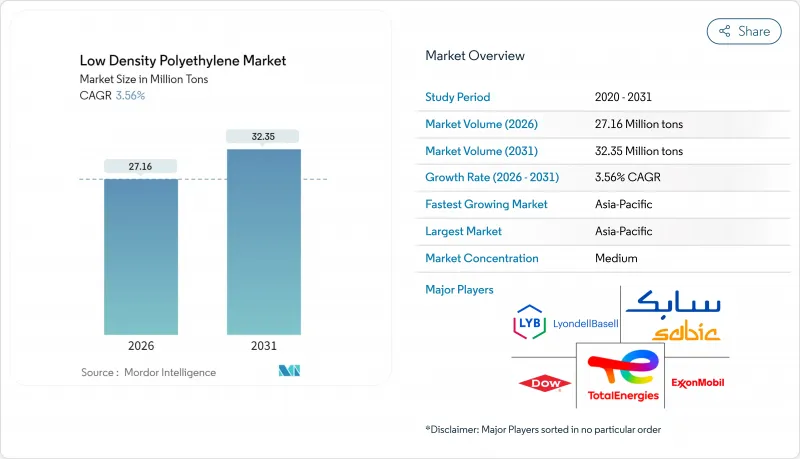
저밀도 폴리에틸렌 시장은 2025년 2,623만 톤에서 2026년에는 2,716만 톤으로 성장하고, 2026년에서 2031년에 걸쳐 CAGR 3.56%로 추이하여, 2031년까지 3,235만 톤에 달할 것으로 예측되고 있습니다.
이러한 성장 궤적은 규제 압력으로 순환 포장 솔루션으로의 전환이 가속화되는 가운데 연질 필름, 단열재, 코팅 및 농업 제품에 대한 엄격한 소비를 반영합니다. 필름이 주요 용도로 계속되는 배경은 가공업자가 LDPE의 밀봉 강도와 광학 투명성을 중시하는 점을 들 수 있습니다. 한편 아시아태평양의 지속적인 생산능력 강화는 신재생에너지 인프라, 정밀농업, 전자상거래의 물류를 지원하는 공급 기반을 강화하고 있습니다. 특히 중국의 기술 라이선싱은 고부가가치 등급을 생산하는 첨단 튜블러법과 오토클레이브법에 대한 접근을 확대하고 있습니다. 한편 유럽연합(EU)의 순환형 경제 의무화는 사용 후 재활용 플라스틱 함량을 평가하고 복잡한 다층 구조를 제한함으로써 조달 전략을 재구성하고 있습니다. 원유가격에 연동하는 에틸렌가격에 의한 원료비용의 변동성은 기업전략의 최우선 과제로 마진관리를 자리매김하여 생산자가 가격 결정력을 가지는 특수용도용 제품 라인업을 최적화하도록 촉진하고 있습니다.
세계의 저밀도 폴리에틸렌 시장의 동향 및 인사이트
전자상거래용 연질 포장의 성장이 필름 기술 혁신을 견인
급증하는 소포량에 대응하기 위해, 컨버터는 운송 중량을 줄이고 재활용 공정을 간소화하는 경량이며 내관통성이 뛰어난 단일 소재 필름의 개발을 추진하고 있습니다. 엑손모빌의 Exceed 및 Enable 폴리머를 기반으로 한 풀 폴리에틸렌 적층 플랫폼은 97%의 PE로 구성된 파우치를 실현하면서 높은 산소차단성을 달성하고 있습니다. 물류 사업자는 씰 강도를 손상시키지 않고 재료 사용량을 줄이는 얇은 구조의 혜택을 받고 있으며, 이 형태는 재활용이 어려운 다층 필름에 부과되는 유럽의 요금 조정 제도에도 적합합니다. 소매업체는 다트 충격 저항성과 투명성이 균형을 이루는 좁은 분자량 분포의 LDPE 등급을 지정하여 저밀도 폴리에틸렌 시장에서 수요 증가를 견인하고 있습니다.
지속가능성과 생산성 향상의 요구로 뒷받침되는 농업용 필름
정밀 농업, 온실 재배, 사일리지 보존 기술의 발전으로 멀티, 훈증, 온실 커버 용도에서 LDPE 소비가 가속화되고 있습니다. BASF사는 농업용 필름의 연간 수요를 700만톤, 성장률 7%로 추계하고 있으며, 이는 수분 손실이나 잡초 번식을 억제함으로써 수확량 향상에 기여하는 본 소재의 중요성을 뒷받침하고 있습니다. 그러나 규제 당국은 폐기물 처리 규제를 강화하고 있으며, 바이오 소재나 광분해성 블렌드의 시험 도입이 진행되고 있습니다. 제조업체는 대체 위험에 대응하기 위해 산화분해성 마스터 배치의 상업화를 추진하고 있습니다. 이는 현장 사용시에는 필름 강도를 유지하면서, 회수 후에는 사슬 절단을 촉진하는 특성에 의해 고성능 용도에서의 LDPE의 경쟁력을 확보하는 것입니다.
범용 용도에서 LLDPE 및 HDPE와의 경쟁 격화
메탈로센 촉매의 진보에 의해 LDPE와 선형 및 고밀도 폴리에틸렌의 성능 차이는 줄어들고 있습니다. 현대의 LLDPE는 견고한 운송용 백에서 높은 내관통성과 얇은 두께를 실현하여 기존의 LDPE 계약량을 흡수하고 있습니다. 한편 HDPE는 강성과 환경 응력 균열 저항이 중시되는 티셔츠 백과 얇은 용기 분야에서 계속 기반을 확대하고 있습니다. LDPE 제조업체는 분지 구조가 선형 등급에서는 달성할 수 없는 열차단성과 광학 특성을 제공하는 고내구성 슈링크 후드나 핫멜트 접착제 안감 등의 틈새 분야로 생산 능력을 전환함으로써 점유율을 유지하고 있습니다.
부문 분석
2025년 저밀도 폴리에틸렌 시장 규모의 56.60%를 필름이 차지하였으며, 이는 식품용 연질 파우치, 산업용 라이너, 농업용 커버에서 정착한 용도를 반영하고 있습니다. 컨버터 각사에 의한 두께 감소와 단일 소재 구조에 대한 관심이 높아지고 있으며 15 미크론 배향성 웹을 실현하여 인열 강도를 손상시키지 않고 수지 투입량을 절감하는 것이 가능해지고 있습니다. 전선 및 케이블 절연재는 수량면에서는 소규모이지만, 재생에너지망이나 전기자동차용 하네스의 보급에 따라, 2031년까지 연평균 복합 성장률(CAGR) 4.07%로 확대될 것으로 전망됩니다. 저밀도 폴리에틸렌 시장에서 블로우 성형 용기가 차지하는 점유율은 투명성과 내충격성의 균형으로 안정적으로 유지됩니다. 반면 사출 성형 부품은 내화학성이 필요한 캡과 마개 부품 수요를 충족합니다.
선형 폴리에틸렌으로부터의 대체 압력이 계속되는 가운데, LDPE 공급업체는 에너지 흡수성과 유연성이 요구되는 발포체 및 시트 용도를 위해 고용융 강도 수지의 개발을 진행하고 있습니다. 발포체와 스포츠용 바닥 제조업체는 LDPE의 셀 구조 안정성을 중시하고, 건축용 랩 제조업체는 방습 특성을 활용하고 있습니다. 과산화물을 쓰지 않는 오토클레이브 기술을 탑재한 특수 반응기 라인은 의료기기 오버몰드용으로 설계된 초청정 등급을 제공함으로써 제품 라인을 더욱 확대하여 저밀도 폴리에틸렌 시장에서 제품 구성의 진화를 드러내고 있습니다.
저밀도 폴리에틸렌 시장의 보고서는 제품 유형(블로우 성형, 필름, 사출 성형, 시트, 발포체 등), 최종 사용자 산업(농업, 전기 및 전자, 포장, 건설, 자동차, 소비재, 의료 및 제약), 지역(아시아태평양, 북미, 유럽, 남미, 중동 및 아프리카)별로 분류되어 있습니다. 시장 예측은 수량(톤) 단위로 제공됩니다.
지역별 분석
아시아태평양은 중국의 대규모 생산 능력 증대와 동남아시아의 제조업 성장에 힘입어 2025년 저밀도 폴리에틸렌 시장 점유율의 47.30%를 차지했습니다. 중국에서는 닝샤 회족 자치구와 산동성에서 새로운 튜블러 플랜트 및 스윙 플랜트 프로젝트가 가동을 시작했으며, 라이온델바젤의 기술 라이선스를 기반으로 한 많은 프로젝트로 수지 생산량이 급증했습니다.
북미는 에탄이 풍부한 셰일 자원에 의해 지원되며 원료 비용면에서 우위성을 가지고 있습니다. 통합 업체는 잉여 LDPE를 전략적으로 라틴아메리카 및 아시아에 수출하는 한편 국내 컨버터는 원료 조달력을 활용하여 지속 가능한 필름 프로그램을 지원하고 있습니다. 유럽에서는 포장 폐기물 규제와 같은 엄격한 지침으로 첨단 재활용 인프라 및 재생 LDPE 등급에 대한 투자가 촉진되고 있습니다. 버진 수지의 성장은 완만하지만, 부가가치가 높은 순환형 제품이 유럽 공급업체에 프리미엄 틈새 시장을 개척하고 있습니다.
중동 및 아프리카는 경쟁력 있는 원료 가격과 급속한 인구 증가를 강점으로 하고 있습니다. 아라비아 걸프의 에탄 분해 장치와 통합된 LDPE 플랜트는 동부로 대량 출하하고 있지만, 급성장하는 국내 건설 및 농업 분야가 현지 소비를 밀어 올리고 있습니다. 남미는 특히 브라질과 아르헨티나에서 작물 보호 필름과 소비자 포장재와 관련된 수요가 완만하게 지속되고 있습니다. 그러나 통화 변동과 경제 불안정성은 투자 판단을 억제합니다. 인도의 버진 폴리에틸렌 품질 기준 강화는 공급망 투명성 향상에 기여함과 동시에 농업 분야와 소비재 분야의 인프라 확충을 지원할 것으로 전망됩니다.
기타 혜택
- 시장 예측(ME) 엑셀 시트
- 3개월 애널리스트 서포트
자주 묻는 질문
목차
제1장 서론
- 조사 전제조건 및 시장 정의
- 조사 범위
제2장 조사 방법
제3장 주요 요약
제4장 시장 상황
- 시장 개요
- 촉진요인
- 전자상거래용 연질 포장의 성장
- 농업용 필름 수요 증가
- 압출 코팅 용도에서의 선호
- 첨단 재활용 기술에 의한 프리미엄 LDPE 등급 실현
- 태양광 패널 봉지 필름 수요 동향
- 억제요인
- LLDPE 및 HDPE와의 경쟁
- 에틸렌 원료 가격의 변동성
- EU에서 금지된 단층 폴리올레핀 필름
- 바이오 폴리올레핀으로의 자본 이동
- 밸류체인 분석
- 규제 상황
- 기술 전망
- Porter's Five Forces 분석
- 공급자의 협상력
- 구매자의 협상력
- 신규 참가업체의 위협
- 대체품의 위협
- 경쟁도
제5장 시장 규모 및 성장 예측
- 제품 유형별
- 블로우 성형
- 필름
- 사출 성형
- 시트
- 폼
- 전선 및 케이블 절연재
- 최종 사용자 업계별
- 농업
- 전기 및 전자기기
- 포장
- 건설
- 자동차
- 소비재
- 의료 및 제약
- 지역별
- 아시아태평양
- 중국
- 인도
- 일본
- 한국
- 말레이시아
- 태국
- 인도네시아
- 베트남
- 기타 아시아태평양
- 북미
- 미국
- 캐나다
- 멕시코
- 유럽
- 독일
- 영국
- 프랑스
- 이탈리아
- 스페인
- 북유럽 국가
- 튀르키예
- 러시아
- 기타 유럽
- 남미
- 브라질
- 아르헨티나
- 콜롬비아
- 기타 남미
- 중동 및 아프리카
- 사우디아라비아
- 카타르
- 아랍에미리트(UAE)
- 나이지리아
- 이집트
- 남아프리카
- 기타 중동 및 아프리카
- 아시아태평양
제6장 경쟁 구도
- 시장 집중도
- 전략적 동향
- 시장 점유율(%) 및 순위 분석
- 기업 프로파일
- Borealis AG
- Braskem SA
- Chevron Phillips Chemical Company LLC
- China Petrochemical Corporation.
- Dow
- ExxonMobil Corporation
- Formosa Plastics Corporation
- Hanwha Solutions Chemical Division Corporation
- INEOS Group
- LG Chem
- LyondellBasell Industries Holdings BV
- Mitsui Chemicals, Inc.
- NOVA Chemicals Corporation
- PetroChina
- PTT Global Chemical PLC
- Qatar Chemical Company Ltd
- Reliance Industries Limited
- Repsol SA
- SABIC
- Sumitomo Chemical Co., Ltd.
- TotalEnergies SE
- Versalis SpA(Eni)
- Westlake Corporation
제7장 시장 기회 및 미래 전망
CSM 26.01.28The Low Density Polyethylene market is expected to grow from 26.23 million tons in 2025 to 27.16 million tons in 2026 and is forecast to reach 32.35 million tons by 2031 at 3.56% CAGR over 2026-2031.
This trajectory reflects entrenched consumption in flexible films, insulation, coatings, and agricultural products, even as regulatory pressures accelerate the shift toward circular packaging solutions. Films retain primacy because converters value LDPE's seal integrity and optical clarity, while sustained capacity additions in Asia-Pacific underpin a supply landscape that feeds renewable-energy infrastructure, precision farming, and e-commerce fulfillment. Technology licensing, particularly in China, is widening access to advanced tubular and autoclave processes that yield higher-value grades. Meanwhile, circular-economy mandates in the European Union are reshaping procurement strategies by rewarding post-consumer-recycled content and penalizing complex multilayer structures. Input-cost volatility tied to crude-driven ethylene prices keeps margin management at the forefront of corporate strategy, encouraging producers to optimize product slates toward specialty applications that command pricing power.
Global Low Density Polyethylene Market Trends and Insights
Growth in E-commerce Flexible Packaging Drives Film Innovation
Surging parcel volumes push converters to engineer lightweight, puncture-resistant mono-material films that slash shipping mass and simplify recycling streams. ExxonMobil's full-polyethylene laminated platforms, built on Exceed and Enable polymers, deliver pouches composed of 97% PE while achieving high oxygen barriers. Logistics operators benefit from down-gauged structures that cut material intensity without sacrificing seal integrity, and the format aligns with European fee modulation schemes that penalize difficult-to-recycle multilayers. Retailers are specifying LDPE grades with narrow molecular-weight distributions that balance dart-impact resistance and clarity, driving incremental demand within the low density polyethylene market.
Agricultural Films Benefit from Sustainability and Productivity Imperatives
Precision farming, greenhouse cultivation, and silage preservation are accelerating LDPE consumption in mulch, fumigation, and greenhouse covers. BASF estimates annual agricultural-film demand at 7 million tons and a 7% growth rate, underscoring the material's role in boosting crop yields by limiting moisture loss and weed pressure. Yet regulators are tightening end-of-life controls, prompting trials of bio-based and photodegradable blends. Producers are countering substitution risk by commercializing oxo-biodegradable masterbatches that retain film strength during field use but accelerate chain scission once recovered, ensuring LDPE remains competitive in high-performance installations.
Competition from LLDPE and HDPE Intensifies in Commodity Applications
Metallocene catalyst advances have narrowed the performance gap between LDPE and its linear and high-density counterparts. Modern LLDPE delivers higher puncture resistance and downgauging potential in heavy-duty shipping sacks, eroding traditional LDPE contract volumes. HDPE, meanwhile, continues to gain traction in t-shirt bags and thin-wall containers, where stiffness and environmental stress crack resistance are prized. LDPE producers are defending share by steering capacity toward niche areas, such as heavy-duty shrink hoods and hot-melt-adhesive backings, where branching architecture delivers heat-seal and optical benefits unattainable with linear grades.
Other drivers and restraints analyzed in the detailed report include:
- Extrusion-Coated Applications Expand Through Technical Innovation
- Advanced Recycling Technologies Enable Premium Grade Recovery
- Ethylene Feedstock Price Volatility Constrains Margin Predictability
For complete list of drivers and restraints, kindly check the Table Of Contents.
Segment Analysis
Films accounted for 56.60% of low density polyethylene market size in 2025, reflecting entrenched usage in flexible food pouches, industrial liners, and agricultural covers. Converter interest in downgauged mono-material structures has intensified, enabling 15-micron oriented webs that cut resin input without compromising tear strength. Wire and cable insulation, although representing a smaller volume base, is set to post a 4.07% CAGR through 2031 as renewable-energy grids and electric-vehicle harnesses proliferate. The low density polyethylene market share commanded by blow-molded containers remains steady due to their balance of clarity and impact resistance, whereas injection-molded components satisfy chemical-resistant caps and closures.
Continuing substitution pressure from linear grades forces LDPE suppliers to cultivate high-melt-strength resins for foams and sheet applications that demand energy absorption and softness. Foam bedding and sports-flooring producers value LDPE's cell-structure stability, while construction wrap manufacturers leverage its moisture-barrier attributes. Specialty reactor lines equipped with peroxide-free autoclave technology further broaden the offering by delivering ultra-clean grades tailored to medical device over-molding, underscoring the evolving product mix inside the low density polyethylene market.
The Low Density Polyethylene Market Report is Segmented by Product Type (Blow Molded, Films, Injection Molded, Sheets, Foams, and More), End-User Industry (Agriculture, Electrical and Electronics, Packaging, Construction, Automotive, Consumer Goods, Healthcare and Pharma), and Geography (Asia-Pacific, North America, Europe, South America, Middle East and Africa). The Market Forecasts are Provided in Terms of Volume (Tons).
Geography Analysis
Asia-Pacific held 47.30% of low density polyethylene market share in 2025, buoyed by China's large-scale capacity additions and Southeast Asia's manufacturing growth. Chinese resin output surged as new tubular and swing-plant projects came online in Ningxia and Shandong provinces, many underpinned by technology licenses from LyondellBasell.
North America enjoys feedstock cost leadership owing to an ethane-rich shale inventory. Integrated producers strategically export surplus LDPE to Latin America and Asia, while domestic converters leverage material availability to support sustainable film programs. Europe confronts stringent directives such as the Packaging and Packaging Waste Regulation, steering investment into advanced recycling infrastructure and post-consumer-recycled LDPE grades. Although virgin-resin growth is modest, value-added circular offerings open premium niches for European suppliers.
The Middle East and Africa capitalize on competitively priced feedstocks and rapid demographic growth. LDPE plants integrated with ethane crackers in the Arabian Gulf ship substantial volumes eastward, but burgeoning domestic construction and agriculture are lifting local off-take. South America, especially Brazil and Argentina, sustains moderate demand tied to crop-protection films and consumer packaging, though currency fluctuation and economic volatility temper investment decisions. India's tightening quality-standard framework for virgin polyethylene is expected to enhance supply-chain transparency while supporting infrastructure expansion in agriculture and fast-moving consumer goods.
- Borealis AG
- Braskem S.A.
- Chevron Phillips Chemical Company LLC
- China Petrochemical Corporation.
- Dow
- ExxonMobil Corporation
- Formosa Plastics Corporation
- Hanwha Solutions Chemical Division Corporation
- INEOS Group
- LG Chem
- LyondellBasell Industries Holdings BV
- Mitsui Chemicals, Inc.
- NOVA Chemicals Corporation
- PetroChina
- PTT Global Chemical PLC
- Qatar Chemical Company Ltd
- Reliance Industries Limited
- Repsol S.A.
- SABIC
- Sumitomo Chemical Co., Ltd.
- TotalEnergies SE
- Versalis S.p.A. (Eni)
- Westlake Corporation
Additional Benefits:
- The market estimate (ME) sheet in Excel format
- 3 months of analyst support
TABLE OF CONTENTS
1 Introduction
- 1.1 Study Assumptions and Market Definition
- 1.2 Scope of the Study
2 Research Methodology
3 Executive Summary
4 Market Landscape
- 4.1 Market Overview
- 4.2 Market Drivers
- 4.2.1 Growth in e-commerce flexible packaging
- 4.2.2 Rising demand for agricultural films
- 4.2.3 Preference for extrusion-coated applications
- 4.2.4 Advanced recycling enabling premium LDPE grades
- 4.2.5 Solar-panel encapsulant film uptake
- 4.3 Market Restraints
- 4.3.1 Competition from LLDPE and HDPE
- 4.3.2 Ethylene feedstock price volatility
- 4.3.3 EU bans on mono-layer polyolefin films
- 4.3.4 Capital shift to bio-based polyolefins
- 4.4 Value Chain Analysis
- 4.5 Regulatory Landscape
- 4.6 Technological Outlook
- 4.7 Porter's Five Forces Analysis
- 4.7.1 Bargaining Power of Suppliers
- 4.7.2 Bargaining Power of Buyers
- 4.7.3 Threat of New Entrants
- 4.7.4 Threat of Substitutes
- 4.7.5 Degree of Competition
5 Market Size and Growth Forecasts (Volume)
- 5.1 By Product Type
- 5.1.1 Blow Molded
- 5.1.2 Films
- 5.1.3 Injection Molded
- 5.1.4 Sheets
- 5.1.5 Foams
- 5.1.6 Wire and Cable Insulation
- 5.2 By End-user Industry
- 5.2.1 Agriculture
- 5.2.2 Electrical and Electronics
- 5.2.3 Packaging
- 5.2.4 Construction
- 5.2.5 Automotive
- 5.2.6 Consumer Goods
- 5.2.7 Healthcare and Pharma
- 5.3 By Geography
- 5.3.1 Asia-Pacific
- 5.3.1.1 China
- 5.3.1.2 India
- 5.3.1.3 Japan
- 5.3.1.4 South Korea
- 5.3.1.5 Malaysia
- 5.3.1.6 Thailand
- 5.3.1.7 Indonesia
- 5.3.1.8 Vietnam
- 5.3.1.9 Rest of Asia-Pacific
- 5.3.2 North America
- 5.3.2.1 United States
- 5.3.2.2 Canada
- 5.3.2.3 Mexico
- 5.3.3 Europe
- 5.3.3.1 Germany
- 5.3.3.2 United Kingdom
- 5.3.3.3 France
- 5.3.3.4 Italy
- 5.3.3.5 Spain
- 5.3.3.6 Nordic Countries
- 5.3.3.7 Turkey
- 5.3.3.8 Russia
- 5.3.3.9 Rest of Europe
- 5.3.4 South America
- 5.3.4.1 Brazil
- 5.3.4.2 Argentina
- 5.3.4.3 Colombia
- 5.3.4.4 Rest of South America
- 5.3.5 Middle-East and Africa
- 5.3.5.1 Saudi Arabia
- 5.3.5.2 Qatar
- 5.3.5.3 United Arab Emirates
- 5.3.5.4 Nigeria
- 5.3.5.5 Egypt
- 5.3.5.6 South Africa
- 5.3.5.7 Rest of Middle-East and Africa
- 5.3.1 Asia-Pacific
6 Competitive Landscape
- 6.1 Market Concentration
- 6.2 Strategic Moves
- 6.3 Market Share (%)/Ranking Analysis
- 6.4 Company Profiles (includes Global level Overview, Market level overview, Core Segments, Financials, Strategic Info, Market Rank/Share, Products and Services, Recent Developments)
- 6.4.1 Borealis AG
- 6.4.2 Braskem S.A.
- 6.4.3 Chevron Phillips Chemical Company LLC
- 6.4.4 China Petrochemical Corporation.
- 6.4.5 Dow
- 6.4.6 ExxonMobil Corporation
- 6.4.7 Formosa Plastics Corporation
- 6.4.8 Hanwha Solutions Chemical Division Corporation
- 6.4.9 INEOS Group
- 6.4.10 LG Chem
- 6.4.11 LyondellBasell Industries Holdings BV
- 6.4.12 Mitsui Chemicals, Inc.
- 6.4.13 NOVA Chemicals Corporation
- 6.4.14 PetroChina
- 6.4.15 PTT Global Chemical PLC
- 6.4.16 Qatar Chemical Company Ltd
- 6.4.17 Reliance Industries Limited
- 6.4.18 Repsol S.A.
- 6.4.19 SABIC
- 6.4.20 Sumitomo Chemical Co., Ltd.
- 6.4.21 TotalEnergies SE
- 6.4.22 Versalis S.p.A. (Eni)
- 6.4.23 Westlake Corporation
7 Market Opportunities and Future Outlook
- 7.1 White-space and Unmet-need Assessment