
|
시장보고서
상품코드
1906109
피브리노겐 농축물 시장 : 점유율 분석, 업계 동향 및 통계, 성장 예측(2026-2031년)Global Fibrinogen Concentrate - Market Share Analysis, Industry Trends & Statistics, Growth Forecasts (2026 - 2031) |
||||||
 Mordor Intelligence
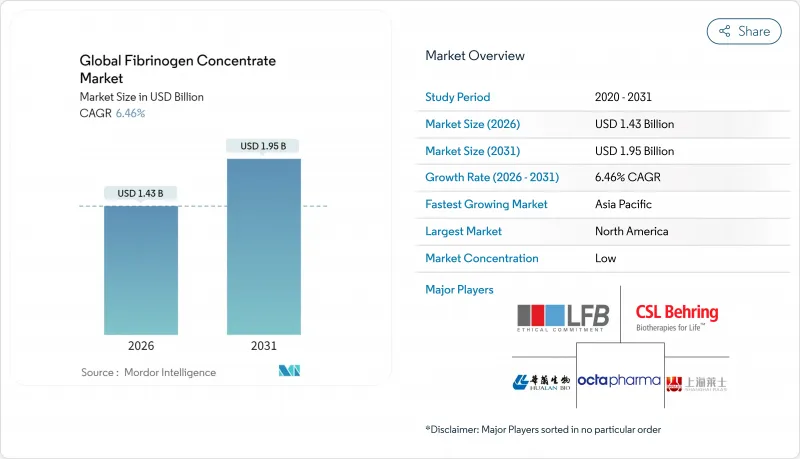
피브리노겐 농축물 시장은 2025년 13억 4,000만 달러에서 2026년에는 14억 3,000만 달러로 성장하고 2026년부터 2031년에 걸쳐 CAGR 6.46%로 성장을 지속하여 2031년까지 19억 5,000만 달러에 달할 것으로 예상됩니다.
확대의 배경은 피브리노겐 결핍증에 대한 인식 증가, 규제 당국의 승인 범위 확대, 재조합 기술의 급속한 진보입니다. 표준화된 용량으로 개입 시간을 단축하고 수혈 수요를 줄일 수 있기 때문에 병원 프로토콜은 동결침전제제에서 농축제제로의 전환이 진행되고 있습니다. 벤처 캐피탈의 유입은 혈장 공급의 한계를 극복하는 식물 유래 및 재조합 플랫폼을 뒷받침합니다. 반면 아시아태평양의 혈장 분획에 대한 투자는 수입 병목 현상을 해소하고 있습니다. 보존성이 있는 액체 제제는 초단위의 대응이 요구되고 냉장 설비가 한정되는 외상 치료나 군사 의료의 분야에서 기세를 늘리고 있습니다.
세계의 피브리노겐 농축물 시장의 동향 및 인사이트
선천성 및 후천성 출혈성 질환의 유병률 상승
진단 기술의 향상과 유전자 검사의 보급으로 선천성 저피브리노겐혈증의 신규 사례가 해마다 증가하고 있습니다. 한편 외상, 산부인과, 대규모 수술에서는 후천성 피브리노겐 결핍증이 빈발하고 만성 및 급성영역 모두에서 수요가 높아지고 있습니다. 중국의 가족에게서 발견된 신규 FGG 돌연변이는 유전자형-표현형 맵을 확충하고 스크리닝 지침의 업데이트를 촉진하고 있습니다. 영국 혈액학회는 현재 고위험 처치에서 피브리노겐 수치를 1.0g/L 이상으로 유지하는 것을 추천하며 의료기관에 명확한 치료 개시 기준을 제공합니다. 선진지역의 고령화와 신흥 시장에서의 도시형 외상 패턴이 결합되어 대응 가능한 증례군을 확대하고 있습니다. 인지도가 높아짐에 따라 전문 시설에서는 출혈 후유증 예방을 위한 예방적 사용이 증가하고 있어 예측 가능한 정기 수요를 창출하고 있습니다. 이러한 역학적 및 임상적 요인이 결합되어 장기적인 CAGR에 1.2%의 지속적인 상승 효과를 가져오고 있습니다.
외상 및 수술 영역에서 동결침전제제를 안전한 농축제제로 대체
임상 가이드라인에서는 주술기 출혈 시에 피브리노겐이 1.5g/L 미만인 경우 가장 우선적인 선택으로서 농축제제를 추천하는 경향이 강해지고 있습니다. 이는 동결혈장제제에 수반되는 효능의 변동이나 조제 지연을 해소하기 위해서입니다. 프랑스의 심장 흉부외과 센터에서는 피브리가를 사용했을 때 과다출혈 억제 성공률이 92.3%로 보고되어 기존의 동결혈장제품에 의존한 치료 결과를 상회했습니다. 전환을 실시한 병원에서는 수술실의 대기 시간 단축과 혈액제제 전체의 사용량 감소가 실현되고 있습니다. 이러한 운영상의 이점은 단가의 상승을 상쇄하고, 재무 부문이 보다 용이하게 약제 품목을 승인하는 도움이 됩니다. 응급 부문이나 외상 치료 부문에서 신속 혼합 투여 키트를 도입함에 따라, 북미와 유럽에서의 보급이 가속화되고, 이후 아시아태평양의 교육 병원으로 이행해 나갈 전망입니다.
치료비 상승과 불균일한 환급
고용량 투여의 필요성, 특수 콜드체인 물류, 기증자 혈장 조달 비용의 상승으로 인해 치료 에피소드 당 비용은 수천 달러에 달하는 경우가 많습니다. 미국 의료보험서비스센터(CMS)의 응고인자 공급료는 2023년 단위당 0.250달러로 상승하여 미국 병원 예산을 압박하고 있습니다. 신흥경제국의 공공보험기관의 대부분은 여전히 동결침전물의 환급에 한정하고 있기 때문에 임상의는 긴급 시에만 농축제제를 사용할 수 밖에 없습니다. 민간 보험 회사는 상당한 리베이트를 협상하고 중소 제조업체는 이를 흡수하기 위해 고전하고 있으며 이는 신규 진입 경쟁을 둔화시키고 있습니다. 비용 효과 모델은 수혈량 감소와 입원 기간 단축으로 인한 다운스트림 절약 효과에 대한 인식을 낮추며, 이는 약물 품목에 대한 도입을 늦추고 있습니다. 따라서, 세계 시장의 CAGR 예측은 1.4% 감소하였습니다.
부문 분석
2025년 시점에서 인간 혈장 유래 농축제제는 피브리노겐 농축물 시장에서 86.72%의 점유율을 차지하였습니다. 이는 기존 인프라가 공급망을 지배하기 때문입니다. 견고한 바이러스 불활성화 과정과 수십년에 걸친 시판 후 데이터가 임상의의 신뢰를 뒷받침하고 있습니다. 반면 재조합 및 합성 아날로그 제제는 7.14%의 연평균 복합 성장률(CAGR)로 계속 성장하고 있습니다. 이들은 세포가 불필요한 생물반응기와 플랜트 플랫폼을 활용하여 기증자 부족 현상을 해결하고 있습니다. Asahi Kasei Corporation 등의 기업은 차세대 바이러스 필터를 이용하여 안전성 향상을 도모해, 혁신이 초래하는 위험의 저감과 공정 시간의 단축을 실현하고 있습니다. 벤처 자본에 의한 신규 참가 기업은 로봇 수술에 대응한 상온 보존 가능한 겔을 개발하여 임상 응용 범위를 확대하고 있습니다.
혈액학 클리닉에서는 제품의 대체 가능성이 조달을 촉진하기 때문에 혈장 유래 물질에 대한 수요가 지속됩니다. 그러나 많은 외상 치료 부문에서는 대량 동결건조 바이알과 소규모 로트 재조합 키트를 병용하는 이중 조달을 계획하고 있으며, 이는 고위험 심장 및 산부인과 사례에 대응하기 때문입니다. 분획업체와 바이오테크 신흥기업과의 전략적 제휴는 기술이전을 가속화하고 확립된 공급망과 신규 발현 시스템을 융합시키고 있습니다. 공급의 안정성과 병원체 안전성이 주요 구매 기준이 되는 가운데, 구매자는 플랫폼의 다양화로 예산을 확대하고 예측 기간 동안 공급자 점유율의 추가 세분화가 진행될 전망입니다.
2025년 피브리노겐 농축물 시장 규모의 46.03%는 선천성 결핍증이 차지했습니다. 이는 유전성 사례가 평생에 걸친 치료를 필요로 하고, 집중 관리형 의료 네트워크가 수요 예측을 단순화하기 때문입니다. 유전성 환자들은 침습적 치료 시 예방적 수액을 투여받기 때문에 예측 가능한 분기별 수요가 고정화됩니다. 그러나 피브리노겐 농축물 시장에서 가장 빠른 판매 증가가 예상되는 것은 외상 및 수술 출혈 영역이며 이 영역은 CAGR 7.52%로 확대 중입니다. 대량 환자 대응 계획을 통해 병원에서 신속 혼합 바이알의 비축이 추진되어 긴급 시 사용이 증가하고 있습니다.
산부인과 출혈 가이드라인에서는 분만 후 프로토콜에 농축제제가 추가됨으로써 아시아태평양의 산부인과 병동에서 사용 용도가 더욱 다양화되고 있습니다. 뇌신경외과 의사는 기존의 응고인자가 혈액-뇌 장벽을 효과적으로 통과할 수 없는 두개내 출혈의 안정화를 향해 미량 투여 스프레이의 연구를 진행하고 있습니다. 수술용 로봇의 보급에 따라 카메라 시야 차단을 최소화하기 위해서는 신속한 겔화 작용을 가진 정밀한 지혈제가 필수적입니다. 이러한 만성 질환과 긴급 질환 적응증의 조합은 치료의 계절 변동에 대한 수익 기반을 안정화시키고 있습니다.
지역별 분석
북미는 2025년 41.78%의 점유율로 수익을 견인하였습니다. 성숙한 외상 네트워크, 넓은 보험 적용 범위, 신속한 FDA 승인으로 인한 병원에서의 도입 촉진이 성장 배경입니다. 캐나다의 외상등록제도에서는 대량 수혈 프로토콜에서의 피브리노겐 수치 검사가 의무화되어 있어 수요를 더욱 확고히 하고 있습니다. 군수계약은 상온 보존 가능한 키트가 원정 의료 전략에 적합하기 때문에 고수익 공급량을 창출하고 있습니다. 유럽은 유럽 의약품청(EMA)과 각국 가이드라인이 주술기 출혈에 대한 '농축제제 우선' 추천 지침으로 일치하는 가운데, 일관적인 성장을 계속하고 있습니다. 독일과 스페인은 현지 분획 처리가 공급 안정성을 확보하고 있습니다.
아시아태평양은 8.96%의 연평균 복합 성장률(CAGR)로 성장의 견인역이 될 전망입니다. 중국은 수술 능력을 확대하고 재조합 기술을 통한 혁신을 추구하고 있으며 이는 혈장 수입 비용의 일부를 대체할 수 있습니다. 인도에서는 교통사고로 인한 부상자가 급증하고 있어 지방 도시의 외상센터에서도 농축제제의 비축이 진행되고 있습니다. 일본과 한국은 고령화와 건강보험제도에 따라 1인당 사용량이 높은 수준을 유지하고 있습니다. 호주에서는 가공방법의 전환에 의해 심장외과 및 산부인과 병동에서의 농축제제 사용이 증가하고 있습니다.
남미에서는 브라질이 지역성 혈우병 치료 거점에 대한 투자를 진행함으로써 꾸준한 성장이 나타나고 있습니다. 중동 및 아프리카에서는 도입 초기 단계에 있으며, 환급 제도의 미정비가 장벽이 되는 한편, 걸프 해안 국가에서의 민간 병원에 대한 투자가 시장을 뒷받침하고 있습니다. 신흥국에서는 현지 분획 프로젝트가 진행 중이며, 리드 타임과 관세 절약을 목표로, 장기적인 가격 경쟁력의 향상을 도모하고 있습니다. 이러한 지역적 동향이 결합되어 세계 수익 기반이 다양해지고 공급업체는 단일 시장 정책 변동의 영향에서 벗어나게 됩니다.
기타 혜택
- 시장 예측(ME) 엑셀 시트
- 3개월 애널리스트 서포트
자주 묻는 질문
목차
제1장 서론
- 조사 전제조건 및 시장 정의
- 조사 범위
제2장 조사 방법
제3장 주요 요약
제4장 시장 상황
- 시장 개요
- 촉진요인
- 선천성 및 후천성 출혈성 질환의 유병률 상승
- 외상 및 수술 영역에서의 안전성이 높은 농축제제가 동결침전제제를 대체
- 보다 광범위한 규제 승인 및 지침 권장
- 신흥 시장에서의 혈장 분획 처리 능력 확대
- 재조합 및 식물 유래 피브리노겐의 혁신 기술로 벤처 캐피탈 자금 유치
- 보존 안정성이 있는 지혈제에 대한 군사 및 항공우주 분야 수요 증가
- 억제요인
- 치료비의 증가와 환급제도의 불균일성
- 혈전성 이벤트의 안전성 우려에 의한 추가 감시의 필요성
- 취약한 혈장 공급 물류체제와 수출 규제
- 합성 피브린 실란트 및 모방품에 의한 경쟁상의 위협
- 가치 및 공급망 분석
- 규제 상황
- 기술 전망
- Porter's Five Forces
- 신규 참가업체의 위협
- 공급자의 협상력
- 구매자의 협상력
- 대체품의 위협
- 경쟁 기업 간 경쟁 관계
제5장 시장 규모 및 성장 예측
- 유래별
- 인간 혈장 유래 농축제제
- 재조합 및 합성 아날로그
- 용도별
- 선천성 피브리노겐 결핍증
- 외상 및 수술에 따른 출혈
- 산부인과 및 부인과 출혈
- 기타(두개내, 심장 등)
- 최종 사용자별
- 병원
- 전문 클리닉 및 혈우병 센터
- 군사 및 응급 의료 서비스
- 형태별
- 동결건조 분말 바이알
- 즉용형 액체 제제
- 지역별
- 북미
- 미국
- 캐나다
- 멕시코
- 유럽
- 독일
- 영국
- 프랑스
- 이탈리아
- 스페인
- 기타 유럽
- 아시아태평양
- 중국
- 인도
- 일본
- 한국
- 호주
- 기타 아시아태평양
- 남미
- 브라질
- 아르헨티나
- 기타 남미
- 중동 및 아프리카
- GCC
- 남아프리카
- 기타 중동 및 아프리카
- 북미
제6장 경쟁 구도
- 시장 집중도
- 시장 점유율 분석
- 기업 프로파일
- CSL Behring
- Octapharma AG
- Grifols SA
- Kedrion SpA
- Biotest AG
- Shanghai RAAS Blood Products Co. Ltd.
- Jiangxi Boya Biological Technology Co. Ltd.
- Hualan Biological Engineering Co. Ltd.
- GC Pharma(Green Cross Corp.)
- Bharat Serums & Vaccines Ltd.
- LFB SA
- Sanquin Plasma Products BV
- Bio Products Laboratory Ltd.(BPL)
- China National Pharmaceutical Group(Sinopharm)
- ADMA Biologics Inc.
- Intas Pharmaceuticals Ltd.
제7장 시장 기회 및 미래 전망
CSM 26.01.21The fibrinogen concentrate market is expected to grow from USD 1.34 billion in 2025 to USD 1.43 billion in 2026 and is forecast to reach USD 1.95 billion by 2031 at 6.46% CAGR over 2026-2031.
Growing recognition of fibrinogen deficiency, wider regulatory approvals, and rapid progress in recombinant technology underpin this expansion. Hospital protocols increasingly replace cryoprecipitate with concentrates because standardized dosing shortens intervention times and lowers transfusion needs. Venture capital inflows support plant-based and recombinant platforms that overcome plasma supply limits, while investments in plasma fractionation across Asia-Pacific remove import bottlenecks. Shelf-stable liquid formats gain momentum in trauma and military care where seconds matter and refrigeration is scarce.
Global Fibrinogen Concentrate Market Trends and Insights
Rising Prevalence of Congenital & Acquired Bleeding Disorders
Improved diagnostics and wider genetic testing uncover more cases of congenital hypofibrinogenemia each year, while trauma, obstetrics, and major surgeries frequently trigger acquired fibrinogen depletion, elevating demand in both chronic and acute settings. A novel FGG mutation confirmed in Chinese families broadens the genotype-phenotype map and sparks updated screening guidelines. The British Society for Haematology now recommends maintaining fibrinogen above 1.0 g/L for high-risk procedures, giving hospitals a clear therapeutic trigger. Aging populations in developed regions and urban injury patterns in emerging markets together widen the addressable case mix. As awareness climbs, specialist centers report rising prophylactic use to prevent bleeding sequelae, creating predictable recurring volumes. Collectively, these epidemiologic and clinical forces add a sustained 1.2% lift to the long-range CAGR.
Substitution of Cryoprecipitate with Safer Concentrates in Trauma & Surgery
Clinical guidelines increasingly cite concentrates as the first choice when fibrinogen falls below 1.5 g/L during perioperative hemorrhage because they eliminate variable potency and preparation delays that accompany cryoprecipitate. Cardiothoracic centers in France reported 92.3% success in curbing major bleeding with Fibryga, surpassing historical outcomes tied to frozen plasma products. Hospitals that convert realize shorter operating room hold times and lower overall blood product usage. These operational gains offset higher unit prices, helping finance teams approve formularies more readily. Because emergency departments and trauma units embrace rapid-mix dosing kits, adoption accelerates across North America and Europe before migrating to Asia-Pacific teaching hospitals.
High Therapy Cost & Uneven Reimbursement
Episode costs often run into thousands of dollars because of high dose requirements, specialized cold-chain logistics, and donor plasma sourcing premiums. CMS furnishing fees for clotting factors rose to USD 0.250 per unit in 2023, squeezing U.S. hospital budgets. Many public payers in emerging economies still limit reimbursement to cryoprecipitate, forcing clinicians to reserve concentrates only for dire emergencies. Private insurers negotiate steep rebates that smaller manufacturers struggle to absorb, dampening competitive entry. Cost-effectiveness models undercount downstream savings from reduced transfusions and shorter stays, which slows formulary inclusion. The net result shaves 1.4% off the global CAGR forecast.
Other drivers and restraints analyzed in the detailed report include:
- Broader Regulatory Approvals and Guideline Endorsements
- Expanded Plasma-Fractionation Capacity in Emerging Markets
- Thrombotic-Event Safety Concerns Prompting Extra Surveillance
For complete list of drivers and restraints, kindly check the Table Of Contents.
Segment Analysis
Human plasma-derived concentrates controlled 86.72% of fibrinogen concentrate market share in 2025 as legacy infrastructure dominates supply chains. Robust viral inactivation processes and decades of post-marketing data sustain clinician confidence. However, recombinant and synthetic analogues advance at 7.14% CAGR, leveraging cell-free bioreactors and plant platforms that sidestep donor limitations. Firms such as Asahi Kasei augment safety with next-gen viral filters that reduce breakthrough risk and cut process time. Venture-backed entrants design shelf-stable gels compatible with robotic surgery, widening clinical utility.
Demand for plasma-derived material will persist in hematology clinics where product interchangeability eases procurement. Yet many trauma units plan dual sourcing, pairing bulk lyophilized vials with small batch recombinant kits for high-risk cardiac and obstetric cases. Strategic alliances between fractionators and biotech startups accelerate technology transfer, blending established supply chains with novel expression systems. As supply security and pathogen safety remain top purchase criteria, buyers allocate larger budgets to platform diversity, further fragmenting supplier shares over the forecast window.
Congenital deficiency retained 46.03% share of fibrinogen concentrate market size in 2025 because hereditary cases require lifelong therapy and centralized care networks simplify forecasting. These patients receive prophylactic infusions during invasive procedures, locking in predictable quarterly demand. The fibrinogen concentrate market, however, gains its fastest incremental sales from trauma and surgical bleeding, which is climbing at a 7.52% CAGR. Mass casualty planning pushes hospitals to stock rapid-mix vials, elevating emergency usage.
Obstetric hemorrhage guidelines now include concentrates in postpartum protocols, further diversifying usage in maternity units across Asia-Pacific. Neurosurgeons explore micro-dosed sprays to stabilize intracranial bleeds where traditional clotting factors cannot cross the blood-brain barrier effectively. As surgical robotics proliferate, precise hemostatic agents with quick gelation become integral to minimizing camera-vision obscuration. This blend of chronic and emergent indications cushions revenue streams against procedural seasonality.
The Fibrinogen Concentrate Market Report is Segmented by Source (Human Plasma-Derived Concentrates, Recombinant/Synthetic Analogues), Application (Congenital Fibrinogen Deficiency, Trauma & Surgery-Related Hemorrhage, and More), End User (Hospitals, and More), Form (Lyophilized Powder Vials, and More), and Geography (North America, Europe, and More). The Market Forecasts are Provided in Terms of Value (USD).
Geography Analysis
North America led revenue with 41.78% share in 2025 supported by mature trauma networks, ample insurance coverage, and swift FDA clearances that speed hospital adoption. Canada's trauma registry mandates fibrinogen level checks in massive transfusion protocols, further cementing demand. Military contracts add high-margin volumes because shelf-stable kits align with expeditionary medicine strategies. Europe follows with disciplined growth as EMA and national guidelines converge on concentrate-first recommendations for perioperative bleeding, while local fractionation in Germany and Spain ensures supply stability.
Asia-Pacific is the growth engine at 8.96% CAGR. China expands surgical capacity and pursues recombinant innovations, potentially displacing part of its plasma import bill. India's rapid rise in road traffic injuries prompts trauma centers to stock concentrates even in tier-two cities. Japan and South Korea maintain high per-capita usage thanks to aging demographics and universal coverage. Australia's processing transition bolsters concentrate uptake in cardiac and obstetric wards.
South America shows steady acceleration as Brazil invests in regional hemophilia hubs. Middle East and Africa record early-stage adoption, hampered by reimbursement gaps but buoyed by private hospital investment in Gulf states. Emerging local fractionation projects aim to cut lead times and duties, improving affordability over the long term. Collectively, these regional patterns diversify the global revenue base and insulate suppliers against single-market policy swings.
List of Companies Covered in this Report:
- CSL Behring
- Octapharma
- Grifols
- Kedrion Biopharma
- Biotest
- Shanghai RAAS Blood Products Co. Ltd.
- Jiangxi Boya Biological Technology Co. Ltd.
- Hualan Biological Engineering Co. Ltd.
- GC Pharma (Green Cross Corp.)
- Bharat Serums & Vaccines Ltd.
- LFB S.A.
- Sanquin Plasma Products B.V.
- Bio Products Laboratory Ltd. (BPL)
- China National Pharmaceutical Group (Sinopharm)
- ADMA Biologics
- Intas Pharmaceutical
Additional Benefits:
- The market estimate (ME) sheet in Excel format
- 3 months of analyst support
TABLE OF CONTENTS
1 Introduction
- 1.1 Study Assumptions & Market Definition
- 1.2 Scope of the Study
2 Research Methodology
3 Executive Summary
4 Market Landscape
- 4.1 Market Overview
- 4.2 Market Drivers
- 4.2.1 Rising prevalence of congenital & acquired bleeding disorders
- 4.2.2 Substitution of cryoprecipitate with safer concentrates in trauma & surgery
- 4.2.3 Broader regulatory approvals and guideline endorsements
- 4.2.4 Expanded plasma-fractionation capacity in emerging markets
- 4.2.5 Recombinant & plant-based fibrinogen innovations attracting VC funding
- 4.2.6 Growth in military & aerospace demand for shelf-stable haemostatics
- 4.3 Market Restraints
- 4.3.1 High therapy cost & uneven reimbursement
- 4.3.2 Thrombotic-event safety concerns prompting extra surveillance
- 4.3.3 Fragile plasma-supply logistics and export restrictions
- 4.3.4 Competitive threat from synthetic fibrin sealants & mimetics
- 4.4 Value / Supply-Chain Analysis
- 4.5 Regulatory Landscape
- 4.6 Technological Outlook
- 4.7 Porter's Five Forces
- 4.7.1 Threat of New Entrants
- 4.7.2 Bargaining Power of Suppliers
- 4.7.3 Bargaining Power of Buyers
- 4.7.4 Threat of Substitutes
- 4.7.5 Competitive Rivalry
5 Market Size & Growth Forecasts (Value, USD)
- 5.1 By Source
- 5.1.1 Human Plasma-derived Concentrates
- 5.1.2 Recombinant / Synthetic Analogues
- 5.2 By Application
- 5.2.1 Congenital Fibrinogen Deficiency
- 5.2.2 Trauma & Surgery-Related Hemorrhage
- 5.2.3 Obstetric & Gynecological Bleeding
- 5.2.4 Others (Intracranial, Cardiac etc.)
- 5.3 By End User
- 5.3.1 Hospitals
- 5.3.2 Specialty Clinics & Hemophilia Centers
- 5.3.3 Military & Emergency Medical Services
- 5.4 By Form
- 5.4.1 Lyophilized Powder Vials
- 5.4.2 Ready-to-use Liquid Formulations
- 5.5 By Geography
- 5.5.1 North America
- 5.5.1.1 United States
- 5.5.1.2 Canada
- 5.5.1.3 Mexico
- 5.5.2 Europe
- 5.5.2.1 Germany
- 5.5.2.2 United Kingdom
- 5.5.2.3 France
- 5.5.2.4 Italy
- 5.5.2.5 Spain
- 5.5.2.6 Rest of Europe
- 5.5.3 Asia-Pacific
- 5.5.3.1 China
- 5.5.3.2 India
- 5.5.3.3 Japan
- 5.5.3.4 South Korea
- 5.5.3.5 Australia
- 5.5.3.6 Rest of Asia-Pacific
- 5.5.4 South America
- 5.5.4.1 Brazil
- 5.5.4.2 Argentina
- 5.5.4.3 Rest of South America
- 5.5.5 Middle East and Africa
- 5.5.5.1 GCC
- 5.5.5.2 South Africa
- 5.5.5.3 Rest of Middle East and Africa
- 5.5.1 North America
6 Competitive Landscape
- 6.1 Market Concentration
- 6.2 Market Share Analysis
- 6.3 Company Profiles (includes Global level Overview, Market level overview, Core Segments, Financials as available, Strategic Information, Market Rank/Share for key companies, Products & Services, and Recent Developments)
- 6.3.1 CSL Behring
- 6.3.2 Octapharma AG
- 6.3.3 Grifols S.A.
- 6.3.4 Kedrion S.p.A.
- 6.3.5 Biotest AG
- 6.3.6 Shanghai RAAS Blood Products Co. Ltd.
- 6.3.7 Jiangxi Boya Biological Technology Co. Ltd.
- 6.3.8 Hualan Biological Engineering Co. Ltd.
- 6.3.9 GC Pharma (Green Cross Corp.)
- 6.3.10 Bharat Serums & Vaccines Ltd.
- 6.3.11 LFB S.A.
- 6.3.12 Sanquin Plasma Products B.V.
- 6.3.13 Bio Products Laboratory Ltd. (BPL)
- 6.3.14 China National Pharmaceutical Group (Sinopharm)
- 6.3.15 ADMA Biologics Inc.
- 6.3.16 Intas Pharmaceuticals Ltd.
7 Market Opportunities & Future Outlook
- 7.1 White-space & Unmet-need Assessment