

|
시장보고서
상품코드
1906160
중동 및 아프리카의 풍력발전 시장 : 점유율 분석, 업계 동향 및 통계, 성장 예측(2026-2031년)Middle-East And Africa Wind Power - Market Share Analysis, Industry Trends & Statistics, Growth Forecasts (2026 - 2031) |
||||||
 Mordor Intelligence
중동 및 아프리카의 풍력발전 시장은 2025년 12.10기가와트에서 2026년에는 14.07기가와트로 성장하고 2026년에서 2031년에 걸쳐 CAGR 16.25%로 성장을 지속하여 2031년까지 29.87기가와트에 달할 것으로 예측되고 있습니다.
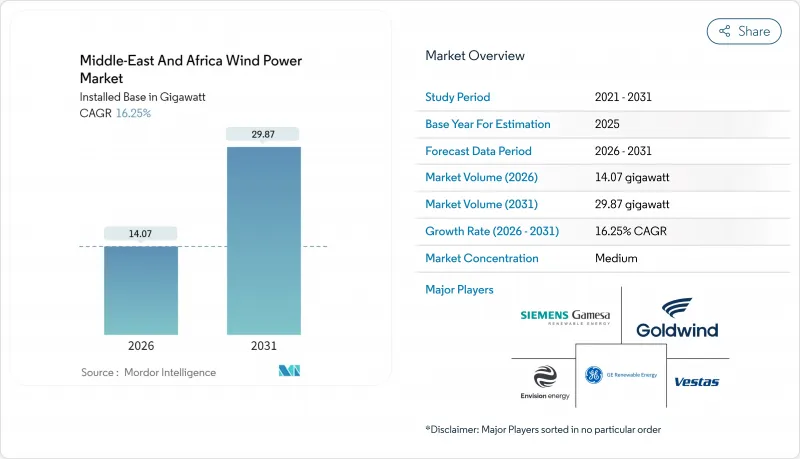
견조한 정부 펀드 투자와 특히 사우디아라비아의 공공 투자 기금으로 인한 500억 달러 규모의 신재생 에너지 투자가 이러한 성장의 기반을 뒷받침하고 있습니다. 정책 목표 강화, 육상 풍력발전의 발전균등화비용(LCOE) 하락, 기업 간 전력구매계약(PPA) 확대가 성장의 핵심을 구성하고 있습니다. 세계의 터빈 제조업체는 현지 사업 기반을 강화하는 한편, 중국의 신규 참가 기업은 비용을 중시하는 입찰로 우위에 서 있습니다. 개발 사업자는 출력 변동을 평준화하는 축전 시스템의 시험 도입과 하이브리드 설계에 의해 계통 리스크를 헤지하고 있습니다. 지역 항만에서의 공급망 혼잡과 해상 풍력발전의 초기 단계에서의 허가 취득은 여전히 운영 상의 마찰점이지만, 명확한 국가 목표에 의해 수년에 걸친 프로젝트의 전망이 확보되고 있습니다.
중동 및 아프리카의 풍력발전 시장의 동향과 분석
정부의 신재생에너지 목표와 입찰제도
국가 입찰 프로그램이 프로젝트 파이프라인을 지원합니다. 사우디아라비아는 2030년까지 풍력발전용량 16GW로 청정전력 50% 달성을 목표로 하고 있으며, 2024년에는 두마툴잔달에서 kWh당 0.0199달러라는 역대 최저 단가를 실현했습니다. 이집트는 2035년까지 7.2GW의 풍력발전 달성을 목표로 32억 달러의 다자간 대출로 지원하고 있습니다. 모로코는 2030년까지 10GW의 목표를 내걸고 대서양 연안의 자원을 활용하며 UAE는 2050년 발전 구성의 12%를 풍력에 할당하고 있습니다. 이러한 조화 정책은 수요 위험을 줄이고 일류 금융기관의 유치와 공급망의 현지화를 촉진합니다.
지역 화석연료 기준에 미달하는 육상 풍력발전의 LCOE
모로코, 이집트, 사우디아라비아에서는 풍력발전 비용이 kWh당 0.03 USD를 밑돌고 천연가스 요금(kWh 당 0.035 - 0.045 USD)을 능가합니다. 두마툴잔달 발전소의 2024년 요금은 화석연료 대체안보다 40% 저렴했습니다. 모로코의 타르파야 복합시설에서는 0.025달러/kWh에 판매하고 있으며, 국경을 넘은 수출이 상업적으로 실현 가능해지고 있습니다. 수에즈만 프로젝트는 40% 이상의 가동률로 운영되고 있으며, 풍력투자의 경제적 합리성을 더욱 견고하게 하고 있습니다.
사하라 지역의 여러 시장에서 불확실한 정책
나이지리아에서는 변동하는 고정 가격 임베디드 제도와 다층적인 허가 프로세스에 의해 자금 조달 비용이 150-200 베이시스 포인트 상승하고 있습니다. 케냐의 새로운 송전망 규정은 전환 지연을 일으키고, 가나는 통화 변동으로 인한 용량 지불 팽창에 직면하고 있으며, 에티오피아에서는 지역 분쟁이 풍력 회랑 개발을 방해하고 있습니다. 이러한 과제에 의해 개발 스케줄은 최대 18개월 지연되고, 안정적인 입찰 제도가 확립되어 있지 않은 지역에서는 단기적인 용량 증가가 억제되고 있습니다.
부문 분석
육상 프로젝트는 성숙한 공급망과 낮은 자본 비용을 배경으로 2025년에는 중동 및 아프리카의 풍력발전 시장 전체를 견인했고 2031년까지 연평균 복합 성장률(CAGR) 16.25%를 유지할 것으로 예측됩니다. 남아프리카 동부 케이프의 풍력발전소와 사우디아라비아의 두마툴잔달 발전소는 약 40%의 시설 이용률을 달성했습니다. 모로코의 대서양 연안 지역에서는 안정적인 무역풍으로 45% 이상의 이용률을 실현하고 있습니다.
해상 풍력발전의 잠재능력도 매우 높은 상황입니다. 홍해 연안은 수심 20-50m, 풍속 9m/s의 조건을 갖추고 있습니다. NEOM의 4GW 계획은 2028년까지 초기 프로젝트 착공을 목표로 하고 있습니다. 이집트는 10GW의 해상 풍력발전 개발 프로젝트를 준비 중이며 유럽에서 우대 대출 협상을 진행하고 있습니다. 파일럿 프로젝트의 채산성이 입증되면 중동 및 아프리카의 풍력발전 시장은 2027년 이후 해상 발전 용량으로 급속히 다양화할 가능성이 있습니다.
중동 및 아프리카의 풍력발전 시장의 보고서는 위치(육상 및 해상), 터빈 용량(3MW 이하, 3-6MW, 6MW 초과), 용도(유틸리티, 상업 및 산업용, 지역 프로젝트), 지역(사우디아라비아, UAE, 요르단, 이란, 남아프리카, 이집트, 모로코, 기타 중동)별로 구분되며, 시장 규모 및 예측은 설치 용량(GW) 단위로 제공됩니다.
기타 혜택
- 시장 예측(ME) 엑셀 시트
- 3개월 애널리스트 서포트
자주 묻는 질문
목차
제1장 서론
- 조사 전제조건 및 시장 정의
- 조사 범위
제2장 조사 방법
제3장 주요 요약
제4장 시장 상황
- 시장 개요
- 촉진요인
- 정부의 재생에너지 목표와 입찰
- 육상 풍력발전의 LCOE가 지역 화석연료 기준가격을 밑도는 상황
- 데이터센터 및 광업 부문에서 기업 간 전력 구매 계약(PPA) 확대
- GCC 국가 및 동아프리카 전역에서의 송전망 확장 투자
- 홍해 연안의 해상 풍력발전으로부터 수소를 제조하는 파일럿 사업
- 사우디아라비아에서의 터빈 제조 현지화 인센티브
- 억제요인
- 사하라 이남 지역의 여러 시장에서 불확실한 정책
- 송전망의 안정성과 출력 억제 위험
- 해상 프로젝트에서 높은 초기 설비 투자 비용
- 중동 및 아프리카의 항만에서의 공급망 혼잡
- 공급망 분석
- 규제 상황
- 기술 전망
- Porter's Five Forces
- 공급자의 협상력
- 구매자의 협상력
- 신규 참가업체의 위협
- 대체품의 위협
- 경쟁 기업 간 경쟁 관계
제5장 시장 규모 및 성장 예측
- 위치별
- 육상
- 해상
- 터빈 용량별
- 3MW 이하
- 3-6MW
- 6MW 초과
- 용도별
- 유틸리티
- 상업 및 산업용
- 지역 프로젝트
- 컴포넌트별(정성적 분석)
- 나셀 및 터빈
- 블레이드
- 타워
- 발전기 및 감속기
- 시스템 주변기기
- 지역별
- 사우디아라비아
- 아랍에미리트(UAE)
- 요르단
- 이란
- 남아프리카
- 이집트
- 모로코
- 기타 중동 및 아프리카
제6장 경쟁 구도
- 시장 집중도
- 전략적 움직임(M&A, 파트너십, 전력 구매 계약)
- 시장 점유율 분석(주요 기업의 시장 순위 및 점유율)
- 기업 프로파일
- Siemens Gamesa Renewable Energy
- Vestas Wind Systems A/S
- GE Renewable Energy
- Xinjiang Goldwind Science & Technology
- Envision Energy
- Acciona Energia
- Mainstream Renewable Power
- EDF Renouvelables
- Enel Green Power
- ENGIE
- ACWA Power
- Masdar Clean Energy
- Lekela Power
- Orascom Construction
- Nordex SE
- Enercon GmbH
- Ming Yang Smart Energy
- Siemens Energy
- Doosan Enerbility
- Suzlon Energy Ltd.
제7장 시장 기회 및 미래 전망
CSM 26.01.28The Middle-East And Africa Wind Power Market is expected to grow from 12.10 gigawatt in 2025 to 14.07 gigawatt in 2026 and is forecast to reach 29.87 gigawatt by 2031 at 16.25% CAGR over 2026-2031.
Robust sovereign wealth-fund investments, especially the Saudi Public Investment Fund's USD 50 billion renewable allocation, anchor this momentum. Intensifying policy targets, declining onshore levelized costs, and expanding corporate power purchase agreements (PPAs) form the core growth architecture. International turbine makers strengthen local footprints while Chinese entrants win cost-sensitive bids. Developers hedge grid risks through storage pilots and hybrid designs that smooth output variability. Supply-chain congestion at regional ports and early-stage offshore permitting remain operational friction points, yet the depth of national targets secures multi-year project visibility.
Middle-East And Africa Wind Power Market Trends and Insights
Government Renewable-Energy Targets & Auctions
National auction programs underpin project pipelines. Saudi Arabia targets 50% clean electricity by 2030 with 16 GW of wind capacity, achieving a record USD 0.0199 per kWh tariff at Dumat Al Jandal in 2024. Egypt aims to achieve 7.2 GW of wind energy by 2035, backed by USD 3.2 billion in multilateral financing. Morocco's 10 GW target for 2030 exploits Atlantic resources, while the UAE channels 12% of its 2050 generation mix toward wind. These synchronized mandates reduce demand risk, attract tier-one financiers, and encourage supply-chain localization.
Falling On-Shore LCOE Below Regional Fossil Benchmarks
Wind costs have dropped below USD 0.03 per kWh in Morocco, Egypt, and Saudi Arabia, which is lower than natural-gas tariffs of USD 0.035-0.045 per kWh. Dumat Al Jandal's 2024 tariff came in 40% under fossil alternatives. Morocco's Tarfaya complex sells at USD 0.025 per kWh, making cross-border exports commercially viable. Gulf of Suez projects operate at capacity factors above 40%, reinforcing the economic argument for wind investment.
Policy Uncertainty in Several Sub-Saharan Markets
Nigeria's shifting feed-in tariffs and multi-layer permitting elevate financing spreads by 150-200 basis points. Kenya's new grid codes create transition delays, Ghana faces currency fluctuations that inflate capacity payments, and Ethiopia's regional conflicts hinder wind corridor development. These issues stretch development timelines by up to 18 months and temper near-term capacity additions outside stable auction jurisdictions.
Other drivers and restraints analyzed in the detailed report include:
- Expansion of Corporate PPAs from Data-Center & Mining Sectors
- Grid-Expansion Investments Across GCC & East Africa
- Grid Stability & Curtailment Risk
For complete list of drivers and restraints, kindly check the Table Of Contents.
Segment Analysis
Onshore projects are expected to control the entire Middle East and Africa wind power market in 2025 and sustain a 16.25% CAGR to 2031, driven by mature supply chains and low capital costs. South Africa's Eastern Cape farms and Saudi Arabia's Dumat Al Jandal demonstrate performance with capacity factors of nearly 40%. Morocco's Atlantic villas exceed 45% factors thanks to consistent trade winds.
Offshore potential is substantial. The Red Sea coasts offer water depths of 20-50 m with wind speeds of 9 m/s. NEOM's 4 GW plan aims to anchor the first projects by 2028. Egypt is lining up 10 GW of offshore prospects and is negotiating concessional European financing. As pilot arrays prove bankable, the Middle East and Africa wind power market may diversify rapidly toward offshore capacity after 2027.
The Middle East and Africa Wind Power Market Report is Segmented by Location (Onshore and Offshore), Turbine Capacity (Up To 3 MW, 3 To 6 MW, and Above 6 MW), Application (Utility-Scale, Commercial and Industrial, and Community Projects), and Geography (Saudi Arabia, UAE, Jordan, Iran, South Africa, Egypt, Morocco, and Rest of Middle East and Africa). The Market Sizes and Forecasts are Provided in Terms of Installed Capacity (GW).
List of Companies Covered in this Report:
- Siemens Gamesa Renewable Energy
- Vestas Wind Systems A/S
- GE Renewable Energy
- Xinjiang Goldwind Science & Technology
- Envision Energy
- Acciona Energia
- Mainstream Renewable Power
- EDF Renouvelables
- Enel Green Power
- ENGIE
- ACWA Power
- Masdar Clean Energy
- Lekela Power
- Orascom Construction
- Nordex SE
- Enercon GmbH
- Ming Yang Smart Energy
- Siemens Energy
- Doosan Enerbility
- Suzlon Energy Ltd.
Additional Benefits:
- The market estimate (ME) sheet in Excel format
- 3 months of analyst support
TABLE OF CONTENTS
1 Introduction
- 1.1 Study Assumptions & Market Definition
- 1.2 Scope of the Study
2 Research Methodology
3 Executive Summary
4 Market Landscape
- 4.1 Market Overview
- 4.2 Market Drivers
- 4.2.1 Government renewable-energy targets & auctions
- 4.2.2 Falling on-shore LCOE below regional fossil benchmarks
- 4.2.3 Expansion of corporate PPAs from data-centre & mining sectors
- 4.2.4 Grid-expansion investments across GCC & East Africa
- 4.2.5 Offshore wind-to-hydrogen pilots along the Red Sea
- 4.2.6 Saudi localisation incentives for turbine manufacturing
- 4.3 Market Restraints
- 4.3.1 Policy uncertainty in several Sub-Saharan markets
- 4.3.2 Grid stability & curtailment risk
- 4.3.3 High upfront CAPEX for offshore projects
- 4.3.4 Supply-chain congestion at MEA ports
- 4.4 Supply-Chain Analysis
- 4.5 Regulatory Landscape
- 4.6 Technological Outlook
- 4.7 Porter's Five Forces
- 4.7.1 Bargaining Power of Suppliers
- 4.7.2 Bargaining Power of Buyers
- 4.7.3 Threat of New Entrants
- 4.7.4 Threat of Substitutes
- 4.7.5 Competitive Rivalry
5 Market Size & Growth Forecasts
- 5.1 By Location
- 5.1.1 Onshore
- 5.1.2 Offshore
- 5.2 By Turbine Capacity
- 5.2.1 Up to 3 MW
- 5.2.2 3 to 6 MW
- 5.2.3 Above 6 MW
- 5.3 By Application
- 5.3.1 Utility-scale
- 5.3.2 Commercial and Industrial
- 5.3.3 Community Projects
- 5.4 By Component (Qualitative Analysis)
- 5.4.1 Nacelle/Turbine
- 5.4.2 Blade
- 5.4.3 Tower
- 5.4.4 Generator and Gearbox
- 5.4.5 Balance-of-System
- 5.5 By Geography
- 5.5.1 Saudi Arabia
- 5.5.2 United Arab Emirates
- 5.5.3 Jordan
- 5.5.4 Iran
- 5.5.5 South Africa
- 5.5.6 Egypt
- 5.5.7 Morocco
- 5.5.8 Rest of Middle East & Africa
6 Competitive Landscape
- 6.1 Market Concentration
- 6.2 Strategic Moves (M&A, Partnerships, PPAs)
- 6.3 Market Share Analysis (Market Rank/Share for key companies)
- 6.4 Company Profiles (includes Global level Overview, Market level overview, Core Segments, Financials as available, Strategic Information, Products & Services, and Recent Developments)
- 6.4.1 Siemens Gamesa Renewable Energy
- 6.4.2 Vestas Wind Systems A/S
- 6.4.3 GE Renewable Energy
- 6.4.4 Xinjiang Goldwind Science & Technology
- 6.4.5 Envision Energy
- 6.4.6 Acciona Energia
- 6.4.7 Mainstream Renewable Power
- 6.4.8 EDF Renouvelables
- 6.4.9 Enel Green Power
- 6.4.10 ENGIE
- 6.4.11 ACWA Power
- 6.4.12 Masdar Clean Energy
- 6.4.13 Lekela Power
- 6.4.14 Orascom Construction
- 6.4.15 Nordex SE
- 6.4.16 Enercon GmbH
- 6.4.17 Ming Yang Smart Energy
- 6.4.18 Siemens Energy
- 6.4.19 Doosan Enerbility
- 6.4.20 Suzlon Energy Ltd.
7 Market Opportunities & Future Outlook
- 7.1 White-space & Unmet-Need Assessment


