|
시장보고서
상품코드
1906180
연구용 장비 및 소모품 시장 : 점유율 분석, 업계 동향 및 통계, 성장 예측(2026-2031년)Global Laboratory Equipment And Disposables - Market Share Analysis, Industry Trends & Statistics, Growth Forecasts (2026 - 2031) |
||||||
 Mordor Intelligence
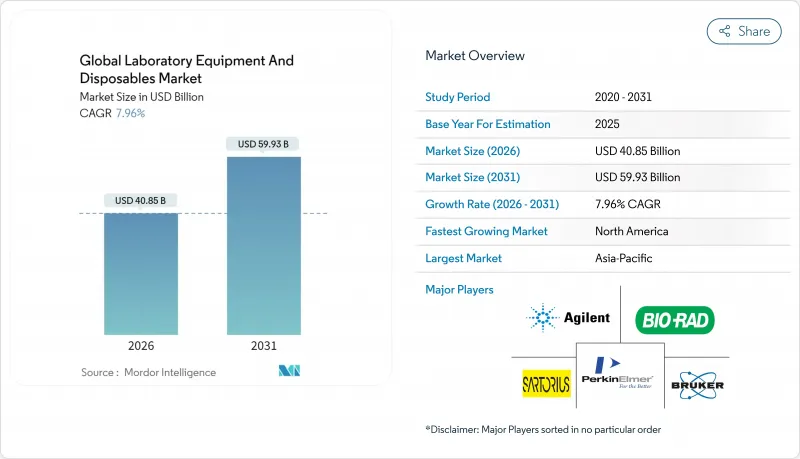
2026년 연구용 장비 및 소모품 시장의 규모는 408억 5,000만 달러로 추정되며, 2025년 378억 4,000만 달러에서 성장하여, 2031년에는 599억 3,000만 달러에 이를 것으로 예측됩니다.
2026년부터 2031년까지의 연평균 성장률(CAGR)은 7.96%로 전망됩니다.
지속적인 성장은 바이오 의약품 분야에서의 R&D 비용 증가, 고처리량 자동화를 필요로 하는 유전체학 워크플로의 급속한 확대, 일회용 소모품을 권장하는 엄격한 오염 관리 프로토콜에 의해 발생합니다. 벤더 각사는 장치 가동률을 극대화하기 위해 AI 탑재 예지보전 기능을 추가하는 한편, 그린랩 인증 프로그램은 연구소에 에너지 및 자재 폐기물의 감축을 요구하고 있습니다. 공급망의 탄력성 강화책과 리쇼어링 정책은 특히 북미 및 유럽에서의 구매 결정에 계속 영향을 주고 있으며, 아시아태평양에서는 정부 주도의 생명공학에 대한 투자가 기세를 늘리고 있습니다. 경쟁 격화에 의해 기존 대기업은 M&A를 통한 규모의 경제를 추구하는 한편, 틈새 진출기업은 모듈형 로보틱스와 지속가능성 서비스로 차별화를 도모하고 있습니다.
세계의 연구용 장비 및 소모품 시장의 동향 및 인사이트
바이오의약품에 대한 연구개발비 증가
제약업계의 연구개발비는 2024년에 2,880억 달러에 이르렀고, 2030년까지 3,400억 달러로 증가할 것으로 예측되고 있으며, 첨단 분석기기에 대한 강한 수요가 지속되고 있습니다. 미국의 생명공학 분야의 벤처 자금 조달은 연간 500억 달러를 넘으며, 유럽의 파이프라인도 견조세를 유지하고 있습니다. 이는 실험실 인프라로의 장기적인 자본 유입을 뒷받침하고 있습니다. FDA의 생물학적 제형 승인 증가는 장비 이용률의 향상과 소모품의 지속적인 판매를 뒷받침합니다. 파이프라인이 세포요법이나 유전자 치료 등 다양한 모달리티로 확대하는 가운데, 실험실에서는 폐쇄형 아이솔레이터나 디지털 문서화 플랫폼으로의 업그레이드가 진행되어 통합 벤더의 월렛 점유율 확대로 이어지고 있습니다.
고처리량 시퀀싱 시설의 급속한 확장
차세대 시퀀싱 시설의 세계적인 확장으로 유전체 샘플 준비, 마이크로유체칩 및 클라우드 기반 데이터 파이프라인에 대한 수요가 가속화되고 있습니다. 생명과학 툴 시장은 CAGR 10.9%로 추이할 것으로 예측되며 시퀀싱 워크플로가 주요 촉진요인이 되고 있습니다. Beckman Coulter의 TruSight Oncology 500과 QIAGEN의 최근 출시 예정인 QIAsymphony Connect는 작업 시간을 줄이면서 처리량을 확대하는 자동화의 사례입니다. 중국의 제14차 5개년 계획에서는 유전체 능력의 강화가 우선 과제로 지정되었으며, 지역 제조업체는 보조금 제도를 활용해 데스크톱 시퀀서를 도입하고 있습니다. 종양학 연구자들은 돌연변이 검출에 AI 알고리즘을 통합하고 있으며, 이에 따라 대용량 서버와 연구실 정보 관리 시스템(LIMS)에 대한 수요도 확대되고 있습니다. 전반적으로 시퀀싱 연구소는 광범위한 소모품과 자본 장비를 견인하는 핵심 고객으로서의 역할을 수행합니다.
의료용 수지 가격의 변동성
폴리프로필렌 및 PTFE 가격의 급격한 변동은 소모품 제조업체의 이익률을 축소시키고 장비 공급업체에 공급업체 계약의 재협상을 강요합니다. 지정학적 긴장으로 인한 화학물질 공급의 병목 현상은 리드타임을 연장하고 구매자에게 안전 재고 비축을 강요하여 운전 자금을 높이고 있습니다. 이스트만사가 22억 5,000만 달러를 투자한 분자 재활용 투자는 순환형 원료를 확보하고 투입 비용 위험을 줄이기 위한 시도입니다. 그러나 스팟 가격의 변동성은 여전히 존재하며, 이는 구매력이 제한된 소규모 연구소에 특히 큰 영향을 미치고 있습니다. 예산의 불확실성은 특정 부문의 설비 업그레이드를 지연시키고, 연구소는 유리 기구를 재멸균하게 되어, 연구용 설비 및 소모품 시장 내 단독 사용 부문의 단기적인 성장이 억제될 전망입니다.
부문 분석
2025년 연구용 장비 및 소모품 시장 점유율의 51.62%를 차지한 주력 범주는 소모품이며, 그 지위는 단일 사용으로 인한 무균성과 워크플로 효율성에 의해 뒷받침됩니다. 이 부문은 2031년까지 연평균 복합 성장률(CAGR) 8.53%를 보일 것으로 예측되며, 원재료 비용의 변동을 상회하는 지속적인 수익 확대가 예상됩니다. 바이오 의약품 및 진단 분야 연구실에서는 교차 오염을 최소화하고 컴플라이언스 문서화를 단순화하는 즉시 사용형 피펫 팁, 여과 어셈블리 및 마이크로유체 플레이트를 선호합니다. 무균 제조에는 클린룸용 의류가 여전히 필수적이며, 폐루프 재활용 파일럿 사업은 증가하는 ESG 감시에 대한 대응책이 되고 있습니다.
분석기, 분광계, 원심분리기, 인큐베이터 등의 연구용 장비는 IoT 연결을 통한 인프라 근대화를 추진하는 기관으로부터의 안정적인 설비 투자 수요를 지속적으로 이어가고 있습니다. 고부가가치 시스템에 내장된 예측 유지보수 모듈은 교환주기의 장기화를 보완하는 지속적인 서비스 수입원을 제공합니다. 벤더는 오픈 아키텍처 소프트웨어, 확장성 로봇, 소모품 및 장비 사용을 연동시키는 시약 임대 번들로 차별화를 도모하고 있습니다. 성숙한 연구소에서는 서비스형 분석계약에 의해 예산이 설비투자에서 운영비용으로 이행하여 수익을 평준화함과 동시에 연구용 기기 및 소모품 시장의 종합적인 성장궤도를 뒷받침하고 있습니다.
지역별 분석
북미는 지속적인 바이오 의약 연구 개발(1,300억 달러 이상)과 정밀의료의 도입 가속화로 2025년에는 최대 점유율인 37.68%를 차지했습니다. 이 지역은 조달 위험을 줄이는 명확한 FDA 지침과 CHIPS & Science Act에 근거한 협력적인 리쇼어링 장려책의 혜택을 받고 있습니다. 이들은 장비 제조에 필수적인 반도체 부품 공급력을 강화합니다. 임상연구실의 13%에서 만성적으로 부족한 인력으로 인해 자동화기기 구입이 촉진되면서 북미가 연구용 기기 및 소모품 시장의 핵심 역할을 확고하게 하고 있습니다.
아시아태평양은 2031년까지 연평균 복합 성장률(CAGR) 9.18%로 가장 급속히 확대될 것으로 예상되는 지역이며 중국의 14차 5개년 계획에 근거한 엄격한 생명공학 보조금과 2027년까지 1,380억 달러에 달할 전망인 의료 인프라 프로젝트가 이를 견인하고 있습니다. 애질런트 및 셩공바이오텍과 같은 전략적 제휴에 의해 핵산 기술이 국내의 요구에 맞추어 조정되는 한편, 일본, 한국, 호주에서는 선진적인 임상 연구 이니셔티브를 통해 수요가 지속되고 있습니다.
유럽에서는 규제 조화와 지속가능성 요구를 배경으로 안정된 5%대 전반의 성장을 유지하고 있습니다. 독일은 21%의 점유율을 차지하면서 그린랩 실천에서 혁신을 견인하고 있습니다. 유럽 의약품청(EMA)의 의약품 부족 감시 플랫폼은 컴플라이언스 감시 기기의 수요를 높이고 있습니다. 남미와 중동 및 아프리카는 미성숙하면서도 매력적인 시장으로 브라질과 GCC 국가들이 공중위생연구소와 학술센터에 투자를 추진함으로써 미래의 연구용 장비 및 소모품 시장에 대한 공헌 확대의 기반을 구축하고 있습니다.
기타 혜택
- 시장 예측(ME) 엑셀 시트
- 3개월 애널리스트 서포트
자주 묻는 질문
목차
제1장 서론
- 조사 전제조건 및 시장 정의
- 조사 범위
제2장 조사 방법
제3장 주요 요약
제4장 시장 상황
- 시장 개요
- 촉진요인
- 바이오의약품 분야에서의 연구개발비 증가
- 고처리량 시퀀싱 랩의 급속한 확대
- 일회용 클린룸용 플라스틱 수요 급증
- AI를 활용한 의료기기의 예지보전(신규)
- '그린랩' 인증으로의 이행(신규)
- 억제요인
- 의료용 수지 가격의 변동성
- 신규 기기 플랫폼의 검증 사이클 장기화
- 일회용 플라스틱에 대한 ESG 반발 증가(신규)
- 자동화 및 데이터 분석 전문가 부족(신규)
- 가치 및 공급망 분석
- 규제 상황
- 기술 전망
- Porter's Five Forces
- 신규 참가업체의 위협
- 공급자의 협상력
- 구매자의 협상력
- 대체품의 위협
- 경쟁 기업 간 경쟁 관계
제5장 시장 규모 및 성장 예측(금액 기준, 2024-2030년)
- 제품 유형별
- 연구용 기기
- 분석장치 및 계측기기
- 분광계
- 크로마토그래피 시스템
- 현미경
- 기타
- 일반 연구용 장비
- 원심분리기
- 인큐베이터
- 오토클레이브 및 멸균장치
- 기타
- 분석장치 및 계측기기
- 연구용 소모품
- 플라스틱 제품 및 유리 제품
- 피펫 및 칩
- 페트리 접시
- 시험관
- 기타
- 여과 및 분리용 자재
- 막 필터
- 주사기 필터
- 클린룸 소모품
- 장갑
- 가운 및 마스크
- 플라스틱 제품 및 유리 제품
- 연구용 기기
- 용도별
- 임상 진단
- 신약 개발 및 연구
- 유전체학 및 단백질체학
- 학술기관 및 연구기관
- 산업 및 환경시험
- 최종 사용자별
- 병원 및 진료소
- 제약 및 생명공학 기업
- 학술기관 및 연구기관
- 계약연구기관
- 지역별
- 북미
- 미국
- 캐나다
- 멕시코
- 유럽
- 독일
- 영국
- 프랑스
- 이탈리아
- 스페인
- 기타 유럽
- 아시아태평양
- 중국
- 인도
- 일본
- 한국
- 호주
- 기타 아시아태평양
- 남미
- 브라질
- 아르헨티나
- 기타 남미
- 중동 및 아프리카
- GCC
- 남아프리카
- 기타 중동 및 아프리카
- 북미
제6장 경쟁 구도
- 시장 집중도
- 시장 점유율 분석
- 기업 프로파일
- Thermo Fisher Scientific Inc.
- Danaher Corporation
- Agilent Technologies Inc.
- Merck KGaA
- F. Hoffmann-La Roche Ltd
- Becton, Dickinson and Company
- Sartorius AG
- PerkinElmer Inc.
- Bio-Rad Laboratories Inc.
- Eppendorf SE
- Bruker Corporation
- Corning Incorporated
- 3M Company
- GE Healthcare(Cytiva)
- Waters Corporation
- Shimadzu Corporation
- Illumina Inc.
- Abbott Laboratories
- Mettler-Toledo International Inc.
- Tecan Group Ltd
제7장 시장 기회 및 미래 전망
CSM 26.01.28The laboratory equipment and disposables market size in 2026 is estimated at USD 40.85 billion, growing from 2025 value of USD 37.84 billion with 2031 projections showing USD 59.93 billion, growing at 7.96% CAGR over 2026-2031.
Sustained growth stems from rising biopharma R&D outlays, fast-growing genomics workflows that require high-throughput automation, and tighter contamination-control protocols that favor single-use supplies. Vendors are adding AI-enabled predictive maintenance to maximize instrument uptime, while green-lab certification programs pressure laboratories to cut energy and material waste. Supply-chain resilience initiatives and reshoring policies continue to influence purchasing decisions, especially in North America and Europe, whereas Asia-Pacific gains momentum from government-backed biotech investments. Intensifying competition encourages large incumbents to pursue scale economies through M&A, while niche entrants differentiate on modular robotics and sustainability services.
Global Laboratory Equipment And Disposables Market Trends and Insights
Growing Biopharma R&D Expenditure
Pharmaceutical R&D spending reached USD 288 billion in 2024 and is projected to climb toward USD 340 billion by 2030, sustaining strong demand for advanced analytical instrumentation. Venture funding in biotech surpasses USD 50 billion annually in the United States, while Europe's pipeline remains robust, reinforcing long-term capital flows into laboratory infrastructure. Increased biologics approvals by the FDA validate greater instrument utilization and recurring consumables sales. As pipelines diversify into cell- and gene-therapy modalities, laboratories upgrade to closed-system isolators and digital documentation platforms, thereby deepening wallet share for integrated vendors.
Rapid Expansion of High-Throughput Sequencing Labs
Global build-out of next-generation sequencing facilities accelerates demand for genomic sample preparation, microfluidic chips, and cloud-based data pipelines. The life-science tools market is forecast at a 10.9% CAGR, with sequencing workflows as a primary catalyst. Beckman Coulter's TruSight Oncology 500 and QIAGEN's forthcoming QIAsymphony Connect exemplify automation aimed at reducing hands-on time while scaling throughput. China's 14th Five-Year Plan prioritizes genomic capabilities, and regional manufacturers leverage local subsidies to deploy bench-top sequencers. Oncology researchers integrate AI algorithms for variant calling, expanding concomitant demand for high-capacity servers and laboratory information management systems. Overall, sequencing labs act as anchor customers that pull through a broad basket of disposables and capital equipment.
Volatility in Medical-Grade Resin Prices
Sharp swings in polypropylene and PTFE pricing compress margins for consumables makers and force instrument vendors to renegotiate supplier contracts. Chemical-supply bottlenecks stemming from geopolitical tensions have extended lead times and compelled buyers to hold higher safety stocks, raising working-capital needs. Eastman's USD 2.25 billion molecular-recycling investment aims to secure circular feedstocks and mitigate input-cost risk. However, spot-price volatility persists and disproportionately impacts small-volume labs with limited purchasing clout. Budget uncertainty can delay discretionary equipment upgrades and prompt laboratories to re-sterilize glassware, tempering near-term growth in single-use categories of the laboratory equipment and disposables market.
Other drivers and restraints analyzed in the detailed report include:
- Surge in Demand for Single-Use Clean-Room Plastics
- AI-Enabled Predictive Maintenance of Instruments
- Lengthy Validation Cycles for Novel Instrument Platforms
For complete list of drivers and restraints, kindly check the Table Of Contents.
Segment Analysis
Disposables represent the dominant 51.62% slice of the laboratory equipment and disposables market share in 2025, a position underpinned by their single-use sterility and workflow efficiency. The same category is forecast to grow at an 8.53% CAGR to 2031, ensuring sustained revenue momentum that outweighs raw-material cost volatility. Laboratories in biopharma and diagnostics favor ready-to-use pipette tips, filtration assemblies, and micro-fluidic plates that minimize cross-contamination and simplify compliance documentation. Clean-room apparel remains indispensable for aseptic manufacturing, while closed-loop recycling pilots address rising ESG scrutiny.
Laboratory equipment-including analyzers, spectrometers, centrifuges, and incubators-continues to generate steady capital orders as institutions modernize infrastructure with IoT connectivity. Predictive maintenance modules embedded in high-value systems offer recurring-service income streams that compensate for extended replacement cycles. Vendors differentiate through open-architecture software, scalable robotics, and reagent-rental bundles that tie consumables to instrument use. In mature labs, analytics-as-a-service contracts shift budgets from capex to opex, smoothing revenue and supporting the overarching growth trajectory of the laboratory equipment and disposables market.
The Laboratory Equipment and Disposables Market Report is Segmented by Product Type (Laboratory Equipment, Laboratory Disposables), Application (Clinical Diagnostics, Drug Discovery & Development, and More), End User (Hospitals & Clinics, Pharmaceutical & Biotechnology Companies, and More), and Geography (North America, Europe, and More). The Market Forecasts are Provided in Terms of Value (USD).
Geography Analysis
North America contributes the largest 37.68% revenue slice in 2025 due to sustained biopharma R&D exceeding USD 130 billion and accelerated precision-medicine adoption. The region benefits from clear FDA guidance that reduces procurement risk and from concerted reshoring incentives under the CHIPS & Science Act, which strengthen semiconductor component supply critical for instrument manufacturing. Persistent 13% staffing shortages in clinical labs catalyze automation purchases, solidifying North America's central role in the laboratory equipment and disposables market.
Asia-Pacific is the fastest-expanding territory with a 9.18% CAGR through 2031, propelled by China's generous biotech subsidies under its 14th Five-Year Plan and healthcare-infrastructure projects slated to hit USD 138 billion by 2027. Strategic alliances like Agilent-Sangon Biotech tailor nucleic-acid technologies to domestic requirements, while Japan, South Korea, and Australia sustain demand through advanced clinical research initiatives.
Europe delivers steady mid-single-digit growth amid regulatory harmonization and sustainability imperatives. Germany holds a 21% share and drives innovation in green-lab practices, while EMA's Shortages Monitoring Platform heightens demand for compliance-monitoring instruments. South America and Middle East & Africa remain nascent but attractive, with Brazil and GCC nations investing in public-health labs and academic centers, laying the groundwork for elevated future contributions to the laboratory equipment and disposables market.
- Thermo Fisher Scientific
- Danaher
- Agilent Technologies
- Merck
- Roche
- Beckton Dickinson
- Sartorius
- PerkinElmer
- Bio-Rad Laboratories
- Eppendorf
- Bruker
- Corning
- 3M
- GE Healthcare (Cytiva)
- Waters Corporation
- Shimadzu
- Illumina
- Abbott Laboratories
- Mettler Toledo
- Tecan Group
Additional Benefits:
- The market estimate (ME) sheet in Excel format
- 3 months of analyst support
TABLE OF CONTENTS
1 Introduction
- 1.1 Study Assumptions & Market Definition
- 1.2 Scope of the Study
2 Research Methodology
3 Executive Summary
4 Market Landscape
- 4.1 Market Overview
- 4.2 Market Drivers
- 4.2.1 Growing biopharma R&D expenditure
- 4.2.2 Rapid expansion of high-throughput sequencing labs
- 4.2.3 Surge in demand for single-use clean-room plastics
- 4.2.4 AI-enabled predictive maintenance of instruments (fresh)
- 4.2.5 Shift toward "green lab" certifications (fresh)
- 4.3 Market Restraints
- 4.3.1 Volatility in medical-grade resin prices
- 4.3.2 Lengthy validation cycles for novel instrument platforms
- 4.3.3 Growing ESG backlash against single-use plastics (fresh)
- 4.3.4 Talent crunch for automation & data-analytics specialists (fresh)
- 4.4 Value / Supply-Chain Analysis
- 4.5 Regulatory Landscape
- 4.6 Technological Outlook
- 4.7 Porter's Five Forces
- 4.7.1 Threat of New Entrants
- 4.7.2 Bargaining Power of Suppliers
- 4.7.3 Bargaining Power of Buyers
- 4.7.4 Threat of Substitutes
- 4.7.5 Competitive Rivalry
5 Market Size & Growth Forecasts (Value, 2024-2030)
- 5.1 By Product Type
- 5.1.1 Laboratory Equipment
- 5.1.1.1 Analyzers & Instruments
- 5.1.1.1.1 Spectroscopy Equipment
- 5.1.1.1.2 Chromatography Systems
- 5.1.1.1.3 Microscopes
- 5.1.1.1.4 Others
- 5.1.1.2 General Lab Equipment
- 5.1.1.2.1 Centrifuges
- 5.1.1.2.2 Incubators
- 5.1.1.2.3 Autoclaves & Sterilizers
- 5.1.1.2.4 Others
- 5.1.1.1 Analyzers & Instruments
- 5.1.2 Laboratory Disposables
- 5.1.2.1 Plasticware & Glassware
- 5.1.2.1.1 Pipettes & Tips
- 5.1.2.1.2 Petri Dishes
- 5.1.2.1.3 Test Tubes
- 5.1.2.1.4 Others
- 5.1.2.2 Filtration & Separation Supplies
- 5.1.2.2.1 Membrane Filters
- 5.1.2.2.2 Syringe Filters
- 5.1.2.3 Clean-room Consumables
- 5.1.2.3.1 Gloves
- 5.1.2.3.2 Gowns & Masks
- 5.1.2.1 Plasticware & Glassware
- 5.1.1 Laboratory Equipment
- 5.2 By Application
- 5.2.1 Clinical Diagnostics
- 5.2.2 Drug Discovery & Development
- 5.2.3 Genomics & Proteomics
- 5.2.4 Academic & Research
- 5.2.5 Industrial & Environmental Testing
- 5.3 By End User
- 5.3.1 Hospitals & Clinics
- 5.3.2 Pharmaceutical & Biotechnology Companies
- 5.3.3 Academic & Research Institutes
- 5.3.4 Contract Research Organizations
- 5.4 By Geography
- 5.4.1 North America
- 5.4.1.1 United States
- 5.4.1.2 Canada
- 5.4.1.3 Mexico
- 5.4.2 Europe
- 5.4.2.1 Germany
- 5.4.2.2 United Kingdom
- 5.4.2.3 France
- 5.4.2.4 Italy
- 5.4.2.5 Spain
- 5.4.2.6 Rest of Europe
- 5.4.3 Asia-Pacific
- 5.4.3.1 China
- 5.4.3.2 India
- 5.4.3.3 Japan
- 5.4.3.4 South Korea
- 5.4.3.5 Australia
- 5.4.3.6 Rest of Asia-Pacific
- 5.4.4 South America
- 5.4.4.1 Brazil
- 5.4.4.2 Argentina
- 5.4.4.3 Rest of South America
- 5.4.5 Middle East and Africa
- 5.4.5.1 GCC
- 5.4.5.2 South Africa
- 5.4.5.3 Rest of Middle East and Africa
- 5.4.1 North America
6 Competitive Landscape
- 6.1 Market Concentration
- 6.2 Market Share Analysis
- 6.3 Company Profiles {(includes Global level Overview, Market level overview, Core Segments, Financials as available, Strategic Information, Market Rank/Share for key companies, Products & Services, and Recent Developments)}
- 6.3.1 Thermo Fisher Scientific Inc.
- 6.3.2 Danaher Corporation
- 6.3.3 Agilent Technologies Inc.
- 6.3.4 Merck KGaA
- 6.3.5 F. Hoffmann-La Roche Ltd
- 6.3.6 Becton, Dickinson and Company
- 6.3.7 Sartorius AG
- 6.3.8 PerkinElmer Inc.
- 6.3.9 Bio-Rad Laboratories Inc.
- 6.3.10 Eppendorf SE
- 6.3.11 Bruker Corporation
- 6.3.12 Corning Incorporated
- 6.3.13 3M Company
- 6.3.14 GE Healthcare (Cytiva)
- 6.3.15 Waters Corporation
- 6.3.16 Shimadzu Corporation
- 6.3.17 Illumina Inc.
- 6.3.18 Abbott Laboratories
- 6.3.19 Mettler-Toledo International Inc.
- 6.3.20 Tecan Group Ltd
7 Market Opportunities & Future Outlook
- 7.1 White-space & Unmet-Need Assessment