|
시장보고서
상품코드
1906190
산소 : 시장 점유율 분석, 업계 동향과 통계, 성장 예측(2026-2031년)Oxygen - Market Share Analysis, Industry Trends & Statistics, Growth Forecasts (2026 - 2031) |
||||||
 Mordor Intelligence
산소 시장은 2025년 8,793만 톤에서 2026년에는 9,192만 톤으로 성장해 2026-2031년에 걸쳐 CAGR 4.53%로 성장할 것으로 보이며, 2031년까지 1억 1,468만 톤에 이를 것으로 예측되고 있습니다.
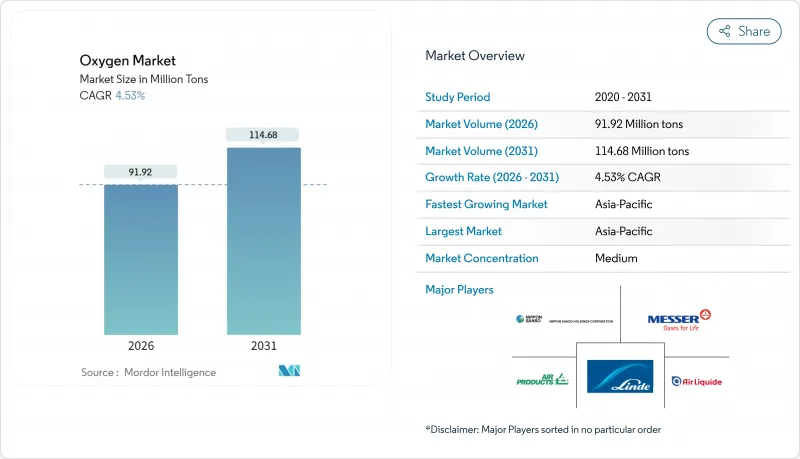
아시아태평양 지역의 철강 생산 증가, 병원 인프라 현대화, 반도체 등급 가스 생산 능력 확충이 종합적으로 시장 확장을 뒷받침하고 있습니다. 첨단 노드 칩 제조 분야의 초고순도 수요와 청정 수소 프로젝트 확장은 새로운 수익원을 창출하는 한편, 극저온 공기 분리 장치의 에너지 효율 개선은 생산자들의 마진 방위에 기여하고 있습니다. 과점적 공급 구조는 합리적인 가격 책정과 장기 계약을 지원하여 기존 업체들에게 예측 가능한 현금 흐름을 제공합니다.
세계의 산소시장 동향 및 인사이트
급성 및 만성 호흡기 질환 증가 경향
고령화 인구 증가와 함께 만성폐쇄성폐질환(COPD), 천식, 노화 관련 폐질환이 확산되면서 의료 시스템에 대한 부담이 커지고 있습니다. 의료용 산소는 최전선 치료법으로, 병원이 조기 퇴원 및 가정 기반 호흡기 치료로 전환함에 따라 수요가 더욱 증가하고 있습니다. 휴대용 농축기와 액체 휴대용 시스템은 환자의 이동성을 유지시켜 치료 순응도를 높이고 재입원을 줄이는 데 기여합니다. 저소득 및 중간 소득 국가에서 중단 없는 산소 공급을 목표로 한 투자는 상당한 잠재 시장을 열어, 장비 공급업체들이 생산 및 교육 프로그램을 현지화하도록 촉진합니다. 정부 및 자선 기금은 조달 격차를 해소하여 PSA 플랜트와 농축기의 확산을 가속화합니다.
아시아의 철강 및 비철금속 생산 성장
아시아태평양 지역의 확대되는 철강 생산 능력은 중국이 비효율적인 제철소를 폐쇄하는 상황에서도 대량 산소 소비를 유지합니다. 전기 아크 및 수소 기반 직접 환원 공정은 기존 고로 공정보다 톤당 더 많은 산소를 소비하여 사용 강도를 높입니다. 베트남과 인도로의 지역 다각화는 단일 국가 위험을 줄이고 신규 공기 분리 설비 투자를 촉진합니다. 서호주에서 발견된 새로운 철광석 매장량은 광석 공급 전망을 연장하는 한편, 인도네시아와 칠레의 알루미늄 및 구리 생산량 증가는 비철금속 수요 집적을 확대합니다. 제조사들은 산소연료 연소 기술을 도입해 용광로 효율을 높이고 탄소 배출을 줄여 산소 시장이 긍정적인 성장 곡선을 유지하도록 합니다.
극저온 분리 장치의 높은 전력 비용
전력은 공기분리기 플랜트의 최대 운영 비용 항목이며, 유럽 및 아시아 일부 지역의 가격 급등이 이익 마진을 압박합니다. 제조사들은 다년간 전력 구매 계약을 통해 부분적으로 헤지하지만, 현물 시장 노출은 변동성을 증폭시킨다. 공정 제어 개조 및 폐열 회수는 점진적 효율 향상을 가져오나, 소폭의 절감 효과를 위해 자본 투자가 필요합니다. 일부 운영사는 화석 연료 가격 변동으로부터 보호하기 위해 재생에너지 발전 설비를 모색하고 있으나, 간헐성 문제가 지속됩니다. 에너지 비용 전가 조항은 고객이 빈번한 가격 조정에 저항할 경우 제한적인 완화 효과만 제공합니다.
부문 분석
액체 산소는 상대적으로 작은 점유율을 차지했으나 가장 빠른 성장세를 기록했으며, 2026년부터 2031년까지 연평균 복합 성장률(CAGR) 4.62%로 발전할 것으로 예상됩니다. 대량 소비자들은 극저온 공급을 현장에서 중단 없는 기체 공급으로 전환하는 확장 비율을 높이 평가하여 트럭 이동과 완충 탱크 설치 공간을 대폭 줄입니다. 단열 ISO 컨테이너 및 원격 측정 기능이 탑재된 차량 관리 시스템에 대한 투자는 증발 손실을 줄여 유통 효율성을 높입니다. 병원 및 지역 공급 기지는 마이크로 액화기를 도입하여 최종 배송 경로를 단축하고 공급 중단 사태 시 비즈니스 회복탄력성을 강화합니다. 미국 식품의약국(FDA)의 라벨링 규정과 같은 진보된 규제 프레임워크는 가압 용기의 안전성과 추적성을 최우선으로 합니다.
그럼에도 불구하고 기체 공급은 2025년 87.62%의 점유율을 유지했으며, 이는 대형 공기분리기 단지에 인접한 철강, 유리, 화학 클러스터를 지원하는 파이프라인 네트워크에 힘입은 바 큽니다. 연속 유동 사용자들은 현장 저장 위험을 제거하는 파이프라인 연결의 단순성을 높이 평가합니다. 이로 인해 체결된 장기 계약은 신규 플랜트 자금 조달의 기반이 되어 기존 업체들의 입지를 공고히 합니다. 고체 산소는 취급 복잡성으로 인해 항공우주 시험 및 극저온 연구 분야에 국한됩니다. 예측 기간 동안 액체 생산, 고압 튜브 트레일러, 현장 진공 스윙 흡착기를 통합한 다중 제품 허브는 공급업체가 고객의 규모 및 순도 요구에 맞춰 공급 방식을 조정할 수 있도록 지원하여 산소 시장을 확대할 것입니다.
산소 시장 보고서는 형태별(가스, 액체, 고체), 용도별(의료용 및 산업용), 용도별(금속 및 광업, 화학, 석유 및 가스, 의료, 제약, 기타 용도), 지역별(아시아태평양, 북미, 유럽, 남미, 중동 및 아프리카)으로 분류되어 있습니다. 시장 예측은 수량(톤) 단위로 제공됩니다.
지역별 분석
아시아태평양 지역은 2025년 산소 시장 점유율 41.45%를 차지했으며, 2031년까지 연평균 5.41%의 성장률을 보일 것으로 예상됩니다. 인도, 베트남, 인도네시아의 철강 및 비철금속 생산 능력 확대와 한국 및 대만의 반도체 메가팹이 지역 수요 클러스터를 주도합니다. 정부 주도 병원 현대화가 액체 의료용 산소 소비를 촉진하는 한편, 친환경 수소 시범 사업에 대한 보조금이 향후 산소 수요를 증가시킬 전망입니다. 싱가포르의 2025년 시행 예정인 개정 화학 저장 규정을 비롯한 현지 규제 기관들은 공급업체들이 물류 자산을 현대화하도록 요구하여 안전성과 시장 전문성을 강화하고 있습니다.
유럽은 산업 탈탄소화에 주력하며 산소 연료 이니셔티브와 수소 대응 직접환원공정을 육성합니다. 유럽연합의 개정 오존층파괴물질 규정은 환경 친화적 공정 가스 전환을 강화해 고순도 산소 수요를 간접적으로 촉진합니다. 의료 시스템은 가정 기반 만성질환 관리 모델로 전환되며 휴대용 농축기 사용이 확대됩니다. 북미는 기존 파이프라인 그리드와 걸프 연안의 청수소 허브 확장을 활용하며 여전히 주요 소비 지역입니다. 에어프로덕츠의 미주리 주 막 솔루션 확장 사업은 산소와 인프라를 공유하는 질소 및 바이오가스 부문의 보완적 성장 기회에 대한 공급업체의 확신을 보여줍니다.
라틴아메리카와 아프리카에서는 병원 및 광업에 대한 투자가 가속화되고 있습니다. 브라질의 자동차용 강재 수요와 칠레의 구리 제련소가 남미의 안정된 산소 수요를 지지하는 한편, 나이지리아, 케냐, 이집트의 의료 자금 확충이 PSA 플랜트 도입을 촉진하고 있습니다. 중동에서는 국유 에너지 기업이 산소 주입을 필요로 하는 탄소 포집 및 증진 채유 기술(EOR)을 추진하고 있으며, 기존의 정제에 편중해 온 이 지역의 구조를 상쇄하고 있습니다. 이러한 동향이 함께 산소 시장은 지역적으로 분산된 기반을 확고한 것으로 하고 있습니다.
기타 혜택 :
- 엑셀 형식 시장 예측(ME) 시트
- 애널리스트의 3개월간 지원
자주 묻는 질문
목차
제1장 서론
- 조사의 전제조건과 시장의 정의
- 조사 범위
제2장 조사 방법
제3장 주요 요약
제4장 시장 상황
- 시장 개요
- 시장 성장 촉진요인
- 급성 및 만성 호흡기 질환의 발생률 상승
- 아시아 지역 철강 및 비철금속 생산 증가
- 전용 수소 및 산소연료 프로젝트 확대
- 신흥 시장에서의 병원용 PSA 소형 플랜트 전환
- 첨단 노드 반도체용 초고순도 산소 수요
- 시장 성장 억제요인
- 극저온 분리 장치의 높은 전력 비용
- 대체 절단/연료 가스(LPG, 아세틸렌)의 이용 가능성
- 대형 극저온 유조선의 세계적 부족
- 밸류체인 분석
- Porter's Five Forces
- 공급기업의 협상력
- 구매자의 협상력
- 신규 참가업체의 위협
- 대체품의 위협
- 경쟁도
제5장 시장 규모와 성장 예측
- 형태별
- 가스
- 액체
- 고체
- 유형별
- 의료용
- 산업용
- 용도별
- 금속 및 광업
- 화학
- 석유 및 가스
- 헬스케어
- 제약
- 기타 용도
- 지역별
- 아시아태평양
- 중국
- 인도
- 일본
- 한국
- ASEAN
- 기타 아시아태평양
- 북미
- 미국
- 캐나다
- 멕시코
- 유럽
- 독일
- 영국
- 프랑스
- 이탈리아
- 스페인
- 기타 유럽
- 남미
- 브라질
- 아르헨티나
- 기타 남미
- 중동 및 아프리카
- 사우디아라비아
- 남아프리카
- 기타 중동 및 아프리카
- 아시아태평양
제6장 경쟁 구도
- 시장 집중도
- 전략적 움직임(합병 및 인수, 합작 사업, 계약)
- 시장 점유율(%)/순위 분석
- 기업 프로파일
- Air Liquide
- Air Products and Chemicals, Inc.
- AIR WATER INC
- Axcel Gases
- Gruppo SIAD
- Guangdong Huate Gas Co., Ltd.
- Gulfcryo
- Hangzhou Oxygen Group Co., Ltd.
- INOX-Air Products Inc.
- International Industrial Gases Ltd
- Iwatani Corporation
- Linde PLC
- Messer SE & Co. KGaA
- NIPPON SANSO HOLDINGS CORPORATION
- Sauerstoffwerk Friedrichshafen GmbH
- SOL Spa
- Steelman Gases Pvt. Ltd.
- Yingde Gas Shanghai
제7장 시장 기회와 장래의 전망
HBR 26.01.26The Oxygen Market is expected to grow from 87.93 million tons in 2025 to 91.92 million tons in 2026 and is forecast to reach 114.68 million tons by 2031 at 4.53% CAGR over 2026-2031.
Growing steel output in the Asia-Pacific, modernization of hospital infrastructure, and capacity additions for semiconductor-grade gases collectively underpin expansion. Ultra-high-purity demand in advanced-node chip fabrication and the build-out of clean-hydrogen projects are opening new revenue streams, while energy-efficiency upgrades in cryogenic air-separation units help producers defend margins. The oligopolistic supply structure supports rational pricing and long-term contracts, giving incumbents predictable cash flows.
Global Oxygen Market Trends and Insights
Rising incidence of acute and chronic respiratory disorders
Healthcare systems face mounting pressure as COPD, asthma, and age-related lung diseases grow alongside aging populations. Medical oxygen is a frontline therapy, and demand intensifies when hospitals pivot toward early discharge and home-based respiratory care. Portable concentrators and liquid portable systems help patients remain mobile, supporting adherence to therapy and reducing readmissions. Investments targeting uninterrupted oxygen supply in low- and middle-income nations unlock a sizeable addressable market, prompting equipment suppliers to localize production and training programs. Government and philanthropic financing bridge procurement gaps, accelerating the diffusion of PSA plants and concentrators.
Steel and non-ferrous metal production growth in Asia
Asia-Pacific's broadening steel capacity sustains bulk oxygen off-take, even as China retires inefficient mills. Electric-arc and hydrogen-based direct-reduction routes consume more oxygen per ton than the legacy blast-furnace process, raising intensity of use. Regional diversification toward Vietnam and India reduces single-country risk and stimulates greenfield air-separation investments. New iron-ore discoveries in Western Australia lengthen ore supply horizons, while rising aluminum and copper output in Indonesia and Chile expands non-ferrous demand clusters. Producers deploy oxy-fuel combustion to lift furnace efficiency and cut carbon emissions, keeping the oxygen market on a positive growth curve.
High electricity cost of cryogenic separation units
Power is the single largest operating expense in air-separation plants, and price surges in Europe and parts of Asia squeeze profit margins. Producers hedge partially via multi-year power purchase agreements, but spot-market exposure amplifies volatility. Process-control retrofits and waste-heat recovery deliver incremental efficiency gains yet require capital for modest savings. Some operators explore renewable-powered plants to shield against fossil-fuel price swings, although intermittency challenges persist. Energy-cost pass-through clauses provide limited relief when customers resist frequent price revisions.
Other drivers and restraints analyzed in the detailed report include:
- Expansion of on-purpose hydrogen and oxy-fuel projects
- Hospital shift to PSA micro-plants in emerging markets
- Availability of alternate cutting/fuel gases (LPG, acetylene)
For complete list of drivers and restraints, kindly check the Table Of Contents.
Segment Analysis
Liquid oxygen held a comparatively smaller share but recorded the swiftest trajectory, advancing at a 4.62% CAGR between 2026 and 2031. Bulk consumers value the expansion ratio that turns cryogenic deliveries into an uninterrupted gaseous supply on site, slashing truck movements and buffer-tank footprints. Investments in insulated ISO containers and telemetry-enabled fleet management shrink boil-off losses, raising distribution efficiency. Hospitals and regional supply depots deploy micro-liquefiers to shorten last-mile routes, enhancing business resilience during supply disruption events. Advancing regulatory frameworks, such as the United States Food and Drug Administration's labeling rule, prioritize safety and traceability for pressurized vessels.
Gaseous supply nonetheless retained an 87.62% foothold in 2025, backed by pipeline networks serving steel, glass, and chemical clusters adjacent to large air-separation complexes. Continuous-flow users prize the simplicity of pipeline ties that remove onsite storage risks. The resulting long-term contracts underpin financing for new plants, cementing the incumbents' presence. Solid oxygen remains confined to aerospace tests and cryogenic research owing to handling complexities. Over the forecast horizon, multiproduct hubs incorporating liquid production, high-pressure tube trailers, and onsite vacuum swing adsorbers will help vendors tailor supply modes to customer scale and purity needs, expanding the oxygen market.
The Oxygen Market Report is Segmented by Form (Gas, Liquid, and Solid), Type (Medical and Industrial), Application (Metals and Mining, Chemical Industry, Oil and Gas, Healthcare, Pharmaceutical, and Other Applications), and Geography (Asia-Pacific, North America, Europe, South America, and Middle-East and Africa). The Market Forecasts are Provided in Terms of Volume (Tons).
Geography Analysis
Asia-Pacific commanded 41.45% oxygen market share in 2025 and is positioned to grow at a 5.41% CAGR to 2031. Expanding steel and non-ferrous capacities in India, Vietnam, Indonesia, and semiconductor mega-fabs in South Korea and Taiwan, anchor regional demand clusters. Government-mandated hospital upgrades drive liquid-medical-oxygen consumption, while subsidies for green-hydrogen pilots boost future oxygen off-take. Local regulators, such as Singapore's revised chemical-storage rules effective 2025, compel suppliers to modernize logistics assets, enhancing safety and market professionalism.
Europe focuses on industrial decarbonization, fostering oxy-fuel initiatives and hydrogen-ready direct-reduction lines. The European Union's updated ozone-depleting-substances regulation reinforces the switch to environment-friendly processing gases, indirectly favoring high-purity oxygen. Healthcare systems shift toward home-based chronic-care models, broadening use of portable concentrators. North America remains a sizeable consumer, leveraging embedded pipeline grids and ramp-ups in blue-hydrogen hubs along the Gulf Coast. Air Products' Missouri membrane-solutions expansion illustrates supplier confidence in complementary nitrogen and biogas opportunities that share infrastructure with oxygen.
Latin America and Africa register accelerating hospital and mining investments. Brazil's automotive steel demand and Chile's copper smelters channel steady oxygen flows in South America, while healthcare-funding expansions in Nigeria, Kenya, and Egypt incentivize PSA plant deployments. In the Middle East, state-owned energy companies pursue carbon-capture and enhanced-oil-recovery schemes requiring oxygen injection, offsetting the region's historical concentration on conventional refining. Collectively, these dynamics keep the oxygen market firmly on a diversified regional footing.
- Air Liquide
- Air Products and Chemicals, Inc.
- AIR WATER INC
- Axcel Gases
- Gruppo SIAD
- Guangdong Huate Gas Co., Ltd.
- Gulfcryo
- Hangzhou Oxygen Group Co., Ltd.
- INOX-Air Products Inc.
- International Industrial Gases Ltd
- Iwatani Corporation
- Linde PLC
- Messer SE & Co. KGaA
- NIPPON SANSO HOLDINGS CORPORATION
- Sauerstoffwerk Friedrichshafen GmbH
- SOL Spa
- Steelman Gases Pvt. Ltd.
- Yingde Gas Shanghai
Additional Benefits:
- The market estimate (ME) sheet in Excel format
- 3 months of analyst support
TABLE OF CONTENTS
1 Introduction
- 1.1 Study Assumptions and Market Definition
- 1.2 Scope of the Study
2 Research Methodology
3 Executive Summary
4 Market Landscape
- 4.1 Market Overview
- 4.2 Market Drivers
- 4.2.1 Rising incidence of acute and chronic respiratory disorders
- 4.2.2 Steel and non-ferrous metal production growth in Asia
- 4.2.3 Expansion of on-purpose hydrogen and oxy-fuel projects
- 4.2.4 Hospital shift to PSA micro-plants in emerging markets
- 4.2.5 Ultra-high-purity O2 demand from advanced-node semiconductors
- 4.3 Market Restraints
- 4.3.1 High electricity cost of cryogenic separation units
- 4.3.2 Availability of alternate cutting/fuel gases (LPG, acetylene)
- 4.3.3 Global shortage of large-bore cryogenic tankers
- 4.4 Value Chain Analysis
- 4.5 Porter's Five Forces
- 4.5.1 Bargaining Power of Suppliers
- 4.5.2 Bargaining Power of Buyers
- 4.5.3 Threat of New Entrants
- 4.5.4 Threat of Substitutes
- 4.5.5 Degree of Competition
5 Market Size and Growth Forecasts (Volume)
- 5.1 By Form
- 5.1.1 Gas
- 5.1.2 Liquid
- 5.1.3 Solid
- 5.2 By Type
- 5.2.1 Medical
- 5.2.2 Industrial
- 5.3 By Application
- 5.3.1 Metals and Mining
- 5.3.2 Chemical Industry
- 5.3.3 Oil and Gas
- 5.3.4 Healthcare
- 5.3.5 Pharmaceutical
- 5.3.6 Other Applications
- 5.4 By Geography
- 5.4.1 Asia-Pacific
- 5.4.1.1 China
- 5.4.1.2 India
- 5.4.1.3 Japan
- 5.4.1.4 South Korea
- 5.4.1.5 ASEAN
- 5.4.1.6 Rest of Asia-Pacific
- 5.4.2 North America
- 5.4.2.1 United States
- 5.4.2.2 Canada
- 5.4.2.3 Mexico
- 5.4.3 Europe
- 5.4.3.1 Germany
- 5.4.3.2 United Kingdom
- 5.4.3.3 France
- 5.4.3.4 Italy
- 5.4.3.5 Spain
- 5.4.3.6 Rest of Europe
- 5.4.4 South America
- 5.4.4.1 Brazil
- 5.4.4.2 Argentina
- 5.4.4.3 Rest of South America
- 5.4.5 Middle-East and Africa
- 5.4.5.1 Saudi Arabia
- 5.4.5.2 South Africa
- 5.4.5.3 Rest of Middle-East and Africa
- 5.4.1 Asia-Pacific
6 Competitive Landscape
- 6.1 Market Concentration
- 6.2 Strategic Moves (Mergers and Acquisitions, JVs, Agreements)
- 6.3 Market Share (%)/Ranking Analysis
- 6.4 Company Profiles (includes Global level Overview, Market level overview, Core Segments, Financials as available, Strategic Information, Market Rank/Share, Products and Services, Recent Developments)
- 6.4.1 Air Liquide
- 6.4.2 Air Products and Chemicals, Inc.
- 6.4.3 AIR WATER INC
- 6.4.4 Axcel Gases
- 6.4.5 Gruppo SIAD
- 6.4.6 Guangdong Huate Gas Co., Ltd.
- 6.4.7 Gulfcryo
- 6.4.8 Hangzhou Oxygen Group Co., Ltd.
- 6.4.9 INOX-Air Products Inc.
- 6.4.10 International Industrial Gases Ltd
- 6.4.11 Iwatani Corporation
- 6.4.12 Linde PLC
- 6.4.13 Messer SE & Co. KGaA
- 6.4.14 NIPPON SANSO HOLDINGS CORPORATION
- 6.4.15 Sauerstoffwerk Friedrichshafen GmbH
- 6.4.16 SOL Spa
- 6.4.17 Steelman Gases Pvt. Ltd.
- 6.4.18 Yingde Gas Shanghai
7 Market Opportunities and Future Outlook
- 7.1 White-space and Unmet-need Assessment