|
시장보고서
상품코드
1906192
마스터배치 : 시장 점유율 분석, 업계 동향과 통계, 성장 예측(2026-2031년)Masterbatch - Market Share Analysis, Industry Trends & Statistics, Growth Forecasts (2026 - 2031) |
||||||
 Mordor Intelligence
마스터배치 시장 규모는 2026년 129억 4,000만 달러로 평가되었고, 2025년 124억 1,000만 달러에서 성장할 것으로 보입니다. 2031년 예측은 159억 5,000만 달러에 이르고, 2026-2031년에 걸쳐 연평균 복합 성장률(CAGR) 4.27%로 성장할 것으로 전망됩니다.

원자재 가격 변동에도 불구하고 포장, 자동차 경량화, 통신 케이블 피복 분야의 지속적인 수요가 성장을 뒷받침하고 있습니다. 아시아태평양 지역은 중국과 인도의 플라스틱 가공 능력 증가에 힘입어 마스터배치 시장에서 45%의 매출 점유율로 선두를 유지하고 있습니다. 이산화티타늄 기반의 불투명도와 자외선 차단 기능이 여전히 필수적이기 때문에 백색 제형이 매출의 32%를 차지합니다. 기업들은 강화되는 세계의 폐기물 지침에 부응하여 바이오 기반 캐리어, 항균 첨가제, 재생 폴리프로필렌 성능 개선 제형 개발에 연구개발 예산을 집중하고 있습니다. 다국적 기업들이 비용 중심의 지역 공급업체에 맞서 시장 점유율을 방위하기 위해 지속가능한 혁신에 주력함에 따라 경쟁 강도는 중간 수준입니다.
세계의 마스터배치 시장 동향 및 인사이트
플라스틱 포장 산업에서 수요 증가
전자상거래 성장과 브랜드 소유자의 진열대 차별화 추구로 인해 포장은 여전히 색소 및 첨가제 농축액의 최대 소비처입니다. 미국과 유럽연합의 식품 접촉 규정은 색상 안정성과 가공 효율성을 보장하는 FDA 및 EU 준수 등급으로 가공업체를 유도하고 있습니다. 항균 및 산소 차단 변형 제품은 신선 식품 포장에서 제품 수명 연장에 기여하며, 재활용 가능한 캐리어 시스템은 순환 경제 목표 달성을 지원합니다. 클라리언트(Clariant)와 앰페이셋(Ampacet)은 마스터배치 시장에서 이주 제한을 충족하면서도 고생산 라인에서 일관된 색상을 구현할 수 있는 식품 등급 솔루션을 제공합니다.
자동차 산업에서 플라스틱 수요 증가
차량 플랫폼은 경량화를 위해 폴리프로필렌 컴파운드에 의존하며, 이는 자외선 차단, 스크래치 방지 및 난연성 마스터배치 채택을 촉진합니다. GRAFE의 기반 블랙 시리즈는 다중 컴파운딩 단계 없이도 비용 효율적인 실내 트림 착색을 가능하게 하는 짙은 검정색을 제공합니다. 내구성과 휘발성 유기 화합물 배출 저감을 위한 OEM 지침은 특수 목적 첨가제 패키지에 대한 수요를 더욱 강화합니다.
원료 비용 변동은 마스터배치 제조업체에게 도전을 가져옵니다.
이산화티타늄과 카본 블랙 가격은 주기적 변동으로 농축액 생산 비용을 상승시킵니다. 변동성은 안료 생산 능력 중단, 에너지 요금 인상, 주기적 수출 제한에서 비롯됩니다. 제조사들은 핵심 안료의 이중 조달, 지수 연동 계약 협상, 적용량당 비용을 낮추는 고함량 농축액 제형을 통해 이러한 위험에 대응합니다.
부문 분석
화이트 농축액은 불투명도와 자외선 차단에 있어 핵심적인 역할을 바탕으로 2025년 마스터배치 시장 규모에서 가장 큰 31.40% 점유율을 차지했습니다. 고순도 이산화 티타늄은 유제품 병, 캡, 외장재에 필요한 밝기와 열 안정성을 제공합니다. 컬러 마스터배치는 일관된 광택을 가진 맞춤형 색조를 요구하는 프리미엄 포장재, 소비자 가전, 자동차 내장재 시장 덕분에 2031년까지 연평균 4.67% 성장할 것으로 예상됩니다. 블랙 카테고리는 전도성 및 내후성 제품에서 강한 수요를 유지하는 한편, 특수 효과 제형은 진주광택 및 금속성 안료를 활용해 고급 화장품 시장에서 진열대 매력도를 높이며 주목받고 있습니다.
지속가능성 목표 재조명으로 바이오 기반 또는 재생 캐리어를 활용한 화이트 및 컬러 솔루션이 부상하고 있습니다. 공급업체들은 안료 가격 압박을 관리하기 위해 이산화티타늄 사용량을 줄이면서도 불투명도를 유지하는 분산 방법을 개선 중입니다. 한편 컬러 개발사들은 디지털 컬러 매칭 플랫폼을 활용해 낮은 희석 비율로 브랜드 색상을 재현함으로써 신규 SKU의 인증 주기를 단축하고 있습니다.
지역별 분석
아시아태평양 지역은 2025년 세계의 매출의 44.60%를 차지했으며, 2031년까지 연평균 4.78% 성장할 것으로 전망됩니다. 중국 가공업체들은 필름, 섬유, 자동차 부품 분야에서 소비량을 주도하는 반면, 인도 변환업체들은 유연 포장재 및 백색 가전 분야에서 생산 능력을 확대하고 있습니다. 중국은 거대한 제조 기반과 증가하는 내수 수요로 지역 마스터배치 시장을 주도하고 있으며, 인도는 확장되는 플라스틱 가공 능력으로 중요한 성장 중심지로 부상하고 있습니다[2]. 전자제품 제조에 대한 정부 인센티브는 색상 첨가제의 현지 조달을 촉진하여 지역 자급률을 높이고 있습니다. 증가하는 가처분 소득은 고성능 착색제에 의존하는 미적으로 매력적인 소비재에 대한 수요를 지속적으로 끌어올리고 있습니다.
북미는 식품 접촉 및 자동차 규제가 엄격한 고부가가치 성숙 시장입니다. 미국은 지역 판매를 주도하며 화학적 재생 수지와 호환되는 농축제 개발을 위해 컴파운더와 긴밀히 협력합니다. 캐나다 포장업체들은 육류 트레이용 항균 제형을 도입하고, 멕시코 가전 제조사들은 외장 패널용 내스크래치성 블랙 PP 컴파운드를 지정합니다.
유럽은 첨단 기능성과 환경 규정 준수로 명성을 유지하고 있습니다. 독일과 동유럽의 자동차 허브는 자외선 안정성 및 저휘발성 유기화합물(VOC) 제형에 대한 꾸준한 주문을 이끌고 있습니다. 유럽연합(EU)의 예정된 재생 소재 의무화 정책은 폐쇄형 폴리프로필렌 및 폴리에틸렌 시스템을 위한 마스터배치를 선호합니다. 동지중해 가공업체들은 중동 원료의 이점을 활용하지만 탄소국경조정제도(CBAM) 준수 압박이 증가하고 있습니다.
중동 및 아프리카는 여전히 기여도가 낮지만, 경쟁력 있는 비용으로 수지 및 안료 중간체를 공급하는 통합 석유화학 단지의 혜택을 받고 있습니다. 클라리언트의 사우디 시설은 파이프, 필름, 섬유 제조업체를 위한 색소 및 첨가제 농축액의 지역 내 공급 안정성을 높입니다. 걸프협력회의(GCC) 국가들의 인프라 프로젝트는 전기 배관 및 케이블 피복용 난연성 및 내후성 컴파운드 수요를 촉진합니다.
기타 혜택 :
- 엑셀 형식 시장 예측(ME) 시트
- 3개월간의 애널리스트 지원
자주 묻는 질문
목차
제1장 서론
- 조사의 전제조건과 시장의 정의
- 조사 범위
제2장 조사 방법
제3장 주요 요약
제4장 시장 상황
- 시장 개요
- 시장 성장 촉진요인
- 플라스틱 포장 업계 수요 증가
- 자동차 산업에서 플라스틱 수요 증가
- 경량화 및 재생 플라스틱 함량이 높은 폴리프로필렌(PP) 컴파운드로의 전환이 화이트 마스터배치 및 필러 마스터배치 사용 촉진
- 광섬유 케이블 인프라 확장으로 인한 난연성 마스터배치 수요 촉진
- 의료 및 위생 제품의 사용량 증가
- 시장 성장 억제요인
- 원료 비용의 변동성
- 엄격한 환경 규제
- 액상 착색제와의 경쟁
- 밸류체인 분석
- Porter's Five Forces
- 신규 참가업체의 위협
- 구매자의 협상력
- 공급기업의 협상력
- 대체품의 위협
- 경쟁 기업간 경쟁 관계
제5장 시장 규모와 성장 예측
- 유형별
- 화이트 마스터배치
- 블랙 마스터배치
- 컬러 마스터배치
- 첨가제 마스터배치
- 특수 효과 마스터배치
- 폴리머별
- 폴리에틸렌
- 폴리프로필렌
- 고충격 폴리스티렌
- 폴리염화비닐
- 폴리에틸렌테레프탈레이트
- 기타
- 최종 사용자별
- 포장
- 건축 및 건설
- 자동차 및 운송
- 전기 및 전자 기기
- 소비재
- 농업
- 기타(의료, 섬유 등)
- 지역별
- 아시아태평양
- 중국
- 인도
- 일본
- 한국
- ASEAN
- 기타 아시아태평양
- 북미
- 미국
- 캐나다
- 멕시코
- 유럽
- 독일
- 영국
- 프랑스
- 이탈리아
- 기타 유럽
- 남미
- 브라질
- 아르헨티나
- 기타 남미
- 중동 및 아프리카
- 사우디아라비아
- 남아프리카
- 기타 중동 및 아프리카
- 아시아태평양
제6장 경쟁 구도
- 시장 집중도
- 전략적 동향
- 시장 점유율 분석
- 기업 프로파일
- Americhem
- Ampacet Corporation
- Astra Polymers
- Avient Corporation
- Scientific and Production Company "BARS-2"
- BASF
- Cabot Corporation
- Clariant
- Dainichiseika Color and Chemicals Mfg. Co. Ltd.
- Gabriel-Chemie GmbH
- Heubach Group
- Hubron International
- JJPlastalloys
- Penn Color Inc. Masterbatch & Color Concentrates
- Plastiblends
- Plastika Kritis SA
- RTP Company
- Samplast Plast
- Shanghai Janton Industrial Co., Ltd
- Sukano
- Tosaf Compounds Ltd.
제7장 시장 기회와 장래의 전망
HBR 26.01.26Masterbatch market size in 2026 is estimated at USD 12.94 billion, growing from 2025 value of USD 12.41 billion with 2031 projections showing USD 15.95 billion, growing at 4.27% CAGR over 2026-2031.
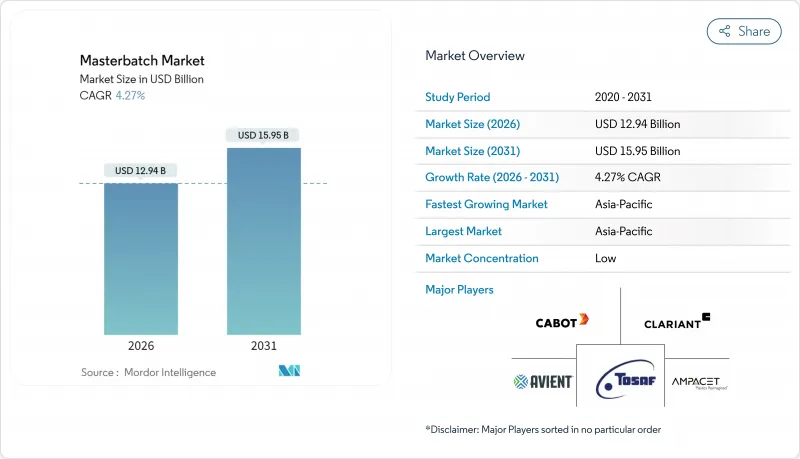
Growth is supported by sustained demand in packaging, automotive lightweighting, and telecom cable jacketing despite raw-material price swings. Asia Pacific retains leadership in the masterbatch market with a 45% revenue share, helped by rising plastic conversion capacity in China and India. White formulations account for 32% of sales because titanium-dioxide-based opacity and UV protection remain indispensable. Companies are directing R&D budgets toward bio-based carriers, antimicrobial additives, and formulations that improve the performance of recyclate-rich polypropylene, aligning with tightening global waste directives. Competitive intensity is moderate as multinationals focus on sustainable innovation to defend share against cost-driven regional suppliers.
Global Masterbatch Market Trends and Insights
Rising Demand in Plastic Packaging Industry
E-commerce growth and brand owners' quest for shelf differentiation keep packaging the single largest consumer of color and additive concentrates. Food contact regulations in the United States and the European Union are steering converters toward FDA- and EU-compliant grades that ensure color stability and processing efficiency. Antimicrobial and oxygen-barrier variants help extend product life in fresh-food formats, while recyclable carrier systems support circular-economy targets. Clariant and Ampacet offer food-grade solutions that allow processors to achieve consistent color across high-throughput lines while meeting migration limits in the masterbatch market.
Increasing Demand of Plastic in Automotive Industry
Vehicle platforms rely on polypropylene compounds to reduce weight, driving uptake of UV-, scratch- and flame-retardant masterbatches. GRAFE's Base Black series provides deep-black shades, enabling cost-effective interior trim coloration without multiple compounding steps. OEM directives for durability and lower volatile organic compound emissions further strengthen demand for purpose-built additive packages.
Feedstock Cost Volatility Challenges Masterbatch Manufacturers
Titanium dioxide and carbon black prices are prone to cyclical swings that inflate concentrate production costs. Volatility stems from pigment capacity outages, rising energy tariffs, and periodic export restrictions. Producers counter this exposure by dual-sourcing critical pigments, negotiating index-linked contracts, and formulating high-loading concentrates that lower cost per application dose.
Other drivers and restraints analyzed in the detailed report include:
- Fiber-Optic Cable Infrastructure Build-out
- Increased Use in Healthcare and Hygiene Products
- Strict Environmental Regulations Impact Product Development
For complete list of drivers and restraints, kindly check the Table Of Contents.
Segment Analysis
White concentrates captured the largest 31.40% share of masterbatch market size in 2025, underpinned by their critical role in opacity and UV protection. High-purity titanium dioxide delivers brightness and heat stability needed in dairy bottles, caps, and facades. Color masterbatch is expected to post a 4.67% CAGR to 2031 due to premium packaging, consumer electronics, and automotive interiors seeking custom shades with consistent gloss. The black category retains strong demand in conductive and weatherable products, while special-effect formulations gain traction in luxury cosmetics, using pearlescent and metallic pigments for shelf appeal.
Renewed sustainability goals foster white and color solutions based on bio-sourced or recycled carriers. Suppliers are refining dispersion methods that lower titanium dioxide usage yet maintain opacity to manage pigment price pressure. Meanwhile, color developers exploit digital color-matching platforms to replicate brand hues at lower let-down ratios, shortening qualification cycles for new SKUs.
The Masterbatch Market Report Segments the Industry by Type (White Masterbatch, Black Masterbatch, Colour Masterbatch, Additive Masterbatch, and More), Polymer (Polypropylene, Polyethylene, High Impact Polystyrene, and More), End-User Industry (Building & Construction, Packaging, and More), and Geography (Asia-Pacific, North America, and More). The Market Forecasts are Provided in Terms of Value (USD).
Geography Analysis
Asia Pacific accounted for 44.60% of worldwide revenue in 2025 and is forecast to advance at 4.78% CAGR through 2031. Chinese processors lead volume consumption across film, fiber, and automotive parts, while Indian converters scale capacity in flexible packaging and white goods. China leads the regional masterbatch market due to its massive manufacturing base and growing domestic demand, while India is emerging as a significant growth center with expanding plastics processing capacity[2]. Government incentives for electronics manufacturing encourage local sourcing of color additives, increasing regional self-reliance. Rising disposable incomes continue to uplift demand for aesthetically appealing consumer products that rely on high-performance colorants.
North America represents a high-value but mature market characterized by stringent food-contact and automotive standards. The United States dominates regional sales, collaborating closely with compounders to develop concentrates compatible with chemically recycled resins. Canadian packaging firms adopt antimicrobial formulations for meat trays, and Mexican appliance producers specify scratch-resistant black PP compounds for exterior panels.
Europe maintains its reputation for advanced functionality and eco-compliance. Automotive hubs in Germany and Eastern Europe drive steady orders for UV-stable and low-VOC formulations. Upcoming recycled-content mandates in the European Union favor masterbatches designed for closed-loop polypropylene and polyethylene systems. Eastern Mediterranean processors tap into Middle-East feedstock advantages yet face rising pressure to comply with carbon-border adjustment mechanisms.
The Middle East and Africa, while still a smaller contributor, benefit from integrated petrochemical complexes supplying resin and pigment intermediates at competitive costs. Clariant's Saudi facility improves regional availability of color and additive concentrates for pipe, film, and fiber producers . Infrastructure projects in Gulf Cooperation Council countries stimulate demand for flame-retardant and weatherable compounds in electrical conduits and cable jacketing.
- Americhem
- Ampacet Corporation
- Astra Polymers
- Avient Corporation
- Scientific and Production Company "BARS-2"
- BASF
- Cabot Corporation
- Clariant
- Dainichiseika Color and Chemicals Mfg. Co. Ltd.
- Gabriel-Chemie GmbH
- Heubach Group
- Hubron International
- JJPlastalloys
- Penn Color Inc. Masterbatch & Color Concentrates
- Plastiblends
- Plastika Kritis S.A.
- RTP Company
- Samplast Plast
- Shanghai Janton Industrial Co., Ltd
- Sukano
- Tosaf Compounds Ltd.
Additional Benefits:
- The market estimate (ME) sheet in Excel format
- 3 months of analyst support
TABLE OF CONTENTS
1 Introduction
- 1.1 Study Assumptions and Market Definition
- 1.2 Scope of the Study
2 Research Methodology
3 Executive Summary
4 Market Landscape
- 4.1 Market Overview
- 4.2 Market Drivers
- 4.2.1 Rising Demand in Plastic Packaging Industry
- 4.2.2 Increasing Demand of Plastic in Automotive Industry
- 4.2.3 Shift Toward Lightweight Recyclate Rich PP Compounds Boosting White and Filler Masterbatch Usage
- 4.2.4 Fiber Optic Cable Infrastructure Build out Propelling Flame Retardant Masterbatch Demand
- 4.2.5 Increased Use in Healthcare and Hygiene Products
- 4.3 Market Restraints
- 4.3.1 Feedstock Cost Volatility
- 4.3.2 Strict Environmental Regulations
- 4.3.3 Competition from Liquid Colorants
- 4.4 Value Chain Analysis
- 4.5 Porter's Five Forces
- 4.5.1 Threat of New Entrants
- 4.5.2 Bargaining Power of Buyers
- 4.5.3 Bargaining Power of Suppliers
- 4.5.4 Threat of Substitute Products
- 4.5.5 Intensity of Competitive Rivalry
5 Market Size and Growth Forecasts (Value)
- 5.1 By Type
- 5.1.1 White Masterbatch
- 5.1.2 Black Masterbatch
- 5.1.3 Colour Masterbatch
- 5.1.4 Additive Masterbatch
- 5.1.5 Special Effect Masterbatch
- 5.2 By Polymer
- 5.2.1 Polyethylene
- 5.2.2 Polypropylene
- 5.2.3 High Impact Polystyrene
- 5.2.4 Polyvinyl Chloride
- 5.2.5 Polyethylene Terephthalate
- 5.2.6 Others
- 5.3 By End-User
- 5.3.1 Packaging
- 5.3.2 Building and Construction
- 5.3.3 Automotive and Transportation
- 5.3.4 Electrical and Electronics
- 5.3.5 Consumer Goods
- 5.3.6 Agriculture
- 5.3.7 Others (Healthcare, Textile, etc.)
- 5.4 By Geography
- 5.4.1 Asia Pacific
- 5.4.1.1 China
- 5.4.1.2 India
- 5.4.1.3 Japan
- 5.4.1.4 South Korea
- 5.4.1.5 ASEAN
- 5.4.1.6 Rest of Asia Pacific
- 5.4.2 North America
- 5.4.2.1 United States
- 5.4.2.2 Canada
- 5.4.2.3 Mexico
- 5.4.3 Europe
- 5.4.3.1 Germany
- 5.4.3.2 United Kingdom
- 5.4.3.3 France
- 5.4.3.4 Italy
- 5.4.3.5 Rest of Europe
- 5.4.4 South America
- 5.4.4.1 Brazil
- 5.4.4.2 Argentina
- 5.4.4.3 Rest of South America
- 5.4.5 Middle East and Africa
- 5.4.5.1 Saudi Arabia
- 5.4.5.2 South Africa
- 5.4.5.3 Rest of Middle East and Africa
- 5.4.1 Asia Pacific
6 Competitive Landscape
- 6.1 Market Concentration
- 6.2 Strategic Moves
- 6.3 Market Share Analysis
- 6.4 Company Profiles (includes Global-level Overview, Market-level Overview, Core Segments, Financials as available, Strategic Information, Market Rank/Share for key companies, Products and Services, and Recent Developments)
- 6.4.1 Americhem
- 6.4.2 Ampacet Corporation
- 6.4.3 Astra Polymers
- 6.4.4 Avient Corporation
- 6.4.5 Scientific and Production Company "BARS-2"
- 6.4.6 BASF
- 6.4.7 Cabot Corporation
- 6.4.8 Clariant
- 6.4.9 Dainichiseika Color and Chemicals Mfg. Co. Ltd.
- 6.4.10 Gabriel-Chemie GmbH
- 6.4.11 Heubach Group
- 6.4.12 Hubron International
- 6.4.13 JJPlastalloys
- 6.4.14 Penn Color Inc. Masterbatch & Color Concentrates
- 6.4.15 Plastiblends
- 6.4.16 Plastika Kritis S.A.
- 6.4.17 RTP Company
- 6.4.18 Samplast Plast
- 6.4.19 Shanghai Janton Industrial Co., Ltd
- 6.4.20 Sukano
- 6.4.21 Tosaf Compounds Ltd.
7 Market Opportunities and Future Outlook
- 7.1 White-Space and Unmet-Need Assessment
- 7.2 Rising Demand for Biobased Masterbatch