
|
시장보고서
상품코드
1906253
마케팅 기술 시장 : 시장 점유율 분석, 업계 동향과 통계, 성장 예측(2026-2031년)Marketing Technology Market - Market Share Analysis, Industry Trends & Statistics, Growth Forecasts (2026 - 2031) |
||||||
 Mordor Intelligence
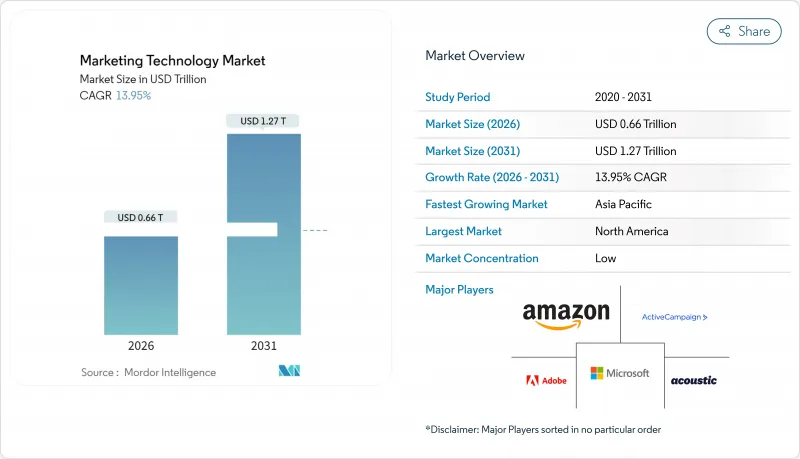
마케팅 기술 시장은 2025년 5,800억 달러로 평가되었고, 2026년 6,609억 1,000만 달러에서 2031년까지 1조 2,708억 2,000만 달러에 이를 것으로 보입니다. 예측기간(2026-2031년)의 CAGR은 13.95%를 나타낼 전망입니다.
기업의 클라우드 우선, AI 내장형 스택에 대한 수요가 주요 가속기로 작용하며, 대규모 캠페인 실시간 오케스트레이션, 동적 콘텐츠 생성, 크로스채널 어트리뷰션을 가능케 합니다. 시장 선도 기업들은 핵심 제품에 생성형 AI를 내장하고 있으며, 프라이버시 우선 데이터 전략으로의 전환을 요구하는 규제 압박은 퍼스트파티 및 제로파티 데이터 자산의 가치를 높입니다. 경쟁 역학은 구성 가능한 아키텍처 내에서 크리에이티브, 데이터, 실행 워크플로우를 통합할 수 있는 벤더에게 유리하게 작용하여 기업이 비용, 지연 시간, 규정 준수에 대한 세분화된 통제력을 확보할 수 있게 합니다. 자동화된 콘텐츠 파이프라인으로 인한 운영 효율성 향상은 이미 캠페인 ROI를 개선하여 증가하는 AI 컴퓨팅 비용을 상쇄할 만큼 충분합니다.
세계의 마케팅 기술 시장 동향 및 인사이트
클라우드 우선 마케팅 스택 채택 급증
기업들은 데이터 사일로를 해소하고 모든 고객 접점에서 실시간 의사결정을 가능하게 하기 위해 클라우드 네이티브 아키텍처로의 적극적인 전환을 지속하고 있습니다. 마이크로소프트의 멕시코 13억 달러, 브라질 27억 달러 규모의 데이터센터 투자 약속은 저지연 고객 데이터 처리를 지원하는 지역 인프라의 필요성을 강조합니다. IT 팀들은 주기 시간 단축으로 마케터들이 캠페인 출시 기간을 몇 주에서 몇 시간으로 단축할 수 있게 되어 개인화 정확도와 수익 창출 속도가 향상되었다고 보고합니다.
캠페인 오케스트레이션 전반에 통합된 생성형 AI
생성형 AI는 기존의 수동적이고 사후 대응적인 워크플로우를 선제적인 경험 오케스트레이션 엔진으로 전환하고 있습니다. 어도비의 고객 경험 오케스트레이션 플랫폼은 AI가 크리에이티브와 마케팅 기능을 통합하여 노동 집약적인 A/B 테스트에 의존하지 않고도 지속적인 콘텐츠 최적화를 가능케 하는 방식을 보여줍니다. 기업들은 독자적 모델이 기존 SaaS 도구 대비 50-60%의 총마진을 제공함으로써 마진 확대 효과를 강조합니다.
총소유비용(TCO)과 통합부채 증가
기존 스택에 AI 도구를 중첩하는 조직들은 계획되지 않은 데이터 마이그레이션 및 유지보수 비용으로 초기 예산을 40-60% 초과하는 상황에 직면합니다. 클라우드 스토리지만 해도 2025년 IT 지출에서 2000억 달러를 넘어섰으며, 이는 CFO들이 플랫폼 선택을 재검토하도록 압박하고 있습니다.
부문 분석
마케팅 자동화는 2025년 마케팅 기술 시장 점유율의 25.60%를 차지하며, 옴니채널 여정 관리의 제어 센터로서의 역할을 입증했습니다. 마케팅 자동화와 연계된 마케팅 기술 시장 규모는 기업들이 데이터, 콘텐츠, 실행 워크플로우를 연결하는 통합 오케스트레이션 엔진으로 전환함에 따라 함께 성장할 것으로 전망됩니다. 현재는 수익 기반이 작지만, 브랜드들이 확장 가능한 AI 기반 콘텐츠 생성에 지출을 재분배함에 따라 젠AI 기반 콘텐츠 도구는 2031년까지 연평균 25.92%의 성장률을 기록할 것으로 전망됩니다. 소셜 미디어 및 콘텐츠 마케팅 제품군은 직접적인 고객 참여를 가능케 하여 꾸준한 성장을 보인 반면, 리치 미디어 제작 도구는 증가하는 동영상 수요의 혜택을 받고 있습니다.
기업은 컨텐츠의 신속한 배포를 지속적인 경쟁 우위로 간주하고 창의성과 실시간 성능 분석을 융합하는 플랫폼에 예산을 집중시키고 있습니다. Adobe의 GenStudio Foundation은 공급업체가 자동화를 컨텐츠 공급 체인에 통합하고 마케터가 브랜드 가치를 손상시키지 않고 공개할 수 있도록 하는 좋은 예입니다. 영업 지원 제품군은 현재 AI에서 학습한 과거 성약 데이터를 기반으로 예측 리드 스코어링을 통합하여 파이프라인 전환을 가속화하고 있습니다.
지역별 분석
북미는 성숙한 클라우드 도입, 벤처 자금, 선진 AI 연구 역량으로 2025년 마케팅 기술 시장의 37.60%를 점유했습니다. 지역 선도 기업들은 주 단위 개인정보 보호법으로 규정 준수 업무가 증가하는 상황에서도 심층적인 생태계 통합을 활용해 경쟁 우위를 유지하고 있습니다. 캐나다 기업들은 C-27 법안 시행을 대비해 동의 전략을 개선하는 한편, 미국 기업들은 소송 위험을 선제적으로 차단하기 위해 개인정보 보호형 분석 기술을 도입하고 있습니다.
아시아태평양(APAC)은 가장 성장이 현저한 지역이며 2026-2031년에 걸쳐 CAGR 15.95%를 보일 것으로 예측되고 있습니다. 각국 정부가 디지털 인프라 정비를 지원하고 있기 때문에 모바일 퍼스트의 소비자층의 마케팅 기술의 보급이 촉진되고 있습니다. 인도에서는 현지 언어 컨텐츠와 AI를 활용한 광고 타겟팅 기술 혁신을 원동력으로 디지털 마케팅 시장이 2025년까지 11조2000억 루피(134억 달러) 규모에 이를 것으로 전망되고 있습니다. 동남아시아 광고주는 미디어 지출의 더 큰 비율을 소셜커머스에 돌려주고 있으며, 호주 기업은 AI 마케팅 예산을 확대하고 전환율의 점증적 향상을 도모하고 있습니다.
유럽의 전망은 엄격한 규제에 의해 영향을 받습니다 : GDPR 2025, 디지털 시장법(Digital Markets Act), 디지털 서비스법(Digital Services Act)이 데이터 관리 의무를 재정의합니다. 해당 지역을 대상으로 하는 벤더들은 27개 회원국 모두에 걸쳐 준수하는 기본 개인정보 보호 아키텍처를 설계해야 하며, 종종 이러한 기준을 세계의로 확대 적용합니다. 라틴 아메리카에서는 멕시코가 넷플릭스의 10억 달러 규모 제작 투자 약속과 알리바바의 첫 현지 클라우드 리전을 모두 환영했는데, 이는 국제 기업들이 강력한 디지털 성장을 예상하고 있음을 시사합니다. 한편 중동 및 아프리카 개발자들은 결제 인프라가 성숙해지고 국경 간 물류가 개선되면서 전자상거래 스택 도입을 가속화하고 있습니다.
기타 혜택 :
- 엑셀 형식 시장 예측(ME) 시트
- 애널리스트의 3개월간 지원
자주 묻는 질문
목차
제1장 서론
- 조사의 전제조건과 시장의 정의
- 조사 범위
제2장 조사 방법
제3장 주요 요약
제4장 시장 상황
- 시장 개요
- 시장 성장 촉진요인
- 주류 동향 - 클라우드 우선 마케팅 스택 채택 급증
- 주류 동향 - 캠페인 오케스트레이션 전체에의 생성형 AI의 임베디드
- 주류 동향 - 프라이버시 중시의 퍼스트 파티 데이터 전략
- 주목도가 낮은 동향 - 제로파티 데이터 마이크로 교환 프로그램
- 주목도 낮음 - 구성 가능한 CDP 아키텍처가 제품군 종속성 극복
- 시장 성장 억제요인
- 주유동향 - 증가하는 총소유비용(TCO) 및 통합 부채
- 주류 동향 - 복잡한 마케팅 기술 스택의 스킬 갭
- 주목도가 낮은 동향 - Apple Private Relay와 브라우저 레벨에서의 광고 블록
- 주목도가 낮은 동향 - 데이터 집약적 마테크에 대한 ESG 기반 클라우드 탄소 배출 제한
- 밸류체인 분석
- 규제 상황
- 기술의 전망
- Porter's Five Forces 분석
- 신규 참가업체의 위협
- 공급기업의 협상력
- 구매자의 협상력
- 대체품의 위협
- 경쟁 기업간 경쟁 관계
- 업계의 자금 조달과 M&A 동향
제5장 시장 규모와 성장 예측
- 제품별
- 소셜 미디어 도구
- 컨텐츠 마케팅 도구
- 리치 미디어 제작 도구
- 마케팅 자동화 플랫폼
- 데이터 및 분석 도구
- 영업 지원 도구
- 용도별
- IT 및 통신
- 소매 및 전자상거래
- 헬스케어
- 미디어 및 엔터테인먼트
- 스포츠 및 이벤트
- BFSI
- 지역별
- 북미
- 남미
- 유럽
- 아시아태평양
- 중동
- 아프리카
제6장 경쟁 구도
- 시장 집중도
- 전략적 동향
- 시장 점유율 분석
- 기업 프로파일
- Adobe Inc.
- Alphabet Inc.(Google Marketing Platform)
- Amazon Web Services(AWS for Martech)
- Salesforce Inc.
- Microsoft Corp.
- Oracle Corp.
- HubSpot Inc.
- SAP SE
- Shopify Inc.
- Mailchimp(Intuit)
- Hootsuite Inc.
- Sprinklr Inc.
- Zoho Corp.(Zoho Marketing Plus)
- Optimizely
- Klaviyo
- Acoustic LP
- ActiveCampaign
- FullCircl Ltd.
- Buzzoole Holdings Ltd.
- Konnect Insights
- Iterable
제7장 시장 기회와 장래의 전망
HBR 26.01.26The Marketing Technology Market was valued at USD 580 billion in 2025 and estimated to grow from USD 660.91 billion in 2026 to reach USD 1,270.82 billion by 2031, at a CAGR of 13.95% during the forecast period (2026-2031).
Enterprise demand for cloud-first, AI-embedded stacks is the primary accelerator, enabling real-time orchestration of campaigns, dynamic content generation, and cross-channel attribution at scale. Market leaders are embedding generative AI in core products, while regulatory pressure to transition toward privacy-first data strategies raises the value of first-party and zero-party data assets. Competitive dynamics favor vendors that can unify creative, data, and activation workflows inside a composable architecture, giving enterprises granular control over costs, latency, and compliance. Operational efficiency gains from automated content pipelines are already improving campaign ROI enough to offset rising AI compute expenditures.
Global Marketing Technology Market Trends and Insights
Cloud-First Marketing Stacks Adoption Surge
Enterprises continue an aggressive pivot toward cloud-native architectures to collapse data silos and enable real-time decisioning across every customer touchpoint. Microsoft's USD 1.3 billion Mexico and USD 2.7 billion Brazil data-center commitments underscore the need for regional infrastructure that supports low-latency customer data processing. IT teams report cycle-time reductions that let marketers shrink campaign rollouts from weeks to hours, boosting personalization accuracy and revenue velocity.
GenAI Embedded Across Campaign Orchestration
Generative AI is transforming what used to be manual, reactive workflows into proactive experience orchestration engines. Adobe's Customer Experience Orchestration platform illustrates how AI unites creative and marketing functions under one roof, enabling continuous content optimization without relying on labor-intensive A/B testing. Enterprises highlight margin expansion as proprietary models deliver 50-60% gross margins versus legacy SaaS tools.
Rising Total Cost of Ownership and Integration Debt
Organizations layering AI tools onto legacy stacks face unplanned data-migration and maintenance bills that exceed initial budgets by 40-60%. Cloud storage alone surpassed USD 200 billion of IT spend in 2025, pressuring CFOs to reassess platform choices.
Other drivers and restraints analyzed in the detailed report include:
- Privacy-Driven First-Party Data Strategies
- Zero-Party Data Micro-Exchange Programs
- Skills Gap for Complex Martech Stacks
For complete list of drivers and restraints, kindly check the Table Of Contents.
Segment Analysis
Marketing Automation captured 25.60% of the marketing technology market share in 2025, validating its role as the control center for omnichannel journey management. The marketing technology market size tied to Marketing Automation is projected to grow alongside enterprises' pivot to unified orchestration engines that connect data, content, and activation workflows. GenAI-Powered Content Tools, while representing a smaller revenue base today, are forecast to post a 25.92% CAGR through 2031 as brands redistribute spend toward scalable, AI-driven content generation. Social media and content marketing suites post steady gains by enabling direct audience engagement, whereas rich-media creation tools benefit from rising video demand.
Enterprises view content velocity as a durable moat, directing budgets toward platforms that marry creative excellence with real-time performance insights. Adobe's GenStudio Foundation exemplifies how vendors integrate automation into the content supply chain, allowing marketers to publish without sacrificing brand integrity. Sales-enablement suites now embed predictive lead scoring that draws on AI-trained historical win data to accelerate pipeline conversion.
The Marketing Technology Market Report is Segmented by Product (Social Media Tools, Content Marketing Tools, Rich-Media Creation Tools, and More), Application (IT and Telecommunications, Retail and E-Commerce, Healthcare, Media and Entertainment, and More), and Geography. The Market Forecasts are Provided in Terms of Value (USD).
Geography Analysis
North America controlled 37.60% of the marketing technology market in 2025 due to mature cloud adoption, venture funding, and advanced AI research capabilities. Regional leaders leverage deep ecosystem integrations to maintain competitive edge, even as state-level privacy statutes multiply compliance tasks. Canadian enterprises refine consent strategies in anticipation of Bill C-27, while US-based firms deploy privacy-preserving analytics to stay ahead of litigation exposure.
APAC is the fastest-growing region, projected to log a 15.95% CAGR over 2026-2031. Governments support digital infrastructure build-outs, enabling widespread uptake of marketing tech among mobile-first consumers. India expects its digital marketing sector to reach INR 1.12 lakh crore (USD 13.4 billion) by 2025, powered by local-language content and AI-enabled ad-targeting innovations. Southeast Asian advertisers are directing larger shares of media spend toward social commerce, and Australian enterprises are expanding AI marketing budgets to capture incremental conversion gains.
Europe's outlook is colored by stringent regulations: GDPR 2025, the Digital Markets Act, and the Digital Services Act collectively redefine data stewardship obligations. Vendors serving the region must design default-privacy architectures that comply across all 27 member states, often rolling those standards global. In Latin America, Mexico welcomed both Netflix's USD 1 billion production pledge and Alibaba's first local cloud region, signals that international players foresee robust digital growth. Meanwhile, Middle East and Africa developers accelerate e-commerce stack adoption as payment rails mature and cross-border logistics improve.
- Adobe Inc.
- Alphabet Inc. (Google Marketing Platform)
- Amazon Web Services (AWS for Martech)
- Salesforce Inc.
- Microsoft Corp.
- Oracle Corp.
- HubSpot Inc.
- SAP SE
- Shopify Inc.
- Mailchimp (Intuit)
- Hootsuite Inc.
- Sprinklr Inc.
- Zoho Corp. (Zoho Marketing Plus)
- Optimizely
- Klaviyo
- Acoustic L.P.
- ActiveCampaign
- FullCircl Ltd.
- Buzzoole Holdings Ltd.
- Konnect Insights
- Iterable
Additional Benefits:
- The market estimate (ME) sheet in Excel format
- 3 months of analyst support
TABLE OF CONTENTS
1 INTRODUCTION
- 1.1 Study Assumptions and Market Definition
- 1.2 Scope of the Study
2 RESEARCH METHODOLOGY
3 EXECUTIVE SUMMARY
4 MARKET LANDSCAPE
- 4.1 Market Overview
- 4.2 Market Drivers
- 4.2.1 Mainstream - Cloud-first marketing stacks adoption surge
- 4.2.2 Mainstream - GenAI embedded across campaign orchestration
- 4.2.3 Mainstream - Privacy-driven first-party data strategies
- 4.2.4 Under-the-radar - Zero-party data micro-exchange programs
- 4.2.5 Under-the-radar - Composable CDP architectures beating suite lock-in
- 4.3 Market Restraints
- 4.3.1 Mainstream - Rising total cost of ownership and integration debt
- 4.3.2 Mainstream - Skills gap for complex martech stacks
- 4.3.3 Under-the-radar - Apple Private Relay and browser-level ad-blocking
- 4.3.4 Under-the-radar - ESG-driven cloud carbon limits on data-heavy martech
- 4.4 Value Chain Analysis
- 4.5 Regulatory Landscape
- 4.6 Technological Outlook
- 4.7 Porter's Five Forces Analysis
- 4.7.1 Threat of New Entrants
- 4.7.2 Bargaining Power of Suppliers
- 4.7.3 Bargaining Power of Buyers
- 4.7.4 Threat of Substitutes
- 4.7.5 Intensity of Competitive Rivalry
- 4.8 Industry Funding and M&A Trends
5 MARKET SIZE AND GROWTH FORECASTS (VALUE)
- 5.1 By Product
- 5.1.1 Social Media Tools
- 5.1.2 Content Marketing Tools
- 5.1.3 Rich-Media Creation Tools
- 5.1.4 Marketing Automation Platforms
- 5.1.5 Data and Analytics Tools
- 5.1.6 Sales Enablement Tools
- 5.2 By Application
- 5.2.1 IT and Telecommunications
- 5.2.2 Retail and E-commerce
- 5.2.3 Healthcare
- 5.2.4 Media and Entertainment
- 5.2.5 Sports and Events
- 5.2.6 BFSI
- 5.3 By Geography
- 5.3.1 North America
- 5.3.2 South America
- 5.3.3 Europe
- 5.3.4 Asia-Pacific
- 5.3.5 Middle East
- 5.3.6 Africa
6 COMPETITIVE LANDSCAPE
- 6.1 Market Concentration
- 6.2 Strategic Moves
- 6.3 Market Share Analysis
- 6.4 Company Profiles (includes Global level Overview, Market level overview, Core Segments, Financials as available, Strategic Information, Market Rank/Share for key companies, Products and Services, and Recent Developments)
- 6.4.1 Adobe Inc.
- 6.4.2 Alphabet Inc. (Google Marketing Platform)
- 6.4.3 Amazon Web Services (AWS for Martech)
- 6.4.4 Salesforce Inc.
- 6.4.5 Microsoft Corp.
- 6.4.6 Oracle Corp.
- 6.4.7 HubSpot Inc.
- 6.4.8 SAP SE
- 6.4.9 Shopify Inc.
- 6.4.10 Mailchimp (Intuit)
- 6.4.11 Hootsuite Inc.
- 6.4.12 Sprinklr Inc.
- 6.4.13 Zoho Corp. (Zoho Marketing Plus)
- 6.4.14 Optimizely
- 6.4.15 Klaviyo
- 6.4.16 Acoustic L.P.
- 6.4.17 ActiveCampaign
- 6.4.18 FullCircl Ltd.
- 6.4.19 Buzzoole Holdings Ltd.
- 6.4.20 Konnect Insights
- 6.4.21 Iterable
7 MARKET OPPORTUNITIES AND FUTURE OUTLOOK
- 7.1 White-space and Unmet-need Assessment