|
시장보고서
상품코드
1906254
플라스틱 팔레트 : 시장 점유율 분석, 업계 동향과 통계, 성장 예측(2026-2031년)Plastic Pallets - Market Share Analysis, Industry Trends & Statistics, Growth Forecasts (2026 - 2031) |
||||||
 Mordor Intelligence
플라스틱 팔레트 시장은 2025년의 86억 5,000만 달러에서 2026년에는 95억 5,000만 달러로 성장할 것으로 예측됩니다. 2026-2031년에 걸쳐 CAGR 10.38%로 성장을 지속하여, 2031년까지 156억 3,000만 달러에 달할 전망입니다.

의약품 콜드체인 내 위생 규정 강화, 목재에 대한 ISPM-15 준수 비용, 자동화 준비형 창고 설계가 플라스틱 팔레트 시장을 주도하는 핵심 성장 동력입니다. 자본 지출을 운영비로 전환하는 풀링 시스템 역시 수요에 긍정적 영향을 미치며, 제3자 물류 기업에게 공유 자산의 매력을 높입니다. EU 전역의 폴리올레핀 수지 재활용 이니셔티브는 팔레트를 순환 경제 목표와 연계함으로써 추가 성장 동력을 제공합니다. 반면 원유 가격 변동에 연동된 수지 가격 변동은 제조업체에 단기적 마진 압박을 가합니다.
세계의 플라스틱 팔레트 시장 동향 및 인사이트
의약품 콜드체인에서 위생 플라스틱 팔레트 채택
FDA 규정은 팔레트를 운송 장비로 분류하여 제약 물류에서 세척 가능하고 비다공성 설계가 필수적입니다. 플라스틱 팔레트는 습기에 강하며 온도 변동 시 구조를 유지해 목재 대비 오염 위험을 낮춘다. Schoeller Allibert와 같은 유럽 제조사들은 이제 무균 의약품 제조에 맞춤화된 클린룸 등급 팔레트를 공급합니다. 제품 리콜 비용 증가로 채택이 확고해지면서 플라스틱 유닛은 규제 대상 콜드 체인의 표준 인프라로 자리잡고 있습니다. 백신 물량이 높은 수준을 유지함에 따라 북미 수요는 여전히 강세를 보이며, 유사한 위생 기준이 유럽 전역으로 확산되고 있습니다.
ISPM-15 준수 의무가 목재에서 플라스틱으로의 전환을 촉진
ISPM-15는 목재 포장재에 열처리 또는 훈증 처리를 요구하여 아시아 수출에 비용과 지연을 초래합니다. 플라스틱 팔레트는 이 규정이 적용되지 않아 중국, 베트남, 태국에서 즉각적인 규정 준수 이점을 제공합니다. 수출업체는 팔레트당 12-15달러의 처리 비용을 절감하여 대량 화물 운송 시 마진을 개선할 수 있습니다. 미국 목재 표준 위원회의 엄격한 감사 일정은 행정 부담을 증가시켜 목재 사용을 더욱 억제합니다. 무역 경로가 리드 타임 창을 좁혀감에 따라 플라스틱 팔레트는 182개 ISPM-15 서명국에서 통관 속도를 높여 확실성을 제공합니다.
신흥 동남아시아 중소기업의 초기 자본 비용 장벽
플라스틱 팔레트는 목재 대비 3-5배 비싸 현금 유동성이 부족한 지역 내 중소기업(전체 기업의 98.7% 차지)의 도입을 가로막습니다. 보조금 대출이 존재하나 이 규모의 운영 자본 업그레이드를 지원하는 경우는 드뭅니다. 소규모 가공업체가 현지 플라스틱 생산을 주도하는 인도네시아에서는 투자 회수 기간이 일반적인 계획 기간을 초과합니다. 비용 분담 풀이 없는 상황에서 도입은 높은 회전율로 투자금을 상각할 수 있는 대형 수출업체로 제한됩니다. 제조사들은 현재 저가형 재생수지 함유 팔레트를 출시하고 있으나, 자금 조달 격차는 여전히 존재합니다.
부문 분석
2025년 시점에서 HDPE는 의약품 및 식품 취급업자가 요구하는 내화학성 덕분에 2025년 플라스틱 팔레트 시장 점유율 66.03%를 유지했습니다. 플라스틱 팔레트 시장은 현재 재생 수지에 프리미엄 가치를 부여하며, EU의 재생 소재 의무화 기준이 강화됨에 따라 재생 소재 부문이 2031년까지 연평균 12.29% 성장할 것으로 전망됩니다. 원유 가격에 연동된 신규 수지 가격 변동성으로 인해 재활용 HDPE가 경제적으로 더 매력적이어서 제조업체의 원자재 비용을 안정화시킵니다. Q-Pall과 같은 생산사는 이미 98% 재활용 원료를 사용한 팔레트를 제조하며 대규모 기술적 실현 가능성을 입증했습니다. 유럽 전역에서 수요가 급증함에 따라 지속적인 규제 압박으로 재활용 등급과 신규 등급 간의 비용 격차가 좁혀질 전망입니다.
재활용 폴리머는 기업 ESG 의제에도 부합하는데, 운송 포장재에 검증된 지속가능성 인증을 요구하는 사례가 증가하고 있기 때문입니다. 플라스틱 팔레트 시장은 성능 저하 없이 반복적으로 분쇄 및 재성형이 가능해 목재 팔레트가 따라잡을 수 없는 순환경제 모델에 부합한다는 점에서 이점을 가진다. 생산자들은 오염물질 제거를 보장하기 위해 세척 라인 설비에 투자하여 재활용 HDPE의 식품 등급 기준을 충족시키고 있습니다. 북미 구매자들은 수지 가격 급등을 대비해 재활용 함량 제품을 테스트하는 한편, 아시아 수출업체들은 입찰에서 저탄소 인증을 강조하기 위해 이를 채택하고 있습니다.
중첩형 팔레트는 빈 반송 화물 비용을 최대 80%까지 절감할 수 있어 2025년 세계의 매출의 42.10%를 차지했습니다. 그러나 자동화 창고가 안정적인 휨 한계치를 요구하는 반면 중첩형 디자인은 이를 거의 충족하지 못해 선반 적재형 부문은 11.62%의 연평균 성장률(CAGR)로 확장될 전망입니다. AS/RS 시스템을 설치하는 소매업체들은 1톤 정적 하중에서 하중 처짐을 6mm 미만으로 유지해 컨베이어 가동 시간을 보장하는 선반 적재형 팔레트를 선호합니다. 생산자들은 무게를 늘리지 않으면서 강성을 높이기 위해 유리섬유 강화 HDPE로 대응하고 있습니다.
적층형 팔레트는 중공업 분야에서 점유율을 유지하고 있습니다. 2-3단 적재가 필요한 경우 강성 데크가 요구되기 때문입니다. 그러나 성장 속도는 선반 적재형에 비해 여전히 더딘 편입니다. 틈새 시장인 디스플레이 팔레트는 대형 할인점의 프로모션 형식을 지원하지만, 특수 규격으로 인해 교체 주기가 제한적입니다. 플라스틱 팔레트 시장은 운송용 공간 절약형 중첩 설계와 자동화 물류용 선반 적재형 사이의 균형을 계속 유지하고 있습니다. 많은 운송업체들이 공급망 노드 최적화를 위해 두 형식을 병행 조달하고 있습니다.
지역별 분석
북미는 2025년 세계 수익의 29.20%를 차지하며 성숙한 풀 네트워크와 FDA 위생 규제(재사용 가능하고 세척 가능한 플랫폼을 촉진)에 지지되고 있습니다. ORBIS사의 텍사스주 그린빌 신공장은 자동화 대응 팔레트의 현지 수요를 충족하는 지속적인 투자를 보여줍니다. 소매 DC의 자동화는 채택을 더욱 촉진하고 플라스틱 유닛은 목재보다 치수 공차가 엄격하기 때문에 컨베이어 다운 타임을 줄입니다.
아시아태평양 지역은 수출 지향 기업들이 ISPM-15 처리 비용을 피하기 위해 플라스틱으로 전환하면서 2031년까지 14.10%의 연평균 성장률(CAGR)을 기록하며 가장 빠르게 성장하는 지역입니다. 중국의 리튬 배터리 붐은 정전기 방지 팔레트 수요를 촉진하는 반면, 태국과 베트남은 지역 물류 흐름을 원활하게 하기 위해 로스캠(Loscam)이 출시한 국경 간 디자인을 시험 중입니다. 그러나 자금 조달 격차와 제한된 회수 루프는 동남아시아 중소기업들의 도입 속도를 계속 늦추고 있습니다.
유럽은 2030년까지 운송용 포장재의 40% 재사용을 의무화하는 엄격한 ‘포장 및 포장 폐기물 규정(PPWR)’ 할당량으로 혜택을 보며 내구성 플라스틱 팔레트로의 전환이 가속화되고 있습니다. 기존 풀링 운영사들은 역물류 밀집도를 활용해 비용 효율적으로 목표를 달성할 수 있습니다. 중동·아프리카 및 남미는 회수 네트워크가 취약해 운영 복잡성과 손실 위험이 가중되며, 이는 플라스틱이 목재 대비 제공하는 수명 주기 절감 효과를 상쇄합니다.
기타 혜택 :
- 엑셀 형식 시장 예측(ME) 시트
- 애널리스트의 3개월간 지원
자주 묻는 질문
목차
제1장 서론
- 조사의 전제조건과 시장의 정의
- 조사 범위
제2장 조사 방법
제3장 주요 요약
제4장 시장 상황
- 시장 개요
- 시장 성장 촉진요인
- 북미 및 유럽에서 의약품 콜드체인에서 위생적 플라스틱 팔레트 채택
- ISPM-15 준거의무화가 아시아 수출 거점의 목재로부터 플라스틱으로의 이행을 촉진
- 유럽 3PL 업체의 총소유비용(TCO)을 절감하는 풀링 모델
- 미국에서 소매 자동화(AS/RS 및 컨베이어 시스템)가 요구하는 치수 안정성 팔레트
- EU에서 순환 경제 목표가 촉진하는 재생 고밀도 폴리에틸렌(HDPE) 팔레트 수요
- 중국의 배터리 및 화학 리튬 공급 체인의 정전기 방지 플라스틱 팔레트의 선호
- 시장 성장 억제요인
- 신흥 동남아시아 중소기업의 높은 초기 자본 비용 장벽
- 아프리카 및 남미에서 팔레트의 일괄 반환을 위한 역물류 인프라의 부족
- 원유 가격 변동에 연동된 신규 폴리올레핀 수지 가격 변동성
- 건설 분야의 중량물 사용자들이 하드우드 팔레트 대비 낮은 적재 용량 인식
- 공급망 분석
- 기술의 전망
- 지속가능성 및 재활용/플라스틱 팔레트의 재사용 가능성
- 규제 프레임워크과 기준
- Porter's Five Forces 분석
- 공급기업의 협상력
- 구매자의 협상력
- 신규 참가업체의 위협
- 대체품의 위협
- 경쟁 기업간 경쟁 관계
제5장 시장 규모와 성장 예측
- 소재 유형별
- 고밀도 폴리에틸렌(HDPE)
- 폴리프로필렌(PP)
- 재활용 소재
- 팔레트 유형별
- 중첩형
- 랙장착형
- 적층형
- 디스플레이/맞춤형
- 최종 사용자 업계별
- 식품 및 음료
- 화학
- 의약품 및 헬스케어
- 소매 및 전자상거래
- 물류와 창고 관리
- 자동차
- 기타 최종 사용자 산업
- 적재량별
- 경량 팔레트
- 중량 팔레트
- 고중량 팔레트
- 지역별
- 북미
- 미국
- 캐나다
- 멕시코
- 유럽
- 독일
- 영국
- 프랑스
- 이탈리아
- 스페인
- 러시아
- 기타 유럽
- 아시아태평양
- 중국
- 인도
- 일본
- 한국
- 호주 및 뉴질랜드
- 기타 아시아태평양
- 중동 및 아프리카
- 중동
- 아랍에미리트(UAE)
- 사우디아라비아
- 튀르키예
- 기타 중동
- 아프리카
- 남아프리카
- 나이지리아
- 이집트
- 기타 아프리카
- 중동
- 남미
- 브라질
- 아르헨티나
- 기타 남미
- 북미
제6장 경쟁 구도
- 시장 집중도
- 전략적 동향
- 시장 점유율 분석
- 기업 프로파일
- Brambles Limited(CHEP)
- CABKA Group GmbH
- Orbis Corporation(Menasha)
- Schoeller Allibert Group BV
- Rehrig Pacific Company
- Tosca Services, LLC
- Loscam International Holdings
- Craemer Holding GmbH
- Gamma-Wopla NV/Smart-Flow NV
- Q-Pall BV
- Plasgad Plastic Products ACS Ltd.
- NAECO SL
- Polymer Solutions International Inc.
- RPP Containers
- IPS Plastics Pallets(IPS Group)
- Shandong Huaxiang Plastic Co., Ltd.
- Beijing Jingliang United Plastic Products Co., Ltd.
- TranPak Inc.
- Allied Plastics, Inc.
- Falkenhahn AG
- Buckhorn Inc.
- iGPS Logistics LLC
제7장 시장 기회와 장래의 전망
HBR 26.01.26The plastic pallets market is expected to grow from USD 8.65 billion in 2025 to USD 9.55 billion in 2026 and is forecast to reach USD 15.63 billion by 2031 at 10.38% CAGR over 2026-2031.
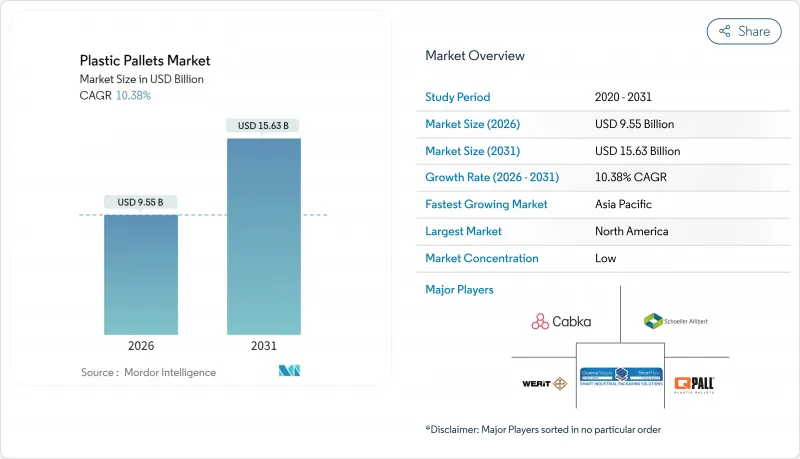
Rising hygiene rules in pharmaceutical cold chains, ISPM-15 compliance costs for wood, and automation-ready warehouse designs are the central growth catalysts shaping the plastic pallets market. Demand also benefits from pooling systems that convert capital expenditure into an operating fee, making shared assets attractive to third-party logistics firms. Polyolefin resin recycling initiatives across the EU add further momentum by aligning pallets with circular-economy targets. Conversely, resin price swings tied to crude oil pose near-term margin pressure for manufacturers.
Global Plastic Pallets Market Trends and Insights
Adoption of Hygienic Plastic Pallets in Pharmaceutical Cold Chains
FDA rules classify pallets as transportation equipment, making cleanable, non-porous designs mandatory in pharma logistics. Plastic pallets resist moisture and maintain structure during temperature swings, lowering contamination risk compared with wood. European producers such as Schoeller Allibert now supply cleanroom-grade pallets tailored to sterile drug manufacturing. The rising cost of product recalls cements adoption, turning plastic units into standard infrastructure for regulated cold chains. As vaccine volumes stay elevated, North American demand remains strong, and similar hygienic standards are spreading across Europe.
Mandates for ISPM-15 Compliance Driving Shift from Wood to Plastic
ISPM-15 requires heat treatment or fumigation for wooden packaging, adding cost and delays to Asia's exports. Plastic pallets are exempt, giving them an immediate compliance advantage in China, Vietnam, and Thailand. Exporters avoid the USD 12-15 per-pallet treatment fee, improving margin on high-volume shipments. The American Lumber Standard Committee's rigorous audit schedule further dissuades wood use by raising administrative burde. As trade lanes tighten lead-time windows, plastic pallets offer certainty, speeding clearance in 182 ISPM-15-signatory nations.
High Upfront Capital Cost Barrier for SMEs in Emerging Southeast Asia
Plastic pallets cost three-to-five times more than wood, deterring cash-constrained SMEs that represent 98.7% of firms in the region. Subsidized loans exist but rarely cover working-capital upgrades of this scale. In Indonesia, where small processors dominate local plastics output, payback periods exceed typical planning horizons. Without cost-sharing pools, adoption remains limited to large exporters who can amortize investment over high rotation counts. Manufacturers now market lower-priced recycled-content pallets, yet financing gaps persist.
Other drivers and restraints analyzed in the detailed report include:
- Pooling Models Reducing Total Cost of Ownership for 3PLs
- Retail Automation Requiring Dimensionally Stable Pallets
- Limited Reverse Logistics Infrastructure for Bulk Return of Pallets
For complete list of drivers and restraints, kindly check the Table Of Contents.
Segment Analysis
HDPE retained 66.03% plastic pallets market share in 2025 thanks to chemical resistance demanded by pharma and food handlers. The plastic pallets market now places premium value on recycled resin, pushing the recycled materials segment toward a 12.29% CAGR through 2031 as EU content mandates tighten. Virgin-resin volatility tied to crude prices makes recycled HDPE more financially attractive, smoothing input costs for manufacturers. Producers such as Q-Pall already manufacture pallets using 98% recycled feedstock, demonstrating technical feasibility at scale.Continued regulatory pressure will likely narrow the cost delta between recycled and virgin grades as demand spikes across Europe.
Recycled polymers also appeal to corporate ESG agendas, which increasingly require transport packaging to carry audited sustainability credentials. The plastic pallets market benefits because pallets can be ground and remolded repeatedly without degrading performance, fitting circular-economy loops that wooden pallets cannot replicate. Producers invest in wash-line capacity to guarantee contaminant removal, thereby meeting food-grade standards for recycled HDPE. North American buyers also test recycled-content offerings to hedge against resin price spikes, while Asian exporters adopt them to highlight low-carbon credentials in tender bids.
Nestable pallets accounted for 42.10% of global revenue in 2025 owing to their ability to cut empty-return freight by up to 80%. Yet the rackable segment will expand at an 11.62% CAGR because automated warehouses demand stable deflection limits that nestable designs seldom meet. Retailers installing AS/RS systems prefer rackable pallets that keep load sag below 6 mm under 1 ton static loads, safeguarding conveyor uptime. Producers answer with glass-fiber-reinforced HDPE to boost stiffness without adding weight.
Stackable pallets hold share in heavy manufacturing where columns two or three loads high demand rigid decks, but growth remains slower than rackable units. Display pallets, a niche sub-group, support promotional formats in big-box retail yet face limited churn due to specialized dimensions. The plastic pallets market continues to balance space-saving nestable designs for transport against rack-ready units for automated fulfillment, with many shippers dual-sourcing both formats to optimize supply chain nodes.
The Plastic Pallets Market Report is Segmented by Material Type (High-Density Polyethylene, and More), Pallet Type (Nestable, Rackable, Stackable, Display/Custom), End-User Industry (Food and Beverage, Chemical, and More), Load Capacity (Light-Duty, Medium-Duty, High-Duty), and Geography (North America, Europe, Asia-Pacific, Middle East and Africa, South America). The Market Forecasts are Provided in Terms of Value (USD).
Geography Analysis
North America commanded 29.20% of global revenue in 2025, supported by mature pooling networks and FDA hygiene regulations that encourage reusable, cleanable platforms. ORBIS's new Greenville, Texas plant shows continuing investment to meet local demand for automation-ready pallets. Retail DC automation further boosts adoption because plastic units maintain tighter dimensional tolerances than wood, reducing conveyor downtime.
Asia-Pacific is the fastest-growing territory, posting a 14.10% CAGR to 2031 as export-oriented firms switch to plastic to avoid ISPM-15 treatment fees. China's lithium battery boom spurs demand for anti-static pallets, while Thailand and Vietnam test cross-border designs launched by Loscam to ease regional flows. Yet financing gaps and limited return loops continue to slow adoption among Southeast Asian SMEs.
Europe benefits from stringent Packaging and Packaging Waste Regulation quotas, which require 40% reusability for transport packaging by 2030, furthering the shift to durable plastic pallets. Established pooling operators can exploit existing reverse-logistics density to hit those targets cost-effectively. Middle East & Africa and South America trail due to weaker retrieval networks, adding operational complexity and loss risk that undercut the life-cycle savings plastic offers over wood.
- Brambles Limited (CHEP)
- CABKA Group GmbH
- Orbis Corporation (Menasha)
- Schoeller Allibert Group BV
- Rehrig Pacific Company
- Tosca Services, LLC
- Loscam International Holdings
- Craemer Holding GmbH
- Gamma-Wopla NV / Smart-Flow NV
- Q-Pall BV
- Plasgad Plastic Products ACS Ltd.
- NAECO S.L.
- Polymer Solutions International Inc.
- RPP Containers
- IPS Plastics Pallets (IPS Group)
- Shandong Huaxiang Plastic Co., Ltd.
- Beijing Jingliang United Plastic Products Co., Ltd.
- TranPak Inc.
- Allied Plastics, Inc.
- Falkenhahn AG
- Buckhorn Inc.
- iGPS Logistics LLC
Additional Benefits:
- The market estimate (ME) sheet in Excel format
- 3 months of analyst support
TABLE OF CONTENTS
1 INTRODUCTION
- 1.1 Study Assumptions and Market Definition
- 1.2 Scope of the Study
2 RESEARCH METHODOLOGY
3 EXECUTIVE SUMMARY
4 MARKET LANDSCAPE
- 4.1 Market Overview
- 4.2 Market Drivers
- 4.2.1 Adoption of Hygienic Plastic Pallets in Pharmaceutical Cold Chains across North America and Europe
- 4.2.2 Mandates for ISPM-15 Compliance Driving Shift from Wood to Plastic in Asia Export Hubs
- 4.2.3 Pooling Models Reducing Total Cost of Ownership for 3PLs in Europe
- 4.2.4 Retail Automation (AS/RS and Conveyor Systems) Requiring Dimensionally Stable Pallets in the U.S.
- 4.2.5 Circular Economy Targets Pushing Demand for Recyclate-Based HDPE Pallets in the EU
- 4.2.6 Battery and Chemical Lithium Supply Chains Preferring Anti-Static Plastic Pallets in China
- 4.3 Market Restraints
- 4.3.1 High Upfront Capital Cost Barrier for SMEs in Emerging Southeast Asia
- 4.3.2 Limited Reverse Logistics Infrastructure for Bulk Return of Pallets in Africa and South America
- 4.3.3 Price Volatility of Virgin Polyolefin Resins Linked to Crude-Oil Swings
- 4.3.4 Perception of Lower Load Capacity Versus Hardwood Pallets Among Heavy-Duty Users in Construction
- 4.4 Supply-Chain Analysis
- 4.5 Technological Outlook
- 4.6 Sustainability and Recycling/Reusability of Plastic Pallets
- 4.7 Regulatory Framework and Standards
- 4.8 Porter's Five Forces Analysis
- 4.8.1 Bargaining Power of Suppliers
- 4.8.2 Bargaining Power of Buyers
- 4.8.3 Threat of New Entrants
- 4.8.4 Threat of Substitutes
- 4.8.5 Intensity of Competitive Rivalry
5 MARKET SIZE AND GROWTH FORECASTS (VALUE)
- 5.1 By Material Type
- 5.1.1 High-Density Polyethylene (HDPE)
- 5.1.2 Polypropylene (PP)
- 5.1.3 Recycled Materials
- 5.2 By Pallet Type
- 5.2.1 Nestable
- 5.2.2 Rackable
- 5.2.3 Stackable
- 5.2.4 Display / Custom
- 5.3 By End-User Industry
- 5.3.1 Food and Beverage
- 5.3.2 Chemical
- 5.3.3 Pharmaceutical and Healthcare
- 5.3.4 Retail and E-Commerce
- 5.3.5 Logistics and Warehousing
- 5.3.6 Automotive
- 5.3.7 Other End-User Industry
- 5.4 By Load Capacity
- 5.4.1 Light - Duty Pallets
- 5.4.2 Medium - Duty Pallets
- 5.4.3 High - Duty Pallets
- 5.5 By Geography
- 5.5.1 North America
- 5.5.1.1 United States
- 5.5.1.2 Canada
- 5.5.1.3 Mexico
- 5.5.2 Europe
- 5.5.2.1 Germany
- 5.5.2.2 United Kingdom
- 5.5.2.3 France
- 5.5.2.4 Italy
- 5.5.2.5 Spain
- 5.5.2.6 Russia
- 5.5.2.7 Rest of Europe
- 5.5.3 Asia-Pacific
- 5.5.3.1 China
- 5.5.3.2 India
- 5.5.3.3 Japan
- 5.5.3.4 South Korea
- 5.5.3.5 Australia and New Zealand
- 5.5.3.6 Rest of Asia-Pacific
- 5.5.4 Middle East and Africa
- 5.5.4.1 Middle East
- 5.5.4.1.1 United Arab Emirates
- 5.5.4.1.2 Saudi Arabia
- 5.5.4.1.3 Turkey
- 5.5.4.1.4 Rest of Middle East
- 5.5.4.2 Africa
- 5.5.4.2.1 South Africa
- 5.5.4.2.2 Nigeria
- 5.5.4.2.3 Egypt
- 5.5.4.2.4 Rest of Africa
- 5.5.4.1 Middle East
- 5.5.5 South America
- 5.5.5.1 Brazil
- 5.5.5.2 Argentina
- 5.5.5.3 Rest of South America
- 5.5.1 North America
6 COMPETITIVE LANDSCAPE
- 6.1 Market Concentration
- 6.2 Strategic Moves
- 6.3 Market Share Analysis
- 6.4 Company Profiles (includes Global level Overview, Market level overview, Core Segments, Financials as available, Strategic Information, Market Rank/Share for key companies, Products and Services, and Recent Developments)
- 6.4.1 Brambles Limited (CHEP)
- 6.4.2 CABKA Group GmbH
- 6.4.3 Orbis Corporation (Menasha)
- 6.4.4 Schoeller Allibert Group BV
- 6.4.5 Rehrig Pacific Company
- 6.4.6 Tosca Services, LLC
- 6.4.7 Loscam International Holdings
- 6.4.8 Craemer Holding GmbH
- 6.4.9 Gamma-Wopla NV / Smart-Flow NV
- 6.4.10 Q-Pall BV
- 6.4.11 Plasgad Plastic Products ACS Ltd.
- 6.4.12 NAECO S.L.
- 6.4.13 Polymer Solutions International Inc.
- 6.4.14 RPP Containers
- 6.4.15 IPS Plastics Pallets (IPS Group)
- 6.4.16 Shandong Huaxiang Plastic Co., Ltd.
- 6.4.17 Beijing Jingliang United Plastic Products Co., Ltd.
- 6.4.18 TranPak Inc.
- 6.4.19 Allied Plastics, Inc.
- 6.4.20 Falkenhahn AG
- 6.4.21 Buckhorn Inc.
- 6.4.22 iGPS Logistics LLC
7 MARKET OPPORTUNITIES AND FUTURE OUTLOOK
- 7.1 White-space and Unmet-Need Assessment