
|
시장보고서
상품코드
1907276
항콕시듐제 : 시장 점유율 분석, 업계 동향 및 통계, 성장 예측(2026-2031년)Anticoccidial Drugs - Market Share Analysis, Industry Trends & Statistics, Growth Forecasts (2026 - 2031) |
||||||
 Mordor Intelligence
항콕시듐제 시장은 2025년 16억 5,000만 달러에서 2026년에는 17억 4,000만 달러로 성장해 2026년부터 2031년에 걸쳐 CAGR 5.28%를 나타낼 전망입니다. 2031년까지 22억 5,000만 달러에 달할 것으로 예상됩니다.
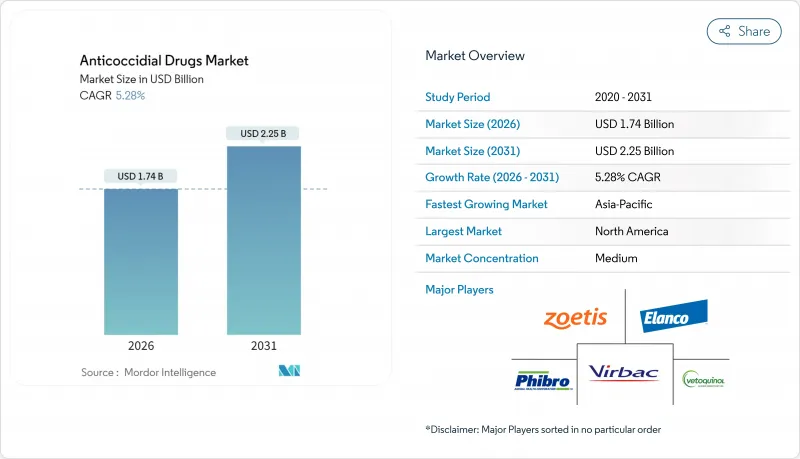
합리적인 가격의 동물성 단백질에 대한 세계 수요 증가, 엄격한 바이오 보안 요건 및 첨단 예방 의료 프로토콜을 통해 항 콕시듐증 대책은 상업 생산자에게 최우선 과제가되고 있습니다. 북미는 자금력 있는 생산자가 정기적으로 로테이션 프로그램을 실시하고, 다른 지역에 앞서 신제제를 도입하고 있기 때문에 주도적 지위를 유지하고 있습니다. 규제 당국이 항균성 사료 첨가물을 엄격하게 모니터링하는 동안, 식물 유래 및 식물성 대체품이 주목을 받고 있으며, 디지털 주문 채널의 확대로 수의사와 생산자 모두에게 제품에 대한 접근이 확대되고 있습니다. 경쟁의 심각성은 중간 정도입니다. 소수의 다각화 동물 건강 기업이 통합된 제조, 유통, 기술 서비스 능력을 활용하여 점유율을 지키고 있지만, 소규모 혁신 기업은 약물 내성 증가를 완화하는 잔류물 제로 요법과 복합 요법이라는 미개척 분야를 발견하고 있습니다.
세계의 항콕시듐제 시장 동향과 인사이트
가금류와 가축에서 콕시듐증 증가 경향
최근 감시조사에서는 한국의 육계 농장에서 감염률이 75%를 넘어 현장 분리주가 6가지 주요 약품 클래스에 내성을 나타내는 것으로 밝혀졌습니다. 케이지 프리 및 릴리프로의 전환은 조류가 더 높은 환경 낭종 부하에 노출되기 때문에 병원체에 대한 노출 위험이 증가하고 있습니다. 무증상 감염은 성장을 최대 1/3로 줄이고 사료요구율을 악화시키고 이미 얇은 생산자의 이익률을 더욱 압박합니다. 지역 감시 프로그램은 또한 아이메리아 속의 균주가 환경적·약리학적 압력에 신속하게 적응하고, 기존 약제의 유효 수명을 단축하고 있는 것이 밝혀졌습니다. 이러한 동향은 기생충 부하를 생산성 제한 임계치 이하로 유지하는 회전 계획, 이중 작용형 약제의 병용, 백신 첨가제에 대한 수요를 더욱 강화하고 있습니다.
세계 동물성 단백질 생산 확대
2050년까지 70%로 예측되는 식육 소비량 증가는 특히 아시아태평양과 아프리카에서 급속한 생산 능력 확대를 이끌고 있습니다. 캄보디아의 칩몬 그룹의 6,000만 달러 규모의 사료 공장과 같은 시설은 고급 약물 첨가 사료 프로그램을 지원하는 수직 통합 시스템에 대한 투자를 상징합니다. 생산 클러스터는 종종 수의학 인프라가 수요를 따라잡지 않은 지역에 형성되어 광역 스펙트럼에서 투여가 용이한 항콕시듐제에 대한 관심을 높이고 있습니다. 다수의 신흥 시장에서는 정책입안자가 확립된 분자화합물의 등록을 신속하게 함으로써 국내 공급의 안정화를 가속화하고 고비용 수입을 억제하는 움직임을 볼 수 있습니다.
항균성 사료 첨가물에 대한 엄격한 규제
EU에서는 이온 포어가 의료상 중요한 항균제와 동등하게 분류되는 경향이 강해져, 사용 제한 및 기록 관리 요건의 강화가 진행중입니다. 경제 모델에 따르면 영국의 육계 생산에서 이온 포어를 완전히 철폐하면 생산자에게는 연간 최대 1억 995만 파운드의 비용 증가가 발생하여 추가로 8만 4,000톤의 CO2가 배출되는 것으로 나타났으며, 이 정책의 광범위한 영향이 부각되고 있습니다. 고급 윤작이나 백신접종 프로그램이 없는 소규모 생산자에게는 컴플라이언스 비용의 부담이 가장 무겁다. 그 결과 시장은 양극화되었습니다. 프리미엄 브랜드는 백신 단독 사용을 주장해 이익을 얻고 있는 한편, 기존 생산자는 한정적이라고 해도 화학물질의 사용 계속을 요구해 로비 활동을 실시했습니다.
부문 분석
이오노포어계 항콕시듐제은 2025년 시장 점유율의 51.78%를 차지하며 대규모 가금류 프로그램의 기반이 되었습니다. 반세기에 걸친 현지 데이터는 상대적으로 느린 내성 형성과 신뢰성이 높은 효과를 뒷받침하기 때문입니다. 식물 유래 항콕시듐제 시장 규모는 현재 소규모이면서 7.18%의 연평균 복합 성장률(CAGR)로 다른 카테고리를 상회하는 성장률을 나타내고 있습니다. 이 성장은 잔여물이 없는 닭고기를 요구하는 소비자 수요와 항균제에 대한 규제 당국의 엄격화 자세에 지지되고 있습니다. 실제 생산 현장에서는 저용량 이오노포어에 식물성 유효성분을 병용하여 효과 지속기간을 연장하는 사례가 증가하고 있습니다. 합성화학약품과 설폰아미드계 약제는 성숙한 지위를 차지하고 있으며, 약제로테이션이 확립된 분자에 의존하는 지역에서는 수요가 평평해지고 있습니다. 한편, 트리아진 유도체와 특수 배합제는 틈새 실패 사례에 대응하고 있습니다. 규제 당국, 특히 FDA와 EMA는 시너지 효과와 명확한 관리 이점을 입증하는 제형의 승인을 선호합니다.
채용 패턴은 지역에 따라 다릅니다. 유럽 기업들은 이오노포어 규제를 피하기 위해 식물성 제품군에 많은 투자를 하고 있는 반면, 미국의 통합 생산자는 여전히 모노센신과 살리노마이신을 회전의 주력으로 의존하고 있습니다. 아시아태평양의 생산자는 혼합 프로그램을 채택하고 저비용 이오노포어와 현지 조달 식물 추출물을 통합하여 경제성과 수출 시장에 대한 적합성의 균형을 이루고 있습니다. 원료의 가용성이 확대되고 추출수율이 향상됨에 따라 식물성 제품과 화학제품 간의 비용차가 줄어들어 이익목표를 희생하지 않고 보다 광범위한 채용을 지원하고 있습니다.
예방 프로그램에서는 콕시듐 증식 억제 작용이 선호되었으며 2025년에는 항콕시듐제 시장 전체의 67.90%를 차지했습니다. 지속적인 저농도 노출은 병원체의 증식을 억제하고 면역 발달을 촉진하기 때문에 돌발적인 치료보다 예측 가능한 평균 일일 증량을 중시하는 업계 경제성에 부합합니다. 살낭제 제품은 점유율이 작은 것, 발생시나 회전 계획이 효력을 잃었을 때에 필수적이기 때문에 7.44%라는 높은 CAGR을 나타내고 있습니다. 생산자는 성장기에 정적 제품을 정기적으로 병용하고, 그리고 축전에는 단기간의 살낭제 펄스 투여로 무리의 노출 상태를 리셋하여 내성 발생을 억제하고 있습니다.
현지 연구자에 따르면, 특정 아이멜리아 속 원충 균주는 정적 약물에 대한 부분적인 감수성을 유지하면서 살충 분자에 대한 내성을 나타내는 것으로 확인되어 내성 진화의 복잡성을 보여주고 있습니다. 이 때문에 개발 기업은 감수성의 차이를 활용하기 위해 연속적 또는 동시적인 약물 조합을 모색하고 있습니다. 규제상 표시에서는 현재, 예방 목적과 치료 목적을 명확하게 구별하는 것이 추천되고 있어, 이것에 의해 수의사의 판단이 용이하게 되어, 고생산 환경에 있어서 항균약의 보다 적절한 관리가 촉진되고 있습니다.
지역별 분석
북미는 2025년에 40.85%의 점유율을 차지하여 최대의 지역 공헌도를 나타냈습니다. 고급 상업 통합은 일상적인 항콕시듐제 사용을 지원하고 FDA의 약물 모니터링 기준은 국제 벤치마크가 되었습니다. 미국은 광대한 육계·비육산업이 전주기 예방 프로토콜을 일상적으로 채용하고 있기 때문에 지역 수익을 견인하고 있습니다. 캐나다와 멕시코는 생조, 사료 원료, 완성 의약품의 국경을 넘은 유통을 통해 대륙 규모의 연계를 강화하고, 삼국간공급 체인을 특징짓고 있습니다.
아시아태평양은 단백질소비량 증가와 농장근대화 프로그램이 함께 2031년까지 연평균 복합 성장률(CAGR) 6.25%라는 가장 빠른 성장을 보입니다. 중국의 생산자는 자동투여시스템을 도입하여 깔개 교환 빈도를 줄이는 채란닭과 육계복합시설을 확대하고 있으며, 모두 효과적인 항콕시듐제에 대한 기초 수요를 높이고 있습니다. 베트남, 인도네시아, 인도에서는 정부가 주도하는 노력을 통해 신규 사료 공장에 대한 대출을 촉진하고 약물 첨가 사료를 표준 운영 절차에 통합하고 있습니다.
유럽에서는 항균제 사용 규제가 있는 것, 전략적 중요성은 변하지 않습니다. 생산자는 식물성 배합 사료와 백신 접종 프로토콜로 전환하고 있으며, 잔류물 제로를 증명할 수 있는 공급자는 우선적인 선반 공간을 획득하고 있습니다. 이 지역의 엄격한 규제는 종종 세계 표준의 선구자이기 때문에 수출 시장을 위한 분자에 대한 유럽 인증은 매우 중요합니다.
남미 및 중동 및 아프리카는 양계통합기업이 사업 규모를 확대하는 가운데 소폭이면서 증가세를 보이고 있습니다. 통화 변동과 불충분한 콜드체인 인프라가 신제품의 보급을 억제하는 한편 다국적 기업은 리드 타임 단축과 가격 현지화를 목적으로 브라질, 남아프리카, 걸프 국가에 2차 포장 시설과 프리믹스 공장을 잇따라 설치하고 있습니다.
기타 혜택 :
- 엑셀 형식 시장 예측(ME) 시트
- 애널리스트 지원(3개월간)
자주 묻는 질문
목차
제1장 서론
- 조사 전제조건 및 시장 정의
- 조사 범위
제2장 조사 방법
제3장 주요 요약
제4장 시장 상황
- 시장 개요
- 시장 성장 촉진요인
- 가금류와 가축에서 콕시듐증 증가 경향
- 세계의 동물성 단백질 생산 확대
- 수의학 제제의 지속적인 혁신
- 신흥 시장에서의 상업 사료 제조 능력의 확대
- 고부담 지역에서의 사료 첨가제의 규제 지원
- 예방적 동물 위생 관리 수법의 도입 확대
- 시장 성장 억제요인
- 항균성 사료 첨가물에 대한 엄격한 규제
- 아이멜리아속에 있어서 항콕시듐제 내성 증가
- 항생제 미사용 및 유기 축산물에 대한 소비자 지향의 변화
- 제약 원약공급 체인 혼란과 가격 변동성
- 규제 상황
- Porter's Five Forces 분석
- 신규 참가업체의 위협
- 구매자/소비자의 협상력
- 공급기업의 협상력
- 대체품의 위협
- 경쟁 기업 간 경쟁 관계
제5장 시장 규모와 성장 예측(금액)
- 약제 클래스별
- 이온포어
- 합성 화학물질
- 설폰아미드
- 트리아진 유도체
- 복합제제
- 식물성 및 식물 유래 대체제
- 기타 약물 분류
- 약리 작용별
- 코크시디오스태틱
- 코크시디오사이드
- 동물별
- 가축
- 소
- 가금류
- 돼지
- 양 및 염소
- 기타 가축
- 반려동물
- 개
- 고양이
- 기타 반려동물
- 가축
- 유통 채널별
- 동물병원
- 소매 약국
- 온라인 약국
- 기타 유통 채널
- 지역별
- 북미
- 미국
- 캐나다
- 멕시코
- 유럽
- 독일
- 영국
- 프랑스
- 이탈리아
- 스페인
- 기타 유럽
- 아시아태평양
- 중국
- 일본
- 인도
- 호주
- 한국
- 기타 아시아태평양
- 중동 및 아프리카
- GCC
- 남아프리카
- 기타 중동 및 아프리카
- 남미
- 브라질
- 아르헨티나
- 기타 남미
- 북미
제6장 경쟁 구도
- 시장 집중도
- 시장 점유율 분석
- 기업 프로파일
- Zoetis
- Phibro Animal Health Corporation
- Huvepharma
- Elanco
- Ceva Sante Animale
- MSD Animal Health
- Boehringer Ingelheim
- Virbac
- Vetoquinol SA
- HIPRA
- Impextraco NV
- Kemin Industries
- Novus International
- De Heus Animal Nutrition
- Advacare Pharma
- BioChek BV
- ECO Animal Health
제7장 시장 기회와 향후 전망
KTH 26.01.20The anticoccidial drugs market is expected to grow from USD 1.65 billion in 2025 to USD 1.74 billion in 2026 and is forecast to reach USD 2.25 billion by 2031 at 5.28% CAGR over 2026-2031.
Rising global demand for affordable animal protein, tightening biosecurity requirements, and increasingly sophisticated preventive-health protocols keep anticoccidiosis control top of mind for commercial producers. North America retains its leadership position because well-capitalized producers routinely implement rotation programs and adopt new formulations ahead of other regions. Botanical and phytogenic alternatives gain traction as regulators scrutinize antimicrobial feed additives, while digital ordering channels broaden product access for veterinarians and producers alike. Competitive intensity is moderate; a handful of diversified animal-health companies leverage integrated manufacturing, distribution, and technical-service capabilities to defend share, yet smaller innovators are finding white space in residue-free and combination therapies that mitigate rising drug resistance.
Global Anticoccidial Drugs Market Trends and Insights
Rising Prevalence of Coccidiosis in Poultry and Livestock
Recent surveillance shows infection rates exceeding 75% on Korean broiler farms, with field isolates resistant to six main drug classes. Transitions to cage-free and free-range housing elevate pathogen exposure because birds encounter higher environmental oocyst loads. Subclinical infections reduce growth by up to one-third and worsen feed-conversion ratios, eroding already thin producer margins. Regional monitoring programs additionally reveal that Eimeria strains adapt quickly to environmental and pharmacologic pressure, shortening the effective lifespan of older molecules. These trends reinforce demand for rotation schemes, dual-mode combinations, and vaccination add-ons that keep parasite loads below performance-limiting thresholds.
Expansion Of Global Animal Protein Production
Projected meat-consumption growth of 70% by 2050 drives rapid capacity additions, particularly in Asia-Pacific and Africa. Facilities such as Chip Mong Group's USD 60 million feed plant in Cambodia illustrate investment in vertically integrated systems capable of supporting advanced medicated-feed programs. Production clusters often emerge in regions where veterinary infrastructure trails demand, prompting interest in broad-spectrum, easy-to-administer anticoccidial options. Policymakers in several emerging markets now fast-track registrations for well-established molecules to accelerate domestic supply security and curtail costly imports.
Stringent Regulations on Antimicrobial Feed Additives
The EU increasingly classifies ionophores alongside medically important antimicrobials, triggering use restrictions and heightened record-keeping requirements. Economic modeling suggests full ionophore withdrawal from UK broiler production would cost producers as much as GBP 109.95 million annually and release an extra 84,000 t of CO2, illustrating the policy's broad implications. Compliance expenses weigh heaviest on smallholders that lack sophisticated rotation or vaccination programs. The resulting market bifurcates: premium brands capitalize on vaccine-only claims, while conventional operations lobby for continued, albeit limited, chemical options.
Other drivers and restraints analyzed in the detailed report include:
- Continuous Innovation in Veterinary Pharmaceutical Formulations
- Growth Of Commercial Feed Manufacturing Capacity In Emerging Markets
- Growing Anticoccidial Drug Resistance Among Eimeria Species
For complete list of drivers and restraints, kindly check the Table Of Contents.
Segment Analysis
Ionophores captured 51.78% of anticoccidial drugs market share in 2025 and continue to underpin large-scale poultry programs because half a century of field data confirms reliable performance with comparatively slower resistance buildup. The anticoccidial drugs market size for botanicals is small today yet grows faster than any other class at 7.18% CAGR, a trajectory fueled by consumer demand for residues-free poultry and regulators' tightening stance on antimicrobials. In practice, producers increasingly layer phytogenic actives over low-dose ionophores to stretch efficacy cycles. Synthetic chemicals and sulfonamides occupy mature positions and face flat demand in regions where drug rotation relies on established molecules, while triazine derivatives and specialized combinations serve niche failures. Regulatory gatekeepers, especially the FDA and EMA, prioritize combination approvals that demonstrate synergistic efficacy and clear stewardship benefits.
Adoption patterns diverge regionally. European firms invest heavily in botanical portfolios to navigate ionophore restrictions, whereas U.S. integrators still rely on monensin and salinomycin as rotation mainstays. APAC producers embrace mixed programs, integrating low-cost ionophores with locally sourced plant extracts to balance economics and export-market compliance. As raw-material availability expands and extraction yields improve, cost gaps between botanicals and chemicals narrow, supporting broader uptake without sacrificing margin targets.
Preventive programs favor coccidiostatic modes, which together comprised 67.90% of the anticoccidial drugs market size in 2025. Steady low-level exposure dampens pathogenic replication and permits immunity development, aligning with industry economics that reward predictable average daily gain over episodic treatment. Coccidiocidal products, although smaller in share, post a brisk 7.44% CAGR because they are indispensable when outbreaks occur or when rotation schemes lose efficacy. Producers regularly pair a static product during grow-out with a short cidal pulse before slaughter to reset flock exposure and curb resistance.
Field researchers note that certain Eimeria strains remain partially susceptible to statics yet display tolerance toward cidal molecules, illustrating the complexity of resistance evolution. Consequently, innovators explore sequential or simultaneous combinations to exploit differential sensitivity. Regulatory labeling now encourages explicit preventive versus therapeutic claims, easing veterinarian decision-making and promoting more judicious antimicrobial stewardship in high-output settings.
The Anticoccidial Drugs Market Report is Segmented by Drug Class (Ionophores, and More), Drug Action (Coccidiostatic and Coccidiocidal), Animal (Livestock Animals and Companion Animals), Distribution Channel (Veterinary Hospitals, and More), and Geography (North America, Europe, Asia-Pacific, Middle East & Africa, South America). The Market Forecasts are Provided in Terms of Value (USD).
Geography Analysis
North America generated the largest regional contribution with 40.85% share in 2025. High levels of commercial integration support routine anticoccidial usage, and FDA pharmacovigilance standards set benchmarks internationally. The United States dominates regional revenue thanks to its expansive broiler and feedlot industries that routinely adopt full-cycle preventive protocols. Canada and Mexico reinforce continental scale through cross-border flows of live birds, feed ingredients, and finished pharmaceuticals, underscoring a trilateral supply chain.
Asia-Pacific posts the fastest advance at 6.25% CAGR to 2031 as protein-consumption gains intersect with farm-modernization programs. Chinese producers expand layer and broiler complexes that deploy automatic dosing and recycle litter less frequently, both of which elevate baseline demand for effective anticoccidials. Government-backed initiatives in Vietnam, Indonesia, and India funnel credit into new feed mills, embedding medicated feeds into standard operating procedures.
Europe remains strategically important despite antimicrobial-use restrictions. Producers pivot toward botanical blends and vaccination protocols, and suppliers that can document residue-free status win premium shelf placement. The region's stringent rules often foreshadow global standards, making European validation critical for molecules targeting export markets.
South America and Middle East & Africa together capture a modest but rising slice as poultry integrators scale operations. Currency volatility and patchy cold-chain infrastructure moderate uptake of newer products, yet multinationals increasingly site secondary packaging or premix facilities in Brazil, South Africa, and the Gulf to shorten lead times and localize pricing.
- Zoetis
- Phibro Animal Health
- Huvepharma
- Elanco
- Ceva Sante Animale
- MSD Animal Health
- Boehringer Ingelheim
- Virbac
- Vetoquinol
- Hipra
- Impextraco
- Kemin Industries
- Novus International
- De Heus Animal Nutrition
- AdvaCare
- Biochek
- ECO Animal Health Group
Additional Benefits:
- The market estimate (ME) sheet in Excel format
- 3 months of analyst support
TABLE OF CONTENTS
1 Introduction
- 1.1 Study Assumptions & Market Definition
- 1.2 Scope of the Study
2 Research Methodology
3 Executive Summary
4 Market Landscape
- 4.1 Market Overview
- 4.2 Market Drivers
- 4.2.1 Rising Prevalence of Coccidiosis in Poultry and Livestock
- 4.2.2 Expansion of Global Animal Protein Production
- 4.2.3 Continuous Innovation in Veterinary Pharmaceutical Formulations
- 4.2.4 Growth of Commercial Feed Manufacturing Capacity in Emerging Markets
- 4.2.5 Regulatory Support for In-Feed Medicated Additives in High-Burden Regions
- 4.2.6 Increasing Adoption of Preventive Animal Health Management Practices
- 4.3 Market Restraints
- 4.3.1 Stringent Regulations on Antimicrobial Feed Additives
- 4.3.2 Growing Anticoccidial Drug Resistance Among Eimeria Species
- 4.3.3 Consumer Shift Toward Antibiotic-Free And Organic Animal Products
- 4.3.4 Supply Chain Disruptions and Price Volatility Of Active Pharmaceutical Ingredients
- 4.4 Regulatory Landscape
- 4.5 Porter's Five Forces Analysis
- 4.5.1 Threat Of New Entrants
- 4.5.2 Bargaining Power Of Buyers/Consumers
- 4.5.3 Bargaining Power Of Suppliers
- 4.5.4 Threat Of Substitute Products
- 4.5.5 Intensity Of Competitive Rivalry
5 Market Size & Growth Forecasts (Value; USD)
- 5.1 By Drug Class
- 5.1.1 Ionophores
- 5.1.2 Synthetic Chemicals
- 5.1.3 Sulphonamides
- 5.1.4 Triazine Derivatives
- 5.1.5 Combination Products
- 5.1.6 Botanicals & Phytogenic Alternatives
- 5.1.7 Other Drug Classes
- 5.2 By Drug Action
- 5.2.1 Coccidiostatic
- 5.2.2 Coccidiocidal
- 5.3 By Animal
- 5.3.1 Livestock Animals
- 5.3.1.1 Cattle
- 5.3.1.2 Poultry
- 5.3.1.3 Swine
- 5.3.1.4 Sheep & Goats
- 5.3.1.5 Other Livestock
- 5.3.2 Companion Animals
- 5.3.2.1 Dogs
- 5.3.2.2 Cats
- 5.3.2.3 Other Companion Animals
- 5.3.1 Livestock Animals
- 5.4 By Distribution Channel
- 5.4.1 Veterinary Hospitals
- 5.4.2 Retail Pharmacies
- 5.4.3 Online Pharmacies
- 5.4.4 Other Distribution Channels
- 5.5 Geography
- 5.5.1 North America
- 5.5.1.1 United States
- 5.5.1.2 Canada
- 5.5.1.3 Mexico
- 5.5.2 Europe
- 5.5.2.1 Germany
- 5.5.2.2 United Kingdom
- 5.5.2.3 France
- 5.5.2.4 Italy
- 5.5.2.5 Spain
- 5.5.2.6 Rest of Europe
- 5.5.3 Asia-Pacific
- 5.5.3.1 China
- 5.5.3.2 Japan
- 5.5.3.3 India
- 5.5.3.4 Australia
- 5.5.3.5 South Korea
- 5.5.3.6 Rest of Asia-Pacific
- 5.5.4 Middle East & Africa
- 5.5.4.1 GCC
- 5.5.4.2 South Africa
- 5.5.4.3 Rest of Middle East & Africa
- 5.5.5 South America
- 5.5.5.1 Brazil
- 5.5.5.2 Argentina
- 5.5.5.3 Rest of South America
- 5.5.1 North America
6 Competitive Landscape
- 6.1 Market Concentration
- 6.2 Market Share Analysis
- 6.3 Company Profiles (includes Global level Overview, Market level overview, Core Business Segments, Financials, Headcount, Key Information, Market Rank, Market Share, Products and Services, and analysis of Recent Developments)
- 6.3.1 Zoetis
- 6.3.2 Phibro Animal Health Corporation
- 6.3.3 Huvepharma
- 6.3.4 Elanco
- 6.3.5 Ceva Sante Animale
- 6.3.6 MSD Animal Health
- 6.3.7 Boehringer Ingelheim
- 6.3.8 Virbac
- 6.3.9 Vetoquinol SA
- 6.3.10 HIPRA
- 6.3.11 Impextraco NV
- 6.3.12 Kemin Industries
- 6.3.13 Novus International
- 6.3.14 De Heus Animal Nutrition
- 6.3.15 Advacare Pharma
- 6.3.16 BioChek BV
- 6.3.17 ECO Animal Health
7 Market Opportunities & Future Outlook
- 7.1 White-Space & Unmet-Need Assessment