
|
시장보고서
상품코드
1907288
인쇄 잉크 시장 : 점유율 분석, 업계 동향, 통계, 성장 예측(2026-2031년)Printing Inks - Market Share Analysis, Industry Trends & Statistics, Growth Forecasts (2026 - 2031) |
||||||
 Mordor Intelligence
인쇄 잉크 시장은 2025년에 185억 8,000만 달러로 평가되었으며, 2026년 191억 6,000만 달러, 2031년까지 223억 3,000만 달러에 이를 것으로 예측됩니다. 예측기간(2026-2031년)의 CAGR은 3.11%를 나타낼 것으로 전망됩니다.
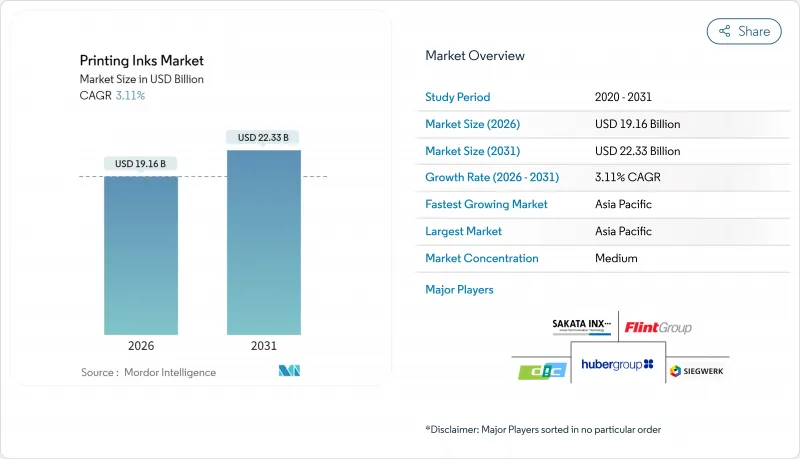
포장 분야, 디지털화, 지속가능성이 결합되어 수요 패턴, 설비 투자, 지역적 변화를 형성하고 있습니다. 포장 분야는 이미 인쇄 잉크 시장의 55.94%를 차지하고 있으며, 2030년까지 연평균 복합 성장률(CAGR)4.37%에서 가장 급속히 확대하는 용도 분야로 계속되고 있습니다. 유성 잉크는 여전히 큰 점유율을 차지하고 있지만, 컨버터가 즉시 경화와 저에너지 소비를 추구하는 가운데, UV-LED 잉크가 7.59%라는 최고의 CAGR을 기록하고 있습니다. 따라서 인쇄 잉크 시장은 기존의 강점과 신흥 환경 친화적 인 디지털 기능을 균형있게 통합합니다.
세계의 인쇄 잉크 시장 동향과 통찰
디지털 인쇄 산업의 성장
디지털 인쇄는 틈새 개념에서 주류 생산 플랫폼으로 전환하여 인쇄 잉크 시장을 재구성합니다. 장비 비용이 지속적으로 감소하고 헤드 성능이 향상됨에 따라 컨버터는 단기 및 중간 로트 생산을 잉크젯으로 전환하여 납기 단축과 재고 위험 감소를 실현합니다. 잉크 제조업체는 이에 대응해, 고속 분사시에도 색조 안정성을 유지하는 저점도 및 고광학 농도 안료 패키지를 제공합니다. 디지털 패브릭 프린팅은 온디맨드 의류 및 장식 맞춤형 수요에 힘입어 연간 150억 미터에 달하는 규모로 성장하고 있습니다. 포장 컨버터는 가변 데이터를 활용해, 계절 한정 프로모션이나 지역 언어에의 대응을 실현. 리드 타임을 몇 주에서 며칠로 단축했습니다.
포장 및 라벨 수요 증가
도시화의 진전, 가구 규모의 축소, EC 물류의 보급에 의해 소비 습관이 변화하는 가운데, 포장 제품의 세계 수요는 꾸준히 확대되고 있습니다. 골판지 상자, 판지 슬리브, 플렉서블 파우치는 모두 기계적 스트레스나 물류시의 습도에 견디는 내구성 및 식품 안전성을 갖춘 잉크가 필요합니다. 브랜드는 혼잡한 선반에서 차별화를 도모하기 때문에 고화질 그래픽과 촉감 마무리에 의존하고, 이것이 특수 코팅과 금속 안료의 가치를 높이고 있습니다. 아시아태평양과 아프리카의 일부 신흥 경제 국가에서는 포장 식품 및 개인 관리 제품이 두 자릿수 성장을 보이며 수성 플렉소 잉크 및 그라비아 잉크 수요 증가를 지원합니다. 라벨 용도는 QR 코드나 위조 방지 기능 등 데이터량이 많은 정보 통합이 진행되어 정밀한 정렬과 뛰어난 색 안정성이 요구되고 있습니다. 그 결과, 거시경제 감속기간에도 수요량의 지속적인 확대가 실현되고, 포장 분야가 인쇄 잉크 시장의 주요 성장 엔진으로서의 역할을 강화하고 있습니다.
전통적인 상업 인쇄 감소
광고주가 예산을 디지털 채널에 재분배하는 가운데, 신문 및 잡지의 발행 부수는 분기마다 축소하고 있습니다. 2024년 1월에는 미국에서의 인쇄 및 필기 용지의 출하량이 전년 대비 9% 감소했습니다. 이로 인해 오프셋 잉크 소비량이 줄어들고 잉여 조제 능력이 생겨 가격 경쟁이 격화되고 있습니다. 인쇄회사는 구식 인쇄기를 폐기하고 있어 대체 잉크의 애프터마켓 수요가 줄어들고, 유지보수 서비스의 수익도 감소하고 있습니다. 일부 공급업체는 수성 플렉소 시스템을 생산하기 위해 혼합 설비를 개조하여 대응하지만, 상업 인쇄 수요가 부진한 상황에서는 투자 회수 기간이 장기화됩니다. 이러한 장기 침체로 인해 예측 CAGR은 0.4포인트 떨어지지만 새로운 디지털 인쇄 및 포장 분야 수요 증가로 인해 일부 상쇄됩니다.
부문 분석
유성 잉크는 비용 효율성과 광범위한 호환성으로 2025년 수익의 40.70%를 차지했지만, VOC 규제 강화로 성장이 둔화되는 경향이 있습니다. UV-LED 제품은 7.47%의 연평균 복합 성장률(CAGR)을 기록하고 있으며, 즉각적인 경화와 에너지 절약성을 요구하는 컨버터의 선호를 반영하고 있습니다. 수성 패키지는 골판지 상자나 종이컵으로 보급이 진행되고 있으며, 특히 식품접촉 규제와 재활용 요건이 엄격화하는 유럽연합(EU) 영역 내에서 수요가 높아지고 있습니다. 솔벤트 시스템은 극한의 접착력이 필요한 특수 산업용 데칼에서 지속적으로 사용되지만 생산량은 점차 휘발성이 낮은 대체품으로 전환하고 있습니다.
제조 공정의 물류가 구매 행동을 좌우합니다. UV-LED 인쇄기는 종종 램프 수명이 20,000시간을 초과하여 장기 유지 보수 정지를 피할 수 있습니다. 폐기물의 감소와 에너지 비용의 감소로 에너지 경화형 화학제품은 총 소유 비용면에서 우위를 나타냅니다. 병행하여 원료 가격의 변동성과 기업 지속가능성 보고 기준에 있어서의 공개 요건의 강화에 따라, 바이오 베이스 오일 대체품의 관심이 높아지고 있습니다. 바이오용제 공급망은 미성숙하면서 조기 도입 기업은 식물 유래 성분에 의한 마케팅 우위를 확보하고 있습니다. 이러한 복합적인 동향은 인쇄 잉크 시장이 저 VOC 및 속 경화 플랫폼으로 점진적이면서도 확실하게 재조합되는 것을 시사하고 있습니다.
인쇄 잉크 시장 보고서는 유형별(용제계, 수성, 유성, UV, UV-LED, 기타), 프로세스별(평판 인쇄, 플렉소 인쇄, 그라비아 인쇄, 디지털 인쇄, 기타), 용도(포장, 상업 인쇄·출판, 섬유, 기타 용도), 지역(아시아태평양, 북미, 유럽, 남미, 중동 및 아프리카)마다 분석했습니다.
지역별 분석
아시아태평양은 2025년 세계 수익의 40.10%를 차지했고 3.96%의 연평균 복합 성장률(CAGR)로 성장하고 있으며 중국, 인도, 동남아시아의 견고한 제조 생태계를 반영합니다. 국내 소비는 확대되는 중산계급과 함께 증가해 포장 스낵, 퍼스널케어, 의약품 수요를 끌어 올리고 있습니다. 현지 컨버터 기업은 고속 플렉소 인쇄 라인에 투자하고 UV-LED로 개수를 진행하여 에너지 절약화 및 수출처 고객의 감사 대응을 도모하고 있습니다. 중국과 인도 정부는 전자기기 및 태양전지 모듈공급망을 지원하고 있으며 센서 및 버스 바용 전도성 잉크 수요를 간접적으로 자극하고 있습니다. 안료 및 수지 중간체와 같은 지역 원재료 조달 환경은 경쟁력있는 가격 설정을 지원하고 인쇄 잉크의 세계 무역 흐름에 기여합니다.
유럽에서는 세계에서 가장 엄격한 환경 규제가 시행되어 수성 잉크와 에너지 경화형 잉크로의 전환이 가속화되고 있습니다. 독일의 에코잉크 도입에 있어서의 주도적 입장과 프랑스의 광물유 금지 조치에 의해 지역공급자는 배합의 재검토나 용제 회수 시스템의 도입을 진행하고 있습니다. 이탈리아와 프랑스의 고급 브랜드 집적지에서는 프리미엄 마무리가 추구되어 메탈릭 펄 촉감성 바니시 시스템에 대한 수요가 높아지고 있습니다. 동유럽 컨버터는 대륙 횡단형 소매 그룹에 대응하기 위해 모듈형 플렉소 라인을 도입하여 서유럽 바이어가 요구하는 저이행성 잉크를 마찬가지로 지정하는 경우가 늘고 있습니다.
북미에서는 기술적 성숙도와 엄격한 VOC 규제가 결합되어 있습니다. EPA의 TSCA 평가를 통해 제형업자는 원재료의 독성학적 검증과 안전한 대체품의 도입을 강요하고 있습니다. 주요 컨버터는 예지보전 플랫폼을 도입하고 있으며, INX 인터내셔널사는 생산 라인에 AI 분석을 도입한 후 설비 가동률이 13% 향상되었다고 보고하고 있습니다. 멕시코는 미국/캐나다용 포장 식품 및 퍼스널케어 제품의 니어 쇼어링 거점으로서 점유율을 확대해, 지역의 잉크 수요를 견인하고 있습니다. 브랜드 오너는 종이의 재펄프화나 폴리올레핀 재생을 저해하지 않는 리사이클 대응 잉크를 추진해, 포장 밸류 체인 전체의 제휴를 촉진하고 있습니다. 이 지역은 자동화, 지속가능성, 규제 강화가 교착하여 인쇄 잉크 시장 전망상을 형성하는 좋은 예라고 할 수 있습니다.
기타 혜택 :
- 엑셀 형식 시장 예측(ME) 시트
- 애널리스트에 의한 3개월간의 지원
자주 묻는 질문
목차
제1장 서론
- 조사의 전제조건과 시장의 정의
- 조사 범위
제2장 조사 방법
제3장 주요 요약
제4장 시장 상황
- 시장 개요
- 시장 성장 촉진요인
- 디지털 인쇄 산업의 성장
- 포장재 및 라벨 수요 확대
- 수성 및 환경 친화적인 잉크로 전환
- UV/에너지 경화 기술의 대두
- 전자 기기 기능성 전도성 잉크 채택
- 시장 성장 억제요인
- 기존 상업 인쇄의 감소
- 엄격한 휘발성 유기 화합물(VOC) 규제 및 폐기물 처리 규제
- 니트로셀룰로오스 원료의 부족
- 밸류체인 분석
- Porter's Five Forces
- 공급기업의 협상력
- 구매자의 협상력
- 신규 참가업체의 위협
- 대체품의 위협
- 경쟁도
제5장 시장 규모와 성장 예측
- 유형별
- 용제
- 수성
- 유성
- UV
- UV-LED
- 기타 유형
- 프로세스별
- 옵셋 인쇄
- 플렉소 인쇄
- 그라비아 인쇄
- 디지털 인쇄
- 기타 프로세스
- 용도별
- 포장
- 경질 포장
- 종이 용기
- 골판지 상자
- 경질 플라스틱 용기
- 금속캔
- 기타 경질 포장
- 연포장
- 라벨
- 기타 포장
- 경질 포장
- 상업 및 출판
- 섬유
- 기타 용도
- 포장
- 지역별
- 아시아태평양
- 중국
- 인도
- 일본
- 한국
- 호주 및 뉴질랜드
- ASEAN 국가
- 기타 아시아태평양
- 북미
- 미국
- 캐나다
- 멕시코
- 유럽
- 독일
- 영국
- 프랑스
- 이탈리아
- 러시아
- 스페인
- 기타 유럽
- 남미
- 브라질
- 아르헨티나
- 기타 남미
- 중동 및 아프리카
- 사우디아라비아
- 남아프리카
- 기타 중동 및 아프리카
- 아시아태평양
제6장 경쟁 구도
- 시장 집중도
- 전략적 동향
- 시장 점유율(%)/순위 분석
- 기업 프로파일
- ALTANA
- Dainichiseika Color & Chemicals Mfg. Co., Ltd.
- DIC Corporation
- DuPont
- Epple Druckfarben AG
- Flint Group
- FUJIFILM Corporation
- hubergroup
- Nazdar
- Sakata INX Corporation
- Sanchez SA de CV
- SICPA HOLDING SA
- Siegwerk Druckfarben AG & Co. KGaA
- T&K TOKA Corporation
- Tokyo Printing Ink Mfg. Co., Ltd.
- Toyo Ink Co. Ltd(artience Co. Ltd)
- Wikoff Color Corporation
- Yip's Chemical Holdings Limited
- Zeller Gmelin
제7장 시장 기회와 장래의 전망
SHW 26.01.26The Printing Inks Market was valued at USD 18.58 billion in 2025 and estimated to grow from USD 19.16 billion in 2026 to reach USD 22.33 billion by 2031, at a CAGR of 3.11% during the forecast period (2026-2031).
Packaging, digitalization, and sustainability together shape demand patterns, capital investment, and regional shifts. Packaging already commands 55.94% of the printing inks market and remains the fastest-expanding application at 4.37% CAGR through 2030. Oil-based formulations keep a major share, but UV-LED inks post the highest 7.59% CAGR as converters pursue instant curing and lower energy use. The printing inks market, therefore, balances legacy strengths with emerging eco-friendly and digital capabilities.
Global Printing Inks Market Trends and Insights
Growth in Digital Printing Industry
Digital printing has moved from a niche concept to a mainstream production platform that reshapes the printing inks market. Continuous drops in equipment cost and head improvements allow converters to migrate short and medium runs toward inkjet, improving job turnaround and reducing inventory risk. Ink manufacturers respond with low-viscosity, high-optical-density pigment packages that maintain color consistency at high jetting speeds. Digital fabric printing already approaches 15 billion meters annually, stimulated by on-demand apparel and decor customization. Packaging converters exploit variable data to address seasonal promotions and localized languages, compressing lead times from weeks to days.
Expansion of Packaging and Labels Demand
Global demand for packaged goods expands steadily as rising urbanization, smaller household sizes, and e-commerce fulfillment change consumption habits. Corrugated boxes, paperboard sleeves, and flexible pouches all require durable, food-safe inks that withstand mechanical stress and logistics humidity. Brands rely on high-fidelity graphics and tactile finishes to stand out on crowded shelves, which boosts the value of specialty coatings and metallic pigments. Emerging economies in Asia-Pacific and parts of Africa see double-digit growth in packaged food and personal care, underpinning volume gains for water-based flexo and gravure inks. Label applications become more data-rich, integrating QR codes and anti-counterfeiting features that demand precise registration and robust color stability. The net result is sustained volume expansion even during macro-economic slowdowns, reinforcing packaging's role as the primary growth engine for the printing inks market.
Decline in Conventional Commercial Printing
Newspaper and magazine circulations shrink every quarter as advertisers reallocate budgets to digital channels. In January 2024, shipments of U.S. printing-writing paper fell 9% year on year. Offset ink consumption therefore declines, leaving surplus blending capacity and intensifying price competition. Print houses retire older presses, which trims aftermarket demand for replacement inks and dampens revenue for maintenance services. Some suppliers respond by refitting mixing facilities to produce water-based flexo systems, but pay-back periods stretch when demand for commercial print remains soft. The secular downturn subtracts 0.4 percentage points from the forecast CAGR, partially offset by new digital and packaging volumes.
Other drivers and restraints analyzed in the detailed report include:
- Shift Toward Water-Based Eco-Friendly Inks
- Emergence of UV/Energy-Curable Technologies
- Stringent VOC and Waste-Disposal Regulations
For complete list of drivers and restraints, kindly check the Table Of Contents.
Segment Analysis
Oil-based inks secured 40.70% of 2025 revenue due to cost efficiency and broad compatibility, yet their growth remains subdued under tightening VOC rules. UV-LED products post a 7.47% CAGR, reflecting converter preference for instant curing and energy savings. Water-based packages gain traction in corrugated cartons and paper cups, especially inside the European Union where food-contact and recyclability requirements grow stricter. Solvent systems persist in specialized industrial decals that need extreme adhesion, though volume gradually migrates toward less volatile alternatives.
Conversion logistics shape purchasing behavior. UV-LED presses avoid extended maintenance shut-downs because lamp life often exceeds 20,000 hours. Reduced scrap and lower energy bills tilt the total cost of ownership advantage toward energy-curable chemistries. In parallel, bio-based oil replacements gain interest as feedstock volatility and disclosure requirements under corporate sustainability reporting standards increase. Early adopters secure marketing premiums for plant-derived content, although supply chains for bio-solvents remain nascent. The combined trend signals a gradual, though definitive, reweighting of the printing inks market toward low-VOC, quick-cure platforms.
The Printing Inks Report is Segmented by Type (Solvent-Based, Water-Based, Oil-Based, UV, UV-LED, and Other Types), Process (Lithographic Printing, Flexographic Printing, Gravure Printing, Digital Printing, Other Processes), Application (Packaging, Commercial and Publication, Textiles, and Other Applications), and Geography (Asia-Pacific, North America, Europe, South America, and Middle-East and Africa).
Geography Analysis
Asia-Pacific holds 40.10% of global 2025 revenue and grows at 3.96% CAGR, reflecting robust manufacturing ecosystems in China, India, and Southeast Asia. Domestic consumption rises alongside expanding middle classes, boosting demand for packaged snacks, personal care, and pharmaceuticals. Local converters invest in high-speed flexo lines and adopt UV-LED retrofits to conserve energy and meet export customer audits. Governments in China and India support electronics and solar module supply chains, indirectly stimulating conductive ink opportunities for sensors and busbars. Regional raw material access, notably pigments and resin intermediates, supports competitive pricing that feeds into global trade flows of printing inks.
Europe enforces some of the most stringent environmental rules, accelerating migration to water-based and energy-curable platforms. Germany's leadership in eco-ink adoption and France's mineral-oil ban drive regional suppliers to overhaul formulations and invest in closed-loop solvent recovery. Luxury brand clusters in Italy and France pursue premium finishing, elevating the demand for metallic, pearlescent, and tactile varnish systems. Eastern European converters adopt modular flexo lines to serve cross-continent retail groups, often specifying the same low-migration inks required by Western buyers.
North America combines technological maturity with tight VOC oversight. The EPA's TSCA evaluations push formulators to validate raw-material toxicology and invest in safer alternatives. Major converters implement predictive maintenance platforms; INX International reported a 13% bump in asset availability after deploying AI analytics on production lines. Mexico gains share as a near-shoring hub for packaged food and personal care goods destined for the United States and Canada, lifting regional ink volumes. Brand owners push for recycling-ready inks that do not impair paper repulping or polyolefin reclamation, fostering collaboration across the packaging value chain. The region exemplifies how automation, sustainability, and regulatory stringency intersect to shape the future trajectory of the printing inks market.
- ALTANA
- Dainichiseika Color & Chemicals Mfg. Co., Ltd.
- DIC Corporation
- DuPont
- Epple Druckfarben AG
- Flint Group
- FUJIFILM Corporation
- hubergroup
- Nazdar
- Sakata INX Corporation
- Sanchez SA de CV
- SICPA HOLDING SA
- Siegwerk Druckfarben AG & Co. KGaA
- T&K TOKA Corporation
- Tokyo Printing Ink Mfg. Co., Ltd.
- Toyo Ink Co. Ltd (artience Co. Ltd)
- Wikoff Color Corporation
- Yip's Chemical Holdings Limited
- Zeller+Gmelin
Additional Benefits:
- The market estimate (ME) sheet in Excel format
- 3 months of analyst support
TABLE OF CONTENTS
1 Introduction
- 1.1 Study Assumptions and Market Definition
- 1.2 Scope of the Study
2 Research Methodology
3 Executive Summary
4 Market Landscape
- 4.1 Market Overview
- 4.2 Market Drivers
- 4.2.1 Growth in Digital Printing Industry
- 4.2.2 Expansion of Packaging and Labels Demand
- 4.2.3 Shift Toward Water-Based, Eco-Friendly Inks
- 4.2.4 Emergence of UV/Energy-Curable Technologies
- 4.2.5 Adoption of Functional Conductive Inks for Electronics
- 4.3 Market Restraints
- 4.3.1 Decline in Conventional Commercial Printing
- 4.3.2 Stringent VOC and Waste-Disposal Regulations
- 4.3.3 Nitrocellulose Raw-Material Shortages
- 4.4 Value Chain Analysis
- 4.5 Porter's Five Forces
- 4.5.1 Bargaining Power of Suppliers
- 4.5.2 Bargaining Power of Buyers
- 4.5.3 Threat of New Entrants
- 4.5.4 Threat of Substitutes
- 4.5.5 Degree of Competition
5 Market Size and Growth Forecasts (Value)
- 5.1 By Type
- 5.1.1 Solvent-Based
- 5.1.2 Water-Based
- 5.1.3 Oil-Based
- 5.1.4 UV
- 5.1.5 UV-LED
- 5.1.6 Other Types
- 5.2 By Process
- 5.2.1 Lithographic Printing
- 5.2.2 Flexographic Printing
- 5.2.3 Gravure Printing
- 5.2.4 Digital Printing
- 5.2.5 Other Processes
- 5.3 By Application
- 5.3.1 Packaging
- 5.3.1.1 Rigid Packaging
- 5.3.1.1.1 Paperboard Containers
- 5.3.1.1.2 Corrugated Boxes
- 5.3.1.1.3 Rigid Plastic Containers
- 5.3.1.1.4 Metal Cans
- 5.3.1.1.5 Other Rigid Packaging
- 5.3.1.2 Flexible Packaging
- 5.3.1.3 Labels
- 5.3.1.4 Other Packaging
- 5.3.1.1 Rigid Packaging
- 5.3.2 Commercial and Publication
- 5.3.3 Textiles
- 5.3.4 Other Applications
- 5.3.1 Packaging
- 5.4 By Geography
- 5.4.1 Asia-Pacific
- 5.4.1.1 China
- 5.4.1.2 India
- 5.4.1.3 Japan
- 5.4.1.4 South Korea
- 5.4.1.5 Australia and New Zealand
- 5.4.1.6 ASEAN Countries
- 5.4.1.7 Rest of Asia-Pacific
- 5.4.2 North America
- 5.4.2.1 United States
- 5.4.2.2 Canada
- 5.4.2.3 Mexico
- 5.4.3 Europe
- 5.4.3.1 Germany
- 5.4.3.2 United Kingdom
- 5.4.3.3 France
- 5.4.3.4 Italy
- 5.4.3.5 Russia
- 5.4.3.6 Spain
- 5.4.3.7 Rest of Europe
- 5.4.4 South America
- 5.4.4.1 Brazil
- 5.4.4.2 Argentina
- 5.4.4.3 Rest of South America
- 5.4.5 Middle-East and Africa
- 5.4.5.1 Saudi Arabia
- 5.4.5.2 South Africa
- 5.4.5.3 Rest of Middle-East and Africa
- 5.4.1 Asia-Pacific
6 Competitive Landscape
- 6.1 Market Concentration
- 6.2 Strategic Moves
- 6.3 Market Share (%)/Ranking Analysis
- 6.4 Company Profiles (includes Global level Overview, Market level overview, Core Segments, Financials as available, Strategic Information, Market Rank/Share for key companies, Products and Services, and Recent Developments)
- 6.4.1 ALTANA
- 6.4.2 Dainichiseika Color & Chemicals Mfg. Co., Ltd.
- 6.4.3 DIC Corporation
- 6.4.4 DuPont
- 6.4.5 Epple Druckfarben AG
- 6.4.6 Flint Group
- 6.4.7 FUJIFILM Corporation
- 6.4.8 hubergroup
- 6.4.9 Nazdar
- 6.4.10 Sakata INX Corporation
- 6.4.11 Sanchez SA de CV
- 6.4.12 SICPA HOLDING SA
- 6.4.13 Siegwerk Druckfarben AG & Co. KGaA
- 6.4.14 T&K TOKA Corporation
- 6.4.15 Tokyo Printing Ink Mfg. Co., Ltd.
- 6.4.16 Toyo Ink Co. Ltd (artience Co. Ltd)
- 6.4.17 Wikoff Color Corporation
- 6.4.18 Yip's Chemical Holdings Limited
- 6.4.19 Zeller+Gmelin
7 Market Opportunities and Future Outlook
- 7.1 White-space and Unmet-need Assessment