|
시장보고서
상품코드
1907311
폴리아크릴아미드 시장 : 점유율 분석, 업계 동향, 통계, 성장 예측(2026-2031년)Polyacrylamide - Market Share Analysis, Industry Trends & Statistics, Growth Forecasts (2026 - 2031) |
||||||
 Mordor Intelligence
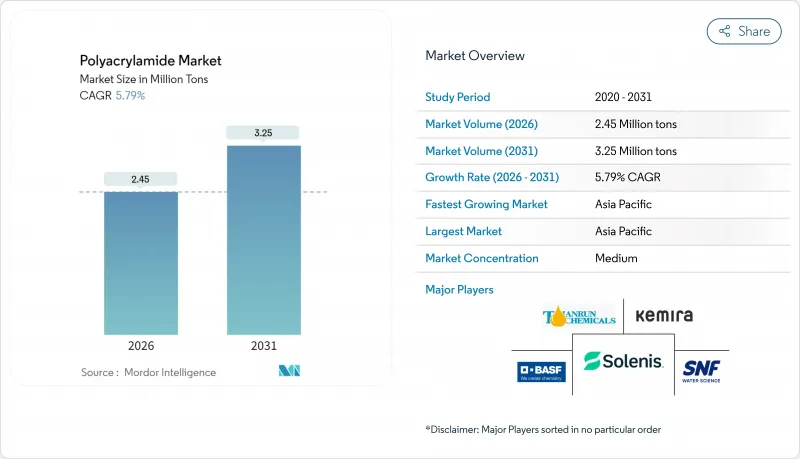
2026년 폴리아크릴아미드 시장 규모는 245만 톤으로 추정되며 2025년 232만 톤에서 성장한 수치입니다. 2031년에는 325만톤으로 성장하고, 2026년부터 2031년까지 연평균 복합 성장률(CAGR) 5.79%로 성장할 전망입니다.
이 확대를 견인하는 주요 요인은 도시 및 산업 폐수 처리에서 고성능 응집제 수요 증가, 비재래형 셰일 완성에서 초고분자량 마찰 감소제의 급속한 채택, 보다 엄격한 제로 액체 배출 규제를 포함합니다. 시장 관계자는 또한 중국의 물 인프라에 수십억 달러 규모의 투자와 BASF에 의한 대규모 생산 능력 증강의 혜택을 받고 있으며, 이로써 원재료의 안정적인 공급이 확보되고 공급 체인이 단축되고 있습니다.
세계의 폴리아크릴아미드 시장 동향과 인사이트
증진 회수(EOR)에서의 이용 확대
석유 생산자는 수성 범람제를 고성능 HPAM 제제로 대체합니다. 이로 인해 가혹한 저류층에서도 6-27%의 증분 회수율이 실현됩니다. 북미 셰일층에 있어서의 실지 시험 결과는 초고분자량 폴리아크릴아미드가 고염분 환경 및 120℃하에서도 점도를 안정화시켜, 약제의 보충 빈도와 다운타임을 삭감하는 것을 실증하고 있습니다. 또한, 산화 그래핀 강화 HPAM은 열안정성을 향상시켜 고온 고압의 심층 저류층에 있어서의 3차 회수의 가능성을 개척하고 있습니다. 시장 리더 기업은 저류층 고유의 화학 특성에 맞춘 폴리머 플러딩 패키지를 개발하기 위해 전용 R&D 플랫폼의 확충을 추진하고 있습니다. 이에 따라 서비스 계약과 프리미엄 제품 가격 설정을 통한 가치 창출을 실현하고, 증진 회수는 현재 폴리아크릴아미드 시장에서 가장 급속히 성장하고 있는 수익원이 되고 있습니다.
도시 및 산업 배수 처리에 있어서의 응집제 수요 증가
유틸리티자는 기존의 응집제와 비교하여 화학약품 소비량을 삭감하면서 탁도를 최대 95% 저감할 수 있다고 보고하고 있습니다. 아시아태평양의 산업 사용자는 EPA 표준의 제로 배출 제한을 충족하고 공정수를 재사용하기 위해 고급 응집제 시스템으로 전환하고 있습니다. 중금속 제거를 목적으로 한 새로운 배합은 카드뮴과 크롬의 규제 대응 갭을 해소하고 대상 고객층을 확대하고 있습니다. 이러한 동향은 수처리 분야에서 폴리아크릴아미드 시장의 장기적인 확대를 지원하고 있습니다.
잔류 아크릴 아미드 단량체에 관한 건강 및 발암성 우려
규제당국은 식품접촉재료에 있어서의 잔류 아크릴아미드를 0.2% 미만, 화장품에서는 0.1% 미만으로 제한하고 있으며, 생산자는 보다 엄격한 정제 공정에 대한 투자를 강요받고 있습니다. 캘리포니아주 프로포지션 65의 분류나 IARC(국제암 연구 기관)에 의한 발암성 물질의 가능성이 있는 물질로서의 지정은 표시 의무나 감시 의무를 강화하고 있습니다. 컴플라이언스 대응은 생산 비용을 높여 소비자 부문에서 제품 승인을 지연시키고 잠재적인 수요를 줄일 수 있습니다. 고급 품질 보증 연구소를 보유한 제조업체는 이러한 제약을 경쟁 우위로 전환할 수 있지만 중소기업은 시장 철수 위험에 직면하여 폴리아크릴아미드 시장 전체의 성장을 둔화시킬 수 있습니다.
부문 분석
분말 부문은 대량 처리의 용이성과 대규모 지자체 프로젝트의 운송 비용이 낮기 때문에 2025년 폴리아크릴아미드 시장 규모의 43.78%를 차지했습니다. 그러나, 액체 에멀젼은 급속히 보급되고 있으며, 2031년까지의 연평균 성장률(CAGR)은 6.10%를 나타낼 것으로 예측되고 있습니다. 이는 즉시 용해성과 분자량 유지가 셰일층의 완성 작업과 고온 공업회로에서의 프로세스 다운타임을 삭감하기 때문입니다.
포장 형태의 변화도이 동향을 반영합니다. 북미에서는 현장에서의 투여 정밀도 향상을 위해 드럼캔에서 IBC 컨테이너로의 전환이 진행되어 중국 공급업체는 활성 폴리머 함유율을 50%까지 높이는 역에멀젼 반응 장치의 확대를 도모하고 있습니다. 따라서 분말은 비용중시의 수도사업 분야에서 우위성을 유지하는 한편, 에멀젼은 성능이 중요한 틈새 시장에서 부가가치를 획득하고 있으며, 폴리아크릴아미드 산업이 특수화학 분야에 성숙화하고 있음을 보여주고 있습니다.
폴리아크릴아미드 보고서는 물리 형태(분말, 액체, 에멀젼/분산액), 용도(증진 회수, 수처리용 응집제, 토양 개량제 등), 최종 사용자 산업(수처리, 석유 및 가스, 펄프 및 제지 등), 지역(아시아태평양, 북미, 유럽, 남미, 중동 및 아프리카)마다 분석했습니다. 시장 예측은 수량(톤) 단위로 제공됩니다.
지역별 분석
아시아태평양은 2025년 세계 폴리아크릴아미드 시장 점유율의 49.92%를 차지했고 중국의 450억 달러 규모의 수처리 프로그램에 견인되어 6.20%의 연평균 복합 성장률(CAGR)로 성장하고 있습니다. 이 지역의 생산 능력 확대와 현지 수요의 자기 증진 루프는 공급 충격으로부터 지역을 보호하고 가격 결정력을 유지하고 있습니다. 인도의 화학산업 회랑과 일본의 막기술에 있어서 리더십이 추가적인 추진력을 더하는 한편, 동남아시아국가는 고도의 배수처리 솔루션을 필요로 하는 제조거점의 이전의 혜택을 받고 있습니다.
북미는 고이익률 증산기술(EOR) 및 마찰저감 등급의 주요 시장으로 셰일가스 개발이 제품 수명주기을 연장하고 SNF사와 같은 공급업체가 보완적인 완성 유체 기업을 인수할 기회를 제공합니다. EPA의 제로 배출 규제는 산업 폐수 프로젝트에 대한 안정적인 판매를 더욱 지원합니다. 유럽에서는 수량 성장이 둔화되고 있지만, 바이오의 혁신에 지표적 역할을 담당하고 있습니다. 이 지역의 녹색 조달 정책은 생분해 성 응집제의 연구 개발을 촉진하고 화학 및 광업 분야의 특수 용도가 폴리머 수요의 기반을 지원하고 있습니다.
중동 및 아프리카은 신흥 성장 시장으로서 풍부한 유전 및 광산 자원을 배경으로 현지 생산 능력의 확충이 진행되고 있습니다. 남미에서는 구리 및 리튬 붐이 침강 조제 수요를 견인해, 정부 주도의 물 인프라 근대화 프로젝트가 잠재 수요를 확대하고 있습니다. 이러한 지리적 다양화는 폴리아크릴아미드 시장의 지속적인 성장을 지원하는 핵심 요인입니다.
기타 혜택 :
- 엑셀 형식 시장 예측(ME) 시트
- 애널리스트 서포트(3개월간)
자주 묻는 질문
목차
제1장 서론
- 조사의 전제조건과 시장의 정의
- 조사 범위
제2장 조사 방법
제3장 주요 요약
제4장 시장 상황
- 시장 개요
- 시장 성장 촉진요인
- 증진 회수(EOR)에 있어서의 이용 확대
- 도시 및 산업 배수 처리에 있어서의 응집제 수요 증가
- 광업 활동의 확대가 침전 보조제 수요 견인
- 무방류(Zero Liquid Discharge) 및 슬러지 저감 관련 정부 규제 강화
- 셰일 완성 작업용 초고분자량 마찰 저감제 채택 확대
- 시장 성장 억제요인
- 잔류 아크릴아미드 단량체에 관한 건강 및 발암성에 대한 우려
- 유럽에서의 바이오 기반 응집제의 선호도 상승
- 중국 및 CIS에서 아크릴로니트릴 원료공급망 취약성
- 밸류체인 분석
- Porter's Five Forces
- 공급기업의 협상력
- 구매자의 협상력
- 신규 참가업체의 위협
- 대체품의 위협
- 경쟁 기업간 경쟁 관계
제5장 시장 규모와 성장 예측
- 물리 형태별
- 분말
- 액체
- 에멀젼/분산액
- 용도별
- 증진 회수
- 수처리용 응집제
- 토양 개량제
- 화장품 바인더 및 안정제
- 기타 용도
- 최종 사용자 업계별
- 수처리
- 석유 및 가스
- 펄프 및 제지
- 광업
- 기타 최종 사용자 산업
- 지역별
- 아시아태평양
- 중국
- 인도
- 일본
- 한국
- 말레이시아
- 태국
- 인도네시아
- 베트남
- 기타 아시아태평양
- 북미
- 미국
- 캐나다
- 멕시코
- 유럽
- 독일
- 영국
- 이탈리아
- 프랑스
- 스페인
- 북유럽 국가
- 튀르키예
- 러시아
- 기타 유럽
- 남미
- 브라질
- 아르헨티나
- 콜롬비아
- 기타 남미
- 중동 및 아프리카
- 사우디아라비아
- 카타르
- 아랍에미리트(UAE)
- 나이지리아
- 이집트
- 남아프리카
- 기타 중동 및 아프리카
- 아시아태평양
제6장 경쟁 구도
- 시장 집중도
- 전략적 동향
- 시장 점유율(%)/순위 분석
- 기업 프로파일
- AnHui JuCheng Fine Chemicals Co. Ltd
- Anhui Tianrun Chemical Industry Co. Ltd
- Ashland
- BASF
- Beijing Hengju Chemical Group Co. Ltd
- Beijing Xitao Technology Development Co. Ltd
- CHINAFLOC
- Envitech Chemical Specialities Pvt. Ltd
- Kemira
- Liaocheng Yongxing Environmental Protection Science & Technology Co. Ltd
- Qingdao Oubo Chemical Co. Ltd
- Shandong Tongli Chemical Co. Ltd
- SNF
- Solenis
- Syensqo
- Universal Fine Chemicals SPC
- Yixing Cleanwater Chemicals Co. Ltd
제7장 시장 기회와 장래의 전망
SHW 26.01.26Polyacrylamide market size in 2026 is estimated at 2.45 million tons, growing from 2025 value of 2.32 million tons with 2031 projections showing 3.25 million tons, growing at 5.79% CAGR over 2026-2031.
Rising demand for high-performance flocculants in municipal and industrial wastewater treatment, the rapid adoption of ultra-high-molecular-weight friction reducers in unconventional shale completions, and stricter zero-liquid-discharge mandates are the primary forces driving this expansion. Market players are also benefiting from China's multibillion-dollar investments in water infrastructure and BASF's large-scale capacity additions, which secure raw material availability and shorten supply chains.
Global Polyacrylamide Market Trends and Insights
Growing Utilization in Enhanced Oil Recovery (EOR)
Oil producers are replacing water-based flooding reagents with high-performance HPAM formulations that add 6%-27% incremental recovery, even in harsh reservoirs. Field results from North American shale plays confirm that ultra-high-molecular-weight polyacrylamide stabilizes viscosity under high salinity and 120 °C, cutting chemical top-ups and downtime. Graphene-oxide-reinforced HPAM further boosts thermal stability, unlocking tertiary recovery opportunities in deep, hot reservoirs. Market leaders are scaling dedicated research and development platforms to tailor polymer flooding packages to reservoir-specific chemistries, capturing value through service contracts and premium product pricing. As a result, enhanced oil recovery now represents the fastest-growing revenue stream within the polyacrylamide market.
Increasing Demand for Flocculants in Municipal and Industrial Wastewater Treatment
Utilities report up to 95% turbidity reduction with lower chemical consumption versus conventional coagulants. Industrial users in Asia-Pacific are migrating to advanced flocculant systems to meet EPA-style zero-discharge limits and recycle process water. New formulations that target heavy-metal removal address cadmium and chromium compliance gaps, broadening the addressable client base. These dynamics underpin the long-term expansion of the polyacrylamide market in water treatment.
Health and Carcinogenicity Concerns Over Residual Acrylamide Monomer
Regulators limit residual acrylamide to below 0.2% in food-contact materials and 0.1% in cosmetics, forcing producers to invest in tighter purification regimes. California's Proposition 65 classification and IARC's probable carcinogen status intensify labeling and monitoring obligations. Compliance raises production costs and slows product approvals in consumer-facing segments, trimming potential demand. Producers with advanced QA laboratories can turn the constraint into a competitive edge, but smaller firms risk market exit, softening overall polyacrylamide market growth.
Other drivers and restraints analyzed in the detailed report include:
- Expansion of Mining Activities Driving Demand for Sedimentation Aids
- Government Mandates on Zero-Liquid-Discharge and Sludge Reduction
- Rising Preference for Bio-Based Flocculants in Europe
For complete list of drivers and restraints, kindly check the Table Of Contents.
Segment Analysis
The powder segment held a 43.78% share of the polyacrylamide market size in 2025, supported by ease of bulk handling and lower freight costs for high-volume municipal projects. However, liquid emulsions are gaining rapid traction, with a 6.10% CAGR forecast to 2031, because instant solubility and molecular-weight preservation reduce process downtime in shale completions and high-temperature industrial circuits.
Packaging shifts illustrate the trend: drum-to-IBC conversions are rising in North America to improve onsite dosing precision, while Chinese suppliers are expanding inverse-emulsion reactors that raise active-polymer content to 50%. Powder therefore retains its stronghold in cost-sensitive water utilities, but emulsions capture incremental value in performance-critical niches, underscoring the maturation of the polyacrylamide industry toward specialized chemistries.
The Polyacrylamide Report is Segmented by Physical Form (Powder, Liquid, and Emulsion/Dispersions), Application (Enhanced Oil Recovery, Flocculants for Water Treatment, Soil Conditioner, and More), End-User Industry (Water Treatment, Oil and Gas, Pulp and Paper, and More), and Geography (Asia-Pacific, North America, Europe, South America, and Middle-East and Africa). The Market Forecasts are Provided in Terms of Volume (Tons).
Geography Analysis
Asia-Pacific captured 49.92% of the global polyacrylamide market share in 2025 and is growing at a 6.20% CAGR, propelled by China's USD 45 billion water-treatment program. The region's self-reinforcing loop of capacity expansion and local demand insulates it from supply shocks and sustains pricing power. India's chemicals corridor and Japan's membrane-technology leadership add further impetus, while Southeast Asian states benefit from manufacturing relocations that demand advanced effluent solutions.
North America remains a powerhouse for high-margin EOR and friction-reducer grades, with shale activity extending product lifecycles and enabling suppliers like SNF to acquire complementary completion-fluid firms. EPA zero-discharge rules further underpin steady sales into industrial wastewater projects. Europe shows slower volume growth but is a bellwether for bio-based innovation; its green-procurement policies stimulate research and development in biodegradable flocculants, while specialty applications in chemicals and mining uphold baseline polymer demand.
The Middle East and Africa are emerging growth theaters, leveraging abundant oilfields and mining prospects to justify local capacity additions. South America's copper and lithium boom likewise drives sedimentation-aid uptake, while government projects to modernize water infrastructure broaden addressable demand. Geographic diversification therefore remains central to sustaining resilient expansion in the polyacrylamide market.
- AnHui JuCheng Fine Chemicals Co. Ltd
- Anhui Tianrun Chemical Industry Co. Ltd
- Ashland
- BASF
- Beijing Hengju Chemical Group Co. Ltd
- Beijing Xitao Technology Development Co. Ltd
- CHINAFLOC
- Envitech Chemical Specialities Pvt. Ltd
- Kemira
- Liaocheng Yongxing Environmental Protection Science & Technology Co. Ltd
- Qingdao Oubo Chemical Co. Ltd
- Shandong Tongli Chemical Co. Ltd
- SNF
- Solenis
- Syensqo
- Universal Fine Chemicals SPC
- Yixing Cleanwater Chemicals Co. Ltd
Additional Benefits:
- The market estimate (ME) sheet in Excel format
- 3 months of analyst support
TABLE OF CONTENTS
1 Introduction
- 1.1 Study Assumptions and Market Definition
- 1.2 Scope of the Study
2 Research Methodology
3 Executive Summary
4 Market Landscape
- 4.1 Market Overview
- 4.2 Market Drivers
- 4.2.1 Growing Utilization in Enhanced Oil Recovery (EOR)
- 4.2.2 Increasing Demand for Flocculants in Municipal and Industrial Wastewater Treatment
- 4.2.3 Expansion of Mining Activities Driving Demand for Sedimentation Aids
- 4.2.4 Government Mandates on Zero-Liquid-Discharge and Sludge Reduction
- 4.2.5 Shift Toward Ultra-High-Molecular-Weight Friction Reducers for Shale Completions
- 4.3 Market Restraints
- 4.3.1 Health And Carcinogenicity Concerns over Residual Acrylamide Monomer
- 4.3.2 Rising Preference for Bio-Based Flocculants in Europe
- 4.3.3 Supply-Chain Vulnerability of Acrylonitrile Feedstock in China and CIS
- 4.4 Value Chain Analysis
- 4.5 Porter's Five Forces
- 4.5.1 Bargaining Power of Suppliers
- 4.5.2 Bargaining Power of Buyers
- 4.5.3 Threat of New Entrants
- 4.5.4 Threat of Substitutes
- 4.5.5 Competitive Rivalry
5 Market Size and Growth Forecasts (Volume)
- 5.1 By Physical Form
- 5.1.1 Powder
- 5.1.2 Liquid
- 5.1.3 Emulsion/Dispersions
- 5.2 By Application
- 5.2.1 Enhanced Oil Recovery
- 5.2.2 Flocculants for Water Treatment
- 5.2.3 Soil Conditioner
- 5.2.4 Binders and Stabilizers in Cosmetics
- 5.2.5 Other Applications
- 5.3 By End-User Industry
- 5.3.1 Water Treatment
- 5.3.2 Oil and Gas
- 5.3.3 Pulp and Paper
- 5.3.4 Mining
- 5.3.5 Other End-user Industries
- 5.4 By Geography
- 5.4.1 Asia-Pacific
- 5.4.1.1 China
- 5.4.1.2 India
- 5.4.1.3 Japan
- 5.4.1.4 South Korea
- 5.4.1.5 Malaysia
- 5.4.1.6 Thailand
- 5.4.1.7 Indonesia
- 5.4.1.8 Vietnam
- 5.4.1.9 Rest of Asia-Pacific
- 5.4.2 North America
- 5.4.2.1 United States
- 5.4.2.2 Canada
- 5.4.2.3 Mexico
- 5.4.3 Europe
- 5.4.3.1 Germany
- 5.4.3.2 United Kingdom
- 5.4.3.3 Italy
- 5.4.3.4 France
- 5.4.3.5 Spain
- 5.4.3.6 Nordic Countries
- 5.4.3.7 Turkey
- 5.4.3.8 Russia
- 5.4.3.9 Rest of Europe
- 5.4.4 South America
- 5.4.4.1 Brazil
- 5.4.4.2 Argentina
- 5.4.4.3 Colombia
- 5.4.4.4 Rest of South America
- 5.4.5 Middle-East and Africa
- 5.4.5.1 Saudi Arabia
- 5.4.5.2 Qatar
- 5.4.5.3 United Arab Emirates
- 5.4.5.4 Nigeria
- 5.4.5.5 Egypt
- 5.4.5.6 South Africa
- 5.4.5.7 Rest of Middle-East and Africa
- 5.4.1 Asia-Pacific
6 Competitive Landscape
- 6.1 Market Concentration
- 6.2 Strategic Moves
- 6.3 Market Share (%)/Ranking Analysis
- 6.4 Company Profiles (includes Global level Overview, Market level overview, Core Segments, Financials as available, Strategic Information, Market Rank/Share for key companies, Products and Services, and Recent Developments)
- 6.4.1 AnHui JuCheng Fine Chemicals Co. Ltd
- 6.4.2 Anhui Tianrun Chemical Industry Co. Ltd
- 6.4.3 Ashland
- 6.4.4 BASF
- 6.4.5 Beijing Hengju Chemical Group Co. Ltd
- 6.4.6 Beijing Xitao Technology Development Co. Ltd
- 6.4.7 CHINAFLOC
- 6.4.8 Envitech Chemical Specialities Pvt. Ltd
- 6.4.9 Kemira
- 6.4.10 Liaocheng Yongxing Environmental Protection Science & Technology Co. Ltd
- 6.4.11 Qingdao Oubo Chemical Co. Ltd
- 6.4.12 Shandong Tongli Chemical Co. Ltd
- 6.4.13 SNF
- 6.4.14 Solenis
- 6.4.15 Syensqo
- 6.4.16 Universal Fine Chemicals SPC
- 6.4.17 Yixing Cleanwater Chemicals Co. Ltd
7 Market Opportunities and Future Outlook
- 7.1 White-space and Unmet-Need Assessment