|
시장보고서
상품코드
1910454
산업용 윤활유 시장 : 점유율 분석, 업계 동향, 통계, 성장 예측(2026-2031년)Industrial Lubricants - Market Share Analysis, Industry Trends & Statistics, Growth Forecasts (2026 - 2031) |
||||||
 Mordor Intelligence
산업용 윤활유 시장은 2025년 228억 2,000만 리터로 평가되었고, 2026년에는 236억 1,000만 리터, 2031년까지 279억 5,000만 리터로 성장할 것으로 예상됩니다. 2026년부터 2031년에 걸쳐 CAGR은 3.44%를 나타낼 전망입니다.
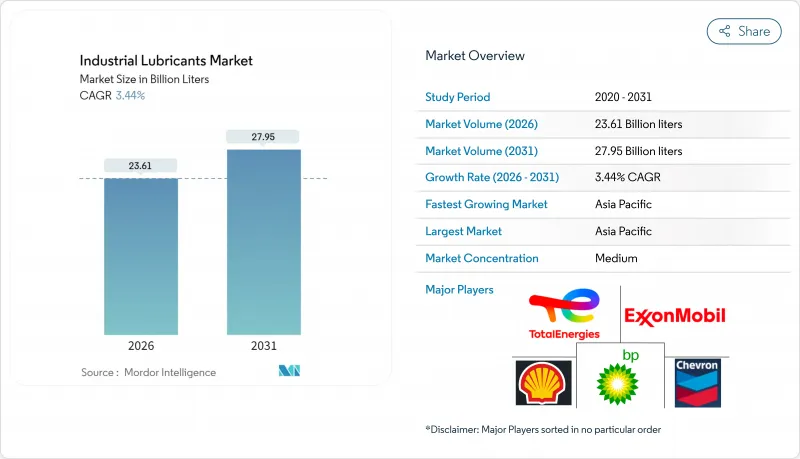
이 꾸준한 성장 궤도는 업계가 대량 판매형 제품에서 설비 가동률과 에너지 효율을 극대화하는 맞춤형 윤활유로 전환하고 있음을 보여줍니다. 풍력 터빈의 급속한 설치 확대 및 인더스트리 4.0으로의 업그레이드로 윤활유의 성능 요구 사항이 기존 사양을 넘어 확장되어 합성 시스템 및 바이오 화학제품에 대한 수요를 촉진하고 있습니다. 아시아태평양은 대규모 제조 투자와 고부가가치 윤활유 마진을 획득하는 통합 정유소 및 석유화학 콤비나트에 의해 현재의 소비량을 주도하고 있습니다. 전 세계 제조업체들은 환경 규제 강화와 예지 보전 도입에 대응하고 PFAS 프리 첨가제 및 상태 모니터링 대응 윤활유의 연구 개발에 주력하고 있습니다.
세계 산업용 윤활유 시장 동향과 전망
풍력 터빈용 기어박스 윤활유 수요 급증
세계의 풍력 발전이 확대됨에 따라 표준 윤활유로 채울 수 없는 특수 기어박스 오일 수요가 증가하고 있습니다. 중국의 풍력 발전 설비 용량은 2023년 12월 현재 440GW에 달했으며 많은 터빈 고장은 윤활 부족으로 인한 것입니다. 내마모제 및 부식 방지제를 강화한 합성유는 서비스 간격을 6개월에서 3년으로 연장하여 해양 유지 보수 비용을 절감합니다. 원격지의 터빈에서는 헬리콥터에 의한 유지 보수를 최소화할 필요가 있기 때문에 우수한 물 분리 특성이 필수적입니다. 개발자는 광범위한 온도 변동 하에서도 점도를 유지하고 강풍시 가혹한 조건 하에서도 몇 메가와트급의 기어 세트를 보호하는 ISO VG 320-460의 PAO 블렌드를 지정하는 경우가 증가하고 있습니다. 산업용 윤활유 시장은 15MW의 해상 풍력 터빈 1대당 1회의 서비스 사이클에서 800리터 이상을 소비할 수 있으므로 유닛 정격의 대형화로 인한 직접적인 수요 증가가 예상됩니다.
산업 자동화 및 인더스트리 4.0에서 윤활유 사용량 증가
스마트 팩토리에서는 고온 및 고속으로 가동하는 정밀 기기가 도입되고 있어 점도 허용 범위가 좁고 센서 간섭이 거의 없는 윤활유가 요구됩니다. 자동 윤활 시스템은 실시간 분석을 기반으로 복용량을 제어하고 소비량을 30-40% 줄이면서 가동률을 향상시킵니다. 마그네틱 플러그나 적외선 파편 감시 장치에 노출될 때 마찰학적 안정성을 유지해야 하기 때문에 첨가제의 용해성과 금속 이온 함량은 엄격히 규정되어 있습니다. 인공지능 플랫폼은 진동 및 온도 데이터를 읽어 배합 추천을 동적으로 조정하게 되었습니다. 이를 통해 공급업체는 현장 맞춤형 모듈식 첨가제 패키지를 개발하고 있으며, 이러한 진전은 산업용 윤활유 시장에서 프리미엄 합성유 및 하이브리드 제품으로의 장기적인 혼합 이동을 가속화하고 있습니다.
폐유 및 누출 규제 강화
EU 및 미국 여러 주에서 PFAS 단계적 폐지 의무로 인해, 배합 엔지니어는 기존 제품의 재설계를 강요하고 있습니다. 대체 화학물질의 인증 획득은 시장 출시까지의 시간을 늦추고 R&D 예산을 부풀립니다. 사용자 수준에서는 회수 시스템이 제조에서 폐기까지의 모든 공정에서 추적성을 문서화할 필요가 있어 폐기 비용과 저장 설비에 대한 자본 지출이 증가하고 있습니다. 유출방지 지령에 의해 이중벽 탱크나 리얼타임 누설 경보장치가 의무화되어 소규모 공장의 인프라 비용이 증가하고 있습니다. 이러한 장벽은 단기적인 수요를 억제하는 한편, 산업용 윤활유 시장에서 규제 적합하고 고이익률의 배합제에 새로운 틈새를 개척할 기회도 낳고 있습니다.
부문 분석
엔진 오일은 2025년 매출의 23.29%를 차지했고 중공업 분야의 중요한 발전기와 고정식 컴프레서를 보호하고 있습니다. 이 점유율은 기존 엔진에 해당하는 단일 점도 SAE 40 및 15W-40 다점도 오일을 선호하는 뿌리 깊은 유지 보수 관행을 반영합니다. 그러나 OEM 제조업체가 교체 간격이 긴 가스 엔진으로 전환함에 따라 수요는 두드러지고 있습니다. 한편 유압 및 변속기유는 로봇공학, 사출성형기, 풍력 터빈 피치 시스템의 확대에 따라 3.92%의 연평균 복합 성장률(CAGR)로 성장이 예상됩니다. 금속가공유는 아시아태평양의 공작기계투자의 혜택을 받고 이온액체절삭유는 광물유 기준품보다 긴 공구수명을 실현합니다.
이황화 몰리브덴과 흑연을 배합한 합성 그리스는 200℃의 킬른 배출구에 노출되는 극압 베어링 분야에서 점유율을 확대하고 있습니다. 한편, 공정 오일 수요는 중국, 인도, 미국에서의 석유화학 플랜트의 병목해소에 직결하고 있습니다. 신규 전동기 냉각유는 기계 프로파일의 진화가 산업용 윤활유 시장을 지속적으로 재구성하는 실례를 보여줍니다.
산업용 윤활유 시장 보고서는 제품 유형별(엔진 오일, 유압 및 변속기유, 금속 가공유 등), 최종 사용자 산업별(발전, 중기, 식품 음료 가공, 금속 및 금속 가공, 화학 및 프로세스 산업, 기타 산업), 지역별(아시아태평양, 북미 등)으로 분류되어 있습니다. 시장 예측은 수량(리터) 단위로 제공됩니다.
지역별 분석
아시아태평양은 2025년 수량 기준으로 46.88%를 차지했으며 2031년까지 연평균 복합 성장률(CAGR) 3.61%로 추이할 것으로 예측됩니다. 중국에서는 화학제품을 통합함으로써 윤활유의 이익률 향상을 도모하는 정제업체가 증가하고 있습니다. 인도는 엄청난 외국 투자를 불러 일으키고 있으며, 루브리졸은 세계 2위 규모의 새로운 오랑가바드 공장에 2억 달러를 투자할 예정입니다. 동남아시아 국가에서는 공장 이전 및 재생에너지 프로젝트가 환영되어 유압유 및 기어유 수요를 견인하고 있습니다. 일본과 한국에서는 정밀 제조업과 까다로운 에너지 절약 목표로 합성유의 보급률이 평균을 웃돌아 가고 있습니다.
북미와 유럽에서는 PFAS 프리 배합과 탄소 관련 효율 향상에 주력하고 있습니다. 미국은 셰일 유래 원료를 활용하는 한편, EV 보급이 기존 엔진 오일 수요를 점감시킵니다. 유럽은 바이오 윤활유 추진 정책을 주도하고 배합의 급속한 전환을 촉진하고 있습니다. 캐나다의 오일 샌드 채굴은 고온 윤활유 수요를 지속하고 멕시코의 자동차 투자는 현지 수요를 확대합니다.
중동 및 아프리카은 기유 공급을 지원하는 탄화수소 추출 프로젝트에 의존하여 화학제품 분야로 다각화를 진행하고 있습니다. 사우디아라비아의 리치 풀 파라비 합작용 신규 첨가제 플랜트는 지역 믹서를 위한 공급 라인을 단축할 전망입니다. 남아프리카의 심부 채굴과 나이지리아의 정화 설비 업데이트는 틈새 시장을 창출하고 있습니다. 남미에서는 브라질의 석유화학 산업에서 병목 현상을 제거하고 칠레의 구리 광산 확장을 배경으로 국부적인 고성장을 볼 수 있습니다. 이를 통해 산업용 윤활유 시장 공급업체의 규모가 작고 중요한 판매 경로로서의 역할이 확고해질 것입니다.
기타 혜택 :
- 엑셀 형식 시장 예측(ME) 시트
- 애널리스트 서포트(3개월간)
자주 묻는 질문
목차
제1장 서론
- 조사의 전제조건과 시장의 정의
- 조사 범위
제2장 조사 방법
제3장 주요 요약
제4장 시장 상황
- 시장 개요
- 시장 성장 촉진요인
- 풍력 터빈 기어 박스 윤활유 수요 급증
- 산업 자동화 및 인더스트리 4.0의 윤활유 사용량
- 합성유 및 반합성 장기교환유(Long-Drain Oil)로의 전환
- 광산 및 건설 장비 보유 대수 확대
- 초저마찰 바이오 윤활유에 대한 탄소가격 인센티브
- 시장 성장 억제요인
- 폐유 및 누출에 관한 규제 강화
- 원유 기반 기유의 가격 변동성
- 건식 구동 전동 모터에 의한 윤활유 수요 감소
- 밸류체인 분석
- Porter's Five Forces
- 공급기업의 협상력
- 구매자의 협상력
- 신규 참가업체의 위협
- 대체품의 위협
- 경쟁도
제5장 시장 규모와 성장 예측
- 제품 유형별
- 엔진 오일
- 유압 및 변속기 오일
- 금속가공유
- 일반 산업용 오일
- 기어 오일
- 그리스
- 공정용 오일
- 기타
- 최종 사용자 업계별
- 발전
- 중장비
- 식품 및 음료 가공
- 금속 및 금속 가공
- 화학 및 프로세스 산업
- 기타 산업(펄프 및 제지, 해운 등)
- 지역별
- 아시아태평양
- 중국
- 인도
- 일본
- 한국
- 인도네시아
- 태국
- 베트남
- 말레이시아
- 기타 아시아태평양
- 북미
- 미국
- 캐나다
- 멕시코
- 유럽
- 독일
- 영국
- 프랑스
- 이탈리아
- 스페인
- 러시아
- 기타 유럽
- 남미
- 브라질
- 아르헨티나
- 콜롬비아
- 기타 남미
- 중동 및 아프리카
- 사우디아라비아
- 아랍에미리트(UAE)
- 남아프리카
- 이집트
- 기타 중동 및 아프리카
- 아시아태평양
제6장 경쟁 구도
- 시장 집중도
- 전략적 동향
- 시장 점유율(%)/순위 분석
- 기업 프로파일
- AMSOIL Inc.
- Bharat Petroleum Corp. Ltd
- Blaser Swisslube AG
- BP plc(Castrol)
- Carl Bechem GmbH
- Chevron Corporation
- China National Petroleum Corporation(PetroChina)
- China Petroleum & Chemical Corp.(Sinopec)
- ENEOS Corporation
- Eni SpA
- Exxon Mobil Corporation
- FUCHS SE
- Gazprom Neft PJSC
- GS Caltex Corporation
- Gulf Oil International
- Hindustan Petroleum Corp. Ltd
- Idemitsu Kosan Co. Ltd
- Indian Oil Corporation Ltd.
- Kluber Lubrication
- LUKOIL
- Motul
- Petrobras
- Petronas Lubricants International
- Phillips 66 Company
- PT Pertamina(Persero)
- Repsol
- ROCOL
- ROSNEFT
- Shell plc
- TotalEnergies SE
- Valvoline Inc.
제7장 시장 기회와 장래의 전망
SHW 26.01.26The Industrial Lubricants Market market is expected to grow from 22.82 billion liters in 2025 to 23.61 billion liters in 2026 and is forecast to reach 27.95 billion liters by 2031 at 3.44% CAGR over 2026-2031.
This steady trajectory shows the sector's shift from bulk commodity sales to tailor-made fluids that maximize equipment uptime and energy efficiency. Rapid wind-turbine installations and Industry 4.0 upgrades are expanding lubricant performance requirements beyond legacy specifications, spurring demand for synthetic and bio-based chemistries. Asia-Pacific dominates current consumption thanks to large-scale manufacturing investments and integrated refinery-petrochemical complexes that capture higher-value lubricant margins. Producers worldwide are also channeling R&D toward PFAS-free additives and condition-monitoring-ready fluids in response to tightening environmental rules and predictive-maintenance adoption.
Global Industrial Lubricants Market Trends and Insights
Surging Wind-Turbine Gearbox Lubricant Demand
Global wind-power build-outs are multiplying specialized gearbox-oil requirements that standard fluids cannot satisfy. China's installed wind capacity reached 440 GW by December 2023, with many turbine failures traced to lubrication shortcomings. Synthetic oils fortified with anti-wear and corrosion inhibitors extend service intervals from 6 months to 3 years, trimming offshore maintenance costs. Robust water-separation properties are essential because remote turbines must minimize helicopter-based servicing. Developers increasingly specify ISO VG 320-460 PAO blends that preserve viscosity across wide temperature swings, protecting multi-megawatt gearsets during harsh gust events. Each 15-MW offshore turbine can consume over 800 liters per service cycle, so the industrial lubricants market sees a direct volume lift from larger unit ratings.
Industrial Automation and Industry 4.0 Lubrication Intensity
Smart factories deploy precision equipment that runs hotter and faster, demanding fluids with narrow viscosity tolerances and negligible sensor interference. Automated lubrication systems meter doses based on real-time analytics, cutting consumption 30%-40% while boosting uptime. Fluids must keep tribological stability when exposed to magnetic-plug or infrared debris monitoring, so additive solubility and metal-ion content are tightly specified. Artificial-intelligence platforms now adjust formulation recommendations by reading vibration and temperature feeds, pushing suppliers to create modular additive packages for on-site customization. These developments anchor a long-term upward mix shift within the industrial lubricants market toward premium synthetic and hybrid products.
Stricter Waste-Oil and Spill Regulations
PFAS-phaseout mandates in the EU and several U.S. states force formulators to redesign long-standing products. Certification of alternative chemistries slows time-to-market and inflates R&D budgets. At the user level, collection systems must now document cradle-to-grave traceability, lifting disposal costs and capital outlays for containment. Spill-prevention directives require double-walled tanks and real-time leak alarms, raising infrastructure costs for small workshops. While these hurdles dampen short-term demand, they also open niches for compliant, higher-margin formulations within the industrial lubricants market.
Other drivers and restraints analyzed in the detailed report include:
- Shift Toward Synthetic and Semi-Synthetic Long-Drain Oils
- Expansion of Mining and Construction Equipment Fleets
- Crude-Derived Base-Oil Price Volatility
For complete list of drivers and restraints, kindly check the Table Of Contents.
Segment Analysis
Engine oil contributed 23.29% of 2025 sales, safeguarding critical generators and stationary compressors across heavy industries. This share underscores deep-rooted maintenance routines that favor monograde SAE 40 and 15W-40 multigrades compatible with legacy engines. Yet demand plateaus as OEMs pivot to gas engines with longer drain specifications. Hydraulic and transmission fluids, in contrast, are set to grow at a 3.92% CAGR as robotics, injection-molding machines, and wind-turbine pitch systems expand. Metalworking fluids benefit from Asia-Pacific machine-tool investments, and ionic-liquid cutting oils deliver longer tool life than mineral benchmarks.
Synthetic grease blends incorporating molybdenum disulfide and graphite are grabbing share in extreme-pressure bearings exposed to 200 °C kiln outlets. Meanwhile, demand for process oils ties directly to petrochemical debottlenecking in China, India, and the U.S. Up-and-coming electric-motor cooling oils illustrate how evolving machinery profiles continuously reshape the industrial lubricants market.
The Industrial Lubricants Market Report is Segmented by Product Type (Engine Oil, Hydraulic and Transmission Fluid, Metalworking Fluid, and More), End-User Industry (Power Generation, Heavy Equipment, Food and Beverage Processing, Metallurgy and Metalworking, Chemical and Process Industries, and Other Industries), and Geography (Asia-Pacific, North America, and More). The Market Forecasts are Provided in Terms of Volume (Liters).
Geography Analysis
Asia-Pacific accounted for 46.88% of 2025 volumes and is tracking a 3.61% CAGR through 2031, where Chinese refiners integrate chemicals to lift lubricant margins. India draws heavy foreign investment, with Lubrizol earmarking USD 200 million for a new Aurangabad plant that will be its second-largest worldwide. Southeast Asian countries welcome factory relocations and renewable-energy projects, driving hydraulic and gear oil uptake. Japan and South Korea sustain above-average synthetic penetration due to precision manufacturing and stringent energy-saving targets.
North America and Europe concentrate on PFAS-free formulations and carbon-linked efficiency gains. The U.S. leverages shale-derived feedstocks, yet EV adoption gradually curbs traditional engine oil demand. Europe leads the policy push that elevates bio-lubricants, compelling rapid formulation shifts. Canada's oil-sands mining keeps high-temperature lubricant requirements active, whereas Mexico's automotive investments broaden local demand.
The Middle-East and Africa rely on hydrocarbon extraction projects that underpin base oil supply and diversify into chemicals. A new additive plant from the Richful-Farabi venture in Saudi Arabia will shorten supply lines for regional blenders. South Africa's deep-level mining and Nigeria's refining upgrades contribute niche opportunities. South America shows pockets of high growth around Brazilian petrochemical debottlenecking and Chilean copper expansions, cementing its role as an important albeit smaller outlet for industrial lubricants market suppliers.
- AMSOIL Inc.
- Bharat Petroleum Corp. Ltd
- Blaser Swisslube AG
- BP p.l.c. (Castrol)
- Carl Bechem GmbH
- Chevron Corporation
- China National Petroleum Corporation (PetroChina)
- China Petroleum & Chemical Corp. (Sinopec)
- ENEOS Corporation
- Eni SpA
- Exxon Mobil Corporation
- FUCHS SE
- Gazprom Neft PJSC
- GS Caltex Corporation
- Gulf Oil International
- Hindustan Petroleum Corp. Ltd
- Idemitsu Kosan Co. Ltd
- Indian Oil Corporation Ltd.
- Kluber Lubrication
- LUKOIL
- Motul
- Petrobras
- Petronas Lubricants International
- Phillips 66 Company
- PT Pertamina (Persero)
- Repsol
- ROCOL
- ROSNEFT
- Shell plc
- TotalEnergies SE
- Valvoline Inc.
Additional Benefits:
- The market estimate (ME) sheet in Excel format
- 3 months of analyst support
TABLE OF CONTENTS
1 Introduction
- 1.1 Study Assumptions and Market Definition
- 1.2 Scope of the Study
2 Research Methodology
3 Executive Summary
4 Market Landscape
- 4.1 Market Overview
- 4.2 Market Drivers
- 4.2.1 Surging wind-turbine gearbox lubricant demand
- 4.2.2 Industrial automation and Industry 4.0 lubrication intensity
- 4.2.3 Shift toward synthetic and semi-synthetic long-drain oils
- 4.2.4 Expansion of mining and construction equipment fleets
- 4.2.5 Carbon-pricing pull for ultra-low-friction bio-lubricants
- 4.3 Market Restraints
- 4.3.1 Stricter waste-oil and spill regulations
- 4.3.2 Crude-derived base-oil price volatility
- 4.3.3 Dry-drive electric motors reducing oil demand
- 4.4 Value Chain Analysis
- 4.5 Porter's Five Forces
- 4.5.1 Bargaining Power of Suppliers
- 4.5.2 Bargaining Power of Buyers
- 4.5.3 Threat of New Entrants
- 4.5.4 Threat of Substitutes
- 4.5.5 Degree of Competition
5 Market Size and Growth Forecasts (Volume)
- 5.1 By Product Type
- 5.1.1 Engine Oil
- 5.1.2 Hydraulic and Transmission Fluid
- 5.1.3 Metalworking Fluid
- 5.1.4 General Industrial Oil
- 5.1.5 Gear Oil
- 5.1.6 Grease
- 5.1.7 Process Oil
- 5.1.8 Others
- 5.2 By End-user Industry
- 5.2.1 Power Generation
- 5.2.2 Heavy Equipment
- 5.2.3 Food and Beverage Processing
- 5.2.4 Metallurgy and Metalworking
- 5.2.5 Chemical and Process Industries
- 5.2.6 Other Industries (Pulp and Paper, Marine, etc.)
- 5.3 By Geography
- 5.3.1 Asia-Pacific
- 5.3.1.1 China
- 5.3.1.2 India
- 5.3.1.3 Japan
- 5.3.1.4 South Korea
- 5.3.1.5 Indonesia
- 5.3.1.6 Thailand
- 5.3.1.7 Vietnam
- 5.3.1.8 Malaysia
- 5.3.1.9 Rest of Asia-Pacific
- 5.3.2 North America
- 5.3.2.1 United States
- 5.3.2.2 Canada
- 5.3.2.3 Mexico
- 5.3.3 Europe
- 5.3.3.1 Germany
- 5.3.3.2 United Kingdom
- 5.3.3.3 France
- 5.3.3.4 Italy
- 5.3.3.5 Spain
- 5.3.3.6 Russia
- 5.3.3.7 Rest of Europe
- 5.3.4 South America
- 5.3.4.1 Brazil
- 5.3.4.2 Argentina
- 5.3.4.3 Colombia
- 5.3.4.4 Rest of South America
- 5.3.5 Middle-East and Africa
- 5.3.5.1 Saudi Arabia
- 5.3.5.2 United Arab Emirates
- 5.3.5.3 South Africa
- 5.3.5.4 Egypt
- 5.3.5.5 Rest of Middle-East and Africa
- 5.3.1 Asia-Pacific
6 Competitive Landscape
- 6.1 Market Concentration
- 6.2 Strategic Moves
- 6.3 Market Share(%)/Ranking Analysis
- 6.4 Company Profiles (includes Global level Overview, Market level overview, Core Segments, Financials as available, Strategic Information, Market Rank/Share for key companies, Products and Services, and Recent Developments)
- 6.4.1 AMSOIL Inc.
- 6.4.2 Bharat Petroleum Corp. Ltd
- 6.4.3 Blaser Swisslube AG
- 6.4.4 BP p.l.c. (Castrol)
- 6.4.5 Carl Bechem GmbH
- 6.4.6 Chevron Corporation
- 6.4.7 China National Petroleum Corporation (PetroChina)
- 6.4.8 China Petroleum & Chemical Corp. (Sinopec)
- 6.4.9 ENEOS Corporation
- 6.4.10 Eni SpA
- 6.4.11 Exxon Mobil Corporation
- 6.4.12 FUCHS SE
- 6.4.13 Gazprom Neft PJSC
- 6.4.14 GS Caltex Corporation
- 6.4.15 Gulf Oil International
- 6.4.16 Hindustan Petroleum Corp. Ltd
- 6.4.17 Idemitsu Kosan Co. Ltd
- 6.4.18 Indian Oil Corporation Ltd.
- 6.4.19 Kluber Lubrication
- 6.4.20 LUKOIL
- 6.4.21 Motul
- 6.4.22 Petrobras
- 6.4.23 Petronas Lubricants International
- 6.4.24 Phillips 66 Company
- 6.4.25 PT Pertamina (Persero)
- 6.4.26 Repsol
- 6.4.27 ROCOL
- 6.4.28 ROSNEFT
- 6.4.29 Shell plc
- 6.4.30 TotalEnergies SE
- 6.4.31 Valvoline Inc.
7 Market Opportunities and Future Outlook
- 7.1 White-space and Unmet-Need Assessment