|
시장보고서
상품코드
1910466
기능성 첨가제 : 시장 점유율 분석, 업계 동향 및 통계, 성장 예측(2026-2031년)Performance Additives - Market Share Analysis, Industry Trends & Statistics, Growth Forecasts (2026 - 2031) |
||||||
 Mordor Intelligence
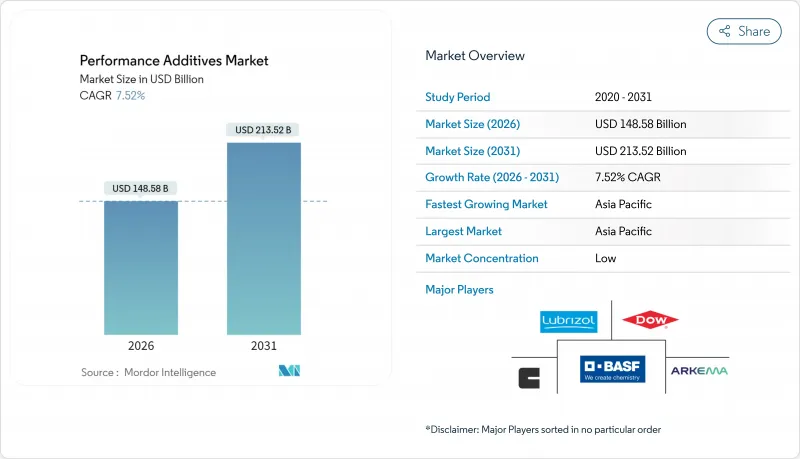
기능성 첨가제 시장은 2025년의 1,381억 9,000만 달러에서 2026년에는 1,485억 8,000만 달러로 성장하여 2026년부터 2031년에 걸쳐 CAGR 7.52%를 나타낼 전망입니다. 2031년까지 2,135억 2,000만 달러에 달할 것으로 예상됩니다.
플라스틱, 윤활유, 도료 분야의 내구성, 지속가능성, 가공 효율을 향상시키는 특수 화학제품에 대한 강한 수요가 기능성 첨가제 시장의 확대를 견인하고 있습니다. 성장의 추풍으로는 자동차의 전동화 가속, 수성 저 VOC 도료로의 세계 전환, 첨가제를 활용한 화학적 재활용 솔루션을 촉진하는 순환형 경제 정책의 강화 등을 들 수 있습니다. 생산자는 또한 아시아태평양의 인프라 정비 계획을 활용하고 있습니다. 이 지역에서는 원유 유래 원료의 가격 변동에 의한 단기적인 비용 압력이 있는 것, 급속한 공업화가 양과 가치의 양면에서의 성장을 지지하고 있습니다. 난연성, 자외선 안정성, 장벽 강화에 대한 요구 증가는 현대 재료 솔루션의 필수 요소로서 기능성 첨가제 시장의 기반을 더욱 견고하게 만듭니다.
세계의 기능성 첨가제 시장 동향과 인사이트
최종 용도 분야에서 기존 재료에서 플라스틱으로 대체
가볍고 내식성이 있고 성형이 용이한 플라스틱에 대한 수요가 높아지는 가운데 자동차, 건설, 소비재 제조의 각 분야에서 금속, 목재, 유리가 플라스틱으로 대체되고 있습니다. 이러한 대안에는 열악한 사용 환경에서도 성능을 유지하는 열 안정제, 자외선 흡수제 및 난연제가 필수적입니다. BASF의 고전압 전기자동차 부품용 난연성 폴리프탈아미드 울트라미드는 고급 첨가제로 플라스틱이 -40℃에서 150℃의 온도 변동을 견디면서 엄격한 유전 임계값을 충족한다는 것을 입증합니다. 플라스틱이 보닛 내부 부품, 외장 패널, 모듈식 건축 부재에 침투함에 따라 다기능 첨가제 패키지 수요량도 동시에 증가하여 고기능성 첨가제 시장의 장기적인 성장의 기반을 구축하고 있습니다.
신흥 경제국에서 플라스틱 수요의 급성장
도시화, 가처분 소득 증가, 광범위한 인프라 정비 계획으로 아시아태평양 및 아프리카 일부 지역에서는 플라스틱 소비가 가속화되고 있습니다. 대규모 고속도로, 철도, 주택 프로젝트에서는 산화방지제, 가공조제, 충격 개질제가 필요한 지오신세틱, 파이프, 단열재가 요구되고 있습니다. 인도에서는 연간 6-8%의 페이스로 증가하는 국내 시멘트 생산량에 대응하기 위해, 건설용 첨가제 수요 급증을 전망해, 특수 화학제품 제조업체가 생산 능력을 확대하고 있습니다. 동남아시아의 소비재 포장 분야에서도 유사한 움직임을 볼 수 있어 기능성 분산제나 윤활제의 수입이 촉진되고 있습니다. 이러한 동향은 2030년까지 신흥지역이 기능성 첨가제 시장의 주요 수요 증가 요인이 되는 것을 확실시했습니다.
일회용 플라스틱 및 유해 물질에 대한 엄격한 규정
식품 접촉·포장 용도에 있어서 특정 첨가물의 규제 금지에 의해 배합 설계자는 고비용의 재배합이나 환경 라벨 대응을 강요받고 있습니다. 캘리포니아가 2027년에 식품 포장용 4종의 기존 플라스틱 첨가물을 금지하는 정책은 다른 관할 구역의 모델 케이스가 될 것입니다. 유럽 연합(EU)이 2025년에 갱신된 식품 접촉 규제에서는 전환 한계가 더욱 엄격해졌고 종합적인 제품 포트폴리오 검토가 요구되었습니다. 클라리언트사 등의 기업은 2023년 12월까지 안정제 제품군에서 PFAS(과불소화합물)의 단계적 폐지를 완료했습니다. 이러한 움직임은 환경 컴플라이언스의 강화로 이어지지만, 단기적으로는 비용 급등이나 인증 취득의 지연을 초래해, 기능성 첨가제 시장의 성장률을 낮추는 요인이 됩니다.
부문 분석
플라스틱 첨가제는 2025년 시점에서 기능성 첨가제 시장의 42.62%를 차지했으며, 이 시장 전체의 수익의 대부분을 담당했습니다. 2031년까지의 CAGR 9.18%는 전자기기 분야에서의 엄격한 난연성 규제와 전기자동차용 자외선 안정성·경량 부품 수요라는 두 가지 요인에 의해 견인됩니다. 최첨단 분산제, 산화방지제, 무할로겐 난연제는 강도를 손상시키지 않고 경량화를 도모하는 가공업체로부터 고가격 수요를 획득하고 있습니다.
고무 첨가제는 타이어 컨베이어 벨트 제조에서 안정적인 수요를 유지하지만, 모빌리티가 경량 폴리머 복합재를 선호하는 EV 플랫폼으로 이행하는 동안 플라스틱 분야의 성장에는 뒤처지고 있습니다. 페인트 및 코팅 첨가제는 수성화의 흐름에 의해 수요가 확대되고 있어 특히 살균제나 레올로지 제어 패키지가 견인역이 되고 있습니다.
본 「기능성 첨가제 보고서」는 첨가제 카테고리(플라스틱 첨가제, 고무 첨가제, 페인트 및 코팅 첨가제, 연료 첨가제 등), 형태(고체/분말, 액체, 마스터 배치/펠릿, 마이크로 캡슐화), 최종 사용자 산업(포장, 자동차 및 운송, 건축 및 건설 등), 지역(아시아태평양, 북미, 유럽, 남미, 중동 및 아프리카)마다.
지역별 분석
아시아태평양은 2025년 시점에서 기능성 첨가제 시장의 46.55%라는 압도적인 점유율을 유지했으며, 2031년까지 연평균 복합 성장률(CAGR) 8.31%로 수익을 확대할 것으로 예측되고 있습니다. 철도, 고속도로, 디지털 인프라에 대한 공공 지출 증가가 건설용 분산제, 기능성 감수제, 보호 코팅 수요를 확대하고 있습니다.
북미는 엄격한 연비 기준과 현지 조달형 특수화학제품에 대한 선호 증가를 배경으로 완만하지만 지속적인 확대를 나타내고 있습니다. 자동차 제조업체와 항공우주 선두는 첨가제 공급업체와의 긴밀한 협력을 통해 라이프사이클 탄소 목표를 달성하고 첨단 분산제 및 윤활성 개량제의 고부가가치 마진을 유지하고 있습니다.
유럽은 다양한 거시경제 상황에서 조타를 하고 있습니다. 2024년에는 에너지 비용의 압력으로 화학제품 생산이 감소했으나 기후 변화와 순환경제에 관한 정책 리더십으로 새로운 첨가제에 대한 수요가 증가하고 있습니다. 기업은 EU의 '지속가능성을 위한 화학물질 전략'을 준수하기 위해 PFAS가 없는 난연제 및 저이행성 안정제의 개발을 서두르고 있습니다.
중동 및 아프리카는 기능성 첨가제 시장 규모에서 여전히 작은 비율을 차지하고 있지만, 인프라 코팅, 파이프 수지, 윤활유 기유 첨가제는 평균 이상의 성장을 기록하고 있습니다. 탄화수소 원료의 이용가능성으로 걸프 협력회의(GCC) 회원국은 후방통합형 첨가제 라인을 확대하는 입장에 있는 반면, 사하라 이남의 아프리카의 도시화에 의해 내후성 도료 및 포장재에 대한 수요가 높아지고 있습니다.
기타 혜택 :
- 엑셀 형식 시장 예측(ME) 시트
- 3개월간의 애널리스트 서포트
자주 묻는 질문
목차
제1장 서론
- 조사 전제조건 및 시장 정의
- 조사 범위
제2장 조사 방법
제3장 주요 요약
제4장 시장 상황
- 시장 개요
- 시장 성장 촉진요인
- 최종 용도 분야에 있어서 종래 재료로부터 플라스틱에의 대체
- 신흥 경제국에서의 플라스틱 수요의 급성장
- 세계의 연비 기준과 배출 가스 규제의 강화가 기능성 윤활유 및 연료 첨가제 수요를 견인
- 수성 도료 및 저 VOC 도료로의 이행이 특수 첨가제 수요 증가를 촉진
- 첨가제를 활용한 화학적 리사이클 및 순서큘러 폴리머의 대처의 기세 확대
- 시장 성장 억제요인
- 일회용 플라스틱 및 유해 물질에 대한 엄격한 규제
- 원유 유래 원료 가격의 변동성
- 포장용 기능성 첨가물을 대상으로 한 마이크로 플라스틱 규제 법안의 심의 중
- 밸류체인 분석
- Porter's Five Forces
- 공급기업의 협상력
- 구매자의 협상력
- 신규 참가업체의 위협
- 대체품의 위협
- 경쟁도
제5장 시장 규모와 성장 예측
- 첨가제 종류별
- 플라스틱 첨가제
- 윤활제
- 가공 보조제(불소수지 기반)
- 유동성 개선제
- 슬립 첨가제
- 정전기 방지 첨가제
- 안료 습윤제
- 충전제 분산제
- 안개 방지 첨가제
- 가소제
- 안정제
- 난연제
- 충격 개질제
- 고무 첨가제
- 가속제
- 열분해 방지제
- 발포제 및 접착제
- 페인트 및 코팅 첨가제
- 살균제
- 분산제 및 습윤제
- 소포제 및 탈기제
- 유변학 조절제
- 표면 개질제
- 안정제
- 유동성 및 평탄화 첨가제
- 기타 페인트 및 코팅 첨가제
- 연료 첨가제
- 침전물 제어제
- 세탄가 향상제
- 윤활성 개선제
- 산화 방지제
- 부식 방지제
- 연료 염료
- 저온 유동성 개선제
- 노킹 방지제
- 기타 연료 첨가제
- 잉크 첨가제
- 유변학 조절제
- 미끄럼 및 마찰 방지제
- 소포제
- 분산제
- 산화 방지제
- 킬레이트제
- 기타 잉크 첨가제
- 가죽 첨가제
- 마감제
- 지방 유제
- 신탄제
- 기타 가죽 첨가제
- 윤활유 첨가제
- 분산제 및 유화제
- 점도 지수 향상제
- 세제
- 부식 방지제
- 산화 방지제
- 극압 첨가제
- 마찰 조절제
- 기타 윤활유 첨가제
- 접착제 및 실란트 첨가제
- 산화 방지제
- 광안정제
- 점착제
- 기타 첨가제
- 플라스틱 첨가제
- 형태별
- 고체 및 분말
- 액체
- 마스터배치 및 펠릿
- 마이크로 캡슐화
- 최종 사용자 업계별
- 포장
- 자동차 및 운송
- 건축 및 건설
- 전기 및 전자 기기
- 산업기계
- 소비재
- 에너지 및 전력(석유 및 가스 포함)
- 기타 최종 사용자 산업
- 지역별
- 아시아태평양
- 중국
- 일본
- 인도
- 한국
- ASEAN 국가
- 기타 아시아태평양
- 북미
- 미국
- 캐나다
- 멕시코
- 유럽
- 독일
- 영국
- 프랑스
- 이탈리아
- 스페인
- 러시아
- 북유럽 국가
- 기타 유럽
- 남미
- 브라질
- 아르헨티나
- 기타 남미
- 중동 및 아프리카
- 사우디아라비아
- 남아프리카
- 기타 중동 및 아프리카
- 아시아태평양
제6장 경쟁 구도
- 시장 집중도
- 전략적 동향
- 시장 점유율(%)/순위 분석
- 기업 프로파일
- Afton Chemical
- Akzo Nobel NV
- Albemarle Corporation
- Arkema
- Ashland
- Baerlocher GmbH
- BASF
- Chevron Oronite Company LLC
- Clariant
- Dow
- Eastman Chemical Company
- Evonik Industries AG
- Exxon Mobil Corporation
- Honeywell International Inc.
- Huntsman International LLC
- Lanxess
- Mitsui & Co.(Asia Pacific) Pte. Ltd.
- Performance Additives
- Songwon
- The Lubrizol Corporation
- Univar Solutions LLC
- WR Grace & Co
제7장 시장 기회와 향후 전망
KTH 26.01.22The Performance Additives market is expected to grow from USD 138.19 billion in 2025 to USD 148.58 billion in 2026 and is forecast to reach USD 213.52 billion by 2031 at 7.52% CAGR over 2026-2031.
Strong demand for specialty chemicals that boost durability, sustainability, and processing efficiency across plastics, lubricants, and coatings keeps the performance additives market on an expansion track. Growth tailwinds include accelerating automotive electrification, the global pivot toward waterborne low-VOC coatings, and intensified circular-economy policies that elevate additive-enabled chemical recycling solutions. Producers are also capitalizing on infrastructure programs in Asia-Pacific, where rapid industrialization supports both volume and value growth despite short-term cost pressure from volatile crude-derived feedstocks. Heightened requirements for flammability resistance, UV stability, and enhanced barrier properties further anchor the performance additives market as an essential enabler of modern materials solutions.
Global Performance Additives Market Trends and Insights
Replacement of Conventional Materials by Plastics Across End-Use Sectors
Demand for light, corrosion-resistant, and easily formable plastics displaces metals, wood, and glass across automotive, construction, and consumer-goods manufacturing. Each substitution requires thermal stabilizers, UV absorbers, and flame retardants that preserve performance under harsher operating envelopes. BASF's flame-retardant Ultramid polyphthalamide for high-voltage electric-vehicle components illustrates how advanced additives permit plastics to withstand temperature swings from -40 °C to 150 °C while meeting stringent dielectric thresholds. As plastics penetrate under-the-hood parts, exterior body panels, and modular building components, volume requirements for multi-functional additive packages climb in tandem, anchoring a long-run growth vector for the performance additives market.
Rapid Plastics Demand Growth in Emerging Economies
Urbanization, rising disposable incomes, and pervasive infrastructure programs are accelerating plastics consumption in Asia-Pacific and parts of Africa. Large-scale highway, rail, and housing projects demand geosynthetics, pipes, and insulation that rely on antioxidants, processing aids, and impact modifiers. In India, specialty-chemical producers are adding capacity to meet surging demand for construction additives that align with national cement output growing 6 to 8% annually. Similar momentum in Southeast Asia's consumer-packaging sector is stimulating imports of high-performance dispersants and slip agents. These dynamics solidify emerging regions as the principal volume engine of the performance additives market through 2030.
Stringent Restrictions on Single-Use Plastics and Hazardous Substances
Regulatory bans on selected additives in food contact and packaging push formulators toward costlier reformulations and eco-labels. California's 2027 prohibition on four legacy plastic additives in food packaging establishes a template for other jurisdictions. The European Union's 2025 update to food-contact regulations imposes tighter migration limits that force comprehensive portfolio audits. Companies like Clariant completed a phased elimination of PFAS from stabilizer ranges by December 2023. While these moves enhance environmental compliance, they introduce short-term cost spikes and qualification delays that shave growth points from the performance additives market.
Other drivers and restraints analyzed in the detailed report include:
- Tightening Global Fuel-Economy and Emissions Norms
- Shift Toward Water-Borne and Low-VOC Coatings
- Volatile Crude-Derived Feedstock Prices
For complete list of drivers and restraints, kindly check the Table Of Contents.
Segment Analysis
Plastic additives commanded 42.62% of the performance additives market share in 2025, contributing the lion's share of revenue to the overall performance additives market. Their 9.18% CAGR through 2031 is propelled by dual imperatives: tighter flammability rules in electronics and the need for UV-stable lightweight parts in electric vehicles. Cutting-edge dispersants, antioxidants, and halogen-free flame retardants capture premium pricing as processors target weight savings without compromising strength.
Rubber additives uphold steady volumes in tire and conveyor-belt manufacturing, but growth lags plastics as mobility shifts to EV platforms that favor lightweight polymer composites. Paints and coatings additives enjoy a lift from waterborne migration, especially for biocide and rheology-control packages.
The Performance Additives Report is Segmented by Additive Category (Plastic Additives, Rubber Additives, Paints and Coatings Additives, Fuel Additives, and More), Form (Solid/Powder, Liquid, Masterbatch/Pellet, and Micro-Encapsulated), End-User Industry (Packaging, Automotive and Transportation, Building and Construction, and More), and Geography (Asia-Pacific, North America, Europe, South America, and Middle-East and Africa).
Geography Analysis
Asia-Pacific retained a commanding 46.55% share of the performance additives market in 2025 and is forecast to lift revenues at an 8.31% CAGR to 2031. High public spending on rail, highways, and digital infrastructure multiplies demand for construction-grade dispersants, superplasticizers, and protective coatings.
North America exhibits moderate yet durable expansion underpinned by stringent fuel-economy standards and a growing preference for locally sourced specialty chemicals. Auto OEMs and aerospace primes leverage close collaboration with additive suppliers to meet lifecycle-carbon targets, sustaining premium margins for advanced dispersants and lubricity modifiers.
Europe navigates mixed macro conditions: energy-cost pressures curtailed chemical output in 2024, but policy leadership on climate and circularity nurtures new additive demand. Companies fast-track PFAS-free flame retardants and low-migration stabilizers to comply with the EU Chemicals Strategy for Sustainability.
Middle East and Africa, while still representing a smaller slice of the performance additives market size, register above-average growth in additives for infrastructure coatings, pipe resins, and lubricant basestocks. Hydrocarbon feedstock availability positions Gulf Cooperation Council members to expand backward-integrated additive lines, while sub-Saharan Africa's urbanization lifts demand for weather-resistant paints and packaging.
- Afton Chemical
- Akzo Nobel N.V.
- Albemarle Corporation
- Arkema
- Ashland
- Baerlocher GmbH
- BASF
- Chevron Oronite Company LLC
- Clariant
- Dow
- Eastman Chemical Company
- Evonik Industries AG
- Exxon Mobil Corporation
- Honeywell International Inc.
- Huntsman International LLC
- Lanxess
- Mitsui & Co. (Asia Pacific) Pte. Ltd.
- Performance Additives
- Songwon
- The Lubrizol Corporation
- Univar Solutions LLC
- W. R. Grace & Co
Additional Benefits:
- The market estimate (ME) sheet in Excel format
- 3 months of analyst support
TABLE OF CONTENTS
1 Introduction
- 1.1 Study Assumptions and Market Definition
- 1.2 Scope of the Study
2 Research Methodology
3 Executive Summary
4 Market Landscape
- 4.1 Market Overview
- 4.2 Market Drivers
- 4.2.1 Replacement of Conventional Materials by Plastics Across End-Use Sectors
- 4.2.2 Rapid Plastics Demand Growth in Emerging Economies
- 4.2.3 Tightening Global Fuel-Economy and Emissions Norms Driving High-Performance Lubricant and Fuel Additives
- 4.2.4 Shift Toward Water-Borne and Low-VOC Coatings Boosts Specialty Additive Uptake
- 4.2.5 Additive-Enabled Chemical-Recycling and Circular-Polymer Initiatives Gain Traction
- 4.3 Market Restraints
- 4.3.1 Stringent Restrictions on Single-Use Plastics and Hazardous Substances
- 4.3.2 Volatile Crude-Derived Feedstock Prices
- 4.3.3 Pending Micro-Plastics Legislation Targeting Functional Additives in Packaging
- 4.4 Value Chain Analysis
- 4.5 Porter's Five Forces
- 4.5.1 Bargaining Power of Suppliers
- 4.5.2 Bargaining Power of Buyers
- 4.5.3 Threat of New Entrants
- 4.5.4 Threat of Substitutes
- 4.5.5 Degree of Competition
5 Market Size and Growth Forecasts (Value)
- 5.1 By Additive Category
- 5.1.1 Plastic Additives
- 5.1.1.1 Lubricants
- 5.1.1.2 Processing Aids (Fluoropolymer-based)
- 5.1.1.3 Flow Improvers
- 5.1.1.4 Slip Additives
- 5.1.1.5 Antistatic Additives
- 5.1.1.6 Pigment Wetting Agents
- 5.1.1.7 Filler Dispersants
- 5.1.1.8 Antifog Additives
- 5.1.1.9 Plasticizers
- 5.1.1.10 Stabilizers
- 5.1.1.11 Flame Retardants
- 5.1.1.12 Impact Modifiers
- 5.1.2 Rubber Additives
- 5.1.2.1 Accelerators
- 5.1.2.2 Antidegradants
- 5.1.2.3 Blowing and Adhesive Agents
- 5.1.3 Paints and Coatings Additives
- 5.1.3.1 Biocides
- 5.1.3.2 Dispersants and Wetting Agents
- 5.1.3.3 Defoamers and De-aerators
- 5.1.3.4 Rheology Modifiers
- 5.1.3.5 Surface Modifiers
- 5.1.3.6 Stabilizers
- 5.1.3.7 Flow and Leveling Additives
- 5.1.3.8 Other Paint and Coating Additives
- 5.1.4 Fuel Additives
- 5.1.4.1 Deposit Control
- 5.1.4.2 Cetane Improvers
- 5.1.4.3 Lubricity Improvers
- 5.1.4.4 Antioxidants
- 5.1.4.5 Anticorrosion
- 5.1.4.6 Fuel Dyes
- 5.1.4.7 Cold-Flow Improvers
- 5.1.4.8 Antiknock Agents
- 5.1.4.9 Other Fuel Additives
- 5.1.5 Ink Additives
- 5.1.5.1 Rheology Modifiers
- 5.1.5.2 Slip / Rub Agents
- 5.1.5.3 Defoamers
- 5.1.5.4 Dispersants
- 5.1.5.5 Antioxidants
- 5.1.5.6 Chelating Agents
- 5.1.5.7 Other Ink Additives
- 5.1.6 Leather Additives
- 5.1.6.1 Finishing Agents
- 5.1.6.2 Fat Liquors
- 5.1.6.3 Syntans
- 5.1.6.4 Other Leather Additives
- 5.1.7 Lubricant Additives
- 5.1.7.1 Dispersants and Emulsifiers
- 5.1.7.2 Viscosity-Index Improvers
- 5.1.7.3 Detergents
- 5.1.7.4 Corrosion Inhibitors
- 5.1.7.5 Oxidation Inhibitors
- 5.1.7.6 Extreme-Pressure Additives
- 5.1.7.7 Friction Modifiers
- 5.1.7.8 Other Lubricant Additives
- 5.1.8 Adhesives and Sealants Additives
- 5.1.8.1 Antioxidants
- 5.1.8.2 Light Stabilizers
- 5.1.8.3 Tackifiers
- 5.1.8.4 Other Additives
- 5.1.1 Plastic Additives
- 5.2 By Form
- 5.2.1 Solid / Powder
- 5.2.2 Liquid
- 5.2.3 Masterbatch / Pellet
- 5.2.4 Micro-encapsulated
- 5.3 By End-user Industry
- 5.3.1 Packaging
- 5.3.2 Automotive and Transportation
- 5.3.3 Building and Construction
- 5.3.4 Electrical and Electronics
- 5.3.5 Industrial Machinery
- 5.3.6 Consumer Goods
- 5.3.7 Energy and Power (incl. Oil and Gas)
- 5.3.8 Other End-user Industries
- 5.4 By Geography
- 5.4.1 Asia-Pacific
- 5.4.1.1 China
- 5.4.1.2 Japan
- 5.4.1.3 India
- 5.4.1.4 South Korea
- 5.4.1.5 ASEAN Countries
- 5.4.1.6 Rest of Asia-Pacific
- 5.4.2 North America
- 5.4.2.1 United States
- 5.4.2.2 Canada
- 5.4.2.3 Mexico
- 5.4.3 Europe
- 5.4.3.1 Germany
- 5.4.3.2 United Kingdom
- 5.4.3.3 France
- 5.4.3.4 Italy
- 5.4.3.5 Spain
- 5.4.3.6 Russia
- 5.4.3.7 NORDIC Countries
- 5.4.3.8 Rest of Europe
- 5.4.4 South America
- 5.4.4.1 Brazil
- 5.4.4.2 Argentina
- 5.4.4.3 Rest of South America
- 5.4.5 Middle-East and Africa
- 5.4.5.1 Saudi Arabia
- 5.4.5.2 South Africa
- 5.4.5.3 Rest of Middle-East and Africa
- 5.4.1 Asia-Pacific
6 Competitive Landscape
- 6.1 Market Concentration
- 6.2 Strategic Moves
- 6.3 Market Share (%)/Ranking Analysis
- 6.4 Company Profiles (includes Global level Overview, Market level overview, Core Segments, Financials as available, Strategic Information, Market Rank/Share, Products and Services, Recent Developments)
- 6.4.1 Afton Chemical
- 6.4.2 Akzo Nobel N.V.
- 6.4.3 Albemarle Corporation
- 6.4.4 Arkema
- 6.4.5 Ashland
- 6.4.6 Baerlocher GmbH
- 6.4.7 BASF
- 6.4.8 Chevron Oronite Company LLC
- 6.4.9 Clariant
- 6.4.10 Dow
- 6.4.11 Eastman Chemical Company
- 6.4.12 Evonik Industries AG
- 6.4.13 Exxon Mobil Corporation
- 6.4.14 Honeywell International Inc.
- 6.4.15 Huntsman International LLC
- 6.4.16 Lanxess
- 6.4.17 Mitsui & Co. (Asia Pacific) Pte. Ltd.
- 6.4.18 Performance Additives
- 6.4.19 Songwon
- 6.4.20 The Lubrizol Corporation
- 6.4.21 Univar Solutions LLC
- 6.4.22 W. R. Grace & Co
7 Market Opportunities and Future Outlook
- 7.1 White-space and Unmet-Need Assessment