|
시장보고서
상품코드
1910468
냉매 시장 : 점유율 분석, 업계 동향, 통계, 성장 예측(2026-2031년)Refrigerants - Market Share Analysis, Industry Trends & Statistics, Growth Forecasts (2026 - 2031) |
||||||
 Mordor Intelligence
냉매 시장은 2025년 209만 톤으로 평가되었고, 2026년 217만 톤, 2031년까지 259만 톤에 달할 전망입니다. 2026년부터 2031년까지 연평균 복합 성장률(CAGR) 은 3.66%를 나타낼 전망입니다.
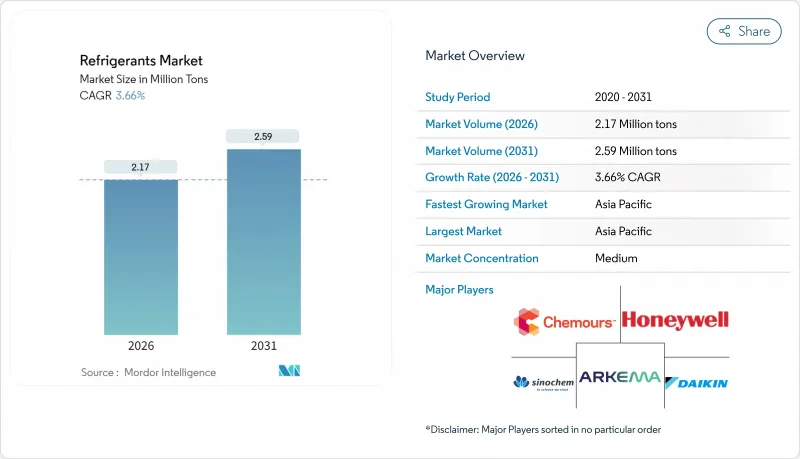
성장의 주요 원동력은 지구 온난화 계수(GWP)의 낮은 배합의 채택 가속, 하이드로플루오로카본(HFC)의 단계적 삭감 의무화, 냉각, 수송, 콜드체인 물류에서의 열 관리 요구의 확대입니다. 규제에 따른 제품 대체, 전기자동차로의 히트 펌프 통합, 다온도 의약품 물류 확대가 냉매 시장 기회를 확대하는 한편 천연 냉매 및 하이드로플루오로올레핀(HFO) 대체품에 대한 수요를 가속화하고 있습니다. 동시에, 원재료 비용의 변동과 할당제에 의한 공급 병목이 가격 변동성을 높이고 있으며, 제조업체는 생산 능력의 최적화와 제품 포트폴리오의 조정을 강요하고 있습니다. 중류 유통업체는 지역별 규제 이행 기한에 앞서 규제 적합 분자를 확보하기 위해 화학 대기업과의 전략적 조달 제휴를 구축 중입니다. 한편, 하류의 기기 제조업체는 A2L 및 A3 분류에 적합한 시스템 재설계를 신속하게 진행하고 있습니다. 이러한 시너지 효과로 인해 2030년까지 냉매 시장은 중간 정도의 단일 자릿수 성장 궤도를 유지할 것으로 예측됩니다.
세계 냉매 시장 동향과 인사이트
신흥 아시아의 룸 에어컨 및 자동차 에어컨 수요 증가
급속한 도시화에 의해 주택용 냉방설비가 제2급 및 제3급 도시의 가정에 보급되는 한편, 자동차 업계에서는 내연기관 플랫폼에서 전기구동 시스템으로의 이행이 진행되고 있습니다. 중국의 히트펌프 출하 대수는 2030년까지 연간 5,000만대에 달할 것으로 예측되며, 인도의 가정용 에어컨 보급률은 여전히 10% 미만이며, 잠재적인 수요의 크기를 나타내고 있습니다. 일본의 개정 프론법과 한국의 효율관리 프로그램은 지구온난화계수(GWP)의 상한을 규정하고 있으며, 이에 따라 프로판, R-32 및 선정된 HFO 블렌드에 대한 조달이 진행되고 있습니다. 지역 자동차 제조업체는 캐빈 및 배터리 루프용으로 R-1234yf를 표준화하고 있으며, 아시아태평양 전체의 분자 전환량을 가속화하고 있습니다. 주택분야에서의 보급과 전동모빌리티의 채택이 함께 예측기간 중 냉매 시장에서 최대 절대톤수 증가를 지지하고 있습니다.
전동 차량의 열 관리 요구 사항
전기자동차(EV)의 배터리 화학 특성은 수명과 충전 속도의 관점에서 좁은 온도 범위를 요구합니다. R-1234yf는 미국의 신형 경차의 95%에 채택되어 현재 세계 2억 2,000만대의 차량에 탑재되고 있습니다. 한편, 기존 차량군에서는 R-134a를 동분자로 교환하는 개조 키트가 채택되고 있습니다. 차내 난방과 배터리 냉각을 통합하는 히트 펌프 구조가 양산차 부문에 보급되어 -30℃-45℃의 효율 곡선에 최적화된 혼합 A2L 냉매의 소비를 촉진하고 있습니다. 컴프레서 제조업체는 인클로저 설계 및 인버터 조정을 통해 스크롤 사운드를 6dBA 줄이고, 이는 고급 EV 모델의 중요한 사양입니다. 이러한 시너지 효과는 2020년대 중반까지 이동성 용도를 위한 냉매의 잠재 시장을 확대합니다.
엄격한 세계의 HFC 단계적 삭감(키갈리 협정, EU 프론 규제)
EU 규칙 2024/573에 따라 HFC 할당량은 2025년 기준치의 60%에서 2036년에는 15%로 줄어들었으며 2050년까지 완전 폐지가 목표로 되어 있습니다. 키갈리 개정에 의한 유사한 생산 동결은 모든 생산자에게 동시에 압력을 가하고 공급을 박박시켜 냉매 시장 전체의 스팟 가격을 끌어 올립니다. 신규 시스템을 설치하는 사업자는 500 tCO2e 이상의 용량에서 자동 누설 검지 장치의 채택이 의무화되어 컴플라이언스 예산이 증가하고 자본이 양적인 성장으로부터 재분배됩니다. 이 불확실성으로 인해 대규모 장비의 도입 결정주기가 지연되고 전환기 중반의 예측 CAGR이 약 2% 포인트 감소합니다.
부문 분석
탄화수소계 냉매는 2025년 냉매 시장 점유율의 49.02%를 차지했으며, 2025년 냉매 시장 점유율은 여러 프레온 규제 일정에 있어서의 적용 제외 상태와 소유 비용면에서의 우위성을 배경으로 했습니다. 시장 리더기업은 주택용 히트펌프와 플러그인식 업무용 캐비닛용 출하량이 2자리 성장을 기록했다고 보고하고 있으며, MEPS 개정을 채택하는 지역에서는 R-290 분할 유닛의 세계 전개가 가속되고 있습니다. 하이드로플루오로올레핀은 자동차 및 고정식 공조설비 분야에서의 신규 채택이 견인역이 되어 9.86%라는 가장 빠른 CAGR을 달성하고 있습니다. 이러한 분야에서는 지구온난화계수(GWP) 750을 넘는 냉매의 사용금지기한이 다가오고 있습니다. 이 두 개의 낮은 GWP 부문이 결합되어 감소 경향에있는 플루오로 카본 냉매의 톤수를 상쇄하여 냉매 시장 전체의 성장을 지원하고 있습니다.
하류 시장에서는 암모니아나 CO2 등 무기계 냉매 시장 규모가 대규모 식품 가공 플랜트나 대형 슈퍼마켓에 있어서 확대를 계속하고 있습니다. 엔지니어는 효율 향상을 위해 저압단에 CO2를, 고압단에 합성 냉매를 조합한 시스템을 채택하고 있으며, 캐스케이드 방식의 각종 조합에 있어서의 최근의 COP 비교 시험에서도 그 유효성이 실증되고 있습니다. 데이터센터의 액침 냉각과 의약품용 냉동고가 CO2의 성장 분야로 참여하는 한편, 암모니아는 창고용 냉동기로 확고한 지위를 유지하고 있습니다. 천연 냉매의 탄소배출권 제도는 비즈니스 케이스를 더욱 매력적으로 만들어 기존 HFC 냉매로부터의 점유율 전환을 지속적으로 촉진하고 있습니다.
냉매 시장 보고서는 유형별(플루오로카본, 무기계, 탄화수소, 기타), 용도별(냉동, 공조, 기타 용도), 최종 사용자 산업별(주택 및 상업 빌딩, 식품 및 음료 가공, 의약품 및 헬스케어, 자동차 및 전기 모빌리티, 기타), 지역별(아시아태평양, 북미, 유럽, 남미, 중동 및 아프리카)로 세분화되어 있습니다.
지역별 분석
2025년 아시아태평양이 냉매 시장에서 차지하는 50.10%의 점유율은 이 지역의 거대한 제조거점, 도시의 기온 상승, 지원적인 정책 틀을 반영하고 있습니다. 중국의 룸 에어컨 수출은 국내 수요 증가에 따라 증가하고 있으며, 수직 통합형 공급망을 통해 R-32 및 R-290의 대량 유통이 확보되고 있습니다. 인도의 백색 가전용 생산 연동형 장려금(PLI) 제도에는 저GWP 냉매의 연구개발에 대한 보조금이 포함되어 현지 부품 생태계 구축을 가속화하고 있습니다. 일본과 한국은 A2L 블렌드용 첨단 재료 개발의 핵심을 담당하고 배합 노하우를 지역 전체에 수출하고 있습니다. 동남아시아 국가는 콜드체인 인프라에 자금을 투자하여 이에 이어 아시아태평양의 냉매 시장에서 주도적 지위를 더욱 강화하고 있습니다.
북미는 균형 잡힌 길을 걷고 있으며, 미국의 IM법이 HFC 소비량의 상한 규제를 단계적으로 도입함과 동시에 HVAC 리노베이션에서의 HFO 수요가 급증하고 있습니다. 켐아즈는 코퍼스 크리스티 공장의 증산으로 2025년 1분기에 옵티온 판매량이 40% 증가했습니다. 캐나다의 탄소가격제도는 식품소매 분야에서 설비사양을 자연냉매로 더욱 기울이는 한편, 멕시코의 공업지대에서는 이행기의 GWP 상한치 하에서 프로세스냉각용 불소계 냉매가 요구되고 있습니다.
유럽은 가장 엄격한 규제 프레임워크 안에서 대응을 진행하고 있습니다. F가스규제 2024의 할당량과 에코디자인규칙에 따라 OEM 제조업체는 R-290 히트펌프의 대규모 도입을 추진하고 있으며, 독일과 프랑스의 보조금제도가 이를 지원하고 있습니다. 고온 환경 최적화 패키지의 보급으로 초임계 CO2는 온난한 기후 지역에서도 슈퍼마켓의 표준 사양이 되었습니다. 영국은 자체 할당량 제도를 유지하면서 EU 스케줄을 준수하기 때문에 냉매 시장 전망은 유럽 전역에서 수렴 경향이 있습니다.
남미 전역 및 중동 및 아프리카의 신흥 지역은 냉매 시장의 긴 꼬리를 형성하고 있습니다. 단계적 감소 일정 지연으로 HFC 수요는 계속되지만 1인당 냉각 수요 증가는 미래의 낮은 GWP 냉매 도입 사이클에 영향을 미칩니다. 인프라 격차는 콜드체인 물류와 농업 생산성 향상을 결합한 다자간 개발 은행 프로그램을 통해 해소되고 있습니다.
기타 혜택 :
- 엑셀 형식 시장 예측(ME) 시트
- 애널리스트에 의한 3개월간의 지원
자주 묻는 질문
목차
제1장 서론
- 조사의 전제조건과 시장의 정의
- 조사 범위
제2장 조사 방법
제3장 주요 요약
제4장 시장 상황
- 시장 개요
- 시장 성장 촉진요인
- 신흥 아시아 지역의 가정용 및 자동차 에어컨 수요 급증
- 냉동 창고 및 3PL 콜드체인 거점의 확대
- 전기자동차의 열 관리 요건
- mRNA형 백신용 초저온 냉동고 수요
- 자연 냉매 전환에 따른 탄소 배출권 수익화(Monetisation)
- 시장 성장 억제요인
- 전 세계적인 수소불화탄소(HFC) 감축 규제 강화 (키갈리 개정서, EU F-가스 규제 등)
- 가연성 A3/A2L 가스의 높은 초기 도입 비용 및 취급 위험성
- 차세대 HFO(수소불화올레핀) 분자 화합물의 급격한 가격 변동성
- 밸류체인 분석
- 규제 상황
- Porter's Five Forces
- 공급기업의 협상력
- 구매자의 협상력
- 신규 참가업체의 위협
- 대체품의 위협
- 경쟁 기업간 경쟁 관계
제5장 시장 규모와 성장 예측
- 유형별
- 불소 화합물
- 하이드로클로로플루오로카본(HCFC)
- 하이드로플루오로카본(HFC)
- 무기 화합물
- 암모니아
- 이산화탄소
- 기타 무기 화합물
- 탄화수소
- 이소부탄
- 프로판
- 기타 탄화수소
- 기타 유형(하이드로플루오로올레핀(HFO))
- 불소 화합물
- 용도별
- 냉동
- 가정용
- 상업용
- 운송용
- 산업용
- 공조
- 고정식/패키지형
- 칠러
- 이동식
- 기타 용도
- 냉동
- 최종 사용자 업계별
- 주택 및 상업 빌딩
- 식품 및 음료 가공
- 의약품 및 헬스케어
- 자동차 및 e-모빌리티
- 화학제품 및 석유화학제품
- 기타 산업
- 지역별
- 아시아태평양
- 중국
- 인도
- 일본
- 한국
- ASEAN
- 기타 아시아태평양
- 북미
- 미국
- 캐나다
- 멕시코
- 유럽
- 독일
- 프랑스
- 영국
- 이탈리아
- 러시아
- 기타 유럽
- 남미
- 브라질
- 아르헨티나
- 기타 남미
- 중동 및 아프리카
- 사우디아라비아
- 남아프리카
- 기타 중동 및 아프리카
- 아시아태평양
제6장 경쟁 구도
- 시장 집중도
- 전략적 동향
- 시장 점유율**/순위 분석
- 기업 프로파일
- A-Gas International Ltd
- AGC Inc.
- Arkema
- Brothers Gas
- Daikin Industries, Ltd.
- Dongyue Group
- Gulfcryo.
- Harp International Ltd
- Honeywell International Inc
- Linde PLC
- Messer SE & Co. KGaA
- Navin Fluorine International Ltd
- Orbia
- Shandong Yuean Chemical Industry Co., Ltd
- Sinochem Holdings Corporation Ltd
- SRF Limited
- The Chemours Company
- Zhejiang Juhua Co. Ltd.
제7장 시장 기회와 장래의 전망
SHW 26.01.26The Refrigerants market is expected to grow from 2.09 million tons in 2025 to 2.17 million tons in 2026 and is forecast to reach 2.59 million tons by 2031 at 3.66% CAGR over 2026-2031.
The core growth engines are the accelerated adoption of low-global-warming-potential (GWP) formulations, mandatory phase-downs of hydrofluorocarbons (HFCs), and expanding thermal-management needs across cooling, transport, and cold-chain logistics. Regulation-driven product substitutions, electrified-vehicle heat-pump integration, and multi-temperature pharmaceutical logistics expand the refrigerant market opportunity while intensifying demand for natural and hydrofluoro-olefin (HFO) alternatives. At the same time, raw-material cost swings and quota-induced supply bottlenecks keep price volatility high, prompting manufacturers to optimize capacity footprints and portfolio mixes. Midstream distributors are forming strategic sourcing alliances with chemical majors to secure compliant molecules ahead of regional cut-off dates, while downstream equipment makers fast-track system redesigns compatible with A2L and A3 classifications. These converging forces collectively reinforce a medium-single-digit growth trajectory for the refrigerant market through 2030.
Global Refrigerants Market Trends and Insights
High Demand for Room and Car Air-Conditioners in Emerging Asia
Rapid urbanization is pushing residential cooling deeper into tier-2 and tier-3 city households while the automotive sector simultaneously swaps internal-combustion platforms for electric drivetrains. China's heat-pump shipments are projected to hit 50 million units annually by 2030, and India's household air-conditioner penetration remains under 10%, underscoring significant latent demand. Japan's revised F-Gas Law and South Korea's efficiency management program impose GWP ceilings that funnel procurement toward propane, R-32, and shortlisted HFO blends. Vehicle OEMs in the region are standardizing R-1234yf for cabin and battery loops, accelerating molecule transition volumes throughout Asia-Pacific. Together, residential uptake and e-mobility adoption underpin the largest absolute tonnage additions in the refrigerant market during the forecast window.
Electrified-Vehicle Thermal-Management Requirements
Electric vehicle (EV) battery chemistries demand narrow temperature windows for longevity and charging speed. R-1234yf enjoys 95% penetration in new U.S. light-duty vehicles, with 220 million cars worldwide now equipped, while legacy fleets adopt retrofit kits that swap out R-134a for the same molecule. Heat-pump architectures unifying cabin heating and battery cooling are spreading into mass-market segments, spurring consumption of blended A2L fluids optimized for -30 °C to +45 °C efficiency curves. Compressor suppliers have cut scroll noise by 6 dBA through housing and inverter tuning, a key specification for premium EV models. The aggregate effect widens the addressable refrigerant market for mobility applications through mid-decade.
Stringent Global HFC Phase-Down (Kigali, EU F-Gas)
EU Regulation 2024/573 cuts HFC quotas from 60% of baseline levels in 2025 to 15% in 2036, with full phase-out targeted by 2050. Similar freezes under the Kigali Amendment pressure all producers simultaneously, tightening supply and elevating spot prices across the refrigerant market. Operators installing new systems must adopt automated leak detection above 500 tCO2e capacity, raising compliance budgets and reallocating capital away from volume growth. The resulting uncertainty slows decision cycles for large installations, shaving nearly two percentage points from projected CAGR during mid-transition years.
Other drivers and restraints analyzed in the detailed report include:
- Ultralow-Temperature Freezers for mRNA-Type Vaccines
- Carbon-Credit Monetization for Natural Refrigerants
- High First-Cost and Handling Risk of Flammable A3/A2L Gases
For complete list of drivers and restraints, kindly check the Table Of Contents.
Segment Analysis
Hydrocarbons commanded 49.02% refrigerant market share in 2025 on the back of exemption status under multiple F-Gas schedules and compelling cost-of-ownership economics. Market leaders report double-digit shipment growth into residential heat-pumps and plug-in commercial cabinets, while global roll-outs of R-290 split units accelerate in regions adopting MEPS revisions. Hydrofluoro-olefins are delivering the fastest 9.86% CAGR, propelled by automotive and stationary HVAC debuts where regulatory cut-off dates for GWP greater than 750 fluids are imminent. Collectively, these two low-GWP segments offset contracting fluorocarbon tonnage, anchoring overall refrigerant market growth.
Downstream, the refrigerant market size for inorganic options such as ammonia and CO2 continues to expand in large food-processing plants and big-box supermarkets. Engineers pair CO2 in low-stage loops with synthetic high-stage fluids for efficiency gains, an architecture validated by recent COP comparisons across cascade permutations. Data-center immersion cooling and pharma freezers add pocket growth for CO2, while ammonia remains entrenched in warehouse chillers. Natural-refrigerant carbon-credit programs further sweeten the business case, ensuring sustained share migration away from legacy HFCs.
The Refrigerants Market Report is Segmented by Type (Fluorocarbons, Inorganics, Hydrocarbons, Other Types), Application (Refrigeration, Air-Conditioning, Other Applications), End-User Industry (Residential and Commercial Buildings, Food and Beverage Processing, Pharmaceuticals and Healthcare, Automotive and E-Mobility, and More), and Geography (Asia-Pacific, North America, Europe, South America, Middle-East and Africa).
Geography Analysis
Asia-Pacific's 50.10% refrigerant market share in 2025 reflects the region's outsized manufacturing base, urban temperature spikes, and supportive policy frameworks. China's room-air-conditioner exports grow with domestic uptake, locking in bulk R-32 and R-290 flows through vertically integrated supply chains. India's Production Linked Incentive (PLI) scheme for white goods includes grants for low-GWP refrigerant R&D, expediting local component ecosystems. Japan and South Korea anchor advanced-material development for A2L blends, exporting formulation know-how across the region. Southeast Asian economies follow with cold-chain infrastructure funding, reinforcing Asia-Pacific's reinforced leadership of the refrigerant market.
North America tracks a balanced path as the U.S. AIM Act mandates an HFC consumption-cap glide path while simultaneously turbo-charging demand for HFOs in HVAC retrofits. Chemours logged a 40% surge in Opteon sales during Q1 2025, enabled by its Corpus Christi capacity expansion. Canada's carbon-pricing architecture further skews equipment specifications toward natural refrigerants in food retail, whereas Mexico's industrial corridor demands process-cooling fluorocarbons under transitional GWP ceilings.
Europe navigates the tightest regulatory straitjacket. F-Gas 2024 quotas and eco-design rules push OEMs to deploy R-290 heat-pumps at scale, supported by German and French subsidy pools. Transcritical CO2 has become the default supermarket specification even in southern climates thanks to high-ambient optimization packages. The United Kingdom maintains an independent quota system but mirrors EU timelines, keeping the refrigerant market outlook convergent across the continent.
Emerging regions across South America and Middle East & Africa constitute the long-tail of the refrigerant market. Delayed phase-down schedules prolong HFC demand, yet rising per-capita cooling expectations seed future low-GWP adoption cycles. Infrastructure gaps are being addressed through multilateral development-bank programs that bundle cold-chain logistics with agricultural productivity mandates.
- A-Gas International Ltd
- AGC Inc.
- Arkema
- Brothers Gas
- Daikin Industries, Ltd.
- Dongyue Group
- Gulfcryo.
- Harp International Ltd
- Honeywell International Inc
- Linde PLC
- Messer SE & Co. KGaA
- Navin Fluorine International Ltd
- Orbia
- Shandong Yuean Chemical Industry Co., Ltd
- Sinochem Holdings Corporation Ltd
- SRF Limited
- The Chemours Company
- Zhejiang Juhua Co. Ltd.
Additional Benefits:
- The market estimate (ME) sheet in Excel format
- 3 months of analyst support
TABLE OF CONTENTS
1 Introduction
- 1.1 Study Assumptions and Market Definition
- 1.2 Scope of the Study
2 Research Methodology
3 Executive Summary
4 Market Landscape
- 4.1 Market Overview
- 4.2 Market Drivers
- 4.2.1 High demand for room and car air-conditioners in emerging Asia
- 4.2.2 Expansion of refrigerated warehousing and 3PL cold-chain nodes
- 4.2.3 Electrified-vehicle thermal-management requirements
- 4.2.4 Ultralow-temperature freezers for mRNA-type vaccines
- 4.2.5 Carbon-credit monetisation for natural refrigerants
- 4.3 Market Restraints
- 4.3.1 Stringent global HFC phase-down (Kigali, EU F-Gas)
- 4.3.2 High first-cost and handling risk of flammable A3/A2L gases
- 4.3.3 Boom-bust price swings for next-gen HFO molecules
- 4.4 Value Chain Analysis
- 4.5 Regulatory Landscape
- 4.6 Porter's Five Forces
- 4.6.1 Bargaining Power of Suppliers
- 4.6.2 Bargaining Power of Buyers
- 4.6.3 Threat of New Entrants
- 4.6.4 Threat of Substitutes
- 4.6.5 Competitive Rivalry
5 Market Size and Growth Forecasts (Volume)
- 5.1 By Type
- 5.1.1 Fluorocarbons
- 5.1.1.1 Hydrochlorofluorocarbons (HCFC)
- 5.1.1.2 Hydrofluorocarbons (HFC)
- 5.1.2 Inorganics
- 5.1.2.1 Ammonia
- 5.1.2.2 Carbon Dioxide
- 5.1.2.3 Other Inorganics
- 5.1.3 Hydrocarbons
- 5.1.3.1 Isobutane
- 5.1.3.2 Propane
- 5.1.3.3 Other Hydrocarbons
- 5.1.4 Other Types (Hydrofluoro-olefins (HFO))
- 5.1.1 Fluorocarbons
- 5.2 By Application
- 5.2.1 Refrigeration
- 5.2.1.1 Domestic
- 5.2.1.2 Commercial
- 5.2.1.3 Transportation
- 5.2.1.4 Industrial
- 5.2.2 Air-Conditioning
- 5.2.2.1 Stationary Room/Packaged
- 5.2.2.2 Chillers
- 5.2.2.3 Mobile
- 5.2.3 Other Applications
- 5.2.1 Refrigeration
- 5.3 By End-user Industry
- 5.3.1 Residential and Commercial Buildings
- 5.3.2 Food and Beverage Processing
- 5.3.3 Pharmaceuticals and Healthcare
- 5.3.4 Automotive and e-Mobility
- 5.3.5 Chemicals and Petrochemicals
- 5.3.6 Other Industries
- 5.4 By Geography
- 5.4.1 Asia-Pacific
- 5.4.1.1 China
- 5.4.1.2 India
- 5.4.1.3 Japan
- 5.4.1.4 South Korea
- 5.4.1.5 ASEAN Countries
- 5.4.1.6 Rest of Asia-Pacific
- 5.4.2 North America
- 5.4.2.1 United States
- 5.4.2.2 Canada
- 5.4.2.3 Mexico
- 5.4.3 Europe
- 5.4.3.1 Germany
- 5.4.3.2 France
- 5.4.3.3 United Kingdom
- 5.4.3.4 Italy
- 5.4.3.5 Russia
- 5.4.3.6 Rest of Europe
- 5.4.4 South America
- 5.4.4.1 Brazil
- 5.4.4.2 Argentina
- 5.4.4.3 Rest of South America
- 5.4.5 Middle-East and Africa
- 5.4.5.1 Saudi Arabia
- 5.4.5.2 South Africa
- 5.4.5.3 Rest of Middle-East and Africa
- 5.4.1 Asia-Pacific
6 Competitive Landscape
- 6.1 Market Concentration
- 6.2 Strategic Moves
- 6.3 Market Share**/Ranking Analysis
- 6.4 Company Profiles (includes Global level Overview, Market level overview, Core Segments, Financials as available, Strategic Information, Market Rank/Share for key companies, Products and Services, and Recent Developments)
- 6.4.1 A-Gas International Ltd
- 6.4.2 AGC Inc.
- 6.4.3 Arkema
- 6.4.4 Brothers Gas
- 6.4.5 Daikin Industries, Ltd.
- 6.4.6 Dongyue Group
- 6.4.7 Gulfcryo.
- 6.4.8 Harp International Ltd
- 6.4.9 Honeywell International Inc
- 6.4.10 Linde PLC
- 6.4.11 Messer SE & Co. KGaA
- 6.4.12 Navin Fluorine International Ltd
- 6.4.13 Orbia
- 6.4.14 Shandong Yuean Chemical Industry Co., Ltd
- 6.4.15 Sinochem Holdings Corporation Ltd
- 6.4.16 SRF Limited
- 6.4.17 The Chemours Company
- 6.4.18 Zhejiang Juhua Co. Ltd.
7 Market Opportunities and Future Outlook
- 7.1 White-space and Unmet-Need Assessment