

|
시장보고서
상품코드
1910477
망간 : 시장 점유율 분석, 업계 동향 및 통계, 성장 예측(2026-2031년)Manganese - Market Share Analysis, Industry Trends & Statistics, Growth Forecasts (2026 - 2031) |
||||||
 Mordor Intelligence
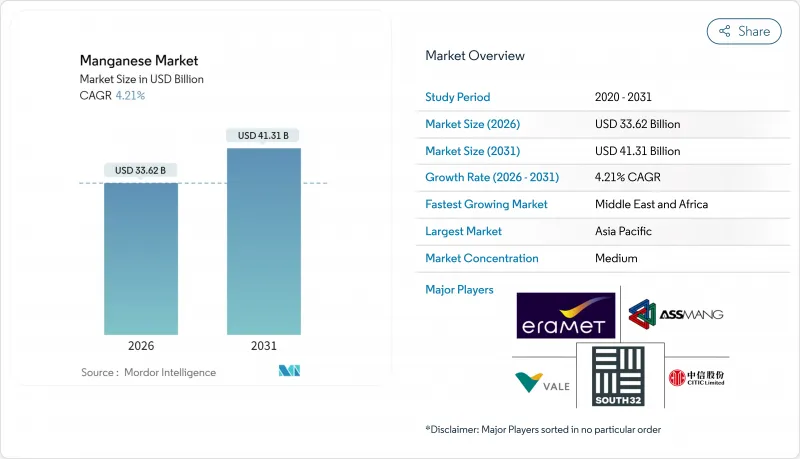
망간 시장은 2025년 322억 6,000만 달러에서 2026년에는 336억 2,000만 달러로 성장하고 2026년부터 2031년에 걸쳐 CAGR 4.21%를 나타낼 전망입니다. 2031년까지 413억 1,000만 달러에 이를 것으로 예측됩니다.
기존의 강재용 합금이 여전히 주류를 차지하고 있습니다만, 전지용 그레이드 및 고순도 특수 품목의 급성장에 의해 무역 루트가 재편되어, 중국 국외에 있어서 새로운 정련소 투자가 촉진되고 있습니다. 사우스32사의 GEMCO광산에 있어서 사이클론 피해 및 가봉에서의 노동 쟁의에 의해 광석 공급이 희박해, 스폿 가격이 상승한 결과, 구미의 구매자는 장기 계약의 확보에 움직이고 있습니다. 유럽과 인도의 수소 기반 직접 환원 철(DRI) 프로젝트는 조강 톤당 페로망간 소비를 증가시키고 있습니다. 한편 대형 전기자동차용 리튬·망간·철·인산염(LMFP) 캐소드는 고순도 망간 수요를 확대하고 있습니다. 미국 및 사우디아라비아 정부는 중국의 정련 의존도를 줄이기 위해 국내 페로알로이 및 황산염 생산 능력에 대한 보조금을 지급하고 있으며, 이 정책 동향은 망간 시장의 GDP를 능가하는 확대를 더욱 강화할 가능성이 높습니다.
세계의 망간 시장 동향과 전망
대형 차량의 전동화가 HP-Mn 수요를 가속
대형 전기 트럭과 버스에서는 기존의 LFP 화학 조성보다 망간 함량이 높은 LMFP 캐소드의 채용이 증가하고 있으며, 실질적으로 kW시당 망간 사용량이 증가하고 있습니다. 미국 에너지부(DOE)의 보조금을 받은 Element 25개사의 루이지애나 제련소는 중국의 중간업체를 거치지 않고 고순도 황산망간을 생산·공급합니다. 주목할만한 변화로 자동차 제조업체는 현재 추적성과 저탄소성을 겸비한 원료에 대해 프리미엄 가격을 지불할 의향을 나타내고 있으며, 이에 따라 망간 시장에서는 2단계 가격 구조가 확립되고 있습니다. 이러한 움직임을 받아 구미의 정책 인센티브가 전지급 원료 수요를 밀어 올리고 있어 철강 사이클의 변동 속에서도 성장이 지속될 전망입니다. 이러한 변화 상황에 따라 기존의 광석 채굴 기업은 시장에서의 지위를 유지하기 위해 다운스트림 공정에 진출하거나 정제업체와의 제휴를 모색하고 있습니다.
제철 업체의 수소 DRI로의 전환은 HC 페로망간 수요 증가
수소 기반 DRI-EAF 공정은 고로 공정과 비교하여 더 많은 망간 첨가가 필요합니다. 이것은 주로 DRI 펠릿의 잔류 망간 함량이 낮기 때문입니다. 스웨덴과 독일의 파일럿 플랜트는 2024년 가동 개시 시 이 합금 첨가량 증가를 입증했습니다. 2030년까지 그린 수소 생산을 확대하는 인도의 '국가 그린 수소 미션'은 이 나라의 페로망간 수요를 증가시킬 수 있습니다. 저탄소 전력을 활용하는 페로망간 공급업체는 특히 EU의 탄소 국경 조정세가 석탄 다용 등급 수입품에 과징금을 부과함으로써 큰 이익을 얻을 것으로 전망됩니다. 이 합금 소비량의 급증은 현재 시장을 강화할 뿐만 아니라 망간 시장의 장기적인 성장을 위한 길을 열어주는 것입니다.
급속한 LFP 채용이 캐소드급 망간 성장을 억제
2024년, 승용 전기자동차 제조업체는 LFP(인산철 리튬) 정극재의 채용 비율을 높여, 망간계 화학 조성을 치환함으로써, 정극재 등급 재료의 당면 수요에 그림자를 떨어뜨렸습니다. LFP 증가는 황산망간 수요의 감소를 의미합니다. 2028년까지 LFP 시장 점유율이 계속 확대될 경우, 배터리 망간 부문은 기존 예측보다 낮을 수 있습니다. 생산자는 제강 첨가제용 전해 금속으로 전환 가능한 정련 설비를 정비하는 것으로 대응하고 있습니다만, 이 유연성의 향상에는 자본 지출 증가가 수반됩니다. 그 결과 LMFP가 병렬로 발전하고 있음에도 불구하고 망간 시장의 성장이 억제되고 있습니다.
부문 분석
2025년 시점의 망간 시장 수요의 67.75%를 합금이 차지했으며, 이는 주로 완성강에의 페로망간 및 실리코망간 첨가가 견인했습니다. 유럽과 인도에서 수소 DRI(직접 환원철) 생산 능력이 확대됨에 따라 합금 사용량이 증가하고 안정적인 수량 성장을 지원하고 있습니다. 전해 이산화망간은 휴대전자기기 및 신흥 그리드 저장 프로젝트 수요에 힘입어 6.17%의 성장이 전망되고 있습니다. 사료, 수처리 및 세라믹을 포함한 기타 최종 용도는 GDP와 연동하여 성장하며 망간 시장의 수량 안정성을 제공합니다. EMD(전해망간금속)의 부활은 주로 아연망간전지에 기인하며, 캘리포니아주 에너지성(DOE)의 유틸리티 규모 파일럿 프로젝트의 주목을 받고 있습니다. 또한 EU 탄소 관세에 직면한 제철 제조업체는 인증된 저탄소 합금 수요를 증가시키고 있으며, 광범위한 상품 시장에서 프리미엄 틈새 시장을 형성하고 있습니다.
본 망간 시장 보고서는 용도별(합금, 전해 이산화망간, 전해 망간 금속, 기타 용도), 최종 용도 분야(공업, 건설, 전력 저장·전력, 기타 최종 용도 분야), 광석 품위(전지용 그레이드, 고순도 그레이드, 표준 그레이드, 공업용 그레이드), 지역(아시아태평양 등)별로 분석했습니다. 시장 예측은 금액 기준(달러)으로 제공됩니다.
지역별 분석
2025년 아시아태평양은 세계 망간 시장의 54.20%를 차지했습니다. 이것은 주로 철강 및 배터리 재료에 대한 수요가 큰 중국에 견인된 것입니다. 인프라 투자와 타타 스틸 및 MOIL의 실리코 망간 사업 확대에 뒷받침된 인도도 크게 기여했습니다. 일본과 한국은 전해망간금속산업에서 주요 기업로서의 지위를 확립하여 고순도 제품을 지역 전체에 수출하고 있습니다. 자원이 풍부한 아프리카에서는 정제 능력의 제약으로부터, 망간 광석의 국내 가공은 극히 일부에 머물러, 대부분이 수출되고 있습니다. 중동 및 아프리카의 망간 시장은 남아프리카의 철도 제약 완화 노력과 사우디아라비아의 하류 투자 추진을 배경으로 2031년까지 연평균 복합 성장률(CAGR) 5.86%로 확대될 것으로 예측되고 있습니다.
북미는 2025년 시점에서 세계의 망간 수요에 차지하는 비율이 작았으며, 루이지애나 주에서의 Element 25 제련소의 가동 개시에 의해 전지급 원료의 현지 조달이 이 점유율 확대에 기여했습니다. 캐나다는 퀘벡주의 망간 광상 개발을 적극적으로 추진하고 있으며, 멕시코 제철소는 미국 자동차 제조업체를 위한 수요에 대응하기 위해 생산 능력을 확대하고 있습니다. 중간 정도의 점유율을 차지하는 유럽에서는 탄소 국경 조정 메커니즘(CBAM)에 의한 과제에 직면하고 있으며, 구매자는 노르웨이의 수력 발전에 의한 합금과 재생 원료로 이행하고 있습니다. 특히 엘라멧사의 'eraLow' 브랜드는 재생가능 전력을 활용하여 EU의 평강 제조업체와의 계약을 확보하고 있습니다.
남미는 세계의 망간 수요에 차지하는 비율은 작은 것으로, 브라질이 합금 소비와 발레사 아줄 광산으로부터의 수출을 견인하고 있습니다. 한편, 아르헨티나의 급성장 리튬 산업은 특히 캐소드 전구체를 위한 망간 수요를 간접적으로 밀어 올리고 있습니다. 지역 전지 공급망 육성의 노력은 대륙 내에서 가공을 증가시킬 수 있으며 망간 시장 역학을 재구성할 수 있습니다. 라틴아메리카 국가가 밸류체인의 업스트림로 이동하는 궤적은 인프라 정비와 녹색 에너지 시책에 달려 있습니다.
기타 혜택 :
- 엑셀 형식 시장 예측(ME) 시트
- 애널리스트 지원(3개월간)
자주 묻는 질문
목차
제1장 서론
- 조사 전제조건 및 시장 정의
- 조사 범위
제2장 조사 방법
제3장 주요 요약
제4장 시장 상황
- 시장 개요
- 시장 성장 촉진요인
- 대형 차량의 전동화가 고순도 망간 수요를 가속
- 제철소에 있어서 수소 DRI로의 전환이 HC페로망간 사용량을 증가
- 서쪽 OEM 제조업체에 의한 HPMSM의 오프 테이크 계약이 공급원의 다양화를 촉진
- 인도 및 ASEAN의 인플래그 레이드 실리코 망간 수요
- 지정학적 요인에 의한 광석 공급의 혼란(가봉, 호주)이 가격 상승 촉진
- 시장 성장 억제요인
- LFP의 급속한 보급이 캐소드급 망간 수요의 성장을 억제
- 남아프리카의 광석 항만의 병목이 수출량을 억제
- 고탄소 페로알로이의 CO2 배출량이 카본 보더세의 대상
- 밸류체인 분석
- Porter's Five Forces
- 공급기업의 협상력
- 구매자의 협상력
- 신규 참가업체의 위협
- 대체 제품 및 서비스의 위협
- 경쟁 기업 간 경쟁 관계
제5장 시장 규모와 성장 예측
- 용도별
- 합금
- 전해 이산화망간
- 전해 망간 금속
- 기타 용도
- 최종 사용 분야별
- 산업
- 건설
- 전력 저장 및 전력
- 기타 최종 용도 분야
- 광석 품위별
- 배터리 등급
- 고순도 등급
- 표준 등급
- 기술 등급
- 지역별
- 아시아태평양
- 중국
- 인도
- 일본
- 한국
- 기타 아시아태평양
- 북미
- 미국
- 캐나다
- 멕시코
- 유럽
- 독일
- 영국
- 프랑스
- 이탈리아
- 러시아
- 기타 유럽
- 남미
- 브라질
- 아르헨티나
- 기타 남미
- 중동 및 아프리카
- 사우디아라비아
- 남아프리카
- 기타 중동 및 아프리카
- 아시아태평양
제6장 경쟁 구도
- 시장 집중도
- 전략적 동향
- 시장 점유율(%)/순위 분석
- 기업 프로파일
- African Rainbow Minerals Limited.
- Anglo American plc
- Assore Limited(Assmang Proprietary Limited)
- BHP
- CITIC LIMITED
- Consolidated Minerals Limited.
- Element 25 Limited
- Eramet
- Giyani Metals Corp
- Jupiter Mines Limited
- Manganese Metal Company(Pty) Ltd.
- MOIL LIMITED
- Ningxia Tianyuan Manganese Industry Group Co. Ltd
- NIPPON DENKO CO. LTD
- OM Holdings Ltd.
- POSCO M-TECH.
- South32
- Tata Steel
- Vale
- Vibrantz
제7장 시장 기회와 향후 전망
KTH 26.01.22The Manganese market is expected to grow from USD 32.26 billion in 2025 to USD 33.62 billion in 2026 and is forecast to reach USD 41.31 billion by 2031 at 4.21% CAGR over 2026-2031.
Traditional steel-grade alloys still dominate; however, rapid growth in battery-grade and high-purity specialties is reshaping trade routes and prompting new refinery investments outside China. Cyclone damage at South32's GEMCO mine and labor unrest in Gabon have tightened ore supply, elevating spot prices and prompting Western buyers to secure long-term contracts. Hydrogen-based direct reduced iron (DRI) projects in Europe and India are raising ferromanganese intensity per tonne of crude steel, while lithium-manganese-iron-phosphate (LMFP) cathodes for heavy-duty electric vehicles are expanding high-purity manganese demand. Governments in the United States and Saudi Arabia are subsidizing domestic ferroalloy and sulfate capacity to reduce dependence on Chinese refining, a policy trend likely to reinforce above-GDP expansion in the Manganese market.
Global Manganese Market Trends and Insights
Electrification of Heavy-Duty Vehicles Accelerates HP-Mn Demand
Heavy-duty electric trucks and buses are increasingly turning to LMFP cathodes, which have a higher manganese content than traditional LFP chemistries, effectively increasing the manganese usage per kilowatt-hour. Element 25's Louisiana refinery, backed by a U.S. DOE grant, will produce and supply high-purity manganese sulfate, circumventing Chinese intermediaries. In a notable shift, automakers are now willing to pay a premium for feedstock that is both traceable and low-carbon, leading to the establishment of a two-tier pricing structure in the manganese market. As a result of these developments, Western policy incentives are driving up demand for battery-grade supplies, ensuring continued growth even amid fluctuations in steel cycles. This evolving landscape is prompting traditional ore miners to either move downstream or collaborate with refiners, all in an effort to maintain their market foothold.
Steelmakers' Switch to Hydrogen-DRI Raises HC FeMn Intensity
Hydrogen-based DRI-EAF pathways necessitate more manganese additions compared to blast-furnace routes, primarily because DRI pellets have a lower residual manganese content. Pilot plants in Sweden and Germany validated these increased alloy additions during their 2024 commissioning. India's National Green Hydrogen Mission, which aims to boost green hydrogen production by 2030, could increase the country's demand for ferromanganese. Suppliers of ferromanganese harnessing low-carbon power are set to gain significantly, especially as EU carbon border taxes impose penalties on coal-intensive grade imports. This surge in alloy consumption not only strengthens the current market but also paves the way for the long-term growth of the Manganese market.
Rapid LFP Adoption Curbs Cathode-Grade Mn Growth
In 2024, passenger EV manufacturers increased the share of LFP cathodes, displacing manganese-based chemistries and casting a shadow on the immediate demand for cathode-grade materials. A rise in LFP translates to a reduction in manganese sulfate demand. Should LFP's market share continue to increase by 2028, the battery-grade manganese sector may fall short of previous projections. While producers are adapting by crafting refineries that can switch to electrolytic metals for steel additives, this added flexibility comes with a hike in capital expenses. As a result, the Manganese market's growth is being restrained, even as LMFP sees parallel advancements.
Other drivers and restraints analyzed in the detailed report include:
- Western OEM Off-Take Deals for HPMSM Diversify Supply
- Infrastructure-Grade Silico-Manganese Demand in India and ASEAN
- Ore-Port Bottlenecks in South Africa Cap Export Volumes
For complete list of drivers and restraints, kindly check the Table Of Contents.
Segment Analysis
Alloys accounted for 67.75% of the manganese market demand in 2025, primarily driven by the addition of ferromanganese and silicomanganese to finished steel. With rising hydrogen-DRI capacities in Europe and India, alloy intensity has increased, supporting steady volume growth. Electrolytic manganese dioxide is poised for 6.17% growth, driven by demand from portable electronics and emerging grid-storage initiatives. Other end-uses, including feed, water treatment, and ceramics, are growing in tandem with GDP, providing volume stability to the manganese market. The resurgence of EMD is largely attributed to zinc-manganese batteries, which have caught the attention of utility-scale pilots in California's DOE. Additionally, steelmakers grappling with EU carbon tariffs are increasingly seeking certified low-carbon alloys, creating a premium niche in the broader commodity market.
The Manganese Market Report is Segmented by Application (Alloys, Electrolytic Manganese Dioxide, Electrolytic Manganese Metals, and Other Applications), End-Use Sector (Industrial, Construction, Power Storage and Electricity, and Other End-Use Sectors), Ore Grade (Battery Grade, High Purity Grade, Standard Grade, and Technical Grade), and Geography (Asia-Pacific, and More). Market Forecasts are Provided in Value (USD).
Geography Analysis
The Asia-Pacific region absorbed 54.20% of the global manganese market in 2025, primarily driven by China's demand, which was largely for steel and battery materials. India, buoyed by infrastructure investments and expansions in silico-manganese at Tata Steel and MOIL, also made significant contributions. Japan and South Korea have established themselves as key players in the electrolytic manganese metal industry, exporting high-purity products throughout the region. Despite being resource-rich, Africa processed only a small portion of its manganese ore domestically, with the bulk exported, a consequence of its limited refining capacity. The Middle East and Africa Manganese market is forecast to grow at a 5.86% CAGR to 2031, driven by South Africa's efforts to alleviate rail constraints and Saudi Arabia's push for downstream investments.
North America accounted for a smaller share of global manganese demand in 2025. However, with the commissioning of Element 25's refinery in Louisiana, the localization of battery-grade supply could bolster this share. Canada is actively pursuing manganese deposits in Quebec, while Mexican steel mills are ramping up capacity to cater to U.S. automotive clients. Europe, holding a moderate share, grapples with challenges from the Carbon Border Adjustment Mechanism (CBAM), nudging buyers towards Norwegian hydro-powered alloys and recycled feedstock. Notably, Eramet's "eraLow" brand is capitalizing on renewable electricity to secure contracts with EU flat-steel producers.
South America, contributing a smaller portion to global manganese demand, sees Brazil leading in alloy consumption and exports from Vale's Azul mine. Meanwhile, Argentina's burgeoning lithium sector is indirectly driving up demand for manganese, particularly for cathode precursors. With regional efforts to cultivate battery supply chains, there's potential for increased intra-continental processing, reshaping the Manganese market dynamics. The trajectory of Latin American nations moving up the value chain will hinge on infrastructure enhancements and green energy initiatives.
- African Rainbow Minerals Limited.
- Anglo American plc
- Assore Limited (Assmang Proprietary Limited)
- BHP
- CITIC LIMITED
- Consolidated Minerals Limited.
- Element 25 Limited
- Eramet
- Giyani Metals Corp
- Jupiter Mines Limited
- Manganese Metal Company (Pty) Ltd.
- MOIL LIMITED
- Ningxia Tianyuan Manganese Industry Group Co. Ltd
- NIPPON DENKO CO. LTD
- OM Holdings Ltd.
- POSCO M-TECH.
- South32
- Tata Steel
- Vale
- Vibrantz
Additional Benefits:
- The market estimate (ME) sheet in Excel format
- 3 months of analyst support
TABLE OF CONTENTS
1 Introduction
- 1.1 Study Assumptions and Market Definition
- 1.2 Scope of the Study
2 Research Methodology
3 Executive Summary
4 Market Landscape
- 4.1 Market Overview
- 4.2 Market Drivers
- 4.2.1 Electrification of heavy-duty vehicles accelerates HP-Mn demand
- 4.2.2 Steelmakers' switch to hydrogen-DRI raises HC FeMn intensity
- 4.2.3 Western OEM off-take deals for HPMSM diversify supply
- 4.2.4 Infrastructure-grade silico-manganese demand in India and ASEAN
- 4.2.5 Geo-political ore disruptions (Gabon, Australia) lift prices
- 4.3 Market Restraints
- 4.3.1 Rapid LFP adoption curbs cathode-grade Mn growth
- 4.3.2 Ore-port bottlenecks in South Africa cap export volumes
- 4.3.3 High-carbon ferroalloy CO2-footprint faces carbon-border taxes
- 4.4 Value Chain Analysis
- 4.5 Porter's Five Forces
- 4.5.1 Bargaining Power of Suppliers
- 4.5.2 Bargaining Power of Buyers
- 4.5.3 Threat of New Entrants
- 4.5.4 Threat of Substitute Products and Services
- 4.5.5 Intensity of Competitive Rivalry
5 Market Size and Growth Forecasts (Value)
- 5.1 By Application
- 5.1.1 Alloys
- 5.1.2 Electrolytic Manganese Dioxide
- 5.1.3 Electrolytic Manganese Metals
- 5.1.4 Other Applications
- 5.2 By End-use Sector
- 5.2.1 Industrial
- 5.2.2 Construction
- 5.2.3 Power Storage and Electricity
- 5.2.4 Other End-use Sectors
- 5.3 By Ore Grade
- 5.3.1 Battery Grade
- 5.3.2 High Purity Grade
- 5.3.3 Standard Grade
- 5.3.4 Technical Grade
- 5.4 By Geography
- 5.4.1 Asia-Pacific
- 5.4.1.1 China
- 5.4.1.2 India
- 5.4.1.3 Japan
- 5.4.1.4 South Korea
- 5.4.1.5 Rest of Asia-Pacific
- 5.4.2 North America
- 5.4.2.1 United States
- 5.4.2.2 Canada
- 5.4.2.3 Mexico
- 5.4.3 Europe
- 5.4.3.1 Germany
- 5.4.3.2 United Kingdom
- 5.4.3.3 France
- 5.4.3.4 Italy
- 5.4.3.5 Russia
- 5.4.3.6 Rest of Europe
- 5.4.4 South America
- 5.4.4.1 Brazil
- 5.4.4.2 Argentina
- 5.4.4.3 Rest of South America
- 5.4.5 Middle-East and Africa
- 5.4.5.1 Saudi Arabia
- 5.4.5.2 South Africa
- 5.4.5.3 Rest of Middle-East and Africa
- 5.4.1 Asia-Pacific
6 Competitive Landscape
- 6.1 Market Concentration
- 6.2 Strategic Moves
- 6.3 Market Share (%)/ Ranking Analysis
- 6.4 Company Profiles (includes Global level Overview, Market level overview, Core Segments, Financials as available, Strategic Information, Market Rank/Share for key companies, Products and Services, and Recent Developments)
- 6.4.1 African Rainbow Minerals Limited.
- 6.4.2 Anglo American plc
- 6.4.3 Assore Limited (Assmang Proprietary Limited)
- 6.4.4 BHP
- 6.4.5 CITIC LIMITED
- 6.4.6 Consolidated Minerals Limited.
- 6.4.7 Element 25 Limited
- 6.4.8 Eramet
- 6.4.9 Giyani Metals Corp
- 6.4.10 Jupiter Mines Limited
- 6.4.11 Manganese Metal Company (Pty) Ltd.
- 6.4.12 MOIL LIMITED
- 6.4.13 Ningxia Tianyuan Manganese Industry Group Co. Ltd
- 6.4.14 NIPPON DENKO CO. LTD
- 6.4.15 OM Holdings Ltd.
- 6.4.16 POSCO M-TECH.
- 6.4.17 South32
- 6.4.18 Tata Steel
- 6.4.19 Vale
- 6.4.20 Vibrantz
7 Market Opportunities and Future Outlook
- 7.1 White-space and Unmet-need Assessment


