

|
시장보고서
상품코드
1910482
중밀도 섬유판(MDF) : 시장 점유율 분석, 업계 동향 및 통계, 성장 예측(2026-2031년)Medium Density Fiberboard (MDF) - Market Share Analysis, Industry Trends & Statistics, Growth Forecasts (2026 - 2031) |
||||||
 Mordor Intelligence
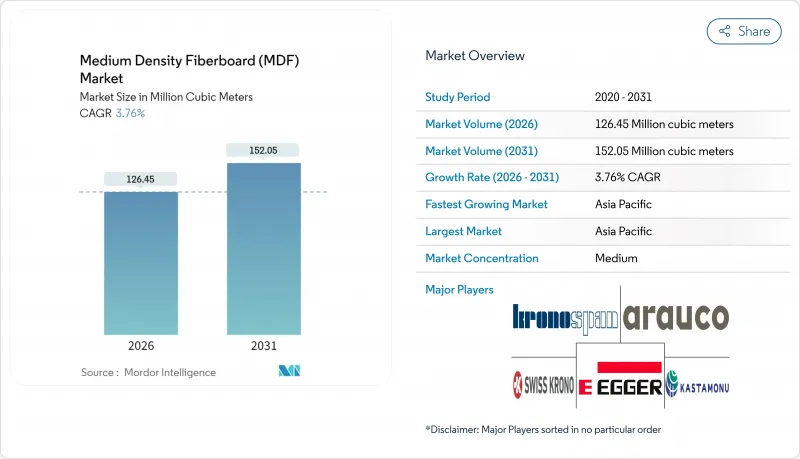
중밀도 섬유판(MDF) 시장은 2025년 1억 2,187만 입방미터에서 2026년에는 1억 2,645만 입방미터로 성장하고 2026년부터 2031년에 걸쳐 CAGR 3.76%를 나타낼 전망입니다. 2031년까지 1억 5,205만 입방미터에 달할 것으로 예상됩니다.
이러한 확대 경향은 세계 패널 생산 능력의 성장이 둔화되고 있는 가운데 계속되고 있습니다. 이는 생산자가 순수한 생산량 증가보다 공정 개량, 바이오 베이스 수지, 순환형 제조 기술에 의해 제품 품질 향상을 도모하는 경향이 강해지고 있기 때문입니다. MDF의 뛰어난 가공성, 균일한 심재, 매끄러운 표면은 조립식 캐비닛, 도어, 선반판의 기재로서 최적이며, 가구 제조업체가 일관된 도장·라미네이트 마무리를 실현하는 것을 가능하게 합니다. 아시아태평양은 2024년 생산량의 60.72%를 차지했으며, 베트남이나 인도 등의 비용 경쟁력 있는 거점이 국내 주택 프로그램과 해외용 가구 계약 모두에 대응하기 위해 생산 라인을 증설했습니다. 한편, 북미와 유럽은 엄격한 배출 규제를 충족하기 위해 프리미엄 낮은 VOC 등급에 주력하고 있습니다. 목재 섬유와 요소 포름알데히드 수지의 가격 변동은 단기적인 과제로 계속되고 있지만, 제조업체는 에너지 효율적인 정제, 삼림지대의 후방 통합, 포름알데히드의 방출을 줄이는 폴리머 MDI 바인더의 채용을 통해 비용 급등을 상쇄하고 있습니다.
세계의 중밀도 섬유판(MDF) 시장 동향과 전망
아시아태평양의 가구 제조 거점에서의 급속한 생산 능력 확대
2024년 7월 베트남에서 가동을 시작한 Siempelkamp 사의 닛산 600m3 생산 라인은 수출업체가 원료 확보와 물류 확실성을 보장하기 위해 패널 생산에 후방 통합을 진행하고 있음을 보여주었습니다. 인도네시아와 필리핀의 유사한 프로젝트는 지역 패널 자급률 향상, 운송 비용 절감, 가구 OEM 제조업체가 기판 사양을 고객의 마무리 시스템에 맞출 수 있도록 합니다. 베트남에서 사업을 확장하는 계약자는 캄보디아와 라오스에 위성 조립 라인을 설치하여 노동력과 항만 위험을 분산시켰으며, 이 패턴은 호스트 국가를 넘어 MDF 수요를 확대하고 있습니다. 중국 업체들은 전기요금 상승에 직면하고 수익률을 유지하면서 수입 고객과의 근접성을 유지하기 위해 증산분을 메콩강 유역의 저비용 지역으로 이전하고 있습니다. 중밀도 섬유판(MDF) 시장은 2024년부터 2026년에 걸쳐 동남아시아에서 생산 라인의 병목 해소와 신공장 가동으로 연간 명목 생산 능력이 합계 600만m3 이상 증가할 혜택을 누릴 전망입니다.
유행 후 세계 주택 리노베이션 지출 회복
Houzz사의 2025년 주택 소유자 의식 조사에 의하면, 키친·화장실의 리폼 의향은 팬데믹전의 고수준으로 회복하고 있어, 북미에 있어서 캐비닛용 MDF 패널 수요 증가로 이어지고 있습니다. 미국에서는 모기지 대출 증가로 자유 자금이 확보되어 에너지 절약 보조금 제도가 창문과 문 교환을 촉진. 이들은 MDF제의 프레임재나 케이싱을 지정하는 케이스가 많이 볼 수 있습니다. 유럽에서는 에너지 가격 상승으로 인해 대규모 프로젝트가 지연되기 때문에 페이스는 보다 안정적이지만, 옷장의 전면 교환 등 소규모 작업에서는 보다 얇고 도장 가능한 보드가 선호되기 때문에 MDF 수요량은 유지되고 있습니다. 발수 가공품 및 내화 등급 공급업체는 가격 프리미엄을 즐길 수 있으며 수지 비용 상승을 상쇄하고 있습니다. 따라서 성숙경제권에서 신축주택 착공건수가 연화되더라도 보다 광범위한 개수 수요 회복이 기준선 성장을 지지하고 있습니다.
목재와 요소 포름알데히드 수지의 가격 변동이 이익률을 압박
독일과 일본의 바이오매스 발전소에서 펄프재 수요의 급증으로 통나무 공급이 희박해 2024년 4분기부터 2025년 2분기에 걸쳐 납입섬유 비용이 9% 상승했습니다. 동시에 천연가스 연동형 메탄올 계약 가격이 급등하고 요소 포름알데히드 수지 가격은 15개월 만에 고가를 기록하고 있습니다. 독일의 MDF 패널 가격은 2024년 4월에 1.26% 상승했지만 RTA 가구 구매자가 6개월 전에 가격을 고정했기 때문에 제조업체는 가격 인상을 완전히 전가할 수 없었습니다. 공장에서는 우레아와 저비용의 대두분 증량제를 혼합하는 자사 수지 플랜트로의 이행에 의해 변동을 완화하고 있습니다. 일부 동남아시아 제조업체는 정화 에너지 절감을 위해 긴 칩 원료를 채용하고 있지만, 이 방법은 표면 평활성의 저하 위험을 수반해 비용과 품질의 트레이드 오프를 부각하고 있습니다.
부문 분석
가구 부문은 2025년 생산량의 51.10%를 차지하고 중밀도 섬유판(MDF) 시장 규모를 약 6,228만m3에 지원했습니다. 2026년부터 2031년까지 캐비닛 도어, 서랍 전면 및 선반은 CAGR 4.04%를 유지할 것으로 예측됩니다. 이는 소비자가 구식 주방을 결함이 없는 MDF 코어가 필요한 페인트 셰이커 스타일로 업데이트하는 경향 때문입니다. 유럽의 건축업자는 욕실용 세면 화장대에 내습성 그린 코어 패널을 선호하는 한편, 북미에서는 프레임리스 캐비닛용으로 두께 18mm의 판재로의 이행이 진행되고 있습니다. 바닥재 용도(주로 라미네이트 기재)는 고급 비닐 타일이 나뭇결 라미네이트를 대체하는 경향이 계속되는 중 안정화하고 있습니다만, 치수 안정성보다 가격이 중시되는 저가격 대상재에서는 MDF가 여전히 중요한 역할을 담당하고 있습니다.
고급 가구 라인에서는 항균 라미네이트나 초매트 래커가 채용되어, 모두 초미세 연마 표면을 요구합니다. 파티클 보드는 경쟁 비용으로 제공하기가 어렵습니다. 브라질과 튀르키예 제조업체는 종이 호일을 인라인으로 공적층함으로써 부가가치를 높여 고객의 가공 공정을 삭감하는 부품 블랭크를 출하하고 있습니다. 포플러재를 원료로 한 경량 MDF는 도어 잎의 중량을 20% 삭감하고 힌지 부하를 경감함으로써 고급 실내 도어 시장에 침투하고 있습니다. 이러한 혁신으로 표면의 완벽성과 가공성이 제품 차별화의 기반이 되는 장면에서는 중밀도 섬유판(MDF)이 기재로 선택되는 시장 기반이 강화되고 있습니다.
중밀도 섬유판(MDF) 보고서는 용도별(가구, 캐비닛, 바닥재, 몰딩/도어/목공 제품, 포장 시스템, 기타 용도), 최종 이용 산업별(주택, 상업, 공공시설), 지역별(아시아태평양, 북미, 유럽, 남미, 중동, 아프리카)으로 분류됩니다. 시장 예측은 수량(입방 미터)으로 제공됩니다.
지역별 분석
아시아태평양은 2025년 생산량의 60.30%를 차지하고 그 우위성을 굳혔습니다. 이 지위는 예측 가능한 MDF에 대한 수요를 이끄는 인도 및 베트남의 정책 주도의 주택 계획에 의해 강화됩니다. 중국은 여전히 가장 큰 생산국이지만 전기요금 상승과 환경감사 엄격화로 저비용 ASEAN 국가에 대한 해외투자를 촉진하고 있습니다. 이 때문에 이 지역의 중밀도 섬유판(MDF) 시장 점유율은 증산 능력이 여러 나라에 분산되어 있는 가운데 질적 가치에서 상승하고 있습니다. 인도의 생산자는 Biesse CNC의 현지화가 국내 조달률 80%에 달하여 캐비닛 제조업체의 정밀 라우터 가공 요구에 대응하여 수출 주문의 리드 타임을 단축할 수 있게 되었습니다.
북미의 20.15% 점유율은 특히 단단한 주방 캐비닛용 등 개수 수요에 뒷받침된 패널 수요를 기반으로 하고 있습니다. MDF의 도장성은 합판에 대한 가격 프리미엄을 정당화하는 것입니다. 조지아와 노스캐롤라이나의 미국 공장은 풍부한 속성송과 정비된 철도망을 활용하여 중서부에 경쟁력 있는 납품가격을 유지하고 있습니다. 캐나다 공급업체는 북방림산물 인증을 활용하여 LEED 프로젝트를 획득하는 동시에 잉여분을 미국 북동부에 수출하고 있습니다.
유럽에서는 순환형 경제에의 적합이 중시되고 있습니다. 독일과 폴란드에서는 썬더 더스트 브리킷 보일러와 광학 선별 라인을 도입하고 생산 폐기물에서 섬유를 회수함으로써 2027년까지 섬유 회수율을 원료 투입량의 11%로 끌어올릴 계획입니다. EU의 2026년 포름알데히드 규제 상한으로 인해 블로우라인 수지 계량장치와 인라인 프레스 씰링장치의 업그레이드가 필수적이지만, 많은 소규모 공장에서는 이 비용을 흡수할 수 없어 업계 재편이 진행될 전망입니다. 남유럽은 과거의 불황에서 회복하고 스페인의 주방 캐비닛 수출 급증으로 이베리아 반도의 MDF 가동률은 90%를 넘어섰습니다.
기타 혜택 :
- 엑셀 형식 시장 예측(ME) 시트
- 애널리스트 지원(3개월간)
자주 묻는 질문
목차
제1장 서론
- 조사 전제조건 및 시장 정의
- 조사 범위
제2장 조사 방법
제3장 주요 요약
제4장 시장 상황
- 시장 개요
- 시장 성장 촉진요인
- 아시아태평양의 가구 제조 거점에서의 급속한 생산 능력 확대
- 유행 후 세계의 주택 리노베이션 지출 회복
- 합판·파티클 보드에서 매끄러운 MDF로의 이행(RTA 가구용)
- 인도 및 동남아시아의 정부 지원 저소득자를위한 주택 프로그램
- PMDI/바이오 베이스 수지의 채용이 프리미엄 낮은 VOC 부문을 개척
- 시장 성장 억제요인
- 목재 및 요소 포름알데히드 수지 가격의 변동이 이익률을 압박
- 대체 장식 패널(멜라민 PB, WPC)과의 경쟁
- 중국에 있어서 전기요금의 상승이 섬유 정제 부문의 운영 경비 상승 촉진
- 밸류체인 분석
- Porter's Five Forces
- 신규 참가업체의 위협
- 공급기업의 협상력
- 구매자의 협상력
- 대체품의 위협
- 경쟁 기업 간 경쟁 관계
제5장 시장 규모와 성장 예측
- 용도별
- 가구
- 캐비닛
- 바닥재
- 몰딩, 도어 및 목공 제품
- 포장 시스템
- 기타 용도
- 최종 이용 산업별
- 주택
- 상업
- 공공시설
- 지역별
- 아시아태평양
- 중국
- 인도
- 일본
- 한국
- ASEAN 국가
- 기타 아시아태평양
- 북미
- 미국
- 캐나다
- 멕시코
- 유럽
- 독일
- 영국
- 프랑스
- 이탈리아
- 러시아
- 북유럽 국가
- 기타 유럽
- 남미
- 브라질
- 아르헨티나
- 기타 남미
- 중동 및 아프리카
- 사우디아라비아
- 남아프리카
- 기타 중동 및 아프리카
- 아시아태평양
제6장 경쟁 구도
- 시장 집중도
- 전략적 동향
- 시장 점유율(%)/순위 분석
- 기업 프로파일
- ARAUCO
- EGGER
- Fantoni SpA
- Finsa
- Georgia-Pacific Wood Products LLC
- GREENPANEL INDUSTRIES LIMITED
- Kastamonu Entegre
- Kronoplus Limited
- Masisa
- MDF Mekong
- Pfleiderer Deutschland GmbH
- Roseburg Forest Products
- Sonae Arauco
- Swiss Krono Group
- Unilin Panels
- VRG Dongwha MDF
- West Fraser
- Weyerhaeuser Company
- Yildiz Entegre
제7장 시장 기회와 향후 전망
KTH 26.01.22The Medium Density Fiberboard market is expected to grow from 121.87 million cubic meters in 2025 to 126.45 million cubic meters in 2026 and is forecast to reach 152.05 million cubic meters by 2031 at 3.76% CAGR over 2026-2031.
This expansion continues even as global panel capacity grows more slowly, because producers increasingly rely on process upgrades, bio-based resins and circular manufacturing to lift output quality rather than pure tonnage. MDF's superior machinability, uniform core and smooth face make it the preferred substrate for ready-to-assemble (RTA) cabinets, doors and shelving, allowing furniture makers to achieve consistent painted and laminated finishes. Asia-Pacific commands 60.72% of 2024 production as Vietnam, India and other cost-competitive hubs add lines to serve both domestic housing programs and offshore furniture contracts, while North America and Europe concentrate on premium low-VOC grades to satisfy tightening emission rules. Price volatility for wood fiber and urea-formaldehyde resin remains a short-term challenge, yet manufacturers are offsetting cost spikes through energy-efficient refining, backward integration in timberlands, and adoption of polymeric MDI binders that cut formaldehyde out-gassing.
Global Medium Density Fiberboard (MDF) Market Trends and Insights
Rapid Capacity Additions in Asia-Pacific Furniture Manufacturing Hubs
Vietnam's July 2024 start-up of a 600 m3 day line supplied by Siempelkamp underscores how exporters are back-integrating into panel production to secure feedstock and logistics certainty. Similar projects in Indonesia and the Philippines lift regional panel self-sufficiency, reduce freight exposure, and allow furniture OEMs to align substrate specs with customer finishing systems. Contractors expanding in Vietnam also establish satellite assembly lines in Cambodia and Laos to diversify labor and port risk, a pattern that multiplies MDF demand beyond the host country. Chinese producers, facing higher electricity tariffs, relocate incremental capacity to lower-cost Mekong provinces to protect margins while maintaining proximity to import customers. The medium density fiberboard market benefits as line debottlenecking and new-plant commissioning collectively add more than 6 million m3 of annual nameplate capacity in Southeast Asia between 2024 and 2026.
Recovery in Global Residential Renovation Spending Post-Pandemic
Houzz's 2025 homeowner sentiment survey shows kitchen and bath remodel intentions back at pre-pandemic highs, translating to heightened demand for cabinet-grade MDF panels in North America. Increased mortgage refinancing in the United States frees up discretionary funds, while energy-efficiency rebates spur window and door replacements that often specify MDF jambs and casings. In Europe, the pace is steadier because elevated energy prices delay bigger projects, yet MDF volumes hold as smaller tasks such as closet re-fronting favor thinner, paint-ready boards. Suppliers of water-repellent and fire-rated grades enjoy price premiums, offsetting resin cost inflation. The broader renovation upturn therefore underwrites baseline growth even if new housing starts soften in mature economies.
Volatile Wood and Urea-Formaldehyde Prices Pressuring Margins
Surging pulpwood demand from biomass energy plants in Germany and Japan tightens log supply, lifting delivered fiber costs by 9% between Q4 2024 and Q2 2025. Concurrently, natural-gas-linked methanol contracts spike, pushing urea-formaldehyde resin prices to a 15-month high. German MDF panel prices rose 1.26% in April 2024, yet producers failed to fully pass through hikes because RTA furniture buyers lock prices six months in advance. Mills mitigate volatility by shifting to in-house resin plants that blend urea with lower-cost soy flour extenders. Some Southeast Asian producers adopt longer-chip furnish to cut refining energy, but this approach risks lower face smoothness, underscoring the trade-off between cost and quality.
Other drivers and restraints analyzed in the detailed report include:
- Shift From Plywood/Particleboard to Smoother MDF for RTA Furniture
- Government-Backed Affordable Housing Programs in India and SE Asia
- Competition From Substitute Decorative Panels (Melamine PB, WPC)
For complete list of drivers and restraints, kindly check the Table Of Contents.
Segment Analysis
The furniture segment captured 51.10% of 2025 volume, anchoring the medium density fiberboard market size near 62.28 million m3. Over 2026-2031, cabinet doors, drawer fronts and shelving sustain a 4.04% CAGR as consumers replace dated kitchens with painted shaker styles that rely on defect-free MDF cores. European builders favor moisture-resistant green-core panels for bath vanities, while North America shifts to thicker 18 mm boards for frameless cabinetry. Flooring uses, mainly laminate substrate, stabilize as luxury vinyl tile keeps displacing wood-look laminate, yet MDF remains pivotal in budget flooring where dimensional stability matters less than price.
Upgraded furniture lines integrate antibacterial laminates and super-matte lacquers, both demanding ultra-fine-sanded surfaces that particleboard struggles to provide at competitive cost. Producers in Brazil and Turkey advance value retention by co-laminating paper foil in-line, thereby shipping component blanks that reduce customer processing steps. Lightweight MDF variants leveraging poplar furnish penetrate premium interior doors by cutting leaf weight 20%, easing hinge load. These innovations reinforce the medium density fiberboard market as the substrate of choice whenever surface perfection and machinability underpin product differentiation.
The Medium Density Fiberboard Report is Segmented by Application (Furniture, Cabinet, Flooring, Molding/Door/Millwork, Packaging System, and Other Applications), End-Use Industry (Residential, Commercial, and Institutional), and Geography (Asia-Pacific, North America, Europe, South America, and Middle East and Africa). The Market Forecasts are Provided in Terms of Volume (Cubic Meters).
Geography Analysis
Asia-Pacific solidified its lead with 60.30% of 2025 production, a position strengthened by policy-driven housing schemes in India and Vietnam that funnel predictable MDF offtake. China remains the single-largest producer, but rising electricity tariffs and stricter environmental audits encourage outbound investment to lower-cost ASEAN states. The region's medium density fiberboard market share therefore rises in qualitative value even as incremental capacity growth disperses across multiple countries. Indian producers, aided by Biesse CNC localization hitting 80% domestic content, now meet cabinetmakers' precision-routing needs and reduce lead times for export orders.
North America's 20.15% share rests on renovation-heavy panel demand, especially for frameless kitchen cabinetry where MDF's paintability justifies a price premium over plywood. U.S. mills in Georgia and North Carolina exploit abundant fast-growing pine and well-developed rail networks, sustaining competitive delivered pricing into the Midwest. Canadian suppliers capitalize on boreal fiber certification to win LEED projects while exporting surplus to the northeastern United States.
Europe emphasizes circular economy compliance. Germany and Poland install sander-dust briquette boilers and optical-sorting lines to reclaim fiber from production waste, thereby raising fiber recovery yield to 11% of intake by 2027. The EU's 2026 formaldehyde cap compels upgrades to blow-line resin dosing and in-line press sealing, costs that many small mills cannot absorb, likely spurring consolidation. Southern Europe rebounds from earlier recessions, and Spain's kitchen cabinet export surge lifts Iberian MDF utilization above 90%.
- ARAUCO
- EGGER
- Fantoni SpA
- Finsa
- Georgia-Pacific Wood Products LLC
- GREENPANEL INDUSTRIES LIMITED
- Kastamonu Entegre
- Kronoplus Limited
- Masisa
- MDF Mekong
- Pfleiderer Deutschland GmbH
- Roseburg Forest Products
- Sonae Arauco
- Swiss Krono Group
- Unilin Panels
- VRG Dongwha MDF
- West Fraser
- Weyerhaeuser Company
- Yildiz Entegre
Additional Benefits:
- The market estimate (ME) sheet in Excel format
- 3 months of analyst support
TABLE OF CONTENTS
1 Introduction
- 1.1 Study Assumptions and Market Definition
- 1.2 Scope of the Study
2 Research Methodology
3 Executive Summary
4 Market Landscape
- 4.1 Market Overview
- 4.2 Market Drivers
- 4.2.1 Rapid Capacity Additions in Asia-Pacific Furniture Manufacturing Hubs
- 4.2.2 Recovery in Global Residential Renovation Spending Post-Pandemic
- 4.2.3 Shift From Plywood/Particleboard to Smoother MDF for RTA Furniture
- 4.2.4 Government-Backed Affordable Housing Programs in India and SE Asia
- 4.2.5 Adoption of Pmdi/Bio-Based Resins Unlocking Premium Low-VOC Segments
- 4.3 Market Restraints
- 4.3.1 Volatile Wood and Urea-Formaldehyde Prices Pressuring Margins
- 4.3.2 Competition from Substitute Decorative Panels (Melamine PB, WPC)
- 4.3.3 Rising Chinese Electricity Tariffs Inflating Fibre-Refining OPEX
- 4.4 Value Chain Analysis
- 4.5 Porter's Five Forces
- 4.5.1 Threat of New Entrants
- 4.5.2 Bargaining Power of Suppliers
- 4.5.3 Bargaining Power of Buyers
- 4.5.4 Threat of Substitutes
- 4.5.5 Competitive Rivalry
5 Market Size and Growth Forecasts (Volume)
- 5.1 By Application
- 5.1.1 Furniture
- 5.1.2 Cabinet
- 5.1.3 Flooring
- 5.1.4 Molding, Door, and Millwork
- 5.1.5 Packaging System
- 5.1.6 Other Applications
- 5.2 By End-Use Industry
- 5.2.1 Residential
- 5.2.2 Commercial
- 5.2.3 Institutional
- 5.3 By Geography
- 5.3.1 Asia-Pacific
- 5.3.1.1 China
- 5.3.1.2 India
- 5.3.1.3 Japan
- 5.3.1.4 South Korea
- 5.3.1.5 ASEAN Countries
- 5.3.1.6 Rest of Asia-Pacific
- 5.3.2 North America
- 5.3.2.1 United States
- 5.3.2.2 Canada
- 5.3.2.3 Mexico
- 5.3.3 Europe
- 5.3.3.1 Germany
- 5.3.3.2 United Kingdom
- 5.3.3.3 France
- 5.3.3.4 Italy
- 5.3.3.5 Russia
- 5.3.3.6 NORDIC Countries
- 5.3.3.7 Rest of Europe
- 5.3.4 South America
- 5.3.4.1 Brazil
- 5.3.4.2 Argentina
- 5.3.4.3 Rest of South America
- 5.3.5 Middle East and Africa
- 5.3.5.1 Saudi Arabia
- 5.3.5.2 South Africa
- 5.3.5.3 Rest of Middle East and Africa
- 5.3.1 Asia-Pacific
6 Competitive Landscape
- 6.1 Market Concentration
- 6.2 Strategic Moves
- 6.3 Market Share (%)/Ranking Analysis
- 6.4 Company Profiles (includes Global level Overview, Market level overview, Core Segments, Financials as available, Strategic Information, Market Rank/Share for key companies, Products and Services, and Recent Developments)
- 6.4.1 ARAUCO
- 6.4.2 EGGER
- 6.4.3 Fantoni SpA
- 6.4.4 Finsa
- 6.4.5 Georgia-Pacific Wood Products LLC
- 6.4.6 GREENPANEL INDUSTRIES LIMITED
- 6.4.7 Kastamonu Entegre
- 6.4.8 Kronoplus Limited
- 6.4.9 Masisa
- 6.4.10 MDF Mekong
- 6.4.11 Pfleiderer Deutschland GmbH
- 6.4.12 Roseburg Forest Products
- 6.4.13 Sonae Arauco
- 6.4.14 Swiss Krono Group
- 6.4.15 Unilin Panels
- 6.4.16 VRG Dongwha MDF
- 6.4.17 West Fraser
- 6.4.18 Weyerhaeuser Company
- 6.4.19 Yildiz Entegre
7 Market Opportunities and Future Outlook
- 7.1 White-space and unmet-need assessment


