

|
시장보고서
상품코드
1910497
폴리비닐리덴 플루오라이드(PVDF) : 시장 점유율 분석, 업계 동향 및 통계, 성장 예측(2026-2031년)Polyvinylidene Fluoride (PVDF) - Market Share Analysis, Industry Trends & Statistics, Growth Forecasts (2026 - 2031) |
||||||
 Mordor Intelligence
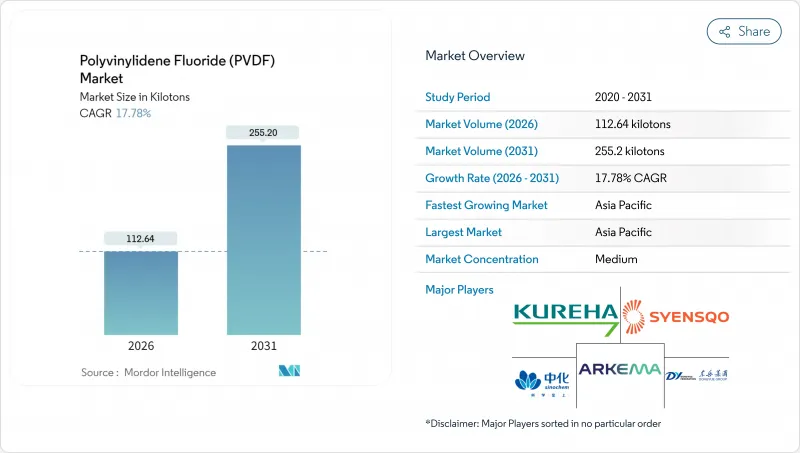
폴리비닐리덴 플루오라이드(PVDF) 시장은 2025년 95.64킬로톤에서 2026년에는 112.64킬로톤으로 성장하고 2026년부터 2031년에 걸쳐 CAGR 17.78%를 나타내 2031년까지 255.2킬로톤에 이를 것으로 예측되고 있습니다.
수송수단의 지속적인 전동화, 10나노미터 이하의 칩용 클린룸 건설의 가속, 장수명의 건축 마무리재를 지정하는 인프라 프로젝트 등, 이들 모두가 다년간 수요의 지속적인 성장을 지지하고 있습니다. 불화비닐리덴 단량체에의 후방 통합, 전지 제조 거점에 가까운 지역에서의 생산 능력, 클린 룸 시스템에 있어서 용도 엔지니어링 지원을 조합한 제조업체는 지속적인 경쟁 우위성을 확보하고 있습니다. 한편, 공급 과잉 상태에 있는 중국의 스팟 시장에서의 가격 변동은 규율 있는 생산 능력 확대와 장기 원료 조달 계약의 필요성을 부각시키고 있습니다. 특히 미국에 의한 1억 7,800만 달러의 조성금(북미 최초의 세계 규모 플랜트의 기반이 되는)을 비롯한 정부의 우대조치는 지역별 공급구조의 균형화와 중요산업용 PVDF의 안정공급을 확보하는데 있어 전략적 정책지원이 계속해서 중요하다는 것을 보여줍니다.
세계의 폴리비닐리덴 플루오라이드(PVDF) 시장 동향과 인사이트
EV 배터리 생산 급증
자동차 제조업체의 수십억 달러 규모의 전동화 로드맵은 수천 번의 충전 사이클 동안 전극 무결성을 유지하는 특수 바인더 수요를 직접 견인합니다. Syensqo의 오거스타 복합시설은 연간 500만 대 이상의 EV 배터리 팩용 PVDF를 공급합니다. 이 규모는 국내 캐소드 바인더 공급망의 기반이 되는 미국 에너지부의 1억 7,800만 달러의 보조금으로 실현 가능해졌습니다. 주요 셀 제조업체에 의한 수직 통합이 진행되는 가운데 사양 범위가 좁아 독일 자동차 공업회(VDA)가 확인한 대로 팩당 PVDF 사용량은 15-50g/kWh로 증가하고 있습니다. 미국, 유럽, 인도에서 기가팩토리 그룹이 확대되는 가운데, 현지 생산 능력을 가진 제조업체는 운송 비용 우위성과 인증 취득의 근접성을 획득하여 지역공급 안정성을 강화하고 있습니다. 이러한 동향이 함께 베이스라인 소비량과 유통 마진을 밀어 올려, 폴리비닐리덴 플루오라이드(PVDF) 시장은 EV전환의 주요 수익자가 되고 있습니다.
내화학성 코팅에 대한 수요
건축 설계자는 색 유지, 광택 안정성 및 분필 저항성에서 AAMA 2605 성능 기준을 초과하는 PVDF 코일 코팅 시스템으로의 전환을 계속하고 있습니다. 플로리다주, 텍사스주, 태풍 다발 지역인 아시아태평양 연안 지역에서는 건축 기준에 따라 이러한 고품질 마감재의 채용이 의무화되고 있으며, 재도장 사이클을 30년으로 연장해, 외관의 라이프 사이클 비용을 저감하고 있습니다. 산업 분야에서도 비슷한 동향을 볼 수 있습니다. 화학처리업체는 강산·강알칼리를 견디는 PVDF 탑코트로 강제 탱크를 개수하여 부식에 의한 조업정지나 규제벌칙을 경감하고 있습니다. 인프라 자극책 법안이 내성이 있는 공공 건축물을 우선하는 가운데, 코팅의 밸류체인은 매크로 경기 후퇴 시나리오에서도 안정된 수량 성장이 전망되어, 폴리비닐리덴 플루오라이드(PVDF) 시장의 방어적 속성을 강화하고 있습니다.
원료(VF2) 가격 변동성
중국의 PVDF 스팟 가격은 급속한 생산 능력 확대가 리튬 이온 배터리용 바인더 수요를 상회했기 때문에 6개월 이내에 하락했습니다. 비닐리덴 불화물의 원가가 PVDF의 현금 비용의 65-70%를 차지하기 때문에 이러한 변동은 마진을 압박하고 장기 구매 계약을 혼란시킵니다. 유럽과 미국의 컨버터는 지수 연동형 공식 계약으로 위험을 피하고 있지만, 아시아의 중견 압출 제조업체는 여전히 영향을 받기 쉽고 투기적 인 재고 증가로 변동성이 확대되고 있습니다. 공급이 합리화될 때까지, 조달 부문은 원료 조달처의 다양화를 우선해, 폴리비닐리덴 플루오라이드(PVDF) 시장에서의 원료 공급의 안정화를 도모하기 위해, 위탁 가공 계약의 검토를 진행할 것입니다.
부문 분석
2025년 시점에서 리튬 이온 배터리용 바인더는 폴리비닐리덴 플루오라이드(PVDF) 시장 규모의 33.62%라는 압도적인 점유율을 차지했으며, 2031년까지 연평균 복합 성장률(CAGR) 31.05%를 나타낼 것으로 전망되고 있습니다. 이것은 고에너지 밀도 전지 화학에서 본 재료가 확립한 역할을 반영한 것입니다. 주요 자동차 제조업체는 차세대 고 니켈 양극재에 PVDF 바인더를 지정합니다. 대체 폴리머는 사이클 수명과 속도 성능을 저하시키기 때문입니다. 동시에, 실리콘 강화 음극에서의 높은 충전율화에 의해 셀당 소비량이 증가하고, 기준 톤수 요건이 배증하고 있습니다.
코팅 및 페인트 분야에서 미국의 외관 보수 가속화와 유럽의 녹색 건물 규제는 안정적이고 중간 정도의 단일 자릿수 성장을 예상합니다. 전선 및 케이블 절연재는 저연·무할로겐 규격이 PVC 재킷을 대체하고 있는 데이터센터 전력 네트워크로 점유율을 확대하고 있습니다. 필름, 시트 및 멤브레인은 가스 분리 모듈에서 강용제용 특수 포장재에 이르는 틈새 분야에 해당하며 PVDF의 장벽 특성이 프리미엄 가격 설정을 정당화합니다. 파이프 및 피팅은 반도체 및 화학 공정을 위해 공급되며, 생산량은 공장 확장 사이클의 영향을 받기 쉬운 것이며, 폴리비닐리덴 플루오라이드(PVDF) 시장에서 최고의 조익률을 자랑합니다.
폴리비닐리덴 플루오라이드(PVDF) 시장 보고서는 용도별(리튬 이온 전지용 바인더, 페인트 및 코팅, 파이프·피팅, 필름 및 시트 등), 최종 사용자 산업별(항공우주, 자동차, 건축 및 건설, 전기 및 전자 등), 지역별(아시아태평양, 북미, 유럽 등)으로 분류되어 있습니다. 시장 예측은 수량(톤) 및 금액(달러)으로 제공됩니다.
지역별 분석
아시아태평양은 2025년 세계 출하량의 56.12%를 차지했으며 2031년까지 연평균 복합 성장률(CAGR) 20.10%를 나타낼 것으로 예측됩니다. 공급량이 급격히 증가함에 따라 가격 변동을 일으키고 있으며, 고객과의 근접성과 규모의 경제성으로 인해 아시아태평양은 저비용 생산 기지로서의 지위를 확고하게 유지하고 있습니다. 일본의 기술 우위성을 강화하는 움직임으로서, 크레하 주식회사가 이와키 공장에 4억 7,000만 달러(700억엔)를 투입한 확장 계획에 의해 고니켈 정극재용으로 특화한 그레이드가 공급됩니다. 정부 보조금은 전략적 자립성을 보장합니다. 인도와 한국에서는 신흥 기가팩토리 계획과 가전 조립 산업의 확대로 수요가 증가하고 폴리비닐리덴 플루오라이드(PVDF) 시장의 지역적 깊이를 확대하고 있습니다.
북미의 점유율은 리쇼어링 정책과 인플레이션 억제법(EV세액 공제의 전액 적용에는 미국산 배터리 재료의 사용이 의무화된다)을 배경으로 확대하고 있습니다. 사이언스코의 오거스타 공장은 북미 최대급의 단일 라인 PVDF 플랜트가 되어, 연간 500만대의 배터리용 현지 공급을 지원합니다. 바인더를 보완하는 형태로, 알케마사가 칼버트 시티 공장에서 15%의 생산 능력 증강을 실시해, 애리조나주와 오하이오주에 공장을 건설하는 반도체 고객용으로 고순도 등급을 확보했습니다. 멕시코 국경지대의 제조업 회랑에서는 자동차용 하네스용으로 미국제 PVDF를 수입하고 있으며, 캐나다의 오일샌드 사업자는 내식성 배관을 지정하는 등, 복수 부문에서의 수요가 더해지고 있습니다.
유럽에서는 그린딜에 의한 비필수 포장재에서의 PFAS 단계적 폐지가 진행되는 한편, 전지·항공우주 용도는 예외로서 인정되고 있으며, 성장과 규제 감시의 균형이 잡혀 있습니다. 독일에서는 자동차 제조업체의 전지 합작 사업이나 BASF의 캐소드 활성 재료 프로젝트가 수요를 지지해, 프랑스와 네덜란드에서는 넷 제로 건축 외피를 목표로 하는 개수 프로그램용 건축용 도료 수요가 견인역이 되고 있습니다. 이 지역의 엄격한 환경 기준은 라이프사이클의 장점이 입증된 PVDF 솔루션의 채용을 촉진하는 한편, 컴플라이언스 비용도 증가하고 있습니다. 이로 인해 규제 강화가 진행되는 폴리비닐리덴 플루오라이드(PVDF) 시장에서 최상급 공급업체가 번영하는 양극화 된 상황이 발생하고 있습니다.
남미, 중동, 아프리카는 여전히 신흥 시장입니다. 브라질의 프리솔트 유전과 사우디아라비아의 화학 하류 복합 시설에서는 총 톤수가 적은 PVDF 파이프가 요구되고 있습니다. 아프리카의 광업 프로젝트는 산성 광산 배수 처리를 위한 PVDF 막 기술을 모색하고 있으며, 자원 주도형 경제에서 이 기술의 인지도를 높이는 틈새 성장 기회를 창출하고 있습니다.
기타 혜택 :
- 엑셀 형식 시장 예측(ME) 시트
- 애널리스트 지원(3개월간)
자주 묻는 질문
목차
제1장 서론
- 조사 전제조건 및 시장 정의
- 조사 범위
제2장 조사 방법
제3장 주요 요약
제4장 시장 상황
- 시장 개요
- 시장 성장 촉진요인
- EV용 배터리 생산량의 급증
- 내약품성 코팅 수요
- 반도체 클린 룸 확장
- 석유 및 가스 부식 방지 배관
- 항공우주 부품의 3D 프린팅
- 시장 성장 억제요인
- 원재료(VF2) 가격 변동성
- PFAS 관련 규제의 감시 강화
- VF2 단량체 생산 능력이 제한
- 밸류체인 분석
- 규제 상황
- Porter's Five Forces 분석
- 공급기업의 협상력
- 구매자의 협상력
- 대체품의 위협
- 경쟁 기업 간 경쟁 관계
- 신규 참가업체의 위협
- 최종 용도 섹터 동향
- 항공우주(항공우주 부품 생산 매출)
- 자동차(자동차 생산 대수)
- 건축 및 건설(신축 건축 연면적)
- 전기 및 전자(전기 및 전자 제품 생산 매출)
- 포장(플라스틱 포장 용량)
제5장 시장 규모와 성장 예측(금액 기준 및 수량 기준)
- 용도별
- 리튬 이온 배터리 바인더
- 코팅 및 페인트
- 파이프 및 피팅
- 필름 및 시트
- 전선 및 케이블 절연체
- 기타(멤브레인 등)
- 최종 사용자 산업별
- 항공우주
- 자동차
- 건축 및 건설
- 전기 및 전자
- 산업 및 기계
- 포장
- 기타 최종 사용자 산업
- 지역별
- 아시아태평양
- 중국
- 일본
- 인도
- 한국
- 호주
- 말레이시아
- 기타 아시아태평양
- 북미
- 미국
- 캐나다
- 멕시코
- 유럽
- 독일
- 프랑스
- 이탈리아
- 영국
- 러시아
- 기타 유럽
- 남미
- 브라질
- 아르헨티나
- 기타 남미
- 중동 및 아프리카
- 사우디아라비아
- 아랍에미리트(UAE)
- 나이지리아
- 남아프리카
- 기타 중동 및 아프리카
- 아시아태평양
제6장 경쟁 구도
- 시장 집중도
- 전략적 동향
- 시장 점유율(%)/랭킹 분석
- 기업 프로파일
- Arkema
- Dongyue Group
- Gujarat Fluorochemicals Limited
- Hubei Everflon Polymer Co., Ltd.
- Kureha Corporation
- RTP Company
- Sinochem
- Syensqo
- Zhejiang Juhua Co., Ltd.
- ZheJiang Yonghe Refrigerant Co.,Ltd
제7장 시장 기회와 향후 전망
제8장 CEO를 위한 주요 전략적 과제
KTH 26.01.22The Polyvinylidene Fluoride market is expected to grow from 95.64 kilotons in 2025 to 112.64 kilotons in 2026 and is forecast to reach 255.2 kilotons by 2031 at 17.78% CAGR over 2026-2031.
Persistent electrification of transportation, accelerating clean-room construction for sub-10 nm chips, and infrastructure projects that specify longer-lasting architectural finishes all reinforce a multi-year demand runway. Producers that combine backward integration into vinylidene fluoride monomer, localized capacity near cell-manufacturing hubs, and application-engineering support in clean-room systems secure durable competitive advantages. Conversely, price volatility in China's oversupplied spot market highlights the need for disciplined capacity addition and long-term feedstock contracts. Government incentives-most notably the United States' USD 178 million grant that anchors North America's first world-scale plant-signal that strategic policy support will remain pivotal in balancing regional supply maps and ensuring PVDF availability for critical industries.
Global Polyvinylidene Fluoride (PVDF) Market Trends and Insights
EV-battery production surge
Automakers' multibillion-dollar electrification roadmaps create direct pull-through for specialized binders that maintain electrode integrity across thousands of charge cycles. Syensqo's Augusta complex will supply PVDF for more than 5 million EV battery packs annually, a scale made viable by the USD 178 million Department of Energy award that anchors domestic cathode-binder chains. Vertical integration by leading cell makers tightens specification windows, raising per-pack PVDF loading to 15-50 g kWh as confirmed by the German automotive association VDA. As gigafactory clusters proliferate in the United States, Europe, and India, producers with local capacity gain freight-cost advantages and proximity to qualification, reinforcing regional supply security. These dynamics collectively raise baseline consumption and channel margins, making the Polyvinylidene Fluoride market a core beneficiary of the EV pivot.
Demand for chemical-resistant coatings
Architectural specifiers continue to migrate to PVDF coil-coating systems that surpass AAMA 2605 performance thresholds in terms of color retention, gloss stability, and chalk resistance. Building codes in Florida, Texas, and typhoon-prone APAC coastal zones increasingly mandate these premium finishes, extending repaint cycles to 30 years and lowering whole-life facade costs. Industrial segments echo the trend: chemical processors retrofit steel tanks with PVDF topcoats that endure aggressive acids and bases, mitigating corrosion downtime and regulatory penalties. With infrastructure stimulus bills prioritizing resilient public buildings, the coatings value chain expects stable volume growth even in macro-downturn scenarios, reinforcing the Polyvinylidene Fluoride market's defensive attributes.
Raw-material (VF2) price volatility
China's spot PVDF price dropped within six months as rapid capacity expansion outstripped Li-ion binder demand. Because vinylidene fluoride accounts for 65-70% of PVDF cash cost, such swings compress margins and disrupt long-term purchasing agreements. Western converters shield themselves through index-linked formula contracts, but Asian mid-tier extruders remain exposed, prompting speculative stock builds that amplify volatility. Until supply rationalizes, procurement teams will prioritize diversified sourcing and consider tolling arrangements to stabilize feedstock availability in the Polyvinylidene Fluoride market.
Other drivers and restraints analyzed in the detailed report include:
- Semiconductor clean-room expansion
- Oil and gas corrosion-control piping
- PFAS-related regulatory scrutiny
For complete list of drivers and restraints, kindly check the Table Of Contents.
Segment Analysis
Li-ion battery binders held a commanding 33.62% share of the Polyvinylidene Fluoride market size in 2025 and are forecast to grow at a 31.05% CAGR through 2031, reflecting the material's entrenched role in high-energy-density cell chemistries. Leading automakers specify PVDF binders for next-generation nickel-rich cathodes because alternative polymers undermine cycle life and rate capability. Simultaneously, higher loading levels in silicon-enhanced anodes elevate per-cell consumption, multiplying baseline tonnage requirements.
Coatings and paints are expected to contribute steady mid-single-digit growth as infrastructure funding accelerates facade retrofits in the United States and green-building mandates in Europe. Wire and cable insulation gains a share in data-center power networks, where low-smoke, halogen-free standards are displacing PVC jackets. Films, sheets, and membranes address niche segments-ranging from gas-separation modules to specialty packaging for aggressive solvents-where PVDF's barrier properties justify premium pricing. Pipes and fittings serve semiconductor and chemical processes, with unit volumes sensitive to fab expansion cycles, yet they command the highest gross margins in the Polyvinylidene Fluoride market.
The Polyvinylidene Fluoride Market Report is Segmented by Application (Li-Ion Battery Binders, Coatings and Paints, Pipes and Fittings, Films and Sheets, and More), End-User Industry (Aerospace, Automotive, Building and Construction, Electrical and Electronics, and More), and Geography (Asia-Pacific, North America, Europe, and More). The Market Forecasts are Provided in Terms of Volume (Tons) and Value (USD).
Geography Analysis
The Asia-Pacific region accounted for 56.12% of global shipments in 2025 and is projected to grow at a 20.10% CAGR through 2031. Although rapid supply buildouts sparked price volatility, proximity to customers and scale economies keep APAC firmly positioned as the hub of low-cost production. Japan reinforces the region's technology edge: Kureha's USD 470 million (JPY 70 billion) expansion at its Iwaki plant will deliver specialty grades tailor-made for high-nickel cathodes while government subsidies safeguard strategic autonomy. India and South Korea are adding incremental demand through nascent gigafactory pipelines and growing consumer electronics assembly, broadening regional depth within the Polyvinylidene Fluoride market.
North America's share advances on the back of re-shoring policies and the Inflation Reduction Act, which requires U.S.-sourced battery materials to unlock full EV tax credits. Syensqo's Augusta facility will be the continent's largest single-line PVDF plant, underpinning local supply for five million batteries each year. Complementing binders, Arkema's 15% capacity hike at Calvert City secures high-purity grades for semiconductor customers building fabs in Arizona and Ohio. Mexico's border manufacturing corridor imports U.S. PVDF for automotive harnesses, while Canada's oil-sands operators specify corrosion-proof piping, adding multi-segment pull.
Europe balances growth with regulatory scrutiny as the bloc's Green Deal phases out PFAS in non-essential packaging but preserves exemptions for battery and aerospace uses. Germany anchors demand through automaker battery JVs and BASF's cathode-active-material projects, whereas France and the Netherlands drive architectural-coating volumes for retrofit programs that target net-zero building envelopes. The region's stringent environmental standards promote the adoption of PVDF solutions with proven life-cycle benefits, yet they also increase compliance costs, creating a bifurcated landscape where best-in-class suppliers thrive amid tightening regulations in the Polyvinylidene Fluoride market.
South America, the Middle East, and Africa remain emerging theatres. Brazil's pre-salt oil fields and Saudi Arabia's downstream chemical complexes require PVDF pipe, albeit in lower total tonnage. African mining ventures are exploring PVDF membrane technology for acid-mine drainage treatment, creating niche growth opportunities that elevate the technology's profile in resource-driven economies.
- Arkema
- Dongyue Group
- Gujarat Fluorochemicals Limited
- Hubei Everflon Polymer Co., Ltd.
- Kureha Corporation
- RTP Company
- Sinochem
- Syensqo
- Zhejiang Juhua Co., Ltd.
- ZheJiang Yonghe Refrigerant Co.,Ltd
Additional Benefits:
- The market estimate (ME) sheet in Excel format
- 3 months of analyst support
TABLE OF CONTENTS
1 Introduction
- 1.1 Study Assumptions and Market Definition
- 1.2 Scope of the Study
2 Research Methodology
3 Executive Summary
4 Market Landscape
- 4.1 Market Overview
- 4.2 Market Drivers
- 4.2.1 EV-battery Production Surge
- 4.2.2 Demand for Chemical-resistant Coatings
- 4.2.3 Semiconductor Clean-room Expansion
- 4.2.4 Oil and Gas Corrosion-control Piping
- 4.2.5 3-D-printing Aerospace Parts
- 4.3 Market Restraints
- 4.3.1 Raw-material (VF2) Price Volatility
- 4.3.2 PFAS-related Regulatory Scrutiny
- 4.3.3 Limited VF2 Monomer Capacity
- 4.4 Value Chain Analysis
- 4.5 Regulatory Landscape
- 4.6 Porter's Five Forces Analysis
- 4.6.1 Bargaining Power of Suppliers
- 4.6.2 Bargaining Power of Buyers
- 4.6.3 Threat of Substitutes
- 4.6.4 Competitive Rivalry
- 4.6.5 Threat of New Entrants
- 4.7 End-use Sector Trends
- 4.7.1 Aerospace (Aerospace Component Production Revenue)
- 4.7.2 Automotive (Automobile Production)
- 4.7.3 Building and Construction (New Construction Floor Area)
- 4.7.4 Electrical and Electronics (Electrical and Electronics Production Revenue)
- 4.7.5 Packaging (Plastic Packaging Volume)
5 Market Size and Growth Forecasts (Value and Volume)
- 5.1 By Application
- 5.1.1 Li-ion Battery Binders
- 5.1.2 Coatings and Paints
- 5.1.3 Pipes and Fittings
- 5.1.4 Films and Sheets
- 5.1.5 Wire and Cable Insulation
- 5.1.6 Others (Membranes, etc.)
- 5.2 By End-User Industry
- 5.2.1 Aerospace
- 5.2.2 Automotive
- 5.2.3 Building and Construction
- 5.2.4 Electrical and Electronics
- 5.2.5 Industrial and Machinery
- 5.2.6 Packaging
- 5.2.7 Other End-user Industries
- 5.3 By Geography
- 5.3.1 Asia-Pacific
- 5.3.1.1 China
- 5.3.1.2 Japan
- 5.3.1.3 India
- 5.3.1.4 South Korea
- 5.3.1.5 Australia
- 5.3.1.6 Malaysia
- 5.3.1.7 Rest of Asia-Pacific
- 5.3.2 North America
- 5.3.2.1 United States
- 5.3.2.2 Canada
- 5.3.2.3 Mexico
- 5.3.3 Europe
- 5.3.3.1 Germany
- 5.3.3.2 France
- 5.3.3.3 Italy
- 5.3.3.4 United Kingdom
- 5.3.3.5 Russia
- 5.3.3.6 Rest of Europe
- 5.3.4 South America
- 5.3.4.1 Brazil
- 5.3.4.2 Argentina
- 5.3.4.3 Rest of South America
- 5.3.5 Middle-East and Africa
- 5.3.5.1 Saudi Arabia
- 5.3.5.2 United Arab Emirates
- 5.3.5.3 Nigeria
- 5.3.5.4 South Africa
- 5.3.5.5 Rest of Middle-East and Africa
- 5.3.1 Asia-Pacific
6 Competitive Landscape
- 6.1 Market Concentration
- 6.2 Strategic Moves
- 6.3 Market Share (%)/Ranking Analysis
- 6.4 Company Profiles (includes Global-level Overview, Market-level Overview, Core Segments, Financials, Strategic Information, Market Rank/Share, Products and Services, Recent Developments)
- 6.4.1 Arkema
- 6.4.2 Dongyue Group
- 6.4.3 Gujarat Fluorochemicals Limited
- 6.4.4 Hubei Everflon Polymer Co., Ltd.
- 6.4.5 Kureha Corporation
- 6.4.6 RTP Company
- 6.4.7 Sinochem
- 6.4.8 Syensqo
- 6.4.9 Zhejiang Juhua Co., Ltd.
- 6.4.10 ZheJiang Yonghe Refrigerant Co.,Ltd
7 Market Opportunities and Future Outlook
- 7.1 White-space and Unmet-need Assessment


