
|
시장보고서
상품코드
1910516
비점착성 코팅 시장 : 점유율 분석, 업계 동향, 통계, 성장 예측(2026-2031년)Non-stick Coatings - Market Share Analysis, Industry Trends & Statistics, Growth Forecasts (2026 - 2031) |
||||||
 Mordor Intelligence
비점착성 코팅 시장은 2025년 18억 9,000만 달러로 평가되었고, 2026년 19억 5,000만 달러, 2031년까지 23억 1,000만 달러에 이를 전망입니다. 2026년부터 2031년에 걸쳐 CAGR은 3.37%를 나타낼 전망입니다.
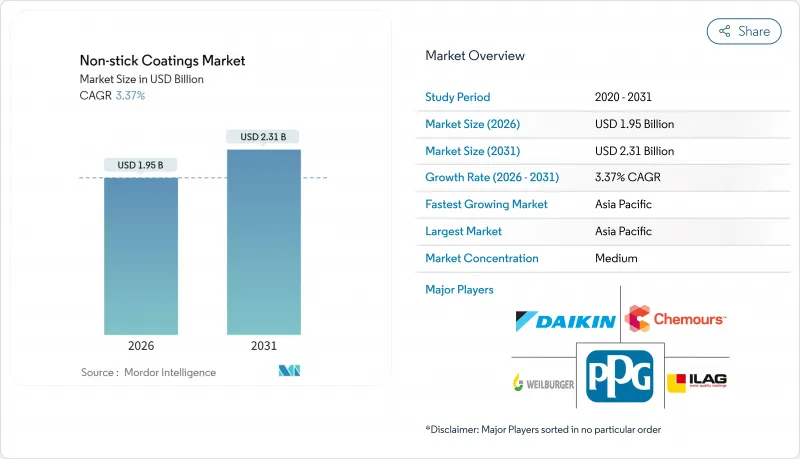
이 확대는 조리기구, 식품가공, 첨단전자기기 분야의 안정적인 수요에 더해 PFAS 프리 화학물질로의 전환이 진행되고 있음을 반영합니다. 불화 칼슘의 가격 변동으로 인한 공급망에 미치는 영향은 여전히 우려되지만, 다양한 원료 포트폴리오를 가진 제조업체들은 경쟁 우위를 유지하고 있습니다. 제품 혁신은 규제 요건을 충족시키면서 이형 성능을 저해하지 않는 세라믹 및 하이브리드 시스템에 초점을 맞추고 있으며, 북미 및 유럽에서의 판매가 둔화되는 가운데 아시아태평양의 기세가 수량 성장을 지원하고 있습니다. 제조업에 있어서의 자동화의 진전과, 가정에 있어서의 저유 조리법에의 지속적인 기호가, 산업 및 소비자용 분야를 불문하고 장기적인 소비를 지지하고 있습니다.
세계의 비점착성 코팅 시장 동향과 인사이트
가정에서 논스틱 조리기구 수요 증가
도시의 생활양식과 바쁜 라이프스타일로 기름 사용량을 최소화하고 세척을 간소화하는 조리기구에 소비자의 선호도가 지속되고 있습니다. 주방 웨어 브랜드는 PFOA 프리 표면을 보증하는 인증을 광고로 강조하는 경향이 강해지고 있으며, 소매업체도 신뢰 구축을 위해 이러한 표시를 전면에 내놓고 있습니다. 중국과 동남아시아에서는 EC 할인으로 구매 사이클이 단축되는 가운데 중가격대와 프리미엄 제품이 온라인 판매 채널을 지배하고 있습니다. 대규모 제조업체는 이 변화를 포착해 PTFE에 필적하는 내마모성을 갖춘 다층 세라믹 마무리를 투입하고 있습니다. 수입품에서는 FDA 21 CFR 175.300 및 동등한 EU 규정에 대한 적합 인증이 주요 마케팅 요소가 되었습니다. 가처분 소득이 증가하고 모듈식 주방이 보급됨에 따라 비점착성 코팅 시장은 안정적인 소비자 기반을 얻고 제품 라인의 고도화를 받아들입니다.
산업기계 및 식품 가공 분야에서의 채택
베이킹 용품, 포장 롤러, 산업용 믹서 제조업체는 위생 기준을 충족하고 다운 타임을 줄이기 위해 고급 코팅을 지정합니다. PPG사가 2024년 9월 말레이시아에 실시한 투자로 베이킹 트레이와 에너지 부품용으로 특화된 수성·용제계 시스템 전용의 생산 라인이 5개 추가되었습니다. 설비 통합업체는 부식성 세척 사이클 및 열 충격을 견딜 수 있는 매끄럽고 청소하기 쉬운 표면을 선호하며 채택하여 대규모 플랜트 전체의 위생 관리 비용을 절감합니다. 석유 및 가스용 밸브에서는 저마찰 불소 수지 필름이 토크를 저감해, 산성 가스 환경하에서의 부식을 방지합니다. 식품안전감사를 엄격하게 하는 정부의 규제는 적합표면에 대한 수요를 간접적으로 자극하고 세계적인 기술지원을 제공하는 공급업체에게 이익을 가져다줍니다. 산업용 부품의 긴 교환 간격은 코팅의 지속적인 구매를 보장하고 이 부문의 가격 안정성을 지원합니다.
PFAS 규제 강화의 영향
기존 PFAS의 공개 의무화 및 전면 금지에 의해 즉각적인 생산 갭이 발생하고 있습니다. 3M사는 2023년 PFAS 판매량이 20% 감소한 것을 기록해 2025년 말까지 모든 불소화학제품 제조에서 철수할 방침입니다. 이에 따라 자산 손상과 관련된 세전 비용 8억 달러를 계상하고 있습니다. 켐아즈는 여러 관할 구역에서의 소송에 직면하고 있으며, 신규 PTFE 생산 능력에 대한 자본 투입이 저해되어 고순도 등급공급이 지연되고 있습니다. 하류의 배합 제조업체는 배합 설계의 재검토나 NSF·EFSA 식품 접촉 기준에 근거한 재인증에 의해 컴플라이언스 코스트 증가를 흡수하지 않을 수 없습니다. 소규모 수탁 코팅업자는 개정된 대기 정화법 규제에서 요구되는 신형 오븐과 배연 포집 시스템의 도입 자금 조달을 고민하고 있습니다. 이러한 혼란이 결합되어 대체 화학물질이 보급될 때까지 비점착성 코팅 시장의 단기 수요는 감소할 것으로 예측됩니다.
부문 분석
2025년 시점에서 불소 수지는 비점착성 코팅 시장 점유율 41.32%를 차지해, 열안정성과 이형 내구성에 있어서의 우위성을 나타냈습니다. 규제 강화가 진행되고 있는 가운데, 불소수지 시장 규모는 경쟁화학제품을 웃도는 달러건설 성장률을 유지하고 있습니다. 기존의 도포장치와의 호환성이 입증된 PFOA 프리 PTFE 제품은 현재 재발주량의 주류를 차지하고 있습니다. 다이킨과 켐아즈는 정전 스프레이를 위해 설계된 낮은 VOC 분산액과 분말 등급을 제공함으로써 이러한 의존도를 활용합니다. 한편, 세라믹 마무리는 PFAS 규제의 대상외이며, 건강 지향의 소비자층에 소구하기 위해, 2031년까지 3.62%라고 하는 가장 빠른 CAGR로 추이할 전망입니다. 상업 전개에서는 취성을 억제하기 위해 나노지르코니아 또는 티타니아로 강화된 졸겔법이 채택되고 있습니다. 실리콘 코팅은 유연성과 생체적합성이 극도의 이형성을 능가하는 베이킹 용품 및 의료기기를 위한 보다 좁은 틈새 시장을 차지합니다. 하이브리드 유기 무기계는 현재 시장 점유율이 작은 것, 내오염성과 내충격성의 융합에 의해 2028년 이후 시장 점유율 재편이 기대됩니다.
반도체 캐리어용으로 특화된 2세대 불소 수지는 고가격대를 유지해, 조리 기구 시장의 주기성으로부터 공급자를 보호하고 있습니다. 한편, 3M사의 생산능력 합리화에 의해 대량공급이 없어지고, 하류의 배합 제조업체는 중요 등급의 이중 조달을 강요당하고 있습니다. 아시아의 제2층 컴파운드 제조업체는 안정된 코팅 라인을 요구하는 가전 OEM과의 복수년 공급 계약을 체결해, 점유율 확대를 도모하고 있습니다. 최종 구매자가 지속가능성의 주장을 감사할 때 ISO 14001 인증이 자격 증명으로 부상하고 공급업체는 폐열 회수 및 솔벤트 회수에 대한 투자를 촉구합니다. 전반적으로, 규제 압력과 용도 특화형 성능의 상호작용은 이 부문에서 양극화된 성장 궤도를 유지하고 있으며, 세라믹은 가속화되는 반면, 불소 수지는 확립된 산업적 역할을 지키고 있습니다.
지역별 분석
아시아태평양은 2025년 수익의 49.62%를 차지했으며, 3.53%의 연평균 복합 성장률(CAGR)을 보일 것으로 예측되어 비점착성 코팅 시장에서의 우위성을 강화하고 있습니다. 중국 절강성과 광동성 클러스터의 생산능력 강화로 조리기구 OEM 제조업체의 리드타임이 단축되는 반면 세제 우대책에 따라 베트남과 인도네시아에 새로운 스프레이 라인 투자가 모여 있습니다. 인도에서는 도시의 중산계급이 플래시 세일 포털 경유로 판매되는 고급 프라이팬을 지지하고 있습니다만, 수입 PTFE에 대한 규제 감시는 BIS 규격의 시행에 의해 강화될 전망입니다. 일본은 첨단 로봇 기술과 반도체 장치 수요를 배경으로 고순도 코팅 수입을 유지하고 가정용 제품의 교체 사이클 감속을 상쇄하고 있습니다.
북미는 금액 기준으로 두 번째이지만 가장 파괴적인 PFAS 규정에 직면하고 있습니다. 주 수준의 금지조치가 세라믹의 연구개발을 가속화시키고 미국의 코팅 제조업체는 EPA 승인을 얻기 위해 배기 가스 포착·분해 시스템에 대한 투자를 추진하고 있습니다. 멕시코에서는 미국 국가전 브랜드의 니어쇼어링 효과에 의해 스토브용 그릴이나 베이킹 시트용 분말 도료의 지역 수요가 확대하고 있습니다. 유럽에서는 REACH 규제하에 장쇄 PFAS로부터의 이행이 계속되고, 독일은 수성 분산액을 추진, 프랑스는 그린 경제 보조금으로 졸겔 기술의 신흥 기업을 지원하고 있습니다. 동유럽 공장에서는 조리기구 조립 사업이 집적되어 운송 비용 절감을 위해 현지 조달에 의한 코팅이 채택되고 있습니다.
중동 및 아프리카에서는 소규모이면서 활기찬 기회가 태어나, 접객 산업의 확대가 업무용 주방 설비의 쇄신을 촉진하고 있습니다. 남미의 닭고기 및 과자 가공업자는 수출 감사 대응을 위해 FDA 준거 필름을 채택해, 브라질에서는 현지 위탁 코팅 사업이 확대되고 있습니다. 이러한 지리적 다양화를 통해 공급업체는 단일 규제 및 거시 경제적 충격의 영향을 완화 할 수 있지만 홍해 무역 경로의 물류 혼란은 주목해야합니다.
기타 혜택 :
- 엑셀 형식 시장 예측(ME) 시트
- 애널리스트에 의한 3개월간의 지원
자주 묻는 질문
목차
제1장 서론
- 조사의 전제조건과 시장의 정의
- 조사 범위
제2장 조사 방법
제3장 주요 요약
제4장 시장 상황
- 시장 개요
- 시장 성장 촉진요인
- 비점착성 주방용품에 대한 가계 수요 증가
- 산업기계 및 식품가공분야에서의 채택
- 규제 주도에 의한 PFOA 프리 세라믹으로의 이행
- 전자기기 및 의료기기에 채택
- 수성 저 VOC 불소 수지 분산액
- 시장 성장 억제요인
- PFAS 규제 강화
- 미세 플라스틱의 건강에 대한 우려
- 형석(Fluorspar) 공급망 불안정에 따른 가격 충격
- 밸류체인 분석
- Porter's Five Forces
- 공급기업의 협상력
- 구매자의 협상력
- 신규 참가업체의 위협
- 대체품의 위협
- 경쟁도
제5장 시장 규모와 성장 예측
- 유형별
- 불소수지
- 세라믹
- 실리콘
- 기타 유형
- 용도별
- 조리기구
- 식품가공
- 패브릭 및 카펫
- 의료
- 전기 및 전자 기기
- 산업기계
- 자동차
- 기타 용도
- 지역별
- 아시아태평양
- 중국
- 인도
- 일본
- 한국
- ASEAN
- 기타 아시아태평양
- 북미
- 미국
- 캐나다
- 멕시코
- 유럽
- 독일
- 영국
- 프랑스
- 이탈리아
- 스페인
- 북유럽 국가
- 러시아
- 기타 유럽
- 남미
- 브라질
- 아르헨티나
- 콜롬비아
- 기타 남미
- 중동 및 아프리카
- 사우디아라비아
- 튀르키예
- 아랍에미리트(UAE)
- 남아프리카
- 기타 중동 및 아프리카
- 아시아태평양
제6장 경쟁 구도
- 시장 집중도
- 전략적 동향
- 시장 점유율/순위 분석
- 기업 프로파일
- 3M
- AGC Chemicals
- Cavero Coatings
- DAIKIN INDUSTRIES, Ltd.
- Endura Coatings
- ILAG-Industrielack AG
- Metal Coatings
- Metallic Bonds Ltd
- PPG Industries, Inc.
- Rhenotherm Kunststoffbeschichtungs GmbH
- Showa Denko KK
- Solvay
- The Chemours Company
- Weilburger
- Zhejiang Pfluon Technology Co., Ltd
제7장 시장 기회와 장래의 전망
SHW 26.01.26The Non-stick Coatings Market is expected to grow from USD 1.89 billion in 2025 to USD 1.95 billion in 2026 and is forecast to reach USD 2.31 billion by 2031 at 3.37% CAGR over 2026-2031.
This expansion reflects steady demand from cookware, food-processing, and advanced electronics alongside the ongoing shift toward PFAS-free chemistries. Supply chains remain vulnerable to fluctuations in fluorspar costs, yet producers with diversified raw-material portfolios hold a competitive edge. Product innovation centers on ceramic and hybrid systems that meet regulatory mandates without compromising release performance, while regional momentum in the Asia-Pacific sustains volume growth despite moderating sales in North America and Europe. Rising automation in manufacturing and sustained household preference for low-oil cooking sustain long-term consumption across industrial and consumer verticals.
Global Non-stick Coatings Market Trends and Insights
Rising Household Demand for Non-Stick Cookware
Urban living patterns and increasingly busy lifestyles have sustained consumer preference for cookware that minimizes oil use and simplifies cleaning. Kitchenware brands are increasingly advertising certifications that guarantee PFOA-free surfaces, and retailers are highlighting such labels to build trust. Mid-tier and premium products now dominate online sales channels in China and Southeast Asia, where e-commerce discounts shorten replacement cycles. Large-scale producers capitalize on this shift by launching multi-layer ceramic finishes that rival PTFE in abrasion resistance. Certification to FDA 21 CFR 175.300 and equivalent EU frameworks has become a core marketing feature for imported offerings. With disposable incomes rising and modular kitchens proliferating, the non-stick coatings market enjoys a stable consumer base that absorbs upgraded product lines.
Industrial Machinery and Food-Processing Uptake
Manufacturers of bakeware, packaging rollers, and industrial mixers specify advanced coatings to meet hygiene mandates and reduce downtime. PPG's September 2024 investment in Malaysia added five production lines dedicated to waterborne and solvent-borne systems tailored for bakery trays and energy components. Equipment integrators favor smooth, easy-clean surfaces that endure caustic wash cycles and thermal shocks, which lowers sanitation costs across large plants. In oil and gas valves, low-friction fluoropolymer films cut torque and prevent corrosion under sour-gas conditions. Governments that legislate stricter food-safety audits indirectly stimulate demand for compliant surfaces, benefiting suppliers with global technical support. The long replacement interval for industrial parts locks in recurrent coating purchases and underpins price stability across this segment.
PFAS Regulatory Clamp-Down
Mandatory disclosure and outright bans on legacy PFAS generate immediate production gaps. 3M recorded a 20% decline in PFAS volumes during 2023 and will exit all fluorochemical manufacturing by the end of 2025, booking a USD 800 million pre-tax charge tied to asset write-downs. Chemours faces multi-jurisdictional litigation that diverts capital away from new PTFE capacity, slowing the supply of high-purity grades. Downstream blenders absorb higher compliance costs as they redesign formulations and requalify them under NSF and EFSA food-contact standards. Small contract coaters struggle to fund new ovens and fume-capture systems required under evolving Clean Air Act rules. Collectively, these disruptions reduce short-term volumes in the non-stick coatings market until alternative chemistries are scaled.
Other drivers and restraints analyzed in the detailed report include:
- Regulation-Driven Shift to PFOA-Free Ceramics
- Electronics and Medical Device Adoption
- Fluorspar-Supply Price Shocks
For complete list of drivers and restraints, kindly check the Table Of Contents.
Segment Analysis
Fluoropolymers held 41.32% non-stick coatings market share in 2025, underscoring their supremacy in thermal stability and release longevity. The non-stick coatings market size for fluoropolymers outstripped USD-denominated growth in rival chemistries even as regulatory headwinds intensified. PTFE variants free of PFOA now dominate reorder volumes, thanks to their proven compatibility with existing application equipment. Daikin and Chemours capitalize on this reliance by offering low-VOC dispersions and powder grades engineered for electrostatic spray. In contrast, ceramic finishes post the fastest 3.62% CAGR to 2031 because they bypass PFAS scrutiny and appeal to health-conscious consumers. Commercial roll-outs employ sol-gel routes reinforced with nano-zirconia or titania to curb brittleness. Silicone coatings occupy a narrower niche serving bakeware and medical devices, where flexibility and biocompatibility trump extreme release. Although hybrid organic-inorganic systems currently account for a small slice of the market, they promise a convergence of stain resistance and impact toughness that could realign market shares after 2028.
Second-generation fluoropolymers purpose-built for semiconductor carriers maintain premium pricing, cushioning suppliers from cookware cyclicality. Conversely, capacity rationalization by 3M removes a sizeable volume and prompts downstream formulators to dual-source critical grades. Tier-two Asian compounds secure share gains by signing multi-year supply deals with appliance OEMs seeking stable coating lines. ISO 14001 certification emerges as a credential when end buyers audit sustainability claims, nudging suppliers to invest in waste-heat recovery and solvent capture. Overall, the interplay of regulatory pressure and application-centric performance sustains a dual-speed trajectory in this segment, with ceramics accelerating yet fluoropolymers defending entrenched industrial roles.
The Non-Stick Coatings Market Report is Segmented by Type (Fluoropolymer, Ceramic, Silicone, and Other Types), by Application (Cookware, Food Processing, Fabrics and Carpets, Medical, Electrical and Electronics, Industry Machinery, Automotive, and Other Applications), and by Geography (Asia-Pacific, North America, Europe, South America, and Middle-East and Africa). The Market Forecasts are Provided in Terms of Value (USD).
Geography Analysis
Asia-Pacific accounted for 49.62% of 2025 revenue and is projected to advance at a 3.53% CAGR, reinforcing its primacy in the non-stick coatings market. Capacity additions in China's Zhejiang and Guangdong clusters shorten lead times for cookware OEMs, while tax incentives draw new spray-line investments to Vietnam and Indonesia. India's urban middle class is embracing premium pans sold via flash-sale portals, although regulatory oversight on imported PTFE will tighten under pending BIS standards. Japan leverages advanced robotics and semiconductor equipment demand to sustain high-purity coating imports, offsetting slower household replacement cycles.
North America ranks second by value but confronts the most disruptive PFAS legislation. State-level bans accelerate ceramic R&D, and US coaters invest in capture-destroy exhaust systems to secure EPA approvals. Mexico benefits from near-shoring by US appliance brands, lifting regional powder demand for stovetop grates and bakeware sheets. Europe continues to migrate away from long-chain PFAS under REACH, with Germany championing water-based dispersions and France encouraging sol-gel start-ups through green economy grants. Eastern European plants attract cookware assembly operations that source coatings locally to sidestep shipping costs.
Smaller yet dynamic opportunities emerge in the Middle East and Africa, where hospitality expansion spurs commercial-kitchen upgrades. South American processors of poultry and confectionery adopt FDA-compliant films to meet export audits, driving localized toll-coating ventures in Brazil. Geographic diversification thus cushions suppliers from any single regulatory or macro-economic shock, although logistics disruptions in the Red Sea trade lane remain a watchpoint.
- 3M
- AGC Chemicals
- Cavero Coatings
- DAIKIN INDUSTRIES, Ltd.
- Endura Coatings
- ILAG - Industrielack AG
- Metal Coatings
- Metallic Bonds Ltd
- PPG Industries, Inc.
- Rhenotherm Kunststoffbeschichtungs GmbH
- Showa Denko K.K.
- Solvay
- The Chemours Company
- Weilburger
- Zhejiang Pfluon Technology Co., Ltd
Additional Benefits:
- The market estimate (ME) sheet in Excel format
- 3 months of analyst support
TABLE OF CONTENTS
1 Introduction
- 1.1 Study Assumptions & Market Definition
- 1.2 Scope of the Study
2 Research Methodology
3 Executive Summary
4 Market Landscape
- 4.1 Market Overview
- 4.2 Market Drivers
- 4.2.1 Rising household demand for non-stick cookware
- 4.2.2 Industrial machinery and food-processing uptake
- 4.2.3 Regulation-driven shift to PFOA-free ceramics
- 4.2.4 Electronics and medical device adoption
- 4.2.5 Water-based low-VOC fluoropolymer dispersions
- 4.3 Market Restraints
- 4.3.1 PFAS regulatory clamp-down
- 4.3.2 Micro-plastic health perception
- 4.3.3 Fluorspar-supply price shocks
- 4.4 Value Chain Analysis
- 4.5 Porter's Five Forces
- 4.5.1 Bargaining Power of Suppliers
- 4.5.2 Bargaining Power of Buyers
- 4.5.3 Threat of New Entrants
- 4.5.4 Threat of Substitutes
- 4.5.5 Degree of Competition
5 Market Size & Growth Forecasts (Value)
- 5.1 By Type
- 5.1.1 Fluoropolymer
- 5.1.2 Ceramic
- 5.1.3 Silicone
- 5.1.4 Other Types
- 5.2 By Application
- 5.2.1 Cookware
- 5.2.2 Food Processing
- 5.2.3 Fabrics and Carpets
- 5.2.4 Medical
- 5.2.5 Electrical and Electronics
- 5.2.6 Industry Machinery
- 5.2.7 Automotive
- 5.2.8 Other Applications
- 5.3 By Geography
- 5.3.1 Asia-Pacific
- 5.3.1.1 China
- 5.3.1.2 India
- 5.3.1.3 Japan
- 5.3.1.4 South Korea
- 5.3.1.5 ASEAN Countries
- 5.3.1.6 Rest of Asia-Pacific
- 5.3.2 North America
- 5.3.2.1 United States
- 5.3.2.2 Canada
- 5.3.2.3 Mexico
- 5.3.3 Europe
- 5.3.3.1 Germany
- 5.3.3.2 United Kingdom
- 5.3.3.3 France
- 5.3.3.4 Italy
- 5.3.3.5 Spain
- 5.3.3.6 Nordic
- 5.3.3.7 Russia
- 5.3.3.8 Rest of Europe
- 5.3.4 South America
- 5.3.4.1 Brazil
- 5.3.4.2 Argentina
- 5.3.4.3 Colombia
- 5.3.4.4 Rest of South America
- 5.3.5 Middle-East and Africa
- 5.3.5.1 Saudi Arabia
- 5.3.5.2 Turkey
- 5.3.5.3 UAE
- 5.3.5.4 South Africa
- 5.3.5.5 Rest of Middle-East and Africa
- 5.3.1 Asia-Pacific
6 Competitive Landscape
- 6.1 Market Concentration
- 6.2 Strategic Moves
- 6.3 Market Share/Ranking Analysis
- 6.4 Company Profiles (includes Global level Overview, Market level overview, Core Segments, Financials as available, Strategic Information, Market Rank/Share for key companies, Products & Services, and Recent Developments)
- 6.4.1 3M
- 6.4.2 AGC Chemicals
- 6.4.3 Cavero Coatings
- 6.4.4 DAIKIN INDUSTRIES, Ltd.
- 6.4.5 Endura Coatings
- 6.4.6 ILAG - Industrielack AG
- 6.4.7 Metal Coatings
- 6.4.8 Metallic Bonds Ltd
- 6.4.9 PPG Industries, Inc.
- 6.4.10 Rhenotherm Kunststoffbeschichtungs GmbH
- 6.4.11 Showa Denko K.K.
- 6.4.12 Solvay
- 6.4.13 The Chemours Company
- 6.4.14 Weilburger
- 6.4.15 Zhejiang Pfluon Technology Co., Ltd
7 Market Opportunities & Future Outlook
- 7.1 White-space and Unmet-need Assessment