|
시장보고서
상품코드
1910614
양자 센서 시장 : 점유율 분석, 업계 동향 및 통계, 성장 예측(2026-2031년)Quantum Sensors - Market Share Analysis, Industry Trends & Statistics, Growth Forecasts (2026 - 2031) |
||||||
 Mordor Intelligence
2026년 양자 센서 시장의 규모는 8억 6,000만 달러로 추정되며, 2025년 7억 6,000만 달러에서 성장하여, 2031년에는 15억 6,000만 달러에 이를 것으로 예측됩니다.
2026년부터 2031년까지 연평균 복합 성장률(CAGR)은 12.72%를 나타낼 전망입니다.
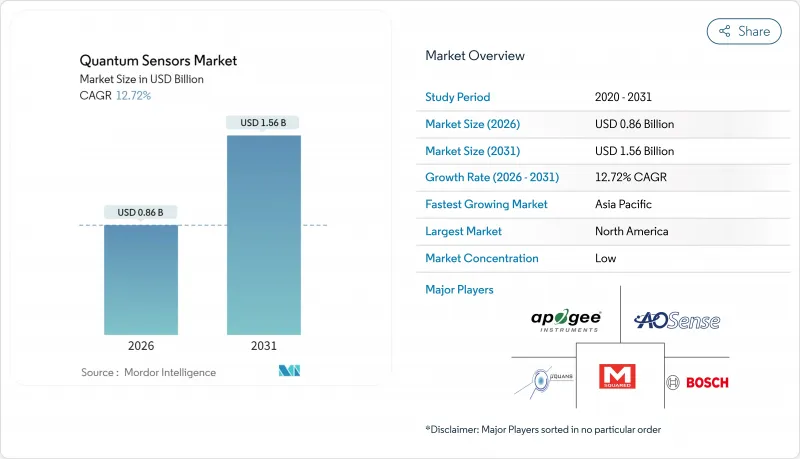
이러한 급속한 확대는 위치, 내비게이션 및 시간 작업에서 전통적인 감지 기술의 한계를 극복하기 위한 정부와 민간 협력 투자로 인해 발생합니다. GPS 위장에 대비한 미 국방부 프로그램, 중국 및 유럽의 플래그십 프로젝트, 보잉사의 양자 관성 시스템 비행 시험은 전략 수준의 성능을 발휘할 수 있는 견고한 장치에 대한 단기적인 수요를 뒷받침하고 있습니다. 250억 달러를 넘는 국가 차원의 양자 예산은 국내 공급망 확보를 위한 경쟁을 격화시키고 있습니다. 한편, 웨이퍼 규모 제조 기술은 단가를 낮추고 새로운 상용화 경로를 개척하고 있습니다. 우주 기관, 통신 사업자, 자율주행 차량 개발 기업, 클라우드 데이터센터 소유자는 현재 나노초 단위의 동기화에서 지하 자원 매핑에 이르는 시스템 수준의 이점을 찾고 있습니다. 냉원자 장치의 결어긋남, 수출 관리 규제, 알칼리 증기 셀의 병목과 같은 과제는 여전히 존재하지만, 오차 보상 알고리즘과 CMOS 호환 프로세스의 진보로 도입 위험이 지속적으로 감소하고 있습니다.
세계의 양자 센서 시장의 동향 및 전망
양자 PNT(위치, 내비게이션 및 시간) 기술에 대한 방위 자금 증가
2024년 이후 발행된 총 27억 달러에 달하는 미 국방부 계약은 GPS 신호가 간섭되거나 위장된 상황에서도 정확성을 유지하는 양자 위치, 내비게이션 및 시간 시스템에 대한 전략적 필요성을 보여줍니다. NATO의 국방혁신가속프로젝트도 같은 우선순위를 표명했으며, 영국은 2024년에 양자 시간 및 내비게이션 기술의 연구 개발에 1억 8,500만 파운드를 계상했습니다. 호주도 같은 노력으로 1억 2,700만 달러를 추가적으로 투입하고 있으며, 양자 PNT가 자율무기, 내장해성 통신, 군수의 중요한 기반 기술이라는 세계적 합의가 제시되고 있습니다. 그 결과, 각국 국방부는 현재 원자 시계, 양자 가속도계, 양자 자력계를 병행하여 조달하고 있으며, 초기 단계의 공급망을 안정시키는 롱테일 수요를 창출하고 있습니다. 각 벤더의 로드맵은 엄격한 군용 표준을 충족하기 위해 방사성 포장, 충격 저항 및 현장 교정 도구의 중요성을 점점 강조하고 있습니다.
국가 차원의 양자 이니셔티브 및 예산
중국의 150억 달러 규모 '양자 정보 과학 국가 실험실', 업그레이드된 미국의 120억 달러 규모 '국가 양자 이니셔티브', EU의 70억 유로 '양자 플래그십'은 양자 센서를 주권 기술로 제도화하는 노력입니다. 일본의 1조엔 규모 문샷 계획은 2030년까지 상용화 이정표를 명확히 설정하여 학술적 혁신과 기업 생산 라인을 연결하고 있습니다. 이러한 여러 해에 걸친 예산 배분은 대학, 주요 방위기업, 스타트업 기업에 대한 예측 가능한 자금 제공을 실현하여 공동 파일럿 프로젝트와 크로스 라이선싱 계약을 촉진합니다. 또한 증기 셀 부품, 레이저, 진공 서브어셈블리의 국내 조달을 촉진하는 수출 관리 규제의 발동도 시행되고 있습니다. 결과적으로 정책의 조화는 단기적인 컴플라이언스 비용을 증가시키지만 양자 센서 시장에 공급하는 지속적인 R&D 파이프라인을 보장합니다.
높은 도입 및 유지 비용
냉원자 간섭계에는 초고진공 챔버, 레이저 주파수 잠금 및 자기 차폐가 필요하며, 이들을 결합하면 사이트당 최대 200만 달러의 자본 지출이 발생합니다. 이는 기존의 가속도계를 대폭 초과하는 금액입니다. 질소 공공 다이아몬드 장치는 극저온에서 작동이 필요할 수 있으며 헬륨 취급 시스템과 서보 제어 서브 시스템이 추가됩니다. 원자물리학이나 광학에 정통한 숙련 기술자는 부족하고, 인건비가 운용 비용을 밀어 올립니다. 이동식 및 항공기 탑재 사용자는 엄격한 SWaP(사이즈, 중량 및 전력) 제약 하에서의 진동 격리, 가압, 열 관리라는 추가 부담에 직면하여 양자 성능이 명확한 투자 대비 효과를 가져오는 프리미엄 용도로의 도입이 한정됩니다.
부문 분석
2025년 양자 센서 시장에서 원자 시계가 31.45%의 최대 점유율을 유지했습니다. 이는 통신 캐리어나 데이터센터 사업자가 나노초 단위의 정확도를 필요로 하는 네트워크의 동기화를 진행했기 때문입니다. 양자 중력계 및 구배계는 가장 성장이 빠른 제품군으로 지구관측위성과 석유 및 가스 탐사 프로젝트가 고해상도의 질량밀도 맵을 요구하는 가운데 2031년까지 연평균 복합 성장률(CAGR) 15.92%로 확대될 전망입니다. 양자 자력계는 신경학, 광물 탐사, 전자전 임무에 활용되며, 양자 가속도계와 자이로스코프는 GPS를 사용할 수 없는 상황에서 관성 항법을 지원합니다. PAR 양자 센서와 각종 틈새 장치가 다양화하는 제품 라인업을 보완하고 있습니다. 벤더 각사는 복수의 센서 유형을 하이브리드 페이로드에 통합해 단일 모듈로 시간, 관성 및 자기 데이터 스트림을 출력하여 자율 시스템용 융합 알고리즘을 실현하고 있습니다. 이 융합은 규모의 경제와 고객 기반의 확대를 보장하며 양자 센서 시장의 지속적인 매출 향상을 지원합니다.
두 번째 혁신의 파도는 CMOS 백플레인에 직접 증기 셀과 포토닉 도파관을 포함하는 웨이퍼 스케일 제조 기술입니다. 초기 프로토타입은 40%의 부품 비용 절감과 열 안정성 향상을 달성했습니다. 이러한 프로세스를 습득한 공급업체는 다이 레벨 서브시스템을 대량 생산용으로 공급할 수 있어 산업 자동화, 정밀 농업, 스마트 그리드 감시 분야로의 보급을 가속화합니다. 스타트업 기업, 주요 방위기업, 반도체 파운더리 간의 크로스 라이선싱은 고전적인 MEMS 센서의 상용화를 반영한 표준화된 폼 팩터로의 전환이 임박함을 보여줍니다.
2025년 양자 센서 시장에서는 냉원자 간섭계가 44.35%의 점유율을 차지했습니다. 이는 수십년에 걸친 실험실 검증과 꾸준히 성숙한 레이저 냉각 기술에 의해 발생합니다. 중력 측정과 관성 측정에서 비교할 수 없는 높은 감도는 측지학과 방위 프로그램의 핵심을 이어가고 있습니다. 질소 공공 다이아몬드 센서는 상온 동작과 생체 적합성에 의해 자기 심전도, 자기 뇌파 및 나노 스케일 재료 연구로의 길을 열어 16.63%라는 가장 높은 CAGR을 기록하고 있습니다. 100MHz의 순간 대역폭을 가진 뤼드베리 원자 전계 센서는 기존 양자 기술로는 도달하기 어려웠던 레이더 스펙트럼 분석 영역을 목표로 하고 있습니다. 광기계 및 포토닉 디바이스는 기존 광학 기기와의 칩 레벨 통합을 가능하게 하고, 초전도 간섭계 시스템은 극저온 물리학용으로 서브펨토 테슬라 감도를 실현합니다.
메커니즘의 다양화는 대응 가능한 시장을 확대하는 반면, 부품 공급망에 부하를 가하고 있습니다. 다이아몬드 성장 챔버, 세슘 및 루비듐 증기 셀, 고간섭성 레이저 다이오드는 각각 전용 제조 설비가 필요합니다. 생태계 기업은 지적 재산을 공유하고 공동 시설에 투자하는 컨소시엄을 형성함으로써 대응하며, 양자 센서 시장에서 여러 분야에서의 수요 급증을 충족시키는 데 필요한 규모의 경제를 기대하고 있습니다.
양자 센서 시장은 제품 유형(원자 시계, 양자 자력계 등), 감지 메커니즘(냉원자 간섭법, 질소 공공 다이아몬드 등), 전개 플랫폼(지상형, 항공기 탑재형, 우주 탑재형 등), 최종 사용자(방위 및 보안, 우주 및 위성 등), 지역별로 세분화됩니다. 시장 예측은 금액, 달러 기준으로 제공됩니다.
지역별 분석
북미는 2025년 세계 수익의 36.40%를 차지했습니다. 이는 DARPA, NASA, 미국 국립과학재단(NSF)이 자금을 제공하는 연구 클러스터 외에도 견고한 설계에 대한 공급자 투자의 위험을 줄이는 국방부의 안정적인 계약 흐름에 의해 뒷받침됩니다. ITAR 등의 수출관리 틀은 라이선싱의 부담을 부과하는 한편, 현지 지적재산을 보호하고 초기 생산을 미국 거점의 팹에 집중시키고 있습니다. 캐나다의 워털루 주변에 형성된 양자 연구 회랑은 보완적인 포토닉 통합 기술을 더해 지역 생태계를 확대하고 있습니다.
아시아태평양은 15.95%라는 가장 높은 CAGR을 달성할 전망이며, 중국에 의한 150억 달러 규모의 양자 프로그램과 일본의 학술 컨소시엄과 전자 및 재료 분야의 산업 대기업을 연계시키는 야심찬 이니셔티브가 견인역이 됩니다. 호주는 광업 및 방위 분야의 최종 사용자와 스타트업 기업을 연결하는 상용화 센터에 자금을 제공하고, 한국은 증착 셀이나 다이아몬드 공공 제조가 가능한 반도체 파운더리에 세제 우대 조치를 배분하는 로드맵을 책정하고 있습니다. 이러한 투자의 물결로 이 지역은 수요 및 공급의 양면에서 핵심적인 역할을 담당해 양자 센서 시장에서의 존재감을 높이고 있습니다.
유럽은 70억 유로 규모의 '양자 기술 플래그십'계획 하에서 결속된 완만한 성장 궤도를 유지하고 있습니다. 독일, 프랑스, 네덜란드는 각각 반도체 제조 장비, 레이저 시스템, 원자 칩 패키징을 전문으로 하며 국경을 넘어 공급망을 형성하고 있습니다. 유럽 우주국(ESA)의 우주 센서 계약으로 대학과 주요 항공우주 기업이 공동 사업을 전개하고, 냉원자 페이로드와 첨단 소형 위성 버스를 통합하고 있습니다. 이중용도에 대한 수출 규제와 데이터 주권 문제에 관한 규제의 명확화에 의해 유럽의 벤더는 ITAR 규제의 제약을 받지 않고 정밀 농업이나 스마트 그리드 감시 등 민간 시장의 틈새 분야를 노리는 것이 가능해지고 있습니다.
기타 혜택
- 시장 예측(ME) 엑셀 시트
- 3개월 애널리스트 서포트
자주 묻는 질문
목차
제1장 서론
- 조사 전제조건 및 시장 정의
- 조사 범위
제2장 조사 방법
제3장 주요 요약
제4장 시장 상황
- 시장 개요
- 촉진요인
- 양자 PNT 기술에 대한 방위 자금 증가
- 국가 차원의 양자 이니셔티브와 예산
- 고정밀 자율 내비게이션에 대한 수요
- 통신 및 데이터센터 분야에서의 양자 시계 상용화
- 우주 탑재형 기후 감시 중력계
- 웨이퍼 규모 제조 기술이 비용 절감을 촉진
- 억제요인
- 높은 도입 및 유지 비용
- 환경에 대한 민감성 및 냉원자 시스템의 결어긋남
- 알칼리 증기 셀 공급망에서의 병목(주목도 낮음)
- 양자 기술에 대한 수출 관리 규제(주목도 낮음)
- 업계 밸류체인 분석
- 규제 상황
- 기술 전망
- Porter's Five Forces 분석
- 공급자의 협상력
- 구매자의 협상력
- 신규 참가업체의 위협
- 대체품의 위협
- 경쟁도
제5장 시장 규모 및 성장 예측
- 제품 유형별
- 원자 시계
- 양자 자력계
- 양자 가속도계 및 자이로스코프
- 양자 중력계 및 구배계
- PAR 양자 센서
- 기타 제품 유형
- 센싱 메커니즘별
- 저온 원자 간섭법
- 질소 공공(NV) 다이아몬드
- 뤼드베리 원자 전기장 센서
- 광기계식 및 포토닉 센서
- 초전도 양자 간섭 소자
- 전개 플랫폼별
- 지상
- 항공기 탑재형
- 우주 탑재형
- 해양 및 지하
- 최종 사용자별
- 방위 및 보안
- 우주 및 위성
- 석유 및 가스 및 광업
- 의료 및 생명과학
- 운송 및 자동차
- 통신 및 데이터센터
- 지역별
- 북미
- 미국
- 캐나다
- 멕시코
- 남미
- 브라질
- 칠레
- 기타 남미
- 유럽
- 독일
- 영국
- 프랑스
- 이탈리아
- 러시아
- 기타 유럽
- 아시아태평양
- 중국
- 일본
- 한국
- 호주
- 인도
- 기타 아시아태평양
- 중동 및 아프리카
- 중동
- 사우디아라비아
- 아랍에미리트(UAE)
- 튀르키예
- 기타 중동
- 아프리카
- 남아프리카
- 나이지리아
- 기타 아프리카
- 중동
- 북미
제6장 경쟁 구도
- 시장 집중도
- 전략적 동향
- 시장 점유율 분석
- 기업 프로파일
- AOSense Inc.
- Robert Bosch GmbH
- Muquans SAS(iXblue)
- M Squared Lasers Ltd.
- Microchip Technology Inc.
- Apogee Instruments Inc.
- Campbell Scientific Inc.
- LI-COR Biosciences Inc.
- Skye Instruments Ltd.
- Q-CTRL Pty Ltd
- Infleqtion Inc.
- SBQuantum Inc.
- iXblue SAS
- Teledyne e2v Semiconductors
- Honeywell Quantum Solutions(Quantinuum)
- Surrey Satellite Technology Ltd.
- SiTime Corp.
- Micro-G LaCoste LLC
- Atomionics Pte Ltd.
- SBQ Instruments AB
제7장 시장 기회 및 미래 전망
CSM 26.01.28The quantum sensors market size in 2026 is estimated at USD 0.86 billion, growing from 2025 value of USD 0.76 billion with 2031 projections showing USD 1.56 billion, growing at 12.72% CAGR over 2026-2031.
This rapid expansion stems from synchronized government and commercial investments aimed at overcoming the limits of classical sensing in timing, navigation, and field-measurement tasks. Pentagon programs that counter GPS spoofing, Chinese and European flagship projects, and Boeing's flight tests of quantum inertial systems validate near-term demand for ruggedized devices capable of strategic-grade performance. National quantum budgets topping USD 25 billion intensify the race to secure domestic supply chains, while wafer-scale fabrication lowers unit costs and opens fresh commercial pathways. Space agencies, telecom operators, autonomous vehicle developers, and cloud data-center owners now explore system-level benefits ranging from nanosecond synchronization to subsurface resource mapping. Headwinds persist-decoherence in cold-atom devices, export-control regimes, and alkali-vapor cell bottlenecks-but advances in error-compensation algorithms and CMOS-compatible processes continue to reduce deployment risk.
Global Quantum Sensors Market Trends and Insights
Growing Defense Funding for Quantum PNT
Pentagon contracts worth USD 2.7 billion issued since 2024 illustrate the strategic need for quantum positioning, navigation and timing systems that remain accurate when GPS signals are jammed or spoofed. NATO's Defence Innovation Accelerator echoes this priority, and the United Kingdom earmarked GBP 185 million for quantum timing and navigation R&D in 2024. Australia added AUD 127 million to similar efforts, underscoring a global consensus that quantum PNT is a critical enabler of autonomous weapons, resilient communications and expeditionary logistics. As a result, defense ministries now procure atomic clocks, quantum accelerometers and magnetometers in parallel, creating long-tail demand that stabilizes early-stage supply chains. Vendor roadmaps increasingly emphasize radiation-hardened packaging, shock tolerance and field-calibration tools to satisfy stringent military standards.
National Quantum Initiatives & Budgets
China's USD 15 billion National Laboratory for Quantum Information Sciences, the renewed USD 12 billion US National Quantum Initiative and the EU's EUR 7 billion Quantum Flagship collectively institutionalize quantum sensors as sovereignty technologies. Japan's trillion-yen moonshot program specifically targets commercialization milestones by 2030, linking academic breakthroughs to corporate manufacturing lines. Such multi-year appropriations deliver predictable funding for universities, defense primes and start-ups, stimulating joint pilot projects and cross-licensing agreements. They also trigger protective export-control regimes that encourage local sourcing of vapor-cell components, lasers and vacuum sub-assemblies. The resulting policy mix raises near-term compliance costs yet guarantees sustained R&D pipelines feeding the quantum sensors market.
High Deployment & Maintenance Costs
Cold-atom interferometers require ultra-high vacuum chambers, laser-frequency locks and magnetic shielding that together raise capital outlay to as much as USD 2 million per site-orders of magnitude above classical accelerometers. Nitrogen-vacancy diamond devices must sometimes operate at cryogenic temperatures, introducing helium handling and servo-control subsystems. Skilled technicians versed in atomic physics and optics are scarce, and their salaries amplify OPEX. Mobile and airborne users face additional burdens of vibration isolation, pressurization and thermal management within tight SWaP envelopes, limiting uptake to premium applications where quantum performance delivers clear ROI.
Other drivers and restraints analyzed in the detailed report include:
- Demand for High-Precision Autonomous Navigation
- Commercial Rollout of Quantum Clocks in Telecom/Datacenters
- Spaceborne Climate-Monitoring Gravimeters
- Environmental Sensitivity of Cold-Atom Systems
For complete list of drivers and restraints, kindly check the Table Of Contents.
Segment Analysis
Atomic clocks maintained the largest 31.45% share of the quantum sensors market in 2025 as telecom carriers and data-center operators synchronized networks requiring nanosecond accuracy. Quantum gravimeters and gradiometers are the fastest-growing product cohort, expanding at a 15.92% CAGR through 2031 as Earth-observation satellites and oil-and-gas exploration projects seek higher-resolution mass-density maps. Quantum magnetometers service neurology, mineral prospecting and electronic-warfare tasks, whereas quantum accelerometers and gyroscopes underpin inertial navigation when GPS is denied. PAR quantum sensors and miscellaneous niche devices round out an increasingly diversified catalogue. Vendors now integrate multiple sensor types into hybrid payloads, enabling single modules to output timing, inertial and magnetic data streams for autonomous-system fusion algorithms. This convergence promises economy of scale and a broader customer base, supporting sustained revenue lift for the quantum sensors market.
A second wave of innovation centers on wafer-scale fabrication that embeds vapor cells and photonic waveguides directly on CMOS backplanes. Early prototypes achieve 40% component cost reduction and improved thermal stability. Suppliers that master these processes can ship die-level subsystems for high-volume assembly, accelerating diffusion into industrial automation, precision agriculture and smart-grid monitoring. Cross-licensing among start-ups, defense primes and semiconductor foundries signals imminent shifts toward standardized form factors that mirror classical MEMS sensor commoditization.
Cold-atom interferometry led with 44.35% quantum sensors market share in 2025, benefiting from decades of lab validation and steadily maturing laser cooling techniques. Its unmatched sensitivity in gravimetry and inertial measurement remains central to geodesy and defense programs. Nitrogen-vacancy diamond sensors post the swiftest 16.63% CAGR thanks to room-temperature operation and biocompatibility that open paths in magnetocardiography, magnetoencephalography and nanoscale materials research. Rydberg-atom electric-field sensors, with 100 MHz instantaneous bandwidth, target radar and spectrum-analysis tasks formerly outside quantum reach. Optomechanical and photonic devices promise chip-level integration with existing optical equipment, while superconducting interference systems deliver sub-femtotesla sensitivity for cryogenic physics.
Diversification of mechanisms broadens addressable markets yet places pressure on component supply chains. Diamond growth chambers, cesium/rubidium vapor cells and high-coherence laser diodes each require specialized manufacturing setups. Ecosystem players respond by forming consortia that pool IP and co-invest in shared facilities, anticipating the economies of scale necessary to satisfy multi-sector demand spikes in the quantum sensors market.
Quantum Sensors Market Segmented by Product Type (Atomic Clocks, Quantum Magnetometers and More), Sensing Mechanism (Cold-Atom Interferometry, Nitrogen-Vacancy Diamond and More), Deployment Platform (Ground-Based, Airborne, Spaceborne, and More), End-User (Defense & Security, Space & Satellite and More), and Geography. The Market Forecasts are Provided in Terms of Value (USD).
Geography Analysis
North America held 36.40% of global revenue in 2025, anchored by DARPA, NASA and National Science Foundation-funded research clusters plus a steady flow of Pentagon contracts that de-risk supplier investment in ruggedized designs. Export-control frameworks such as ITAR impose licensing overhead but also protect local intellectual property, concentrating early production in US-based fabs. Canada's quantum research corridor around Waterloo adds complementary photonic-integration expertise, expanding the regional ecosystem.
Asia-Pacific is on track for the fastest 15.95% CAGR, driven by China's USD 15 billion quantum program and Japan's moonshot initiative that pairs academic consortia with industrial titans in electronics and materials. Australia funds commercialization centers that match start-ups with end users in mining and defense, while South Korea's roadmap allocates tax incentives for semiconductor foundries capable of vapor-cell and diamond-defect manufacture. This investment wave positions the region as both a demand and supply powerhouse, elevating its weight in the quantum sensors market.
Europe maintains a cohesive, moderate-growth trajectory under the EUR 7 billion Quantum Technologies Flagship. Germany, France and the Netherlands specialize respectively in semiconductor tooling, laser systems and atomic-chip packaging, forming a transnational supply chain. ESA's space-sensor contracts pull universities and aerospace primes into joint ventures that combine cold-atom payloads with advanced small-sat buses. Regulatory clarity on dual-use export and data-sovereignty issues helps European vendors target civil-market niches such as precision agriculture and smart-grid monitoring without facing the same degree of ITAR restraints.
- AOSense Inc.
- Robert Bosch GmbH
- Muquans SAS (iXblue)
- M Squared Lasers Ltd.
- Microchip Technology Inc.
- Apogee Instruments Inc.
- Campbell Scientific Inc.
- LI-COR Biosciences Inc.
- Skye Instruments Ltd.
- Q-CTRL Pty Ltd
- Infleqtion Inc.
- SBQuantum Inc.
- iXblue SAS
- Teledyne e2v Semiconductors
- Honeywell Quantum Solutions (Quantinuum)
- Surrey Satellite Technology Ltd.
- SiTime Corp.
- Micro-G LaCoste LLC
- Atomionics Pte Ltd.
- SBQ Instruments AB
Additional Benefits:
- The market estimate (ME) sheet in Excel format
- 3 months of analyst support
TABLE OF CONTENTS
1 INTRODUCTION
- 1.1 Study Assumptions and Market Definition
- 1.2 Scope of the Study
2 RESEARCH METHODOLOGY
3 EXECUTIVE SUMMARY
4 MARKET LANDSCAPE
- 4.1 Market Overview
- 4.2 Market Drivers
- 4.2.1 Growing defense funding for quantum PNT
- 4.2.2 National quantum initiatives and budgets
- 4.2.3 Demand for high-precision autonomous navigation
- 4.2.4 Commercial rollout of quantum clocks in telecom/datacenters
- 4.2.5 Spaceborne climate-monitoring gravimeters
- 4.2.6 Wafer-scale fabrication drives cost decline
- 4.3 Market Restraints
- 4.3.1 High deployment and maintenance costs
- 4.3.2 Environmental sensitivity/decoherence of cold-atom systems
- 4.3.3 Alkali-vapor cell supply-chain bottlenecks (under-radar)
- 4.3.4 Export-control restrictions on quantum tech (under-radar)
- 4.4 Industry Value Chain Analysis
- 4.5 Regulatory Landscape
- 4.6 Technological Outlook
- 4.7 Porter's Five Forces Analysis
- 4.7.1 Bargaining Power of Suppliers
- 4.7.2 Bargaining Power of Buyers
- 4.7.3 Threat of New Entrants
- 4.7.4 Threat of Substitutes
- 4.7.5 Degree of Competition
5 MARKET SIZE AND GROWTH FORECASTS (VALUE)
- 5.1 By Product Type
- 5.1.1 Atomic Clocks
- 5.1.2 Quantum Magnetometers
- 5.1.3 Quantum Accelerometers and Gyroscopes
- 5.1.4 Quantum Gravimeters and Gradiometers
- 5.1.5 PAR Quantum Sensors
- 5.1.6 Other Product Types
- 5.2 By Sensing Mechanism
- 5.2.1 Cold-Atom Interferometry
- 5.2.2 Nitrogen-Vacancy (NV) Diamond
- 5.2.3 Rydberg-Atom Electric-Field Sensors
- 5.2.4 Optomechanical / Photonic Sensors
- 5.2.5 Superconducting Quantum Interference Sensors
- 5.3 By Deployment Platform
- 5.3.1 Ground-based
- 5.3.2 Airborne
- 5.3.3 Spaceborne
- 5.3.4 Marine / Sub-surface
- 5.4 By End-user
- 5.4.1 Defense and Security
- 5.4.2 Space and Satellite
- 5.4.3 Oil, Gas and Mining
- 5.4.4 Healthcare and Life Sciences
- 5.4.5 Transportation and Automotive
- 5.4.6 Telecom and Datacenters
- 5.5 By Geography
- 5.5.1 North America
- 5.5.1.1 United States
- 5.5.1.2 Canada
- 5.5.1.3 Mexico
- 5.5.2 South America
- 5.5.2.1 Brazil
- 5.5.2.2 Chile
- 5.5.2.3 Rest of South America
- 5.5.3 Europe
- 5.5.3.1 Germany
- 5.5.3.2 United Kingdom
- 5.5.3.3 France
- 5.5.3.4 Italy
- 5.5.3.5 Russia
- 5.5.3.6 Rest of Europe
- 5.5.4 Asia-Pacific
- 5.5.4.1 China
- 5.5.4.2 Japan
- 5.5.4.3 South Korea
- 5.5.4.4 Australia
- 5.5.4.5 India
- 5.5.4.6 Rest of Asia Pacific
- 5.5.5 Middle East and Africa
- 5.5.5.1 Middle East
- 5.5.5.1.1 Saudi Arabia
- 5.5.5.1.2 United Arab Emirates
- 5.5.5.1.3 Turkey
- 5.5.5.1.4 Rest of Middle East
- 5.5.5.2 Africa
- 5.5.5.2.1 South Africa
- 5.5.5.2.2 Nigeria
- 5.5.5.2.3 Rest of Africa
- 5.5.5.1 Middle East
- 5.5.1 North America
6 COMPETITIVE LANDSCAPE
- 6.1 Market Concentration
- 6.2 Strategic Moves
- 6.3 Market Share Analysis
- 6.4 Company Profiles (includes Global level Overview, Market level overview, Core Segments, Financials as available, Strategic Information, Market Rank/Share for key companies, Products and Services, and Recent Developments)
- 6.4.1 AOSense Inc.
- 6.4.2 Robert Bosch GmbH
- 6.4.3 Muquans SAS (iXblue)
- 6.4.4 M Squared Lasers Ltd.
- 6.4.5 Microchip Technology Inc.
- 6.4.6 Apogee Instruments Inc.
- 6.4.7 Campbell Scientific Inc.
- 6.4.8 LI-COR Biosciences Inc.
- 6.4.9 Skye Instruments Ltd.
- 6.4.10 Q-CTRL Pty Ltd
- 6.4.11 Infleqtion Inc.
- 6.4.12 SBQuantum Inc.
- 6.4.13 iXblue SAS
- 6.4.14 Teledyne e2v Semiconductors
- 6.4.15 Honeywell Quantum Solutions (Quantinuum)
- 6.4.16 Surrey Satellite Technology Ltd.
- 6.4.17 SiTime Corp.
- 6.4.18 Micro-G LaCoste LLC
- 6.4.19 Atomionics Pte Ltd.
- 6.4.20 SBQ Instruments AB
7 MARKET OPPORTUNITIES AND FUTURE OUTLOOK
- 7.1 White-space and Unmet-need Assessment