|
시장보고서
상품코드
1910630
스마트 모터 시장 : 점유율 분석, 업계 동향 및 통계, 성장 예측(2026-2031년)Smart Motors - Market Share Analysis, Industry Trends & Statistics, Growth Forecasts (2026 - 2031) |
||||||
 Mordor Intelligence
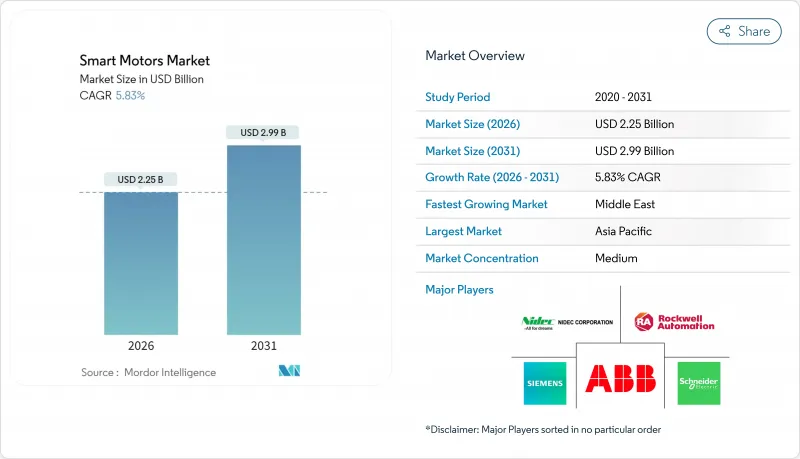
스마트 모터 시장은 2025년 21억 3,000만 달러로 평가되었으며, 2026년 22억 5,000만 달러에서 2031년까지 29억 9,000만 달러에 이를 것으로 예측됩니다.
예측기간(2026-2031년)의 CAGR은 5.83%로 예상됩니다.
엣지 인공지능, 첨단 파워 일렉트로닉스, 산업용 자동화 플랫폼의 고도의 융합이 진행되면서 제조업, 상업 빌딩 소유자, 인프라 운영자가 에너지 비용 절감과 가동률 향상을 도모하는 가운데 도입이 가속하고 있습니다. 모터 효율에 관한 규제 요건, 예지보전에 대한 관심 고조, 기업의 정보기술 영역 내에 확실히 자리잡은 모터 네트워크에 대한 보안 확보의 필요성이 수요를 더욱 뒷받침하고 있습니다. 기술적으로 여전히 중간 정도의 단편화가 나타나고 있지만 경쟁 방향은 명확합니다. 제어 로직, 엣지 분석, 안전한 연결성을 컴팩트한 인클로저에 통합할 수 있는 공급업체가 시장 점유율을 빠르게 획득하고 있습니다. 데이터센터 냉각, 해상 풍력 시스템, 자율 이동 로봇 등의 분야에서는 컴팩트하고 고성능인 드라이브가 측정 가능한 생산성 향상을 가져오기 때문에 기회가 확대되고 있습니다.
세계의 스마트 모터 시장의 동향 및 인사이트
엣지 AI와의 융합에 의한 스마트 모터 제어의 디바이스 내 최적화
엣지 AI는 모터의 지능화를 중앙 집중식 PLC에서 로컬 추론을 실행할 수 있는 임베디드 마이크로컨트롤러로 마이그레이션하고 있습니다. ST마이크로일렉트로닉스의 STM32 제품군은 응답 지연을 밀리초에서 마이크로초로 단축하는 AI 가속기를 통합했습니다. 텍사스 인스트루먼트의 C2000 실시간 디바이스는 고장 30일 전에 베어링 및 권선 고장을 감지하는 머신러닝 모델을 실행하여 생산 중단 없이 유지보수 직원이 수리를 계획할 수 있도록 합니다. 르네사스 일렉트로닉스는 로봇 조립 셀용 모터 드라이브에 적응형 토크 알고리즘을 탑재한 결과 15-20%의 효율 개선을 확인했습니다. 이 효과는 순간 동작 프로파일이 처리량을 좌우하는 픽앤플레이스 로봇과 같은 응용 분야에서 특히 중요합니다. 엣지 처리는 또한 운영 데이터를 온프레미스로 유지함으로써 데이터 주권에 관한 규제에 대응합니다.
유럽과 중국에서 산업용 에너지 효율 기준의 의무화
유럽 연합의 규정 2019/1781은 대부분의 산업 분야에서 IE3 모터의 최저 기준을 상향하고 고소비 환경에서는 IE4-IE5를 권장하며 인텔리전트 드라이브를 컴플라이언스 전략에 통합하는 것을 효과적으로 추진하고 있습니다. 중국의 14차 5개년 계획은 2025년까지 산업 에너지 강도를 13.5% 낮추는 목표를 설정하여 스마트 모터를 핵심 실현 수단으로 자리매김하고 있습니다. IEC 60034-30-1 및 IEC 60034-2-1은 제조업체가 충족해야 하는 분류 기준과 조사 기법을 제공합니다. 따라서 모터가 전력 소비의 70%를 차지하는 야금, 시멘트, 화학공업 등의 산업 플랜트에서는 자본 예산을 센서를 다수 탑재한 고효율 드라이브로 재분배하는 움직임이 진행되고 있습니다. 규제의 최소 기준도 도입을 가속화하고 있습니다. 스마트 모터는 에너지 성능을 실시간으로 기록 및 보고할 수 있기 때문에 컴플라이언스 감사의 검증이 가능하기 때문입니다.
네트워크 연결 모터 시스템의 사이버 보안 취약점
수천 대의 드라이브를 이더넷 네트워크에 연결하면 공격자가 악용할 수 있는 공격 대상 영역이 확대됩니다. 미국 국립표준기술연구소(NIST)는 제대로 분류되지 않은 모터 네트워크에서 단일 드라이브에서 플랜트 전체의 제어층으로의 횡방향 이동이 가능하다고 경고합니다. ICS-CERT의 2024년 경보에서는 침해된 인버터가 속도 이상을 일으키고 펌프나 생산 배치에 손해를 초래한 멀웨어 사건이 기록되어 있습니다. 실시간 제약은 패치 적용을 복잡화합니다. 이는 드라이브가 표준 IT 보안 도구와 관련된 통신 지연을 허용하지 않기 때문입니다. 그 결과, 화학, 물 및 전력 사업자는 벤더가 IEC 62443 인증을 취득한 드라이브 고유의 보안 스택을 실증할 때까지, 스마트 모터의 도입을 연기하는 경우가 많아지고 있습니다.
부문 분석
2025년 시점에서 가변 속도 드라이브는 스마트 모터 시장을 47.82%의 점유율로 주도했습니다. 이는 가변 속도 드라이브가 오랜 세월 모터와 자동화 네트워크의 주요 연결 수단으로 작용해 왔기 때문입니다. 그러나 통합 모터 드라이브 패키지는 6.85%의 가장 높은 CAGR을 기록했습니다. 이는 파워 일렉트로닉스, 제어 장치, 센서를 통합한 단일 밀폐 유닛을 설치할 수 있다는 점을 구매자가 중시하고 있기 때문입니다. 이 방법은 외부 캐비닛이 필요 없고 배선 거리가 단축되므로 생산 구역의 점유 면적이 줄어듭니다. 이는 식음료 및 제약 가공업자, 그리고 특히 위생이나 안전 감사의 대상이 되어 노출된 케이블 트레이가 문제시되는 기업에게 매력적입니다. 통합 드라이브는 전자기 호환성 테스트에도 쉽게 통과하므로 설계 반복 작업을 수주 단축할 수 있습니다.
보다 높은 스위칭 주파수와 저손실에서 동작하는 실리콘 카바이드(SiC) 및 질화 갈륨(GaN) 트랜지스터의 발전으로 수년 전에 과열된 고밀도 패키징이 가능해졌습니다. ABB의 통합 솔루션은 디스크리트형에 비해 리터당 30-40% 높은 출력을 실현하는 동시에 진동, 온도, 전류 센서를 내장하고 엣지 PC로 분석 데이터를 스트리밍합니다. 이러한 진단 기능을 통해 유지보수 팀은 월별 정기 점검에서 상태 모니터링형 계획으로 이행하여 인건비 절감과 예기치 않은 고장 방지를 실현합니다. 리노베이션 환경에서는 독립형 인버터의 판매가 견조하지만, 새로운 프로젝트에서는 라이프사이클 비용의 이점으로 인해 통합 유형이 주류가 되고 있습니다. 공장 자동화 벤더가 통합 모터에 멀티 프로토콜 펌웨어를 프리로드하는 움직임이 퍼지고 있는 가운데, 사용자는 하드웨어 교환이 아닌 소프트웨어 업그레이드에 의한 통신 재구성이 가능해져 도입 촉진이 더욱 가속화되고 있습니다.
2025년 시점에서는 1-10kW 클래스가 스마트 모터 시장 규모의 60.74%를 차지했습니다. 이는 컨베이어, 믹서, 압축기 등의 중간 규모 기계가 디스크리트 산업과 공정 산업 모두에서 널리 보급되기 때문입니다. 이 출력대의 모터는 장시간의 가동 사이클로 에너지 절약 효과가 쌓여 신속한 투자 회수를 전망할 수 있습니다. 그러나 도입세가 가장 강한 것은 1kW 미만의 영역이며, 판매대수는 CAGR 7.02%로 확대되고 있습니다. 연구실 자동화, 의료 진단, 픽앤플레이스 피더에는 미세한 속도 제어와 저소음, 고위치 정밀도를 겸비한 초소형 구동 장치가 요구됩니다. 여기에서는 단순한 음극모터나 스테핑모터 설계를 대신하여 분수 마력의 스마트 모터를 도입하여 출하수량이 극적으로 증가하고 있습니다.
통합 동향은 고출력 영역과 유사하지만 전력 밀도에 대한 중시가 더욱 높아지고 있습니다. 텍사스 인스트루먼트는 소형 C2000 마이크로컨트롤러, 게이트 드라이버, 필드 지향 제어 펌웨어를 탑재한 레퍼런스 설계를 입증하고 있습니다. 이들 모두가 손바닥 사이즈의 케이스에 포함되면서 3상 전류의 제어를 가능하게 하고 있습니다. 1kW 미만의 구동장치는 팬 코일 유닛, 스마트 블라인드, HVAC 물 순환 루프 내의 마이크로펌프 등 보다 광범위한 빌딩 자동화 이용 사례의 가능성도 개척합니다. 분산형 빌딩 장비는 수천 대 규모에 이르기 때문에 소형 모터조차도 시장 전체에 영향을 미칩니다. 한편, 10kW를 초과하는 시스템은 보수적인 경향이 계속되고 있습니다. 석유 시추 장비와 광산은 최첨단 제어보다 견고성과 검증된 성능을 강조하기 때문에 업그레이드가 더 긴 사이클로 진행됩니다.
지역별 분석
아시아태평양은 2025년 세계 매출의 37.42%를 차지하였고 중국이 추진하는 산업 에너지 집약도 감소와 인도의 생산연계 인센티브 제도(선진 자동화에 대한 보조금 유도책)가 이를 지원하고 있습니다. 일본의 로봇 셀 제조업체는 밀리초 미만의 지터를 가지는 서보가 필요하며 이는 고성능 스마트 드라이브의 수요를 견인하고 있습니다. 한편 한국 조선소에서는 25년 이상의 수명주기에 견디는 내염성 환경 대응 모터가 통합되어 있습니다. 반도체 주조가 급성장하는 대만과 중국 본토에서는 저진동 고순도 클린룸용 모터에 대한 수요가 더욱 높아지고 있습니다. 현지 조달을 통한 공급망의 단축화로 아시아 OEM 업체들은 기능을 유지하면서 가격 면에서 해외 경쟁사보다 높은 경쟁력을 획득하고 있습니다.
중동은 2031년까지 연평균 복합 성장률(CAGR) 6.35%로 업계를 견인할 전망입니다. 사우디아라비아의 '비전 2030' 계획에서는 석유화학, 광업 및 그린 수소 프로젝트에 수십억 달러를 투입하고 있습니다. 각 프로젝트는 사막 사이트에 대한 유지보수 방문을 최소화하기 위해 고급 진단 기능을 갖춘 모터 시스템을 지정합니다. 아랍에미리트(UAE)의 고층 빌딩에서는 지속가능성 평가 기준을 충족하기 위해 지능형 HVAC 구동 장치가 채택되었습니다. 걸프 지역의 해상 담수화 플랜트는 내식성 스마트 모터를 채택하여 심각한 고장이 발생하기 전에 베어링의 마모를 감지하여 물 생산량을 보호합니다.
북미에서는 리쇼어링 동향으로 새로운 자동화 공장이 가동을 시작하는 가운데 레거시 자산의 업그레이드가 계속되고 있습니다. 미국 연방 정부의 효율적인 모터에 대한 세금 혜택은 캘리포니아와 뉴욕의 건축 기준을 보완합니다. 이러한 기준은 특정 마력 이상의 HVAC 시스템에 가변 속도 드라이브를 사용해야 합니다. NIST 프레임워크를 기반으로 하는 사이버 보안 요구사항으로 인해 IEC 62443-4-2 인증을 획득한 드라이브에 대한 수요가 증가하고 있습니다. 유럽에서는 규제 2019/1781이 전면 시행되어 소규모 작업장에서도 IE3 기준 미만의 모터에 대한 교환이 의무화되고 있습니다. 독일의 자동차 그룹은 도장 공장의 컨베이어와 용접 로봇의 제어 및 제휴에 PROFINET 대응 스마트 드라이브를 조기 도입하고 있습니다. 노동 비용이 낮은 동유럽은 위탁 제조의 거점으로 부상하고 스마트 모터 공급업체에게 투자처로 주목받고 있습니다.
기타 혜택
- 시장 예측(ME) 엑셀 시트
- 3개월 애널리스트 서포트
자주 묻는 질문
목차
제1장 서론
- 조사 전제조건 및 시장 정의
- 조사 범위
제2장 조사 방법
제3장 주요 요약
제4장 시장 상황
- 시장 개요
- 촉진요인
- 엣지 AI와의 융합에 의한 스마트 모터 제어의 디바이스 내 최적화
- 유럽 및 중국에서의 산업용 에너지 효율 기준 의무화
- 상업 빌딩용 공조 시스템의 급속한 전기화
- 자율 이동 로봇 및 AGV의 도입 확대
- 해상 풍력 터빈의 피치 및 요 시스템에서 도입 증가
- SiC 및 GaN 파워 디바이스에 의한 통합형 모터 및 드라이브 패키지의 비용 저하
- 억제요인
- 네트워크화된 모터 시스템의 사이버 보안 취약성
- 단편화된 통신 프로토콜 환경에 의한 상호 운용성의 제한
- 파워 일렉트로닉스 부품 공급망 제약의 장기화
- 상태 모니터링형 유지보수 분석에서의 기술 격차
- 업계 밸류체인 분석
- 규제 상황
- 기술 전망
- Porter's Five Forces 분석
- 공급자의 협상력
- 구매자의 협상력
- 신규 참가업체의 위협
- 대체품의 위협
- 경쟁도
- 거시경제 요인의 영향
제5장 시장 규모 및 성장 예측
- 컴포넌트별
- 가변 속도 드라이브
- 모터
- 통합형 모터 드라이브
- 정격 출력별
- 1kW 미만
- 1-10kW
- 10kW 이상
- 통신 프로토콜별
- Ethernet 및 IP
- PROFINET
- Modbus TCP
- 기타 통신 프로토콜
- 용도별
- 산업
- 석유 및 가스
- 금속 및 광업
- 물 및 폐수 처리
- 식품 및 음료
- 화학제품
- 기타 산업
- 상업용
- HVAC 및 빌딩 자동화
- 데이터센터
- 기타 상업 분야
- 자동차
- 항공우주 및 방위
- 산업
- 지역별
- 북미
- 미국
- 캐나다
- 멕시코
- 유럽
- 독일
- 영국
- 프랑스
- 러시아
- 기타 유럽
- 아시아태평양
- 중국
- 일본
- 인도
- 한국
- 호주
- 기타 아시아태평양
- 중동 및 아프리카
- 중동
- 사우디아라비아
- 아랍에미리트(UAE)
- 기타 중동
- 아프리카
- 남아프리카
- 이집트
- 기타 아프리카
- 중동
- 남미
- 브라질
- 아르헨티나
- 기타 남미
- 북미
제6장 경쟁 구도
- 전략적 동향
- 시장 점유율 분석
- 기업 프로파일
- Siemens AG
- Schneider Electric SE
- ABB Ltd
- Rockwell Automation Inc.
- Nidec Corporation
- Safran Electrical and Power
- Nanotec Electronic GmbH and Co. KG
- Turntide Technologies Inc.
- Fuji Electric Co. Ltd
- Moog Inc.
- Dunkermotoren GmbH(Ametek Inc.)
- Shanghai Moons'Electric Co. Ltd
- WEG SA
- Yaskawa Electric Corporation
- Parker Hannifin Corporation
- SEW-Eurodrive GmbH and Co KG
- Brook Crompton Holdings Ltd
- Bonfiglioli Riduttori SpA
- Emerson Electric Co.
- Applied Motion Products Inc.
제7장 시장 기회 및 미래 전망
CSM 26.01.28The smart motors market was valued at USD 2.13 billion in 2025 and estimated to grow from USD 2.25 billion in 2026 to reach USD 2.99 billion by 2031, at a CAGR of 5.83% during the forecast period (2026-2031).
The heightened convergence of edge artificial intelligence, advanced power electronics, and industrial automation platforms is accelerating adoption as manufacturers, commercial building owners, and infrastructure operators seek to reduce energy bills and enhance uptime. Demand is further driven by regulatory mandates on motor efficiency, growing interest in predictive maintenance, and the need to secure motor networks that now reside firmly within enterprise information-technology perimeters. While the technology remains moderately fragmented, the direction of competition is clear: vendors that can integrate control logic, edge analytics, and secure connectivity within compact housings are rapidly capturing market share. Opportunities are expanding in data center cooling, offshore wind systems, and autonomous mobile robotics, where compact, high-performance drives provide measurable productivity gains.
Global Smart Motors Market Trends and Insights
Convergence of Smart Motor Controls with Edge AI for On-Device Optimization
Edge AI is moving motor intelligence from centralized PLCs toward embedded microcontrollers that can execute inference locally. STMicroelectronics' STM32 family now integrates AI accelerators that cut response latency from milliseconds to microseconds. Texas Instruments' C2000 real-time devices run machine-learning models that flag bearing or winding failures up to 30 days before breakdown, allowing maintenance staff to schedule repairs without disrupting production. Renesas Electronics measured 15-20% efficiency improvements after loading adaptive torque algorithms onto motor drives serving robotic assembly cells. These gains are significant in applications such as pick-and-place robotics, where split-second motion profiles determine throughput. Edge processing also addresses data sovereignty rules by keeping operational data on-premises.
Mandates on Industrial Energy Efficiency Standards in Europe and China
The European Union's Regulation 2019/1781 raises the minimum standard for IE3 motors for most industrial applications and promotes IE4-IE5 in high-consumption settings, effectively drawing intelligent drives into compliance strategies. China's 14th Five-Year Plan targets a 13.5% cut in industrial energy intensity by 2025, naming smart motors as core enablers. IEC 60034-30-1 and IEC 60034-2-1 supply the classification and test methodology that manufacturers must satisfy. Industrial plants in metallurgy, cement, and chemicals-where motors absorb as much as 70% of electricity-are therefore reshuffling capital budgets toward high-efficiency, sensor-rich drives. Regulatory floors accelerate adoption because smart motors can log and report energy performance in real time, validating compliance audits.
Cybersecurity Vulnerabilities in Networked Motor Systems
Linking thousands of drives onto Ethernet networks expands the attack surface that adversaries can exploit. NIST warns that poorly segmented motor networks can allow lateral movement from a single drive to plant-wide control layers. ICS-CERT alerts from 2024 documented malware incidents in which compromised inverters caused speed excursions, damaging pumps and production batches. Real-time constraints complicate patching because drives cannot tolerate the communication latency associated with standard IT security tools. As a result, chemical, water, and power utilities often defer smart motor rollouts until vendors demonstrate drive-native security stacks certified under IEC 62443.
Other drivers and restraints analyzed in the detailed report include:
- Rapid Electrification of HVAC Systems in Commercial Buildings
- Increasing Adoption in Autonomous Mobile Robots and AGVs
- Fragmented Communication Protocol Ecosystem Limiting Interoperability
For complete list of drivers and restraints, kindly check the Table Of Contents.
Segment Analysis
Variable speed drives dominated the smart motors market with a 47.82% share in 2025, as they have long served as the principal link between motors and automation networks. Integrated motor-drive packages, however, are experiencing the fastest 6.85% CAGR because buyers value the ability to install a single, sealed unit that combines power electronics, controls, and sensors. The approach eliminates external cabinets and reduces wiring runs, resulting in a cleaner plant floor footprint that appeals to food, beverage, and pharmaceutical processors, particularly those subject to hygiene or safety audits that penalize exposed cable trays. Integrated drives also pass electromagnetic-compatibility tests more readily, saving weeks in design iterations.
Advances in silicon carbide and gallium nitride transistors, operating at higher switching frequencies and lower losses, now permit dense packaging that would have overheated just a few years ago. ABB's integrated solutions deliver 30-40% more power per liter than discrete counterparts while embedding vibration, temperature, and current sensors that stream analytics data to edge PCs. These diagnostics help maintenance teams transition from monthly route-based inspections to condition-based plans, trimming labor and preventing surprise failures. In retrofit environments, stand-alone inverters continue to sell steadily, while new greenfield projects increasingly default to integrated form factors because lifecycle economics favor them. As more factory automation vendors preload multi-protocol firmware onto integrated motors, users gain the flexibility to reconfigure communications through software updates rather than hardware swaps, further stimulating adoption.
The 1-10 kW tranche retained a 60.74% share of the smart motors market size in 2025, as mid-range machines-such as conveyors, mixers, and compressors-remain prevalent across both discrete and process industries. Motors in this band see rapid payback when energy savings compound across long duty cycles. Nonetheless, adoption momentum is strongest below 1 kW, where unit sales are expanding at a 7.02% CAGR. Laboratory automation, medical diagnostics, and pick-and-place feeders require ultra-compact drives that mix fine speed control with low acoustic noise and high positional accuracy. Here, fractional-horsepower smart motors replace simple shaded-pole or stepper designs, resulting in a dramatic increase in shipment volumes.
Integration trends mirror those in higher ratings but with heightened emphasis on power density. Texas Instruments demonstrates reference designs featuring a tiny C2000 microcontroller, gate drivers, and field-oriented control firmware, all housed within a palm-sized enclosure that can still manage three-phase currents. Below 1 kW drives also unlock broader building automation use cases, including fan-coil units, smart blinds, and micro-pumps in HVAC hydronic loops. Because distributed building devices number in the thousands, even small motors collectively move the market needle. Above-10 kW systems, in contrast, stay conservative; oil rigs and mines value ruggedness and proven performance over bleeding-edge controls, so upgrades follow longer refresh cycles.
The Smart Motors Market Report is Segmented by Component (Variable Speed Drive, Integrated Motor-Drive, and More), Power Rating (Below 1 KW, 1-10 KW, and More), Communication Protocol (Ethernet/IP, PROFINET, and More), Application (Industrial, Commercial, Automotive, and More), and Geography (North America, Europe, Asia-Pacific, Middle East and Africa, South America). The Market Forecasts are Provided in Terms of Value (USD).
Geography Analysis
The Asia Pacific region held 37.42% of global revenue in 2025, underscored by China's push to reduce industrial-energy intensity and India's Production Linked Incentive schemes, which channel subsidies toward advanced automation. Japanese robotic cell makers require servos with sub-millisecond jitter, fueling demand for high-performance smart drives, while South Korean shipyards integrate ruggedized motors to endure salt-laden atmospheres over 25-year lifecycles. Taiwan and mainland China, home to booming semiconductor foundries, add further pull for low-vibration, high-purity clean-room motors. Local supply chains shorten lead times, letting Asian OEMs undercut foreign rivals on pricing without sacrificing features.
The Middle East is the pacesetter with a 6.35% CAGR through 2031. Saudi Arabia's Vision 2030 plans channel billions into petrochemical, mining, and green-hydrogen projects, each specifying motor systems with advanced diagnostics to minimize maintenance trips to remote desert sites. United Arab Emirates mega-buildings adopt intelligent HVAC drives to comply with sustainability ratings. Offshore desalination plants along the Gulf rely on corrosion-resistant smart motors that flag bearing wear before catastrophic failures, protecting water output.
North America continues to upgrade legacy assets as reshoring trends bring new automated factories online. U.S. federal tax incentives for efficient motors complement California and New York building codes, which mandate the use of variable-speed drives in HVAC systems over certain horsepower thresholds. Cybersecurity stipulations under the NIST framework elevate demand for drives certified to IEC 62443-4-2. In Europe, Regulation 2019/1781 is in full effect, obliging even small workshops to swap out sub-IE3 motors. German automotive groups are early adopters of PROFINET-enabled smart drives to control and coordinate paint-shop conveyors and welding robots. Eastern Europe, with its lower labor costs, is emerging as a contract-manufacturing hub and a successive investment wave for smart motor suppliers.
- Siemens AG
- Schneider Electric SE
- ABB Ltd
- Rockwell Automation Inc.
- Nidec Corporation
- Safran Electrical and Power
- Nanotec Electronic GmbH and Co. KG
- Turntide Technologies Inc.
- Fuji Electric Co. Ltd
- Moog Inc.
- Dunkermotoren GmbH (Ametek Inc.)
- Shanghai Moons' Electric Co. Ltd
- WEG S.A.
- Yaskawa Electric Corporation
- Parker Hannifin Corporation
- SEW-Eurodrive GmbH and Co KG
- Brook Crompton Holdings Ltd
- Bonfiglioli Riduttori S.p.A.
- Emerson Electric Co.
- Applied Motion Products Inc.
Additional Benefits:
- The market estimate (ME) sheet in Excel format
- 3 months of analyst support
TABLE OF CONTENTS
1 INTRODUCTION
- 1.1 Study Assumptions and Market Definition
- 1.2 Scope of the Study
2 RESEARCH METHODOLOGY
3 EXECUTIVE SUMMARY
4 MARKET LANDSCAPE
- 4.1 Market Overview
- 4.2 Market Drivers
- 4.2.1 Convergence of Smart Motor Controls with Edge AI for On-Device Optimization
- 4.2.2 Mandates on Industrial Energy Efficiency Standards in Europe and China
- 4.2.3 Rapid Electrification of HVAC Systems in Commercial Buildings
- 4.2.4 Increasing Adoption in Autonomous Mobile Robots and AGVs
- 4.2.5 Rising Deployment in Offshore Wind Turbine Pitch and Yaw Systems
- 4.2.6 Declining Cost of Integrated Motor-Drive Packages Due to SiC/GaN Power Devices
- 4.3 Market Restraints
- 4.3.1 Cybersecurity Vulnerabilities in Networked Motor Systems
- 4.3.2 Fragmented Communication Protocol Ecosystem Limiting Interoperability
- 4.3.3 Prolonged Supply Chain Constraints for Power Electronics Components
- 4.3.4 Skills Gap in Condition-Based Maintenance Analytics
- 4.4 Industry Value Chain Analysis
- 4.5 Regulatory Landscape
- 4.6 Technological Outlook
- 4.7 Porter's Five Forces Analysis
- 4.7.1 Bargaining Power of Suppliers
- 4.7.2 Bargaining Power of Buyers
- 4.7.3 Threat of New Entrants
- 4.7.4 Threat of Substitutes
- 4.7.5 Degree of Competition
- 4.8 Impact of Macroeconomic Factors
5 MARKET SIZE AND GROWTH FORECASTS (VALUE)
- 5.1 By Component
- 5.1.1 Variable Speed Drive
- 5.1.2 Motor
- 5.1.3 Integrated Motor-Drive
- 5.2 By Power Rating
- 5.2.1 Below 1 kW
- 5.2.2 1-10 kW
- 5.2.3 Above 10 kW
- 5.3 By Communication Protocol
- 5.3.1 Ethernet/IP
- 5.3.2 PROFINET
- 5.3.3 Modbus TCP
- 5.3.4 Other Communication Protocol
- 5.4 By Application
- 5.4.1 Industrial
- 5.4.1.1 Oil and Gas
- 5.4.1.2 Metal and Mining
- 5.4.1.3 Water and Wastewater
- 5.4.1.4 Food and Beverage
- 5.4.1.5 Chemicals
- 5.4.1.6 Other Industrial
- 5.4.2 Commercial
- 5.4.2.1 HVAC and Building Automation
- 5.4.2.2 Data Centers
- 5.4.2.3 Other Commercial
- 5.4.3 Automotive
- 5.4.4 Aerospace and Defense
- 5.4.1 Industrial
- 5.5 By Geography
- 5.5.1 North America
- 5.5.1.1 United States
- 5.5.1.2 Canada
- 5.5.1.3 Mexico
- 5.5.2 Europe
- 5.5.2.1 Germany
- 5.5.2.2 United Kingdom
- 5.5.2.3 France
- 5.5.2.4 Russia
- 5.5.2.5 Rest of Europe
- 5.5.3 Asia-Pacific
- 5.5.3.1 China
- 5.5.3.2 Japan
- 5.5.3.3 India
- 5.5.3.4 South Korea
- 5.5.3.5 Australia
- 5.5.3.6 Rest of Asia-Pacific
- 5.5.4 Middle East and Africa
- 5.5.4.1 Middle East
- 5.5.4.1.1 Saudi Arabia
- 5.5.4.1.2 United Arab Emirates
- 5.5.4.1.3 Rest of Middle East
- 5.5.4.2 Africa
- 5.5.4.2.1 South Africa
- 5.5.4.2.2 Egypt
- 5.5.4.2.3 Rest of Africa
- 5.5.4.1 Middle East
- 5.5.5 South America
- 5.5.5.1 Brazil
- 5.5.5.2 Argentina
- 5.5.5.3 Rest of South America
- 5.5.1 North America
6 COMPETITIVE LANDSCAPE
- 6.1 Strategic Moves
- 6.2 Market Share Analysis
- 6.3 Company Profiles (includes Global Level Overview, Market Level Overview, Core Segments, Financials as Available, Strategic Information, Market Rank/Share for Key Companies, Products and Services, and Recent Developments)
- 6.3.1 Siemens AG
- 6.3.2 Schneider Electric SE
- 6.3.3 ABB Ltd
- 6.3.4 Rockwell Automation Inc.
- 6.3.5 Nidec Corporation
- 6.3.6 Safran Electrical and Power
- 6.3.7 Nanotec Electronic GmbH and Co. KG
- 6.3.8 Turntide Technologies Inc.
- 6.3.9 Fuji Electric Co. Ltd
- 6.3.10 Moog Inc.
- 6.3.11 Dunkermotoren GmbH (Ametek Inc.)
- 6.3.12 Shanghai Moons' Electric Co. Ltd
- 6.3.13 WEG S.A.
- 6.3.14 Yaskawa Electric Corporation
- 6.3.15 Parker Hannifin Corporation
- 6.3.16 SEW-Eurodrive GmbH and Co KG
- 6.3.17 Brook Crompton Holdings Ltd
- 6.3.18 Bonfiglioli Riduttori S.p.A.
- 6.3.19 Emerson Electric Co.
- 6.3.20 Applied Motion Products Inc.
7 MARKET OPPORTUNITIES AND FUTURE OUTLOOK
- 7.1 White-Space and Unmet-Need Assessment