|
시장보고서
상품코드
1910663
의료용 전자기기 시장 : 점유율 분석, 업계 동향 및 통계, 성장 예측(2026-2031년)Medical Electronics - Market Share Analysis, Industry Trends & Statistics, Growth Forecasts (2026 - 2031) |
||||||
 Mordor Intelligence
세계의 의료용 전자기기 시장은 2025년 103억 3,000만 달러에서 2026년에는 110억 5,000만 달러로 성장하고, 2026년부터 2031년까지 CAGR 6.97%로 성장을 지속하여 154억 8,000만 달러에 이를 것으로 예측됩니다.
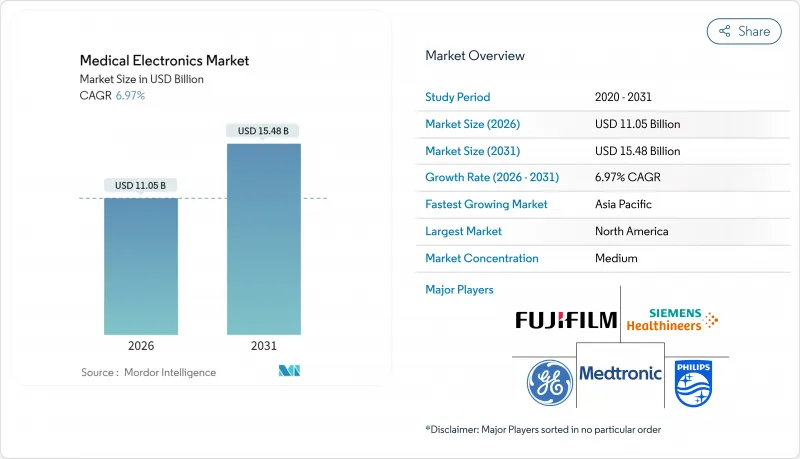
이 확대는 규제의 현대화, 의료비를 30% 삭감하는 재택치료 모델로의 급속한 이행, AI를 활용한 진단 및 모니터링 솔루션 도입 가속에 의해 추진되고 있습니다. 2030년까지 세계 인구의 약 20%가 60세 이상이 될 전망이며, 지속적이고 분산적인 의료 요구가 지속적으로 높아짐에 따라 수요는 더욱 확대됩니다. 반도체 공급의 불안정화와 사이버 보안 규제의 강화는 성장을 억제하는 한편, 공급업체의 다양화, 니어 쇼어링, 제품 재설계를 촉진하고 있습니다. 아시아태평양은 17.79%의 연평균 복합 성장률(CAGR)로 주도적인 입장을 유지하고 있으며, 북미는 FDA의 새로운 사이버 보안 요구사항에 따라 기술적 우위를 유지하며, 유럽은 복잡한 컴플라이언스 요건과 혁신의 균형을 이루고 있습니다.
세계의 의료용 전자기기 시장 동향과 통찰
고령화 인구 증가
고령층 인구의 확대에 따라, 평생에 걸친 치료 요구가 높아지고, 비침습적인 심장 및 대사 모니터링 수요가 증가하고 있습니다. 고령자의 약 80%가 자립 생활을 보내고 있기 때문에 임상의에게 실시간으로 바이탈 사인을 전달하는 원격 센서의 도입이 진행되고 있습니다. Medical Blackbox 플랫폼과 같은 소형 패치는 노인 운영 제약에 맞는 자동 경고를 제공합니다. 정부가 '재택 고령화' 전략을 우선하는 가운데, 디바이스 제조업체는 장기 재택 케어의 요구에 부응하기 위해, 배터리 수명, 직관적인 인터페이스, 전도 검지 알고리즘의 개량을 계속하고 있습니다.
진단 영상 기술의 보급
정기 유방촬영에서 5년간 유방암 위험을 예측하는 CLAIRITY BREAST와 같은 AI 도구의 FDA 승인은 진단 패러다임이 예측 의료로 전환하고 있음을 보여줍니다. GE Healthcare는 AI 대응 영상 진단에 연간 10억 달러 이상을 투자해 심근 관류 스캔용 Flyrcado 등의 응용을 추가하고 있습니다. 향후 6G 네트워크는 클라우드 플랫폼 간에 방사선 영상 파일을 즉시 전송하고, 보고서 처리 시간을 단축하고, 재검사를 줄이는 것을 목표로 하고 있습니다. 의료기관은 자본 예산을 알고리즘에 의한 트리어지를 통합한 영상 진단 시스템으로 옮겨 환자 1인당 치료 비용을 절감하면서 처리 능력을 향상시키고 있습니다.
엄격한 규제 프레임 워크
2023년 10월 시행의 FDA 규칙에서는 접속 기기 전부 사이버 보안 관리 계획, 소프트웨어 부품표, 시판 후 취약성 대응 프로세스 기재가 의무화됩니다. 컴플라이언스 비용과 심사주기의 장기화는 신생 기업에 장벽이 되고 중견기업의 연구개발 예산을 압박하고 있습니다. 병행하여 EU 의료기기 규정(MDR 2017/745)은 많은 신청자들에게 제출 기한이 12-18개월 연장되었으며, 승인은 세계 규제 부서를 보유한 선도적인 제조업체에 집중하는 경향이 있습니다.
부문 분석
비침습적 장치는 임상가가 감염 위험을 줄이는 무통 진단을 선호했기 때문에 2025년에는 의료용 전자기기 시장의 61.12%를 차지했습니다. MRI, CT, X선 플랫폼에는 현재 이상을 자동 감지하고 방사선 피폭을 줄이는 AI 엔진이 통합되어 있습니다. 웨어러블 및 패치형 디바이스의 의료용 전자기기 시장 규모는 저소비전력 칩셋과 일반 소비자용 시판품의 FDA 승인 경로에 지지되어 12.94%의 연평균 복합 성장률(CAGR)로 확대가 전망됩니다.
비침습적 대안이 부족한 경우, 리듬 관리, 통증 치료 및 내시경 검사에서 침습적 솔루션이 전략적 중요성을 유지합니다. 이식 가능한 루프 레코더는 최대 3년간의 심장 모니터링을 지원하며, 신흥 흡수성 심장박동기는 수술 후 장치 불필요한 회복을 약속합니다. Inceptiv와 같은 실시간 폐쇄 루프 자극기는 적응 알고리즘을 통해 치료 전류를 개별화하고 배터리 수명을 연장합니다. 치료의 복잡성과 무균 요건은 수량 성장을 억제하는 반면 전문 수술실에서 지속적인 수요를 보장합니다.
지역별 분석
아시아태평양은 산업 지원 정책, 중산 계급의 의료 지출 증가, 병원 건설의 급속한 진전으로 17.55%의 연평균 복합 성장률(CAGR)로 가장 빠른 성장 궤도를 기록하고 있습니다. 2024년에는 벤처 자금 조달이 감소했지만, 국내 가속기 및 공적 보조금은 지역의 역학 상황과 가격대에 맞춘 제품을 제공하는 AI 대응 화상 진단 스타트업 기업에 대한 지원을 계속하고 있습니다.
북미는 예측 가능한 FDA 심사 프로세스와 강력한 조기 도입 의료기관 네트워크에 힘입어 33.49%의 수익 점유율로 선두를 유지하고 있습니다. 제안된 반도체 관세는 미국 등록 의료기기의 절반 이상에 원재료 비용 상승의 우려를 초래하지만, 미국을 위한 의료기기 최대 수출국이 된 멕시코에 대한 니어 쇼어링은 장기적인 공급 위험에 대한 노출을 완화시킵니다. 북미의 의료용 전자기기 시장 규모는 30%의 비용 절감 효과를 실증하고 보험 적용 확대를 촉진하는 재택치료 파일럿 사업으로부터 혜택을 받고 있습니다.
유럽 시장도 큰 존재감을 나타내고 있으며, 고급 연구 개발 클러스터와 엄격한 컴플라이언스 체제가 균형을 유지하고 있습니다. EU 의료기기규칙(MDR)은 신청 서류의 복잡성을 늘렸으나 독일의 디지털 헬스 용도 프레임워크 등의 노력으로 연결형 디바이스의 상환 범위가 확대되고 있습니다. 지속가능성 지령은 에너지 절약형 영상 진단실과 순환형 경제 포장을 권장하고 제조업체에게 제품 수명주기의 재설계를 촉구하고 있습니다. 고령화에 따른 다질환 관리 수요와 정부의 전자기록 상호운용성에 대한 투자로 지역 성장은 안정을 유지하고 있습니다.
기타 혜택:
- 엑셀 형식 시장 예측(ME) 시트
- 애널리스트에 의한 3개월간의 지원
자주 묻는 질문
목차
제1장 서론
- 조사의 전제조건과 시장의 정의
- 조사 범위
제2장 조사 방법
제3장 주요 요약
제4장 시장 상황
- 시장 개요
- 시장 성장 촉진요인
- 고령화 인구 증가
- 진단 영상 기술 보급 확대
- 센서 소형화에 있어서의 기술적 진보
- 만성 질환 증가 경향
- AI와 엣지 분석의 통합
- 재택 병원 케어 모델의 상승
- 시장 성장 억제요인
- 엄격한 규제 프레임워크
- 높은 초기 투자 및 유지 관리 비용
- 반도체 공급망의 변동성
- 사이버 보안 및 데이터 프라이버시 컴플라이언스 비용 상승
- Porter's Five Forces 분석
- 신규 참가업체의 위협
- 구매자의 협상력
- 공급기업의 협상력
- 대체품의 위협
- 경쟁 기업간 경쟁 관계
제5장 시장 규모와 성장 예측(금액은 미화)
- 제품별
- 비침습적 제품
- MRI
- X선
- CT 스캔
- 초음파
- 핵의학 영상 진단 시스템
- 심장 모니터
- 호흡 모니터
- 헤모다이나믹 모니터
- 다기능 모니터
- 디지털 체온계
- 웨어러블 및 패치형 디바이스
- 기타 비침습적 제품
- 침습적 제품
- 내시경
- 페이스메이커
- 이식형 제세동기(ICD)
- 이식형 루프 레코더
- 척수 자극 장치
- 기타 침습적 제품
- 비침습적 제품
- 용도별
- 진단
- 모니터링
- 치료법
- 최종 사용자별
- 병원 및 진료소
- 외래수술센터(ASC)
- 재택치료 시설
- 기타 최종 사용자
- 지역별
- 북미
- 미국
- 캐나다
- 멕시코
- 유럽
- 독일
- 영국
- 프랑스
- 이탈리아
- 스페인
- 기타 유럽
- 아시아태평양
- 중국
- 일본
- 인도
- 호주
- 한국
- 기타 아시아태평양
- 중동 및 아프리카
- GCC
- 남아프리카
- 기타 중동 및 아프리카
- 남미
- 브라질
- 아르헨티나
- 기타 남미
- 북미
제6장 경쟁 구도
- 시장 집중도
- 시장 점유율 분석
- 기업 프로파일
- GE HealthCare
- Koninklijke Philips NV
- Siemens Healthineers AG
- Medtronic plc
- Canon Medical Systems Corp.
- Fujifilm Corporation
- Mindray Medical Int'l Ltd.
- Nihon Kohden Corp.
- Boston Scientific Corp.
- Abbott Laboratories
- Hologic Inc.
- Olympus Corp.
- Dragerwerk AG & Co. KGaA
- Getinge AB
- McKesson Corporation
- Smiths Medical
- Masimo Corporation
- B. Braun Melsungen AG
- Baxter International Inc.
- Esaote SpA
제7장 시장 기회와 미래 전망
SHW 26.01.26The Medical Electronics market is expected to grow from USD 10.33 billion in 2025 to USD 11.05 billion in 2026 and is forecast to reach USD 15.48 billion by 2031 at 6.97% CAGR over 2026-2031.
The expansion is propelled by regulatory modernization, the rapid shift toward hospital-at-home models that lower care costs by 30%, and accelerated adoption of AI-enabled diagnostics and monitoring solutions. Demand intensifies as nearly 20% of the global population will be 60 or older by 2030, creating sustained requirements for continuous, decentralized care. Semiconductor supply instability and tightening cybersecurity rules temper growth yet simultaneously stimulate supplier diversification, near-shoring, and product redesign. Asia-Pacific leads with a 17.79% CAGR, North America maintains technology leadership under new FDA cybersecurity mandates, and Europe balances innovation with complex compliance demands.
Global Medical Electronics Market Trends and Insights
Increasing Geriatric Population
An expanding senior demographic elevates lifetime treatment needs and multiplies demand for non-invasive cardiac and metabolic monitoring. Nearly 80% of older adults live independently, prompting uptake of remote sensors that relay real-time vitals to clinicians. Miniaturized patches such as Medical Blackbox platforms deliver automated alerts that match seniors' usability constraints. As governments prioritize "aging-in-place" strategies, device makers continue refining battery life, intuitive interfaces, and fall-detection algorithms to meet long-term home-care needs.
Widespread Adoption of Diagnostic Imaging Technologies
FDA clearance of AI tools like CLAIRITY BREAST, which forecasts five-year breast-cancer risk from routine mammograms, illustrates a diagnostic paradigm moving toward predictive medicine. GE Healthcare invests over USD 1 billion yearly in AI-enabled imaging, adding applications such as Flyrcado for myocardial perfusion scans. Forthcoming 6G networks aim to transmit radiology files instantly across cloud platforms, improving report turnaround and cutting repeat scans. Providers shift capital budgets into imaging suites that integrate algorithmic triage, lowering per-patient procedure cost while raising throughput.
Stringent Regulatory Frameworks
FDA rules effective October 2023 require every connected device to include a cybersecurity management plan, a software bill of materials, and post-market vulnerability processes. Compliance fees and longer review cycles raise barriers for start-ups and stretch R&D budgets of mid-tier firms. In parallel, the EU MDR 2017/745 extends submission timelines by 12-18 months for many applicants, concentrating approvals among large manufacturers with global regulatory departments.
Other drivers and restraints analyzed in the detailed report include:
- Technological Advances in Sensor Miniaturization
- Rising Prevalence of Chronic Diseases
- High Upfront Investment and Maintenance Costs
For complete list of drivers and restraints, kindly check the Table Of Contents.
Segment Analysis
Non-invasive devices delivered 61.12% medical electronics market share in 2025 as clinicians favored painless diagnostics that lower infection risk. MRI, CT, and X-ray platforms now bundle AI engines that automatically flag anomalies and reduce radiation exposure. The medical electronics market size for wearable and patch-based devices is projected to advance at 12.94% CAGR, supported by battery-sipping chipsets and FDA pathways for over-the-counter consumer use.
Invasive solutions maintain strategic importance for rhythm management, pain therapy, and endoscopy when non-invasive alternatives remain inadequate. Implantable loop recorders support cardiac monitoring for up to three years, while emerging resorbable pacemakers promise postoperative device-free recovery. Real-time closed-loop stimulators such as Inceptiv personalize therapy currents and extend battery life through adaptive algorithms. Procedural complexity and sterility requirements temper volumetric growth yet secure enduring demand in specialized surgical suites.
The Medical Electronics Market Report Segments the Industry Into by Product (Non-Invasive Products [MRI, X-Ray, CT Scan, and More], Invasive Products [Endoscopes, Pacemakers, and More]), Application (Diagnostics, Monitoring, Therapeutics), End User (Hospitals and Clinics, Ambulatory Surgical Centers, and More), and Geography (North America, Europe, Asia-Pacific, and More). The Market Forecasts are Provided in Terms of Value (USD).
Geography Analysis
Asia-Pacific records the fastest trajectory at 17.55% CAGR due to supportive industrial policy, rising middle-class healthcare spending, and rapid hospital construction. Venture funding receded during 2024, yet domestic accelerators and public grants continue to underwrite AI-enabled imaging start-ups that tailor products to regional epidemiology and price points.
North America retains 33.49% revenue leadership, aided by predictable FDA review pathways and strong early-adopter provider networks. Proposed semiconductor tariffs could lift input costs for more than half of US-registered devices, but near-shoring to Mexico, now the largest exporter of medical instruments to the United States, blunts longer-term supply-risk exposure. The medical electronics market size in North America benefits from hospital-at-home pilots that demonstrate 30% cost reduction and motivate payer coverage expansion.
Europe shares a sizable presence, balancing advanced R&D clusters with rigorous compliance regimes. EU MDR increases dossier complexity, yet initiatives such as Germany's Digital-Health-Applications framework broaden reimbursement for connected devices. Sustainability directives favor energy-efficient imaging suites and circular-economy packaging, encouraging manufacturers to redesign product lifecycles. Regional growth remains steady as aging populations demand multi-pathology management and governments invest in digital records interoperability.
- GE Healthcare
- Koninklijke Philips
- Siemens Healthineers
- Medtronic
- Canon
- FUJIFILM
- Mindray Medical Int'l Ltd.
- Nihon Kohden Corp.
- Boston Scientific
- Abbott Laboratories
- Hologic
- Olympus Corp.
- Dragerwerk
- Getinge
- Mckesson
- Smiths Group
- Masimo
- B. Braun
- Baxter
- Esaote
Additional Benefits:
- The market estimate (ME) sheet in Excel format
- 3 months of analyst support
TABLE OF CONTENTS
1 Introduction
- 1.1 Study Assumptions & Market Definition
- 1.2 Scope of the Study
2 Research Methodology
3 Executive Summary
4 Market Landscape
- 4.1 Market Overview
- 4.2 Market Drivers
- 4.2.1 Increasing Geriatric Population
- 4.2.2 Widespread Adoption of Diagnostic Imaging Technologies
- 4.2.3 Technological Advances in Sensor Miniaturization
- 4.2.4 Rising Prevalence of Chronic Diseases
- 4.2.5 Integration of AI and Edge Analytics
- 4.2.6 Emergence of Hospital-At-Home Care Models
- 4.3 Market Restraints
- 4.3.1 Stringent Regulatory Frameworks
- 4.3.2 High Upfront Investment and Maintenance Costs
- 4.3.3 Volatility in Semiconductor Supply Chains
- 4.3.4 Rising Cybersecurity and Data Privacy Compliance Costs
- 4.4 Porter's Five Forces Analysis
- 4.4.1 Threat of New Entrants
- 4.4.2 Bargaining Power of Buyers
- 4.4.3 Bargaining Power of Suppliers
- 4.4.4 Threat of Substitute Products
- 4.4.5 Intensity of Competitive Rivalry
5 Market Size & Growth Forecasts (Value in USD)
- 5.1 By Product
- 5.1.1 Non-invasive Products
- 5.1.1.1 MRI
- 5.1.1.2 X-Ray
- 5.1.1.3 CT Scan
- 5.1.1.4 Ultrasound
- 5.1.1.5 Nuclear Imaging Systems
- 5.1.1.6 Cardiac Monitors
- 5.1.1.7 Respiratory Monitors
- 5.1.1.8 Hemodynamic Monitors
- 5.1.1.9 Multiparameter Monitors
- 5.1.1.10 Digital Thermometers
- 5.1.1.11 Wearable & Patch-based Devices
- 5.1.1.12 Other Non-invasive Products
- 5.1.2 Invasive Products
- 5.1.2.1 Endoscopes
- 5.1.2.2 Pacemakers
- 5.1.2.3 Implantable Cardioverter-Defibrillators (ICD)
- 5.1.2.4 Implantable Loop Recorders
- 5.1.2.5 Spinal Cord Stimulators
- 5.1.2.6 Other Invasive Products
- 5.1.1 Non-invasive Products
- 5.2 By Application
- 5.2.1 Diagnostics
- 5.2.2 Monitoring
- 5.2.3 Therapeutics
- 5.3 By End User
- 5.3.1 Hospitals & Clinics
- 5.3.2 Ambulatory Surgical Centers
- 5.3.3 Home Healthcare Settings
- 5.3.4 Other End Users
- 5.4 By Geography
- 5.4.1 North America
- 5.4.1.1 United States
- 5.4.1.2 Canada
- 5.4.1.3 Mexico
- 5.4.2 Europe
- 5.4.2.1 Germany
- 5.4.2.2 United Kingdom
- 5.4.2.3 France
- 5.4.2.4 Italy
- 5.4.2.5 Spain
- 5.4.2.6 Rest of Europe
- 5.4.3 Asia-Pacific
- 5.4.3.1 China
- 5.4.3.2 Japan
- 5.4.3.3 India
- 5.4.3.4 Australia
- 5.4.3.5 South Korea
- 5.4.3.6 Rest of Asia-Pacific
- 5.4.4 Middle East & Africa
- 5.4.4.1 GCC
- 5.4.4.2 South Africa
- 5.4.4.3 Rest of Middle East & Africa
- 5.4.5 South America
- 5.4.5.1 Brazil
- 5.4.5.2 Argentina
- 5.4.5.3 Rest of South America
- 5.4.1 North America
6 Competitive Landscape
- 6.1 Market Concentration
- 6.2 Market Share Analysis
- 6.3 Company Profiles (includes Global level Overview, Market level overview, Core Segments, Financials as available, Strategic Information, Market Rank/Share for key companies, Products & Services, and Recent Developments)
- 6.3.1 GE HealthCare
- 6.3.2 Koninklijke Philips N.V.
- 6.3.3 Siemens Healthineers AG
- 6.3.4 Medtronic plc
- 6.3.5 Canon Medical Systems Corp.
- 6.3.6 Fujifilm Corporation
- 6.3.7 Mindray Medical Int'l Ltd.
- 6.3.8 Nihon Kohden Corp.
- 6.3.9 Boston Scientific Corp.
- 6.3.10 Abbott Laboratories
- 6.3.11 Hologic Inc.
- 6.3.12 Olympus Corp.
- 6.3.13 Dragerwerk AG & Co. KGaA
- 6.3.14 Getinge AB
- 6.3.15 McKesson Corporation
- 6.3.16 Smiths Medical
- 6.3.17 Masimo Corporation
- 6.3.18 B. Braun Melsungen AG
- 6.3.19 Baxter International Inc.
- 6.3.20 Esaote SpA
7 Market Opportunities & Future Outlook
- 7.1 White-space & Unmet-need Assessment