|
시장보고서
상품코드
1910664
광학 현미경 : 시장 점유율 분석, 업계 동향 및 통계, 성장 예측(2026-2031년)Optical Microscopes - Market Share Analysis, Industry Trends & Statistics, Growth Forecasts (2026 - 2031) |
||||||
 Mordor Intelligence
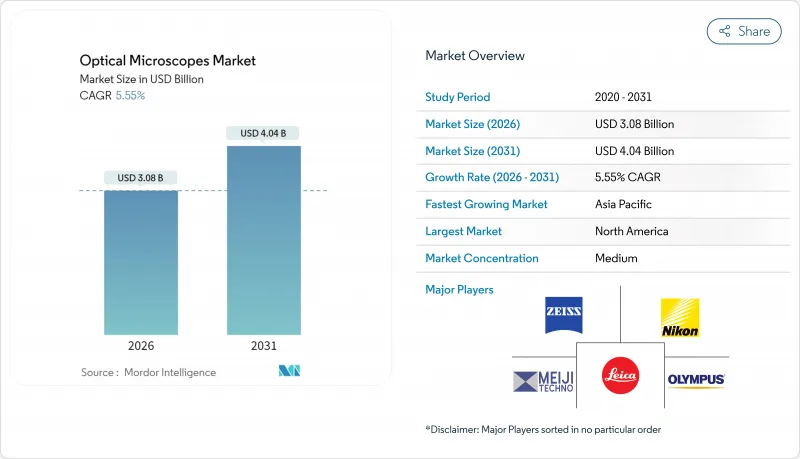
2026년 광학 현미경 시장 규모는 30억 8,000만 달러로 추정되고 있으며, 2025년 29억 2,000만 달러에서 성장이 예상됩니다.
2031년 예측은 40억 4,000만 달러에 이르고, 2026년부터 2031년까지 연평균 복합 성장률(CAGR) 5.55%로 성장할 것으로 전망됩니다.
머신러닝 알고리즘은 이미지 획득과 해석을 자동화하고 분석 시간을 몇 시간에서 몇 분으로 단축했습니다. 이에 따라 연구소에서는 증가하는 샘플량에 대응할 수 있게 되었습니다. 양자센서의 통합으로 공간분해능이 10나노미터까지 향상되어 분자생물학이나 나노재료 연구에 있어서 새로운 조사 창이 열리고 있습니다. 특히 미국 국립위생연구소(NIH)의 공유기기 보조금에 의한 자금 유입이 학술기관과 임상시설에서 견조한 갱신주기를 지원하고 있습니다. 한편, 50달러 미만의 완전 3D 프린팅 광학 어셈블리와 같은 민주화된 제조 기술은 자원 제약이 있는 환경에서 도입 장벽을 줄이기 시작했습니다.
세계의 광학 현미경 시장 동향과 전망
생명 과학 연구 개발에 대한 자금 증가
연방 및 자선 프로그램은 NIH의 1억 3,000만 달러 규모의 저온 전자 현미경(cryo-EM) 확장 계획과 프린스턴 대학의 기금을 이용한 광학 코어 장비 업그레이드 등 차세대 이미징 시설의 정비를 지원합니다. 조성금 제도는 공유 이용 모델을 우대하고 있어 이용률의 향상과 범용성이 높은 모듈형 플랫폼에의 조달 유도를 촉진하고 있습니다. 자본조달의 용이화는 특히 고가격대이면서도 고급 생물의학 이용 사례에 적합한 형광현미경이나 초해상 현미경에 혜택을 가져왔습니다. 이 때문에 광학 현미경 시장은 학술 컨소시엄과 지역 연구 네트워크에서 여러 해에 걸친 수주 전망이 확보되고 있습니다.
디지털화와 AI를 활용한 이미지 해석
심층 학습 파이프라인은 종양의 악성도 판정에 있어서 전문 병리의와 동등 이상의 정확도를 달성하여 현미경이 거의 실시간으로 실용적인 인사이트를 제공하는 것을 가능하게 하고 있습니다. ATOMIC 등의 프레임워크는 제로 샷 재료 특성 평가를 실현하고, 사전 학습 모델의 병목 현상을 해소함과 동시에 산업 적용 범위를 확대하고 있습니다. 카메라 센서에 직접 내장된 엣지 컴퓨팅은 지연을 크게 줄이고, 인공지능에 의한 적응 조명은 광독성 노출을 2자리 비율로 줄입니다. 그 결과, 광학 현미경 시장에서는 단독의 광학 기기보다 통합된 하드웨어 소프트웨어 번들 수요가 높아지고 있습니다.
전자 현미경과의 해상도 격차
광학 시스템은 회절 한계로 인해 가시광선 해상도가 약 200 나노미터로 제한되는 반면, 전자 현미경 장치는 일상적으로 서브 옹스트롬 영역에 도달합니다. MINFLUX와 관련 기술이 생물학적 이미징을 1-3나노미터 영역까지 축소시키는 것, 재료과학 분야에서는 격자 레벨의 상세 해석을 위해 전자현미경 플랫폼이 여전히 주류입니다. 표준 투과형 전자 현미경(TEM)을 이용한 전자 프티코그래피 기술의 진보는 고가의 수차 보정 없이 0.44 옹스트롬의 분해능을 실현하여 이 비교를 더욱 선명하게 하고 있습니다. 그 결과, 일부 자본 예산은 순수한 광학 기기의 업그레이드가 아니고, 복수 기술을 도입한 실험실로 기울어 가고, 고정밀 금속 가공이나 반도체 제조 공장에서의 광학 현미경 시장의 성장 가능성을 억제하고 있습니다.
부문 분석
2025년 시점에서 광학 현미경 시장의 36.55%를 차지한 디지털 서브카테고리는 광학계와 그래픽 처리 유닛을 통합하여 즉시 렌더링 및 주석을 가능하게 하는 카메라 중심 아키텍처로의 결정적인 이행을 반영하고 있습니다. 연구자와 임상의는 통합형 전동 스테이지, 스펙트럼 분해, 엔드 투 엔드 해석 시간을 단축하는 AI 대응 파일 형식을 높이 평가했습니다. 한편 형광현미경과 초해상도 시스템은 성장을 견인해 2031년까지 연평균 복합 성장률(CAGR)7.28%가 전망되고 있습니다. 이것은 세포내 기구의 체적 이미징을 가능하게 하는 λ/33축 방향 분해능의 결정론적 나노스카피라고 하는 획기적인 기술 혁신이 원동력이 되고 있습니다. 복합 현미경은 혈액학이나 교실에서의 교육에서 여전히 클래식이며, 스테레오 현미경은 전자 기기 검사 및 생명 과학 분야의 해부에 활용되고 있습니다. 10나노미터에서 자기 공명을 광 신호로 변환할 수 있는 신흥 양자 센서 구성은 기존 제품 라인의 경계를 모호하게 하기 시작하여 광학 현미경 시장에서 새로운 차원의 다용도를 약속합니다.
오픈소스 에코시스템이 개발 사이클을 가속화하고 있습니다. 대학은 50달러 미만으로 세포 수준의 상세한 관찰이 가능한 3D 프린팅 대응 장치를 공개해, 매개성 질환의 야외 감시에 있어서 보급을 촉진하고 있습니다. 시장 리더기업은 AI가이드식 오토포커스나 클라우드 텔레메트리를 통합함으로써 대응하여 소프트웨어에 의한 차별화를 강화하고 있습니다. 역위 형식은 장기 관찰을 가능하게 하는 생세포 챔버 덕분에 바이오프로세스 시설 내에서 주목받고 있습니다. 그 결과, 디지털 및 형광 라인의 광학 현미경 시장 규모는 엔트리 레벨 부문이 가격 압축으로 고통받는 가운데 향후 5년간 증분 수익의 대부분을 차지할 것으로 예측됩니다.
지역별 분석
북미는 2025년에 33.80%의 수익 공헌도로 광학 현미경 시장을 선도했습니다. 이는 NIH 자금에 의한 저온전자현미경(크라이오EM) 거점과 확립된 임상병리 워크플로우에 지지되어 있습니다. 그러나 2024년에 46%의 결원률이 보고된 만성 검사기사 부족이 처리 능력을 제한하고 있으며, 병원은 자동화와 통합 AI 플랫폼의 도입을 우선할 수밖에 없습니다. 원격 진료가 표준화되는 가운데, 디지털 병리의 보급이 진행되고 있으며, 시장 기업은 스캐너, 분석 툴, 클라우드 스토리지를 구독 모델로 패키지화해, 예측 가능한 지출을 확보하고 있습니다.
아시아태평양은 가장 빠르게 성장하고 있으며 2031년까지 연평균 복합 성장률(CAGR) 10.55%를 나타낼 전망입니다. 중국에서는 지방정부가 3차 병원 업그레이드에 여러 해 예산을 배분해 다광자 현미경과 양자 센서 장치를 도입했습니다. 한편 인도의 진단 분야는 분산형 이미징의 비옥한 토양을 창출하고 있습니다. 공급업체는 현지화를 가속화하고 있습니다. 자이스사는 소주에 1만 3,000제곱미터의 연구개발·제조거점을 개설하여 현지 프로토콜에 맞춘 광학기기와 소프트웨어 개발을 진행하고 있습니다. 그러나 일부 시장에서 규제 불확실성과 상환 지연으로 인해 수익 인식이 지연되는 경우도 있으며, 벤더는 파트너십 주도 시장 진입 모델을 채용하는 경향이 강해지고 있습니다.
유럽은 '호라이즌·유럽' 연구조성금과 국경을 넘은 판매를 간소화하는 CE 마크의 통일 틀에 힘입어 균형 잡힌 성장을 유지하고 있습니다. 중동, 아프리카 및 남미는 정부가 의료 자급 자족을 중시하고 G7 기관과의 학술 협력이 기술 이전을 촉진하는 가운데 광학 현미경 시장에서 소규모이면서 가속하는 점유율을 차지하고 있습니다.
기타 혜택 :
- 엑셀 형식 시장 예측(ME) 시트
- 애널리스트 지원(3개월간)
자주 묻는 질문
목차
제1장 서론
- 조사 전제조건 및 시장 정의
- 조사 범위
제2장 조사 방법
제3장 주요 요약
제4장 시장 상황
- 시장 개요
- 시장 성장 촉진요인
- 생명과학 분야의 연구개발 자금 증가
- 디지털화와 AI를 활용한 화상 해석
- 나노기술 주도의 현미경 수요의 급증
- 임상 현장에서의 현미경 검사의 성장
- 오픈소스 하드웨어 및 3D 프린팅 광학 부품
- 실험실 온 칩/마이크로플루이딕스 통합
- 시장 성장 억제요인
- 전자현미경과의 해상도 격차
- 저가 브랜드에 의한 가격 하락
- 고급 현미경 기술자의 부족
- 저비용 대체품의 이용가능성
- 기술 전망
- Porter's Five Forces 분석
- 신규 참가업체의 위협
- 구매자의 협상력
- 공급기업의 협상력
- 대체품의 위협
- 경쟁 기업 간 경쟁 관계
제5장 시장 규모와 성장 예측(금액)
- 제품별
- 복합 현미경
- 입체 현미경
- 디지털 현미경
- 역상 현미경
- 형광 및 초고해상도 현미경
- 기타 광학 현미경
- 최종 사용자별
- 병원 및 클리닉
- 학술 및 연구 기관
- 진단 실험실
- 제약 및 바이오테크놀러지 기업
- 지역별
- 북미
- 미국
- 캐나다
- 멕시코
- 유럽
- 독일
- 영국
- 프랑스
- 이탈리아
- 스페인
- 기타 유럽
- 아시아태평양
- 중국
- 일본
- 인도
- 호주
- 한국
- 기타 아시아태평양
- 중동 및 아프리카
- GCC
- 남아프리카
- 기타 중동 및 아프리카
- 남미
- 브라질
- 아르헨티나
- 기타 남미
- 북미
제6장 경쟁 구도
- 시장 집중도
- 시장 점유율 분석
- 기업 프로파일
- Carl Zeiss AG
- Nikon Instruments Inc.
- Leica Microsystems(Danaher)
- Olympus Corporation
- Bruker Corporation
- Hitachi High-Tech Corp.
- Agilent Technologies
- Keyence Corp.
- Thermo Fisher Scientific
- Meiji Techno
- Labomed Inc.
- AmScope
- Celestron
- Accu-Scope Inc.
- Motic Microscope
- Andor Technology(Oxford Instr.)
- Jenoptik AG
- Prior Scientific Instruments
- Dino-Lite(AnMo Electronics)
- OPTO-Tech
제7장 시장 기회와 향후 전망
KTH 26.01.22Optical Microscopes market size in 2026 is estimated at USD 3.08 billion, growing from 2025 value of USD 2.92 billion with 2031 projections showing USD 4.04 billion, growing at 5.55% CAGR over 2026-2031.
Machine-learning algorithms now automate image acquisition and interpretation, cutting analysis times from hours to minutes and allowing laboratories to cope with mounting sample volumes. Quantum-sensor integrations are pushing spatial resolution to 10 nanometers, opening new investigative windows in molecular biology and nanomaterials research. Funding inflows particularly the National Institutes of Health's shared instrumentation grants underpin robust upgrade cycles in academic and clinical facilities. Meanwhile, democratized fabrication such as fully 3D-printed optical assemblies priced below USD 50 has begun to lower adoption barriers in resource-limited settings.
Global Optical Microscopes Market Trends and Insights
Rising Funding for Life-Science R&D
Federal and philanthropic programs are underwriting next-generation imaging facilities, such as NIH's USD 130 million cryo-EM expansion and Princeton University's endowment-backed optical core upgrades. Grant mechanisms favor shared-use models, elevating utilization rates and steering procurement toward versatile, modular platforms. Higher capital availability particularly benefits fluorescence and super-resolution instruments whose premium pricing aligns with advanced biomedical use cases. The optical microscopes market therefore locks in multi-year order visibility across academic consortia and regional research networks.
Digitization & AI-Enabled Image Analytics
Deep-learning pipelines now equal or exceed expert pathologists in tumor grading tasks, enabling microscopes to deliver actionable insights in near real time. Frameworks such as ATOMIC demonstrate zero-shot material characterization, removing pre-trained model bottlenecks and widening industrial applicability. Edge computing embedded directly into camera sensors slashes latency, and adaptive illumination guided by AI reduces phototoxic exposure by double-digit percentages. As a result, the optical microscopes market sees escalating demand for integrated hardware-software bundles rather than standalone optics.
Resolution Gap vs. Electron Microscopes
Optical systems remain bounded by diffraction, capping visible-light resolution near 200 nanometers, whereas electron setups routinely push into the sub-angstrom realm. Although MINFLUX and related modalities shrink biological imaging to the 1-3 nanometer domain, materials science still gravitates toward electron platforms for lattice-level insights. Advances in electron ptychography using standard TEMs intensify the comparison by delivering 0.44-angstrom resolution without costly aberration correction. Consequently, some capital budgets tilt toward multi-technique labs rather than pure-play optical upgrades, trimming optical microscopes market growth potential in high-precision metallurgy and semiconductor fabs.
Other drivers and restraints analyzed in the detailed report include:
- Surge in Nanotechnology-Driven Microscopy Demand
- Growth of Clinical Point-of-Care Microscopy
- Price Erosion from Low-Cost Brands
For complete list of drivers and restraints, kindly check the Table Of Contents.
Segment Analysis
The digital sub-category accounted for 36.55% of the optical microscopes market in 2025, reflecting a decisive shift toward camera-centric architectures that merge optics with graphics-processing units for instantaneous rendering and annotation. Researchers and clinicians value integrated motorized stages, spectral unmixing, and AI-ready file formats that shrink end-to-end analysis times. Meanwhile, fluorescence and super-resolution systems lead growth, projected at a 7.28% CAGR through 2031, driven by breakthroughs such as λ/33 axial resolution deterministic nanoscopy that unlocks volumetric imaging of intracellular machinery. Compound microscopes remain staples in hematology and classroom instruction, while stereo variants serve electronics inspection and life-science dissection. Emerging quantum-sensor configurations capable of converting magnetic resonance into optical signals at 10 nanometers start to blur traditional product lines, promising a new echelon of versatility within the optical microscopes market.
Open-source ecosystems accelerate iteration cycles: universities now release 3D-printable rigs that hit sub-cellular clarity for under USD 50, catalyzing adoption in field surveillance of vector-borne diseases. Market leaders respond by embedding AI-guided autofocus and cloud telemetry, reinforcing differentiation through software. Inverted formats gain traction inside bioprocessing facilities thanks to live-cell chambers supporting long-term observation. Consequently, the optical microscopes market size for digital and fluorescence lines is projected to command the bulk of incremental revenue over the next half-decade, even as entry-level segments wrestle with price compression.
The Optical Microscopes Market Report is Segmented by Product (Compound Microscopes, Stereo Microscopes, Digital Microscopes, Inverted Microscopes, and More), End User (Hospitals & Clinics, Academic & Research Institutes, Diagnostic Laboratories, Pharmaceutical & Biotech Companies), and Geography (North America, Europe, Asia Pacific, Middle East & Africa, South America). The Market Forecasts are Provided in Terms of Value (USD).
Geography Analysis
North America leads the optical microscopes market with a 33.80% revenue contribution in 2025, supported by NIH-funded cryo-EM hubs and well-established clinical pathology workflows. Yet chronic laboratory technologist shortages 46% vacancy reported in 2024 limit throughput, prompting hospitals to prioritize automation and integrated AI platforms. Digital pathology penetration rises as teleconsultation becomes standard, and market players package scanners, analytics, and cloud storage in subscription models that ensure predictable spending.
Asia Pacific is the fastest mover, expanding at an 10.55% CAGR through 2031. China's provincial governments allocate multi-year budgets for tertiary-hospital upgrades that include multi-photon and quantum-sensor units, while India's diagnostics sector, creating fertile ground for decentralized imaging. Suppliers accelerate localization ZEISS inaugurated a 13,000 square-meter R&D and manufacturing site in Suzhou to tailor optics and software for local protocols. Still, regulatory uncertainty and reimbursement lag in some markets introduce revenue recognition delays, encouraging vendors to adopt partnership-led go-to-market models.
Europe maintains balanced growth, buoyed by Horizon Europe research grants and a cohesive CE-mark framework that simplifies cross-border sales. Middle East & Africa and South America collectively account for a modest but accelerating slice of the optical microscopes market as governments emphasize healthcare self-sufficiency and academic collaborations with G7 institutions drive technology transfers.
- Carl Zeiss
- Nikon Instruments
- Danaher
- Olympus
- Bruker
- Hitachi High-Tech Corp.
- Agilent Technologies
- Keyence Corp.
- Thermo Fisher Scientific
- Meiji Techno
- Labomed Inc.
- AmScope
- Celestron
- Accu-Scope Inc.
- Motic Microscope
- Andor Technology (Oxford Instr.)
- Jenoptik AG
- Prior Scientific Instruments
- Dino-Lite (AnMo Electronics)
- OPTO-Tech
Additional Benefits:
- The market estimate (ME) sheet in Excel format
- 3 months of analyst support
TABLE OF CONTENTS
1 Introduction
- 1.1 Study Assumptions & Market Definition
- 1.2 Scope of the Study
2 Research Methodology
3 Executive Summary
4 Market Landscape
- 4.1 Market Overview
- 4.2 Market Drivers
- 4.2.1 Rising Funding for Life-Science R&D
- 4.2.2 Digitization & AI-Enabled Image Analytics
- 4.2.3 Surge in Nanotechnology-Driven Microscopy Demand
- 4.2.4 Growth Of Clinical Point-Of-Care Microscopy
- 4.2.5 Open-Source Hardware & 3-D-Printed Optical Components
- 4.2.6 Lab-On-Chip / Micro-Fluidic Integration
- 4.3 Market Restraints
- 4.3.1 Resolution Gap Vs. Electron Microscopes
- 4.3.2 Price Erosion from Low-Cost Brands
- 4.3.3 Shortage of Advanced Microscopy Technicians
- 4.3.4 Availability of Low-Cost Alternatives
- 4.4 Technological Outlook
- 4.5 Porter's Five Forces Analysis
- 4.5.1 Threat of New Entrants
- 4.5.2 Bargaining Power of Buyers
- 4.5.3 Bargaining Power of Suppliers
- 4.5.4 Threat of Substitutes
- 4.5.5 Competitive Rivalry
5 Market Size & Growth Forecasts (Value in USD)
- 5.1 By Product
- 5.1.1 Compound Microscopes
- 5.1.2 Stereo Microscopes
- 5.1.3 Digital Microscopes
- 5.1.4 Inverted Microscopes
- 5.1.5 Fluorescence & Super-Resolution Microscopes
- 5.1.6 Other Optical Microscopes
- 5.2 By End User
- 5.2.1 Hospitals & Clinics
- 5.2.2 Academic & Research Institutes
- 5.2.3 Diagnostic Laboratories
- 5.2.4 Pharmaceutical & Biotech Companies
- 5.3 By Geography
- 5.3.1 North America
- 5.3.1.1 United States
- 5.3.1.2 Canada
- 5.3.1.3 Mexico
- 5.3.2 Europe
- 5.3.2.1 Germany
- 5.3.2.2 United Kingdom
- 5.3.2.3 France
- 5.3.2.4 Italy
- 5.3.2.5 Spain
- 5.3.2.6 Rest of Europe
- 5.3.3 Asia Pacific
- 5.3.3.1 China
- 5.3.3.2 Japan
- 5.3.3.3 India
- 5.3.3.4 Australia
- 5.3.3.5 South Korea
- 5.3.3.6 Rest of Asia-Pacific
- 5.3.4 Middle East & Africa
- 5.3.4.1 GCC
- 5.3.4.2 South Africa
- 5.3.4.3 Rest of Middle East & Africa
- 5.3.5 South America
- 5.3.5.1 Brazil
- 5.3.5.2 Argentina
- 5.3.5.3 Rest of South America
- 5.3.1 North America
6 Competitive Landscape
- 6.1 Market Concentration
- 6.2 Market Share Analysis
- 6.3 Company Profiles (includes Global level Overview, Market level overview, Core Segments, Financials as available, Strategic Information, Market Rank/Share for key companies, Products & Services, and Recent Developments)
- 6.3.1 Carl Zeiss AG
- 6.3.2 Nikon Instruments Inc.
- 6.3.3 Leica Microsystems (Danaher)
- 6.3.4 Olympus Corporation
- 6.3.5 Bruker Corporation
- 6.3.6 Hitachi High-Tech Corp.
- 6.3.7 Agilent Technologies
- 6.3.8 Keyence Corp.
- 6.3.9 Thermo Fisher Scientific
- 6.3.10 Meiji Techno
- 6.3.11 Labomed Inc.
- 6.3.12 AmScope
- 6.3.13 Celestron
- 6.3.14 Accu-Scope Inc.
- 6.3.15 Motic Microscope
- 6.3.16 Andor Technology (Oxford Instr.)
- 6.3.17 Jenoptik AG
- 6.3.18 Prior Scientific Instruments
- 6.3.19 Dino-Lite (AnMo Electronics)
- 6.3.20 OPTO-Tech
7 Market Opportunities & Future Outlook
- 7.1 White-Space & Unmet-Need Assessment