|
시장보고서
상품코드
1910707
이 치료 시장 : 점유율 분석, 업계 동향 및 통계, 성장 예측(2026-2031년)Lice Treatment - Market Share Analysis, Industry Trends & Statistics, Growth Forecasts (2026 - 2031) |
||||||
 Mordor Intelligence
세계의 이 치료 시장은 2025년 10억 4,000만 달러에서 2026년에는 11억 달러로 성장하고, 2026년부터 2031년까지 연평균 복합 성장률(CAGR) 5.93%로 추이해 14억 7,000만 달러에 이를 것으로 예측됩니다.
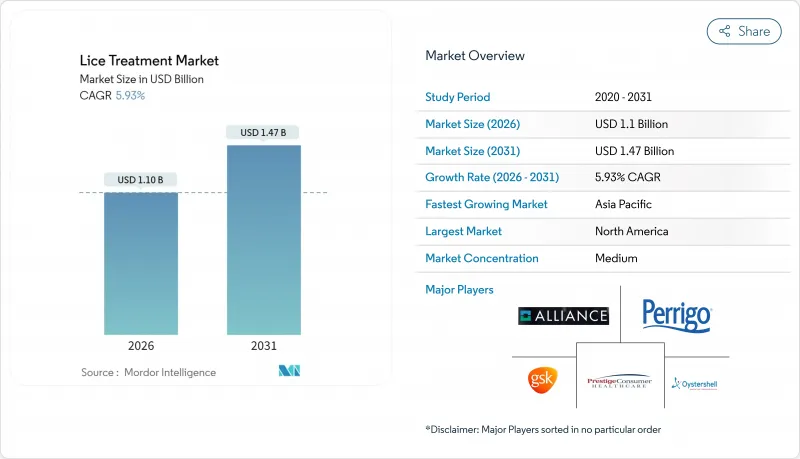
피레드로이드 내성을 가지는 슈퍼 이가 기존 제품의 효과를 저하시키는 중, 수요가 높아지고 있어 신규 유효 성분, 전신성 제제, 디지털을 활용한 구매 모델로의 전환이 진행되고 있습니다. 이베르멕틴이나 스피노새드를 주성분으로 하는 처방약이 기세를 늘리는 한편, 제제 형태 중에서는 경구 정제가 가장 높은 성장률을 나타내고 있습니다. 온라인 약국은 접근성과 개인 정보 보호를 촉진하고 전자상거래의 침투를 뒷받침합니다. 지역별로는 북미가 지출 규모로 주도권을 유지하는 반면 아시아태평양은 건강관리 접근 확대와 위생투자 증가로 가장 빠른 성장률을 보이고 있습니다. 경쟁의 심각성은 차세대 제형과 전문 클리닉 서비스의 상업화를 경쟁하는 분산된 기업에 의해 형성됩니다.
세계의 이 치료 시장 동향과 통찰
머릿니 기생 증가 경향
학령기 아동의 지속적인 감염률은 주요 지역 전역에서 지속적인 수요를 지원합니다. 미국에서의 직접 치료비는 연간 10억 달러를 초과하고 생산성 손실은 연간 40억-80억 달러에 이릅니다. 밀접한 접촉 행동과 교실의 고밀도 환경이 감염을 조장합니다. 수십년에 걸친 시판약의 선택에도 불구하고, 감염이 계속되고 있는 상황은 약제 내성에 의한 유효성의 격차를 부각시키고 있어, 가족이나 고용주를 보다 강력하고 때로는 고가의 해결책으로 향하게 하고 있습니다. 공중보건 부문은 스크리닝 프로그램을 강화하고 있으며, 이 치료 시장을 지속적으로 주목받고 있는 상태로 유지하고 제품 혁신을 촉진하고 있습니다.
소매점 및 전자상거래에서 상업적인 의약품의 용이한 가용성
FDA의 21 CFR 358.610에 근거한 규격에 의해 유효 성분이 표준화되어, 매장 및 온라인 판매에 있어서 시판약의 안정 공급이 확보되고 있습니다. 멀티채널 전개에 의해 구입 장벽이 낮아져, 자기 치료가 일반화되었습니다. 이에 따라 임상 상담이 없어도 이 치료 시장에 대한 접근이 유지됩니다. 온라인으로 눈에 띄지 않는 주문은 사회적 편견을 완화하고 세트 판매되는 온라인 상담은 올바른 사용법 향상에 기여합니다. 소매 체인은 구색을 확충하고 온라인 약국은 알고리즘에 의한 상품 추천을 활용하여 검색 트래픽을 매출로 전환. 이로 인해 교외와 지방 지역으로의 도달 범위가 확대되고 있습니다.
개발 도상국의 낮은 인지도와 가처분 소득 부족
공중위생 예산이 감염증 대책을 우선하기 때문에 이 대책에 대한 자금이 부족하고 교육 계발 활동이 정체되고 있습니다. 농촌 소비자들은 비용 제약으로부터 소량 살충제를 구입하거나 효과가 없는 민간 요법에 의존하는 경향이 있으며, 이 치료 시장의 침투를 막고 있습니다. 약국의 밀도가 낮고 공급망이 취약하기 때문에 재고 부족이 장기화되고 치료 지속률이 떨어지고 있습니다. NGO가 학교 검진 파일럿 프로그램을 실시하고 있지만, 확대는 불균일하고, 미해결의 부담이 계속되고 있습니다.
부문 분석
2025년 시점에서 시판약(OTC) 제제는 매장에서의 시인성과 소비자의 습관에 힘입어 이 치료 시장 점유율의 69.67%를 유지했습니다. 퍼메트린 및 피레드린 제품은 판매 수량을 유지하고 있지만, 내성 문제로 실임상 환경하에서의 치유율은 저하 경향에 있습니다. 의료 제공자는 제1선택 요법이 실패할 경우 신속하게 이버멕틴, 스피노사드, 또는 말라티온으로 이행하는 경향이 강해져, 이것이 처방약 판매를 견인하고 있습니다.
처방약은 2031년까지 연평균 복합 성장률(CAGR) 6.36%로 성장을 지속하고, 보험 적용 범위의 확대와 단회 투여의 편리성이 시간적 제약이 있는 가정에 지지됨으로써 이 치료 시장을 재구축하고 있습니다. FDA에 의한 이버멕틴 로션제의 OTC 재분류는 카테고리 경계의 모호화를 초래하여 기존의 피레스로이드계 제품으로부터 점유율을 빼앗을 수 있는 적극적인 DTC 마케팅 캠페인을 가능하게 하고 있습니다.
2025년 시점에서 소아의 사용 용이성과 기존 소매 플라노그램 배치로 인해 샴푸는 이 치료 시장 규모의 42.07%를 차지했습니다. 로션과 스프레이는 향기에 민감한 사용자를 위한 대체품으로 남아 있는 반면, 폼과 젤은 '기타' 카테고리로 분류되어 현재는 천연 성분을 내걸고 있는 신흥기업이 참가하고 있습니다.
경구 정제는 6.42%의 연평균 복합 성장률(CAGR)로 확대되었습니다. 이는 간병인이 빗 제거 작업의 부담을 피하고 약물의 균일한 노출을 보장하는 전신작용 치료법을 요구하기 때문입니다. 비교 연구는 증상 완화가 더 빠르다는 것을 보여 처방 의사의 신뢰를 높이고 있습니다. 이 전신 요법으로의 전환은 이 치료 시장의 궤도를 크게 변화시키는 징후이며, 1정으로 구제를 달성할 수 있는 서방형 제제 시장 개척의 여지를 열고 있습니다.
본 이 치료 시장 보고서는 제품 유형별(OTC 의약품, 처방약), 유통 채널별(병원 및 진료소, 소매 약국, 기타 유통 채널), 지역별(북미, 유럽, 아시아태평양, 중동 및 아프리카, 남미)로 업계를 부문화하고 있습니다. 과거 5년간의 데이터와 향후 5년간 시장 예측을 아울러 제공합니다.
지역별 분석
북미는 2025년 세계 수익의 37.84%를 차지하며 높은 1인당 지출, 보험 적용 범위, 전문 클리닉에서의 광범위한 채용이 기반이 되고 있습니다. FDA에 의한 유효성분 모노그래프의 명확화는 규제 확실성을 제공하고 브랜드 라이프사이클 연장을 촉진하고 있습니다. 진행 중인 약물 내성 동향은 환자의 재진률을 높여 처방약과 서비스 카테고리에서 매출 증가를 뒷받침하고 있습니다.
유럽은 북미와 유사한 약물 내성 동향을 보이면서도 식물 유래 제제에 대한 소비자 지향이 더 두드러집니다. 약국에서는 약사 주도의 상담을 통해 적절한 빗 사용을 지도하고 재방문을 촉진합니다. 신경 독성 성분에 대한 규제 강화는 물리적 치료법에 대한 투자를 촉진하고, 이 치료 시장의 포트폴리오 확대와 지역의 자연파 지향과 일치합니다.
아시아태평양은 2031년까지 6.88%라는 가장 빠른 CAGR을 기록하고 위생 의식의 고조와 전자상거래의 보급이 이를 견인하고 있습니다. 도시의 중류 가구는 브랜드 제품으로의 전환이 진행되는 한편, 지방에서는 스마트폰에 의한 주문과 급속하게 개선되는 라스트 마일 물류의 혜택을 받고 있습니다. 국내 제조업체는 일직원 노동자의 예산에 맞는 가방 크기를 도입해 인구층을 횡단한 이 치료 시장의 포괄성을 확대하고 있습니다.
기타 혜택:
- 엑셀 형식 시장 예측(ME) 시트
- 애널리스트에 의한 3개월간의 지원
자주 묻는 질문
목차
제1장 서론
- 조사의 전제조건과 시장의 정의
- 조사 범위
제2장 조사 방법
제3장 주요 요약
제4장 시장 상황
- 시장 개요
- 시장 성장 촉진요인
- 머릿니 기생증 증가 경향
- 소매점 및 전자상거래에서 시판 제품의 용이한 입수가능성
- 신흥 시장에서의 위생 및 헬스케어 지출 증가
- 전자상거래 유통의 침투 확대
- 피레스로이드 내성을 가지는 슈퍼 이 급증이 신규 치료법 개발을 촉진
- 전문 살롱 클리닉에서 이 제거 서비스 확대
- 시장 성장 억제요인
- 개발도상국의 인지도가 낮고 가처분 소득이 낮음
- 기존 피레트린 및 퍼메트린 제품의 효력 저하
- 신경독성 농약에 대한 규제상의 제약
- DIY에 의한 가정요법 대체품의 고조
- 가치/공급망 분석
- 규제 상황
- Porter's Five Forces 분석
- 신규 참가업체의 위협
- 구매자 및 소비자의 협상력
- 공급기업의 협상력
- 대체품의 위협
- 경쟁 기업간 경쟁 관계
제5장 시장 규모와 성장 예측
- 치료 유형별
- 일반용 의약품
- 퍼메트린계
- 피레트린계
- 기타
- 처방약
- 이버멕틴
- 스피노새드
- 말라티온
- 기타
- 일반용 의약품
- 제형별
- 샴푸
- 로션
- 스프레이
- 경구 정제
- 기타
- 유통 채널별
- 병원 약국
- 소매 약국
- 온라인 약국
- 투여 경로별
- 경구
- 외용
- 지역별
- 북미
- 미국
- 캐나다
- 멕시코
- 유럽
- 독일
- 영국
- 프랑스
- 이탈리아
- 스페인
- 기타 유럽
- 아시아태평양
- 중국
- 일본
- 인도
- 호주
- 한국
- 기타 아시아태평양
- 중동 및 아프리카
- GCC
- 남아프리카
- 기타 중동 및 아프리카
- 남미
- 브라질
- 아르헨티나
- 기타 남미
- 북미
제6장 경쟁 구도
- 시장 집중도
- 시장 점유율 분석
- 기업 프로파일
- Prestige Consumer Healthcare Inc.
- Perrigo Company plc
- Bayer-Oystershell Consumer Health
- Alliance Pharmaceuticals Ltd(Vamousse)
- Johnson & Johnson Services, Inc.
- GlaxoSmithKline plc
- Arbor/Azurity Pharmaceuticals
- Parapro Pharmaceuticals
- Fleming Medical Ltd
- Lice Clinics of America(Larada Sciences)
- TyraTech Inc.
- Teva Pharmaceutical Industries Ltd
- Sanofi SA
- Dr. Reddy's Laboratories
- Shionogi & Co., Ltd.
- Sandoz(Novartis division)
- Taro Pharmaceutical Industries
- Reckitt Benckiser Group plc
- Procter & Gamble Co.
- Thor International(Licener)
제7장 시장 기회와 미래 전망
SHW 26.01.26The lice treatment market is expected to grow from USD 1.04 billion in 2025 to USD 1.10 billion in 2026 and is forecast to reach USD 1.47 billion by 2031 at 5.93% CAGR over 2026-2031.
Demand rises as pyrethroid-resistant "super lice" undercut legacy products, prompting a pivot toward novel actives, systemic dosage forms and digitally enabled buying models. Prescription therapies featuring ivermectin and spinosad are gaining momentum, while oral tablets post the highest growth among dosage forms . Online pharmacies accelerate access and discretion, reinforcing e-commerce penetration. Regionally, North America retains leadership on spending strength, yet Asia-Pacific delivers the fastest growth on expanding healthcare access and hygiene investment. Competitive intensity is shaped by fragmented players racing to commercialize next-generation formulations and professional clinic services.
Global Lice Treatment Market Trends and Insights
Increasing Prevalence of Head-Lice Infestation
Persistent infestation rates among school-age children sustain recurring demand across every major geography. The economic cost exceeds USD 1 billion per year in direct U.S. treatment spending, while productivity losses add USD 4-8 billion annually. Close-contact behaviors and high classroom densities reinforce transmission. Continued outbreaks despite decades of OTC options spotlight resistance-driven efficacy gaps, pushing families and employers toward more potent and sometimes costlier solutions. Public health departments intensify screening programs, keeping the lice treatment market in constant visibility and stimulating product innovation.
Easy Availability of OTC Products in Retail & E-Commerce
The FDA monograph under 21 CFR 358.610 standardizes active ingredients, ensuring consistent OTC supply in store aisles and on digital shelves. Multichannel presence lowers purchase friction and normalizes self-treatment, which keeps the lice treatment market accessible even in the absence of clinical consultation. Discreet online ordering lessens stigma, while bundled virtual advice improves correct application. Retail chains upscale inventory breadth, and e-pharmacies leverage algorithmic recommendations to convert search traffic into sales, broadening reach across suburban and rural areas.
Low Awareness & Low Disposable Income in Developing Nations
Public health budgets prioritizing communicable diseases leave lice management under-funded, stalling educational outreach. Rural consumers often purchase small-volume pesticides or rely on ineffective folk cures due to cost constraints, limiting lice treatment market penetration. Sparse pharmacy density and weak supply chains prolong stock-outs, curbing treatment adherence rates. NGOs implement pilot school screening programs, yet scale-up remains uneven, sustaining an unaddressed burden.
Other drivers and restraints analyzed in the detailed report include:
- Rising Hygiene & Healthcare Spending in Emerging Markets
- Growing Penetration of E-Commerce Distribution
- Declining Efficacy of Legacy Pyrethrin and Permethrin Products
For complete list of drivers and restraints, kindly check the Table Of Contents.
Segment Analysis
OTC formulations retained 69.67% lice treatment market share in 2025, anchored by shelf visibility and consumer habit. Permethrin and pyrethrin products continue to move volume, yet resistance has eroded cure rates under real-world conditions. Healthcare providers now escalate quickly to ivermectin, spinosad or malathion when first-line therapy fails, propelling prescription sales.
Prescription drugs post a 6.36% CAGR to 2031, reshaping the lice treatment market as insurance coverage widens and single-dose convenience resonates with time-pressed families. FDA reclassification of ivermectin lotion to OTC sparks category blurring, enabling aggressive DTC marketing campaigns that could siphon share from entrenched pyrethroids .
Shampoos led with 42.07% of the lice treatment market size in 2025 due to ease of pediatric use and existing retail planogram placement. Lotions and sprays remain alternatives for fragrance-sensitive users, while foams and gels populate the "others" bucket now targeted by natural-ingredient startups.
Oral tablets expand at 6.42% CAGR as caregivers seek systemic options that bypass combing fatigue and ensure uniform drug exposure. Comparative studies reveal faster symptom relief, fostering prescriber confidence. This systemic shift signals a profound change in the lice treatment market trajectory, opening space for extended-release formats that could achieve single-tablet eradication.
The Lice Treatment Market Report Segments the Industry Into by Product Type (OTC Medication, Prescription Medication), by Distribution Channel (Hospitals and Clinics, Retail Pharmacies, Other Distribution Channels), and Geography (North America, Europe, Asia-Pacific, Middle-East and Africa, South America). Get Five Years of Historical Data Alongside Five-Year Market Forecasts.
Geography Analysis
North America generated 37.84% of global revenue in 2025, underpinned by high per-capita spend, insurance coverage and widespread professional clinic adoption. FDA clarity on active ingredient monographs provides regulatory certainty, stimulating brand lifecycle extensions. Ongoing resistance trends raise patient revisit rates, fueling incremental sales across both prescription and service categories.
Europe mirrors North American resistance dynamics yet demonstrates a stronger consumer tilt toward plant-based formulations. Pharmacies leverage pharmacist-led consultations to encourage proper combing techniques, sustaining repeat visits. Regulatory restraints on neuro-toxic ingredients encourage investment in physical-mode treatments, broadening the lice treatment market portfolio and aligning with the region's natural-product ethos.
Asia-Pacific records the fastest CAGR at 6.88% through 2031, propelled by escalating hygiene awareness and e-commerce adoption. Urban middle-class households shift to branded solutions, while rural uptake benefits from smartphone ordering and rapidly improving last-mile logistics. Domestic manufacturers introduce sachet pack sizes priced for daily-wage budgets, widening inclusivity in the lice treatment market across population tiers.
- Prestige Consumer Healthcare
- Perrigo Company
- Bayer - Oystershell Consumer Health
- Alliance Pharmaceuticals Ltd (Vamousse)
- Johnson & Johnson
- GlaxoSmithKline
- Arbor / Azurity Pharmaceuticals
- Parapro Pharmaceuticals
- Fleming Medical
- Lice Clinics of America (Larada Sciences)
- TyraTech Inc.
- Teva Pharmaceutical Industries
- Sanofi
- Dr. Reddy's Laboratories
- Shionogi & Co., Ltd.
- Sandoz (Novartis division)
- Taro Pharmaceutical Industries
- Reckitt Benckiser Group
- Procter & Gamble
- Thor International (Licener)
Additional Benefits:
- The market estimate (ME) sheet in Excel format
- 3 months of analyst support
TABLE OF CONTENTS
1 Introduction
- 1.1 Study Assumptions & Market Definition
- 1.2 Scope of the Study
2 Research Methodology
3 Executive Summary
4 Market Landscape
- 4.1 Market Overview
- 4.2 Market Drivers
- 4.2.1 Increasing prevalence of head-lice infestation
- 4.2.2 Easy availability of OTC products in retail & e-commerce
- 4.2.3 Rising hygiene & healthcare spending in emerging markets
- 4.2.4 Growing penetration of e-commerce distribution
- 4.2.5 Surge in pyrethroid-resistant super-lice driving novel therapies
- 4.2.6 Expansion of professional salon/clinic lice-removal services
- 4.3 Market Restraints
- 4.3.1 Low awareness & low disposable income in developing nations
- 4.3.2 Declining efficacy of legacy pyrethrin and permethrin products
- 4.3.3 Regulatory curbs on neuro-toxic pesticides
- 4.3.4 Popularity of DIY home-remedy alternatives
- 4.4 Value / Supply-Chain Analysis
- 4.5 Regulatory Landscape
- 4.6 Porters Five Forces Analysis
- 4.6.1 Threat of New Entrants
- 4.6.2 Bargaining Power of Buyers/Consumers
- 4.6.3 Bargaining Power of Suppliers
- 4.6.4 Threat of Substitute Products
- 4.6.5 Intensity of Competitive Rivalry
5 Market Size & Growth Forecasts (Value, USD)
- 5.1 By Treatment Type
- 5.1.1 OTC Medication
- 5.1.1.1 Permethrin-based
- 5.1.1.2 Pyrethrin-based
- 5.1.1.3 Others
- 5.1.2 Prescription Medication
- 5.1.2.1 Ivermectin
- 5.1.2.2 Spinosad
- 5.1.2.3 Malathion
- 5.1.2.4 Others
- 5.1.1 OTC Medication
- 5.2 By Dosage Form
- 5.2.1 Shampoo
- 5.2.2 Lotion
- 5.2.3 Spray
- 5.2.4 Oral Tablet
- 5.2.5 Others
- 5.3 By Distribution Channel
- 5.3.1 Hospital Pharmacies
- 5.3.2 Retail Pharmacies
- 5.3.3 Online Pharmacies
- 5.4 By Route of Administration
- 5.4.1 Oral
- 5.4.2 Topical
- 5.5 By Geography
- 5.5.1 North America
- 5.5.1.1 United States
- 5.5.1.2 Canada
- 5.5.1.3 Mexico
- 5.5.2 Europe
- 5.5.2.1 Germany
- 5.5.2.2 United Kingdom
- 5.5.2.3 France
- 5.5.2.4 Italy
- 5.5.2.5 Spain
- 5.5.2.6 Rest of Europe
- 5.5.3 Asia-Pacific
- 5.5.3.1 China
- 5.5.3.2 Japan
- 5.5.3.3 India
- 5.5.3.4 Australia
- 5.5.3.5 South Korea
- 5.5.3.6 Rest of Asia-Pacific
- 5.5.4 Middle East and Africa
- 5.5.4.1 GCC
- 5.5.4.2 South Africa
- 5.5.4.3 Rest of Middle East and Africa
- 5.5.5 South America
- 5.5.5.1 Brazil
- 5.5.5.2 Argentina
- 5.5.5.3 Rest of South America
- 5.5.1 North America
6 Competitive Landscape
- 6.1 Market Concentration
- 6.2 Market Share Analysis
- 6.3 Company Profiles (includes Global level Overview, Market level overview, Core Segments, Financials as available, Strategic Information, Market Rank/Share for key companies, Products & Services, and Recent Developments)
- 6.3.1 Prestige Consumer Healthcare Inc.
- 6.3.2 Perrigo Company plc
- 6.3.3 Bayer - Oystershell Consumer Health
- 6.3.4 Alliance Pharmaceuticals Ltd (Vamousse)
- 6.3.5 Johnson & Johnson Services, Inc.
- 6.3.6 GlaxoSmithKline plc
- 6.3.7 Arbor / Azurity Pharmaceuticals
- 6.3.8 Parapro Pharmaceuticals
- 6.3.9 Fleming Medical Ltd
- 6.3.10 Lice Clinics of America (Larada Sciences)
- 6.3.11 TyraTech Inc.
- 6.3.12 Teva Pharmaceutical Industries Ltd
- 6.3.13 Sanofi SA
- 6.3.14 Dr. Reddy's Laboratories
- 6.3.15 Shionogi & Co., Ltd.
- 6.3.16 Sandoz (Novartis division)
- 6.3.17 Taro Pharmaceutical Industries
- 6.3.18 Reckitt Benckiser Group plc
- 6.3.19 Procter & Gamble Co.
- 6.3.20 Thor International (Licener)
7 Market Opportunities & Future Outlook
- 7.1 White-space & Unmet-Need Assessment