|
시장보고서
상품코드
1910711
산업용 드럼통 : 시장 점유율 분석, 업계 동향 및 통계, 성장 예측(2026-2031년)Industrial Drums - Market Share Analysis, Industry Trends & Statistics, Growth Forecasts (2026 - 2031) |
||||||
 Mordor Intelligence
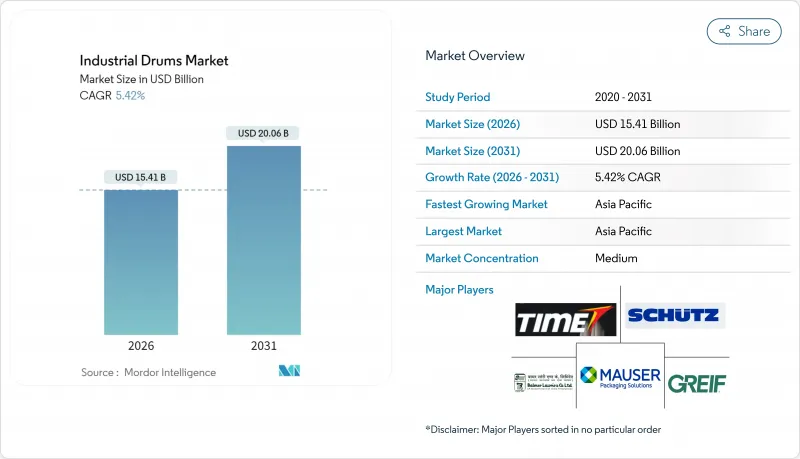
산업용 드럼통 시장은 2025년 146억 2,000만 달러에서 2026년에는 154억 1,000만 달러로 성장했으며, 2026년부터 2031년까지는 CAGR 5.42%를 나타낼 전망입니다. 2031년에는 200억 6,000만 달러에 이를 것으로 예측됩니다.
안정적인 화학제품 생산, 석유화학 투자 증가, 식품급 수출 흐름 확대가 수요의 기반이 되고 있습니다. 커민스의 RFID 대응 리터너블 프로그램으로 대표되는 재사용 가능한 포장재에 대한 규제의 기세는 일회용 벌크백으로부터의 이행을 뒷받침하고 있습니다. 무게에 민감한 화물주가 내식성 옵션을 요구하는 가운데, 복합 드럼이 점유율을 확대하는 반면, 추적성 향상을 위해 위험물 운송 차량에 RFID 채용이 확산되고 있습니다. 아시아태평양은 중국의 크래커 증설과 2030년까지 연간 12%의 화학제품 성장 목표를 내세우는 인도를 배경으로 수량을 견인하고 있습니다. 한편, 북미와 유럽은 컴플라이언스 주도의 프리미엄 형식을 선호합니다. 베리 세계의 2025년 암콜사와의 합병 등의 통합으로 규모의 장점이 생겨 소규모 경쟁사는 압박되고 있습니다.
세계의 산업용 드럼통 시장 동향과 인사이트
화학 및 석유화학 생산량 증가
중국에 있어서 특수화학제품의 견조한 생산 확대, 중동의 크래커 증설, 일본 대기업 간의 합병이 함께 드럼 처리량 수요를 증가시키고 있습니다. 미국 화학 산업 협회(ACC)는 물류 병목에도 불구하고 미국 화학 생산이 지속적인 탄력성을 보여주고 있다고 지적합니다. 한편 인도는 12%의 복합성장률을 목표로 하고 있으며 드럼 수요는 확실히 상승세를 유지하고 있습니다. 대규모 통합 플랜트에서는 배치 사이즈가 커지기 때문에 운송업자는 100갤런 이상의 용량, 부식성이 강한 중간체에도 견딜 수 있는 복합 라이닝 사양의 드럼이 요구되고 있습니다. SysKem Chemie는 유엔 시험 표준에 부합하는 코팅 드럼만을 사용하여 카프릴산(클래스 8)을 출하하며 사양이 높아지는 좋은 예입니다.
식품 등급 수출 물류 확대
원료 조달처의 다양화에 의해 감미료, 식물성 단백질, 과일 농축액공급 체인이 장기화하고 있습니다. CDF Corporation은 2025년 2월 미국 농무부(USDA) 준수 라이너를 도입하여 오염 허용치의 엄격화에 대한 공급업체의 대응을 나타냈습니다. 코덱스 위원회(Codex Alimentarius)에 근거한 조화로운 문서화로 여러 지역에서 인증이 가능해져 식품급 드럼을 대량 생산하는 제조업체의 규모의 경제를 지원하고 있습니다. 프리미엄 유기 수출업체는 변조 방지 씰과 QR 코드를 통한 추적성 데이터를 통합한 드럼에 대해 가격차를 지불하게 되어, 마무리 시장에서의 원산지 주장을 강화하고 있습니다.
원재료 가격의 변동성
강재와 수지의 가격 변동이 이익률을 압박하는 가운데, 드럼 제조업체는 고객 가격표와의 계약 동기를 고민하고 있습니다. 라이어슨사의 2025년 예측에서는 아시아산 열연 코일에 대한 잠재적인 안티 덤핑 관세가 지적되어 더욱 불확실성이 더해졌습니다. 발머 롤리사는 코일 비용 상승을 상쇄하기 위해 기존 규격보다 4개 많은 80개를 TEU당 적재 가능한 0.5mm 두께 드럼의 시험 운용을 개시했습니다. 2024년 매출 233억 9,000만 루피(2억 8,080만 달러)에서 이 비용 절감 효과가 두드러졌습니다.
부문 분석
강철 드럼은 46.68%로 최대 점유율을 차지하고 있습니다. 이는 정유소와 농약 제조업체가 기계적 강도와 간편한 재생 과정을 강조하기 때문입니다. 한편, 복합재 드럼은 7.21%의 성장 궤도에 있으며, 구매자는 운송 비용 절감과 초기 비용의 차액을 비교 검토하고 있습니다. 인도항만의 최근 감사에서는 수출위험화학제품 수송의 37%를 경량강제 드럼이 차지하고 있어 박육화에 의한 비용절감효과가 분명합니다. 산업용 드럼통 시장은 저합금강을 순환형 자산으로 하는 세계의 스크랩 장려책의 혜택을 받고 있지만, 버진 HDPE 수지는 프로파일렌 가격에 연동하는 경향이 강해지고 있습니다.
플라스틱 및 섬유의 변형은 특정 용질 적합성 및 중량 제약에 대응합니다. 섬유 용기는 액체 UN 인증을 취득하지 않았지만, 현재는 내습성 라이너를 통합하여 건조 식품 분말의 보존 기간을 연장하고 있습니다. 복합 모델은 고분자 장벽과 강철 리브를 결합하여 습기에 민감한 접착제 원료의 제조 업체를 대상으로합니다. 이러한 상승은 산업용 드럼통 시장이 이중 소재 전환이 아니라 하이브리드화를 통해 진화하고 있음을 보여줍니다.
60 - 100 갤런 드럼은 지게차 클리어런스에 적합하며 35.21%의 점유율로 주력 제품으로 계속되고 있습니다. 그러나 완전 자동화된 화학 클러스터에서는 처리 톤당 리프트 횟수를 줄일 수 있는 110갤런 드럼이 선호됩니다. 2031년까지 100갤런 이상의 포맷이 6.08%라는 가장 빠른 확대율을 유지할 것으로 예측되고 있습니다. 캄코케미칼사의 300만 달러 라인은 30갤런과 110갤런의 SKU에 대응하는 듀얼 충전 헤드를 갖추고 있으며, 다용량 대응의 유연성을 요구하는 구매자의 의향을 반영하고 있습니다. 100갤런 초과 용량의 산업용 드럼통 시장 규모는 팔레트리스 로봇 핸들링 셀의 보급 확대를 배경으로 2031년까지 45억 5,000만 달러에 달할 것으로 예측됩니다.
소형 드럼은 로트 분리가 벌크 경제성을 웃도는 특수 향료, 의약품 원약, 실험용 시약용으로 활용됩니다. 그러나 탱크에서 직접 채우는 마이크로 블렌딩 장비의 도입은 현장의 중간 재고를 줄이면서 점유율이 떨어지는 경향이 있습니다. 전반적으로, 용량 선택은 작업 안전, 화물 이용률 및 항공 운송에서 포장 단위당 허용 질량에 대한 규제 상한과의 절충을 반영합니다.
지역별 분석
2025년 아시아태평양은 중국 크래커 프로젝트와 인도의 화학제품 로드맵에 힘입어 수익의 39.55%를 차지했습니다. Balmer Lawrie는 8개의 공장을 활용하여 농약 수출업체와의 국내 계약을 확보하고 233억 9,000만 n돌피(2억 8,080만 달러)의 매출을 기록했습니다. 지역정부는 정유소 회랑에 인접한 포장 클러스터에 대한 토지 할인을 제공하여 납기 단축과 함몰 손상의 감소를 도모하고 있습니다.
북미는 셰일 기반 원료의 혜택을 받아 높은 사양의 스틸 드럼 수요를 견인하는 엄격한 DOT 감독을 유지하고 있습니다. 커민스의 리터너블 시스템은 미국의 OEM 제조업체가 순환성 향상을 위해 포장을 내부화하는 방법을 보여줍니다. 유럽은 '포장 및 포장 폐기물 규정'에 따른 순환 경제 준수를 중시하고 있으며, 2023년 이후 주로 식품 및 개인 관리 성분을 위한 조종사 스풀이 3배로 증가하고 있습니다. 남미, 중동, 아프리카는 규모가 작고 고성장의 거점으로 계속되고 있습니다. 브라질의 바이오디젤 수출업체는 콩기름의 산화를 완화하기 위해 복합 드럼으로 전환하는 반면, 걸프의 석유화학 허브는 극단적인 주변 온도를 견딜 수 있는 두꺼운 강철 드럼을 조달하고 있습니다. 지역 간 화물 재정 거래는 드럼 재생 네트워크를 자극하고 산업용 드럼통 시장에서 세계 연계를 강화하고 있습니다.
기타 혜택 :
- 엑셀 형식 시장 예측(ME) 시트
- 애널리스트 지원(3개월간)
자주 묻는 질문
목차
제1장 서론
- 조사 전제조건 및 시장 정의
- 조사 범위
제2장 조사 방법
제3장 주요 요약
제4장 시장 상황
- 시장 개요
- 시장 성장 촉진요인
- 화학 및 석유화학의 생산량 증가
- 식품급 수출물류 확대
- 공급 체인의 탄력 강화의 필요성
- 일회용 벌크백의 규제에 의한 단계적 폐지
- 순환형 경제에서의 리스 및 재생 모델
- 위험물 규제 대응을 위한 RFID 탑재 드럼 추적 시스템
- 시장 성장 억제요인
- 원재료 가격의 변동성
- 폐기물 처리에 따른 환경 규제 대응 비용
- IBC 및 플렉시 탱크에 의한 카니발리제이션
- 현장에서의 마이크로 블렌딩이 드럼 수요를 삭감
- 업계 밸류체인 분석
- 규제 상황
- 기술 전망
- Porter's Five Forces 분석
- 공급기업의 협상력
- 구매자의 협상력
- 신규 참가업체의 위협
- 경쟁 기업 간 경쟁 관계
- 대체품의 위협
- 거시경제 요인이 시장에 미치는 영향
제5장 시장 규모와 성장 예측
- 재료별
- 강철 드럼
- 플라스틱 드럼
- 섬유 드럼
- 복합 및 하이브리드 드럼
- 용량별
- 30갤런 미만
- 30-60갤런
- 60-100갤런
- 100갤런 이상
- 마개 유형별
- 밀폐형 및 폐쇄형
- 개방형
- 최종 사용자 산업별
- 화학 및 비료
- 석유 및 윤활유
- 식품 및 음료
- 의약품
- 도료, 코팅 및 접착제
- 건축 및 건설
- 기타 최종 사용자 산업
- 지역별
- 북미
- 미국
- 캐나다
- 멕시코
- 남미
- 브라질
- 아르헨티나
- 칠레
- 기타 남미
- 유럽
- 독일
- 영국
- 프랑스
- 이탈리아
- 스페인
- 기타 유럽
- 아시아태평양
- 중국
- 일본
- 인도
- 한국
- 호주
- 기타 아시아태평양
- 중동 및 아프리카
- 중동
- 사우디아라비아
- 아랍에미리트(UAE)
- 튀르키예
- 기타 중동
- 아프리카
- 남아프리카
- 나이지리아
- 케냐
- 기타 아프리카
- 중동
- 북미
제6장 경쟁 구도
- 시장 집중도
- 전략적 동향
- 시장 점유율 분석
- 기업 프로파일
- Greif, Inc.
- Mauser Packaging Solutions Holding Company
- SCHUTZ GmbH & Co. KGaA
- Time Technoplast Ltd.
- Balmer Lawrie & Co. Ltd.
- Sicagen India Ltd.
- TPL Plastech Ltd.
- Peninsula Drums(Pty) Ltd.
- Eagle Manufacturing Company(Justrite Safety Group)
- US Coexcell Inc.
- Industrial Container Services, Inc.
- Hoover Ferguson Group, Inc.
- Berry Global Group, Inc.
- Brambles Ltd.
- Myers Industries, Inc.
- Orlando Drum & Container Corp.
- Rahway Steel Drum Co., Inc.
- Re-Gen Drums Ltd.
- Palm Containers(Pty) Ltd.
- Schutz DSL(Asia) Pte Ltd.
제7장 시장 기회와 향후 전망
KTH 26.01.22The industrial drums market is expected to grow from USD 14.62 billion in 2025 to USD 15.41 billion in 2026 and is forecast to reach USD 20.06 billion by 2031 at 5.42% CAGR over 2026-2031.
Steady chemical output, rising petrochemical investments, and widening food-grade export flows anchor demand. Regulatory momentum toward reusable packaging, demonstrated by Cummins' RFID-enabled returnable program, reinforces the shift away from single-use bulk bags. Composite drums win share as weight-sensitive shippers pursue corrosion-resistant options, while RFID adoption spreads across hazardous-materials fleets to improve traceability. Asia-Pacific drives volume on the back of China's cracker additions and India's 12% annual chemical growth target through 2030, whereas North America and Europe prioritize premium, compliance-led formats. Consolidation such as Berry Global's 2025 merger with Amcor adds scale advantages that squeeze smaller rivals.
Global Industrial Drums Market Trends and Insights
Growth in Chemical and Petrochemical Output
Robust specialty-chemical builds in China, cracker expansions in the Middle East, and mergers among Japanese majors collectively increase drum throughput requirements. The American Chemistry Council notes sustained resilience in U.S. chemical production despite logistics bottlenecks, while India is targeting 12% compound growth, which keeps drum demand firmly on an upward path. Larger integrated complexes process greater batch sizes, pushing shippers toward 100-plus gallon formats and composite linings that withstand aggressive intermediates. SysKem Chemie ships Class 8 caprylic acid exclusively in coated drums that meet United Nations test codes, illustrating the higher specification trend.
Expansion of Food-Grade Export Logistics
Diversification of ingredient sourcing has lengthened supply chains for sweeteners, plant proteins, and fruit concentrates. CDF Corporation launched USDA-compliant liners in February 2025, showing suppliers' response to stricter contamination thresholds. Harmonized documentation under the Codex Alimentarius enables multi-regional certification, supporting scale economies for manufacturers producing food-grade drums in bulk. Premium organic exporters have begun to pay price differentials for drums embedded with tamper-evident seals and QR-code lineage data, enhancing provenance claims in destination markets.
Raw-Material Price Volatility
Steel and resin swings squeeze margins as drum makers struggle to synchronize contracts with customer price lists. Ryerson's 2025 forecast flags potential anti-dumping duties on Asian hot-rolled coil, adding another layer of unpredictability. Balmer Lawrie is piloting 0.5 mm-wall drums that allow 80 units per TEU, four more than traditional gauges, to offset rising coil costs; at INR 23.39 billion (USD 280.8 million) 2024 sales, the savings are material.
Other drivers and restraints analyzed in the detailed report include:
- Strengthening Supply-Chain Resiliency Needs
- Regulatory Phase-Out of Single-Use Bulk Bags
- Cannibalization by IBCs and Flexitanks
For complete list of drivers and restraints, kindly check the Table Of Contents.
Segment Analysis
Steel captured the lion's share at 46.68% because refinery and agrochemical players favor its mechanical strength and straightforward reconditioning loops. At the same time, composite drums are on a 7.21% trajectory as buyers weigh freight savings against initial premiums. Recent audits at Indian ports show that lightweight steel accounted for 37% of outbound haz-chem shipments, underscoring cost reductions from thinner gauges. The industrial drums market benefits from global scrap incentives that make low-alloy steel a closed-loop asset, whereas virgin HDPE resin tracks propylene prices more closely.
Plastic and fiber variants address niche solute compatibility or weight constraints. Although fiber units lack UN credentials for liquids, they now incorporate moisture-resistant liners that extend shelf life for dry food powders. Composite models combine polymer barriers with steel ribs, targeting formulators of moisture-sensitive adhesive ingredients. Their rise illustrates how the industrial drums market evolves through hybridization rather than a binary material switch.
Sixty-to-one-hundred-gallon drums align with forklift clearance and remain the workhorse at 35.21% share. However, fully automated chemical clusters prefer 110-gallon drums that support fewer lifts per ton processed. Through 2031, above-100-gallon formats hold the fastest 6.08% expansion rate. Camco Chemical's USD 3 million line allows dual fill heads for 30 and 110 gallon SKUs, underlining buyers' preference for multi-volume flexibility. The industrial drums market size for capacities beyond 100 gallons is projected to touch USD 4.55 billion by 2031, reflecting wider adoption of palletless robotic handling cells.
Smaller drums serve specialty flavors, pharma actives, and lab reagents where lot segregation trumps bulk economics. Yet their share erodes as tank-to-fill micro-blending units shrink on-site intermediate inventories. Overall, capacity choice mirrors a trade-off between ergonomic safety, freight utilization, and regulatory caps on allowable mass per package in airborne routes.
The Global Industrial Drums Market Report is Segmented by Material (Steel Drum, Plastic Drum, and More), Capacity (Up To 30 Gallons, 30-60 Gallons, and More), Closure Type (Tight-Head/Closed-Head, and Open-Head), End-User Industry (Chemicals and Fertilizers, Petroleum and Lubricants, and More), and Geography (North America, South America, and More). The Market Forecasts are Provided in Terms of Value (USD).
Geography Analysis
Asia-Pacific contributed 39.55% revenue in 2025, propelled by Chinese cracker projects and India's chemicals roadmap. Balmer Lawrie leveraged eight plants to secure national contracts for agrochemical exporters and logged INR 23.39 billion (USD 280.8 million) turnover. Regional governments offer land rebates for packaging clusters adjacent to refinery corridors, shortening delivery lead times and reducing dent damage.
North America benefits from shale-based feedstock and maintains stringent DOT oversight that drives demand for high-specification steel drums. Cummins' returnable system illustrates how U.S. OEMs internalize packaging for circularity gains. Europe emphasizes circular economy compliance under the Packaging and Packaging Waste Regulation and has seen pilot leasing pools triple since 2023, mostly for food and personal-care ingredients. South America and the Middle East and Africa remain smaller but high-growth nodes. Brazilian biodiesel exporters pivot to composite drums to mitigate soy-oil oxidation, whereas Gulf petrochemical hubs procure thick-gauge steel variants to withstand extreme ambient temperatures. Cross-regional freight arbitrage also stimulates backhaul drum reconditioning networks, reinforcing global linkages within the industrial drums market.
- Greif, Inc.
- Mauser Packaging Solutions Holding Company
- SCHUTZ GmbH & Co. KGaA
- Time Technoplast Ltd.
- Balmer Lawrie & Co. Ltd.
- Sicagen India Ltd.
- TPL Plastech Ltd.
- Peninsula Drums (Pty) Ltd.
- Eagle Manufacturing Company (Justrite Safety Group)
- U.S. Coexcell Inc.
- Industrial Container Services, Inc.
- Hoover Ferguson Group, Inc.
- Berry Global Group, Inc.
- Brambles Ltd.
- Myers Industries, Inc.
- Orlando Drum & Container Corp.
- Rahway Steel Drum Co., Inc.
- Re-Gen Drums Ltd.
- Palm Containers (Pty) Ltd.
- Schutz DSL (Asia) Pte Ltd.
Additional Benefits:
- The market estimate (ME) sheet in Excel format
- 3 months of analyst support
TABLE OF CONTENTS
1 INTRODUCTION
- 1.1 Study Assumptions and Market Definition
- 1.2 Scope of the Study
2 RESEARCH METHODOLOGY
3 EXECUTIVE SUMMARY
4 MARKET LANDSCAPE
- 4.1 Market Overview
- 4.2 Market Drivers
- 4.2.1 Growth in chemical and petrochemical output
- 4.2.2 Expansion of food-grade export logistics
- 4.2.3 Strengthening supply-chain resiliency needs
- 4.2.4 Regulatory phase-out of single-use bulk bags
- 4.2.5 Circular-economy leasing and re-conditioning models
- 4.2.6 RFID-enabled drum tracking for haz-mat compliance
- 4.3 Market Restraints
- 4.3.1 Raw-material price volatility
- 4.3.2 Environmental compliance cost for disposal
- 4.3.3 Cannibalization by IBCs and flexitanks
- 4.3.4 On-site micro-blending cutting drum demand
- 4.4 Industry Value Chain Analysis
- 4.5 Regulatory Landscape
- 4.6 Technological Outlook
- 4.7 Porter's Five Forces Analysis
- 4.7.1 Bargaining Power of Suppliers
- 4.7.2 Bargaining Power of Buyers
- 4.7.3 Threat of New Entrants
- 4.7.4 Intensity of Competitive Rivalry
- 4.7.5 Threat of Substitutes
- 4.8 The Impact of Macroeconomic Factors on the Market
5 MARKET SIZE AND GROWTH FORECASTS (VALUE)
- 5.1 By Material
- 5.1.1 Steel Drum
- 5.1.2 Plastic Drum
- 5.1.3 Fiber Drum
- 5.1.4 Composite/Hybrid Drum
- 5.2 By Capacity
- 5.2.1 Up to 30 Gallons
- 5.2.2 30 - 60 Gallons
- 5.2.3 60 - 100 Gallons
- 5.2.4 Above 100 Gallons
- 5.3 By Closure Type
- 5.3.1 Tight-Head / Closed-Head
- 5.3.2 Open-Head
- 5.4 By End-user Industry
- 5.4.1 Chemicals and Fertilizers
- 5.4.2 Petroleum and Lubricants
- 5.4.3 Food and Beverage
- 5.4.4 Pharmaceuticals
- 5.4.5 Paints, Coatings and Adhesives
- 5.4.6 Building and Construction
- 5.4.7 Other End-user Industries
- 5.5 By Geography
- 5.5.1 North America
- 5.5.1.1 United States
- 5.5.1.2 Canada
- 5.5.1.3 Mexico
- 5.5.2 South America
- 5.5.2.1 Brazil
- 5.5.2.2 Argentina
- 5.5.2.3 Chile
- 5.5.2.4 Rest of South America
- 5.5.3 Europe
- 5.5.3.1 Germany
- 5.5.3.2 United Kingdom
- 5.5.3.3 France
- 5.5.3.4 Italy
- 5.5.3.5 Spain
- 5.5.3.6 Rest of Europe
- 5.5.4 Asia-Pacific
- 5.5.4.1 China
- 5.5.4.2 Japan
- 5.5.4.3 India
- 5.5.4.4 South Korea
- 5.5.4.5 Australia
- 5.5.4.6 Rest of Asia-Pacific
- 5.5.5 Middle East and Africa
- 5.5.5.1 Middle East
- 5.5.5.1.1 Saudi Arabia
- 5.5.5.1.2 United Arab Emirates
- 5.5.5.1.3 Turkey
- 5.5.5.1.4 Rest of Middle East
- 5.5.5.2 Africa
- 5.5.5.2.1 South Africa
- 5.5.5.2.2 Nigeria
- 5.5.5.2.3 Kenya
- 5.5.5.2.4 Rest of Africa
- 5.5.5.1 Middle East
- 5.5.1 North America
6 COMPETITIVE LANDSCAPE
- 6.1 Market Concentration
- 6.2 Strategic Moves
- 6.3 Market Share Analysis
- 6.4 Company Profiles (includes Global level Overview, Market level overview, Core Segments, Financials as available, Strategic Information, Market Rank/Share for key companies, Products and Services, and Recent Developments)
- 6.4.1 Greif, Inc.
- 6.4.2 Mauser Packaging Solutions Holding Company
- 6.4.3 SCHUTZ GmbH & Co. KGaA
- 6.4.4 Time Technoplast Ltd.
- 6.4.5 Balmer Lawrie & Co. Ltd.
- 6.4.6 Sicagen India Ltd.
- 6.4.7 TPL Plastech Ltd.
- 6.4.8 Peninsula Drums (Pty) Ltd.
- 6.4.9 Eagle Manufacturing Company (Justrite Safety Group)
- 6.4.10 U.S. Coexcell Inc.
- 6.4.11 Industrial Container Services, Inc.
- 6.4.12 Hoover Ferguson Group, Inc.
- 6.4.13 Berry Global Group, Inc.
- 6.4.14 Brambles Ltd.
- 6.4.15 Myers Industries, Inc.
- 6.4.16 Orlando Drum & Container Corp.
- 6.4.17 Rahway Steel Drum Co., Inc.
- 6.4.18 Re-Gen Drums Ltd.
- 6.4.19 Palm Containers (Pty) Ltd.
- 6.4.20 Schutz DSL (Asia) Pte Ltd.
7 MARKET OPPORTUNITIES AND FUTURE OUTLOOK
- 7.1 White-space and Unmet-Need Assessment