|
시장보고서
상품코드
1910804
형석 시장 : 점유율 분석, 업계 동향 및 통계, 성장 예측(2026-2031년)Fluorspar - Market Share Analysis, Industry Trends & Statistics, Growth Forecasts (2026 - 2031) |
||||||
 Mordor Intelligence
형석 시장은 2025년 801만톤에서 2026년 823만톤으로 성장하고 2026년부터 2031년에 걸쳐 CAGR 2.77%로 성장을 지속하여 2031년까지 944만톤에 달할 것으로 예측되고 있습니다.
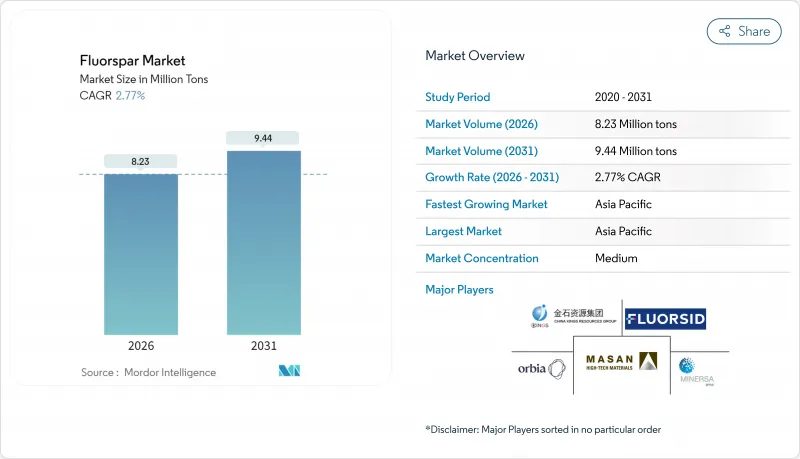
안정된 수량 성장은 불화수소산의 생산, 철강 및 알루미늄 야금, 불소수지 제조에서의 본 광물의 확고한 용도를 반영하고 있으며, 배터리, 반도체, 냉매 공급망에서 새로운 수요가 태어나는 상황에서도 마찬가지입니다. 중국은 여전히 주요 공급국이며 채굴량의 60% 이상을 차지하고 있습니다. 이 나라의 수출 규제로 인해 최종 사용자는 조달 대상의 분산화, 비축, 장기 공급 계약 체결을 진행하고 있습니다.
세계의 형석 시장의 동향 및 인사이트
불소화학제품 수요의 급증이 시장 확대를 견인
지구온난화계수가 낮은 냉매가 불화수소산 소비량의 급증을 뒷받침하고 있으며, 2025년 2분기 케무어스사의 서멀 스페셜라이즈드 솔루션 부문 매출이 전기 대비 25% 증가한 것이 그 현저한 예입니다. 미국 AIM법의 스케줄에 따라 높은 GWP 프론 대체가 가속화되고, 더불어 EU 프론 규제도 유럽 전역에서 유사한 도입 곡선을 형성하고 있습니다. 전기자동차 1대당 약 30kg의 산성형석의 상당량이 바인더, 냉각제 및 전선 피복에 사용되기 때문에 전지 시장의 성장이 형석의 대량 수요와 직결됩니다. 연료전지막이나 수소 인프라용 불소 수지 용도가 2차적인 수요 견인 요인이 됩니다. 프로세스 혁신도 주목할 요소입니다. 한국의 연구팀은 선진적인 전기화학적 경로를 통해 플루오로에테르 수율을 12-16% 포인트 향상시켰습니다. 이는 완성된 불소화학 1톤당 원료 광석 사용량을 줄일 가능성을 시사합니다.
신흥 시장에서 철강 및 알루미늄 생산 급증
인도의 조강 생산량은 2024-25년도에 1억 5,196만 7,000톤으로 전년 대비 5.3% 증가하였고 국내 소비도 증가했기 때문에 슬래그 조정 및 탈황용 야금용 형석 조달량이 증가했습니다. 걸프 협력 회의(GCC) 회원국의 제련소는 사우디아라비아의 '비전 2030'에 근거하여 저비용 에너지를 활용하여 알루미늄 생산량과 이에 따른 불화알루미늄 수요를 확대하고 생산능력 증강을 추진하고 있습니다. 순환경제의 진전도 마찬가지로 중요합니다. ScienceDirect의 연구에서는 폐기 빙정석에서 고순도의 AlF3를 85.6% 추출하는 데 성공하였으며, 금속 재활용 네트워크가 정비된 지역에서는 2차 원료가 1차 산성형석 수요의 15-20%를 대체할 수 있음을 보여주고 있습니다.
환경 규제로 광업 컴플라이언스 비용 증가
미국 환경보호청(EPA)의 40 CFR Part 436에 따라 부선법을 이용한 형석 공장에 폐액 제로 배출 기준이 적용되어 사업자는 페이스트 농축 장치, 필터 프레스, 전기 탈수 시스템에 1,000만-1,500만 달러의 투자를 요구받고 있습니다. 중국의 2024년 안전 캠페인은 여러 소규모 광산 허가를 취소하여 최소 120,000톤의 생산 능력 손실로 세계 공급을 압박하고 하고 있습니다. 몽골의 산업은 아동 노동 문제에 대한 우려로 OECD 회원국 구매자는 공급망 감사를 의무화할 수 있으며 경우에 따라 인증 프리미엄을 지불해야 합니다. 한편, 새롭게 확정된 PFAS 식수 기준(PFOA 및 PFOS 각 4ppt)에 의해 대수층 부근의 불소화학 공장에서의 감시 의무가 확대하고 있습니다.
부문 분석
2025년 산성 원료는 형석 시장에서 61.36%의 점유율을 유지했습니다. 이는 불화수소산 합성에 필수적인 97% 이상의 CaF2 규격에 의해 뒷받침되었습니다. 고순도 기반은 냉동, 알루미늄 정련, 반도체 에칭제 분야에 공급하는 화학 제조업체를 위한 형석 시장의 규모를 뒷받침합니다. 연마용 등급은 레이저, 리소그래피, 우주 탑재 센서 시스템의 광학 렌즈 수요를 배경으로 CAGR 4.23%로 확대되고 있습니다.
제법 개량에 의해 품위의 유연성이 확대하고 있습니다. 중국 후난성의 새로운 부선회로 도입으로 저품위 광석의 CaF2 함유율이 70%에서 95%로 향상되어 실질적으로 세라믹 등급 자원을 산성형석 원료로 전환하게 되었습니다. 마찬가지로 멕시코 두랑고 광산에서는 가압 침출과 용매 추출에 의해 회수율이 향상되고 있습니다. 2031년까지 북미에서 산성 등급의 공급 증가로 세계의 형석 시장에서 중국의 점유율은 54%에서 47%로 줄어들고 형석 시장은 완만하게 다양화될 것으로 전망됩니다.
형석 시장 보고서는 품위별(산성 등급, 세라믹 등급, 야금 등급, 광학 등급, 보석 등급), 품종별(안토조나이트, 블루존, 클로로판, 이트로세라이트 등), 용도(야금 용도, 세라믹 용도, 화학 용도, 기타 용도), 지역(아시아태평양, 북미, 유럽)별로 구분되며 시장 예측은 수량(톤) 단위로 제공됩니다.
지역별 분석
아시아태평양은 2025년 형석 시장에서 73.88%의 점유율을 차지하였으며 중국의 산성형석의 우위성과 인도의 철강 생산 능력 확대를 배경으로 2031년까지 연평균 복합 성장률(CAGR) 2.95%로 확대될 것으로 전망됩니다. 일본과 한국은 전자기기 및 EV 공급체인용으로 고순도 소재를 수입하고 있으며, 한국은 자국의 불소화학제품 생산을 확보하기 위해 전기화학적 불소화 기술을 추진 중입니다.
북미는 거의 완전한 수입 의존에서 부분적인 자급 자족으로 전환 중입니다. 유타주 로스트 쉽 광산은 2026년 6만 5,000톤의 형석 공급을 예정하고 있으며, 이는 미국 수입량의 약 10%를 대체할 전망입니다. 멕시코는 이 지역의 주력 공급국으로 2024년에는 123만 톤을 출하했으며, 이는 미국 산성광석 수입량의 74%에 해당합니다. 캐나다의 세인트 로렌스 광산 재개는 2025년 생산 재개 후 배터리 등급 불화물의 공급 위험을 더욱 완화할 전망입니다.
스페인과 남아프리카는 지역 내 원료를 공급하는 한편, 케냐에서는 현재 국내 가공이 없는 원료 수출이 금지되어 있습니다. 중동 국가들은 광업을 경제의 축으로 자리매김하고 있으며, 사우디아라비아의 2024년 광물법 개정에서는 25년간의 채굴권이 부여되어 유망한 형석광상에 대한 외국 투자가 촉진되고 있습니다.
기타 혜택
- 시장 예측(ME) 엑셀 시트
- 3개월 애널리스트 서포트
자주 묻는 질문
목차
제1장 서론
- 조사 전제조건 및 시장 정의
- 조사 범위
제2장 조사 방법
제3장 주요 요약
제4장 시장 상황
- 시장 개요
- 촉진요인
- 불소화학제품 수요의 급증(저GWP 냉매 및 불소수지)
- 아시아 및 중동 및 북아프리카에서 철강 및 알루미늄 생산량 증가
- 리튬이온 전지용 기가팩토리로부터의 전지 등급 불화 알루미늄 수요
- 반도체 에칭 가스에 필요한 초고순도 산성형석(주목도 낮음)
- 구미에서의 '중요 광물'의 국내 회귀 촉진책(주목도 낮음)
- 억제요인
- 광업에서의 환경 규제 및 미광 처리 규정 강화
- 중국의 수출 할당 변동과 수송 병목(주목도 낮음)
- 불화규산 유래 HF에 의한 대체(주목도 낮음)
- 밸류체인 분석
- Porter's Five Forces
- 신규 참가업체의 위협
- 구매자의 협상력
- 공급자의 협상력
- 대체품의 위협
- 경쟁도
제5장 시장 규모 및 성장 예측
- 등급별
- 산성 등급
- 세라믹 등급
- 야금 등급
- 광학 등급
- 연마 등급
- 유형별
- 안토조나이트
- 블루존
- 클로로판
- 이트로세라이트
- 이트로플루오라이트
- 기타 유형
- 용도별
- 야금
- 세라믹
- 화학제품
- 기타 용도(광학, 유리, 시멘트, 코팅)
- 지역별
- 아시아태평양
- 중국
- 인도
- 일본
- 한국
- 말레이시아
- 태국
- 인도네시아
- 베트남
- 기타 아시아태평양
- 북미
- 미국
- 캐나다
- 멕시코
- 유럽
- 독일
- 영국
- 프랑스
- 이탈리아
- 스페인
- 북유럽 국가
- 튀르키예
- 러시아
- 기타 유럽
- 남미
- 브라질
- 아르헨티나
- 콜롬비아
- 기타 남미
- 중동 및 아프리카
- 사우디아라비아
- 아랍에미리트(UAE)
- 카타르
- 나이지리아
- 이집트
- 남아프리카
- 기타 중동 및 아프리카
- 아시아태평양
제6장 경쟁 구도
- 시장 집중도
- 전략적 동향
- 시장 점유율(%) 및 순위 분석
- 기업 프로파일
- ARES Strategic Mining Inc.
- Chifeng Sky-Horse Fluorspar Mining Co., Ltd.
- China Kings Resources Group Co., Ltd.
- Erdenes Critical Minerals SOE
- Fluorsid
- Kenya Fluorspar Company Ltd.
- Luoyang Fengrui Fluorine Industry Co., Ltd.
- Masan High-Tech Materials Corporation
- MINERSA GROUP
- Orbia
- Sallies Industrial Minerals
- SepFluor
- Sinochem Group Co., Ltd.
- Steyuan Mineral Resources Group Ltd.
- Yingpeng Chemical Co., Ltd.
제7장 시장 기회 및 미래 전망
CSM 26.01.28The Fluorspar market is expected to grow from 8.01 Million tons in 2025 to 8.23 Million tons in 2026 and is forecast to reach 9.44 Million tons by 2031 at 2.77% CAGR over 2026-2031.
Stable volume growth reflects the mineral's entrenched use in hydrofluoric-acid production, steel and aluminum metallurgy, and fluoropolymer manufacturing, even as new demand streams emerge from battery, semiconductor, and refrigerant supply chains. China remains the pivotal supplier, responsible for more than 60% of mined output, and its export-control posture is prompting end users to dual-source, stockpile, and enter long-term offtake contracts.
Global Fluorspar Market Trends and Insights
Fluorochemicals Demand Boom Drives Market Expansion
Low-global-warming-potential refrigerants are underpinning a steep rise in hydrofluoric-acid consumption, highlighted by Chemours' 25% sequential revenue jump in its Thermal and Specialized Solutions segment during Q2 2025. The U.S. AIM Act schedule is accelerating replacement of high-GWP HFCs, and parallel EU F-Gas rules are pushing similar adoption curves across Europe. Each electric vehicle uses roughly 30 kg of acid-spar equivalent in binders, coolants, and wire coatings, linking battery growth directly to bulk fluorspar demand. Fluoropolymer applications in fuel-cell membranes and hydrogen infrastructure add a secondary pull. Process innovation is also noteworthy: South Korean researchers lifted hydrofluoroether yield by 12-16 percentage points via an advanced electrochemical route, hinting at future reductions in raw-ore intensity per ton of finished fluorochemical.
Steel and Aluminum Production Surge in Emerging Markets
India's crude-steel output climbed to 151.967 million tons in fiscal 2024-25, up 5.3% year on year, while domestic consumption advanced, driving incremental metallurgical-grade fluorspar procurement for slag-conditioning and desulfurization. Gulf Cooperation Council smelters are scaling capacity under Saudi Vision 2030, leveraging low-cost energy to expand aluminum output and corresponding aluminum-fluoride demand. Circular-economy advances are equally material: a ScienceDirect study achieved 85.6% extraction of high-purity AlF3 from waste cryolite, indicating that secondary feedstock could displace 15-20% of primary acidspar needs in regions with robust metal recycling networks.
Environmental Regulations Increase Mining Compliance Costs
The U.S. Environmental Protection Agency's 40 CFR Part 436 now enforces zero-liquid-discharge standards for flotation-based fluorspar mills, compelling operators to invest USD 10-15 million in paste-thickening, filter-press, and electro-dewatering systems. China's 2024 safety campaign revoked several small-scale licenses, removing at least 120,000 tons of capacity and tightening world supply. Mongolia's sector faces child-labor red flags, obliging OECD buyers to audit supply chains and sometimes pay certification premiums. Meanwhile, newly finalized PFAS drinking-water limits at 4 ppt for PFOA and PFOS broaden monitoring obligations for fluorochemical sites near aquifers.
Other drivers and restraints analyzed in the detailed report include:
- Battery-Grade Aluminum Fluoride Demand Accelerates
- Semiconductor Industry Drives Ultra-Pure Acidspar Demand
- China Export Controls Create Supply Chain Vulnerabilities
For complete list of drivers and restraints, kindly check the Table Of Contents.
Segment Analysis
Acid-grade material retained a 61.36% fluorspar market share in 2025, anchored by more than or equal to 97% CaF2 specifications essential for hydrofluoric-acid synthesis. This high-purity bench underpins the fluorspar market size for chemical producers that serve refrigeration, aluminum-smelting, and semiconductor etchant channels. Lapidary grade is growing at a 4.23% CAGR on the back of optical-lens demand in laser, lithography, and space-borne sensor systems.
Process upgrades are unlocking grade flexibility. New flotation circuits in China's Hunan province raise low-grade ore from 70% to 95% CaF2, effectively converting ceramic-grade resource into acid-spar feed. Pressure-leaching followed by solvent extraction is similarly lifting recovery at Mexico's Durango mines. Through 2031, acid-grade supply additions in North America could trim the Chinese share of global fluorspar trade from 54% to 47%, modestly diversifying the fluorspar market.
The Fluorspar Report is Segmented by Grade (Acid Grade, Ceramic Grade, Metallurgical Grade, Optical Grade, and Lapidary Grade), Variety (Antozonite, Blue John, Chlorophane, Yttrocerite, and More), Application (Metallurgical, Ceramics, Chemicals, and Other Applications), and Geography (Asia-Pacific, North America, Europe, South America, and Middle-East and Africa). The Market Forecasts are Provided in Terms of Volume (Tons).
Geography Analysis
Asia-Pacific anchored 73.88% of the 2025 fluorspar market volume and is projected to expand at a 2.95% CAGR through 2031, fueled by Chinese acidspar dominance and expanding Indian steel capacity. Japan and South Korea import high-purity material for electronics and EV supply chains, with South Korea advancing electrochemical fluorination to secure indigenous fluorochemical production.
North America is transitioning from near-total import reliance toward partial self-sufficiency. Utah's Lost Sheep mine is slated to deliver 65,000 tons of acidspar in 2026, displacing roughly 10% of current U.S. inbound volumes. Mexico remains the region's workhorse, shipping 1.23 million tons in 2024, equal to 74% of U.S. acidspar imports. Canada's St. Lawrence mine revival will further ease supply risk for battery-grade fluoride once production resumes in 2025.
Spain and South Africa furnish regional material, while Kenyan policy now forbids raw export without in-country processing. Middle-Eastern governments are positioning mining as an economic pillar; Saudi Arabia's 2024 minerals law revision grants 25-year exploitation leases, catalyzing foreign investment in prospective fluorite deposits.
- ARES Strategic Mining Inc.
- Chifeng Sky-Horse Fluorspar Mining Co., Ltd.
- China Kings Resources Group Co., Ltd.
- Erdenes Critical Minerals SOE
- Fluorsid
- Kenya Fluorspar Company Ltd.
- Luoyang Fengrui Fluorine Industry Co., Ltd.
- Masan High-Tech Materials Corporation
- MINERSA GROUP
- Orbia
- Sallies Industrial Minerals
- SepFluor
- Sinochem Group Co., Ltd.
- Steyuan Mineral Resources Group Ltd.
- Yingpeng Chemical Co., Ltd.
Additional Benefits:
- The market estimate (ME) sheet in Excel format
- 3 months of analyst support
TABLE OF CONTENTS
1 Introduction
- 1.1 Study Assumptions and Market Definition
- 1.2 Scope of the Study
2 Research Methodology
3 Executive Summary
4 Market Landscape
- 4.1 Market Overview
- 4.2 Market Drivers
- 4.2.1 Fluorochemicals demand boom (low-GWP refrigerants and fluoropolymers)
- 4.2.2 Rising steel and aluminum output in Asia and MENA
- 4.2.3 Battery-grade aluminum-fluoride demand from Li-ion gigafactories
- 4.2.4 Semiconductor-etching gases require ultra-pure acidspar (under-reported)
- 4.2.5 Western "critical-mineral" onshoring incentives (under-reported)
- 4.3 Market Restraints
- 4.3.1 Stricter environmental and tailings rules on mining
- 4.3.2 China export-quota volatility and freight bottlenecks (under-reported)
- 4.3.3 Substitution by fluorosilicic-acid-derived HF (under-reported)
- 4.4 Value Chain Analysis
- 4.5 Porter's Five Forces
- 4.5.1 Threat of New Entrants
- 4.5.2 Bargaining Power of Buyers
- 4.5.3 Bargaining Power of Suppliers
- 4.5.4 Threat of Substitute Products
- 4.5.5 Degree of Competition
5 Market Size and Growth Forecasts (Volume)
- 5.1 By Grade
- 5.1.1 Acid Grade
- 5.1.2 Ceramic Grade
- 5.1.3 Metallurgical Grade
- 5.1.4 Optical Grade
- 5.1.5 Lapidary Grade
- 5.2 By Variety
- 5.2.1 Antozonite
- 5.2.2 Blue John
- 5.2.3 Chlorophane
- 5.2.4 Yttrocerite
- 5.2.5 Yttrofluorite
- 5.2.6 Other Varieties
- 5.3 By Application
- 5.3.1 Metallurgical
- 5.3.2 Ceramics
- 5.3.3 Chemicals
- 5.3.4 Other Applications (Optical, Glass, Cement, and Coatings)
- 5.4 By Geography
- 5.4.1 Asia-Pacific
- 5.4.1.1 China
- 5.4.1.2 India
- 5.4.1.3 Japan
- 5.4.1.4 South Korea
- 5.4.1.5 Malaysia
- 5.4.1.6 Thailand
- 5.4.1.7 Indonesia
- 5.4.1.8 Vietnam
- 5.4.1.9 Rest of Asia-Pacific
- 5.4.2 North America
- 5.4.2.1 United States
- 5.4.2.2 Canada
- 5.4.2.3 Mexico
- 5.4.3 Europe
- 5.4.3.1 Germany
- 5.4.3.2 United Kingdom
- 5.4.3.3 France
- 5.4.3.4 Italy
- 5.4.3.5 Spain
- 5.4.3.6 Nordic Countries
- 5.4.3.7 Turkey
- 5.4.3.8 Russia
- 5.4.3.9 Rest of Europe
- 5.4.4 South America
- 5.4.4.1 Brazil
- 5.4.4.2 Argentina
- 5.4.4.3 Colombia
- 5.4.4.4 Rest of South America
- 5.4.5 Middle-East and Africa
- 5.4.5.1 Saudi Arabia
- 5.4.5.2 United Arab Emirates
- 5.4.5.3 Qatar
- 5.4.5.4 Nigeria
- 5.4.5.5 Egypt
- 5.4.5.6 South Africa
- 5.4.5.7 Rest of Middle-East and Africa
- 5.4.1 Asia-Pacific
6 Competitive Landscape
- 6.1 Market Concentration
- 6.2 Strategic Moves
- 6.3 Market Share (%)/Ranking Analysis
- 6.4 Company Profiles (includes Global level Overview, Market level overview, Core Segments, Financials as available, Strategic Information, Market Rank/Share for key companies, Products and Services, and Recent Developments)
- 6.4.1 ARES Strategic Mining Inc.
- 6.4.2 Chifeng Sky-Horse Fluorspar Mining Co., Ltd.
- 6.4.3 China Kings Resources Group Co., Ltd.
- 6.4.4 Erdenes Critical Minerals SOE
- 6.4.5 Fluorsid
- 6.4.6 Kenya Fluorspar Company Ltd.
- 6.4.7 Luoyang Fengrui Fluorine Industry Co., Ltd.
- 6.4.8 Masan High-Tech Materials Corporation
- 6.4.9 MINERSA GROUP
- 6.4.10 Orbia
- 6.4.11 Sallies Industrial Minerals
- 6.4.12 SepFluor
- 6.4.13 Sinochem Group Co., Ltd.
- 6.4.14 Steyuan Mineral Resources Group Ltd.
- 6.4.15 Yingpeng Chemical Co., Ltd.
7 Market Opportunities and Future Outlook
- 7.1 White-space and Unmet-need Assessment