|
시장보고서
상품코드
1910822
프로세스 계측 시장 : 점유율 분석, 업계 동향 및 통계, 성장 예측(2026-2031년)Process Instrumentation - Market Share Analysis, Industry Trends & Statistics, Growth Forecasts (2026 - 2031) |
||||||
 Mordor Intelligence
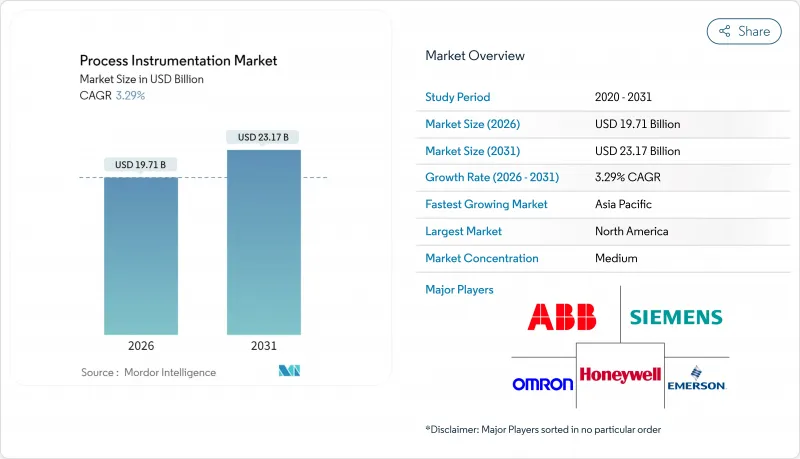
프로세스 계측 시장은 2025년에 190억 8,000만 달러로 평가되었고, 2026년 197억 1,000만 달러에서 2031년까지 231억 7,000만 달러에 이를 것으로 예측됩니다.
예측기간(2026-2031년)의 CAGR은 3.29%로 전망됩니다.
이 완만한 성장 궤도는 디지털화, 탈탄소화의 의무화, 리노베이션 사이클이 교환 수요를 강화하고 있음에도 불구하고 고객 기반이 성숙해지고 있음을 반영합니다. 공급업체는 하드웨어, 소프트웨어 및 서비스를 통합한 솔루션을 지속적으로 제공하여 라이프사이클 비용을 절감하고 배출량 모니터링을 위한 컴플라이언스 지원을 제공합니다. 노후화된 플랜트에서의 개보수 프로그램, 싱글 페어 이더넷의 도입, 그리고 노동력 부족이 더하여 기존 설비의 업그레이드 수요를 안정적으로 지지하고 있습니다. 동시에 그린 수소 및 물 재사용 프로젝트는 새로운 수요를 창출하고 프로세스 계측 시장에 대한 견조한 수요 전망을 지원합니다. 고객이 측정 정밀도, 사이버 보안 인증, 서비스 대응력을 우선시하기 때문에 가격 경쟁은 한정적이며, 벤더는 디지털 기술을 활용한 차별화 요소에 의해 이익률을 유지할 수 있습니다.
세계의 프로세스 계측 시장의 동향 및 인사이트
탈탄소화에 연동한 프로세스 최적화의 요청
유럽 연합의 탄소국경조정메커니즘(CBAM)과 같은 탄소 감축 규제는 지속적인 배출 감시와 에너지 효율 측정을 핵심 운영 지표로 자리매김하고 있습니다. 플랜트에서는 현재 고정밀도 센싱과 안전한 데이터 파이프라인을 조합한 계측 기기가 지정되어 IEC 62443-2-1:2024 사이버 보안 프로그램 규격에 근거한 감사 대응 보고서의 생성이 가능하도록 되어 있습니다. 화학, 정제, 시멘트 산업 수요가 가장 높으며 실시간 분석을 통해 연료 소비량을 줄이고 스코프 1 및 스코프 2 배출 목표 달성을 도모하고 있습니다. 이에 비해 공급자는 자기 진단 기능, 엣지 기반 검증, 암호화 클라우드 접속을 통합한 스마트 분석 장치를 제공하고 있습니다. 이는 컴플라이언스 대응을 에너지 비용 절감 및 탄소세 부담 경감이라는 측정 가능한 수익으로 변환합니다. 이러한 규제에 의해 사양 요구는 기본 정밀도를 넘어, 데이터 무결성과 추적 가능성까지 확대되고 있습니다. 따라서 프로세스 계측 시장 전체에서 프리미엄 가격 설정이 강화되었습니다.
노후화 플랜트에서 폭발 검출기의 리노베이션 사이클
1980년대부터 1990년대에 건설된 시설은 교정 비용 증가와 예기치 않은 다운타임에 직면해 있습니다. 자산 수명 연장 프로젝트에서는 센서의 개보수와 디지털화를 동시에 실시해 종래의 트랜스미터를 스마트 모델로 대체하여 다변량 데이터와 예지 진단 기능을 실현하고 있습니다. 엔드레스하우저의 컴팩트한 스테인레스 스틸 계측 장비는 현대적인 형상 설계가 CIP 세척을 견디고 데드레그의 축적을 최소화함으로써 공정 정지 없이 유지보수를 가능하게 하는 좋은 예입니다. 플랜트 관리자는 최대 20%의 유지보수 비용 절감과 안전 사고의 감소를 입증하고 있으며, 이로써 단기간에 투자 회수가 가능해져 주문 주기가 가속화되고 있습니다. 이미 설치된 디바이스의 60% 이상이 여전히 아날로그 4-20mA 루프에서 실행 중이기 때문에 개보수 프로그램은 프로세스 계측 시장에서 수년에 걸쳐 성장을 견인할 전망입니다.
스마트 트랜스미터용 칩 공급의 병목 현상
산업용 마이크로프로세서는 여전히 할당제의 대상이 되고 있으며, HART 및 이더넷 대응 송신기의 리드 타임은 2025년까지 최대 32주까지 연장될 전망입니다. 벤더 각사는 대체 부품을 이용한 기판의 재설계를 진행하고 있지만, 12-18개월에 이르는 인정 사이클에 의해 양산 회복은 지연되고 있습니다. 아시아태평양의 화학 플랜트 단지 프로젝트는 긴급 운송 및 직전 설계 변경으로 인해 최대 150만 달러의 비용 초과가 발생하였습니다. 이러한 부족은 특수한 A/D 컨버터를 필요로 하는 다변량 분석기에 특히 심각한 영향을 미치고 출하 지연과 프로세스 계측 시장의 단기적인 기세 둔화를 초래하고 있습니다.
부문 분석
2025년 시점에서 트랜스미터는 프로세스 계측 시장에서 37.62%의 점유율을 차지하여 레벨, 압력 및 온도 제어 루프의 핵심 역할을 확고히 하고 있습니다. 진단 기능, 사이버 보안 대응 펌웨어, 핫 스왑 모듈성의 지속적인 개선이 기존 설비 기반을 보호하고 있습니다. 벤더 각사는 현재 고도의 드리프트 보상 알고리즘을 추가하여 교정 사이클을 1년에서 3년으로 연장하고 24시간 365일 가동 시간을 유지하고 있습니다. 마그네트롤의 주피터 JM4와 같은 현장 교체 가능한 헤드 설계로 플랜트는 프로세스 씰의 손상 없이 전자부품을 교체할 수 있어 유지보수 작업과 벤트 리스크를 줄일 수 있습니다. 예측기간 동안 트랜스미터는 안정적인 수익원으로 지속되며 배출량 측정 규제 강화로 인한 수요 증가가 예상됩니다.
분석 장비는 연평균 CAGR 3.62%로 확대되며 실시간 분광 분석, 용존 산소 감지, 다항목 가스 분석을 측정 툴킷에 추가합니다. 이 태도는 단순한 상태 모니터링에서 능동적인 프로세스 최적화로의 전환을 반영합니다. 모듈형 플랫폼은 단일 섀시에서 광학식, 전기화학식 및 질량 분광식 카트리지 장착을 가능하게 하여 설치 공간을 줄이고 예비 부품 재고를 최소화합니다. 분석 장비의 보급 확대는 추가 소프트웨어 라이선싱과 클라우드 게이트웨이 기회를 제공하여 포인트당 평생 수익을 높입니다. 이 움직임은 프로세스 계측 장비 시장 전체의 지속적인 성장을 지원합니다.
PLC(프로그래머블 로직 컨트롤러)는 확정적인 스캔 시간, 페일 세이프 중복화, 범용적인 서비스 노하우가 높이 평가되어 2025년 프로세스 계측 시장에서 34.02%의 점유율을 차지했습니다. 업그레이드의 초점은 보안 부트 로딩, 중복 기가비트 백플레인 및 업스트림 데이터 공유를 단순화하는 임베디드 OPC UA 서버에 있습니다. 수소전해장치 스키드나 물 재활용 모듈에서의 컨트롤러의 도입 확대가 PLC의 출하 대수의 안정성을 강화하고 있습니다.
제조 실행 시스템(MES)은 생산 스케줄링, 전자 배치 기록, 실시간 품질 분석을 일원적으로 관리하는 '싱글 페인 오브 글라스'를 요구하는 시설이 증가하면서 3.76%라는 최고 성장률(CAGR)로 확대하고 있습니다. 에머슨의 DeltaV Edge 2.0은 컨텍스트화된 히스토리언 데이터를 노스바운드로 전송할 수 있어 컨트롤러를 양방향 트래픽에 노출시키지 않고도 IT 보안 감사를 용이하게 합니다. MES와 고급 프로세스 제어의 융합은 의사결정 지연을 줄이고 센서 인텔리전스를 에너지 절약 및 처리량 향상으로 전환합니다. 이를 통해 프로세스 계측 시장 전체에서 투자 수익률을 보호합니다.
지역별 분석
2025년 북미는 프로세스 계측 시장에서 29.12%의 점유율을 차지했습니다. 이 지역에서는 환경보호청(EPA)의 규제에 따라 배출물과 수질의 지속적인 모니터링이 의무화되고 있으며, 이는 레거시 아날로그 루프의 급속한 업그레이드를 촉진하고 있습니다. 미국의 유틸리티 기업은 퍼플루오로알킬 물질 및 폴리플루오로알킬 물질에 대한 엄격한 규제 기준을 준수하기 위해 스마트 트랜스미터에 대한 투자를 추진하고 있습니다. 한편 캐나다의 오일샌드 사업자는 연마성 슬러리를 견디는 다변량 유량계를 도입하고 있습니다. 국경을 넘어서는 공급망과 현지 서비스 네트워크가 애프터마켓 회복력을 강화하고 벤더에게 높은 예비 부품 비축률과 안정적인 서비스 수익률을 확보하고 있습니다.
아시아태평양은 가장 성장하는 지역이며, 2031년까지의 연평균 성장률(CAGR)은 3.81%로 예측됩니다. 이는 급속한 산업화, 녹색 수소전해장치의 도입, 중국 및 인도 및 동남아시아에서 제조업의 회귀(리쇼어링)가 주요 요인입니다. 중국의 화학산업 거점에서는 휘발성 유기 화합물의 관리에 고주파 레이더식 레벨계가 활용되고, 인도의 제약 클러스터에서는 미국 FDA 수출 요건을 충족하기 위해 분광법을 활용한 PAT 프레임워크가 도입되고 있습니다. 일본과 한국의 반도체 공장을 위한 정부 지원책은 초순수계측기기와 서브ppm급 가스분석장치 수요를 촉진하고 있습니다. 새로운 설비 투자의 확산으로 아시아태평양은 프로세스 계측 시장에서 현지 생산 및 지원 센터를 확대하는 세계 벤더에게 우선시되는 지역이 되고 있습니다.
유럽은 탈탄소화법 규제와 인더스트리 4.0의 도입으로 안정적인 성장을 유지하고 있습니다. 독일의 특수화학 복합시설에서는 ATEX와 IEC 62443 모두의 요구를 충족하는 통합 안전 및 사이버 보안 인증을 활용하여 이더넷 APL 필드 네트워크로의 업그레이드가 진행되고 있습니다. 영국에서는 배출 규제 강화에 대응하기 위해 암모니아 슬립 감시 시스템에 의한 수도 사업 근대화가 추진되고, 프랑스에서는 중복 클래스 전송기를 필요로 하는 수소 전해 장치 실증 플랜트에 대한 투자가 이루어지고 있습니다. 대륙 전체에서는 각국의 부흥기금이 효율화 업그레이드에 자본을 투입하여 경제적인 역풍에도 불구하고 기준선 수요를 보호하고 있습니다. 중동 및 아프리카에서는 석유화학 통합 프로젝트, 해수 담수화 플랜트, 광업 확장이 계측 장비의 수주를 자극하고 프로세스 계측 시장에서 세계 및 지역 기업의 사업 범위를 확대하는 성장 인접 영역을 제공합니다.
기타 혜택
- 시장 예측(ME) 엑셀 시트
- 3개월 애널리스트 서포트
자주 묻는 질문
목차
제1장 서론
- 조사 전제조건 및 시장 정의
- 조사 범위
제2장 조사 방법
제3장 주요 요약
제4장 시장 환경
- 시장 개요
- 촉진요인
- 탈탄소화와 관련된 공정 최적화 의무화
- 노후화 플랜트에서의 폭발 검지기 개보수 사이클
- 이더넷-APL 싱글 페어 이더넷의 전개
- 번들형 O&M 계약(계기 서비스로 제공)
- 팬데믹 이후 노동력 부족이 무인 자동화를 추진
- 그린 수소 메가프로젝트가 계측 기기 수요를 견인
- 억제요인
- 스마트 트랜스미터용 칩 공급의 병목
- 멀티 프로토콜 레거시의 종속 비용
- 교정시설의 용량 부족
- IIoT 연결에 대한 사이버 보안 보험의 할증 요금
- 업계 밸류체인 분석
- 규제 상황
- 기술 전망
- Porter's Five Forces 분석
- 공급자의 협상력
- 구매자의 협상력
- 신규 참가업체의 위협
- 대체품의 위협
- 경쟁 기업 간 경쟁 관계
- 시장의 거시 경제 동향 평가
제5장 시장 규모 및 성장 예측
- 기기별
- 송신기
- 레벨 트랜스미터
- 온도 트랜스미터
- 압력 트랜스미터
- 제어 밸브
- 분석기기
- 필드 컨트롤러(RTU/PLC)
- 공정 분석장치
- 가스 분석장치
- 액체 분석장치
- 기타 기기
- 송신기
- 기술별
- 분산제어시스템(DCS)
- 프로그래머블 로직 컨트롤러(PLC)
- 감시 제어 및 데이터 수집(SCADA)
- 제조 실행 시스템(MES)
- 기타 제어 기술
- 최종 사용자 산업별
- 수처리 및 폐수 처리
- 석유 및 가스 채굴
- 화학제조업
- 에너지 및 유틸리티
- 의약품
- 금속 및 광업
- 식품 및 음료
- 종이 및 펄프
- 기타 공정 산업
- 측정 파라미터별
- 흐름
- 압력
- 레벨
- 기온
- 습도
- 지역별
- 북미
- 미국
- 캐나다
- 멕시코
- 남미
- 브라질
- 아르헨티나
- 기타 남미
- 유럽
- 독일
- 영국
- 프랑스
- 이탈리아
- 스페인
- 기타 유럽
- 아시아태평양
- 중국
- 일본
- 인도
- 싱가포르
- 한국
- 호주
- 기타 아시아태평양
- 중동 및 아프리카
- 중동
- 사우디아라비아
- 아랍에미리트(UAE)
- 튀르키예
- 기타 중동
- 아프리카
- 남아프리카
- 나이지리아
- 기타 아프리카
- 중동
- 북미
제6장 경쟁 구도
- 시장 집중도
- 전략적 동향
- 시장 점유율 분석
- 기업 프로파일
- Endress Hauser AG
- Yokogawa Electric Corporation
- Emerson Electric Co.
- ABB Ltd.
- Honeywell International Inc.
- Siemens AG
- Schneider Electric SE
- Rockwell Automation Inc.
- Azbil Corporation
- KROHNE Messtechnik GmbH
- Pepperl Fuchs SE
- Brooks Instrument LLC
- Mettler-Toledo International Inc.
- Badger Meter Inc.
- Spirax-Sarco Engineering plc
- AMETEK Inc.(Process Instruments)
- Omron Corporation
- Valmet Flow Control Oy
- HIMA Paul Hildebrandt GmbH
- Omega Engineering Inc.
- Samson AG
제7장 시장 기회 및 미래 전망
CSM 26.01.28The process instrumentation market was valued at USD 19.08 billion in 2025 and estimated to grow from USD 19.71 billion in 2026 to reach USD 23.17 billion by 2031, at a CAGR of 3.29% during the forecast period (2026-2031).
The moderate growth trajectory reflects a maturing customer base, even as digitalization, decarbonization mandates, and retrofit cycles strengthen replacement demand. Suppliers continue to bundle hardware, software, and services, offering integrated solutions that reduce lifecycle costs and support compliance with emissions monitoring. Retrofit programs in aging plants, single-pair Ethernet rollouts, and labor shortages collectively sustain a steady flow of brownfield upgrades. At the same time, green hydrogen and water reuse projects create incremental greenfield opportunities, anchoring a resilient demand outlook for the process instrumentation market. Price competition remains limited because customers prioritize measurement accuracy, cybersecurity certification, and service responsiveness, allowing vendors to defend margins with digitally enabled differentiators.
Global Process Instrumentation Market Trends and Insights
Decarbonization-Linked Process-Optimization Mandates
Carbon-reduction legislation, such as the European Union's Carbon Border Adjustment Mechanism, elevates continuous emissions monitoring and energy-efficiency measurement to core operational metrics. Plants now specify instruments that combine high-accuracy sensing with secure data pipelines, enabling the generation of audit-ready reports under the IEC 62443-2-1:2024 cybersecurity program standard. Demand is strongest in the chemicals, refining, and cement industries, where real-time analytics help trim fuel consumption and align with Scope 1 and Scope 2 inventory targets. Suppliers respond with smart analyzers that integrate self-diagnostics, edge-based verification, and encrypted cloud connectors, turning compliance into measurable returns through reduced energy bills and lower carbon tax exposure. These mandates lift specification requirements beyond basic accuracy to encompass data integrity and traceability, reinforcing premium pricing across the process instrumentation market.
Explosive Sensor Retrofit Cycles in Ageing Plants
Facilities built during the 1980s and 1990s face rising calibration expenses and unplanned downtime. Asset-life extension projects now bundle sensor retrofits with digital upgrades, replacing legacy transmitters with smart models that deliver multivariable data and predictive diagnostics. Endress+Hauser's compact stainless-steel instrumentation demonstrates how modern form factors can withstand cleaning-in-place while minimizing dead-leg buildup, allowing for maintenance without process shutdowns. Plant managers document maintenance cost savings of up to 20% and safety-incident reductions, justifying quick payback periods that accelerate order cycles. Because more than 60% of installed base devices still run analog 4-20 mA loops, retrofit programs remain a multi-year growth engine for the process instrumentation market.
Chip-Supply Bottlenecks for Smart Transmitters
Industrial-grade microprocessors remain subject to allocation, extending lead-times for HART and Ethernet-enabled transmitters to as long as 32 weeks in 2025. While vendors re-engineer boards around second-source components, qualification cycles spanning 12-18 months defer volume recovery. Projects in Asia Pacific chemical complexes have documented cost overruns of up to USD 1.5 million due to expedited freight and last-minute redesigns. The shortage disproportionately affects multivariable analyzers that require specialized A/D converters, slowing shipments and tempering short-term momentum in the process instrumentation market
Other drivers and restraints analyzed in the detailed report include:
- Ethernet-APL Single-Pair Ethernet Roll-outs
- Bundled O&M Contracts (Instrument-as-a-Service)
- Multi-Protocol Legacy Lock-in Costs
For complete list of drivers and restraints, kindly check the Table Of Contents.
Segment Analysis
Transmitters held a 37.62% share of the process instrumentation market size in 2025, cementing their role as the backbone of level, pressure, and temperature control loops. Continuous improvements in diagnostics, cybersecurity firmware, and hot-swap modularity protect this installed base. Vendors now embed advanced drift-compensation algorithms that extend calibration cycles from yearly to once every three years, preserving uptime in 24/7 operations. Field-removable head designs, such as Magnetrol's Jupiter JM4, enable plants to replace electronics without breaching process seals, thereby reducing maintenance labor and venting risk.Over the forecast horizon, transmitters remain a stable revenue pillar, with incremental demand driven by tighter emissions-measurement rules.
Analytical instruments, growing at a 3.62% CAGR, add real-time spectroscopy, dissolved-oxygen sensing, and multi-parameter gas analysis to the instrumentation toolkit. Their rise reflects a shift from simple condition monitoring to active process optimization. Modular platforms enable a single chassis to accept optical, electrochemical, or mass spectrometric cartridges, thereby reducing the footprint and minimizing spare parts inventory. The expanding analytics footprint brings additional software licensing and cloud gateway opportunities, elevating lifetime revenue per point. This dynamic supports sustained growth across the process instrumentation market.
PLCs commanded 34.02% of the process instrumentation market in 2025, valued for deterministic scan times, fail-safe redundancy, and universal service know-how. Upgrades focus on secure bootloading, redundant gigabit backplanes, and embedded OPC UA servers that simplify upstream data sharing. Wider controller footprints emerge in hydrogen electrolyzer skids and water-recycling modules, reinforcing the stability of PLC volume.
Manufacturing execution systems are growing at the fastest rate of 3.76% CAGR as facilities seek a single pane of glass for production scheduling, electronic batch records, and real-time quality analytics. Emerson's DeltaV Edge 2.0 enables contextualized historian data to flow northbound without exposing controllers to bidirectional traffic, easing IT security audits. The convergence of MES with advanced process control narrows decision latency, translating sensor intelligence into energy savings and throughput gains that safeguard return on investment across the process instrumentation market.
The Process Instrumentation Market is Segmented by Instrument (Transmitters, Control Valves, Analytical Instruments, and More), Technology (DCS, PLC, SCADA, MES, Other Control Technologies), End-User Industry (Water and Wastewater Treatment, Oil and Gas Extraction, and More), Measurement Parameter (Flow, Pressure, Level, Temperature, Humidity), and Geography. The Market Forecasts are Provided in Terms of Value (USD).
Geography Analysis
North America held a 29.12% market share in the process instrumentation market in 2025. The region benefits from Environmental Protection Agency mandates that require continuous emissions and water quality monitoring, driving the accelerated replacement of legacy analog loops. U.S. utilities invest in smart transmitters to comply with stricter limits on per- and polyfluoroalkyl substances, while Canadian oil sands operators deploy multivariable flowmeters that withstand abrasive slurries. Cross-border supply chains and local service networks strengthen aftermarket resilience, ensuring high spare-part attachment rates and stable service revenue for vendors.
The Asia Pacific is the fastest-growing region, with a 3.81% CAGR through 2031, driven by rapid industrialization, green hydrogen electrolyzer deployments, and manufacturing reshoring in China, India, and Southeast Asia. Chinese chemical hubs utilize high-frequency radar level instruments for the control of volatile organic compounds, while Indian pharmaceutical clusters employ spectroscopy-enabled PAT frameworks to meet U.S. FDA export requirements. Government incentives for semiconductor fabs in Japan and South Korea spur demand for ultra-pure water instrumentation and sub-ppm gas analyzers. The breadth of new capacity investments positions Asia Pacific as a priority for global vendors expanding localized production and support centers in the process instrumentation market.
Europe maintains steady momentum, supported by decarbonization legislation and the adoption of Industry 4.0. German specialty-chemicals complexes upgrade to Ethernet-APL field networks, leveraging integrated safety and cybersecurity certification to satisfy both ATEX and IEC 62443 demands. The United Kingdom modernizes water utilities with ammonia-slip monitoring to hit tightening discharge consents, while France invests in hydrogen electrolyzer demonstration plants that require redundancy-class transmitters. Across the continent, national recovery funds channel capital toward efficiency upgrades, protecting baseline demand despite economic headwinds. Middle East and Africa provide growth adjacency as oil-to-chemicals integration projects, desalination plants, and mining expansions stimulate instrumentation orders, extending reach for global and regional players within the process instrumentation market.
- Endress+Hauser AG
- Yokogawa Electric Corporation
- Emerson Electric Co.
- ABB Ltd.
- Honeywell International Inc.
- Siemens AG
- Schneider Electric SE
- Rockwell Automation Inc.
- Azbil Corporation
- KROHNE Messtechnik GmbH
- Pepperl + Fuchs SE
- Brooks Instrument LLC
- Mettler-Toledo International Inc.
- Badger Meter Inc.
- Spirax-Sarco Engineering plc
- AMETEK Inc. (Process Instruments)
- Omron Corporation
- Valmet Flow Control Oy
- HIMA Paul Hildebrandt GmbH
- Omega Engineering Inc.
- Samson AG
Additional Benefits:
- The market estimate (ME) sheet in Excel format
- 3 months of analyst support
TABLE OF CONTENTS
1 INTRODUCTION
- 1.1 Study Assumptions and Market Definition
- 1.2 Scope of the Study
2 RESEARCH METHODOLOGY
3 EXECUTIVE SUMMARY
4 MARKET LANDCSAPE
- 4.1 Market Overview
- 4.2 Market Drivers
- 4.2.1 Decarbonisation-linked process-optimisation mandates
- 4.2.2 Explosive sensor retrofit cycles in ageing plants
- 4.2.3 Ethernet-APL single-pair Ethernet roll-outs
- 4.2.4 Bundled OandM contracts (instrument-as-a-service)
- 4.2.5 Post-COVID labour shortfalls driving lights-out automation
- 4.2.6 Green-hydrogen mega-projects instrument demand
- 4.3 Market Restraints
- 4.3.1 Chip-supply bottlenecks for smart transmitters
- 4.3.2 Multi-protocol legacy lock-in costs
- 4.3.3 Shortage of calibration-lab capacity
- 4.3.4 Cyber-security insurance surcharges on IIoT links
- 4.4 Industry Value Chain Analysis
- 4.5 Regulatory Landscape
- 4.6 Technological Outlook
- 4.7 Porter's Five Forces Analysis
- 4.7.1 Bargaining Power of Suppliers
- 4.7.2 Bargaining Power of Buyers
- 4.7.3 Threat of New Entrants
- 4.7.4 Threat of Substitutes
- 4.7.5 Intensity of Competitive Rivalry
- 4.8 Assessment of Macro-economic Trends on the Market
5 MARKET SIZE AND GROWTH FORECASTS (VALUE)
- 5.1 By Instrument
- 5.1.1 Transmitters
- 5.1.1.1 Level Transmitters
- 5.1.1.2 Temperature Transmitters
- 5.1.1.3 Pressure Transmitters
- 5.1.2 Control Valves
- 5.1.3 Analytical Instruments
- 5.1.4 Field Controllers (RTU/PLC)
- 5.1.5 Process Analyzer
- 5.1.5.1 Gas Analyzer
- 5.1.5.2 Liquid Analyzer
- 5.1.6 Other Instruments
- 5.1.1 Transmitters
- 5.2 By Technology
- 5.2.1 Distributed Control System (DCS)
- 5.2.2 Programmable Logic Controller (PLC)
- 5.2.3 Supervisory Control and Data Acquisition (SCADA)
- 5.2.4 Manufacturing Execution System (MES)
- 5.2.5 Other Control Technologies
- 5.3 By End-User Industry
- 5.3.1 Water and Wastewater Treatment
- 5.3.2 Oil and Gas Extraction
- 5.3.3 Chemical Manufacturing
- 5.3.4 Energy and Utilities
- 5.3.5 Pharmaceutical
- 5.3.6 Metals and Mining
- 5.3.7 Food and Beverage
- 5.3.8 Paper and Pulp
- 5.3.9 Other Process Industries
- 5.4 By Measurement Parameter
- 5.4.1 Flow
- 5.4.2 Pressure
- 5.4.3 Level
- 5.4.4 Temperature
- 5.4.5 Humidity
- 5.5 By Geography
- 5.5.1 North America
- 5.5.1.1 United States
- 5.5.1.2 Canada
- 5.5.1.3 Mexico
- 5.5.2 South America
- 5.5.2.1 Brazil
- 5.5.2.2 Argentina
- 5.5.2.3 Rest of South America
- 5.5.3 Europe
- 5.5.3.1 Germany
- 5.5.3.2 United Kingdom
- 5.5.3.3 France
- 5.5.3.4 Italy
- 5.5.3.5 Spain
- 5.5.3.6 Rest of Europe
- 5.5.4 Asia Pacific
- 5.5.4.1 China
- 5.5.4.2 Japan
- 5.5.4.3 India
- 5.5.4.4 Singapore
- 5.5.4.5 South korea
- 5.5.4.6 Australia
- 5.5.4.7 Rest of Asia Pacific
- 5.5.5 Middle East and Africa
- 5.5.5.1 Middle East
- 5.5.5.1.1 Saudi Arabia
- 5.5.5.1.2 United Arab Emirates
- 5.5.5.1.3 Turkey
- 5.5.5.1.4 Rest of Middle East
- 5.5.5.2 Africa
- 5.5.5.2.1 South Africa
- 5.5.5.2.2 Nigeria
- 5.5.5.2.3 Rest of Africa
- 5.5.5.1 Middle East
- 5.5.1 North America
6 COMPETITIVE LANDSCAPE
- 6.1 Market Concentration
- 6.2 Strategic Moves
- 6.3 Market Share Analysis
- 6.4 Company Profiles (includes Global level Overview, Market level overview, Core Segments, Financials as available, Strategic Information, Market Rank/Share for key companies, Products and Services, and Recent Developments)
- 6.4.1 Endress+Hauser AG
- 6.4.2 Yokogawa Electric Corporation
- 6.4.3 Emerson Electric Co.
- 6.4.4 ABB Ltd.
- 6.4.5 Honeywell International Inc.
- 6.4.6 Siemens AG
- 6.4.7 Schneider Electric SE
- 6.4.8 Rockwell Automation Inc.
- 6.4.9 Azbil Corporation
- 6.4.10 KROHNE Messtechnik GmbH
- 6.4.11 Pepperl + Fuchs SE
- 6.4.12 Brooks Instrument LLC
- 6.4.13 Mettler-Toledo International Inc.
- 6.4.14 Badger Meter Inc.
- 6.4.15 Spirax-Sarco Engineering plc
- 6.4.16 AMETEK Inc. (Process Instruments)
- 6.4.17 Omron Corporation
- 6.4.18 Valmet Flow Control Oy
- 6.4.19 HIMA Paul Hildebrandt GmbH
- 6.4.20 Omega Engineering Inc.
- 6.4.21 Samson AG
7 MARKET OPPORTUNITIES AND FUTURE OUTLOOK
- 7.1 White-space and Unmet-Need Assessment