|
시장보고서
상품코드
1910942
해상 화물 운송 시장 : 점유율 분석, 업계 동향 및 통계, 성장 예측(2026-2031년)Maritime Freight Transport - Market Share Analysis, Industry Trends & Statistics, Growth Forecasts (2026 - 2031) |
||||||
 Mordor Intelligence
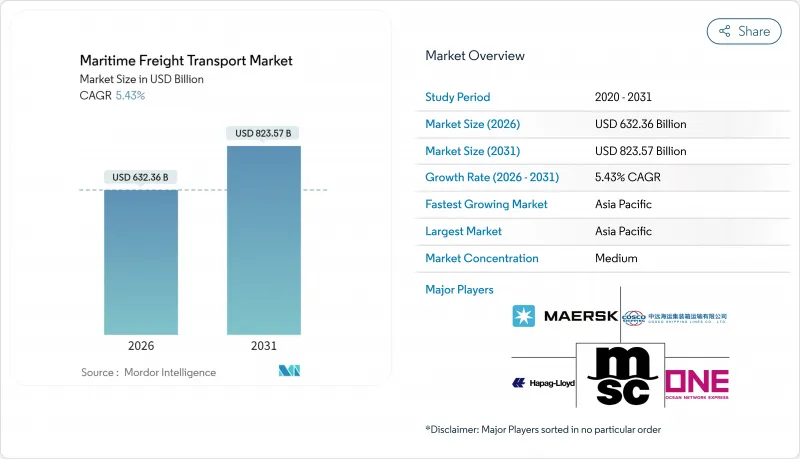
해상 화물 운송 시장은 2025년 5,997억 8,000만 달러로 평가되었고 예측 기간(2026-2031년) 동안 CAGR 5.43%로 성장하고 2026년 6,323억 6,000만 달러에서 2031년에는 8,235억 7,000달러에 달할 전망입니다.
지속적인 확대는 견조한 세계 무역량, 혼잡지역 및 분쟁지역을 회피하는 선박의 우회항로에 의한 톤마일 수요 증가, 그리고 아시아 지역 내 물류를 활성화시키는 남-남 회랑으로의 화물수송의 급속한 이행에 기인하고 있습니다. EU 배출권 거래 제도(EU ETS) 준수를 통해 2025년 운영 비용은 1톤당 206달러 증가하였지만, 동시에 저탄소 톤수에 대한 선대 업그레이드가 가속화되고 장기적인 경쟁력이 강화됩니다. 머스크와 하팍로이드 간의 제미니 협력 등 제휴의 재편은 동서항로의 슬롯 배분을 재조정하여 스케줄 신뢰성의 목표를 90%로 끌어올려 서비스의 차별화를 명확화 합니다. 현재 컨테이너 거래의 80% 이상을 차지하는 디지털 화물 플랫폼은 실시간 용량 균형 조정, 평균 체류 시간 12% 단축, 공선 이동 구간의 수익화에 공헌하고 있습니다.
세계의 해상 화물 운송 시장의 동향 및 전망
아시아 지역내 남-남 무역회랑 급증
2023년 ASEAN은 4,688억 달러로 유럽 연합(EU)을 제치고 중국의 최대 무역 상대가 되었습니다. 10.5%의 급증은 아시아 지역 내 화물 루프가 새로운 성장 엔진으로 정착되었음을 나타냅니다. ACFTA(아시아 자유무역협정)에 근거한 단계적인 관세 철폐에 의해 구미의 환적 허브를 경유하지 않는 물류가 효율화되는 한편, 2026년 완공 예정인 중국 평평운하(전장 84마일)는 연간 8,900만 톤의 화물 수송을 실현해, 공급 체인 비용을 7억 2,500달러 절감할 전망입니다. 제조업의 동남아시아 이전은 항구 근처의 산업 클러스터를 강화하고 2차 게이트웨이에 대한 피더 수요를 확대합니다. 이로 인해 발생하는 화물 밀도는 단거리 수송과 고회전율에 최적화된 15,000TEU급 주력선에 대한 규모 투자를 뒷받침합니다. 이러한 동향이 결합되어 해상 화물 운송 시장의 예측 기간 내 CAGR에 예상 1.2포인트의 기여를 가져올 것으로 예측됩니다.
니어 쇼어링이 단거리 피더 수요를 견인
2024년 미국과 멕시코 간의 트럭 경계 운송량이 역대 최고를 기록했고, 니어 쇼어링이 멕시코 걸프 및 카리브해 지역의 피더 루프에 파급되고 있음이 입증되었습니다. 주요 해운회사는 현재 소규모 멕시코 만안 항만을 우회하고 지역 전문업체와 계약하여 허브 앤 스포크 방식의 셔틀 항공편을 운행함으로써 도어 투 도어 수송 사이클을 2-4일 단축하고 있습니다. X-Press Feeders사가 유럽의 항만 6곳과 체결한 그린 회랑 구축 협정은 사업자들이 단거리 해상 수송량 증가를 활용하면서 스코프 3 배출 목표를 달성하는 좋은 예입니다. 경영진은 물류 비용 절감을 최대 동기로 지적하고 있으며, 41%가 세계 규모보다 근접성을 우선하고 있습니다. 수요가 높아짐에 따라 1,500-2,000 TEU 선박의 선박 가동률과 일일용선료가 상승해, 해상 화물 수송 시장의 성장 궤도가 0.8포인트 증가했습니다.
만성적인 항만 인프라 병목
2025년에는 싱가포르와 콜롬보가 케이프 회항선을 흡수하여 혼잡이 피크에 달했고, 야드 가동률은 90%를 넘어 평균 버스 대기 시간은 3배로 증가했습니다. 상하이는 미국 관세 발효 전 2025년 1월에 역대 최고인 500만 TEU를 처리했으며, 18개의 완전 자동화 터미널을 추가한 후에도 야드 설비에 부하가 걸렸습니다. 로스앤젤레스 항구와 롱비치 항구에서는 섀시 부족이 심각해지는 반면, 말라카 해협에서는 지정학적 혼란과 기후 변화에 의한 흡수 제한이 발생하고 있습니다. 게이트 자동화 및 내륙 철도 연결에 대한 투자 부족 현상은 화물 운송 속도를 저해하고 해상 화물 운송 시장의 장기 CAGR을 1.1포인트 감소시키고 있습니다.
부문 분석
드라이 벌크가 최대 점유율을 차지하였으며 중국의 1억 6,500만 톤의 철광석 및 석탄 비축 수요를 배경으로 2025년 해상 화물 운송 시장 규모의 28.65%를 차지했습니다. 그러나 2025년 3,600만dwt급의 인도로 견조한 톤수 수요 성장에도 불구하고 TCE 운임의 침체 위험이 발생했습니다. 운항회사는 하방 위험을 줄이기 위해 지수연동형 용선계약으로 전환을 진행하고 있습니다. 과잉공급 우려에 의해 핸디사이즈선의 조기 해체가 촉진되어, 틈새 항로공급이 억제되고, 운임 하락 압력이 완화될 전망입니다.
액체 벌크는 특히 현저한 성장 엔진이며, LNG 액화량의 확대와 화학제품 무역의 다양화에 의해 2031년까지 연평균 복합 성장률(CAGR) 4.02%를 기록할 전망입니다. 스팟 VLCC의 수익은 2025년 하루 5만 1,600달러로 예측되며, 에너지 대기업의 정기적 선박 수요를 환기하고 있습니다. 유조선 소유자는 그린 프리미엄 화물 획득을 위해 듀얼 연료 기능을 도입하고 항만 운영자는 암모니아 대응 선박에 해당하는 극저온 수출 설비에 투자하고 있습니다. 액체 벌크 운송의 견조한 성장 궤도는 해상 화물 운송 시장에 필요한 다양성을 추가하고 다른 화물 흐름의 변동을 완화하는 역할을 합니다.
지역별 분석
아시아태평양은 2025년 해상화물 운송 시장 점유율의 37.65%를 차지하였으며, 2031년까지 연평균 복합 성장률(CAGR) 5.02%로 확대될 것으로 전망됩니다. 57%에 달하는 지역 내 무역 의존도와 구미 수요 사이클에 의존하지 않는 성장의 다양화가 성장을 뒷받침하고 있습니다. 상하이의 자동화 계획 18의 완전 무인 터미널''은 시간당 크레인 작동 변동을 줄이고 버스 생산성의 새로운 기준을 수립합니다. 중국 평평운하는 2026년까지 연간 8,900만 톤을 처리하여, 내륙 수송의 병목 현상을 해소함과 동시에 연간 7억 2,500만 달러의 비용을 절약할 것으로 전망됩니다.
북미에서는 2025년 10월 이후 관세 재조정과 섹션 301 과세로 중국제 선박의 비용이 증가하고 컨테이너 취급량이 1% 감소하는 이례적인 축소에 직면하게 됩니다. 그러나 멕시코의 무역 부흥은 일부 상쇄 효과를 가져오고, 니어 쇼어링은 멕시코만 피더 서비스와 내륙 철도의 개선을 촉진합니다. 유럽에서는 연간 100억 유로(110억 3,000만 달러)에 이르는 배출권 거래 제도(ETS) 대응 비용이 발생하여 운송 루트의 재우선화와 연료 전략의 재검토를 요구받고 있습니다. 동시에 녹색 회랑의 파일럿 사업을 통해 유럽 항만은 대체 연료 벙커링의 조기 도입 기지로서의 지위를 확립하고 있습니다.
중동에서는 사우디아라비아의 45억 달러 항만 투자를 활용하여 2026년까지 지역 물류 수익을 388억 달러로 확대할 전망입니다. IMEC(이라크 메소포타미아 회랑)은 철도와 항만의 연계를 통해 아시아와 유럽 간의 운송 시간을 40% 단축하여 다극화 무역 흐름에 있어서 이 지역의 중요성을 돋보이게 합니다. 남미는 중립적인 입장을 살려 공급망 혼란 하에서 브라질산 대두의 중국용 수출이 확대되고 있습니다. 러시아와 나이지리아를 연결하는 서비스가 BRICS 회원국을 위한 농업 회랑을 개척하는 가운데 아프리카의 점유율은 점차 증가하고 있습니다.
기타 혜택
- 시장 예측(ME) 엑셀 시트
- 3개월 애널리스트 서포트
자주 묻는 질문
목차
제1장 서론
- 조사 전제조건 및 시장 정의
- 조사 범위
제2장 조사 방법
제3장 주요 요약
제4장 시장 상황
- 시장 개요
- 촉진요인
- 아시아 지역 내 남-남 무역회랑의 급증
- 니어 쇼어링이 근해 피더 수요를 견인
- EU 배출량 거래 제도(EU-ETS)에 의한 해운 배출 규제가 선대 경제성을 재구축
- 디지털 화물 플랫폼에 의한 실시간 수송력 매칭
- 대체연료의 도입으로 장기적인 운영비용 절감
- 수에즈 운하의 우회 항로와 파나마 운하 확장에 의한 톤마일 증가
- 억제요인
- 만성적인 항만 인프라의 병목
- 2023-26년의 기록적인 컨테이너선 수주에 의한 공급 과잉 리스크
- 해사 사이버 보안 위협 증가
- 인플레이션에 의한 연료유 가격의 변동성
- 가치 및 공급망 분석
- 규제 상황
- 기술 전망
- COVID-19 및 지정학적 이벤트의 영향
- Porter's Five Forces
- 구매자의 협상력
- 공급자의 협상력
- 신규 참가업체의 위협
- 대체품의 위협
- 경쟁 기업 간 경쟁 관계
제5장 시장 규모 및 성장 예측
- 화물 유형별
- 컨테이너화물
- 드라이
- 리퍼
- 드라이 벌크 화물
- 액체 벌크 화물
- 일반 화물
- RO-RO 화물
- 컨테이너화물
- 최종 사용자 업계별
- 전자기기 및 반도체
- 화학제품 및 석유화학제품
- 식품 및 음료
- 의약품 및 의료
- 소매 및 전자상거래
- 기타
- 지역별
- 북미
- 미국
- 캐나다
- 멕시코
- 남미
- 브라질
- 페루
- 칠레
- 아르헨티나
- 기타 남미
- 아시아태평양
- 인도
- 중국
- 일본
- 호주
- 한국
- 동남아시아(싱가포르, 말레이시아, 태국, 인도네시아, 베트남, 필리핀)
- 기타 아시아태평양
- 유럽
- 영국
- 독일
- 프랑스
- 스페인
- 이탈리아
- 베네룩스(벨기에, 네덜란드, 룩셈부르크)
- 북유럽 국가(덴마크, 핀란드, 아이슬란드, 노르웨이, 스웨덴)
- 기타 유럽
- 중동 및 아프리카
- 아랍에미리트(UAE)
- 사우디아라비아
- 남아프리카
- 나이지리아
- 기타 중동 및 아프리카
- 북미
제6장 경쟁 구도
- 시장 집중도
- 전략적 동향
- 시장 점유율 분석
- 기업 프로파일
- Mediterranean Shipping Company(MSC)
- AP Moller-Maersk
- COSCO Shipping Lines
- Hapag-Lloyd
- Ocean Network Express(ONE)
- Evergreen Marine Corp.
- HMM Co., Ltd.
- Yang Ming Marine Transport
- ZIM Integrated Shipping
- Pacific International Lines(PIL)
- SITC International
- X-Press Feeders
- Matson Inc.
- Swire Shipping
- NYK Line
- K Line
- MOL Logistics
- CMA CGM
- Wan Hai Lines
- Emirates Shipping Line
제7장 시장 기회 및 미래 전망
CSM 26.01.23The Maritime Freight Transport Market was valued at USD 599.78 billion in 2025 and estimated to grow from USD 632.36 billion in 2026 to reach USD 823.57 billion by 2031, at a CAGR of 5.43% during the forecast period (2026-2031).
Sustained expansion springs from resilient global trade volumes, the rerouting of vessels around congestion and conflict zones that inflates ton-mile demand, and the accelerating shift of cargo toward South-South corridors that intensify intra-Asian flows. Compliance with the EU Emissions Trading System (EU ETS) adds USD 206 per metric ton to operating costs in 2025 but simultaneously accelerates fleet renewal toward low-carbon tonnage, supporting long-run competitiveness. Alliance realignments such as the Gemini Cooperation between Maersk and Hapag-Lloyd recalibrate slot allocation across East-West lanes, raising schedule reliability targets to 90% and sharpening service differentiation. Digital freight platforms that now govern more than 80% of container transactions provide real-time capacity balancing, cut average dwell time by 12%, and help carriers monetize empty repositioning legs.
Global Maritime Freight Transport Market Trends and Insights
Surge in South-South Intra-Asian Trade Corridors
ASEAN surpassed the European Union as China's top trading partner in 2023 at USD 468.8 billion, a 10.5% jump that cements intra-Asian cargo loops as the new growth engine. Progressive tariff eliminations under ACFTA streamline flows that bypass Western transshipment hubs, while China's 84-mile Pinglu Canal slated for 2026 will move 89 million tons annually and slice USD 725 million from supply-chain costs. Manufacturing migration toward Southeast Asia reinforces near-port industrial clusters, amplifying feeder demand to secondary gateways. The resulting cargo density underpins scale investments in 15,000 TEU workhorses optimized for shorter hauls yet higher turn-round frequencies. Collectively, these dynamics contribute an estimated 1.2 percentage-points to the Maritime freight transport market CAGR forecast period.
Near-shoring Drives Short-Sea Feeder Demand
U.S.-Mexico truck crossings hit record levels in 2024, validating near-shoring's spillover into Gulf and Caribbean feeder loops. Mainline carriers now skip smaller Gulf ports, contracting regional specialists for hub-and-spoke shuttles that compress door-to-door cycles by two to four days. X-Press Feeders' pact with six European ports to create green corridors exemplifies operators capturing rising short-sea volumes while satisfying Scope 3 emission objectives. Executives cite logistics cost reduction as the single largest incentive, with 41% prioritizing proximity over global scale. Elevated demand lifts vessel utilization and daily charter rates for 1,500-2,000 TEU ships, translating into a 0.8 percentage-point uptick in the Maritime freight transport market growth trajectory.
Chronic Port-Side Infrastructure Bottlenecks
Congestion peaked in 2025 as Singapore and Colombo absorbed Cape-routed vessels, causing yard utilization to exceed 90% and average berth wait times to triple. Shanghai processed a record 5 million TEU in January 2025 ahead of U.S. tariff enactments, stressing yard equipment even after adding 18 fully automated terminals. Los Angeles and Long Beach struggle with chassis shortages, while the Malacca Strait faces geopolitical disruptions and climate-driven draft limitations. Investment lags in gate automation and hinterland rail links hamper cargo velocity, subtracting 1.1 percentage-points from the Maritime freight transport market's long-run CAGR.
Other drivers and restraints analyzed in the detailed report include:
- EU-ETS on Maritime Emissions Reshapes Fleet Economics
- Digital Freight Platforms Enable Real-Time Capacity Matching
- Oversupply Risk from Record Container-Ship Orderbook 2023-26
For complete list of drivers and restraints, kindly check the Table Of Contents.
Segment Analysis
Dry bulk holds the lion's share, accounting for 28.65% of Maritime freight transport market size in 2025 on the back of China's 165 million-ton iron-ore and coal restocking drive. However, a 36 million dwt delivery slate scheduled for 2025 risks dampening TCE rates despite robust tonnage demand growth. Operators therefore pivot to index-linked charters to mitigate downside exposure. Overcapacity fears spur early scrapping of Handysize vessels, constraining supply in niche routes and moderating rate compression.
Liquid bulk is the standout growth engine, posting a 4.02% CAGR through 2031 as LNG liquefaction volumes scale and chemicals trades diversify. Spot VLCC earnings are forecast at USD 51,600 per day for 2025, stimulating time-charter interest among energy majors. Tanker owners install dual-fuel capability to capture green-premium cargoes, while port operators invest in cryogenic export arms to service ammonia-ready tonnage. The strengthening liquid bulk trajectory adds needed diversity to the Maritime freight transport market, cushioning volatility in other cargo streams.
The Maritime Freight Transport Market Report is Segmented by Cargo Type (Containerized Cargo, Dry Bulk Cargo, Liquid Bulk Cargo, General Cargo, Roll-On/Roll-Off Cargo), End-User Industry (Electronics & Semiconductors, Chemicals & Petrochemicals, Food & Beverage, and More), and Geography (North America, South America, Asia-Pacific, Europe, Middle East and Africa). The Market Forecasts are Provided in Terms of Value (USD).
Geography Analysis
Asia-Pacific commands 37.65% of Maritime freight transport market share in 2025 and is set to expand at a 5.02% CAGR to 2031, buoyed by 57% intra-regional trade dependence that diversifies growth away from Western demand cycles. Shanghai's automation blueprint-18 fully unmanned terminals-cuts crane moves per hour variance and sets new benchmarks for berth productivity. China's Pinglu Canal, capable of handling 89 million tons a year by 2026, will reduce inland transit bottlenecks and save USD 725 million annually.
North America confronts a rare 1% contraction in container throughput as tariff realignments and Section 301 levies raise costs on Chinese-built vessels beginning October 2025. Yet Mexico's trade renaissance offers partial offset, with near-shoring catalyzing Gulf feeder services and inland rail upgrades. Europe faces EUR 10 billion (USD 11.03 billion) annual ETS compliance costs that reprioritize corridor routing and bunker strategies. Simultaneously, green-corridor pilots position European ports as early-adoption nodes for alternative-fuel bunkering.
The Middle East leverages USD 4.5 billion in Saudi port investments to lift regional logistics revenue to USD 38.8 billion by 2026. IMEC promises to shorten Asia-Europe transit times by 40% via integrated rail-port linkages, underscoring the region's role in multipolar trade flows. South America capitalizes on its neutral stance; Brazilian soybean exports to China expand under disrupted supply chains. Africa's share gradually rises as Russia-Nigeria services unlock agricultural corridors for BRICS members.
- Mediterranean Shipping Company (MSC)
- A.P. Moller-Maersk
- COSCO Shipping Lines
- Hapag-Lloyd
- Ocean Network Express (ONE)
- Evergreen Marine Corp.
- HMM Co., Ltd.
- Yang Ming Marine Transport
- ZIM Integrated Shipping
- Pacific International Lines (PIL)
- SITC International
- X-Press Feeders
- Matson Inc.
- Swire Shipping
- NYK Line
- K Line
- MOL Logistics
- CMA CGM
- Wan Hai Lines
- Emirates Shipping Line
Additional Benefits:
- The market estimate (ME) sheet in Excel format
- 3 months of analyst support
TABLE OF CONTENTS
1 Introduction
- 1.1 Study Assumptions & Market Definition
- 1.2 Scope of the Study
2 Research Methodology
3 Executive Summary
4 Market Landscape
- 4.1 Market Overview
- 4.2 Market Drivers
- 4.2.1 Surge in South-South intra-Asian trade corridors
- 4.2.2 Near-shoring drives short-sea feeder demand
- 4.2.3 EU-ETS on maritime emissions reshapes fleet economics
- 4.2.4 Digital freight platforms enable real-time capacity matching
- 4.2.5 Alternative fuels adoption lowers long-term OPEX
- 4.2.6 Suez diversions & Panama expansion boost ton-miles
- 4.3 Market Restraints
- 4.3.1 Chronic port-side infrastructure bottlenecks
- 4.3.2 Oversupply risk from record container-ship orderbook 2023-26
- 4.3.3 Escalating maritime cyber-security threats
- 4.3.4 Inflation-driven bunker price volatility
- 4.4 Value / Supply-Chain Analysis
- 4.5 Regulatory Landscape
- 4.6 Technological Outlook
- 4.7 Impact of COVID-19 and Geo-Political Events
- 4.8 Porters Five Forces
- 4.8.1 Bargaining Power of Buyers
- 4.8.2 Bargaining Power of Suppliers
- 4.8.3 Threat of New Entrants
- 4.8.4 Threat of Substitutes
- 4.8.5 Competitive Rivalry
5 Market Size & Growth Forecasts (Value)
- 5.1 By Cargo Type
- 5.1.1 Containerized Cargo
- 5.1.1.1 Dry
- 5.1.1.2 Reefer
- 5.1.2 Dry Bulk Cargo
- 5.1.3 Liquid Bulk Cargo
- 5.1.4 General Cargo
- 5.1.5 Roll-On/Roll-Off Cargo
- 5.1.1 Containerized Cargo
- 5.2 By End-User Industry
- 5.2.1 Electronics & Semiconductors
- 5.2.2 Chemicals & Petrochemicals
- 5.2.3 Food & Beverage
- 5.2.4 Pharmaceuticals & Healthcare
- 5.2.5 Retail & E-commerce
- 5.2.6 Others
- 5.3 By Geography
- 5.3.1 North America
- 5.3.1.1 United States
- 5.3.1.2 Canada
- 5.3.1.3 Mexico
- 5.3.2 South America
- 5.3.2.1 Brazil
- 5.3.2.2 Peru
- 5.3.2.3 Chile
- 5.3.2.4 Argentina
- 5.3.2.5 Rest of South America
- 5.3.3 Asia-Pacific
- 5.3.3.1 India
- 5.3.3.2 China
- 5.3.3.3 Japan
- 5.3.3.4 Australia
- 5.3.3.5 South Korea
- 5.3.3.6 South East Asia (Singapore, Malaysia, Thailand, Indonesia, Vietnam, and Philippines)
- 5.3.3.7 Rest of Asia-Pacific
- 5.3.4 Europe
- 5.3.4.1 United Kingdom
- 5.3.4.2 Germany
- 5.3.4.3 France
- 5.3.4.4 Spain
- 5.3.4.5 Italy
- 5.3.4.6 BENELUX (Belgium, Netherlands, and Luxembourg)
- 5.3.4.7 NORDICS (Denmark, Finland, Iceland, Norway, and Sweden)
- 5.3.4.8 Rest of Europe
- 5.3.5 Middle East and Africa
- 5.3.5.1 United Arab of Emirates
- 5.3.5.2 Saudi Arabia
- 5.3.5.3 South Africa
- 5.3.5.4 Nigeria
- 5.3.5.5 Rest of Middle East And Africa
- 5.3.1 North America
6 Competitive Landscape
- 6.1 Market Concentration
- 6.2 Strategic Moves
- 6.3 Market Share Analysis
- 6.4 Company Profiles (includes Global level Overview, Market level overview, Core Segments, Financials as available, Strategic Information, Market Rank/Share for key companies, Products & Services, and Recent Developments)
- 6.4.1 Mediterranean Shipping Company (MSC)
- 6.4.2 A.P. Moller-Maersk
- 6.4.3 COSCO Shipping Lines
- 6.4.4 Hapag-Lloyd
- 6.4.5 Ocean Network Express (ONE)
- 6.4.6 Evergreen Marine Corp.
- 6.4.7 HMM Co., Ltd.
- 6.4.8 Yang Ming Marine Transport
- 6.4.9 ZIM Integrated Shipping
- 6.4.10 Pacific International Lines (PIL)
- 6.4.11 SITC International
- 6.4.12 X-Press Feeders
- 6.4.13 Matson Inc.
- 6.4.14 Swire Shipping
- 6.4.15 NYK Line
- 6.4.16 K Line
- 6.4.17 MOL Logistics
- 6.4.18 CMA CGM
- 6.4.19 Wan Hai Lines
- 6.4.20 Emirates Shipping Line
7 Market Opportunities & Future Outlook
- 7.1 White-space & Unmet-Need Assessment